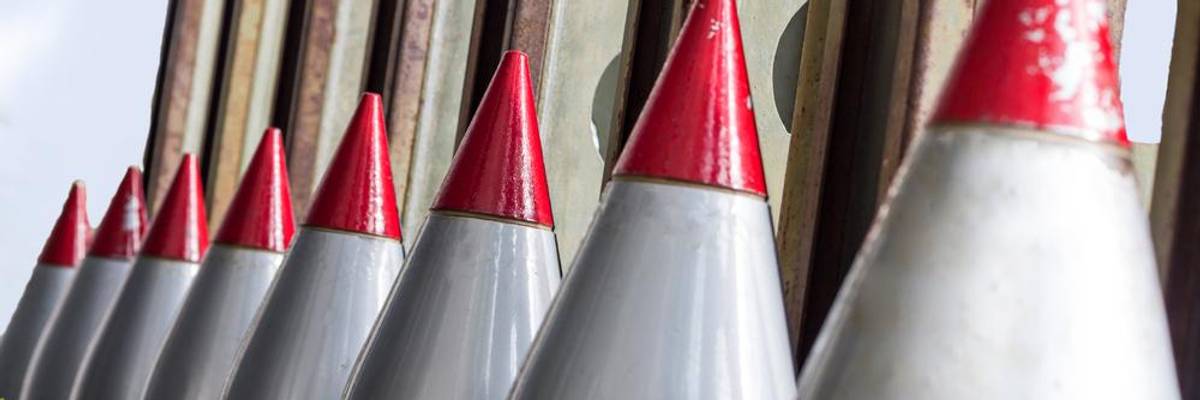
We can and must avoid getting any closer to the brink of nuclear war--we're already dangling too close to the edge. (Photo: Shutterstock)
We Need to Treat Nuclear War Like the Emergency It Is
Alarmingly, the Trump administration is shredding arms control agreements and deploying "more usable" nuclear weapons.
If the current state of global affairs reminds you of an over-the-top plot by a white-cat-stroking James Bond villain, you're not far off. When it comes to nuclear policy, we are closer than ever to a real-life movie disaster.
During his February 4 State of the Union address, President Donald Trump declared that "the Iranian regime must abandon its pursuit of nuclear weapons." He omitted the part where he withdrew the United States from the only existing international treaty with the capability to compel the Iranian regime to do so.
The Joint Comprehensive Plan of Action (JCPOA), aka the Iran Deal, is the one international treaty that has effectively de-escalated tensions and ensured continued progress in securing Iran's nonproliferation. It's vital that the United States reenters the Iran Deal, or it could take ages to repair the damage and restart progress.
That treaty isn't the only one on the chopping block.
The United States has also withdrawn from the landmark Intermediate-Range Nuclear Forces Treaty between the United States and Russia, a vital arms reduction treaty that was responsible for eliminating over 2,600 intermediate-range missiles, bringing tangible progress in stabilization and disarmament efforts between the two countries.
The most important remaining international arms control treaty to which the United States is still a party, the New Strategic Arms Reduction Treaty (New START), is set to expire in February 2021, just a year from now.
Russian President Vladimir Putin has publicly offered to immediately extend New START, without any preconditions. However, the treaty's future is unclear -- Trump may attempt to reach a broader deal involving China, as some of his advisors have suggested, or may trash this treaty as well.
Nuclear weapons make us all less safe. The United States can and must once again lead on nuclear nonproliferation and disarmament. Nothing less than human health and survival is at stake. We all have a vested interest in ensuring nuclear weapons are not used.
Despite that existential risk, the U.S. Defense Department confirmed on February 5 that the Navy has deployed a low-yield, submarine-launched ballistic missile warhead. Bill Arkin and Hans Kristensen of the Federation of American Scientists first disclosed the deployment a week before that.
These warheads lower the threshold for potential nuclear conflict while increasing the chances of a real-life James Bond movie situation, due to human error or miscalculation. These low-yield warheads may be indistinguishable on radar from missiles armed with high-yield bombs, meaning an adversary could respond to such a launch with a full attack, immediately escalating the conflict to full nuclear war.
Proponents of this low-yield nuclear warhead say it is more "usable," a euphemistic phrase that should send chills down the spines of anyone who can't afford to escape planetary orbit on a SpaceX rocket.
"Low-yield" nuclear weapons are misleadingly named. At 6.5 kilotons, they are 591 times more powerful than the largest conventional weapon the United States has ever used, the GBU-43/B "Massive Ordnance Air Blast" (MOAB) bomb, and 2,600 times more powerful than the 1995 Oklahoma City bomb.
In fact, the W76-2 "low-yield" nuclear weapon that was deployed on those submarines can have up to 43 percent of the yield of the atomic bomb that destroyed Hiroshima in 1945. That bomb killed between 90,000 and 166,000 people.
According to the Bulletin of Atomic Scientists' Doomsday Clock, we're at just 100 seconds to midnight, thanks in part to the Trump administration's reckless, systematic dismantling and undermining of vital international arms control agreements.
We can and must avoid getting any closer to the brink of nuclear war--we're already dangling too close to the edge. It's time for the United States to reenter or renegotiate vital arms control treaties like the Iran Deal and extend New START.
We are at a crossroads
This country and this world are at a monumental crossroads. In a few short weeks, US voters will have an opportunity to beat back the forces of fascism and confront the billionaires who are rigging the economy, our media system, and our democracy, making it increasingly impossible for ordinary people to get by. We’re not just talking about the election. We’re talking about what must be done once these fascist elements are vanquished from power. We need a bolder set of solutions than what either major party has so far been willing to offer and a working-class movement ready to fight like hell for it. Trump didn't emerge from nowhere. The conditions that fueled MAGA authoritarianism were created by decades of radical neoliberal economic policies and a corrupt political system dominated by corporate interests. They slashed taxes on the super-rich, promising that the benefits would trickle down. They said giveaways to the corporate titans would make life more affordable for the rest of us. It was all bullshit. And when a bitter, betrayed populace searches for someone to blame, right-wing demagogues have little trouble finding scapegoats. People know when they're being lied to, but you won't hear any of this from the corporate media. Only independent journalism—powered and funded by people who believe in building a better world—can deliver truly trustworthy daily news. Our Fall Campaign is underway, and we need your help. To power our newsroom through the rest of the year, we need to raise $125,000 by midnight on October 31. So if you share our vision, please contribute whatever you can to sustain our work. |
If the current state of global affairs reminds you of an over-the-top plot by a white-cat-stroking James Bond villain, you're not far off. When it comes to nuclear policy, we are closer than ever to a real-life movie disaster.
During his February 4 State of the Union address, President Donald Trump declared that "the Iranian regime must abandon its pursuit of nuclear weapons." He omitted the part where he withdrew the United States from the only existing international treaty with the capability to compel the Iranian regime to do so.
The Joint Comprehensive Plan of Action (JCPOA), aka the Iran Deal, is the one international treaty that has effectively de-escalated tensions and ensured continued progress in securing Iran's nonproliferation. It's vital that the United States reenters the Iran Deal, or it could take ages to repair the damage and restart progress.
That treaty isn't the only one on the chopping block.
The United States has also withdrawn from the landmark Intermediate-Range Nuclear Forces Treaty between the United States and Russia, a vital arms reduction treaty that was responsible for eliminating over 2,600 intermediate-range missiles, bringing tangible progress in stabilization and disarmament efforts between the two countries.
The most important remaining international arms control treaty to which the United States is still a party, the New Strategic Arms Reduction Treaty (New START), is set to expire in February 2021, just a year from now.
Russian President Vladimir Putin has publicly offered to immediately extend New START, without any preconditions. However, the treaty's future is unclear -- Trump may attempt to reach a broader deal involving China, as some of his advisors have suggested, or may trash this treaty as well.
Nuclear weapons make us all less safe. The United States can and must once again lead on nuclear nonproliferation and disarmament. Nothing less than human health and survival is at stake. We all have a vested interest in ensuring nuclear weapons are not used.
Despite that existential risk, the U.S. Defense Department confirmed on February 5 that the Navy has deployed a low-yield, submarine-launched ballistic missile warhead. Bill Arkin and Hans Kristensen of the Federation of American Scientists first disclosed the deployment a week before that.
These warheads lower the threshold for potential nuclear conflict while increasing the chances of a real-life James Bond movie situation, due to human error or miscalculation. These low-yield warheads may be indistinguishable on radar from missiles armed with high-yield bombs, meaning an adversary could respond to such a launch with a full attack, immediately escalating the conflict to full nuclear war.
Proponents of this low-yield nuclear warhead say it is more "usable," a euphemistic phrase that should send chills down the spines of anyone who can't afford to escape planetary orbit on a SpaceX rocket.
"Low-yield" nuclear weapons are misleadingly named. At 6.5 kilotons, they are 591 times more powerful than the largest conventional weapon the United States has ever used, the GBU-43/B "Massive Ordnance Air Blast" (MOAB) bomb, and 2,600 times more powerful than the 1995 Oklahoma City bomb.
In fact, the W76-2 "low-yield" nuclear weapon that was deployed on those submarines can have up to 43 percent of the yield of the atomic bomb that destroyed Hiroshima in 1945. That bomb killed between 90,000 and 166,000 people.
According to the Bulletin of Atomic Scientists' Doomsday Clock, we're at just 100 seconds to midnight, thanks in part to the Trump administration's reckless, systematic dismantling and undermining of vital international arms control agreements.
We can and must avoid getting any closer to the brink of nuclear war--we're already dangling too close to the edge. It's time for the United States to reenter or renegotiate vital arms control treaties like the Iran Deal and extend New START.
If the current state of global affairs reminds you of an over-the-top plot by a white-cat-stroking James Bond villain, you're not far off. When it comes to nuclear policy, we are closer than ever to a real-life movie disaster.
During his February 4 State of the Union address, President Donald Trump declared that "the Iranian regime must abandon its pursuit of nuclear weapons." He omitted the part where he withdrew the United States from the only existing international treaty with the capability to compel the Iranian regime to do so.
The Joint Comprehensive Plan of Action (JCPOA), aka the Iran Deal, is the one international treaty that has effectively de-escalated tensions and ensured continued progress in securing Iran's nonproliferation. It's vital that the United States reenters the Iran Deal, or it could take ages to repair the damage and restart progress.
That treaty isn't the only one on the chopping block.
The United States has also withdrawn from the landmark Intermediate-Range Nuclear Forces Treaty between the United States and Russia, a vital arms reduction treaty that was responsible for eliminating over 2,600 intermediate-range missiles, bringing tangible progress in stabilization and disarmament efforts between the two countries.
The most important remaining international arms control treaty to which the United States is still a party, the New Strategic Arms Reduction Treaty (New START), is set to expire in February 2021, just a year from now.
Russian President Vladimir Putin has publicly offered to immediately extend New START, without any preconditions. However, the treaty's future is unclear -- Trump may attempt to reach a broader deal involving China, as some of his advisors have suggested, or may trash this treaty as well.
Nuclear weapons make us all less safe. The United States can and must once again lead on nuclear nonproliferation and disarmament. Nothing less than human health and survival is at stake. We all have a vested interest in ensuring nuclear weapons are not used.
Despite that existential risk, the U.S. Defense Department confirmed on February 5 that the Navy has deployed a low-yield, submarine-launched ballistic missile warhead. Bill Arkin and Hans Kristensen of the Federation of American Scientists first disclosed the deployment a week before that.
These warheads lower the threshold for potential nuclear conflict while increasing the chances of a real-life James Bond movie situation, due to human error or miscalculation. These low-yield warheads may be indistinguishable on radar from missiles armed with high-yield bombs, meaning an adversary could respond to such a launch with a full attack, immediately escalating the conflict to full nuclear war.
Proponents of this low-yield nuclear warhead say it is more "usable," a euphemistic phrase that should send chills down the spines of anyone who can't afford to escape planetary orbit on a SpaceX rocket.
"Low-yield" nuclear weapons are misleadingly named. At 6.5 kilotons, they are 591 times more powerful than the largest conventional weapon the United States has ever used, the GBU-43/B "Massive Ordnance Air Blast" (MOAB) bomb, and 2,600 times more powerful than the 1995 Oklahoma City bomb.
In fact, the W76-2 "low-yield" nuclear weapon that was deployed on those submarines can have up to 43 percent of the yield of the atomic bomb that destroyed Hiroshima in 1945. That bomb killed between 90,000 and 166,000 people.
According to the Bulletin of Atomic Scientists' Doomsday Clock, we're at just 100 seconds to midnight, thanks in part to the Trump administration's reckless, systematic dismantling and undermining of vital international arms control agreements.
We can and must avoid getting any closer to the brink of nuclear war--we're already dangling too close to the edge. It's time for the United States to reenter or renegotiate vital arms control treaties like the Iran Deal and extend New START.