
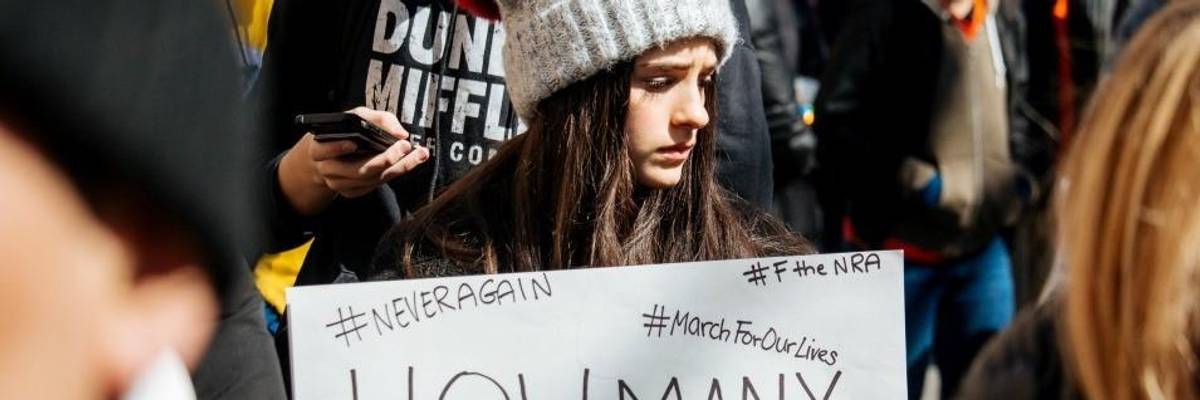
A student carried a sign at the March for Our Lives in Washington D.C. (Photo: mathiaswasik/Flickr/cc)
The NRA Versus American Children
Children and teens in the United States experience much higher rates of gun deaths and injuries than in any other industrialized country
If any doubts remain about the nefarious influence of the National Rifle Association (NRA) on the political life of the United States, President Donald Trump's decision to discuss gun control measures with that organization should dispel them. The offer to discuss these measures is like asking a criminal for his weapon of choice in order to hand it over. This obsequiousness equals that of many legislators, mainly Republican, who refuse to pass effective legislation on gun control measures out of fear of losing NRA support. Scores of people stand to lose, among them a significant number of children and adolescents, whose lives end needlessly by criminal violence.
In 2016, children in the U.S. were 36 times more likely to be killed by a gun than the total number of children in the other 12 wealthiest countries in the world.
Children and teens in the United States experience much higher rates of gun deaths and injuries than in any other industrialized country. In 2016, guns killed twice as many children as did cancer; only vehicle crashes were a higher cause of death. That same year, firearm-related injuries killed 3,143 children, while cancer caused 1,893 childhood deaths.
When compared to other countries, the statistics are also surprising. In 2016, children in the U.S. were 36 times more likely to be killed by a gun than the total number of children in the other 12 wealthiest countries in the world. There is also a big difference between the U.S. and low-to-middle income countries. There were five times as many child gun deaths in the former than in the latter, according to 2016 data (the last year this information was available.) "Children in America are dying or being killed at rates that are shameful," concluded in an editorial Edward W. Champion, the executive editor of the New England Journal of Medicine.
The consequences of gun violence are also felt in other ways. Children and teens are affected when a friend or family member is killed or harmed, or when they witness deadly gun violence. School shootings leave scores of children with post-traumatic-stress disorder, leading some to commit suicide. Many of the survivors suffer other serious psychological consequences.
The impact of gun violence is not shared equally across populations. In the U.S., African American and Latino children experience higher rates gun violence than their white peers; they are 22 and 14 times, respectively, more likely to die by gun homicide than their white counterparts. To a large extent, this is the result of political decisions that create segregated neighborhoods and do not provide economic incentives for development.
So far, the response of both the president and most legislators to this dire situation has been inadequate. Senate Majority leader Mitch McConnell, a well-known supporter of gun rights, refused to convene the Senate back early to discuss this crisis or to commit addressing it with the urgency and care it deserves.
The president's flippant attitude belittles the problem. At first, he stated his support for more extensive background checks of potential arms purchasers. Later he spoke to Wayne LaPierre, chief executive of the NRA, after which he told reporters: "People don't realize we have very strong backgrounds checks rights now. You go in to buy a gun, you have to sign up. There are a lot of background checks that have been approved over the years, so I'll have to see what it is."
Until new and more effective gun control laws are enacted, children will continue to be the helpless victims of criminal gun violence in the U.S.
A useful comparison can be made between the U.S. and Japan, a country with one of the lowest rates of gun crime in the world. In 2014, there were six gun deaths in Japan, compared to 33,599 in the U.S. Handguns are banned, and only shotguns and air rifles are permitted. In addition, there are mental health and drug tests, and the applicant's criminal record is checked, as are the records of relatives and sometimes of their co-workers. As a result, gun ownership in 2007 was only 0.6 guns per 100 people in Japan, compared to 6.2 in England and Wales and 88.8 in the U.S.
Dr. Orlando Garcia, an American psychiatrist with decades of experience with perpetrators and victims of violence told me recently: "The chance of being killed or of witnessing shootings and killings has become a way of life. The fascination with guns and violence now reaches all segments of society."
The NRA calls itself a "human rights" organization. What it doesn't say is that it promotes legislation that kills innocent American children. Until new and more effective gun control laws are enacted, children will continue to be the helpless victims of criminal gun violence in the U.S.
We are at a crossroads
This country and this world are at a monumental crossroads. US voters have an opportunity to beat back the forces of fascism and confront the billionaires who are rigging the economy, our media system, and our democracy, making it increasingly impossible for ordinary people to get by. We’re not just talking about the election. We’re talking about what must be done once these fascist elements are vanquished from power. We need a bolder set of solutions than what either major party has so far been willing to offer and a working-class movement ready to fight like hell for it. Trump didn't emerge from nowhere. The conditions that fueled MAGA authoritarianism were created by decades of radical neoliberal economic policies and a corrupt political system dominated by corporate interests. They slashed taxes on the super-rich, promising that the benefits would trickle down. They said giveaways to the corporate titans would make life more affordable for the rest of us. It was all bullshit. And when a bitter, betrayed populace searches for someone to blame, right-wing demagogues have little trouble finding scapegoats. People know when they're being lied to, but you won't hear any of this from the corporate media. Only independent journalism—powered and funded by people who believe in building a better world—can deliver truly trustworthy daily news. Our Fall Campaign is underway, and we need your help. To power our newsroom through the rest of the year, we need to raise $125,000 by midnight on October 31. So if you share our vision, please contribute whatever you can to sustain our work. |
If any doubts remain about the nefarious influence of the National Rifle Association (NRA) on the political life of the United States, President Donald Trump's decision to discuss gun control measures with that organization should dispel them. The offer to discuss these measures is like asking a criminal for his weapon of choice in order to hand it over. This obsequiousness equals that of many legislators, mainly Republican, who refuse to pass effective legislation on gun control measures out of fear of losing NRA support. Scores of people stand to lose, among them a significant number of children and adolescents, whose lives end needlessly by criminal violence.
In 2016, children in the U.S. were 36 times more likely to be killed by a gun than the total number of children in the other 12 wealthiest countries in the world.
Children and teens in the United States experience much higher rates of gun deaths and injuries than in any other industrialized country. In 2016, guns killed twice as many children as did cancer; only vehicle crashes were a higher cause of death. That same year, firearm-related injuries killed 3,143 children, while cancer caused 1,893 childhood deaths.
When compared to other countries, the statistics are also surprising. In 2016, children in the U.S. were 36 times more likely to be killed by a gun than the total number of children in the other 12 wealthiest countries in the world. There is also a big difference between the U.S. and low-to-middle income countries. There were five times as many child gun deaths in the former than in the latter, according to 2016 data (the last year this information was available.) "Children in America are dying or being killed at rates that are shameful," concluded in an editorial Edward W. Champion, the executive editor of the New England Journal of Medicine.
The consequences of gun violence are also felt in other ways. Children and teens are affected when a friend or family member is killed or harmed, or when they witness deadly gun violence. School shootings leave scores of children with post-traumatic-stress disorder, leading some to commit suicide. Many of the survivors suffer other serious psychological consequences.
The impact of gun violence is not shared equally across populations. In the U.S., African American and Latino children experience higher rates gun violence than their white peers; they are 22 and 14 times, respectively, more likely to die by gun homicide than their white counterparts. To a large extent, this is the result of political decisions that create segregated neighborhoods and do not provide economic incentives for development.
So far, the response of both the president and most legislators to this dire situation has been inadequate. Senate Majority leader Mitch McConnell, a well-known supporter of gun rights, refused to convene the Senate back early to discuss this crisis or to commit addressing it with the urgency and care it deserves.
The president's flippant attitude belittles the problem. At first, he stated his support for more extensive background checks of potential arms purchasers. Later he spoke to Wayne LaPierre, chief executive of the NRA, after which he told reporters: "People don't realize we have very strong backgrounds checks rights now. You go in to buy a gun, you have to sign up. There are a lot of background checks that have been approved over the years, so I'll have to see what it is."
Until new and more effective gun control laws are enacted, children will continue to be the helpless victims of criminal gun violence in the U.S.
A useful comparison can be made between the U.S. and Japan, a country with one of the lowest rates of gun crime in the world. In 2014, there were six gun deaths in Japan, compared to 33,599 in the U.S. Handguns are banned, and only shotguns and air rifles are permitted. In addition, there are mental health and drug tests, and the applicant's criminal record is checked, as are the records of relatives and sometimes of their co-workers. As a result, gun ownership in 2007 was only 0.6 guns per 100 people in Japan, compared to 6.2 in England and Wales and 88.8 in the U.S.
Dr. Orlando Garcia, an American psychiatrist with decades of experience with perpetrators and victims of violence told me recently: "The chance of being killed or of witnessing shootings and killings has become a way of life. The fascination with guns and violence now reaches all segments of society."
The NRA calls itself a "human rights" organization. What it doesn't say is that it promotes legislation that kills innocent American children. Until new and more effective gun control laws are enacted, children will continue to be the helpless victims of criminal gun violence in the U.S.