SUBSCRIBE TO OUR FREE NEWSLETTER
Daily news & progressive opinion—funded by the people, not the corporations—delivered straight to your inbox.
5
#000000
#FFFFFF
To donate by check, phone, or other method, see our More Ways to Give page.
Daily news & progressive opinion—funded by the people, not the corporations—delivered straight to your inbox.
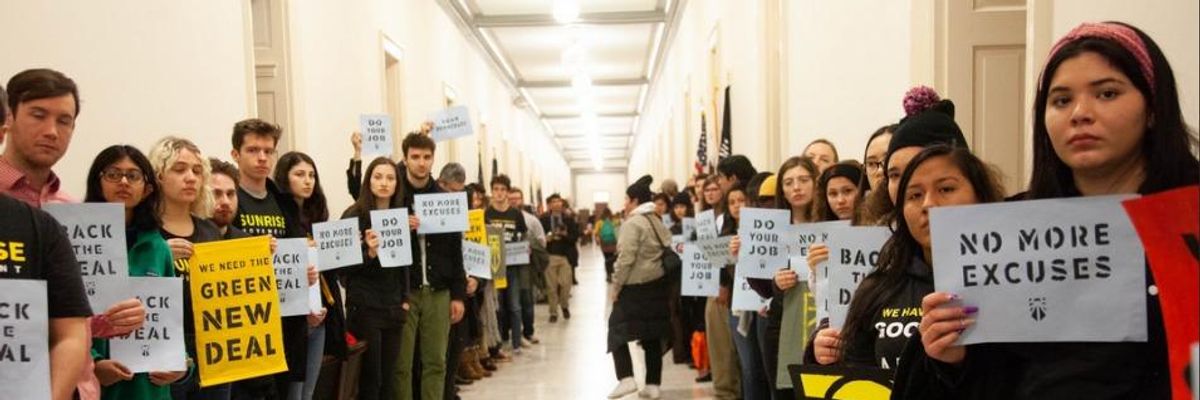
Once seeing the Green New Deal not as a choice but an investment in life itself, funding streams appear that were before invisible--many wielding the power to make our economy fairer, too. (Photo: @skenigsberg/Twitter)
Despite ridicule by Republican leaders, calls for a Green New Deal resonate with 80 percent of Americans. Building on the vision laid out by Alexandria Ocasio Cortez and Ed Markey, now Joe Biden and Elizabeth Warren have weighed in with their versions.
Americans love the idea of taking on the climate crisis, but three-fourths of us also worry about paying the bill. So, we started looking for answers and have some heartening news to share. But first, a stark reality.
Doing little or nothing could cost hundreds of billions annually by the end of the century, experts warn; and even that feels optimistic to us, given the multitude of climate-related variables likely to harm our health, infrastructure, agriculture, and so much more.
Bottom line: To avoid immeasurable catastrophe, we now know we cannot heat the planet above 1.5 over preindustrial levels, says the U.N. Intergovernmental Panel on Climate Change. And that means getting serious fast: Slashing global, human-caused CO2 emissions 45 percent by 2030, compared to 2010 levels, and reaching net-zero by 2050.
Once we grasp this reality, the mundane question--"How do we cover the cost?"--suddenly becomes profound.
To begin, we question the term "cost." It's typically used for what we pay for goods and services, which usually bring short-term benefits. But when educating our children, buying a home, or starting a business, another term seems apt--"investment." Similarly, with climate chaos on the horizon, a Green New Deal is clearly an investment.
A Green New Deal will pay for itself in the long run and bring short-term benefits as well--to our nation's health, ecosystems and beyond. Not only can a Green New Deal mitigate further climate-caused economic losses, but it can generate economic growth through harnessing clean energy, with wind and solar already substantively cheaper than many fossil fuels.
So, how big does America's investment need to be? Well, some economists and engineers are already busy crunching the numbers.
Stanford civil and environmental engineer Mark Jacobson's estimates that reaching net-zero emissions by 2050 would require an investment in the range of $350-$500 billion per year. And University of Massachusetts environmental economist Robert Pollin, who prepared "green new deals" for the states of Washington and Colorado, arrives at a higher figure: roughly $600 billion annually over thirty years, or about 2 percent of GDP per year.
Note that these estimates are well in the ballpark of what our nation has spent per year in times of crisis.
FDR's first New Deal in 1933, for example, is estimated to have been quite a bit more; in fact three times more as a percentage of GDP, coming to about 6 percent at the time. And the Second New Deal, in 1935, reached nearly 7 percent. Note that these investments were made over six to seven years, a shorter duration than a Green New Deal will entail.
Now, with some sense of scale, let's turn our gaze toward sources for funding.
Once seeing the Green New Deal not as a choice but an investment in life itself, funding streams appear that were before invisible--many wielding the power to make our economy fairer, too. They include no-brainer steps at the IRS, and popular, progressive tax proposals, to name just a couple.
Our nation's wellbeing depends on the IRS doing a bang-up job in securing public revenue for our essential needs. Yet, Congress cut the agency's budget by $2 billion, or 18 percent, between 2010 and 2017. The number of auditors fell to a level not seen since 1953, when our economy was one seventh its current size.
These cuts made a bad situation much worse, as the IRS's "tax gap"--what's owed but uncollected--was already huge. Between 2008 and 2010, an average of $405 billion went uncollected annually, rendering a pitiful "net compliance rate" of under 85 percent.
Assuming this low rate continued, in 2017 roughly $640 billion went uncollected. That's a sum in the ballpark experts predict a Green New Deal demands.
Illegal tax evasion not caught by the IRS is one thing, but trillions more are legally untaxed because corporations and individuals hold them overseas. By the end of 2016, 322 of Fortune 500 companies held $2.6 trillion in off-shore wealth, avoiding a whopping $767 billion in taxes, reports the Institute on Taxation and Economic Policy ("ITEP"). To that sum, add $200 billion in tax revenue uncollected each year from individuals holding their assets abroad, as reported by renowned tax-haven economist Gabriel Zucman.
And note that in an earlier era, corporations contributed much more to the public purse. In 1943, corporations were responsible for about 40 percent of federal tax revenue, but by 2018 their share had dropped to 6.1 percent. And in 2018, alone, corporate tax revenue fell 31 percent--a "more precipitous decline than in any year of normal economic growth in U.S. history," says the ITEP.
Americans are catching on. Sixty-six percent of us believe corporations pay too little in taxes, and over 80 percent want corporations to pay as much on foreign profits as they do domestically. Once we listen to the American people and take seriously proposals like Sen. Sanders' Corporate Tax Fairness Act--which would end the loophole allowing U.S. corporations to defer taxes on overseas income--investing in a Green New Deal is do-able.
Wealthy individuals can also contribute their fair share.
Seventy-six percent of registered voters believe the wealthiest Americans should be paying more in taxes, according to a Politico poll. And even Fox News reported that 70 percent of Americans, including 44 percent of Republicans, want higher taxes on those earning over $10 million per year.
From the late 1940s to the early '70s, the wealthiest Americans paid a somewhat higher effective tax rate than they do today. The sky did not fall. In fact, Americans of all income levels doubled their real family income. This is why leading economists, including Nobel Prize-winning Paul Krugman, advocate a higher top marginal tax rate on the wealthiest Americans, such as that floated by Congresswomen Alexandria Ocasio-Cortez on income over $10 million.
Furthermore, with today's top 1 percent capturing over 20 percent of the nation's income, more than double what it was from the early '50s to the '70s, basic fairness demands we take these steps. Done well, our investments will benefit those most hurt by climate chaos as we expand meaningful, well-paid work in clean energy and sustainability--from manufacturing and installation to restoring our landscapes and so much more.
So, let's drop the false narrative of "unaffordability." As we citizens step up--so that our democracy answers to our good sense and our needs--America has the resources to meet our historic challenge in ways that are not only life saving but life enhancing.
Dear Common Dreams reader, It’s been nearly 30 years since I co-founded Common Dreams with my late wife, Lina Newhouser. We had the radical notion that journalism should serve the public good, not corporate profits. It was clear to us from the outset what it would take to build such a project. No paid advertisements. No corporate sponsors. No millionaire publisher telling us what to think or do. Many people said we wouldn't last a year, but we proved those doubters wrong. Together with a tremendous team of journalists and dedicated staff, we built an independent media outlet free from the constraints of profits and corporate control. Our mission has always been simple: To inform. To inspire. To ignite change for the common good. Building Common Dreams was not easy. Our survival was never guaranteed. When you take on the most powerful forces—Wall Street greed, fossil fuel industry destruction, Big Tech lobbyists, and uber-rich oligarchs who have spent billions upon billions rigging the economy and democracy in their favor—the only bulwark you have is supporters who believe in your work. But here’s the urgent message from me today. It's never been this bad out there. And it's never been this hard to keep us going. At the very moment Common Dreams is most needed, the threats we face are intensifying. We need your support now more than ever. We don't accept corporate advertising and never will. We don't have a paywall because we don't think people should be blocked from critical news based on their ability to pay. Everything we do is funded by the donations of readers like you. When everyone does the little they can afford, we are strong. But if that support retreats or dries up, so do we. Will you donate now to make sure Common Dreams not only survives but thrives? —Craig Brown, Co-founder |
Despite ridicule by Republican leaders, calls for a Green New Deal resonate with 80 percent of Americans. Building on the vision laid out by Alexandria Ocasio Cortez and Ed Markey, now Joe Biden and Elizabeth Warren have weighed in with their versions.
Americans love the idea of taking on the climate crisis, but three-fourths of us also worry about paying the bill. So, we started looking for answers and have some heartening news to share. But first, a stark reality.
Doing little or nothing could cost hundreds of billions annually by the end of the century, experts warn; and even that feels optimistic to us, given the multitude of climate-related variables likely to harm our health, infrastructure, agriculture, and so much more.
Bottom line: To avoid immeasurable catastrophe, we now know we cannot heat the planet above 1.5 over preindustrial levels, says the U.N. Intergovernmental Panel on Climate Change. And that means getting serious fast: Slashing global, human-caused CO2 emissions 45 percent by 2030, compared to 2010 levels, and reaching net-zero by 2050.
Once we grasp this reality, the mundane question--"How do we cover the cost?"--suddenly becomes profound.
To begin, we question the term "cost." It's typically used for what we pay for goods and services, which usually bring short-term benefits. But when educating our children, buying a home, or starting a business, another term seems apt--"investment." Similarly, with climate chaos on the horizon, a Green New Deal is clearly an investment.
A Green New Deal will pay for itself in the long run and bring short-term benefits as well--to our nation's health, ecosystems and beyond. Not only can a Green New Deal mitigate further climate-caused economic losses, but it can generate economic growth through harnessing clean energy, with wind and solar already substantively cheaper than many fossil fuels.
So, how big does America's investment need to be? Well, some economists and engineers are already busy crunching the numbers.
Stanford civil and environmental engineer Mark Jacobson's estimates that reaching net-zero emissions by 2050 would require an investment in the range of $350-$500 billion per year. And University of Massachusetts environmental economist Robert Pollin, who prepared "green new deals" for the states of Washington and Colorado, arrives at a higher figure: roughly $600 billion annually over thirty years, or about 2 percent of GDP per year.
Note that these estimates are well in the ballpark of what our nation has spent per year in times of crisis.
FDR's first New Deal in 1933, for example, is estimated to have been quite a bit more; in fact three times more as a percentage of GDP, coming to about 6 percent at the time. And the Second New Deal, in 1935, reached nearly 7 percent. Note that these investments were made over six to seven years, a shorter duration than a Green New Deal will entail.
Now, with some sense of scale, let's turn our gaze toward sources for funding.
Once seeing the Green New Deal not as a choice but an investment in life itself, funding streams appear that were before invisible--many wielding the power to make our economy fairer, too. They include no-brainer steps at the IRS, and popular, progressive tax proposals, to name just a couple.
Our nation's wellbeing depends on the IRS doing a bang-up job in securing public revenue for our essential needs. Yet, Congress cut the agency's budget by $2 billion, or 18 percent, between 2010 and 2017. The number of auditors fell to a level not seen since 1953, when our economy was one seventh its current size.
These cuts made a bad situation much worse, as the IRS's "tax gap"--what's owed but uncollected--was already huge. Between 2008 and 2010, an average of $405 billion went uncollected annually, rendering a pitiful "net compliance rate" of under 85 percent.
Assuming this low rate continued, in 2017 roughly $640 billion went uncollected. That's a sum in the ballpark experts predict a Green New Deal demands.
Illegal tax evasion not caught by the IRS is one thing, but trillions more are legally untaxed because corporations and individuals hold them overseas. By the end of 2016, 322 of Fortune 500 companies held $2.6 trillion in off-shore wealth, avoiding a whopping $767 billion in taxes, reports the Institute on Taxation and Economic Policy ("ITEP"). To that sum, add $200 billion in tax revenue uncollected each year from individuals holding their assets abroad, as reported by renowned tax-haven economist Gabriel Zucman.
And note that in an earlier era, corporations contributed much more to the public purse. In 1943, corporations were responsible for about 40 percent of federal tax revenue, but by 2018 their share had dropped to 6.1 percent. And in 2018, alone, corporate tax revenue fell 31 percent--a "more precipitous decline than in any year of normal economic growth in U.S. history," says the ITEP.
Americans are catching on. Sixty-six percent of us believe corporations pay too little in taxes, and over 80 percent want corporations to pay as much on foreign profits as they do domestically. Once we listen to the American people and take seriously proposals like Sen. Sanders' Corporate Tax Fairness Act--which would end the loophole allowing U.S. corporations to defer taxes on overseas income--investing in a Green New Deal is do-able.
Wealthy individuals can also contribute their fair share.
Seventy-six percent of registered voters believe the wealthiest Americans should be paying more in taxes, according to a Politico poll. And even Fox News reported that 70 percent of Americans, including 44 percent of Republicans, want higher taxes on those earning over $10 million per year.
From the late 1940s to the early '70s, the wealthiest Americans paid a somewhat higher effective tax rate than they do today. The sky did not fall. In fact, Americans of all income levels doubled their real family income. This is why leading economists, including Nobel Prize-winning Paul Krugman, advocate a higher top marginal tax rate on the wealthiest Americans, such as that floated by Congresswomen Alexandria Ocasio-Cortez on income over $10 million.
Furthermore, with today's top 1 percent capturing over 20 percent of the nation's income, more than double what it was from the early '50s to the '70s, basic fairness demands we take these steps. Done well, our investments will benefit those most hurt by climate chaos as we expand meaningful, well-paid work in clean energy and sustainability--from manufacturing and installation to restoring our landscapes and so much more.
So, let's drop the false narrative of "unaffordability." As we citizens step up--so that our democracy answers to our good sense and our needs--America has the resources to meet our historic challenge in ways that are not only life saving but life enhancing.
Despite ridicule by Republican leaders, calls for a Green New Deal resonate with 80 percent of Americans. Building on the vision laid out by Alexandria Ocasio Cortez and Ed Markey, now Joe Biden and Elizabeth Warren have weighed in with their versions.
Americans love the idea of taking on the climate crisis, but three-fourths of us also worry about paying the bill. So, we started looking for answers and have some heartening news to share. But first, a stark reality.
Doing little or nothing could cost hundreds of billions annually by the end of the century, experts warn; and even that feels optimistic to us, given the multitude of climate-related variables likely to harm our health, infrastructure, agriculture, and so much more.
Bottom line: To avoid immeasurable catastrophe, we now know we cannot heat the planet above 1.5 over preindustrial levels, says the U.N. Intergovernmental Panel on Climate Change. And that means getting serious fast: Slashing global, human-caused CO2 emissions 45 percent by 2030, compared to 2010 levels, and reaching net-zero by 2050.
Once we grasp this reality, the mundane question--"How do we cover the cost?"--suddenly becomes profound.
To begin, we question the term "cost." It's typically used for what we pay for goods and services, which usually bring short-term benefits. But when educating our children, buying a home, or starting a business, another term seems apt--"investment." Similarly, with climate chaos on the horizon, a Green New Deal is clearly an investment.
A Green New Deal will pay for itself in the long run and bring short-term benefits as well--to our nation's health, ecosystems and beyond. Not only can a Green New Deal mitigate further climate-caused economic losses, but it can generate economic growth through harnessing clean energy, with wind and solar already substantively cheaper than many fossil fuels.
So, how big does America's investment need to be? Well, some economists and engineers are already busy crunching the numbers.
Stanford civil and environmental engineer Mark Jacobson's estimates that reaching net-zero emissions by 2050 would require an investment in the range of $350-$500 billion per year. And University of Massachusetts environmental economist Robert Pollin, who prepared "green new deals" for the states of Washington and Colorado, arrives at a higher figure: roughly $600 billion annually over thirty years, or about 2 percent of GDP per year.
Note that these estimates are well in the ballpark of what our nation has spent per year in times of crisis.
FDR's first New Deal in 1933, for example, is estimated to have been quite a bit more; in fact three times more as a percentage of GDP, coming to about 6 percent at the time. And the Second New Deal, in 1935, reached nearly 7 percent. Note that these investments were made over six to seven years, a shorter duration than a Green New Deal will entail.
Now, with some sense of scale, let's turn our gaze toward sources for funding.
Once seeing the Green New Deal not as a choice but an investment in life itself, funding streams appear that were before invisible--many wielding the power to make our economy fairer, too. They include no-brainer steps at the IRS, and popular, progressive tax proposals, to name just a couple.
Our nation's wellbeing depends on the IRS doing a bang-up job in securing public revenue for our essential needs. Yet, Congress cut the agency's budget by $2 billion, or 18 percent, between 2010 and 2017. The number of auditors fell to a level not seen since 1953, when our economy was one seventh its current size.
These cuts made a bad situation much worse, as the IRS's "tax gap"--what's owed but uncollected--was already huge. Between 2008 and 2010, an average of $405 billion went uncollected annually, rendering a pitiful "net compliance rate" of under 85 percent.
Assuming this low rate continued, in 2017 roughly $640 billion went uncollected. That's a sum in the ballpark experts predict a Green New Deal demands.
Illegal tax evasion not caught by the IRS is one thing, but trillions more are legally untaxed because corporations and individuals hold them overseas. By the end of 2016, 322 of Fortune 500 companies held $2.6 trillion in off-shore wealth, avoiding a whopping $767 billion in taxes, reports the Institute on Taxation and Economic Policy ("ITEP"). To that sum, add $200 billion in tax revenue uncollected each year from individuals holding their assets abroad, as reported by renowned tax-haven economist Gabriel Zucman.
And note that in an earlier era, corporations contributed much more to the public purse. In 1943, corporations were responsible for about 40 percent of federal tax revenue, but by 2018 their share had dropped to 6.1 percent. And in 2018, alone, corporate tax revenue fell 31 percent--a "more precipitous decline than in any year of normal economic growth in U.S. history," says the ITEP.
Americans are catching on. Sixty-six percent of us believe corporations pay too little in taxes, and over 80 percent want corporations to pay as much on foreign profits as they do domestically. Once we listen to the American people and take seriously proposals like Sen. Sanders' Corporate Tax Fairness Act--which would end the loophole allowing U.S. corporations to defer taxes on overseas income--investing in a Green New Deal is do-able.
Wealthy individuals can also contribute their fair share.
Seventy-six percent of registered voters believe the wealthiest Americans should be paying more in taxes, according to a Politico poll. And even Fox News reported that 70 percent of Americans, including 44 percent of Republicans, want higher taxes on those earning over $10 million per year.
From the late 1940s to the early '70s, the wealthiest Americans paid a somewhat higher effective tax rate than they do today. The sky did not fall. In fact, Americans of all income levels doubled their real family income. This is why leading economists, including Nobel Prize-winning Paul Krugman, advocate a higher top marginal tax rate on the wealthiest Americans, such as that floated by Congresswomen Alexandria Ocasio-Cortez on income over $10 million.
Furthermore, with today's top 1 percent capturing over 20 percent of the nation's income, more than double what it was from the early '50s to the '70s, basic fairness demands we take these steps. Done well, our investments will benefit those most hurt by climate chaos as we expand meaningful, well-paid work in clean energy and sustainability--from manufacturing and installation to restoring our landscapes and so much more.
So, let's drop the false narrative of "unaffordability." As we citizens step up--so that our democracy answers to our good sense and our needs--America has the resources to meet our historic challenge in ways that are not only life saving but life enhancing.