SUBSCRIBE TO OUR FREE NEWSLETTER
Daily news & progressive opinion—funded by the people, not the corporations—delivered straight to your inbox.
5
#000000
#FFFFFF
To donate by check, phone, or other method, see our More Ways to Give page.
Daily news & progressive opinion—funded by the people, not the corporations—delivered straight to your inbox.
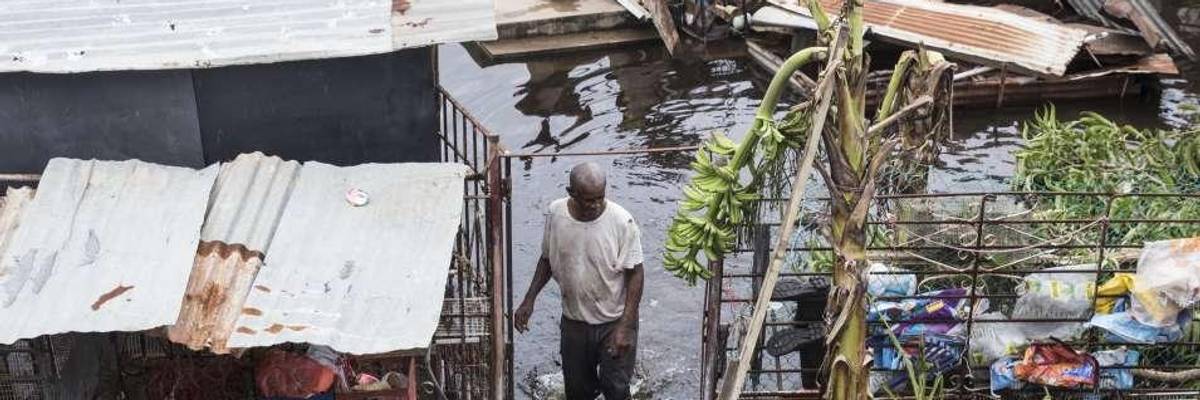
"Hurricane Maria's devastation of Puerto Rico may offer a preview for Americans of one of the most jarring potential consequences of global warming: the movement of large numbers of people pushed out of their homes by the effects of climate change." (Photo: Alex Wroblewski/Getty Images)
So this is what climate change looks like. One week on from when Hurricane Maria hit the island, Puerto Rico is facing a humanitarian crisis.
Some 97% of the island's 3.4 million residents are still without power. About half of the Island's residents do not have running water. And no one knows when things will be fixed.
The situation is made worse by rising daily temperatures, threatening to increase the spread of water-borne diseases.
Carmen Yulin Cruz, the Mayor of San Juan, the capital of Puerto Rico said bluntly: "People are dying. This is the reality that we live in, the crude aftermath of a storm, a hurricane that has left us practically paralyzed."
Scientists have been warning about the risk to Puerto Rica from climate change for years, but was anyone listening? Four years ago, the Puerto Rico Climate Change Council, warned in a report on the subject of global warming that: "Puerto Rico's population reflects high levels of vulnerability to hazards."
The report concluded with a prediction for the future that has come to pass all too quickly:
"Temperatures are increasing, precipitation patterns are changing, extreme events are occurring more frequently, oceans are more acidic, and sea level is rising. These climatic changes are projected to occur at much faster than natural rates. Some types of extreme weather and climate events have already increased in frequency and intensity and these changes are projected to continue."
It continued: "Climate changes are already affecting some aspects of society, the economy and natural ecosystems of Puerto Rico and these effects are expected to increase. Not all of these changes will be gradual."
And finally said: "When certain tipping points are crossed, impacts can increase dramatically. Past climate is no longer a reliable guide to the future. This affects planning for public and private infrastructure, tourism and industry, water resources, energy and all other social and economic systems".
But nothing was done. The warnings went unheeded.
Many people believe that the recent Hurricanes we have witnessed in the Caribbean and US maybe evidence that the climate change "tipping point" is here. The future people worried about has arrived.
The time to act is now. Instead we have a climate denying President in the White House who is coming under increasing pressure to not only act on climate but to act to help those in Puerto Rico.
On Monday, the creator of "Hamilton", Lin-Manuel Miranda, tweeted at Trump that "there will be a lot of American deaths on your watch" if additional aid is not sent very soon.
But Trump not only denies climate change, but basic human rights too. Yesterday the Trump Administration turned down a request to waive shipping restrictions, known as the Jones Act, to help get fuel and supplies to Puerto Rico.
Even senior republicans have criticised this. Senator John McCain (R-Ariz.) said "it is unacceptable to force the people of Puerto Rico to pay at least twice as much for food, clean drinking water, supplies and infrastructure due to Jones Act requirements as they work to recover from this disaster."
With no power, no water and even no homes, many people have no option but to leave for the US mainland. Yesterday. Puerto Rico Governor, Ricardo Rossello, warned that without "unprecedented relief" from the US government, "thousands if not millions" of residents could leave the island for the mainland in the coming days and weeks.
They are climate refugees and they could be soon heading to major US cities in their thousands.
As Bloomberg notes today: "Hurricane Maria's devastation of Puerto Rico may offer a preview for Americans of one of the most jarring potential consequences of global warming: the movement of large numbers of people pushed out of their homes by the effects of climate change."
Bloomberg quotes the International Monetary Fund, which released a report today examining the links between extreme weather and emigration in over 100 countries over three decades. According to Petia Topalova, the lead author of the report, the IMF found "a rise in temperature and greater incidence of weather-related disasters increase out-migration."
That is exactly what is happening in Puerto Rico. Next week, Donald Trump will visit the island, some two weeks into the disaster.
For many his visit will be too little, too late. He should have listened to the warnings from the experts' years ago.
Dear Common Dreams reader, It’s been nearly 30 years since I co-founded Common Dreams with my late wife, Lina Newhouser. We had the radical notion that journalism should serve the public good, not corporate profits. It was clear to us from the outset what it would take to build such a project. No paid advertisements. No corporate sponsors. No millionaire publisher telling us what to think or do. Many people said we wouldn't last a year, but we proved those doubters wrong. Together with a tremendous team of journalists and dedicated staff, we built an independent media outlet free from the constraints of profits and corporate control. Our mission has always been simple: To inform. To inspire. To ignite change for the common good. Building Common Dreams was not easy. Our survival was never guaranteed. When you take on the most powerful forces—Wall Street greed, fossil fuel industry destruction, Big Tech lobbyists, and uber-rich oligarchs who have spent billions upon billions rigging the economy and democracy in their favor—the only bulwark you have is supporters who believe in your work. But here’s the urgent message from me today. It's never been this bad out there. And it's never been this hard to keep us going. At the very moment Common Dreams is most needed, the threats we face are intensifying. We need your support now more than ever. We don't accept corporate advertising and never will. We don't have a paywall because we don't think people should be blocked from critical news based on their ability to pay. Everything we do is funded by the donations of readers like you. When everyone does the little they can afford, we are strong. But if that support retreats or dries up, so do we. Will you donate now to make sure Common Dreams not only survives but thrives? —Craig Brown, Co-founder |
So this is what climate change looks like. One week on from when Hurricane Maria hit the island, Puerto Rico is facing a humanitarian crisis.
Some 97% of the island's 3.4 million residents are still without power. About half of the Island's residents do not have running water. And no one knows when things will be fixed.
The situation is made worse by rising daily temperatures, threatening to increase the spread of water-borne diseases.
Carmen Yulin Cruz, the Mayor of San Juan, the capital of Puerto Rico said bluntly: "People are dying. This is the reality that we live in, the crude aftermath of a storm, a hurricane that has left us practically paralyzed."
Scientists have been warning about the risk to Puerto Rica from climate change for years, but was anyone listening? Four years ago, the Puerto Rico Climate Change Council, warned in a report on the subject of global warming that: "Puerto Rico's population reflects high levels of vulnerability to hazards."
The report concluded with a prediction for the future that has come to pass all too quickly:
"Temperatures are increasing, precipitation patterns are changing, extreme events are occurring more frequently, oceans are more acidic, and sea level is rising. These climatic changes are projected to occur at much faster than natural rates. Some types of extreme weather and climate events have already increased in frequency and intensity and these changes are projected to continue."
It continued: "Climate changes are already affecting some aspects of society, the economy and natural ecosystems of Puerto Rico and these effects are expected to increase. Not all of these changes will be gradual."
And finally said: "When certain tipping points are crossed, impacts can increase dramatically. Past climate is no longer a reliable guide to the future. This affects planning for public and private infrastructure, tourism and industry, water resources, energy and all other social and economic systems".
But nothing was done. The warnings went unheeded.
Many people believe that the recent Hurricanes we have witnessed in the Caribbean and US maybe evidence that the climate change "tipping point" is here. The future people worried about has arrived.
The time to act is now. Instead we have a climate denying President in the White House who is coming under increasing pressure to not only act on climate but to act to help those in Puerto Rico.
On Monday, the creator of "Hamilton", Lin-Manuel Miranda, tweeted at Trump that "there will be a lot of American deaths on your watch" if additional aid is not sent very soon.
But Trump not only denies climate change, but basic human rights too. Yesterday the Trump Administration turned down a request to waive shipping restrictions, known as the Jones Act, to help get fuel and supplies to Puerto Rico.
Even senior republicans have criticised this. Senator John McCain (R-Ariz.) said "it is unacceptable to force the people of Puerto Rico to pay at least twice as much for food, clean drinking water, supplies and infrastructure due to Jones Act requirements as they work to recover from this disaster."
With no power, no water and even no homes, many people have no option but to leave for the US mainland. Yesterday. Puerto Rico Governor, Ricardo Rossello, warned that without "unprecedented relief" from the US government, "thousands if not millions" of residents could leave the island for the mainland in the coming days and weeks.
They are climate refugees and they could be soon heading to major US cities in their thousands.
As Bloomberg notes today: "Hurricane Maria's devastation of Puerto Rico may offer a preview for Americans of one of the most jarring potential consequences of global warming: the movement of large numbers of people pushed out of their homes by the effects of climate change."
Bloomberg quotes the International Monetary Fund, which released a report today examining the links between extreme weather and emigration in over 100 countries over three decades. According to Petia Topalova, the lead author of the report, the IMF found "a rise in temperature and greater incidence of weather-related disasters increase out-migration."
That is exactly what is happening in Puerto Rico. Next week, Donald Trump will visit the island, some two weeks into the disaster.
For many his visit will be too little, too late. He should have listened to the warnings from the experts' years ago.
So this is what climate change looks like. One week on from when Hurricane Maria hit the island, Puerto Rico is facing a humanitarian crisis.
Some 97% of the island's 3.4 million residents are still without power. About half of the Island's residents do not have running water. And no one knows when things will be fixed.
The situation is made worse by rising daily temperatures, threatening to increase the spread of water-borne diseases.
Carmen Yulin Cruz, the Mayor of San Juan, the capital of Puerto Rico said bluntly: "People are dying. This is the reality that we live in, the crude aftermath of a storm, a hurricane that has left us practically paralyzed."
Scientists have been warning about the risk to Puerto Rica from climate change for years, but was anyone listening? Four years ago, the Puerto Rico Climate Change Council, warned in a report on the subject of global warming that: "Puerto Rico's population reflects high levels of vulnerability to hazards."
The report concluded with a prediction for the future that has come to pass all too quickly:
"Temperatures are increasing, precipitation patterns are changing, extreme events are occurring more frequently, oceans are more acidic, and sea level is rising. These climatic changes are projected to occur at much faster than natural rates. Some types of extreme weather and climate events have already increased in frequency and intensity and these changes are projected to continue."
It continued: "Climate changes are already affecting some aspects of society, the economy and natural ecosystems of Puerto Rico and these effects are expected to increase. Not all of these changes will be gradual."
And finally said: "When certain tipping points are crossed, impacts can increase dramatically. Past climate is no longer a reliable guide to the future. This affects planning for public and private infrastructure, tourism and industry, water resources, energy and all other social and economic systems".
But nothing was done. The warnings went unheeded.
Many people believe that the recent Hurricanes we have witnessed in the Caribbean and US maybe evidence that the climate change "tipping point" is here. The future people worried about has arrived.
The time to act is now. Instead we have a climate denying President in the White House who is coming under increasing pressure to not only act on climate but to act to help those in Puerto Rico.
On Monday, the creator of "Hamilton", Lin-Manuel Miranda, tweeted at Trump that "there will be a lot of American deaths on your watch" if additional aid is not sent very soon.
But Trump not only denies climate change, but basic human rights too. Yesterday the Trump Administration turned down a request to waive shipping restrictions, known as the Jones Act, to help get fuel and supplies to Puerto Rico.
Even senior republicans have criticised this. Senator John McCain (R-Ariz.) said "it is unacceptable to force the people of Puerto Rico to pay at least twice as much for food, clean drinking water, supplies and infrastructure due to Jones Act requirements as they work to recover from this disaster."
With no power, no water and even no homes, many people have no option but to leave for the US mainland. Yesterday. Puerto Rico Governor, Ricardo Rossello, warned that without "unprecedented relief" from the US government, "thousands if not millions" of residents could leave the island for the mainland in the coming days and weeks.
They are climate refugees and they could be soon heading to major US cities in their thousands.
As Bloomberg notes today: "Hurricane Maria's devastation of Puerto Rico may offer a preview for Americans of one of the most jarring potential consequences of global warming: the movement of large numbers of people pushed out of their homes by the effects of climate change."
Bloomberg quotes the International Monetary Fund, which released a report today examining the links between extreme weather and emigration in over 100 countries over three decades. According to Petia Topalova, the lead author of the report, the IMF found "a rise in temperature and greater incidence of weather-related disasters increase out-migration."
That is exactly what is happening in Puerto Rico. Next week, Donald Trump will visit the island, some two weeks into the disaster.
For many his visit will be too little, too late. He should have listened to the warnings from the experts' years ago.