SUBSCRIBE TO OUR FREE NEWSLETTER
Daily news & progressive opinion—funded by the people, not the corporations—delivered straight to your inbox.
5
#000000
#FFFFFF
To donate by check, phone, or other method, see our More Ways to Give page.


Daily news & progressive opinion—funded by the people, not the corporations—delivered straight to your inbox.
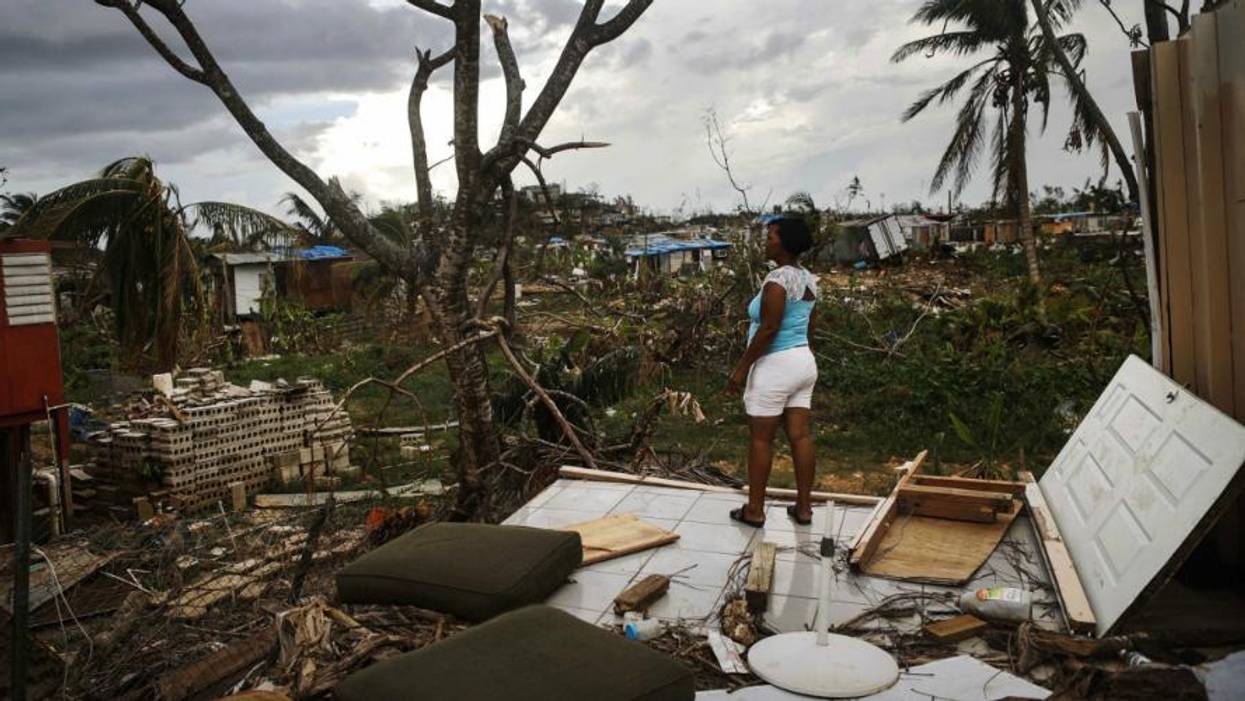
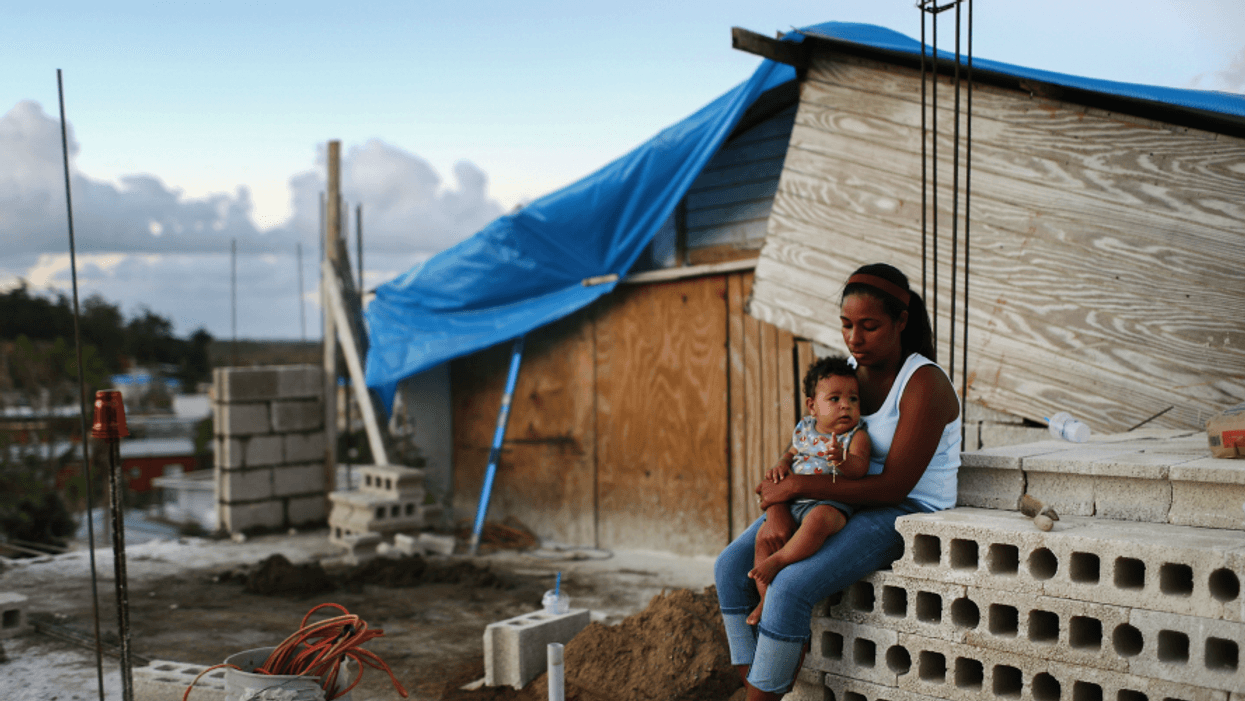
Puerto Rico's death toll of about 3,000 from Hurricanes Irma and Maria in 2017 ought to be the biggest strike against President Donald Trump. The majority of deaths on the island occurred in the days and weeks following the hurricanes, largely due to inadequate health care and the admitted failures of the Federal Emergency Management Authority (FEMA), suggesting that these were preventable deaths. And yet to Trump, Puerto Rico is the recipient of fantastical amounts of undeserved money.
In many ways, Trump sees the U.S. colony as a personification of his usual enemies. Puerto Rico is brown skinned, non-English speaking, foreign, Democratic, and poor--whether or not any or all of these things are entirely true. Therefore, if it does not accept his patronizing gestures with undying gratitude, it deserves nothing but disdain.
That disdain has been apparent right from the start, most notably during Trump's post-hurricane paper towel-throwing exercise in 2017 and in his denials of the extent of the hurricane-related death toll. It was also on full display earlier this week during his Monday night tweet-storm. In an error-filled statement, Trump tweeted that "Puerto Rico got far more money than Texas & Florida combined, yet their government can't do anything right, the place is a mess--nothing works." He also said, "Puerto Rico got 91 Billion Dollars for the hurricane, more money than has ever been gotten for a hurricane before." Trump--who, like his base, feels his manhood is deeply threatened by strong women of color leaders--called San Juan Mayor Carmen Yulin Cruz "crazed and incompetent." He then spoke of himself in the third person, bombastically asserting that "The best thing that ever happened to Puerto Rico is President Donald J. Trump."
Multiple news outlets exposed his $91 billion figure and claims that Puerto Rico received more money than any other region for a hurricane as flat-out lies. No one is quite sure where Trump conjured up the number, but some have speculated that he confused the total amount of damage suffered by Puerto Rico from the 2017 storms with the amount it has actually received. The Washington Post reported that it "is a combination of $41 billion that's been set aside for recovery combined with $50 billion expected to be spent over the life of the recovery effort." Regardless of where he got the figure, the difference between reality and Trump's fiction ironically encompasses Puerto Rico's actual need.
Trump's claim that Puerto Rico was given more money than any hurricane-affected region has ever been granted is also erroneous. Federal funds to Louisiana after the 2005 Hurricane Katrina totaled about $120 billion.
The president's bizarre comments come as the Senate failed to pass two bills on disaster relief this week hinging on expanding Puerto Rico's food stamp program. Trump has privately told his Republican colleagues that he will not support additional funding going to Puerto Rico, proving that the consequences of his defiant misinformation have a real-world impact. Eric LeCompte, executive director of Jubilee USA, put it in these terms in an interview: "Puerto Rico has become kind of a bargaining chip to move forward proposals." He explained that Trump considered "taking aid that was committed for Puerto Rico in order to build or strengthen the border wall."
What Trump also exposed in his series of tweets was how he has clearly "otherized" Puerto Rico. In his complaints against Senate Democrats for voting down the disaster relief bill for other states that he backed, the president tweeted: "Puerto Rico has already been scheduled to receive more hurricane relief funding than any 'place' in history." His use of the quotation marks in referring to Puerto Rico as a "place" is suggestive of his uncomfortable attitude toward the U.S. colony. He also complained about how Puerto Rico's politicians "only take from USA," implying that the island was not part of this country, rather an outsider leeching from the federal treasury. It's not just Trump. White House Deputy Press Secretary Hogan Gidley twice referred to Puerto Rico as "that country" during an interview this week. LeCompte explained to me that "Unfortunately, a lot of Americans don't understand that people who are living in Puerto Rico, people born in Puerto Rico, are U.S. citizens." It seems as though this ignorance may extend to the White House under Trump.
Trump has also decided that Puerto Rico's governor does not deserve his attention, and in a manner that can only be described as utterly juvenile, as he has been actively avoiding Gov. Ricardo Rossello. Rossello responded by saying such behavior was "below the dignity of a sitting President" and "irresponsible, regrettable and, above all, unjustified."
The fact that about 3,000 Americans died on Trump's watch in Puerto Rico should be at least as large a stain on his presidency as Hurricane Katrina was on George W. Bush's legacy. That 2005 tragedy resulted in 1,833 deaths and was seen as the lowest point of Bush's domestic record. But amid the endless fallout of Trump's train wreck of a presidency, there has been very little accountability for Puerto Rico's hurricane deaths. And now Trump has gone further in trying to rewrite history, making up facts and figures to suit his agenda, and shirking his responsibility to even meet with Puerto Rico's leaders.
Today, according to LeCompte, there are more Americans of Puerto Rican descent living on the mainland than on the island. Years of human caused and natural disasters have fueled an ongoing exodus. After Hurricane Maria alone, an estimated 200,000 Puerto Ricans resettled on the mainland, many of them making their homes in places like Florida. Republican politicians counting on reelection in states with a sizable Puerto Rican population have "put distance between themselves and the president," said LeCompte. And he said they have "been very clear in public statements and social media that they disagree with the president's statements on Puerto Rico." For example, Florida Gov. Rick Scott, in a Spanish-language ad last fall, asserted that he "confronted" Trump over his denial of the actual hurricane-related death toll.
Some political scientists have warned that Puerto Rican voters in key presidential election swing states like Florida could undo Trump's reelection hopes in 2020. "The Puerto Rican diaspora vote is a very important vote," said LeCompte. In addition to Florida, he cited key states like Texas, Pennsylvania, New York and Illinois where this critical vote could make a difference. Indeed, it would be a delicious irony if Trump's presidency was to be undone by the very demographic that he has maligned and let suffer.
"He can huff and puff all he wants but he cannot escape the death of 3,000 on his watch."
That was San Juan Mayor Carmen Yulin Cruz's response to President Donald Trump's Monday night tweet-storm, in which he once again inflated the amount of federal aid Puerto Rico has received since Hurricane Maria and attacked Cruz as "crazed and incompetent."
"He is unhinged," Cruz tweeted in response to the president's rant, which came after a GOP emergency aid bill stalled in the Senate, in part due to Democratic opposition over the legislation's inadequate relief to Puerto Rico.
"He knows his response was insufficient at best," the San Juan Mayor continued. "Shame on you!"
Trump's Puerto Rico rant came as over a million U.S. citizens on the island are facing massive food stamp cuts amid congressional inaction.
The president has repeatedly claimed Puerto Rico has received $91 billion in federal disaster relief. According to the Washington Post, this number "appears to be a steep inflation of what's actually been appropriated."
Trump has also reportedly told aides that he "doesn't want another single dollar going to the island."
The $13 billion relief bill that failed in the Senate Monday included $600 million in aid for Puerto Rico's food stamp program, as well as aid to California, North and South Carolina, and other states.
As the Post reported, Senate Democrats argued the GOP legislation is "inadequate to meet the U.S. territory's needs as it attempts to recover from Hurricane Maria."
According to a study published in The New England Journal of Medicine last year, as many as 6,000 people may have died in Puerto Rico due to Hurricane Maria.
"Democrats are embracing a House-passed relief bill containing hundreds of millions of dollars more for Puerto Rico than the GOP version, but it, too, failed to advance Monday as Republicans opposed it," the Post reported. "Trump opposes sending any additional aid to Puerto Rico apart from the food stamp money, funding Republicans convinced him to accept as the price for passing the long-pending disaster bill."
In a statement last week, Puerto Rico governor Ricardo Rossello accused Trump of treating residents of the island as second-class citizens.
"People from all over the nation, and the world, have witnessed the inequalities Americans face on the island," Rossello said. "Mr. President: Enough with the insults and demeaning characterizations."
With over a million U.S. citizens in Puerto Rico facing devastating food stamp cuts as Congress fails to provide necessary hurricane relief funding, President Donald Trump reportedly complained to Republican senators on Tuesday that the island is receiving "too much" aid--a position that was decried as both false and cruel.
"The president continues to show his vindictive behavior towards Puerto Rico and he continues to make the humanitarian crisis worse," said San Juan Mayor Carmen Yulin Cruz. "He is ensuring that people don't have food to put on the table."
"The federal response and its treatment during these past months in the aftermath of Hurricane Maria is clear evidence of our second-class citizenship."
--Ricardo Rossello, governor of Puerto Rico
Trump's remarks came during a private lunch with Republicans Tuesday, during which--according to the Washington Post--the president inflated the amount of aid Puerto Rico has received since Hurricane Maria and pushed lawmakers to limit funding to the island.
"At the lunch Tuesday, Trump rattled off the amount of aid that had been designated for other disaster-hit states and compared it with the amount allocated for Puerto Rico following the 2017 hurricane, which he said was too high," the Post reported.
After claiming that Puerto Rico has received $91 billion in federal aid--it is unclear where he got this number--Trump reportedly said "one could buy Puerto Rico four times over for $91 billion."
Puerto Rico Gov. Ricardo Rossello responded with outrage to Trump's reported comments in a statement late Tuesday.
"People from all over the nation, and the world, have witnessed the inequalities Americans face on the island," Rossello said. "The federal response and its treatment during these past months in the aftermath of Hurricane Maria is clear evidence of our second-class citizenship."
"Mr. President: Enough with the insults and demeaning characterizations," he added. "We are not asking for anything more than any other U.S. state has received. We are merely asking for equality."
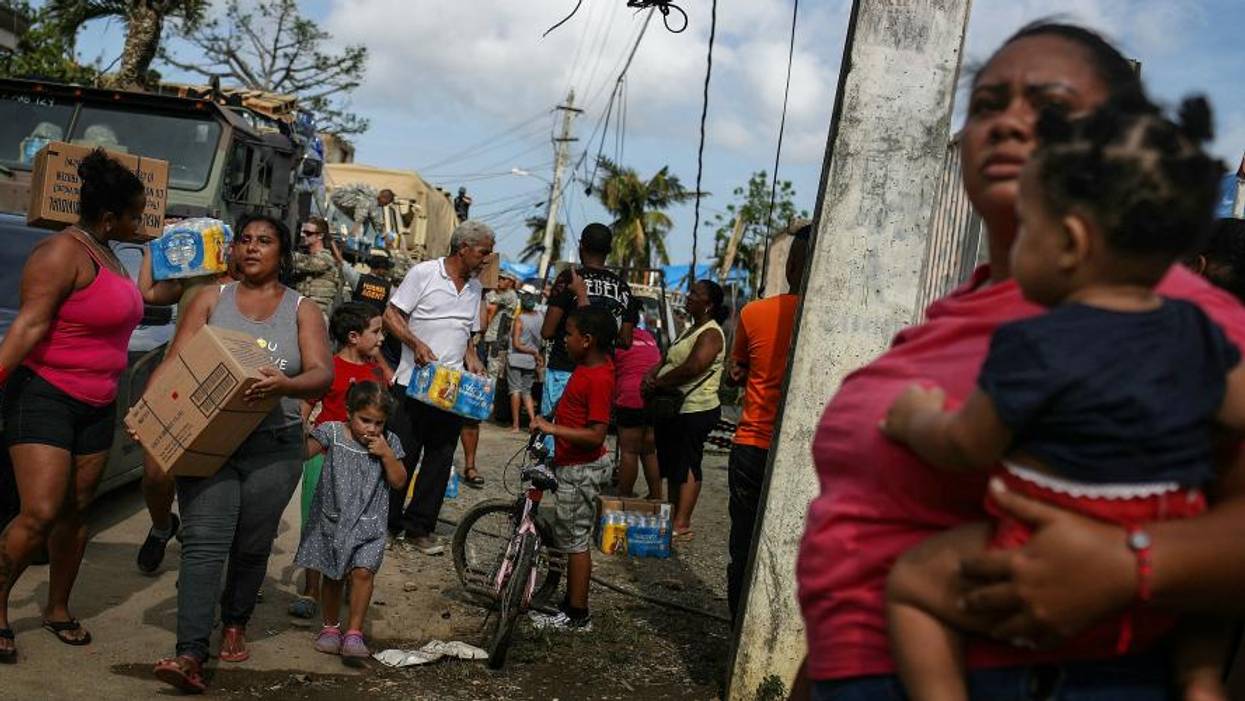
Trump's complaint about aid to the storm-ravaged island comes as an estimated 1.3 million Puerto Ricans--including hundreds of thousands of children and elderly people--have had life-saving food aid cut amid inaction and obstruction from the White House and congressional Republicans.
"We just don't have the money right now," said Myrna Izquierdo, an administrator at a Puerto Rican health clinic that relies on food stamp funding. "It's very hard. It is so unfair. That cut is going to kill us."
Late Tuesday afternoon, the Senate advanced a disaster relief bill that Democrats said is far from adequate to address the crises in Puerto Rico in the aftermath of Hurricane Maria. According to one study, the storm may have killed nearly 6,000 people.
"The lack of leadership and coordination, combined with delays in meeting the basic needs of the island, more than 18 months after receiving a presidential disaster declaration, has left far too many children and elderly citizens in unhealthy and unsafe conditions, families in severely damaged homes and communities without adequate infrastructure to sustain a decent quality of life," Sens. Patrick Leahy (D-Vt.) and Chuck Schumer (D-N.Y.) wrote in a letter to the White House on Tuesday.
Despite the island's dire situation, Trump has reportedly said that he "doesn't want another single dollar going to the island."
"Puerto Rico is in dire need of increased food assistance funding," Sen. Bernie Sanders (I-Vt.) wrote on Twitter this week. "It's unconscionable that we've allowed our fellow Americans to suffer for so long without the full resources of the U.S. government. We must act now to end this crisis."
Facing previous criticism that his campaign team during his 2016 presidential run was "too white" and "too male," Sen. Bernie Sanders (I-Vt.) received praise on Tuesday after it was reported his campaign has hired a diverse slate of high-caliber women for key posts on his 2020 leadership team.
As journalist Natalie Gontcharova of Refinery29 was the first to report, the Sanders campaign now claims that "every single one of its teams -- management, political, policy, organizing, communications, advance, digital, and fundraising -- has women, and predominantly women of color, in leadership positions. Overall, the national leadership team is around 70% women."
According to Gontcharova, the ten new female staffers include (emphasis added):
Rene Spellman, deputy campaign manager, a Bernie 2016 alumna who has worked in the Obama White House; Analilia Mejia, political director, a union organizer who was honored by President Obama as a "Champion of Change"; Sarah Badawi, deputy political director, previously the legislative affairs director for the Progressive Change Campaign Committee; Claire Sandberg, national organizing director, a Bernie 2016 alumna and previously the deputy campaign manager for Abdul El-Sayed's gubernatorial run in Michigan; Dr. Heather Gautney, deputy director of policy, formerly a senior policy advisor on the U.S. Senate Budget Committee and a researcher for Bernie 2016; Arianna Jones, communications director, a Bernie 2016 alumna with experience leading media strategy for progressive clients; Sarah Ford, deputy communications director, a Bernie 2016 alumna who served as the communications director for Cynthia Nixon's 2018 gubernatorial campaign in New York; Briahna Joy Gray, national press secretary, a former attorney and senior politics editor at The Intercept; Georgia Parke, senior social media strategist, who worked in Sen. Sanders' Senate office since 2016; and Robin Curran, digital fundraising director, formerly the email director at the Democratic National Committee.
The new staffers follow last month's announcement of Sanders' national co-chairs, who include: former Ohio state and Our Revolution president Sen. Nina Turner, San Juan Mayor Carmen Yulin Cruz, Rep. Ro Khanna (D-Calif), and Ben & Jerry's co-founder Ben Cohen. Over the weekend, the Sanders campaign also announced that staff workers would be unionized.
Tuesday's news of the fresh hires was met with congratulations for many of the well-known progressive journalists, organizers, and scholars headed to the campaign as well as a nod to Sanders for taking concrete step towards fulfilling his promise to build a much more diverse and representative team:
With hurricane relief funding stalled in Congress due to opposition from the Trump administration, Puerto Rico has reportedly started slashing food stamps in an attempt to preserve the life-saving program.
The move could harm as many as 1.4 million Puerto Ricans--including hundreds of thousands of children and elderly people.
"This is not about politics--this is literally about people's lives and their ability to feed their children and their elders in Puerto Rico."
--Carmen Yulin Cruz, San Juan mayor
"This is not about politics--this is literally about people's lives and their ability to feed their children and their elders in Puerto Rico," Carmen Yulin Cruz, the mayor of San Juan, told the Washington Post. "The need is still there."
Sen. Bernie Sanders (I-Vt.) issued an urgent call for congressional action in response to news of the cuts.
"Puerto Rico needs food assistance funding due to the hurricanes which devastated the island. Some 1.4 million U.S. citizens will face large cuts to their food assistance benefits, 230,000 will lose the benefits entirely," Sanders tweeted. "We must act now to end this crisis."
Food stamp use soared in the aftermath of Hurricane Maria, which devastated the island and--according to one study--may have killed as many as 6,000 people.
Due to lack of assistance from the federal government, Puerto Rican officials are reportedly cutting food stamps to pre-hurricane levels.
"It is dangerous. People don't have enough money to buy food already."
--Socorro Rivera, La Fondita de Jesus
"For a senior citizen who lives alone, their benefits have dipped from $194 per month to $112 per month," Buzzfeed reported, citing Puerto Rican authorities. "A family of four with a monthly income of around $2,000 has seen their benefits drop from $649 per month to $410 per month."
Socorro Rivera, executive director of the San Juan non-profit La Fondita de Jesus, told the Post that "a lot of people will have severe problems" if the Congress and the Trump administration do not act quickly to provide relief.
"It is dangerous. People don't have enough money to buy food already," Rivera said.
The reductions in food stamp assistance come just over a month after the Trump administration dismissed as "excessive and unnecessary" House Democrats' plan to provide $600 million in funding for Puerto Rico's Nutritional Assistance Program (NAP).
According to the Post, the White House is now backing a broad Republican proposal that includes $600 million in food stamp aid to Puerto Rico, but there is no vote scheduled on the measure.
"Puerto Rico's food stamp program is uniquely dependent on periodic help from Congress, though the island does not have a voting representative in either the House or Senate, or a say in presidential elections," the Post reported. "Even if approved by Congress, the additional $600 million allocation would only fund the island's food stamps program until September 2019."
According to the Center on Budget and Policy Priorities (CBPP), more than 300,000 children could be effected by the food stamp cuts.
"The fact that we've had to reduce benefits to those that need it the most is alarming," George Laws-Garcia, deputy director of the Puerto Rico Federal Affairs Administration, told Buzzfeed. "Puerto Ricans are being treated unequally and that is unfair."
A recent CNN poll shows that among potential Democratic candidates in Iowa caucuses Senator Bernie Sanders has the highest approval rating from people of color. And the diversity of the Sanders-inspired left was on display at the Sanders Institute Gathering in Burlington Vermont earlier this month, which I covered on my podcast, The Katie Halper Show.
But empirical evidence has not stopped much of the corporate press--including many "liberal" or "progressive" outlets and commentators--from condemning the senator as having "a race problem."
Over the past week we saw Jonathan Martin of the New York Times (who happens to be white) claim that Sanders "has done little to broaden his political circle and has struggled to expand his appeal beyond his base of primarily white supporters." Meanwhile, Clara Jeffery, the editor-in-chief of Mother Jones (also white), recently presented not only Sanders' supporters but the left movement in general as white. Linking to a written exchange between two Splinter journalists about Sanders, she tweeted, "In which white lefties have a debate that somehow does not discuss the fact that Bernie has no real purchase among the POC base of the Democratic party. And that problem has not improved for him, if anything it seems larger..."
Even those who openly mock the concerns of the white working class, undermine their own alleged commitment to marginalized voices when they ignore the diversity of Sanders' supporters.
But despite evidence like the new CNN poll, in which Sanders had the highest approval among non-white voters, outlets reporting on the survey studiously avoided mentioning that key finding which undermines the media narrative about Sanders' struggle to appeal to minority voters. While it's only one poll, and his favorability among voters of color isn't far ahead of Joe Biden's, it's newsworthy and significant precisely because it undermines the media narrative about Sanders' alleged struggle to appeal to non-white voters. On social media people who happily call Sanders #FakeJews, and defend Hillary Clinton's use of prison slave labor, continue to vilify Sanders as somehow "racist."
Most politicians could "do better," when it comes to addressing and speaking about racial inequities, sexism, homophobia, transphobia and classism. But the claim that Sanders is exceptionally problematic is absurd, given, for example, that Biden opposed integrated busing in the 1970's; mistreated Anita Hill during the confirmation process of Clarence Thomas; called Obama "the first mainstream African-American who is articulate and bright and clean and a nice-looking guy"; and said "You cannot go to a 7-Eleven or a Dunkin' Donuts unless you have a slight Indian accent. I'm not joking."
Sanders' critics smear him as blinded by straight, white, male privilege. The mere mention of class gets Sanders and others condemned as class reductionists. The irony is that many of the most vocal critics attacking him for being insufficiently intersectional fail to address class altogether as an aspect of identity.
It's cruel, immoral and politically disastrous to dismiss the experience of working class people of all colors and backgrounds. But even those who openly mock the concerns of the white working class, undermine their own alleged commitment to marginalized voices when they ignore the diversity of Sanders' supporters. By ignoring the people of all ages, backgrounds, genders, sexuality, and ethnicity who support Sanders, they engage in the very erasure and marginalization of the women, people of color, LGBTQ people (and all the intersections thereof) that they claim to oppose.
The real story is very different, as I found at the Sanders Institute Gathering. Organized by Jane Sanders and David Driscoll, the 3-day event was more about the movement that Sanders helped spark than it was about the man. Though Sanders delivered the keynote and participated in several panels, the gathering focused on issues, bringing together leaders, thinkers, organizers and activists. Participants included physician and public health activist Abdul El-Sayed; San Juan Mayor Carmen Yulin Cruz; actor and activist Danny Glover; executive director of Good Jobs Nation, Joseph Geevarghese; Our Revolution director, Nina Turner; Presente.org's executive director Matt Nelson; and many others. Over the weekend, the panels and roundtables addressed healthcare, climate change, criminal "injustice," civil rights, immigration, Puerto Rico, the housing crisis, the international progressive movement, and other issues with attention to class, race, and gender.
The following are excerpts from my interviews, which you can hear in full here and here:
Bernie Sanders: Bringing people together
The first person I ran into at the gathering was, believe it or not, Bernie Sanders himself. I told the senator, "One of the things that's really frustrating to progressives who support you is this narrative about your not being a feminist or not being anti-racist." Then I asked, "How can we push back on that, given how much the corporate media seems to be interested in that narrative?"
"What we are fighting for is to bring people together--Black and White and Latino, Native American and Asian American--around an agenda that speaks to the needs of ordinary Americans and not just the one percent."
--Sen. Bernie SandersTo which he replied:
What we are fighting for is to bring people together--Black and White and Latino, Native American and Asian American--around an agenda that speaks to the needs of ordinary Americans and not just the one percent. We want Medicare for All, we want to raise the minimum wage to a living wage, we don't want our kids to be living in a planet ravaged by climate change. So we are making progress. We expect opposition to continue. And we're gonna do the best in this fight that we can.
When you look at corporate media, you're looking at media owned by large, often international corporate conglomerates, which are owned by some of the wealthiest people in this country or in the world. They will do anything and everything they can do to protect their own interest and they will say anything about anybody that they want.
During a panel discussion later that day, he went spoke further about the dangers of divide-and-conquer strategies deployed by the enemies of equality:
When people are pushed aside, when people are hurting, you have demagogues who step in and say "Our problem is that Mexican who is picking strawberries." So you take that anger and frustration and pain that people are feeling and you turn them against people who are in worse shape than [they] are. And our job is to bring people together and say, "No. It is not some Mexican who is picking strawberries who is our enemy. It is Wall Street, it is the fossil fuel industries, it is the drug companies, it's the insurance companies." Let's stand together and take those people on.
Mayor Michael Tubbs: We absolutely have to be intersectional
I also interviewed Stockton, California Mayor Michael Tubbs, who--as he put it during a panel at the Gathering in Burlington--grew up a "poor black child on the south side of Stockton with an incarcerated father and a mother who had me at sixteen as a teenager. The things we fight for like affordable healthcare, affordable childcare, entitlement programs like WIC and Head Start all paved the way for me to be here today."
After the round table he spoke to me about how Sanders' 2016 run pushed him to embrace bolder more progressive ideas:
Senator Sanders came and spoke in Stockton in a presidential campaign, which was unheard of--someone running for president to come to Stockton. And I was able to introduce him. And I was also impressed with the number of people who were at that rally in the middle of the day like five- or six-thousand people. And Stockton's not a super rabid political town and I was like, "Wow, this message is resonating." And I think that gave me the confidence to be a little more bold in my policy prescriptions or pilot programs that we're doing in the city because I saw the hunger and the want for a government that is actually responsive and works for regular everyday people.
The mayor sees such bold progressive policies as crucial to defeating the equally bold but opposingly reactionary policies of Trumpism. There is "no middle ground," Tubbs said, when you're battling fascism. "Some of Trump's supporters wanted to see--and I don't think that discounts racial resentment--something bold, shocking, say something that's different, that's not vanilla."
"We absolutely have to be intersectional in how we think about things. It's not just one thing, we have to be intersectional in our policies and programs."
--Mayor Michael TubbsThe president's rhetoric and policies are xenophobic, Tubbs continued, and his solutions are bad. "But some of the problems he articulated with trade deals and the way they impact regular people are clear problems that we have to address," he said. "So I think it's about how do we give people something bold that relates to their everyday life that says [to them]: 'I am seen. I am heard. This leader cares about what I'm dealing with.'"
Tubbs sees intersectionality and multiracial organizing as challenging but crucial.
"Historically since Bacon's Rebellion," Tubbs explained, "poor white folks have voted against their best interest and I don't think we've done enough work to actually show people why is it in your best interest to cast your lot with these folks that don't look like you. We absolutely have to be intersectional in how we think about things. It's not just one thing, we have to be intersectional in our policies and programs."
Mayor Gus Newport: Neoliberals are single-issue people
Right before speaking to the mayor of Stockton, I interviewed the former mayor of another California city. Eighty-three year old Eugene "Gus" Newport worked with Malcolm X, is the great grandson of a slave and was the mayor of Berkeley from 1979-1986. He and Sanders were mayors at the same time and Newport had stumped for Bernie earlier during Sanders' unsuccessful runs for governor of Vermont in 1972 and 1976.
Newport recalls that as the two campaigned in Burlington, a reporter asked Sanders, "Why does a Jew from Brooklyn, who's a Socialist, invite Gus Newport, a former black nationalist and a socialist from Berkeley to campaign for him in a state that is 97% white?" Bernie's answer was short: "Because we're gonna talk about the issues." After that, Newport explained, the reporters had no more questions. "I've loved him ever since," he said.
"Why does a Jew from Brooklyn, who's a Socialist, invite Gus Newport, a former black nationalist and a socialist from Berkeley to campaign for him in a state that is 97% white?" Bernie's answer was short: "Because we're gonna talk about the issues."
Sanders would later appoint Newport to the Democratic Unity Commission in 2017 in the wake of Hillary Clinton's loss to Trump. "I found out more than I ever wanted to know about the Democratic National Committee than I ever wanted to know," he said, but "nobody in the Democratic Party has ever spoken to all the issues in the depth that Bernie Sanders has."
When I asked him what he thought about the claim, often perpetuated by the media, that socialism is a white project, Newport responded:
The media--look who they work for, that's corporate America. You must remember Malcolm X was a socialist and Martin Luther kIng was moving towards socialism when he talked about the war against Vietnam. But a lot of Black leaders didn't go along. We've got to educate our own to become an integral part of this. And we're gonna do it. Danny Glover and I, we've gone down to Mississippi and South Carolina with Bernie. And the minute it appears that Bernie's going out there [to run in the 2020 primary], we're gonna go organize. I'm gonna be ready to campaign 9 to 10 months out of the year. I'm going to rehab now for this bad knee but as soon as I can--I'll do a lot of walking.
While some smear Sanders for being a "single issue" candidate, Newport believes it's the centrist "neoliberal" Democrats who deserve that label. "They are a single issue people," he declared. "They do not work around other issues [like class or poverty]. They're usually not a part of the working class. We're looking for real people."
Newport was thrilled that the Gathering--for which "Jane Sanders needs to be given all the credit in the world"--provided participants with "a challenge to pull ourselves together and make sure there's a worthwhile future for the next generation."
Though people often consider the intersection of race, gender and sexuality--class and age are often excluded. A popular narrative which pits people of different ages against each other is that of the spoiled, entitled and lazy millennial. Newport has sympathy, empathy and righteous outrage for the bleak economic reality that millennials face.
As he said at the Democratic Unity Commission, it is time to get "past our own egos and look at the issues." He added, "Too many of us who get into body politic eventually just focus on ourselves. We got retirement for life, we got healthcare for life. But what about the people? You gotta think of the reality: the millennials have had enough. Many of them know they won't be able to buy a house in their life times. They gotta pay student loans. So I'm proud. But we have a lot more work to do."
Naomi Klein: connecting the dots between all issues
In some ways climate change affects us all, as writer and journalist Naomi Klein told me: "Climate change impacts everything because we're all inside the climate so there's no prying anything apart from it."
"[The left has to] deepen its analysis of what racial capitalism means. Too often race is an add-on. Too often gender is an add-on. And we have to take that on board and do a better job."
-- Naomi KleinIn some ways, climate disasters don't discriminate: "As anyone who's lived through a hurricane knows, no matter how rich you are or how powerful you are those winds are absolutely terrifying; no matter how rich you are or how powerful you are if the flames are coming towards your house in Malibu, you're not safe." But, Klein added class perspectives to her analysis. "Climate change doesn't affect all of us equally." She explained:
It's tricky. [Climate change] isn't a leveler. In the short term what it does is exacerbate pre-existing inequalities. It's already here for people who are very precarious and who have no protections. And it is true that wealth can buy you protection for a couple of generations. And in the meantime there are enormous profit potentials. It's not very comforting that there's such a keen interest in Mars. Because that really does start to feel like a Plan B. Not that it's a realistic one.
Ultimately this is a system that will collapse on everyone's head... eventually. But in the short term there are definitely rooms that are going to collapse first.
I'm not making the argument that it has to be the issue to trump all other issues. I think we need to have an analysis that is all about connecting the dots between all of these issues.
Klein pointed to the distinctions among Democrats that the Sanders campaign exposed. There were liberal centrists who were liberal centrists "because they honestly didn't believe that more progressive, more redistributive policies were popular or possible. But when they saw that they might be, they got on board." And then there were liberal centrists who didn't shift to the left because, it turned out, they "just opposed those ideas."
"We've all have our eyes opened by that," Klein said. "And then you realize, we're not all on the same side."
Roseann DeMoro: The duplicitous Bernie Bro smear
Former executive director of National Nurses United and of the California Nurses Association/National Nurses Organizing Committee, Roseann DeMoro does not mince words when describing the dishonesty of the latter group.
"I was just talking to Susan Sarandon," she explains. "We were all accused of being Bernie Bros. It's to delegitimize us. It's a lie. It's a duplicitous, ugly, malicious, horrendous, calculated lie. It's a calculated lie by the DNC. It's a PR campaign masquerading as politics."

I agreed that many of the people who spread the Bernie Bro smear are, indeed, disingenuous and malicious. Others, however, are more misinformed by the coordinated propaganda campaign which portrays Sanders as "bad on race and gender" whose supporters are a monolith of white men or people who want to curry their favor.
DeMoro objected to prioritizing identity over policy and profits over people. "People are suffering across the spectrum," she said. "They can't take care of their families or of themselves. Their personal dignity is going down the drain. Ultimately, what we were supposed to do was to buy into a neoliberal paradigm to elect a neoliberal woman who didn't share our values because she was a woman. Well, Margaret Thatcher was a woman."
Of course, as DeMoro and I agreed, one of the differences between Clinton and Thatcher is that neither Thatcher, nor her fans, ever claimed the Iron Lady was a feminist.
An ardent supporter for Sanders to run again in 2020, DeMoro is prepared for more of the smears which started in 2016 and never really went away. "They're gonna throw everything at us, when it comes to Bernie, and we're gonna be like Wonder Woman and bounce 'em right back. So put on your bracelets."
Maria Svart: You can't understand class without understanding gender and race and vice versa
I also interviewed Maria Svart, the national director of the Democratic Socialists of America (DSA), for The Real News Network and my podcast. She also criticized the Bernie Bro narrative.
"Look at Bernie Sanders," Svart said, "the most popular politician in the country. And yet people that support Bernie are called Bernie Bros. You look at DSA. I am a Latina. I'm leading the organization. And there are many women of color in leadership, and yet we are characterized as a bunch of Bernie Bros."
Svartz went on to describe her own intersectional identity:
"You look at DSA. I am a Latina. I'm leading the organization. And there are many women of color in leadership, and yet we are characterized as a bunch of Bernie Bros."
--Maria Svart, Democratic Socialists of America
You can't understand class without understanding gender, and race--and vice versa. How can you possibly understand, for example, the life experience of my grandmother, who was an undocumented Mexican immigrant, without understanding the much bigger picture, the whole systems of our society, whether it's white supremacy or xenophobia or capitalism? They all intersect. And we need to talk about the complexity of that reality all the time, and we have to push back against lean-in feminism, mainstream feminism, all the time.
Whether or not Sanders decides to run for the 2020 Democratic presidential nomination (and in case you can't tell, I hope that he does), the movement he sparked is deepening its understanding and analyses of the intersectionality for the electoral and organizing work ahead in 2020 and beyond.
According to Klein, the left has to "deepen its analysis of what racial capitalism means. Too often race is an add-on. Too often gender is an add-on. And we have to take that on board and do a better job."
No matter what the landscape looks like in 2020, Klein continued, "we have to spend 2019 building as broad a coalition as possible, understanding as deeply as we possibly can that all these issues are so profoundly intertwined. To me what's clear is that if we fail, it is not because our ideas are unpopular. It is because we failed as organizers."
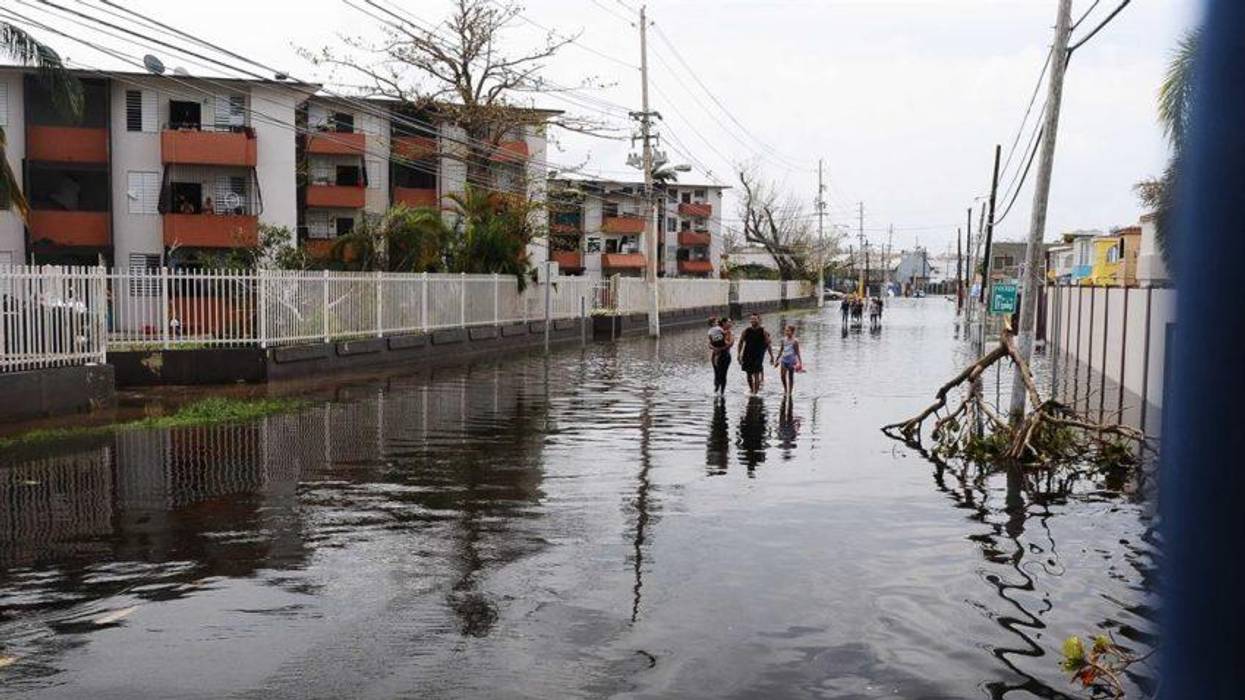
BURLINGTON, VT. -- The hope for a House Committee that would work to pass a Green New Deal--now supported by 15 representatives thanks to grassroots pressure--was the subject of much discussion at the Sanders Institute Gathering this weekend, and on Saturday the specifics of how the bold proposal for a new nationwide sustainable infrastructure would help some of the Americans most affected by austerity policies came into view.
San Juan Mayor Carmen Yulin Cruz led a panel discussion with Political Economic Research Institute (PERI) co-director and University of Massachusetts professor Robert Pollin and community development advocate John Davis, about how a Green New Deal could radically change the daily lives of Puerto Ricans and the outlook for the island, more than a year after the two hurricanes which decimated the country--leaving some communities still in disrepair as federal funds slowly trickle in.
"We don't want a Green New Deal for electricity or to take hot showers or to have air conditioning. We want it for children to go to school...for children to have access to nebulizers. That's what we want it for. To live, to thrive, not only to survive." --San Juan Mayor Carmen Yulin Cruz
Along with the Trump administration's woefully inadequate and callous response to the hurricanes, the state of the island--a "colony" of the United States government, Cruz said, rather than a "territory" as it's commonly called--has been compounded by its long history of austerity, including reduced pensions, slashed sick leave and vacation pay for public employees, aid cuts across the island, and the establishment by the Obama administration of a board to oversee Puerto Rico's debt.
"We are not a theoretical case," Cruz said. "We are what happens when you have the perfect storm--an environmental crisis preceded by a financial crisis and then followed by a human crisis; an utter violation of civil rights and human rights."
As Cruz and Pollin explained, the island is also at the mercy of the U.S. government regarding its fossil fuel consumption, importing the vast majority of its energy from the mainland and unable to purchase components of sustainable infrastructure, like solar panels, without approval from the Trump administration.
Under a Green New Deal, Pollin said, 1.5 percent of Puerto Rico's $100 billion GDP would be invested in green energy, financed by a carbon tax as well as public investments and private incentives--allowing the island to shift to a 100 percent renewable energy economy by 2050.
"It will dramatically reduce energy costs throughout Puerto Rico," said the University of Massachusetts economics professor. "We will create through this somewhere in the range of 25,000 jobs in the early stages 80,000 jobs per year in the later stages. It will be good for business, it will create all kinds of business opportunities...You can create a domestically-created infrastructure that is maintained and owned by small businesses."
Austerity, Pollin added, can not serve as a solution for Puerto Rico's troubled economy, in which hedge funds--or "vulture funds"--have purchased billions of dollars of the island's debt. The debt, which reached $73 billion before Hurricane Maria hit in September 2017, was incurred due partially to a lack of tax revenue brought on by Congress's repeal of business tax breaks there.
" Colonialism is a crime and financial domination is a crime," Cruz said. "The right-wing people say, 'You just want things done for you.' No, we want what everybody wants."
"We don't want a Green New Deal for electricity or to take hot showers or to have air conditioning," she added. "We want it for children to go to school...for children to have access to nebulizers. That's what we want it for. To live, to thrive, not only to survive."
Watch the panel discussion, which also included a discussion of how a community-owned land trust has empowered the residents of one area of San Juan along a polluted canal, below:
With the stated mission of "revitalizing our democracy," Sen. Bernie Sanders (I-Vt.) and Jane O'Meara Sanders are hosting a gathering of 250 progressive thinkers, politicians, and activists this weekend in Burlington, Vermont, where they'll discuss bold solutions to persistent inequality, the climate crisis, human rights violations, and other issues in the U.S. and around the world.
The inaugural Sanders Institute Gathering--which Common Dreams plans to cover over the three days--will include panel discussions and speeches including an opening keynote speech given by the senator on Thursday evening, as well as appearances by author Naomi Klein and Cornel West; politicians such as Rep. Tulsi Gabbard and San Juan mayor Carmen Yulin Cruz; economists Stephanie Kelton and Jeffrey Sachs; former Greek finance minister Yanis Varoufakis; U.S. labor leaders Roseann DeMoro and Peter Knowlton; organizers Bill McKibben and Nina Turner; and many others.
"The core intent of the Sanders Institute Gathering is to share replicable policies, develop actionable steps, establish ongoing networks and articulate a progressive vision," the Institute shared on the event website. "Economic, environmental, racial and social justice issues will be threaded throughout the conference as we discuss the climate crisis, healthcare, housing, democracy, foreign policy, criminal justice, labor issues, and more."
"We believe that a vital democracy requires an informed electorate, civil discourse, and bold progressive ideas." --Jane O'Meara Sanders
Panel discussion topics will include "How We Win Medicare for All" as well as a conversation about financing the increasingly popular program, the Green New Deal, chronic injustice in the criminal justice system, and America's housing crisis.
On the heels of their joint venture to craft an International New Deal aimed at countering the emerging alliance of powerful, nationalist right-wing extremists, Varoufakis will join Sanders along with several other speakers at an International Round Table on Friday to discuss solutions to economic inequality around the world.
"We're seeing authoritarian leaders come in and throw away the norms of a democracy like the free press or individual rights," Jane Sanders told local CBS affiliate station WCAX. "And we need to have voices out there everywhere, saying, 'No, this is not okay,' and this is what we need to fight for instead of always just hearing political back and forth, electoral issues, and what we're against. We're going to be talking about what we're for."
The Gathering comes as Sanders' potential 2020 presidential campaign has appeared increasingly likely, with the senator saying at George Washington University this week that he is "thinking about" running and telling New York magazine, "If it turns out that I am the best candidate to beat Donald Trump, then I will probably run."
However, as Jane Sanders told WCAX, the Gathering "won't have anything to do with Bernie's campaign."
"We are focused on policies," Sanders said. "We believe that a vital democracy requires an informed electorate, civil discourse, and bold progressive ideas. So that's what we're trying to do: engage people in finding solutions to economic, environmental, racial, and social justice issues."
Although it has been more than a year since Hurricane Maria ravaged Puerto Rico, in parts of the U.S. territory, "it's like the hurricane hit yesterday"--yet President Donald Trump wants to cut off recovery money, according to Axios, "because he claims, without evidence, that the island's government is using federal disaster relief money to pay off debt."
"We remind the Pres the 'help' you say will not come is YOUR RESPONSIBILITY. You are violating our human right by denying us what we need."
--San Juan Mayor Carmen Yulin Cruz
The unfounded claims about federal funds being misappropriated come from Trump's misreading of an October Wall Street Journal article, multiple unnamed sources told Axios' Jonathan Swan.
A day after the Journal report was published, Trump falsely alleged on Twitter that the island's "inept politicians are trying to use the massive and ridiculously high amounts of hurricane/disaster funding" to pay off Puerto Rico's substantial debt.
While "Puerto Rico is expecting billions in disaster recovery aid to help rebuild from last year's Hurricane Maria," as Bloomberg pointed out after the president's tweet, "neither the island's leaders--nor the board installed by the U.S. to oversee its budget--are proposing using disaster recovery aid to directly pay off bondholders or other lenders, who have been squaring off in federal court and stand to recover a portion of their investments once the government emerges from bankruptcy."
Some members of Congress and others, meanwhile, have called for canceling the island's debt as a form of relief, noting that decades of U.S. policy that produced the debt crisis, and the federally-mandated austerity plan crafted in response to it is cruel, particularly after the devastation left by the hurricane.
In addition to Trump's desire to block future funding for recovery from a storm that killed thousands of Americans, sources also revealed to Axios that the president wants "to claw back some of the federal money Congress has already set aside for Puerto Rico's disaster recovery."
Even though Trump can't take back money Congress already has set aside for the commonwealth, he could refuse to sign off on future spending bills, which could notably impact the island's already sluggish and widely criticized recovery process. So far, Federal Emergency Management Agency (FEMA) reports that more than $6 billion has been spent on Hurricane Maria relief, and the agency expects such spending to exceed $55 billion.
In contrast to federal Maria relief, when Hurricane Katrina devastated the Gulf Coast in 2005, "Congress approved $10 billion for the Federal Emergency Management Agency four days later, and another $50 billion six days later," the New York Times reported earlier this year. "The federal government is still spending money on Katrina assistance, more than 12 years after the storm's landfall."
The Axios report elicited immediate outrage from Puerto Ricans and others. San Juan Mayor Carmen Yulin Cruz--a long-time critic of the Trump administration's response to the storm--said in a pair of tweets, "[Trump] has never acknowledged his responsibility in the PR humanitarian crisis; 3000+ died on his watch. We remind the Pres the 'help' you say will not come is YOUR RESPONSIBILITY. You are violating our human right by denying us what we need."
One year since Hurricanes Maria and Irma killed thousands in Puerto Rico and caused the longest blackout in U.S. history, we are joined by Naomi Klein, author of "The Battle for Paradise: Puerto Rico Takes on the Disaster Capitalists," whose recent report for The Intercept is titled "There's Nothing Natural About Puerto Rico's Disaster."
Last week, President Trump generated widespread criticism when he falsely claimed on Twitter that thousands of people did not die in the two storms, even as a Harvard study estimated the death toll may top 4,600. Meanwhile on Monday, President Trump declared himself an "absolute no" on statehood for Puerto Rico as long as San Juan's mayor Carmen Yulin Cruz, a major critic of his administration's response to Maria, is in office. We also discuss the role of the unelected PROMESA fiscal control board in the island's unfolding economic crisis, with co-host and reporter.
Video: