SUBSCRIBE TO OUR FREE NEWSLETTER
Daily news & progressive opinion—funded by the people, not the corporations—delivered straight to your inbox.
5
#000000
#FFFFFF
To donate by check, phone, or other method, see our More Ways to Give page.
Daily news & progressive opinion—funded by the people, not the corporations—delivered straight to your inbox.
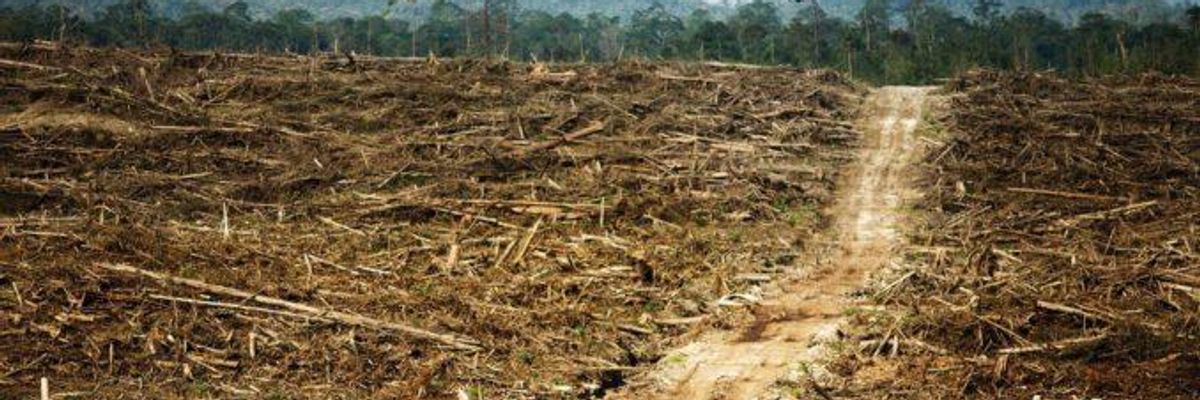
Destruction of rainforest in West Kalimantan, Borneo paves way for palm oil plantation.
A recent investigation by the anti-poverty advocacy organization Oxfam reveals how the world's top ten food and beverage companies are failing to protect environmental and human rights defenders caught in the companies' supply chains.
The Oxfam report, Pathways to Deforestation-Free Food, demonstrates how Associated British Foods, Danone, Coca-Cola, General Mills, Kellogg, Mars, Mondelez, PepsiCo, Nestle and Unilever have committed to tackling deforestation caused by their companies, but crucially lack policies to protect local activists and environmentalists within their supply networks from violence, threats, and attacks.
"A glaring policy gap across all the companies analyzed," the Oxfam report found, "is that none have policies to protect human rights defenders, nor require their suppliers to put in place policies of zero threats, intimidation or attacks against human rights defenders and local communities."
Industrial farming of food ingredients such as soy and palm oil, for example, have led to massive deforestation and displacement of rural communities in Indonesia, Brazil, Colombia, and elsewhere throughout the globe. Activists standing up against such industries in defense of forests, rivers, land, and the livelihoods of local communities have been threatened and murdered at an increased rate in recent years.
Four environmental activists were murdered each week in 2016 for defending their communities and environment from the impacts of agribusiness, mining, and logging industries, according to a report from the human rights organization Global Witness.
In Colombia, activists standing up against the impacts of El Cerrejon, Latin America's largest open-pit mine, have faced regular threats and violence.
Jakeline Romero has organized against the water shortages and displacement caused by this mine, which is owned by Glencore, BHP Billiton, and Anglo-American.
"They threaten you so you will shut up," Romero told Global Witness. "I can't shut up. I can't stay silent faced with all that is happening to my people. We are fighting for our lands, for our water, for our lives."
The world's leading food and beverage companies are not doing enough to stem the violence against environmental activists in their own supply chains, the new Oxfam report found.
"In many countries where agribusiness companies are investing, the rights of community activists are under attack because of their work to defend the rights of their communities--the right to forests and natural resources, to their land and water, their livelihood and their way of life," Oxfam stated.
"From violent crackdowns on protests and criminalization of speech, to arbitrary arrests and assaults or, in some cases, murder of human rights defenders, as well as restrictions on activities of civil society organizations, such attacks seek to delegitimize the voice and interests of communities," Oxfam explained.
Across the world, from Indonesia to Honduras, environmental defenders are facing down multinational corporations and the devastating impacts of their industries on local communities, rivers, forests, and indigenous ways of life.
Honduran activist and social justice leader Berta Caceres was murdered in March, 2016 for her environmental activism and leadership of the Civic Council of Popular and Indigenous Organizations of Honduras (COPINH).
In an interview on the legacy of her mother's struggle, Berta Caceres' daughter Berta Zuniga Caceres, explained the vision of COPINH and how it challenges the economic model guiding multinational corporations and their political allies.
"It's a very rich vision and one that exists among many indigenous peoples," Caceres explained. "It has to do with building a logic that's completely opposed to the hegemonic way of thinking that we're always taught. The vision and proposals are defiant, totally different than the academic, patriarchal, racist, positivist vision of the world. They include relations between people that are much more communitarian and collective, and that also have a strong relationship to the global commons and to nature, defying the dominant anthropocentric vision. They relate to spirituality and the relationships we have with all living beings - a holistic vision of life."
"Indigenous people find themselves battling extractivism, companies, mining, because that's the battleground where these different ways of knowing, of feeling, of cosmovision play out," she said. "This is the wealth of indigenous peoples. But it also represents a threat for the economic model that's based on profits and money, and that's developed through repression and exclusion."
Dear Common Dreams reader, It’s been nearly 30 years since I co-founded Common Dreams with my late wife, Lina Newhouser. We had the radical notion that journalism should serve the public good, not corporate profits. It was clear to us from the outset what it would take to build such a project. No paid advertisements. No corporate sponsors. No millionaire publisher telling us what to think or do. Many people said we wouldn't last a year, but we proved those doubters wrong. Together with a tremendous team of journalists and dedicated staff, we built an independent media outlet free from the constraints of profits and corporate control. Our mission has always been simple: To inform. To inspire. To ignite change for the common good. Building Common Dreams was not easy. Our survival was never guaranteed. When you take on the most powerful forces—Wall Street greed, fossil fuel industry destruction, Big Tech lobbyists, and uber-rich oligarchs who have spent billions upon billions rigging the economy and democracy in their favor—the only bulwark you have is supporters who believe in your work. But here’s the urgent message from me today. It's never been this bad out there. And it's never been this hard to keep us going. At the very moment Common Dreams is most needed, the threats we face are intensifying. We need your support now more than ever. We don't accept corporate advertising and never will. We don't have a paywall because we don't think people should be blocked from critical news based on their ability to pay. Everything we do is funded by the donations of readers like you. When everyone does the little they can afford, we are strong. But if that support retreats or dries up, so do we. Will you donate now to make sure Common Dreams not only survives but thrives? —Craig Brown, Co-founder |
A recent investigation by the anti-poverty advocacy organization Oxfam reveals how the world's top ten food and beverage companies are failing to protect environmental and human rights defenders caught in the companies' supply chains.
The Oxfam report, Pathways to Deforestation-Free Food, demonstrates how Associated British Foods, Danone, Coca-Cola, General Mills, Kellogg, Mars, Mondelez, PepsiCo, Nestle and Unilever have committed to tackling deforestation caused by their companies, but crucially lack policies to protect local activists and environmentalists within their supply networks from violence, threats, and attacks.
"A glaring policy gap across all the companies analyzed," the Oxfam report found, "is that none have policies to protect human rights defenders, nor require their suppliers to put in place policies of zero threats, intimidation or attacks against human rights defenders and local communities."
Industrial farming of food ingredients such as soy and palm oil, for example, have led to massive deforestation and displacement of rural communities in Indonesia, Brazil, Colombia, and elsewhere throughout the globe. Activists standing up against such industries in defense of forests, rivers, land, and the livelihoods of local communities have been threatened and murdered at an increased rate in recent years.
Four environmental activists were murdered each week in 2016 for defending their communities and environment from the impacts of agribusiness, mining, and logging industries, according to a report from the human rights organization Global Witness.
In Colombia, activists standing up against the impacts of El Cerrejon, Latin America's largest open-pit mine, have faced regular threats and violence.
Jakeline Romero has organized against the water shortages and displacement caused by this mine, which is owned by Glencore, BHP Billiton, and Anglo-American.
"They threaten you so you will shut up," Romero told Global Witness. "I can't shut up. I can't stay silent faced with all that is happening to my people. We are fighting for our lands, for our water, for our lives."
The world's leading food and beverage companies are not doing enough to stem the violence against environmental activists in their own supply chains, the new Oxfam report found.
"In many countries where agribusiness companies are investing, the rights of community activists are under attack because of their work to defend the rights of their communities--the right to forests and natural resources, to their land and water, their livelihood and their way of life," Oxfam stated.
"From violent crackdowns on protests and criminalization of speech, to arbitrary arrests and assaults or, in some cases, murder of human rights defenders, as well as restrictions on activities of civil society organizations, such attacks seek to delegitimize the voice and interests of communities," Oxfam explained.
Across the world, from Indonesia to Honduras, environmental defenders are facing down multinational corporations and the devastating impacts of their industries on local communities, rivers, forests, and indigenous ways of life.
Honduran activist and social justice leader Berta Caceres was murdered in March, 2016 for her environmental activism and leadership of the Civic Council of Popular and Indigenous Organizations of Honduras (COPINH).
In an interview on the legacy of her mother's struggle, Berta Caceres' daughter Berta Zuniga Caceres, explained the vision of COPINH and how it challenges the economic model guiding multinational corporations and their political allies.
"It's a very rich vision and one that exists among many indigenous peoples," Caceres explained. "It has to do with building a logic that's completely opposed to the hegemonic way of thinking that we're always taught. The vision and proposals are defiant, totally different than the academic, patriarchal, racist, positivist vision of the world. They include relations between people that are much more communitarian and collective, and that also have a strong relationship to the global commons and to nature, defying the dominant anthropocentric vision. They relate to spirituality and the relationships we have with all living beings - a holistic vision of life."
"Indigenous people find themselves battling extractivism, companies, mining, because that's the battleground where these different ways of knowing, of feeling, of cosmovision play out," she said. "This is the wealth of indigenous peoples. But it also represents a threat for the economic model that's based on profits and money, and that's developed through repression and exclusion."
A recent investigation by the anti-poverty advocacy organization Oxfam reveals how the world's top ten food and beverage companies are failing to protect environmental and human rights defenders caught in the companies' supply chains.
The Oxfam report, Pathways to Deforestation-Free Food, demonstrates how Associated British Foods, Danone, Coca-Cola, General Mills, Kellogg, Mars, Mondelez, PepsiCo, Nestle and Unilever have committed to tackling deforestation caused by their companies, but crucially lack policies to protect local activists and environmentalists within their supply networks from violence, threats, and attacks.
"A glaring policy gap across all the companies analyzed," the Oxfam report found, "is that none have policies to protect human rights defenders, nor require their suppliers to put in place policies of zero threats, intimidation or attacks against human rights defenders and local communities."
Industrial farming of food ingredients such as soy and palm oil, for example, have led to massive deforestation and displacement of rural communities in Indonesia, Brazil, Colombia, and elsewhere throughout the globe. Activists standing up against such industries in defense of forests, rivers, land, and the livelihoods of local communities have been threatened and murdered at an increased rate in recent years.
Four environmental activists were murdered each week in 2016 for defending their communities and environment from the impacts of agribusiness, mining, and logging industries, according to a report from the human rights organization Global Witness.
In Colombia, activists standing up against the impacts of El Cerrejon, Latin America's largest open-pit mine, have faced regular threats and violence.
Jakeline Romero has organized against the water shortages and displacement caused by this mine, which is owned by Glencore, BHP Billiton, and Anglo-American.
"They threaten you so you will shut up," Romero told Global Witness. "I can't shut up. I can't stay silent faced with all that is happening to my people. We are fighting for our lands, for our water, for our lives."
The world's leading food and beverage companies are not doing enough to stem the violence against environmental activists in their own supply chains, the new Oxfam report found.
"In many countries where agribusiness companies are investing, the rights of community activists are under attack because of their work to defend the rights of their communities--the right to forests and natural resources, to their land and water, their livelihood and their way of life," Oxfam stated.
"From violent crackdowns on protests and criminalization of speech, to arbitrary arrests and assaults or, in some cases, murder of human rights defenders, as well as restrictions on activities of civil society organizations, such attacks seek to delegitimize the voice and interests of communities," Oxfam explained.
Across the world, from Indonesia to Honduras, environmental defenders are facing down multinational corporations and the devastating impacts of their industries on local communities, rivers, forests, and indigenous ways of life.
Honduran activist and social justice leader Berta Caceres was murdered in March, 2016 for her environmental activism and leadership of the Civic Council of Popular and Indigenous Organizations of Honduras (COPINH).
In an interview on the legacy of her mother's struggle, Berta Caceres' daughter Berta Zuniga Caceres, explained the vision of COPINH and how it challenges the economic model guiding multinational corporations and their political allies.
"It's a very rich vision and one that exists among many indigenous peoples," Caceres explained. "It has to do with building a logic that's completely opposed to the hegemonic way of thinking that we're always taught. The vision and proposals are defiant, totally different than the academic, patriarchal, racist, positivist vision of the world. They include relations between people that are much more communitarian and collective, and that also have a strong relationship to the global commons and to nature, defying the dominant anthropocentric vision. They relate to spirituality and the relationships we have with all living beings - a holistic vision of life."
"Indigenous people find themselves battling extractivism, companies, mining, because that's the battleground where these different ways of knowing, of feeling, of cosmovision play out," she said. "This is the wealth of indigenous peoples. But it also represents a threat for the economic model that's based on profits and money, and that's developed through repression and exclusion."