

"We're surrounded by agricultural land but we have no food security. Right now we're strapped to the global market," said Miguel Santistevan, a New Mexican farmer and biologist. "Some people are trying to figure out how to set themselves free and are showing other people. It's as if we were all tied to a train that's headed off a cliff, and pretty soon a lot of us are saying, 'Hey, I'm going to jump off this train before it goes.'
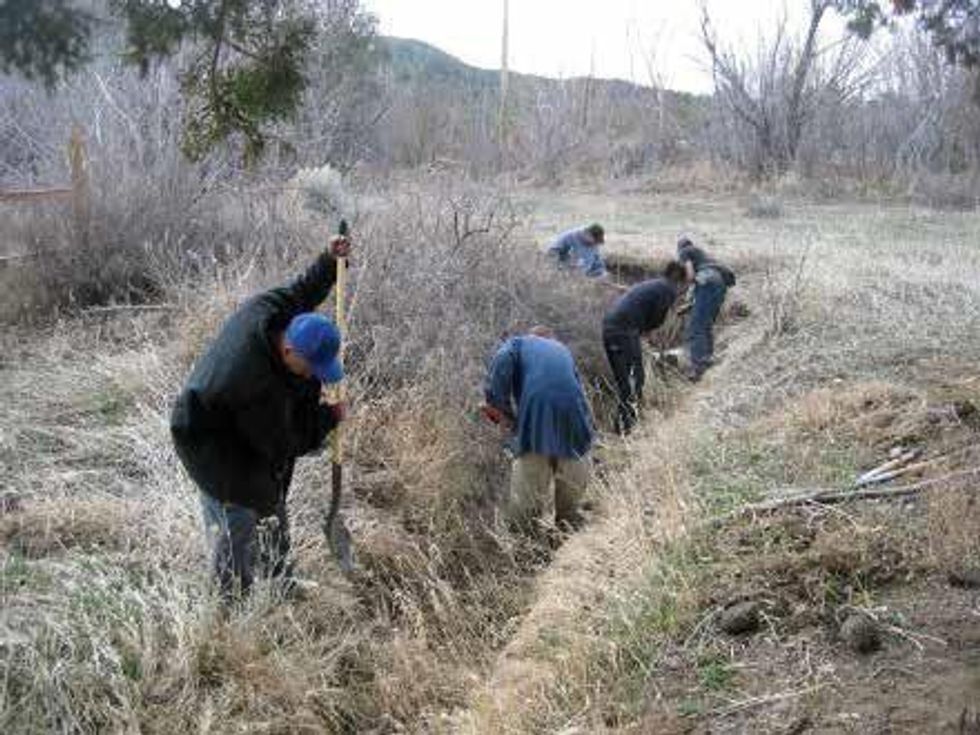
Miguel and his partner Margarita Garcia are helping youth reclaim knowledge about traditions behind lands and waters. Sol Feliz Farm, Miguel's grandfather's house east of Taos, is an acre of spiral gardens, rock gardens, and straight rows. The farm's Agriculture Implementation Research and Education (AIRE) project is capturing the imagination of an impassioned group of youth in northern New Mexico. At AIRE, the youth get to engage in everything from planting seeds to plucking chickens to visiting the state legislature. On any given morning during the summer, you can find the youth irrigating the field, using the traditional acequia method of diverting flowing water to the land via hand-dug channels.
"You figure maize agriculture, 10,000 years of agricultural evolution, at least," Miguel said, "and we're losing all that cumulative knowledge." Miguel is a walking encyclopedia about plants and water, but not the type of encyclopedia you'd find in any local library. "People try to put together equations. 'Oh, well, you have this many acres and this much corn, and corn requires this much water, so you've got to irrigate this many times.' And I say, 'Dude, nature doesn't work that way. Go talk to the Hopi about how much water corn needs.' I know an elder Hopi who said, 'It doesn't even need to rain. A cloud just needs to fly overhead.'
"All these people think that, dammit, this system has to conform to the mathematics of engineers, lawyers and economists, with the help of politicians. That's why I like working with youth, because the youth don't buy it. They buy a lot of it: this rap music, and the gangster stuff, and the drug subculture. When it comes to what's happening to the mountains, what's happening to the rivers, what's happening to the elders, they don't buy it. Some kids are saying, 'Oh well, the world's gonna end anyways. The older generation, they already destroyed the planet. Might as well just party, have a good time.' But other kids are saying, 'How're we going to fix it?'
"Our part in this process is not just about social change and justice, it's also about food production and how do we feed ourselves.
"The other day, we were harvesting corn. Some of these kids are on probation, getting in trouble in school, dropping out of school. Just to see that look on their faces and the wonder as they're opening that corn up, just amazed at the sight of the kernels, the color... it was awesome. That wonderment, that's how we're going to get to the next stage."
Other New Mexicans are focused on creating a "regional foodshed," a local food ecosystem that bases its boundaries on ecological parameters like water flow, rather than on arbitrary state lines. One important contributor to rebuilding the foodshed along the Rio Grande Valley is La Montanita Co-op food market. A 37-year-old store with five locations throughout the state, one of La Montanita's slogans is "fair fresh local."
The ecosystem dictates what the co-op sells, said Robin Seydel, membership coordinator. "We want to utilize all the eco-climes up and down the Rio Grande Valley." Currently, 20% of the store's sales come from more than 1,500 different items produced by nearly 900 local producers. The goal is to increase that to 50%. The co-op's local production coordinator develops plans with farmers to increase the diversity and seasonality of local foods. "That way we'll have quinoa from Southern Colorado, chili from New Mexico," said Robin. La Montanita also provides training in land-stewardship practices and product improvement, and negotiates pre-payment on some contracts to help out struggling farmers.
Over the past few years, as Robin and others at the co-op watched many local farms go out of business, they realized that a major challenge for farmers - especially given the skyrocketing cost of gas - was transporting their products to market. The co-op now leases a refrigerated truck to bring local goods to its stores, like milk from one of the only two dairy farms in the state that still produces and bottles milk for local consumption.
Some other pro-agriculture, pro-environment initiatives in New Mexico include:
* Preservation of agricultural lands, both through direct purchase and mechanisms like conservation easements and agricultural land trusts (see, for example, the Quivira Coalition, www.quiviracoalition.org);
* Community kitchens for small producers so that, without the hefty cost of starting their own commercial kitchens, they can create value-added products and capture a better price (see, for example, the Taos Food Kitchen of the Taos County Economic Development Corporation, www.tcedc.org/TFC.html);
* Production, distribution, and marketing alliances to help small farmers increase their sales (see, for example, the Southwest Grassfed Livestock Alliance, www.swgla.org);
* Programs to help small farmers sell to restaurants, schools, and other institutions, (see, for example, Farm to Table New Mexico, www.farmtotablenm.org); and
* Farmer-to-farmer trainings to exchange innovative practices and information.
Miguel said, "The revolution isn't going to be fought with guns. It's like [Iroquois author and activist] John Mohawk said: the revolution is going to be fought with the hoe. And the shovel. And not against people, but with people, working the land."
"We're surrounded by agricultural land but we have no food security. Right now we're strapped to the global market," said Miguel Santistevan, a New Mexican farmer and biologist. "Some people are trying to figure out how to set themselves free and are showing other people. It's as if we were all tied to a train that's headed off a cliff, and pretty soon a lot of us are saying, 'Hey, I'm going to jump off this train before it goes.'
Miguel and his partner Margarita Garcia are helping youth reclaim knowledge about traditions behind lands and waters. Sol Feliz Farm, Miguel's grandfather's house east of Taos, is an acre of spiral gardens, rock gardens, and straight rows. The farm's Agriculture Implementation Research and Education (AIRE) project is capturing the imagination of an impassioned group of youth in northern New Mexico. At AIRE, the youth get to engage in everything from planting seeds to plucking chickens to visiting the state legislature. On any given morning during the summer, you can find the youth irrigating the field, using the traditional acequia method of diverting flowing water to the land via hand-dug channels.
"You figure maize agriculture, 10,000 years of agricultural evolution, at least," Miguel said, "and we're losing all that cumulative knowledge." Miguel is a walking encyclopedia about plants and water, but not the type of encyclopedia you'd find in any local library. "People try to put together equations. 'Oh, well, you have this many acres and this much corn, and corn requires this much water, so you've got to irrigate this many times.' And I say, 'Dude, nature doesn't work that way. Go talk to the Hopi about how much water corn needs.' I know an elder Hopi who said, 'It doesn't even need to rain. A cloud just needs to fly overhead.'
"All these people think that, dammit, this system has to conform to the mathematics of engineers, lawyers and economists, with the help of politicians. That's why I like working with youth, because the youth don't buy it. They buy a lot of it: this rap music, and the gangster stuff, and the drug subculture. When it comes to what's happening to the mountains, what's happening to the rivers, what's happening to the elders, they don't buy it. Some kids are saying, 'Oh well, the world's gonna end anyways. The older generation, they already destroyed the planet. Might as well just party, have a good time.' But other kids are saying, 'How're we going to fix it?'
"Our part in this process is not just about social change and justice, it's also about food production and how do we feed ourselves.
"The other day, we were harvesting corn. Some of these kids are on probation, getting in trouble in school, dropping out of school. Just to see that look on their faces and the wonder as they're opening that corn up, just amazed at the sight of the kernels, the color... it was awesome. That wonderment, that's how we're going to get to the next stage."
Other New Mexicans are focused on creating a "regional foodshed," a local food ecosystem that bases its boundaries on ecological parameters like water flow, rather than on arbitrary state lines. One important contributor to rebuilding the foodshed along the Rio Grande Valley is La Montanita Co-op food market. A 37-year-old store with five locations throughout the state, one of La Montanita's slogans is "fair fresh local."
The ecosystem dictates what the co-op sells, said Robin Seydel, membership coordinator. "We want to utilize all the eco-climes up and down the Rio Grande Valley." Currently, 20% of the store's sales come from more than 1,500 different items produced by nearly 900 local producers. The goal is to increase that to 50%. The co-op's local production coordinator develops plans with farmers to increase the diversity and seasonality of local foods. "That way we'll have quinoa from Southern Colorado, chili from New Mexico," said Robin. La Montanita also provides training in land-stewardship practices and product improvement, and negotiates pre-payment on some contracts to help out struggling farmers.
Over the past few years, as Robin and others at the co-op watched many local farms go out of business, they realized that a major challenge for farmers - especially given the skyrocketing cost of gas - was transporting their products to market. The co-op now leases a refrigerated truck to bring local goods to its stores, like milk from one of the only two dairy farms in the state that still produces and bottles milk for local consumption.
Some other pro-agriculture, pro-environment initiatives in New Mexico include:
* Preservation of agricultural lands, both through direct purchase and mechanisms like conservation easements and agricultural land trusts (see, for example, the Quivira Coalition, www.quiviracoalition.org);
* Community kitchens for small producers so that, without the hefty cost of starting their own commercial kitchens, they can create value-added products and capture a better price (see, for example, the Taos Food Kitchen of the Taos County Economic Development Corporation, www.tcedc.org/TFC.html);
* Production, distribution, and marketing alliances to help small farmers increase their sales (see, for example, the Southwest Grassfed Livestock Alliance, www.swgla.org);
* Programs to help small farmers sell to restaurants, schools, and other institutions, (see, for example, Farm to Table New Mexico, www.farmtotablenm.org); and
* Farmer-to-farmer trainings to exchange innovative practices and information.
Miguel said, "The revolution isn't going to be fought with guns. It's like [Iroquois author and activist] John Mohawk said: the revolution is going to be fought with the hoe. And the shovel. And not against people, but with people, working the land."
"We're surrounded by agricultural land but we have no food security. Right now we're strapped to the global market," said Miguel Santistevan, a New Mexican farmer and biologist. "Some people are trying to figure out how to set themselves free and are showing other people. It's as if we were all tied to a train that's headed off a cliff, and pretty soon a lot of us are saying, 'Hey, I'm going to jump off this train before it goes.'
Miguel and his partner Margarita Garcia are helping youth reclaim knowledge about traditions behind lands and waters. Sol Feliz Farm, Miguel's grandfather's house east of Taos, is an acre of spiral gardens, rock gardens, and straight rows. The farm's Agriculture Implementation Research and Education (AIRE) project is capturing the imagination of an impassioned group of youth in northern New Mexico. At AIRE, the youth get to engage in everything from planting seeds to plucking chickens to visiting the state legislature. On any given morning during the summer, you can find the youth irrigating the field, using the traditional acequia method of diverting flowing water to the land via hand-dug channels.
"You figure maize agriculture, 10,000 years of agricultural evolution, at least," Miguel said, "and we're losing all that cumulative knowledge." Miguel is a walking encyclopedia about plants and water, but not the type of encyclopedia you'd find in any local library. "People try to put together equations. 'Oh, well, you have this many acres and this much corn, and corn requires this much water, so you've got to irrigate this many times.' And I say, 'Dude, nature doesn't work that way. Go talk to the Hopi about how much water corn needs.' I know an elder Hopi who said, 'It doesn't even need to rain. A cloud just needs to fly overhead.'
"All these people think that, dammit, this system has to conform to the mathematics of engineers, lawyers and economists, with the help of politicians. That's why I like working with youth, because the youth don't buy it. They buy a lot of it: this rap music, and the gangster stuff, and the drug subculture. When it comes to what's happening to the mountains, what's happening to the rivers, what's happening to the elders, they don't buy it. Some kids are saying, 'Oh well, the world's gonna end anyways. The older generation, they already destroyed the planet. Might as well just party, have a good time.' But other kids are saying, 'How're we going to fix it?'
"Our part in this process is not just about social change and justice, it's also about food production and how do we feed ourselves.
"The other day, we were harvesting corn. Some of these kids are on probation, getting in trouble in school, dropping out of school. Just to see that look on their faces and the wonder as they're opening that corn up, just amazed at the sight of the kernels, the color... it was awesome. That wonderment, that's how we're going to get to the next stage."
Other New Mexicans are focused on creating a "regional foodshed," a local food ecosystem that bases its boundaries on ecological parameters like water flow, rather than on arbitrary state lines. One important contributor to rebuilding the foodshed along the Rio Grande Valley is La Montanita Co-op food market. A 37-year-old store with five locations throughout the state, one of La Montanita's slogans is "fair fresh local."
The ecosystem dictates what the co-op sells, said Robin Seydel, membership coordinator. "We want to utilize all the eco-climes up and down the Rio Grande Valley." Currently, 20% of the store's sales come from more than 1,500 different items produced by nearly 900 local producers. The goal is to increase that to 50%. The co-op's local production coordinator develops plans with farmers to increase the diversity and seasonality of local foods. "That way we'll have quinoa from Southern Colorado, chili from New Mexico," said Robin. La Montanita also provides training in land-stewardship practices and product improvement, and negotiates pre-payment on some contracts to help out struggling farmers.
Over the past few years, as Robin and others at the co-op watched many local farms go out of business, they realized that a major challenge for farmers - especially given the skyrocketing cost of gas - was transporting their products to market. The co-op now leases a refrigerated truck to bring local goods to its stores, like milk from one of the only two dairy farms in the state that still produces and bottles milk for local consumption.
Some other pro-agriculture, pro-environment initiatives in New Mexico include:
* Preservation of agricultural lands, both through direct purchase and mechanisms like conservation easements and agricultural land trusts (see, for example, the Quivira Coalition, www.quiviracoalition.org);
* Community kitchens for small producers so that, without the hefty cost of starting their own commercial kitchens, they can create value-added products and capture a better price (see, for example, the Taos Food Kitchen of the Taos County Economic Development Corporation, www.tcedc.org/TFC.html);
* Production, distribution, and marketing alliances to help small farmers increase their sales (see, for example, the Southwest Grassfed Livestock Alliance, www.swgla.org);
* Programs to help small farmers sell to restaurants, schools, and other institutions, (see, for example, Farm to Table New Mexico, www.farmtotablenm.org); and
* Farmer-to-farmer trainings to exchange innovative practices and information.
Miguel said, "The revolution isn't going to be fought with guns. It's like [Iroquois author and activist] John Mohawk said: the revolution is going to be fought with the hoe. And the shovel. And not against people, but with people, working the land."