

SUBSCRIBE TO OUR FREE NEWSLETTER
Daily news & progressive opinion—funded by the people, not the corporations—delivered straight to your inbox.
5
#000000
#FFFFFF
To donate by check, phone, or other method, see our More Ways to Give page.
Daily news & progressive opinion—funded by the people, not the corporations—delivered straight to your inbox.
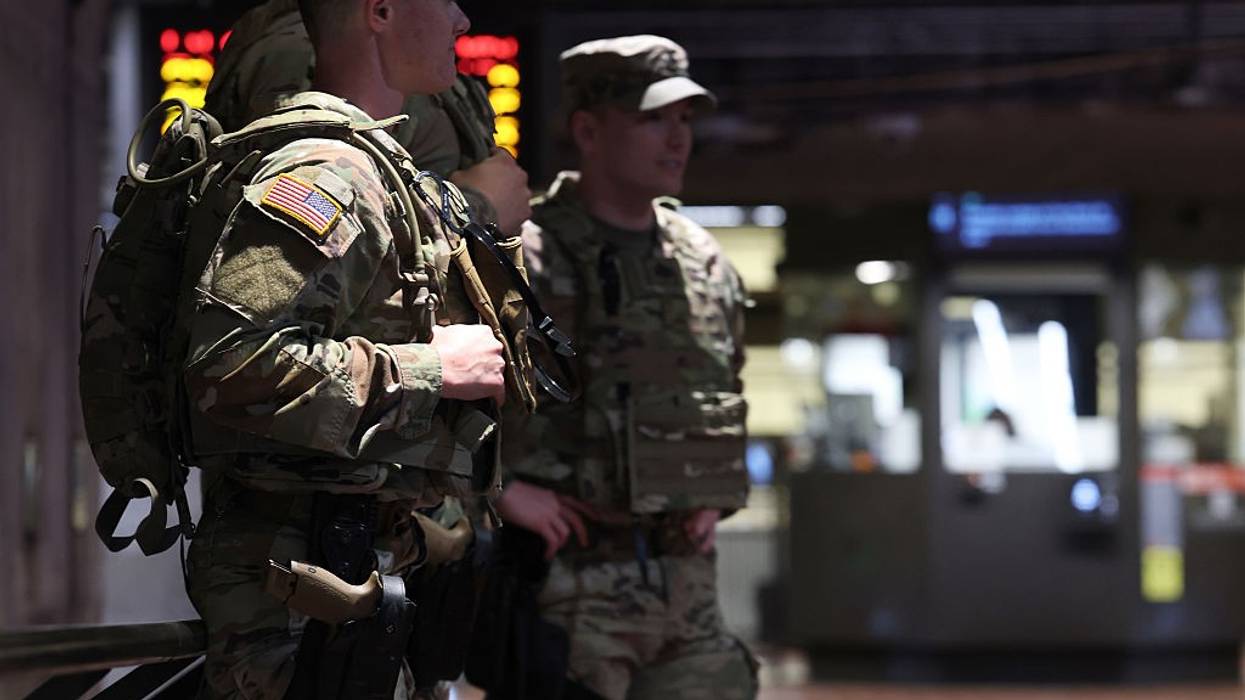
The new order, he says, would essentially allow "random fascist vigilantes" to "sign up to be a Brownshirt" for Trump's militarized occupation forces.
An executive order signed Monday by US President Donald Trump may permit "random fascist vigilantes" to help him crack down on protests across the country, according to one prominent civil rights lawyer.
The new order, which comes amid wider concern about Trump's militarized takeover of Washington, DC, directs Secretary of Defense Pete Hegseth to ensure that each state's National Guard is equipped to "assist Federal, State, and local law enforcement in quelling civil disturbances and ensuring the public safety."
To that end, it orders the secretary to create a "standing National Guard quick reaction force" that "can be deployed whenever the circumstances necessitate," not just in the nation's capital but in "other cities where public safety and order has been lost."
Monday's order calls for the creation of "an online portal for Americans with law enforcement or other relevant backgrounds and experience." Agency heads then "shall each deputize the members of this unit to enforce federal law."
Alec Karakatsanis, the executive director of the Civil Rights Corps, described it in a post on X as "an online portal to permit random fascist vigilantes to join soldiers," adding that it was "one of the scariest things I've seen in US politics in my adult life."
Earlier this month, the Washington Post reported on an internal memo discussing the creation of a "quick reaction force," which outlined its objectives in clearer detail.
It called for 600 National Guard troops to be "on standby at all times so they can deploy in as little as one hour," to "American cities facing protests or other unrest." It did not specifically mention the involvement of civilians.
Lisa Gilbert, co-president of the pro-democracy advocacy group Public Citizen, said on Monday that the executive order represents a dangerous expansion of Trump's authoritarian takeover.
"Freedom of speech and the right to assembly are foundational constitutional rights, and the Posse Comitatus Act prevents the use of the military domestically," Gilbert warned in a statement. "The moves outlined in this overreaching and unnecessary executive action undercut those foundational rights and are egregious steps by a wanna-be-dictator who is placing the pursuit of power above the well-being of our country."
During his second term, Trump has maintained friendly relations with far-right militia groups. He pardoned over a thousand people involved in the violent insurrection of January 6, 2021, including members of the militant Proud Boys group, which Trump infamously told to "stand back and stand by" amid 2020's racial justice protests in American cities.
He has also met with its leader, Enrique Tarrio, who, along with Oath Keepers militia leader Stewart Rhodes, had previously suggested after his pardon that their groups could help Trump serve "retribution" upon his enemies.
The Oath Keepers also notably used the same term "quick reaction force" to refer to its efforts to transfer weapons across state lines to have them ready in DC to help with efforts to overturn Trump's election loss on January 6.
Earlier this month, the Trump administration—attempting to swell the ranks of Immigration and Customs Enforcement—eliminated degree requirements for new recruits, lowered the minimum age to 18, and introduced a fat $50,000 signing bonus, along with student loan relief.
In The Atlantic, technology reporter Ali Breland noted that members of the Proud Boys he'd been monitoring "seemed to be particularly pleased by the government's exciting career opportunity."
Since Trump took over law enforcement in Washington, DC, onlookers have described and documented countless egregious civil rights violations.
Jesse Rabinowitz of the DC-based National Homeless Law Center has described the dystopian scene on the ground in a post on X.
"There are full-on police checkpoints most nights," he said. "Every day, multiple friends see ICE kidnapping people. Daycares are scared to have kids go on walks due to ICE."
According to research by the libertarian Cato Institute published earlier this month, one in five people arrested by ICE have been Latinos with no criminal past or removal orders against them from the government, which they called a "telltale sign of illegal profiling."
Karkatsanis warns that through his latest order, Trump has created a "vigilante portal" where anyone can "sign up to be a Brownshirt to brutalize poor people, immigrants, people of color, and anyone else who might dare to, say, go to a protest."
He says that it "should be a nonstop emergency news alert," but that "instead, mainstream news and Democrats are barely mentioning it."
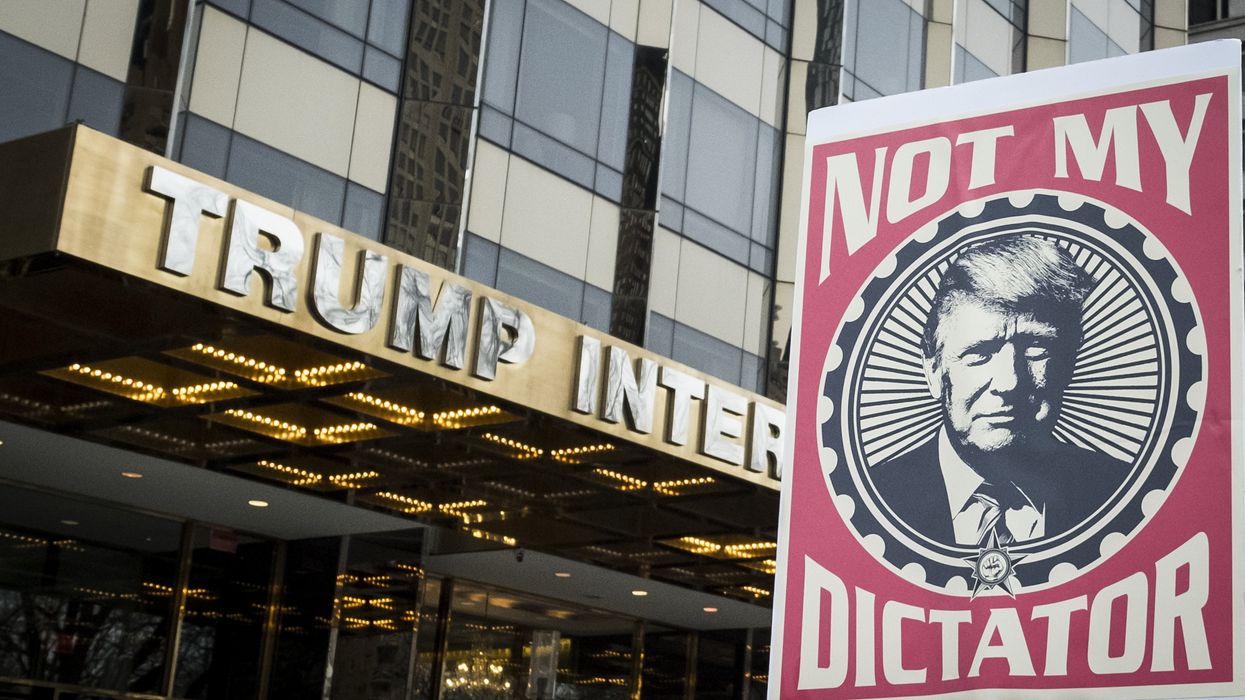
I laugh at the thought of him making way for Vice President JD Vance, whom he clearly despises—and often humiliates—let alone a Democrat. No, he won’t make way for anyone.
This piece has been updated with edits from the author.
Despite everything U.S. President Donald Trump has said and done, Democrats are still delusional.
I keep hearing things like, “He can’t run again.” “We no longer need to [find a way to] beat him.” “Eventually there will be a post-Trump.” Yes. When he dies. If he dies. I’m starting to believe as he probably does: that he’s immortal. That’s probably what keeps him going. Pure will and rage. But until then—his death—he will remain our opponent to beat, the biggest threat to America, to democracy, and to the world order.
I laugh at the thought of him making way for Vice President JD Vance, whom he clearly despises—and often humiliates—let alone a Democrat. No, he won’t make way for anyone. “Over my dead body,” as they say, or if at some point in the near future he’s so demented—he’s not far off—he can no longer pretend to be sane, and can be wheeled out of the White House, a senile Hannibal Lecter, scowl gone, blank stare on his face.
Even if some or all of Trump’s maneuvers are deemed—or indeed are—unconstitutional, will that stop him?
It’ll go a little something like this, and yes, feel free to scoff. I’m but a writer, doing as a writer does: stressing, speculating, imagining worlds and situations that might prove nothing more than pure fiction. I hope so, although so often writers—especially fiction writers—get it right. At the very least, I hope to widen my reader’s eyes, force them to think. Better yet, to act...
So much of what I’ve feared has already come to pass, and at this point I simply beg that the worst be considered and prepared for. Without a sense of urgency—of terror—the status quo of apathy and acceptance will remain. As William Butler Yeats writes, “The best lack all conviction, while the worst are full of passionate intensity.”
In three years time or sooner, when the majority of Americans, including many of Trump’s own voters, are fed up with him; the chaos he has sowed at home and abroad; the broken promises, namely the increased prices of everything, his tariffs and tax cuts a disaster for everyone except the very wealthy; the loss of healthcare; the loss of labor or a loved one or a business or a job or an education to deportation or violence or budget cuts, he will wage a war.
Alongside Israel and similarly-immortal, criminal-in-arms Benjamin Netanyahu, he will wage a war against Iran, hoping Vladimir Putin and Russia will be too caught up in Ukraine, still, to care; see Putin’s failure to help Bashar Al-Assad in Syria.
Perhaps a deal by then will have been made: America will no longer support Ukraine. America, perhaps, will withdraw from NATO, as France did in 1966. Trump hates NATO, as we know. He hates all such international agreements and organizations, already withdrawing—for the second time—from The Paris agreement, as well as from the World Health Organization... A new deal with Iran, meanwhile, would be “nice” Trump said. Why arm your future enemy?
The votes necessary for this, both the withdrawal and for war, will come through a dictator’s favorite forms of power: fear, force, coercion, intimidation. It won’t matter if the midterms bring more Democrats into the mix. I worry they won’t, that billionaires and the disinformation they sow, and exhaustion, and yet more fear, force... will keep a blue resurgence in check. It might even get worse, Republicans adding to their numbers.
Sen. Chris Murphy (D-Conn.), one of the few Democrats who has been speaking up these past few weeks, has been very clear that his Democratic colleagues are scared: “When your family is threatened with harm, of course it may at the very least subconsciously depress your interest in fighting as hard as you can.”
He adds that the social media storms greeted by those who stand up against people like Elon Musk come with an implicit threat of violence. (Pod Save America, January 31, 2025). The same can be said about Trump.
And such threats will only worsen. Trump has his militia after all. At the core of it are the Proud Boys and the J6 Prison Choir, all of whom are deeply indebted to him, still standing by, and will have grown as a force by then.
It’ll be easy work; besides Murphy, Democrats have yet to show any sort of real fight in them, a willingness—the courage—to do anything other than give in. Slink away. Joe Biden, Kamala Harris, Merrick Garland… How pathetic, the lot of them. After all the threats they spoke of…
Besides, if a war with Iraq was possible, justified by faulty intelligence and false allegations in the pre-social media age, an age of generally agreed-upon facts, corruption, racism, and hubris all playing their part, with 110 Democrats voting in favor of it, including, unsurprisingly, the soon to be forgotten, aforementioned lame-duck president and similarly spiritless, failed candidate Hillary Clinton—that alone should’ve have disqualified both of them—war with Iran, under these circumstances, most definitely is.
Trump will make a similar deal with Xi Jinping and China: feel free to take Taiwan. Marco Rubio will happily comply, breaking his back once again to change his hawkish approach on China. Maybe he’ll just undulate; at this point, does he even have a back? Spineless, all of Trump’s appointees, appointed for that very purpose: They will do exactly as he says. Pete Hegseth can’t wait.
Trump will become a wartime president. He and Republican governors will simultaneously declare states of emergencies or martial law where they can, citing attacks on home soil, assassinations or suicide bombings by Iranians and Islamic extremists, possibly false-flag operations, the Proud Boys and J6 Prison Choir again called upon; citing massive protests against him, the war, and said governors, violent clashes between all parties, the National Guard called in and ordered to shoot; perhaps he’ll declare martial law in the vein of Abraham Lincoln, who he weirdly admires, a broad one targeting “all rebels and insurgents, their aiders and abettors,” and he will use these various reasons—“peril to life and extensive damage to infrastructure”—to break from precedent, as he and Republicans have a penchant for doing—who cares if this one is 175-years old? Abortion bans put forth by his colleagues are just as old—and suspend or simply delay elections indefinitely.
This isn’t impossible. “While the Executive Branch does not currently have this power… Congress may be able to delegate [it] to the Executive Branch by enacting a statute.”
Additionally, “Foreign interference could, in and of itself, disrupt future elections; could exacerbate other disruptions (e.g., power failures) by spurring doubt about the legitimacy or accuracy of political or voting processes; or both.”
Perhaps another—more successful—elector scheme will surface.
In any case—or in all of them—Congress will again prove compliant; where the mob fails, investigations by Kash Patel and the weaponized justice department will succeed. And even if some or all of Trump’s maneuvers are deemed—or indeed are—unconstitutional, will that stop him? We’ve seen how fragile democracy is. How corrupt the Supreme Court is. They too—the majority—answer to Trump, who knows he can’t be criminally prosecuted even for blatantly illegal acts. And so he presses on, emboldened…
The Constitution is under constant attack. The funding freeze and executive action ending birthright citizenship are more recent examples. But let’s not forget Trump’s total disdain for the separation of powers, consolidating it more every day; let’s not forget the Muslim Ban and various emolument rackets and pay-to-play schemes…
For now the courts are holding relatively strong. The worst of his agenda is being delayed. Will they continue to? I’m starting to seriously doubt it, as others are, and I can’t help but wonder: How much longer will Trump accept the decisions of the courts when they don’t go his way? A coup has always been on his mind. How much longer will the Constitution as it stands, amendments already being proposed to grant Trump a third term—will democracy—last?
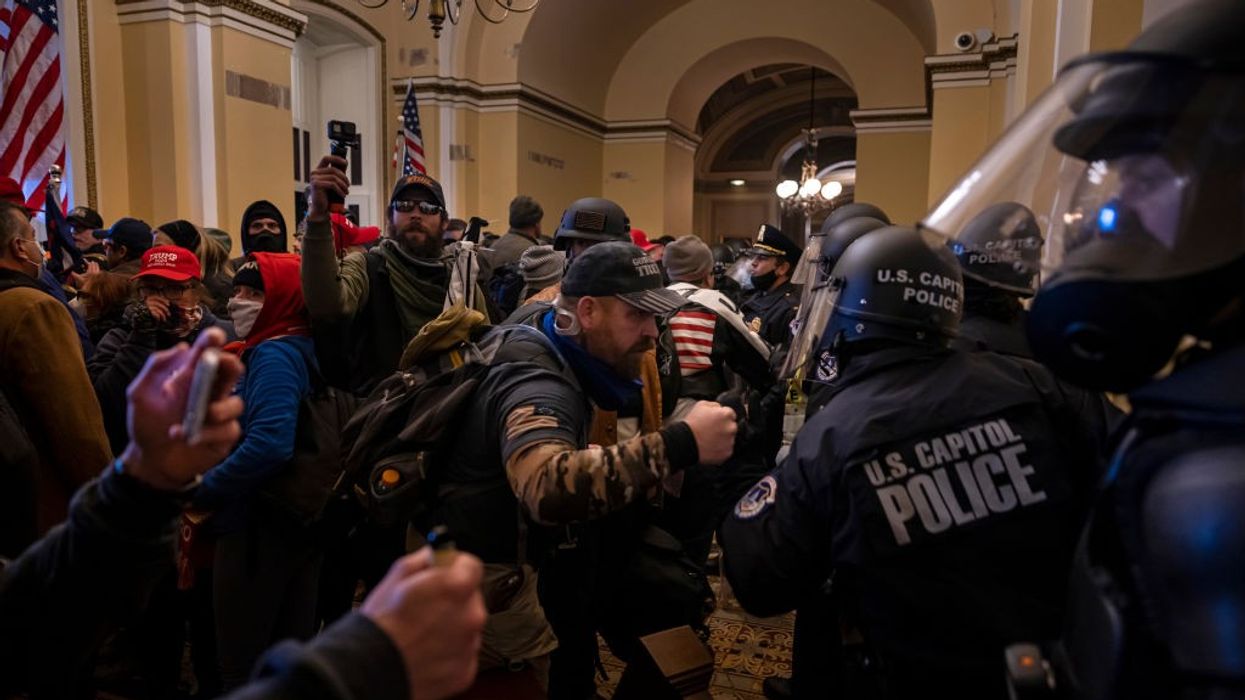
Individuals eager to overturn democratic institutions stand sanctioned, if not emboldened, to commit another violent insurrection.
U.S. President Donald Trump’s flurry of executive orders rattled nerves, elevating the tension levels of many Americans. On his first day in office, he pardoned the January 6 rioters, withdrew from the Paris climate agreement, transferred 1,500 military personnel to the southern border, and began mass deportations. Each of his leadership behaviors rings their own unique alarms. But in the interest of brevity, I’ll explore only the impact of the pardons.
Trump promised to screen those prosecuted for the seriousness of those January 6 crimes—at least during the weeks prior to taking office. Nonetheless, on his fateful first day, Trump issued blanket pardons for all of the approximately 1,600 individuals involved in the insurrection. One-third of those cases involved “assaulting, resisting, or impeding law enforcement.” Trump wiped the insurrection’s criminality clean, issuing “a full, complete, and unconditional pardon” to those prosecuted; he also commuted the sentences of those already serving prison time. A few cases involved brutal violence, and several others sedition.
Examination of even a small sampling of these cases explains why anxiety erupted, how rage fuels it, and how general fearfulness can be expected to surge over time. Consider these examples, starting with the ones who committed violent acts.
Trump rendered the January 6 event a non-event. The insurrection (almost) vanishes from history.
Daniel Rodriguez received a three-year sentence for deploying an “electroshock weapon” against a policeman and then “plunging it into the officer’s neck.” William Lewis received the same amount of jail time for spraying “streams of Wasp and Hornet Killer spray at multiple police officers.” Israel Easterday received a 30-month sentence for blasting an officer “in the face with pepper spray at point-blank range,” after which the officer “collapsed and temporarily lost consciousness.” The brutality of these crimes is self-evident.
Regarding prosecutions for sedition, former Proud Boys leader Enrique Tarrio received a 22-year prison sentence for orchestrating his far-right extremist group’s attack on the Capitol. It topped the 18-year sentence handed out for Oath Keeper’s founder Stewart Rhodes. One-time Proud Boys leader Ethan Nordean also received an 18-year sentence. The leader of the Florida chapter of the Oath Keepers, Kelly Megs, was sentenced to 12 years in prison. Details of their guilt in directly planning to overturn the U.S. government can be found in publicly available court documents.
Perhaps the clearest example of sedition occurred when the Southern states seceded from the United States in 1861, sparking the Civil War. Sedition, the crime of illegally inciting people to rebel against a government, is rarely prosecuted. The last significant case of sedition involved socialist leader Eugene V. Debs who, during World War I, urged resistance to the draft and obstructed military recruitment. He was convicted of sedition in 1918, receiving a 10-year sentence. The fact that four of the January 6 insurrectionists were convicted of sedition is remarkable. But, now, and again, those convictions—for literally attempting to topple our government—are moot.
Most presidents issue pardons at the end of their terms, not at the beginning. They deliver them for reasons related to the public good, not for their self-interests. For the first time in U.S. history, Trump pardoned these individuals on his first day and for his personal gain. The pardons reinforce the fictional narrative that the 2020 election was “stolen” from him—a belief Trump (allegedly) holds despite the absence of a shred of tangible evidence. More importantly, they show how Trump’s egotism overshadows his regard for the rule of law.
Americans’ levels of anxiety heightened, in reaction to these pardons, for several reasons. The perpetrators of the January 6 violence, not only freed but newly empowered, may go on to harm others. Several have already threatened those who testified against them, including injured Capitol police officers. Some promise retribution. Who cannot help but feel fearful of the release of violent criminals in any context?
Those convicted of sedition, and many of those who committed violence, show no remorse. Some feel proud, considering their actions necessary. Because of the pardons or commutations, the perpetrators can retain weapons they own or purchase new ones. Will their freedom lead directly to other forms of violence? Might Trump’s pardons inspire other would-be violent criminals? These are all nerve-wracking questions.
Trump’s executive order also negates the time spent by prosecutors, defense attorneys, bailiffs, and jurors involved in these cases, blatantly disrespecting them. Given that nearly 2,000 cases were filed, it is likely that 40,000 or more persons served in the justice process. Their hundreds of thousands of hours of work, time spent away from the families, and the stress involved in processing these cases ends up a total waste. Dispiriting is too mild a word. Trump shows a breathtaking lack of understanding of what justice means.
On an entirely different level, the pardons and commutations threaten the foundations of governmental order. All indictments, prosecutions, and sentences, for charges ranging from trespassing to seditious conspiracy, have been nullified. Trump rendered the January 6 event a non-event. The insurrection (almost) vanishes from history. And now armed individuals intent on overturning the U.S. government, and those lying in wait for the opportunity, remain a lingering risk. Individual loyalties to Trump could change in a hot second. Individuals eager to overturn democratic institutions stand sanctioned, if not emboldened, to commit another violent insurrection.
Trump’s executive orders impact the American psyche in still other ways. We Americans, or citizens of any country, rely on government to provide a basic sense of physical and emotional stability. Along with ensuring access to clean water and air, food, education, and medical care, governments provide citizens with law enforcement and judicial systems. The fairness of these systems warrant constant evaluation, but not through their destruction. Trump opened fault lines in these basic structures, eliciting distrust. Whether conscious of them or not, Americans feel these losses. Will we be safe from harm, or from another attempt to bring the government down? Will other institutions be threatened? While I was finalizing this essay, Trump issued a directive freezing spending on all forms of federal assistance.
Finally, many individuals (like me) are enraged at Trump’s release of individuals who the justice system indicted, tried, and imprisoned. Anger that lacks an adaptive channel of expression may cause any number of psychophysiological problems. It becomes suppressed (conscious) and repressed (unconscious). Americans can expect to experience symptoms ranging from headaches and muscle pain to panic attacks and depression.
Events like these pardons and commutations, or the federal funding freeze, seep into our collective psyches, our unconscious minds. They impact Trump’s supporters, most of whom will feel concern about his impulsivity despite their backing his election. In a statement made in his first day in office, Trump declared, “We’re going to do things that people will be shocked at.” One week in, and he has indeed delivered shocks.
Trump continues to make disquieting speeches and to issue orders. He acts impulsively. Many of his directives, like nominating unfit individuals for cabinet level positions or removing security details for his former advisors, show a reckless disregard for the American public. Trump is motivated by power and revenge, not by empathy and care. He displays precisely the opposite qualities of a competent leader. Simple logic argues that Americans’ anxiety levels will be on the rise.
Thus far, Americans mostly remain apathetic, as I discussed in a recent essay. However, one wonders when the angst and the anger fueling much of it will rise to the surface. When, and if, it does, oppositional movements will likely emerge. Quite possibly, there will be mass demonstrations. These will further test Trump’s judgment. Will he heed their calls, or will he turn the military against American citizens? What if the military refuses? Could there be a military coup? Then, real panic would arise. The international financial markets would crash. Even glancing fantasies of such scenarios raise blood pressures, validating that Trump’s first days in office are truly creating a pandemic of fear.
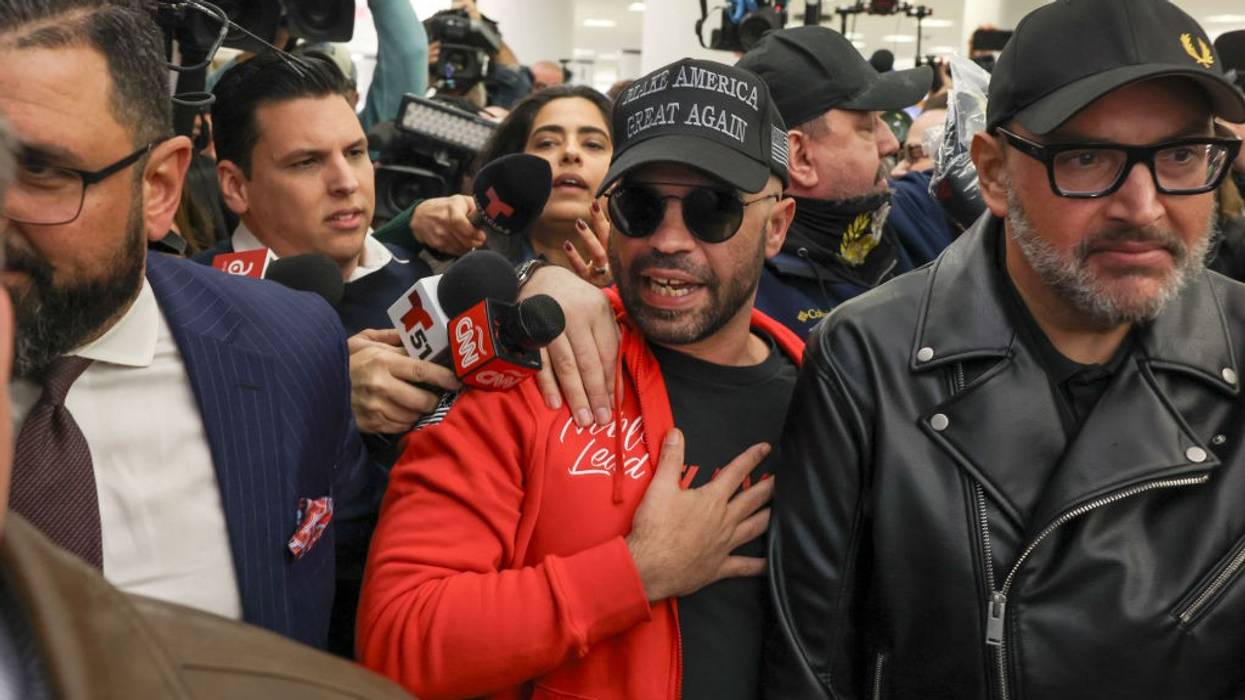
What history teaches should worry us very much.
President Trump’s recent granting of freedom to nearly 1,600 January 6 insurrectionists, followed by other actions fulfilling what the New York Times last week called “his promises to exact revenge on his perceived enemies,” emphasize the ominous portent of an authoritarian regime in the United States.
The history of fascist regimes documents a direct correlation between unleashing political violence and the intimidation, muzzling, arrests and worse of political opponents which leads to securing mass acceptance for repressive policies and governance.
“This is part of his plan,” said Capitol Police officer Michael Fanone who suffered a traumatic brain injury and heart attack after being pulled from the police line, beaten and shocked with a stun gun on January 6, 2021. “The plan is to pardon those on his behalf, because he knows that will send a message to the citizens of this country,” he told MSNBC’s Joy Reid. “If you commit crimes on my behalf, I support you. If you try to prevent me from doing things I want to do, you know what is coming.”
“This is actually about the future, why this is so dangerous,” said podcaster Jon Favreau. “Because now Donald Trump has pardoned all of these right-wing extremists who were armed, who committed violence, who are not apologetic at all, who are not maintaining their innocence either. They’ve said they’re guilty. They’re not apologetic. And now they’re out of prison. And other right-wing extremists who might want to cause violence now know that if you commit violence in Donald Trump’s name, then he’s got your back. And so why wouldn’t they commit violence again?”
While initial outrage focused on the pardons, Trump’s decision to pull security protections for people he has demonized who continue to face death threats, like infectious disease adviser Dr. Anthony Fauci and other moves targeting perceived opponents, underline the stakes. Trump’s “retribution is intended not just to impose punishment for the past but also to intimidate anyone who might cross him in the future,” said the Times calling it a “signal” Trump is “willing to impose potentially profound consequences on anyone he sees as having been insufficiently loyal.”
“We can take this back to 2015, when (Trump) said at his rallies punch them out to people who were protesting, and I’ll take care of your representation. I’ll pay for your lawyers,” noted Sherrilyn Ifill, former president of the NAACP Legal Defense Fund to MSNBC’s Chris Hayes.
Trump’s language in his campaign and first term helped fuel a rise in far-right hate speech that led to vigilante mass shootings at a Pittsburgh synagogue in 2018 and at an El Paso Walmart in 2019 by gunmen influenced by Trump’s violent rhetoric. It was also evident in the 2020 storming of the Michigan Capitol by armed anti-government militia and a plan by one group to abduct Democratic Governor Gretchen Whitmer. That came after Trump encouraged supporters to “liberate” Democratic-led states from Covid-19 safety measures he opposed, and tweeted solidarity with the Michigan militia protesters.
The pinnacle of the violence, of course, was the January 6 insurrection intended to overturn the 2020 election. It emphatically escalated the role of violence to achieve authoritarian rule. That was the danger seen in Trump’s pardons within hours of his inauguration for his second term.
“Now they’re all talking about revenge,” noted Favreau. “Revenge against the people who testified, against the prosecutors, against the judges who put them in prison. And so like when the Proud Boys come to your community and start marching or menacing people or whatever the hell they do, what are the police going to do?”
“Now it’s our turn,” said Proud Boys leader Henry “Enrique” Tarrio, who received the longest riot sentence for mobilizing his right-wing group as an “army” to keep Trump in power through violence after his pardon. Trial evidence showed he and his lieutenants, inspired by Trump’s directive to “stand by” during a 2020 presidential debate, joined what Trump promised would be a “wild” protest on January 6. Similarly, Oath Keepers founder Stewart Rhodes echoed Tarrio, projecting plans for retribution against police witnesses and prosecutors “on up the chain.”
“The most important part of the pardons isn’t specifically who is released from prison, but the meaning of Trump’s gesture: Radical militias are free to act with impunity — as long as they’re loyal to Trump,” wrote Ali Breland in The Atlantic. “After the riot, as law-enforcement agencies began to prosecute those involved, the militias went underground. Political violence, particularly by the right, has been ascendant over the past several years. Now, after the pardons, right-wing extremists no longer have to hide.”
In her book Strongmen: Mussolini to the Present, Ruth Ben-Ghiat, describes the binding of political violence to modern dictatorships, especially in fascist regimes dating to Mussolini’s organization of Fascist Combat Leagues in 1919. It began with assaults and murders on union leaders, socialists, and left-leaning priests in offices, homes, city occupations and ultimately a march on Rome by thousands of fascists and Blackshirt paramilitaries that led to his appointment as prime minister, in what Ben-Giatt called “an elite-approved transfer of power.”
“Fascist violence was neither random nor indiscriminate,” driven by persuading “law and order conservatives and members of the middle class to tolerate fascist violence as a harsh necessity” against disorder or provocation, wrote Robert Paxton in The Anatomy of Fascism. “For some, fascist violence was more than useful: it was beautiful,” he adds, a prescient prediction of Trump’s labeling January 6 a “day of love.”
With Trump’ pardons for January 6, suggested Ifil, “he wants to know he has a kind of army, a group of Brownshirts who will support him, who will show fealty to him to the point of violence,” referencing the most infamous linkage of political violence and fascism — Nazi Germany.
In Hitler’s First Hundred Days, Peter Fritzsche describes the murderous connection. Hitler’s climb also coincided with the formation of a paramilitary organization, the Sturmabteilung (SA), or Brownshirts that carried out his ideological mission of revenge, including physical assaults on those he blamed for Germany’s defeat in World War I, mainly Communists, the Social Democratic Party (a party similar to the centrist Democrats of today in the U.S.), and Jews.
Through street violence against his enemies, the Nazis and SA created an atmosphere of disruption and chaos that, accompanied by an economic collapse in a global depression, produced a desire for political change and distrust in democracy and traditional parties by ordinary Germans.
By 1932, the Nazis had become the top party in the parliamentary elections. But they were eroding support in January 1933 when the then-ruling rightwing nationalist, monarchist parties and leaders, like President Paul von Hindenburg, that also hated the left and Social Democrats, agreed to appoint Hitler chancellor. They believed it “was the only way to establish an authoritarian state” they also favored, writes Fritzsche, thinking they could control him, as many traditional Republicans believed of Trump prior to his first term. It was a catastrophic miscalculation. “It took a long, long time when Germany was already in ruins, for conservatives to understand that they had made a pact with the devil in 1933,” Fritzsche observes.
Like Mussolini before him, Hitler saw physical coercion as central to eliminating his political opposition and helping achieve acceptance of the then majority of non-Nazi supporting Germans. Almost immediately the Brownshirts escalated street attacks to “settle the score,” as one put it, on those deemed as, in words Trump would emulate in 2024, “the enemy from within.” In a February 1933 speech, Hitler declared, “there can be only one victor: either Marxism or the German Volk (people).”
“The Nazis won support because of their militance,” says Fritzsche. “By launching furious, uncompromising attacks on the ‘system’ and physically engaging their enemies, they dramatized the combustibility of the present. … and opened the way to the future. “I want no softies in my movement, I want fanatics,” Hitler told a reporter for the UK Daily Mail, yet another similarity to Trump’s opinion of conservatives, including his own Cabinet appointees, who failed to show unquestioned loyalty to him.
Just weeks after Hitler’s appointment, a massive fire consumed the Reichstag, Germany’s legislative building, akin to the U.S. Capitol. Hindenburg declared a state of emergency, convinced by Hitler and his rightwing coalition allies that Communists were to blame for the fire as a step toward insurrection, though many still believed the Nazis orchestrated it. The order “symbolized the death of representative government and the rule of law,” writes Fritzsche, followed by federal decrees that suspended civil liberties, expanded protective custody and sanctioned the removal of state governments.
The SA Brownshirts, who “sustained the extraordinary energy of the Nazi movement” were deputized by the government as auxiliary police. They now had unlimited power to break up opposition meetings, shut down opposition parties and newspapers, and assault political opponents. Thousands were arrested, mostly Communists initially, then Social Democratic leaders. Home raids, arbitrary arrests, torture of prisoners and prolonged periods of incarceration created fear and widespread disquiet and reinforced a growing sense of national emergency especially heading into new elections in early March.
The violence coincided with other Nazis tactics to build their power in the election turning the election to a victory plebiscite. They exploited state resources, including domination of the media and national festivals, depicted their role as savior of the nation, and “presented themselves as the guardians of a sound moral order threatened by ‘Marxists’ and Jews’.” Immediately after the election, the SA “instigated a reign of terror wrecking trade union and Social Democratic offices, occupying city halls,” and escalated virulent attacks on Jewish shops, synagogues, and street beatings of individual Jews.
By Day 34 of Hitler’s reign, executive power passed almost completely into the hands of the Nazis, and enabled the Nazis to “consolidate one party rule.” The Communists were the first targets, “but all independent political organizations were eliminated or coordinated in the months to come,” Fritzsche notes.
Through the Spring of 1933, the Nazis engineered acceptance by a majority of the German people with a collective conformity, also based on opportunism, patriotic fervor and the far-right nationalist ideology they had long fostered, including racism and antisemitism.
Contrived fears that “the German people were about to perish” at the hands of Communists and Jews, offers a chilling parallel to the white nationalist Great Replacement conspiracy theory, and Charlottesville neo-Nazi and KKK marchers chanting “Jews will not replace us.”
“Coercion always accompanied consent,” says Fritzsche. Ben-Ghiat draws a similar outcome with fascist Spain under Gen. Francisco Franco, quoting philosopher Jose Ortega y Gasset who said: “the threat in my mind of an eventual violence, coercion, or sanction that other people are going to exercise against me” bred conformity.
“Social Democrats believed they could not compete, they could pick up after the Nazis had bankrupted themselves and could act in the future, but not in the present. But the popularity of the Nazis was such that the future kept slipping away, and the pieces the socialists finally did pick up in the late 1940s were destroyed cities and millions murdered,” Fritzsche concludes.
That should be a warning to all elected officials, corporate CEOs, major media, community organizations and anyone else rolling over and seeking to align with Trump and his MAGA policies.
Hitler had no intention of giving up power. “I’m never leaving here” he said a week after moving into the chancellery. ”We have power and we’re going to keep it.” Top Nazi Hermann Goering echoed Hitler, predicting the March 5 election “would surely be the last for ten years or even a hundred years.”
“In four years, you don’t have to vote again,” Trump famously said to supporters last July. “Success is going to be retribution,” Proud Boys leader Enrique Tarrio told conspiracy monger Alex Jones after his release. “We’ve got to do everything in our power to make sure that the next four years sets us up for the next hundred years.”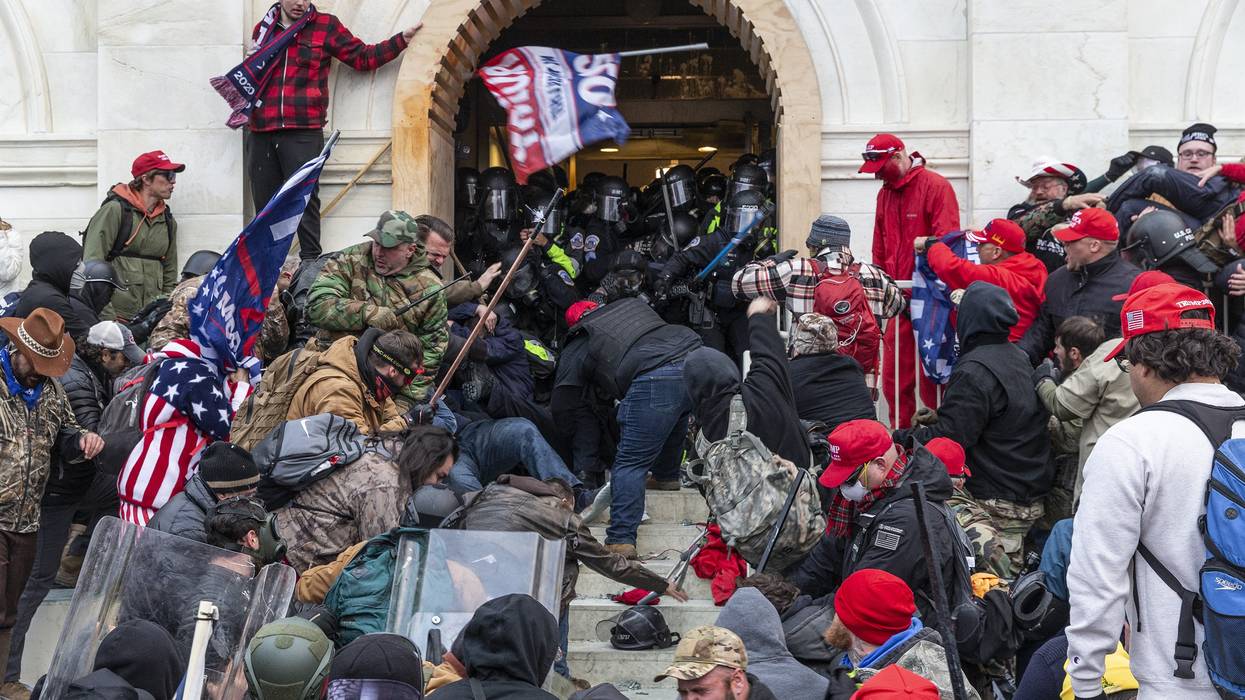
"At a fundamental level, the agencies failed to fulfill their mission and connect the public and nonpublic information they received."
The Department of Homeland Security and Federal Bureau of Investigation "failed to fulfill their mission" by dismissing or downplaying ominous intelligence in the weeks and days leading up to the deadly January 6, 2021 attack on the U.S. Capitol by supporters of then-President Donald Trump, according to a Senate investigation published Tuesday.
The report—entitled Planned in Plain Sight: A Review of the Intelligence Failures in Advance of January 6, 2021—was published by Democrats on the Senate Homeland Security Committee and calls the Capitol attack "an unprecedented effort to disrupt the certification of the 2020 presidential election and our nation's long history of peaceful transitions of power" that "followed months of repeated and false claims by former President Donald Trump, his lawyers, and certain elected officials, that the presidential election was stolen."
"What was shocking is that this attack was essentially planned in plain sight in social media. And yet it seemed as if our intelligence agencies completely dropped the ball."
"During the violent attack, individuals dragged a police officer into the crowd and beat him, struck another officer with a flagpole attached to an American flag, hit another police officer with a fire extinguisher, and damaged the Capitol building," the report continued. "Rioters committed hundreds of assaults on law enforcement officers, temporarily delayed the joint session of Congress, and contributed to the deaths of at least nine individuals."
"This attack on our democracy came in the wake of years of increasing domestic terrorism in this country—which top federal law enforcement and national security agencies had previously identified as the most persistent and lethal terrorist threat to the homeland," the publication added.
According to the report:
The intelligence failures in the lead-up to January 6th were not failures to obtain intelligence indicating the potential for violence. On the contrary, the two primary domestic intelligence agencies—the Federal Bureau of Investigation (FBI) and the Department of Homeland Security (DHS) Office of Intelligence and Analysis (I&A)—obtained multiple tips from numerous sources in the days and weeks leading up to the attack that should have raised alarms. Rather, those agencies failed to fully and accurately assess the severity of the threat identified by that intelligence, and formally disseminate guidance to their law enforcement partners with sufficient urgency and alarm to enable those partners to prepare for the violence that ultimately occurred on January 6th. At a fundamental level, the agencies failed to fulfill their mission and connect the public and nonpublic information they received.
This information included:
Senate Homeland Security Committee Chair Gary Peters (D-Mich.) told NBC News that "what was shocking is that this attack was essentially planned in plain sight in social media."
"And yet it seemed as if our intelligence agencies completely dropped the ball," he added.
In a separate Associated Press interview, Peters said the agencies' failure to act on the "massive" amount of intelligence they received "defies an easy explanation."
Peters said the Senate probe "in a lot of ways echoes the findings of the September 11 commission, which identified similar failures to take warnings seriously" ahead of the September 11, 2001 attacks on the United States that killed nearly 3,000 people.
Similarities between 9/11 and January 6 also include a lack of effective interagency communication and coordination, which resulted in "pretty constant finger-pointing" by intelligence agency officials following the Capitol attack, Peters said.
"Everybody should be accountable," the senator asserted, "because everybody failed."

Some Glendale parents say the paper downplayed that the school district overwhelmingly supports LGBTQ rights in schools and that outside activists have been driving much of the hostility.
Violent outbursts and a handful of arrests at a protest against the Glendale Unified School District, in the Los Angeles suburbs, and its vote to recognize June as LGBTQ+ Pride Month, have thrust the town into the news (Washington Post, 6/7/23). The local police chief “blamed ‘agitators on both sides of the issue’ for inciting violence” (City News Service, 6/7/23).
The anti-trans movement has been targeting public schools for some time now. For far-right organizations and their media organs, it is a perfect storm of anti-education, anti-labor, and anti-LGBTQ rage against a public institution, where they see unionized teachers on taxpayer salaries indoctrinating the youth with queer pornography. It’s an old moral hysteria that goes back to the Anita Bryant days, but it still works to rile up reactionary forces and generate headlines.
The battle in Glendale received national media attention (CBS, 6/6/23; CNN, 6/7/23; Fox News, 6/7/23; USA Today, 6/7/23), but it naturally was covered in the leading regional paper, the Los Angeles Times. Some Glendale parents are worried that the LA Times, a major source of information in Southern California, has downplayed the fact that the school district overwhelmingly supports LGBTQ rights in schools, and outside far-right activists have been driving much of the hostility.
While the Times (6/6/23) did note that the Proud Boys, a violent far-right group, had reportedly been on-hand at the protest, it also lumped activists on each side together, reporting that “hundreds of protesters had swarmed outside the building, some waving American flags and others waving Pride flags.” It suggested that the transphobic activists were motivated by concern for their children, noting that “those who were protesting the board’s LGBTQ+ policies chanted, ‘Leave our kids alone’ while naming each of the five members of the board.”
A report in the Daily Beast (6/8/23) painted a fuller picture, describing many of the far-right provocateurs at the meeting as not being Glendale school system parents, and identifying their ringleader as Jordan Henry. Henry, according to the Daily Beast, “moved to the district in 2021”; he “ran for Glendale City Council in 2022 but was not elected,” and “does not have children enrolled in local schools.” Nevertheless, he “has made frequent public comments at school board meetings, speaking against ‘cultural Marxism,’ critical race theory, and LGBTQ-inclusive programs.”
In fact, there is a whole website devoted to tracking Henry’s time as a far-right crusader, showing that he is anything but a mere voice in the wind, as the most recent Times coverage portrayed him.
Meanwhile, Henry, identified only as a former city council candidate, was quoted by the Times saying, “This is about, specifically, gender ideology being put upon and thrust upon children at Glendale Unified.”
The Times would have been well-served if it had researched its own records. A year ago, the paper (5/11/22) reported on how a records request filed by Henry, who was looking into “social justice learning standards,” led to a backlash against third-grade teacher Tammy Tiber for showing “videos celebrating gay pride to her students.” Henry’s activism prompted so many anti-LGBTQ threats that Tiber had to be “transferred from her classroom for safety reasons”—a controversy that was also covered by the Advocate (5/12/22) and Daily Kos (5/16/22).
In fact, there is a whole website devoted to tracking Henry’s time as a far-right crusader, showing that he is anything but a mere voice in the wind, as the most recent Times coverage portrayed him. There is also a series of YouTube videos documenting him.
Elizabeth Vitanza, a Glendale school district parent, told FAIR that the LA Times has missed an opportunity to put the conflict into context, especially as it pertains to Henry. She said:
The problem is they are not framing this for what it is: an extremist with no children in the schools here, connecting with other extremists like Proud Boys and January 6 insurgents to use our small, successful school district to raise his profile.
Vitanza added, “I find it incredibly frustrating that they don’t look at who’s behind it, just showing fighting in parking lots.”
She criticized a kind of “he said, she said” reporting that portrayed the two sides as equally legitimate voices on either side of the issue. For example, the LA Times (6/6/23) wrote: “GUSD Parents Voices, a conservative group, called for parents to attend Tuesday’s meeting, posting: ‘Join the fight against indoctrination in our schools.’” That sentence was followed by “LGBTQ+ advocacy organization glendaleOUT also urged supporters to attend Tuesday’s meeting.”
In fact, sources told FAIR, the Glendale community largely supports LGBTQ rights in schools, and many of the protesters against the school board were organized by the larger national right-wing push against LGBTQ inclusion.
For Angela Givant, who organizes with the GUSD Parents for Public Schools, the situation is especially frustrating, because public school advocates had been monitoring the social media of far-right groups who were organizing in anticipation of the school board vote. She told FAIR in an email:
Our group of parent organizers had specifically reached out to the Times after a recent protest featured more violence and outside elements. We shared images and information outlining our concerns. I personally had been in touch with two LA Times reporters in 2022, when they covered Tammy Tiber and how Jordan [and] his group’s accusations had led to threats, causing her to be moved from her school to a different site. At the time, we wanted the Times to cover more deeply Henry’s anti-school organizing, and the group’s media he was publicly trying to connect with.
At the time, the reporters thought covering any further would only give him more attention. When his efforts and the attention he was getting escalated even more intensely in right-wing channels, I reached out again to the same two reporters I’d previously been in touch with, and noted the new connections to known extremists. I did not receive a reply.
But, as Givant explained, the LA Times reporters seem uninterested in the fact that Henry, who had formerly advocated against critical race theory in schools, and other far-right agitators are clearly in a minority against the area’s parents. “The Times still framed their coverage as a clash between ‘concerned parents and activists,’” she said, calling it
actively harmful framing, which denies the fact that those of us in support of our schools and long-standing legislation which protects children of all identities are also “concerned parents.”
And it’s having an impact on the public discussion, she said. “I’ve seen readers convinced that there are two equal opposing sides here, both with extreme elements,” Givant said. “The curriculum and legislation they oppose are extremely popular and supported by the majority of families.”
The LA Times editorial board (6/9/23) supports the school district against the right, saying the school district “took a courageous stand against an insidious strain of intolerance that has been creeping into public school districts across the nation.” The paper’s news coverage does not condone the anti-LGBTQ rage. The problem is that news coverage doesn’t go deep enough, leaving the reader to think that there is homegrown outrage against a supposed sexualized curriculum, rather than a coordinated effort by far-right organizations.
And expect the coverage to become thinner: The LA Times just announced it was laying off 74 news staff positions (Variety, 6/7/23).
Anti-trans rhetoric—and a larger outrage about LGBTQ “grooming,” the idea that education about the existence and rights of sexual minorities is somehow conditioning kids into a certain sexual way of life—is a major part of the contemporary right’s cultural agenda. And that’s amplified in the right’s corporate media (FAIR.org, 1/6/23, 3/30/23). But as the LA Times‘ coverage of the attacks on Glendale’s Pride commemoration shows, centrist elements of the corporate media can also inflict harm when their framing over-amplifies the right’s crusade against an incredibly marginalized segment of the population.

"One parent could get my poetry banned from classrooms. And yet one country can't ban assault rifles from massacring them," noted Gorman, who recited her poem, The Hill We Climb, at President Joe Biden's inauguration.
Amanda Gorman, the first-ever National Youth Poet Laureate, reacted Tuesday after a South Florida school banned elementary students from reading the poem she recited at President Joe Biden's 2021 inauguration following the complaint of a parent who has repeatedly espoused white supremacist and anti-Jewish views.
"I'm gutted," Gorman said in a statement posted on Twitter. "Because of one parent's complaint, my inaugural poem, The Hill We Climb, has been banned from an elementary school in Miami-Dade County, Florida."
"Book bans aren't new," she continued, "but they have been on the rise—according to the [American Library Association], 40% more books were challenged in 2022 compared to 2021."
"The majority of these censored works are by queer and non-white voices."
Common Dreams reported last month that laws passed in Republican-controlled states have led to nearly 1,500 book bans nationwide during just the first half of the 2022-23 school year. This followed a record number of book bans last year, according to the American Library Association.
"What's more, often all it takes to remove these works from our libraries and schools is a single objection," Gorman added. "And let's be clear: Most of the forbidden works are by authors who have struggled for generations to get on bookshelves. The majority of these censored works are by queer and nonwhite voices."
While Gorman's poem can still be read by sixth, seventh, and eighth-graders at Bob Graham Education Center in Miami Lakes, students in grades K-5 are barred from reading or reciting the widely acclaimed work, which promotes unity, reflection on the past, and hope for the future of the United States.
The restriction was enacted after Daily Salinas, a mother of two students at the school, lodged a complaint challenging five works—Gorman's poem, plus The ABCs of Black History, Cuban Kids, Countries in the News Cuba, and Love to Langston—over what she claimed are references to critical race theory, "indirect hate messages," gender ideology, and indoctrination.
"One parent could get my poetry banned from classrooms. And yet one country can't ban assault rifles from massacring them," Gorman noted on Twitter.
In her complaint, Salinas—who erroneously attributed Gorman's poem to "Oprah Winfrey"—objected to pages containing two passages of The Hill We Climb.
In a Monday interview with the Miami Herald, Salinas insisted she "is not for eliminating or censoring any books," but wants materials to be age-appropriate and for students "to know the truth" about Cuba—a socialist dictatorship with a higher literacy rate than the United States.
The Herald made no mention of Salinas' ties to far-right and white supremacist groups. A Twitter thread posted Tuesday by Miami Against Fascism shows Salinas rallying with the Proud Boys, a neo-fascist group that promotes and perpetrates political violence, and Christopher Monzon, who allegedly assaulted anti-racist counterprotesters at the deadly 2017 Unite the Right rally in Charlottesville, Virginia.
Miami Against Fascism also posted video showing Salinas and members of the far-right group Moms for Liberty—a Florida-based pressure group sometimes referred to as "Klanned Karenhood" for its crusade ban books in schools across the United States—interrupting a July 2022 Miami school board meeting.
Salinas also shared social media posts promoting white supremacist and anti-Jewish conspiracy theories, including Protocols of the Elders of Zion.
The Miami Lakes school's restriction of Gorman's poem comes amid relentless attacks by Florida Gov. Ron DeSantis—who on Wednesday officially declared his candidacy for the 2024 Republican presidential nomination—and other GOP state officials on educational freedom from kindergarten through the university level.
DeSantis has replaced key state education officials with right-wing allies who toe his "anti-woke" line, and has been accused of stoking a climate of fear in which educators have removed books from classroom libraries to avoid running afoul of bans on titles dealing with race or LGBTQ+ issues.
Notable figures who rushed to defend Gorman include Miami-Dade Mayor Daniella Levine Cava, a Democrat, who invited the 25-year-old poet to recite The Hill We Climb before a public audience, and the ACLU, which tweeted: "Schools should be fostering growth and the exchange of ideas—not preventing students from learning and understanding different perspectives."
"These unnecessary book bans join a host of other attempts to silence us," the civil liberties group added. "We must fight back."
In her statement Tuesday, Gorman explained that "I wrote The Hill We Climb so that all young people could see themselves in a historical moment."
"Ever since, I've received countless letters and videos from children inspired by The Hill We Climb to write their own poems," she said. "Robbing children of the chance to find their voices in literature is a violation of their right to free thought and free speech."
"What can we do? We must speak out and have our voices heard," Gorman stressed. "That's why my publisher, Penguin Random House, joined PEN America, authors, and community members in a lawsuit in Florida's Escambia County to challenge book restrictions like these."
"Together this is a hill we won't just climb, but a hill we will conquer."
"Together this is a hill we won't just climb, but a hill we will conquer," Gorman asserted.
Gorman was referring to a lawsuit filed last week claiming Escambia County School Board book bans are unconstitutional.
"It's quite apparent what [book bans] are about: It's an effort to erase certain segments of our population, to marginalize particular stories, to prevent kids from seeing themselves in the books they find on the shelf," PEN America CEO Suzanne Nossel said during an interview on MSNBC last week.
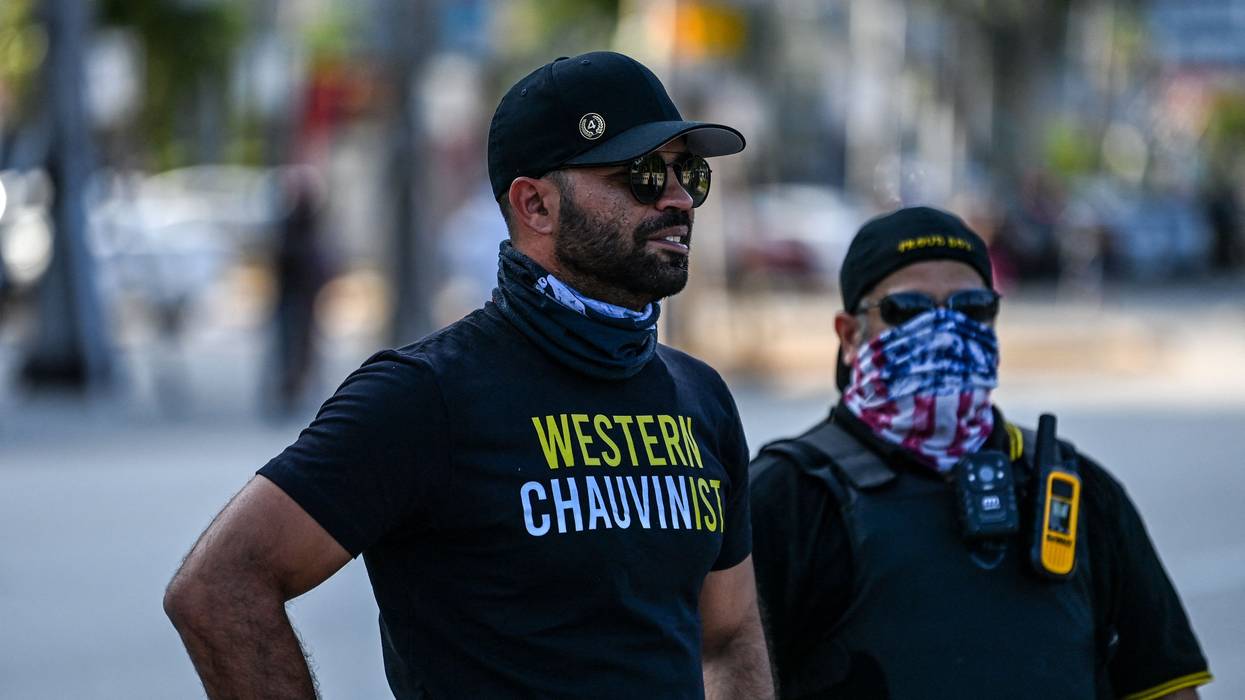
One journalist noted that those convicted "identified President Donald Trump's admonition for them to 'stand back and stand by' as a major motivation for recruitment and action."
The former chairman of the Proud Boys was among four members of the white nationalist and misogynist group convicted on Thursday of seditious conspiracy for planning and carrying out the January 6, 2021 insurrection at the U.S. Capitol. The members now face a maximum prison sentence of 20 years and numerous potential fines.
The U.S. Department of Justice (DOJ) proved to a jury in Washington, D.C. that former leader Enrique Tarrio was sufficiently involved in the conspiracy to attack the U.S. Capitol as members of Congress certified the 2020 election, even though he was in a hotel room in Baltimore on the day of the insurrection—having been banned from the nation's Capitol the day before by a judge for burning a Black Lives Matter flag stolen from a church.
Although Tarrio wasn't present on Capitol Hill as thousands of supporters of Republican then-President Donald Trump stormed the Capitol, encrypted messages revealed during the trial showed that the Proud Boys leader wanted a "spectacle" in Washington, D.C. on January 6 and that he said after the attack: "Make no mistake. We did this."
Prosecutors also publicized a document titled "1776 Returns" that they said Tarrio used to map out the planned occupation of Capitol building. The document said the Proud Boys and other far-right, pro-Trump groups including the Oath Keepers would fill federal buildings and at least one news outlet—CNN—"with patriots and communicate our demands."
The document also said the group would maintain control of "crucial buildings in the D.C. area for a set period of time" and would try to get as "many people as possible inside these buildings."
The attack came as Trump and other Republican leaders baselessly claimed that President Joe Biden was not the legitimate winner of the 2020 election, and months after Trump called on the Proud Boys to "stand back and stand by" as he repeatedly suggested fraud would be rampant in the voting process.
"These Proud Boys just convicted of seditious conspiracy against the United States identified President Donald Trump's admonition for them to 'stand back and stand by' as a major motivation for recruitment and action," said Todd Zwillich, deputy Washington, D.C. bureau chief for Vice News.
Along with Tarrio, Proud Boys chapter leaders Ethan Nordean, Joseph Biggs, and Zachary Rehl were convicted of seditious conspiracy.
U.S. District Judge Timothy Kelly asked the jury to continue deliberations over a seditious conspiracy verdict for a fifth member, Dominic Pezzola, who admitted to smashing a Capitol building window with a stolen police shield.
All five members were convicted of other charges including obstruction of an official proceeding and preventing lawmakers and law enforcement agents from carrying out their duties.
Guilty verdicts in seditious conspiracy cases have been rare in the U.S. The Biden administration has successfully prosecuted six members of the Oath Keepers this year for the same crime related to January 6.
Ryan Goodman, former special counsel for the Department of Defense, called the verdict an "enormous victory."
"Important victory for accountability, for historical record, for democracy," Goodman said. "The white supremacist paramilitary group would not have taken these actions without Trump's messaging."
Trump is now seeking the 2024 Republican nomination for president.

Zero House Republicans on Wednesday supported a measure requiring the Pentagon and federal law enforcement agencies to publish a report on countering white supremacist and neo-Nazi activity in their ranks.
Rep. Brad Schneider's (D-Ill.) amendment to the National Defense Authorization Act (NDAA) for fiscal year 2023 directing the FBI, Department of Homeland Security, and Department of Defense "to publish a report that analyzes and sets out strategies to combat white supremacist and neo-Nazi activity in the uniformed services and federal law enforcement agencies" passed in a party-line 218-208 vote.
Among present lawmakers, Democrats were unified in support and Republicans in opposition. Reps. Theodore Deutch (D-Fla.), Kevin Brady (R-Texas), Madison Cawthorn (R-N.C.), and Adam Kinzinger (R-Ill.) did not vote.
The House is expected to pass the full NDAA this week, after which it will conference with the Senate, where amendments to the annual military spending bill could be struck down.
Schneider's proposal requests "figures on the number of people who were discharged from uniformed services or law enforcement because of situations involving white supremacy and neo-Nazi activity," The Hill reported. It also calls for "information on how the agency leaders responded to 'planned or effectuated incidents' connected to white supremacist and neo-Nazi ideology."
The report--to be published no more than 180 days after enactment of the NDAA and every six months thereafter--would be submitted to congressional committees, and unclassified sections would be made public.
In a House floor speech on Wednesday, Schneider said that the U.S. is experiencing a rise in domestic terrorism, pointing to the 2018 mass shooting at the Tree of Life synagogue in Pittsburgh by a right-wing, anti-Semitic gunman, and the 2017 "Unite the Right" rally in Charlottesville, where Heather Heyer was killed when a neo-Nazi drove his car into a crowd of progressive counter-protesters.
In a 2020 report titled Hidden in Plain Sight: Racism, White Supremacy, and Far-Right Militancy in Law Enforcement, the Brennan Center for Justice wrote that "the government's response to known connections of law enforcement officers to violent racist and militant groups has been strikingly insufficient."
Last year, a House Committee on Veterans' Affairs hearing on "Violent Domestic Extremist Groups and the Recruitment of Veterans" highlighted the dangers of far-right extremism among veterans and active-duty military personnel.
According to the Center for Strategic and International Studies, the percentage of all domestic terrorist incidents linked to active-duty military personnel and reservists increased in 2020 to 6.4%, up from 1.5% in 2019 and 0% in 2018.
Schneider cited a May presentation from the Defense Counterintelligence and Security Agency, titled "The Insider Threat and Extremist Activity Within the DOD," which detailed cases of domestic terrorism connected to members of the U.S. military.
"Such behavior, such extremism is a threat to us in all segments of society," Schneider said during debate. "There is no reason to believe that our military is any different."
"These are exceptions, they are rare," he added, "but we must do everything we can to identify them and to thwart them before risks become a reality."
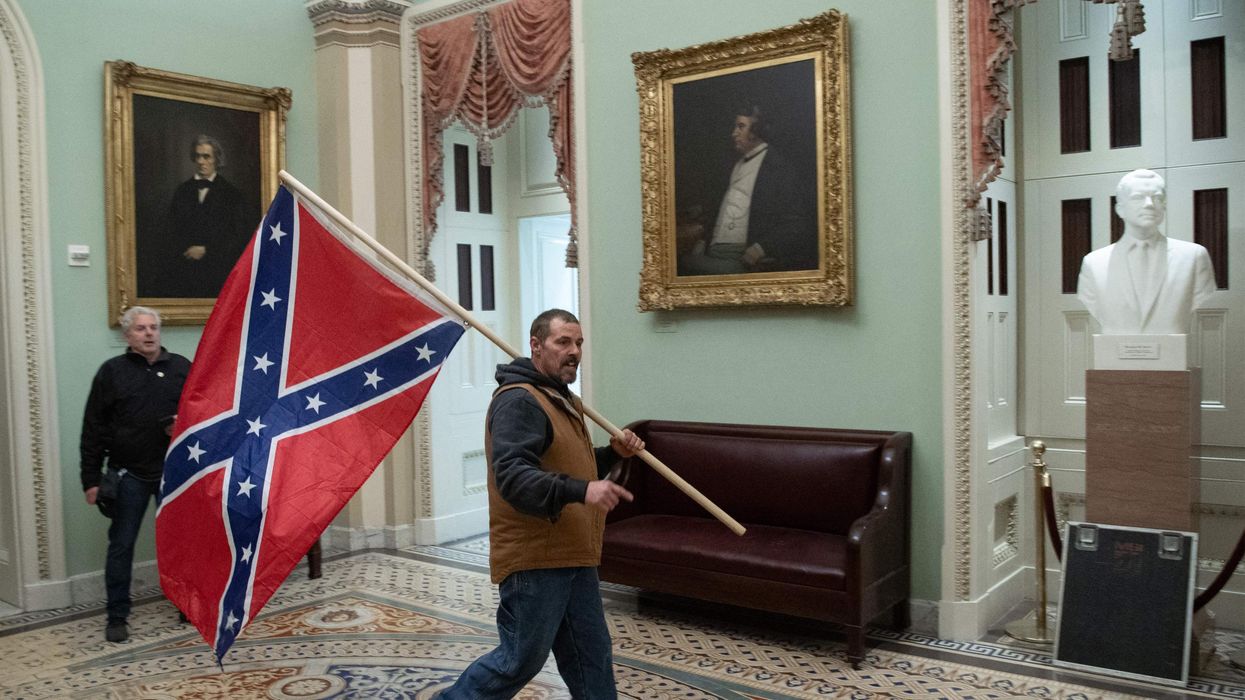
Blood alone moves the wheels of history.
-Benito Mussolini
"Have you noticed that people are getting meaner?" the villain asks in a Paramount+ promo for their new show Evil.
"What does it mean?" asks the "nice" character.
"It means," says the evil character with a note of triumph in her voice, "that your side is losing."
And here we are. The lede of an above-the-fold story in yesterday's Washington Post lays it out:
"In the past 24 hours, there has been an uptick in the number of violent threats against lawmakers on the House select committee investigating the Jan. 6, 2021, insurrection at the U.S. Capitol, and all lawmakers on the committee are likely to receive a security detail..."
We need to discuss the violence and threats of violence now endemic to the GOP, because they signal a hopefully reversible--but possibly terminal--slide into fascism.
Fascism is violence.
Its philosophy is rooted in violence: the domination of the many by a few, whether the main instrument of that domination is personal physical violence, the violence of great wealth or political power being used to destroy one's enemies, or unjustified violence inflicted by the state under color of law.
But at its core, fascism is rooted in physical violence, intimidation, and murder. It's war brought into politics and governance.
Violence like this has its own power and its own attraction.
The media is drawn to it, making it the most powerful recruiting tool a fascist movement has.
Insecure, frightened men (and the occasional woman) participating in fascist violence find a sense of agency, of individual power and meaning, a sort of orgasmic release from a life of ordinariness and political impotence.
And make no mistake: the GOP has become the party of political violence.
Democrats treat the violence associated with today's Republican Party as if it were coming from outliers, as if it's "a few bad apples," as if it's simply a troublesome weirdness on the extreme periphery of the conservative movement.
We see this in their response to the violence of January 6th, to the threats of violence directed at members of the January 6th Committee who are now getting security details, and to the frequent but scattershot violence that erupts across the country almost daily.
Democrats watch threats of violence against school board members; against nurses and hospitals treating Covid; against abortion providers; against racial minorities and queer people who Republican legislators declare--and try to put into law--are less than human or "aberrations" that must not be tolerated in a "free society."
The media continues to largely ignore those frequent moments when fascist-infiltrated police--the only group within our society who are legally authorized to use violence without consequence--overlook or overtly encourage the violence that breaks out when Americans dare stand up to fascist militias.
"It's the exception," the media notes, and moves on to the next story.
In fact, these displays of violence and the willingness to use violence are declarations. They are statements of purpose. They're spoken and executed with pride.
They are assertions by fascists that they intend to exercise violence and its power up to and including the ultimate: the power to take human life.
Republicans and their media lionize Kyle Rittenhouse for showing up at a Black Lives Matter protest and killing two protestors. They celebrate police violence with "thin blue line" flags, and wave the all-black US flag that signifies the willingness to kill one's political opponents.
They show up at protests heavily armed and wearing tee-shirts evoking General Pinochet with the slogan, "Free helicopter rides for liberals." Their leader said there are "very good people on both sides" after his fascists murdered a young woman named Heather Heyer.
Republicans running for office feature guns or imply threats to kill people in their television and online advertising. Eric Greitens is just the latest in a long list of GOP shooters glorifying assault weapons and implying political violence. This is Kentucky Republican Thomas Massie's Christmas Card:
These are all expressions of fascism.
When men like Rusty Bowers and Brad Raffensperger--who dared stop Trump's criminal attempts to steal the 2020 election--describe how they were and continue to be threatened with violence, elected Republicans fall silent.
Arizona House Speaker Bowers endured violent threats outside his home through night after night as his daughter lay dying: this kind of violence is devoid of compassion. It is evil.
Not a word from Ronna Romney McDaniel about the embrace of violence by the base of the Republican Party she leads, not a word from congressional Republicans about the violence their own fellow conservatives now face, not a word from Republican media other than to cynically mouth phony excuses and justifications.
Because violence is now their brand. They revel in it.
They boast of it in ways that are often misinterpreted as either hyperbole or jokes, like when Sharron Angle (and others) warned of "Second Amendment solutions" to Democratic efforts, or when Donald Trump said he could murder someone on Fifth Avenue and still get elected.
Their fascist followers know better: these are proud statements of their willingness to use or endorse violence, and carry explicit threats.
Holocaust survivor Hannah Arendt wrote in The Origins of Totalitarianism:
"[T]he propaganda of totalitarian movements which precede and accompany totalitarian regimes is invariably as frank as it is mendacious, and would-be totalitarian rulers usually start their careers by boasting of their past crimes and carefully outlining their future ones.
"The Nazis 'were convinced that evil-doing in our time has a morbid force of attraction,' ... and experience has proved time and again that the propaganda value of evil deeds and general contempt for moral standards is independent of mere self-interest, supposedly the most powerful psychological factor in politics.
"The attraction of evil and crime for the mob mentality is nothing new. It has always been true that the mob will greet 'deeds of violence with the admiring remark: it may be mean, but it is very clever.'"
When a nation goes fascist, it happens quickly. It takes people by surprise.
In 1919, Benito Mussolini started out with 300 armed volunteers, his Blackshirts. They began by terrorizing gay men, striking union members, and socialists; newspaper reports of their violence, beatings, and the occasional murder swept across Italy.
Over the next three years Mussolini's Blackshirt militia burgeoned to over 20,000 men, so when, on the last day of October 1922, he directly confronted King Victor Emmanuel III with the threat of violence, the king gave in, dissolved the government, and appointed Mussolini Prime Minister of Italy.
No campaign, no election, just three years of unrelenting violence and the threat of more violence.
Hitler rose to power on the wings of violence as well, first in the Beer Hall Putsch and later, when he became Chancellor, through his volunteer militia the Brownshirts terrorizing gays, Jews, and union members. Paul von Hindenburg thought Hitler would set aside the violence, as promised, if he was given the power he demanded. Hindenburg didn't understand fascism.
Violence is the cardinal characteristic, the logo, the brand identity of fascism. Every fascist movement in history has lifted itself to power on the scaffold of violence. And then continues to rule with violence.
Fascist media revel in the language of violence. They dehumanize the victims of their violence with words like "invaders" and "vermin" and "illegals."
To justify the violence at the heart of their movement, they squeal a phony claim to victimhood: They think Democrats are trying to take their tax dollars. They fear gays are trying to groom their children. They believe teachers are indoctrinating their youth in socialism. Violence, they say, is their only option.
Over the past two decades, as this fascist movement has arisen in America and taken over the GOP, more than three-quarters of all politically motivated murders have been committed by rightwing often-Republican-aligned terrorists.
Terrorism is fascism. Isis and Al-Qaeda are fascist organizations, just like the various militias that attacked our Capitol on January 6th and today stalk our streets from the backs of pickup trucks while brandishing assault weapons.
For the Republicans in Congress, this is not a problem until violence is threatened against one of their own; when a lone mentally ill man calls police to confess he's hallucinating voices telling him to kill Brett Kavanaugh, legislation is passed within days to protect the Court's justices.
Two years earlier, when "men's rights" advocate Roy Den Hollander murdered the 20-year-old son of Judge Esther Salas and was carrying detailed plans to kill Supreme Court Justice Sonya Sotomayor next, Republican Senator Rand Paul blocked legislation in the Senate to provide federal judges with that protection.
Not even one Republican objected to Paul's obstruction, and Mitch McConnell let it stand. Violence is their brand.
When violence is threatened against the few remaining non-fascist Republicans, theoretically members of their own tribe, that's just fine with the "base voter" fascists who now control the levers of power in the party. Just ask any of the Republicans who have testified before the January 6th Committee or who voted to impeach Trump.
Fascists justify their violence as necessary to protect their faith, their families, and the "identity" of their homeland. They will tell you it's the unfortunate last-ditch "necessity" provoked by the "others" who "threaten our way of life."
In reality, violence is not the fascist's final, last-gasp option: it's their first.
The final cause to which fascist violence is directed is what Jefferson (and Hobbes) called bellum omnium in omnia: war of all against all. Every murderous act is designed intentionally to bring society closer to breakdown, so the fascists can openly kill their enemies--particularly people of color and "liberals"--in the streets of the nation.
It's why Tim McVeigh blew up the Oklahoma Federal Building in 1995, killing 168 people and injuring another 680. It appears to be what motivated both the Las Vegas shooter who killed 58 people and the Boston Bomber. It was claimed by the Buffalo killer of 20 people in a supermarket, and the 2019 El Paso shooter who murdered 23 people.
It's the story line of the two best-selling books within the militia movement, Camp of the Saints and The Turner Diaries. Each ends with mass slaughter leaving a nation of "pure" white Christian survivors, most holding well-used assault rifles as they stand atop piles of bodies.
Hannah Arendt noted in her 1969 essay "Reflections on Violence":
"[T]he danger of the practice of violence, even if it moves consciously within a non-extremist framework of short-term goals, will always be that the means overwhelm the end.
"If goals are not achieved rapidly, the result will not merely be defeat but the introduction of the practice of violence into the whole body politic. Action is irreversible, and a return to the status quo in case of defeat is always unlikely.
"The practice of violence, like all action, changes the world, but the most probable change is a more violent world."
House Speaker Nancy Pelosi recently demanded that Republicans "take back their party." So far, they're not listening.
Every day that Republicans refuse to seize and root out the fascist violence now associated with their party is another day closer to a dystopia like the one through which Hannah Arendt lived.
It can happen here.