SUBSCRIBE TO OUR FREE NEWSLETTER
Daily news & progressive opinion—funded by the people, not the corporations—delivered straight to your inbox.
5
#000000
#FFFFFF
To donate by check, phone, or other method, see our More Ways to Give page.
Daily news & progressive opinion—funded by the people, not the corporations—delivered straight to your inbox.
"We are on the brink of an irreversible climate disaster. This is a global emergency beyond any doubt."
As Hurricane Milton barreled toward Florida's Gulf Coast, demonstrating the dangers of global warming, international scientists on Tuesday published a terrifying annual analysis that highlights the need to swiftly phase out planet-heating fossil fuels.
"Our aim in the present article is to communicate directly to researchers, policymakers, and the public," the coalition wrote in BioScience. "As scientists and academics, we feel it is our moral duty and that of our institutions to alert humanity to the growing threats that we face as clearly as possible and to show leadership in addressing them."
"We are on the brink of an irreversible climate disaster. This is a global emergency beyond any doubt. Much of the very fabric of life on Earth is imperiled. We are stepping into a critical and unpredictable new phase of the climate crisis," warned the 14 experts from Australia, Brazil, China, Denmark, Germany, Switzerland, the United Kingdom, and the United States.
Their latest edition, "The 2024 State of the Climate Report: Perilous Times on Planet Earth," shows that 25 of the 35 "planetary vital signs" the team uses to track the climate emergency are at record extremes. They include U.S.-heat related mortality, fossil fuel subsidies, coal and oil consumption, carbon dioxide equivalent emissions, per capita meat consumption, global tree cover loss due to fires, ocean acidity and heat content change, glacier thickness change, and ice mass change in Antarctica and Greenland.
"Ecological overshoot, taking more than the Earth can safely give, has pushed the planet into climatic conditions more threatening than anything witnessed even by our prehistoric relatives."
The report emphasizes that "human-caused carbon dioxide emissions and other greenhouse gases are the primary drivers of climate change. As of 2022, global fossil fuel combustion and industrial processes account for approximately 90% of these emissions, whereas land-use change, primarily deforestation, accounts for approximately 10%."
"For many years, scientists, including a group of more than 15,000, have sounded the alarm about the impending dangers of climate change driven by increasing greenhouse gas emissions and ecosystem change," the publication notes. "For half a century, global warming has been correctly predicted even before it was observed—and not only by independent academic scientists but also by fossil fuel companies."
"Despite these warnings, we are still moving in the wrong direction; fossil fuel emissions have increased to an all-time high, the three hottest days ever occurred in July of 2024, and current policies have us on track for approximately 2.7°C peak warming by 2100," the article adds. "Tragically, we are failing to avoid serious impacts, and we can now only hope to limit the extent of the damage. We are witnessing the grim reality of the forecasts as climate impacts escalate, bringing forth scenes of unprecedented disasters around the world and human and nonhuman suffering."
Oregon State University professor William Ripple, who led the team with Christopher Wolf of Terrestrial Ecosystems Research Associates, said in a Tuesday statement that "ecological overshoot, taking more than the Earth can safely give, has pushed the planet into climatic conditions more threatening than anything witnessed even by our prehistoric relatives."
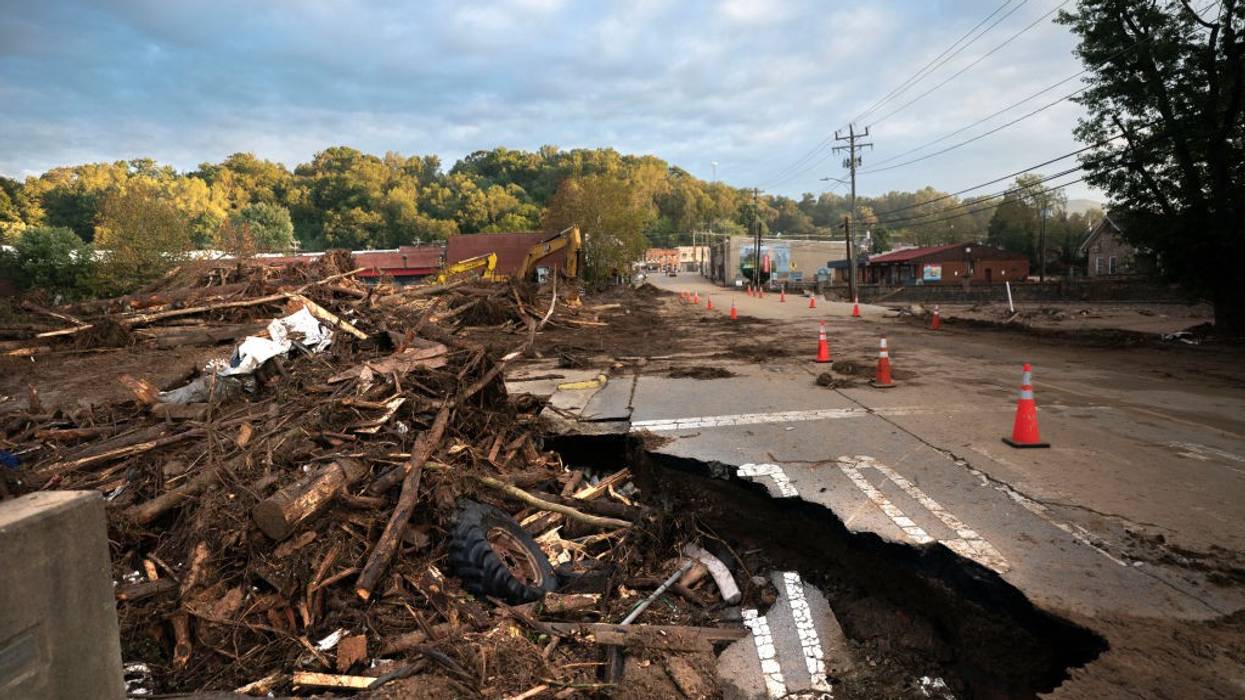
"We're already in the midst of abrupt climate upheaval," Ripple stressed. "For example, Hurricane Helene caused more than 200 deaths in the southeastern United States and massive flooding in a North Carolina mountain area thought to be a safe haven from climate change."
"Since the publication of our 2023 report, multiple climate-related disasters have taken place, including a series of heatwaves across Asia that killed more than a thousand people and led to temperatures reaching 122°F in parts of India," he continued. "Climate change has already displaced millions of people, with the potential to displace hundreds of millions or even billions. That would likely lead to greater geopolitical instability, possibly even partial societal collapse."
To avoid that dark future, the article argues, "we need bold, transformative change: drastically reducing overconsumption and waste, especially by the affluent, stabilizing and gradually reducing the human population through empowering education and rights for girls and women, reforming food production systems to support more plant-based eating, and adopting an ecological and post-growth economics framework that ensures social justice."
The assessment—whose authors include Michael Mann of the University of Pennsylvania, Naomi Oreskes of Harvard University, and Stefan Rahmstorf and Johan Rockström of the Potsdam Institute for Climate Impact Research—comes just over a month away from the next United Nations Climate Change Conference, COP29, which is scheduled for November 11-22 in Azerbaijan.
Pointing to previous summits, Wolf said Tuesday that "despite six reports from the International Panel on Climate Change, hundreds of other reports, tens of thousands of scientific papers, and 28 annual meetings of the U.N.'s Conference of the Parties, the world has made very little headway on climate change."
"Humanity's future depends on creativity, moral fiber, and perseverance," he warned. "If future generations are to inherit the world they deserve, decisive action is needed, and fast."
"This clearly shows that protecting our climate is much cheaper than not doing so, and that is without even considering noneconomic impacts such as loss of life or biodiversity," a new study's lead author said.
The climate crisis will shrink the average global income 19% in the next 26 years compared to what it would have been without global heating caused primarily by the burning of fossil fuels, a study published in Nature Wednesday has found.
The researchers, from the Potsdam Institute for Climate Impact Research (PIK), said that economic shrinkage was largely locked in by mid-century by existing climate change, but that actions taken to reduce emissions now could determine whether income losses hold steady at around 20% or triple through the second half of the century.
"These near-term damages are a result of our past emissions," study lead author and PIK scientist Leonie Wenz said in a statement. "We will need more adaptation efforts if we want to avoid at least some of them. And we have to cut down our emissions drastically and immediately—if not, economic losses will become even bigger in the second half of the century, amounting to up to 60% on global average by 2100."
"I am used to my work not having a nice societal outcome, but I was surprised by how big the damages were."
Put in dollar terms, the climate crisis will take a yearly $38 trillion chunk out of the global economy in damages by 2050, the study authors found.
"That seems like… a lot," writer and climate advocate Bill McKibben wrote in response to the findings. "The entire world economy at the moment is about $100 trillion a year; the federal budget is about $6 trillion a year."
This means that the costs of inaction have already exceeded the costs of limiting global heating to 2°C by six times, the study authors said. However, limiting warming to 2°C can still significantly reduce economic losses through 2100.
"This clearly shows that protecting our climate is much cheaper than not doing so, and that is without even considering noneconomic impacts such as loss of life or biodiversity," Wenz said.
The damages predicted by the study were more than twice those of similar analyses because the researchers looked beyond national temperature data to also incorporate the impacts of extreme weather and rainfall on more than 1,600 subnational regions over a 40-year period, The Guardian explained.
"Strong income reductions are projected for the majority of regions, including North America and Europe, with South Asia and Africa being most strongly affected," PIK scientist and first author Maximilian Kotz said in a statement. "These are caused by the impact of climate change on various aspects that are relevant for economic growth such as agricultural yields, labor productivity, or infrastructure."
However, Wenz told the paper that the paper's projected reduction was likely a "lower bound" because the study still doesn't include climate impacts such as heatwaves, tropical storms, sea-level rise, and harms to human health.
Unlike previous studies, the research predicted economic losses for most wealthier countries in the Global North, with the U.S. and German economies shrinking by 11% by mid-century, France's by 13%, and the U.K.'s by 7%. However, the countries set to suffer the most are countries closer to the equator that have lower incomes already and have historically done much less to contribute to the climate crisis. Iraq, for example, could see incomes drop by 30%, Botswana 25%, and Brazil 21%.
"Our study highlights the considerable inequity of climate impacts: We find damages almost everywhere, but countries in the tropics will suffer the most because they are already warmer," study co-author Anders Levermann, who leads Research Department Complexity Science at PIK, said in a statement. "Further temperature increases will therefore be most harmful there. The countries least responsible for climate change, are predicted to suffer income loss that is 60% greater than the higher-income countries and 40% greater than higher-emission countries. They are also the ones with the least resources to adapt to its impacts."
Wenz told The Guardian that the results were "devastating."
"I am used to my work not having a nice societal outcome, but I was surprised by how big the damages were. The inequality dimension was really shocking," Wenz said.
Levermann said the paper presented society with a clear choice:
It is on us to decide: Structural change towards a renewable energy system is needed for our security and will save us money. Staying on the path we are currently on, will lead to catastrophic consequences. The temperature of the planet can only be stabilized if we stop burning oil, gas, and coal.
McKibben, meanwhile, argued that the findings should persuade major companies to embrace climate action for self-interested reasons. He noted that most corporate emissions come from how company money is invested by banks, particularly in the continued exploitation of fossil fuel resources.
"If Amazon and Apple and Microsoft wanted to avoid a world where, by century's end, people had 60% less money to spend on buying whatever phones and software and weird junk (doubtless weirder by then) they plan on selling, then they should be putting pressure on their banks to stop making the problem worse. They should also be unleashing their lobbying teams to demand climate action from Congress," McKibben wrote.
"These people are supposed to care about money, and for once it would help us if they actually did," he continued. "Stop putting out ads about how green your products are—start making this system you dominate actually work."
If Amazon and Apple and Microsoft wanted to avoid a world where, by century’s end, people had 60% less money to spend on buying whatever they plan on selling, then they should be putting pressure on their banks to stop making the problem worse.
A new study released today in Nature examines data from 1,600 regions of the earth for the last 40 years, and concludes that by 2050 climate change will be causing economic damage worth $38 trillion every single year. That seems like… a lot. The entire world economy at the moment is about $100 trillion a year; the federal budget is about $6 trillion a year. $38 trillion is 150 Bezoses (which is sick in its own way).
If those numbers seem impossible to comprehend, then let Bloomberg break it down for you, “planetary warming will result in an income reduction of 19% globally by mid-century, compared to a global economy without climate change.”
This is the largest study of this kind I know of; it comes from the Potsdam Institute in Germany, and as James Murray, writing in BusinessGreen points out, it’s more “granular and empirical” than past efforts. It concludes that these losses are already locked in, thanks to the carbon and methane we’ve already poured into the air.
“Strong income reductions are projected for the majority of regions, including North America and Europe, with South Asia and Africa being most strongly affected,” said PIK scientist and co-author of the study, Maximilian Kotz.
“These are caused by the impact of climate change on various aspects that are relevant for economic growth such as agricultural yields, labour productivity or infrastructure… We find that economies across the world are committed to an average income loss of 19% by 2049 due to past emissions. This corresponds to a 17% reduction in global GDP.”
If anything, as Murray points out, the numbers are quite likely conservative:
The projected damages are mainly the result of rising average temperatures and changes in rainfall and temperature variability. But other weather extremes that are harder to model, such as storms or wildfires, could result in higher economic costs. The study also assumes that over time economies start to adapt to more intense climate impacts, serving to curb the resulting negative economic impacts. As climate scientists have repeatedly warned, there are plausible scenarios where some regions find it near impossible to adapt and development is thrown into reverse. Such outcomes would trigger huge geopolitical risks that could impact the entire global economy.
What might cause even deeper problems? Just for fun, read another European study from last week, on the rapid slowdown in the Atlantic Ocean circulation and the possible looming shutdown of the entire system.
Oh, and if we don’t take strong action now to limit the rise in temperature, then the economic losses just keep growing—that 19% at mid-century becomes 60% by 2100, when people currently being born will still be alive, and cursing us.
There are a couple of things to say here.
One, some of you may remember the famous Limits to Growth report from the early 1970s. It predicted that without serious efforts to change our demands on the planet, economic growth would begin to suffer right about now. We thought about it as a society and then, with the election of Ronald Reagan, rejected it; we are now harvesting that bitter fruit. If we don’t act now then our children may wish they still had bitter fruit to harvest.
These people are supposed to care about money, and for once it would help us if they actually did.
Two, capitalism—which regularly acts homicidally—is acting truly suicidally. Having been warned for years now, it resists every effort to rein in its excesses. As Exxon’s CEO helpfully explained earlier this year, it’s not that you couldn’t make good money from renewable energy—you just couldn’t make “above average returns” because sunshine is free. So instead we’ll tank the world, and with it the world economy (which is a subset of the first, not the other way round).
In Europe, for instance, climate protest has finally persuaded regulators to start slowing loans to the fossil fuel industry—but new data this week makes it clear that the slack is being taken up by American banks, and not just the mighty money center banks that are already most deeply implicated in this immoral trade. Now regional banks are taking it up too:
Some of the U.S. regional banks stepping up oil, gas, and coal lending are based in states that have either passed or are reviewing anti-ESG laws. In Oklahoma, which enforced its Energy Discrimination Elimination Act in late 2022, local bank BOK Financial recently soared up the league table to become one of the world’s 30 busiest dealmakers in fossil fuels.
Marisol Salazar, senior vice president and manager for energy banking at BOK Financial, says the bank is now seeing “much more opportunities” in the fossil-fuel industry.
“We’re not just picking up customers,” she said. “We’re also picking up talent, we’re picking up engineers, we’re picking up investment bankers, we’re picking up experienced relationship managers.”
All of this makes even more important the release of the Carbon Bankroll 2.0 report earlier this spring. You’ll recall the first version of this report a year ago, which made it clear that for many companies—Apple, Amazon, Microsoft, and on and on—the bulk of their carbon emissions came from the cash they kept in the bank, where it got lent out to build more fossil fuel infrastructure. That’s because, as the new report makes clear,
If the largest banks and asset managers in the U.S. were a country, they would be the third-largest emitting country in the world, behind China and the U.S.
So let’s think about this for a moment. If Amazon and Apple and Microsoft wanted to avoid a world where, by century’s end, people had 60% less money to spend on buying whatever phones and software and weird junk (doubtless weirder by then) they plan on selling, then they should be putting pressure on their banks to stop making the problem worse. They should also be unleashing their lobbying teams to demand climate action from Congress.
These people are supposed to care about money, and for once it would help us if they actually did. Stop putting out ads about how green your products are—start making this system you dominate actually work.
This is not a radical proposition. A radical—and probably wise, if unlikely—proposition would be get past capitalism. But for the moment this is where we are, and the people who dominate it have an obligation to make it work, if only out of their own sad self-interest.
Here’s how the unradical Todd Stern—longtime American climate negotiator at international talks—put it in a quite powerful speech he gave last week in the U.K.:
“We are slowed down by those who think of themselves as grownups and believe decarbonisation at the speed the climate community calls for is unrealistic.”
“They say that we need to slow down, that what is being proposed [in cuts to greenhouse gas emissions] is unrealistic,” he told The Observer. “You see it a lot in the business world too. It’s really hard [to push for more urgency] because those ‘grownups’ have a lot of influence.”
Stern says that the ‘grownups’ will only listen when the rest of us push:
The original Earth Day in 1970 happened in a societal moment that isn’t easily replicated, but it does teach that there is still more to do in filling the streets and campuses with young people and people young at heart who see the danger of climate change for what it is.
What that original Earth Day represented was not just norm change but a sociopolitical tipping point in environmental concern—the kind of positive tipping point we need to reach on climate change as well. And it will come. But it has to be our collective mission to make it come sooner.
Indeed! Watch this space.
"This update on planetary boundaries clearly depicts a patient that is unwell," said one scientist.
Scientists behind a new study on the crossing of the Earth's "planetary boundaries" on Wednesday likened the planet to a sick patient, warning that six out of nine barriers that ensure the Earth is a "safe operating space for humanity" have now been breached.
Researchers at the University of Copenhagen, the Potsdam Institute for Climate Impact Research (PIK), and other international institutions analyzed 2,000 studies to update a planetary boundary framework developed in 2009 by the Stockholm Resilience Center, completing the first "complete check-up of all nine processes and systems that determine the stability and resilience of the planet."
The boundaries for climate change and land use have been broken for decades as extractive industries have razed forests and planet-heating fossil fuel emissions have significantly increased since preindustrial times.
The "novel entities" boundary—pertaining to the accumulation of synthetic pollution from substances such as microplastics, pesticides, and nuclear waste—was quantified for the first time in the study, which was published in Science Advances.
Freshwater change—both "green" freshwater in soil and vegetation and "blue" freshwater in bodies of water—has also been breached, along with biogeochemical flows, or the flow of nitrogen and phosphorus into the environment, which can create ocean dead zones and algal blooms.
"We don't know how long we can keep breaching these key boundaries before combined pressures lead to irreversible change and harm."
The study marked the first time researchers quantified a control variable for the "biosphere integrity" boundary, which they found was breached long before the framework was introduced—in the late 19th century as the Industrial Revolution and other factors accelerated the destruction of the natural world.
Co-author Wolfgang Lucht called biosphere integrity "the second pillar of stability for our planet" next to climate change, and warned the pillar is being destabilized by humans "taking out too much biomass, destroying too much habitat, deforesting too much land. Our research shows that mitigating global warming and saving a functional biosphere for the future should go hand in hand."
"This update on planetary boundaries clearly depicts a patient that is unwell, as pressure on the planet increases and vital boundaries are being transgressed," said Johan Rockström, director of PIK. "We don't know how long we can keep breaching these key boundaries before combined pressures lead to irreversible change and harm."
The boundaries for atmospheric aerosol loading, or air pollution, and ocean acidification, are both close to being crossed, while the atmospheric ozone boundary is currently well below the "zone of increasing risk," due to global initiatives within the Montreal Protocol, adopted in 1987.
The fact that the boundary for ozone depletion was once "headed for increasing regional transgressions" and slowly recovered, said co-author Katherine Richardson of the University of Copenhagen, shows that it is possible to bring the planet back from the boundaries that it's close to crossing or that have been breached to a lesser degree, such as freshwater change.
"We can think of Earth as a human body, and the planetary boundaries as blood pressure," said Richardson. "Over 120/80 does not indicate a certain heart attack but it does raise the risk and, therefore, we work to reduce blood pressure."
The boundaries that have reached the highest risk level are biosphere integrity, climate change, novel entities, and biogeochemical flows.
The update to the framework "may serve as a renewed wake-up call to humankind that Earth is in danger of leaving its Holocene-like state," reads the study, referring to relatively stable state the planet was in between the end of the last ice age—10,000 years ago—until the start of the Industrial Revolution.
The study, said global grassroots climate action campaign Extinction Rebellion, offered the latest evidence that policymakers must do everything in their power to "just stop oil"—ending approval for fossil fuel projects, subsidies for oil and gas companies, and policies that slow down a transition to renewable energy.
"We are not separate from the Earth," said the group. "We ignore these warnings at our peril."
"Ongoing climate change is keeping many people in the Global South in poverty, making it more difficult for them to migrate," said the co-author of a new study. "Thus climate change deprives people of an important way to adapt to its impacts and increases the gap between rich and poor."
As the worsening climate emergency creates an increasing number of migrants around the world, the economic effects of the planetary crisis are paradoxically making millions of people throughout the Global South too poor to escape its ravages.
That's according to a study published recently in the journal Environmental Research Letters by researchers from the Potsdam Institute for Climate Impact Research (PIK) in Germany.
" Climate change reduces economic growth in almost all countries of the world. But it has very divergent effects in poorer and richer countries," study co-author Jacob Schewe said Monday. "Overall, migration related to climate change has increased—but it has done so to a lesser extent than might have been expected. The reason is bitter: In poor countries, many people in need are lacking the means to migrate. They have no choice but to stay where they are."
Co-author Christian Otto noted that "economic growth affects national income levels, which in turn affect migration. Relatively few people migrate from high-income and from very low-income countries. In the case of poor countries, this is partly because many people simply cannot afford to leave. So very poor people often stay in their home country, even if they are in need or would like to migrate for other reasons."
Another study co-author, Anders Levermann, said that "ongoing climate change is keeping many people in the Global South in poverty, making it more difficult for them to migrate. Thus climate change deprives people of an important way to adapt to its impacts and increases the gap between rich and poor."
According to a 2017 study published by the British medical journal The Lancet, climate change could create a billion refugees by 2050. Other studies conclude the number could be even higher. Additionally, the World Bank says the planetary emergency could displace more than 200 million people within their home countries by mid-century.
"Our analysis shows that ExxonMobil's own data contradicted its public statements, which included exaggerating uncertainties, criticizing climate models, mythologizing global cooling, and feigning ignorance," said lead author Geoffrey Supran.
"This is the nail in the coffin of ExxonMobil's claims that it has been falsely accused of climate malfeasance."
That's what University of Miami associate professor Geoffrey Supran said about a peer-reviewed study on the fossil fuel giant's global warming projections published Thursday in the journal Science, which he began work on as a Harvard University research fellow.
"Our analysis shows that ExxonMobil's own data contradicted its public statements, which included exaggerating uncertainties, criticizing climate models, mythologizing global cooling, and feigning ignorance about when—or if—human-caused global warming would be measurable, all while staying silent on the threat of stranded fossil fuel assets," said Supran, the study's lead author.
Exxon—and the fossil fuel industry overall—has faced scrutiny from campaigners, journalists, lawmakers, and scientists for spending decades hugely profiting off of its planet-wrecking products while spreading climate misinformation.
The new study from Supran, Harvard professor Naomi Oreskes, and University of Potsdam professor Stefan Rahmstorf—who is also a researcher at the Potsdam Institute for Climate Impact Research—comes as policymakers worldwide continue to allow major corporations to cash in on fossil fuels, despite the increasingly devastating impacts of heating the planet.
Supran and Oreskes have previously published peer-reviewed research on the "discrepancy between what ExxonMobil's scientists and executives discussed about climate change privately and in academic circles, and what it presented to the general public," confirming the findings from 2015 reports by Inside Climate News and The Los Angeles Times.
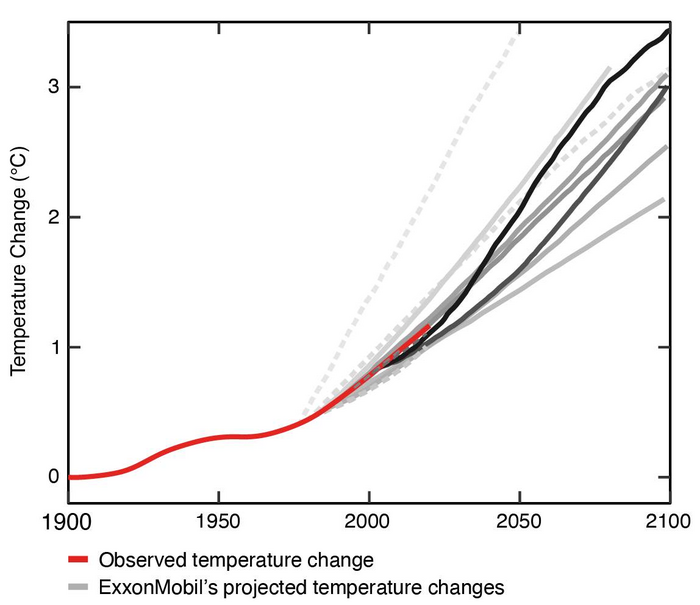
For their latest study, the pair and Rahmstorf analyzed all known global warming projections documented and modeled by Exxon scientists between 1977 and 2003. The researchers found that 63-83% of the company's projections were accurate.
"ExxonMobil's average projected warming was 0.20° ± 0.04°C per decade, which is, within uncertainty, the same as that of independent academic and government projections published between 1970 and 2007," the publication states.
The study includes the following graphic, which shows Exxon scientists' projections from internal documents and peer-reviewed publications for the review period in gray along with historically observed temperature change in red.
The company's science was "actually astonishing" in its precision and accuracy—but so was its "hypocrisy because so much of the ExxonMobil disinformation for so many years... was the claim that climate models weren't reliable," Oreskes told The Associated Press.
In a statement to AP and other media outlets, Exxon spokesperson Todd Spitler said that "this issue has come up several times in recent years and, in each case, our answer is the same: Those who talk about how 'Exxon Knew' are wrong in their conclusions."
"Some have sought to misrepresent facts and ExxonMobil's position on climate science, and its support for effective policy solutions, by recasting well-intended, internal policy debates as an attempted company disinformation campaign," he said. "ExxonMobil's understanding of climate science has developed along with that of the broader scientific community."
Meanwhile, climate advocates and experts echoed the points made by the study's authors.
"A fossil fuel company? Putting profits over people? We're shocked. This is shocking news," Earthjustice sardonically tweeted.
"In all seriousness, this is an outrage," the group added. "Exxon has had fairly accurate data on climate change for decades... and buried it. Instead, it has been fervently and publicly contradicting its own research to preserve its profit."
As The Guardian reported:Climate scientists said the new study highlighted an important chapter in the struggle to address the climate crisis. "It is very unfortunate that the company not only did not heed the implied risks from this information, but rather chose to endorse nonscientific ideas instead to delay action, likely in an effort to make more money," said Natalie Mahowald, a climate scientist at Cornell University.
Mahowald said the delays in action aided by Exxon had "profound implications" because earlier investments in wind and solar could have averted current and future climate disasters. "If we include impacts from air pollution and climate change, their actions likely impacted thousands to millions of people adversely," she added.
Drew Shindell, a climate scientist at Duke University, said the new study was a "detailed, robust analysis" and that Exxon's misleading public comments about the climate crisis were "especially brazen" given their scientists' involvement in work with outside researchers in assessing global heating. Shindell said it was hard to conclude that Exxon's scientists were any better at this than outside scientists, however.
"The harm caused by Exxon has been huge," University of Michigan professor Jonathan Overpeck told the AP. "They knew that fossil fuels, including oil and natural gas, would greatly alter the planet's climate in ways that would be costly in terms of lives, human suffering, and economic impacts. And yet, despite this understanding they choose to publicly downplay the problem of climate change and the dangers it poses to people and the planet."
Alyssa Johl, vice president of legal at the Center for Climate Integrity, said that "this quantitative assessment puts a fine point on the fact that Exxon knew with incredible precision that the burning of their fossil fuel products would result in temperature increases and severe climate harms in the 2000s and beyond."
"They pretty much nailed these predictions with incredible accuracy. That cannot be refuted at this point," Johl added, suggesting that the research could bolster climate liability lawsuits filed by dozens of U.S. states and municipalities against ExxonMobil and other fossil fuel companies for driving the global emergency.
"There are two very important pieces to the puzzle that need to be established and proven in these cases: the fact that oil and gas companies had longstanding knowledge of the causes and consequences of climate change, and that rather than disclose that information, they actively concealed and denied it," she said. "This analysis shows once again that Exxon knew."
As Fossil Free Media director Jamie Henn put it: "This is exactly like Big Tobacco companies knowing that cigarettes caused cancer but lying about it anyway. Exxon knew they were causing catastrophic damage and buried the truth. Time to make them pay."