

SUBSCRIBE TO OUR FREE NEWSLETTER
Daily news & progressive opinion—funded by the people, not the corporations—delivered straight to your inbox.
5
#000000
#FFFFFF
To donate by check, phone, or other method, see our More Ways to Give page.
Daily news & progressive opinion—funded by the people, not the corporations—delivered straight to your inbox.
The book is Carson McCullers' 1940 Southern Gothic tome, The Heart is a Lonely Hunter. The story is about a deaf-mute man named John Singer who loses his companion and suddenly shows up in a small Southern town, except that the story is even more about the reactions of the various characters -- a young woman coming of age, a black doctor angry about racism, the "town drunk," and others -- who pour out their heart and soul and project their own dreams and fears onto McCullers' protagonist, who cannot hear them or speak back.
In 2018, the American heart is the loneliest hunter of all, and so an increasingly lost and disillusioned nation turned its lonely eyes toward McCain. The late senator's 81-plus years on Planet Earth embodied so many contradictions -- the military man of honor and stoic POW who also took free trips from a sleazeball savings-and-loan multi-millionaire and cheated on his first wife after she'd been injured in a car wreck, the political "maverick" who nonetheless enabled the modern GOP's turn toward authoritarianism with the vast majority of his votes -- that Americans of every ideology and every psychological state could project onto him their own vision of what this country ought to, or our despair over what it's become. The story isn't really about who was John McCain, now no longer able to hear our plaintive appeals. The story is really about our anxiety over who we are.
It was McCain's adoptive West, where -- in a line from 1962's The Man Who Shot Liberty Valance that's been repeated in newsrooms thousands of times -- the supposed mantra was, "When the facts become legend, print the legend." (The movie, ironically, is about a character elected U.S. senator on a mangled version of his supposed heroic act as a younger man.)
In death, it was the John McCain legend -- the myth that a public so desperately craves when vainglorious "Individual-1" and his sweaty 1 a.m. Twitter fingers is keeping the lights on in the White House -- that landed on America's front doorstep Sunday morning.
The truth is that had there not been a John McCain to shoehorn into a broader myth -- a POW who endured years of torture for his brothers-in-arms and the doomed war effort and then entered politics as a public service, a "maverick" who did the right thing in a time of knee-jerk polarization, the last defender of true American values who rode off into the sunset -- America would likely have invented just such a character.
And let's be clear, it's impossible to write about McCain's passing without acknowledging the many places where the man and the myth overlapped, without expressing gratitude for the sacrifices and awe at the pain he endured during the "Hanoi Hilton" years, and without expressing deep sympathy to all those who loved him. But in the end, McCain the man was very much just like the rest of us flawed mortals -- with no novelistic plot line pointing to some grand moral climax, just the normal blend of human contradiction.
McCain the man, after all, tended to only be a "maverick" when it didn't matter. Yes, he became the leading Republican advocate for campaign finance reform -- but only after he was caught red-handed in the cookie jar with future S&L felon Charles Keating, with official favors and lavish free trips that are almost identical to the bad behavior that got his later Senate colleague Bob Menendez indicted. Yes, his experiences in Hanoi led McCain to become a moral beacon on the torture issue, but his nightmarish Vietnam experiences (including some real-time regret over his bombing and napalm runs) didn't stop him from advocating for more immoral Vietnam-style military actions around the globe. Yes, his 3 a.m. vote saved Obamacare, which saved lives. but just a few months later he voted to end the Obamacare individual mandate, which will ultimately price many middle-class Americans out of the health market. Yes, he was a man from a bygone era of honor on U.S. politics -- except for that time he told an ugly and beyond misogynistic joke about Chelsea Clinton and Janet Reno.
McCain the myth is largely the result of McCain's brilliant strategy of courting and even flattering reporters when his 99 Senate colleagues mostly sprinted to the elevator to get away from them, and the bonds among the Beltway elite who shape public opinion -- or at least used to. The legend of McCain riding in from the West to tell humble truths and clean up a wicked, sinful Washington is the kind of self-aggrandizing story about American politics that so many people at the pinnacle of power cling to, the story that we tell ourselves in order to live.
The epic moment where the man and the myth collided with full force occurred when McCain was at the high point of his 30-year career in politics, after he'd finally won the Republican presidential nomination in the summer of 2008 and -- with the economy in shambles and many voters unhappy with the Iraq War that McCain had cheered for -- faced an uphill fall campaign against Barack Obama.
True to the moral-less storyline of McCain the man, the Arizona senator only won the nomination after turning away from the beloved McCain of his failed 2000 race who'd won so much admiration with his "Straight Talk Express" and with more moderate stands on issues. The last, hard kick was nominating the supremely unqualified right-wing ideologue Sarah Palin to serve as his running mate, unleashing forces with her talk of Obama as a kind of "terrorist" and defining where is "the real America" that McCain didn't seem to anticipate and could barely control.
It all came to a head on a Friday night in a packed school gym in a place called Lakeville, Minn., in a town meeting held on Oct. 10, 2008. Palin's pitbull-in-lipstick-hockey-mom attacks had stoked up a GOP base that was increasingly angry as Obama pulled ahead in the polls; several times the audience actually booed McCain voiced his "respect" for his Democratic opponent even as those in the audience were branding Obama as a socialist or a terrorist.
Finally, a woman in a bright red T-shirt with gray hair was called onto the stage and took the mic for her question.
"I can't trust Obama. I have read about him and he's not, he's not uh -- he's an Arab. He's not -- "
McCain dramatically grabbed the mic before she could say another word.
"No, ma'am. He's a decent family man [and] citizen that I just happen to have disagreements with on fundamental issues and that's what this campaign's all about. He's not [an Arab]."
This was the Rashomon moment -- 29 seconds that would come to define American politics, where all of us saw the same event but, like characters in the classic Kurosawa movie, spun wildly different interpretations of what it all meant.
To the McCain myth-makers and legend keepers, McCain's honorable comments -- viewing politics as a decent if spirited clash of ideas, not a war of hateful stereotypes -- was the America That Used To Be, even if it requires a pair of rose-colored glasses to see it that way. To this interpretation, McCain was committing an act of cowboy-style patriotism by standing up for American values -- the moment that defined him even as the actual values he stood up for were slipping away.
The problem is that to millions of people watching the same scene -- just not the people with the loud megaphone of the mainstream media -- the hero of those 29 seconds was not McCain but the woman in red. Over the next decade, the people like her would grow louder and more influential, a Tea Party screaming at politicians that "I want my country back," to be climaxed by a demagogic political leader happy to ride their waves of racism and xenophobia. Not the America That Used to Be, but the America That Really Is.
There is a less-heard third perspective on what went down in Lakeville on that Friday night. Why, some people asked, was McCain's instinctive, gut-level reaction that being a "decent family man" was the polar opposite of being "a Muslim"? Aren't most of the millions of American Muslims decent, family men and women? What if -- imagine the thought -- an actual Muslim ran for president in the nation that once embraced the world's refugees?
This is The America That Should Be But Never Was -- the America that can never fully get past its McCain-like contradictions, that saved the American middle class with the Depression-era New Deal, as long as the middle class was white, and that defeated fascism during World War II even as it tossed thousands of Japanese-Americans into internment camps. There's something to be said for looking at the McCain Moment and wondering if -- instead of a gauzy view of a lost America was there was more liberty and justice, but not for all - we can't do even better than that.
But in the present moment we're a long way away from that. I think a big reason why the 2008 McCain Moment got so much play with his passing is because -- as much as we want to hold aloft the senator's decent response -- we're even more mortified that the bad guys ultimately won. And with each passing day we're running out of good ideas for what to do about it.
John McCain was maddeningly inconsistent and too often self-serving, and yet compared to the current crew of crooks, he comes off like the blessed love child of Abraham Lincoln and Joan of Arc. And so now we're just left staring into an orange sunset, with The Man Who Shot Liberty Valance -- even if he didn't, really -- gone on the other side of the mountain.

A young Nikolas Cruz, the Parkland shooter, posted the image shown (above left) on his Instagram account. The date is unknown. The orange tip on the end of the gun signifies he is holding an "air-soft" gun that fires BB-like, spherical projectiles that are typically made of plastic. American youth are introduced to these guns at an early age. The lethal weapon Cruz is holding shoots a projectile at 500 feet per second.
The term "air soft" is concocted by the wizards of Madison Avenue who represent the arms industry. The term conveys the idea that these guns are harmless. Remember Ralphie in "Christmas Story"? "You'll shoot your eye out kid!" The BB gun Ralphie got for Christmas, The Daisy Red Ryder, shoots BB's at 350 feet per second.
Airsoft guns represent the starter drug of choice for the American arms industry. It has long been the strategy of this industry and its bankrollers at the Pentagon to wrap as many young fingers around as many triggers as possible - whether those triggers are virtual or real. The intoxicating effects of firearms provide the military a way to exploit the powerful, visceral connection to a child's soul. In this regard, Nikolas Cruz was the victim of a malicious system.
Because airsoft guns look a lot like the real thing - and are dangerous in their own right - laws exist that affect their manufacture, purchase, and ownership.
Find Law reports that individuals in the U.S. must be 18 years of age or older to purchase an airsoft gun. On the other hand, airsoft guns are not classified as firearms and are legal for use by all ages under federal law. New York City, Washington, D.C., Chicago, and San Francisco outlaw airsoft guns entirely.
National data from the Centers for Disease Control and Prevention on non-powder gun injuries illustrates the inherent danger of these weapons. Between 2001 and 2011, non-powder guns injured 209,981 people nationwide, including 145,423 children age 19 or younger, and the numbers are rapidly climbing. Between 2007 and 2009 in Texas alone, 124 people (including 23 children under the age of 18) were killed in accidents involving BB guns, pellet guns, and other non-powder guns.
Cruz's airsoft pistol is available on Amazon for $50. Similar, but much more powerful CO2-propelled handguns are available for sale for the use by children through the congressionally established Civilian Marksmanship Program, CMP.
The image at the top right is an M1911 US Army pistol, a cherished collector's item. It served as the standard-issue sidearm for the United States Armed Forces for 75 years, from 1911 to 1986. The weapons are revered by millions. They're reliable. They'll kill the enemy, and they're American-made. Today, many American youth are enamored by these semi-automatic handguns, the way Ralphie was enthralled by his BB gun.
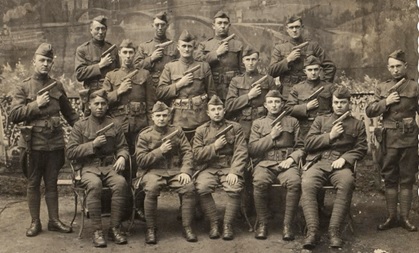
American "Doughboys" display their M1911's during WWI.
All that love for the M1911 pistol led the Trump administration to OK the release of the weaponry from the Army's ammunition depot in Anniston, Alabama to the CMP, also based in Anniston. The semiautomatic handguns are to be sold to the American public. The US stands alone as the only nation that offers its warehoused military weapons for sale to the public. Prudent nations destroy antiquated guns. The CMP has been recirculating used rifles to the public since 1903, but this is the first time the agency will be selling handguns. Soon, youth like Cruz will be allowed to purchase these extraordinarily lethal, semi-automatic weapons through the quasi-governmental CMP.

Although President Obama authorized the sale of the M1911 when he approved his last National Defense Authorization Act two years ago, his administration held up the Army's actual shipment of the handguns to the CMP. Obama's Justice Department published a paper, obtained by the Huffington Post, saying the guns would eventually end up arming criminals. The Obama era DOJ argued, "The Army is concerned about loss of accountability of weapons after transfer to CMP; expanding the scope of CMP's mission to include handguns; and the potential negative impacts on public safety from the large amount of semi-automatic and concealable pistols that will be released for public purchase." The Army cited DOJ statistics that is has tracked an average of nearly 1,800 of these handguns being used in crimes every year over the last decade, including a significant number of those guns that were originally military surplus.
The Department of Justice under Attorney General Jeff Sessions has been silent on the issue.
The Army's initial cache of 100,000 of these handguns could net the CMP more than $50 million. Congress has been largely silent for the past twenty years regarding CMP weapons sales, a testament to the lobbying fire-power of the NRA.
When Congress privatized the CMP in 1996, after Republicans took control of both chambers, Senator Paul Simon (D-IL) described the CMP as "an incomprehensible, irresponsible, baffling boondoggle for the NRA."
Poor young men, slumdwellers and single mothers are hurt the most by anti-drug policies in Latin America, according to representatives of governments, social organisations and multilateral bodies meeting at the Fifth Latin American Conference on Drug Policies.
During the Sept. 3-4 conference held in San Jose, Costa Rica, activists, experts and decision-makers from throughout the region demanded reforms of these policies, to ease the pressure on vulnerable groups and shift the focus of law enforcement measures to those who benefit the most from the drug trade.
Today things are backwards - the focus is on "the small fish" rather than "the big fish", Paul Simons, the executive secretary of the Inter-American Drug Abuse Control Commission (CICAD), told IPS.
The proposals set forth during the meeting recommended an overhaul of the legal systems in Latin America, to reduce incarceration and establish sentences proportionate to minor crimes. The participants argued that laws and the justice systems should focus on cracking down on the big interests involved in drug trafficking.
They also recommended that amounts for legal personal possession should be established, along with measures such as the decriminalisation of some drugs or the creation of markets controlled by the state, along the lines of what Uruguay is doing in the case of marijuana.
The current policies give rise to cases like that of Rosa Julia Leyva, an indigenous Mexican woman who now works in the Mexican interior ministry's National Commission on Security.
Leyva was imprisoned in 1993 for carrying a woven bag with a small package of heroin, which was given to her by a friend who paid her plane ticket in exchange for help with her baggage. It was the first time she had ever left the Petatlan mountains in the southwest state of Guerrero. Until her arrest, she told IPS, she thought she was carrying money or clothes.
At the time, she was the prototype of the women who are constantly thrown into Latin American prisons for drug smuggling: an illiterate 29-year-old, the mother of a five-year-old daughter, sentenced to a quarter century in prison for possession of heroin.
The Organisation of American States (OAS) reports that 70 percent of the female prison population in the region was incarcerated for drug possession.
"I'm just a poor woman who went through something very difficult," Leyva says. "I had nothing to do with drugs and I never could have imagined that they would give me 25 years for drug trafficking. They made out like I was a big drug smuggler and I didn't even speak Spanish."
"I think the law should be more specific in these things," said Leyva, who also makes crafts. She managed to get her sentence reduced to 13 years, of which she served just over 12. Now she gives theatre classes in Mexican prisons.
In the world's most unequal region, the prisons are packed full of poor people, while white collar criminals are much less likely to be brought to justice, said experts participating in the "Drugs and Social Inclusion" panel during the conference.
This imbalance and overcrowding of the prisons could change, they said, if the courts and prison systems made the effort.
"We want to see who is brought before the courts, and look into options for people who are not violent and who have committed minor crimes, as consumers, drug mules [who smuggle small quantities] or people who committed the crime to feed themselves and their families," Simons told IPS.
"They are the small fish, like bus drivers or mules, who smuggle small quantities without any violence in a region full of contrasts," said the head of CICAD, which forms part of the OAS. "We want to see if there is a way for these people not to be caught up in the prison cycle."
In a region where 10 of the most unequal countries in the world are located, "drug policies must be reformulated," said Yoriko Yasukawa, resident coordinator of the United Nations Development Programme (UNDP) in Costa Rica.
The proportionality of sentences in cases like Leyva's was a recurrent theme among the experts, who called for a "more just" legal system in line with the real damage caused by people convicted of drug-related crimes.
"Sometimes the punishment is comparable to the penalties for homicide or other serious crimes," Argentine social worker Graciela Touze told IPS.
"It is not similar to the damage caused, and the punishment can't be similar either, although that does not mean that they shouldn't be held accountable," added the president of the Intercambios Asociacion Civil, an organisation based in Buenos Aires.
Social cost
During the regional conference, speakers were adamant in their criticism of the social costs of repressive anti-drug policies.
Costa Rica's minister of public security, Celso Gamboa, explained that the people arrested in his country in the first eight months of 2014 included fishermen, flight attendants and drivers who were drawn into drug smuggling by poverty.
"The blows to drug trafficking structures have focused on the most vulnerable parts, which leads us to conclude that much of the fight against drugs in Costa Rica and the rest of Latin America fuels the criminalisation of poverty," he said.
"The question is: where are the investigations enabling us to reach the white collar structures and those who hold the real power?" said Gamboa, a former prosecutor from the Caribbean province of Limon, where he was involved in hundreds of drug trafficking cases.
Above and beyond the complicated situation in the prisons, civil society organisations insisted that anti-drug policies are marked by inequality. For that reason, activists said, drug consumers and young people are punished more harshly.
But the different proposals for redressing the imbalance sometimes clash.
Gamboa believes in tackling the drug problem with an economics-based approach that goes after the big fish who hold the real money, while Zara Snapp, of the Mexican Movement for Peace with Justice and Dignity, says the best way to reduce the number of civilian victims of the drug trade is by creating a market in Mexico regulated by the state.
"The inequality does not mean that there isn't a lot that we can do, because we still have many resources, it's just that we channel them into the militarisation of the struggle and into law enforcement, rather than towards creating opportunities for the vulnerable populations," the Mexican activist, who also forms part of the non-governmental Mexican Commission for the Promotion of Human Right, told IPS.
"The only thing that approach does is to create fertile ground for recruitment by organised crime," she said.
It is poor young men and women who pay the cost. According to the OAS, the prevalence of consumption of "pasta base" or cocaine paste is 1.8 percent overall, but 8.0 percent among young people in poverty.
The stigma surrounding the use of pasta base accentuates their marginalisation and further limits their opportunities, according to the Report on the Drug Problem in the Americas.
Edited by Estrella Gutierrez/Translated by Stephanie Wildes
This just in: building a pipeline to carry the dirtiest oil ever used, creating 17% more greenhouse gasses than conventional oil and hastening the greatest environmental disaster ever faced by humanity, has no negative environmental impact. At least that's the conclusion of the Environmental Impact Statement issued by the State Department ...
This just in: building a pipeline to carry the dirtiest oil ever used, creating 17% more greenhouse gasses than conventional oil and hastening the greatest environmental disaster ever faced by humanity, has no negative environmental impact. At least that's the conclusion of the Environmental Impact Statement issued by the State Department ...

Dateline Mayflower Arkansas: According to some estimates, more than 150,000 gallons of bitumen ran through the streets and yards of Mayflower Arkansas, spewing fumes and posing a risk to health, property, and wildlife when the Pegasus pipeline, owned be ExxonMobile burst ...
In related news, A tax loophole for tar sands that allowed ExxonMobile to avoid paying into the Oil Liability Trust Fund means US taxpayers will likely get stuck with the bill ... the loophole could ultimately cost Americans $400 billion ...
Elsewhere in the news, The National Safety Council gave ExxonMobile a Safety Award on April 5th for its leadership and "comprehensive commitment to safety and excellence." The award was presented at a fundraiser in Houston. Oh, a Safety Award. At a fundraiser. To one of the most profitable companies in history. I feel better...
Breaking News: Indian Country Media Network features a video campaign opposing the use of ports in British Columbia for tar sands released on the 24th anniversary of the Exxon Valdez Disaster. Some 80% of BC residents oppose allowing tar sands to pass through BC ...
Dateline New Orleans: BP called its first witness in the civil trial against its Deepwater Horizon disaster which spewed some 4 million barrels of oil into the gulf. Some legal experts suggest BPs best hope may be to convince the Judge they were just a little negligent, as opposed to grossly negligent ...
News you may have missed, Since the gulf disaster less than a year ago, there have been 15 major oil spills, 8 of them involving ruptured pipelines resulting in tens of millions of barrels of oil spewing into the environment.
Which brings us back to that XL EIS, which suggests the probability of a leak is negligible.
Wait a minute. How stupid do they think we are?
Basically, the US government and the oil industry are trying to slip this past a gullible public with vague assurances of safety and promises of jobs and economic growth.
The comment period for the Environmental Impact Statement on the XL Pipeline closes on April 22, the shortest public comment allowed, for one of the most important decisions humanity will ever make.
But the fact that pipelines leak, and tar sand bitumen is notoriously hard to clean up is the least of the problems with the EIS.
The real problem is that it assumes we must continue to use fossil fuels in much the same way, and at the same quantities that we do now, for the foreseeable future.
As a result, they are able to construct an absurd argument - that the continued use of fossil fuels - the gravest threat to our environment the world has ever faced since the dawn of human existence - has no environmental impact.
It is done with the skill of the sophist and the tools of wizards, witches and warlocks.
The Environmental Impact Statement for the proposed XL pipeline fails to ask the right question. It addresses GHG emissions from the construction and operation of the pipeline - which is tantamount to asking tsunami victims if their leaky faucet bothers them. It addresses operation and maintenance of the pipeline, another gnat on an elephant. And incredibly, it addresses the effect of climate change on the operation of the pipeline itself ... yes, ask not what billions of barrels of crude tar sands can do for global warming; ask instead, what global warming can do to tar sands transport. Really.
In a section marked Life Cycle Analysis, it concludes that the carbon intensity of alternative to tar sands will go up, so the increased carbon emissions of tar sands won't matter as much, if at all.
But wait a minute. What if we didn't use more oil? What if we used less? We have the technology to cut oil use drastically. Plug-in hybrids and electric cars get the equivalent of about 100 miles per gallon, they are cheaper to run, and they are much cleaner, even if they use relatively dirty fossil fuels to charge their batteries. And in many areas they can use renewables which are becoming cost competitive with new fossil fuel power. Moreover, the grid has enough off-peak power to charge an enormous fleet of electric cars with existing capacity.
So at this point, the decision to use oil is not destiny, it is choice. And if it's a choice, the entire basis of the XL EIS is null and void.
Now let's look at the question of whether we should make the choice to get off oil. The environmental issue is a slam dunk. If we stay above an atmospheric concentration of 350 ppm carbon dioxide for any length of time we court disaster - and for you fundamentalists out there, it's disaster of biblical proportions. We are currently 396.8 ppm. So our emissions have to go down, and go down now.
There has been a lot of talk about the pipeline creating jobs and fueling economic growth. In actuality, it will do neither. Here's why. Clean energy investments create three times as many jobs per dollar invested as fossil fuels do. So in essence, each dollar we put into fossil fuels at the expense of clean energy actually costs us jobs and that slows growth.
The EIS sidesteps the real issue: We must get off fossil fuels as rapidly as possible. Expanding our use of fossil fuels with dirtier oil is a form of madness we simply can't afford.
Dean Henderson's career with FedEx ended abruptly when a reckless driver plowed into his company truck and mangled his leg. His doctor will decide this week if it needs to be amputated. No longer able to drive, stripped of value in our commodity culture, he was tossed aside by the company. He became human refuse. He spends most of his days, because of the swelling and the pain, with his leg raised on a recliner in the tiny apartment in Fairfax, Va., he shares with his stepsister. He struggles without an income and medical insurance, and he fears his future.
Dean Henderson's career with FedEx ended abruptly when a reckless driver plowed into his company truck and mangled his leg. His doctor will decide this week if it needs to be amputated. No longer able to drive, stripped of value in our commodity culture, he was tossed aside by the company. He became human refuse. He spends most of his days, because of the swelling and the pain, with his leg raised on a recliner in the tiny apartment in Fairfax, Va., he shares with his stepsister. He struggles without an income and medical insurance, and he fears his future.
Henderson is not alone. Workers in our corporate state earn little when they work--Henderson made $18 an hour--and they are abandoned when they can no longer contribute to corporate profits. It is the ethic of the free market. It is the cost of unfettered capitalism. And it is plunging tens of millions of discarded workers into a collective misery and rage that is beginning to manifest itself in a dangerous right-wing backlash.
"This happened while I was wearing their uniform and driving one of their company vehicles," Henderson, a 40-year-old military veteran, told me. "My foot is destroyed. I have a fused ankle. I have had over a dozen surgeries. It hurts to wear a sock. I was limping pretty badly, but in the spring of 2008 FedEx said I had to come back to work and sit in a chair. It saved them money on workers' compensation payments. I worked a call center job and answered telephones. I did that for three months. I had my ankle fused in January 2009, and then FedEx fired me. I was discarded. They washed their hands of me and none of this was my fault."
Our destitute working class is beginning to grasp that Barack Obama and other elected officials in Washington, who speak in a cloying feel-your-pain language, are liars. They are not attempting to prevent wages from sinking, unemployment from mounting, foreclosures from ripping apart communities, banks from looting the U.S. Treasury or jobs from being exported. The gap between our stark reality and the happy illusions peddled by smarmy television news personalities and fatuous academic and financial experts, as well as oily bureaucrats and politicians, is becoming too wide to ignore. Those cast aside are reaching out to anyone, no matter how buffoonish or ignorant, who promises that the parasites and courtiers who serve the corporate state will disappear. Right-wing rage is being fused with right-wing populism. And once this takes hold, a protofascism will sweep across our blighted landscape fueled by a mounting personal and economic despair. Take a look at Sinclair Lewis' "It Can't Happen Here." It is a good window into what awaits us.
"One thing that is very likely to happen is that the gains made in the past forty years by black and brown Americans, and by homosexuals, will be wiped out," the philosopher Richard Rorty warns in his book "Achieving Our Country." "Jocular contempt for women will come back into fashion. The words 'nigger' and 'kike' will once again be heard in the workplace. All the sadism which the academic Left has tried to make unacceptable to its students will come flooding back. All the resentment which badly educated Americans feel about having their manners dictated to them by college graduates will find an outlet."
Whoever rides to power on the back of this rage will swiftly broker a deal with corporations and corporate overlords. But by then it will be too late. Dissent will become a form of treason. The security state will be quickly cemented in place. The bankrupt liberal class, which abandoned the working class and the fight for basic civil liberties, will be reviled, discredited and impotent. America will develop its own peculiar form of Christian fascism.
Obama, entranced with power and prestige, is more interested in courting the elite than saving the disenfranchised. The president, when asked to name a business executive he admires, cited Frederick Smith of FedEx, although Smith is a union-busting Republican. Smith, who was a member of Yale's secret Skull & Bones Society along with George W. Bush, served as John McCain's finance chair. I guess Obama is hoping for some cash. And Smith has a lot of it. He founded FedEx in 1971, and the company had more than $35 billion in revenue in the fiscal year that ended in May. Smith is rich and powerful, but there is no ethical system, religious or secular, that would hold him up as a man worthy of emulation. Those who make vast profits at the expense of workers and the common good are not moral. They are not worthy of adulation. They build fortunes and little monuments to themselves off the pain and suffering of people like Henderson. Jesus called them "vipers."
"He's an example of somebody who is thinking long term," the president said of Smith in an interview with Bloomberg BusinessWeek, adding that he "really enjoyed talking" with him at a Feb. 4 White House luncheon.
Smith does think in the long term. His company lavished money on members of Congress in 1996 so they would vote for an ad hoc change in the law banning the Teamsters Union from organizing workers at Federal Express. A few stalwarts in the Senate, including Edward Kennedy (in a speech reprinted in the Congressional Record on Oct. 1, 1996) and his then-colleague Paul Simon, denounced the obvious. The company had bought its legislative exemption. Most members of Congress, then as now, had become corporate employees.
"I think we have to honestly ask ourselves, why is Federal Express being given preferential treatment in this body now?" Sen. Simon said at the time. "I think the honest answer is Federal Express has been very generous in their campaign contributions."
Following the Senate vote, a company spokesman was quoted as saying, "We played political hardball, and we won."
What happened to our historical memory? How did we forget that those who built our democracy and protected American workers were not men like Smith, who use power and money to further the parochial and selfish interests of the elite, but the legions of embattled strikers in the coal fields, on factory floors and in steel mills that gave us unions, decent wages and the 40-hour workweek. How was it possible in 1947 to pass the Taft-Hartley Labor Act, which, in one deft move, emasculated the labor movement? How is it possible that it remains in force? Union workers, who at times paid with their lives, halted the country's enslavement to the rich and the greedy. And now that unions have been broken, rapacious corporations like FedEx and toadies in Congress and the White House are turning workers into serfs.
UPS is unionized. It is the largest employer of the Teamsters. Labor costs, because of the union, account for almost two-thirds of its operating expenses. But Smith spends only a third of his costs on labor. There is something very wrong with a country that leaves a worker like Henderson sitting most of the day in a tiny apartment in excruciating pain and fighting off depression while his billionaire former boss is feted as a man of vision and invited to lunch at the White House. A country that stops taking care of its own, that loses the capacity for empathy and compassion, that crumples up human beings and throws them away when it is done with them, feeds dark ideological monsters that inevitably rise to devour the body politic.
FedEx is busy making sure Congress keeps unions out of its shops. It has lavished $17 million, double its 2008 total, on Congress to fight off an effort by UPS and the Teamsters to revoke Smith's tailor-made ban on unions. Smith, again thinking "long term," plans to continue to hire thousands of full-time employees and list them as independent contractors. If his workers are listed as independent contractors he does not have to pay Social Security, Medicare and unemployment insurance taxes. And when they get sick or injured or old he can push them onto the street. Henderson says FedEx treats its equipment as shabbily as its employees. There's no difference between trucks and people to corporations that view everything as a commodity. Corporations exploit human beings and equipment and natural resources until exhaustion or collapse. They are cannibals.
"The trucks are a liability," Henderson said. "They are junk. The tires are bald. The engines cut out. There are a lot of mechanical problems. The roofs leak. They wobble and pull to one side or the other. The heating does not work. And the company pushes its employees in the same way. The first Christmas I was there I worked 13 hours without a break and without anything to eat. It is dangerous. I could have fallen asleep at the wheel and injured someone."
If you have to send packages do not be a scab. Send it with UPS or the U.S. Postal Service. They have unions. Every step, however tiny, we take to thwart the corporate rape of the country and protect workers counts. We would have to do more, much more, but this would be a small start. Like Smith, our politicians have sold their souls. They will not help us. We must help ourselves. And the longer we stand by and permit the Democrats and the Republicans to strip American workers of their jobs and their dignity the less we will have to say when the day of angry retribution arrives.
With
climate change deepening the water crisis, wonky discussions of how to
manage our water systems are suddenly attracting increased public
attention. "Unlike oil, there's no substitute for fresh water," says
Maude Barlow, senior advisor on water to the president of the United Nations General Assembly. "We all need it."
This recognition of the indispensability of water has raised the
profile of groups arguing for treating water as a common good. In
recent years across Latin America and Africa, consumer, human rights,
and environmental organizations have campaigned successfully on
referenda for constitutional amendments and laws enshrining water as a
human right. At the recent World Water Forum, 25 countries signed an
alternative declaration affirming that right (the official declaration
weakly suggested that it was simply a human need). Here in the United
States, a bi-partisan group of Vermont legislators working with the
citizen's group, Vermont Natural Resources Council, co-sponsored legislation to protect
that state's groundwater. The 2008 law declares groundwater a public
trust and requires industries to acquire permits for withdrawals of
over 56,000 gallons a day.
Yet it remains an uphill battle to shift the narrative, policies,
and laws to ensure that water is managed as a commons and a human
right. This work is made more difficult by the fact that the principal
forum for global water policy discussions is not the UN but the World Water Forum,
a mostly pro-privatization, tri-annual gathering of government
delegations, non-governmental organizations, international financial
institutions, and private industry representatives. It is convened by
the World Water Council, a French non-profit whose board of governors is dominated by water privateers.
At the latest World Water Forum meeting from March 16th to 22nd in
Istanbul, neoliberal water-management prescriptions varied little.
Whether discussing the Parisian water system or South African
townships, the prescription was the same: full cost recovery. In other
words, agencies that provide water must recover the full costs
associated with delivering the service. Increasingly
pro-water-privatization development agencies, such as the U.S. Agency
for International Development (USAID), are insisting that consumers pay
more for water.
Full cost recovery policy is immoral, claim organizers of the People's Water Forum
- a parallel gathering advocating for water to be managed as a commons
for all rather than a commodity for profit. Moreover, such a corporate
strategy lacks creativity and is applied only selectively. That is,
poor users who consume the least amount of water bear a
disproportionate burden. Instead, progressive taxation programs could
support public water systems just as they do public schools.
Consider the example of the Finnish company Botnia, operating in
Uruguay. Its production of cellulose products consumes 80 million
liters of water per day, using a large percentage of the daily output
of Uruguay's public utilities at a low, subsidized price. Similar
regressive anti-conservation subsidies are found throughout the world -
especially in the United States - where irrigation water is priced far
below cost, a boon for water intensive agribusinesses and a blow to
family farmers. Unlike air, it costs money to deliver water, so we must
put a price on its management while taking care not to turn the water
itself into a commodity. But the largest users - and the wealthiest
users - should pay their fair share and subsidize consumption for the
world's poorest families.
For the average person simply concerned about getting water to those
who need it, this polarization in water management strategies may well
be confusing. How is one to judge which water policies are effective
and which are wrong-headed? When two water conferences recently faced
off in Istanbul - the industry-backed World Water Forum and the
activist People's Water Forum - the debate highlighted these stark
tensions. But the discussion, in identifying some common ground, also
took hopeful steps forward.
Around the world, both activists and government officials have challenged
the way we think about water. In Bangladesh and Brazil and through
public-public partnerships around the world, public water utilities are
seeking out public loans rather than private equity to improve water
delivery infrastructure. These public utilities seek to learn together
to overcome management, engineering, and financial obstacles. They are
bucking the privatization trend, refusing development bank financing
when conditioned on the privatization of their utilities.
Such innovative financing approaches go hand in hand with new
approaches to water management. Local authorities in Rajasthan, India,
for instance, are organizing water governance around natural contours -
the world's river basins. There, the citizens group Tarun Bharat Sangh
constructs johads, earthen small-scale reservoirs that help
to harvest rainwater and improve the recharge of groundwater resources.
In Rajasthan, as well as newly enshrined in the Ecuadoran constitution,
citizens view water not just as a human right but as a right of the
earth.
Maude Barlow suggests 10 principles
to create and manage a water commons. The principles are broad-ranging,
from applying human rights and public trust law to ensuring
conservation and improved public delivery. She, too, sees privatization
of water supplies as antithetical to this notion of the commons. She
cites the case of Felton, California, which has taken back its public
water system from a failed privatization experience. Further south,
through trial and error, Cochabamba, Bolivia is experimenting with
community-managed water utilities to deliver quality water at fair
prices. In South Africa, communities have rejected pre-paid water
meters and pricing schemes that undermine families' water security.
Adriana Marquisio, president of Uruguay's water workers union,
insists that public water management must be improved but is equally
adamant that water remain a public good. She calls for measuring
efficiency not just in terms of liters per second but through public
oversight over water fees and system improvements, public health
indicators, innovations in community management, and the ecological
health of groundwater reserves.
A principal U.S. policy tool for solving the world water crisis is the Senator Paul Simon Water for the World Act of 2009.
This act builds on a similar law signed by President Bush in 2005. The
bill seeks to provide "100 million of the world's poorest with
sustainable drinking water and sanitation by 2015." Operationally, the
proposed law establishes an Office of Water within USAID, an agency
that embodies the entrepreneurial and privatizing spirit associated
with shrinking the public sector.
If passed, the Water for the World Act will further enable the role
of private investment in public drinking and waste water infrastructure
in developing nations, according to Wenonah Hauter, executive director
of Food and Water Watch. "Water
privatization has proven a commercial failure in most countries around
the world because private companies have, time and again, proven
incapable of meeting their obligations to both their customers and
their shareholders," she argues. "Reinforcing the role of private
investment in the water infrastructure systems of developing countries
will only perpetuate the problems that this well-intended act is
designed to solve. Instead, we must work with developing countries to
implement sound water policies based on public management of this
essential resource."
In reports to Congress,
USAID largely measured its success in implementing the Simon water acts
by the amount of dollars spent on water systems. Investments in
extending service and repairing ailing infrastructure are certainly
critical. In this time of financial crisis, these ought to be a core
part of public spending programs to reactivate the global economy.
However, it matters a great deal how the money is spent, with what
oversight and based on what political agenda. Certainly, the recent
damage caused by channeling public monies to poorly regulated mortgage
companies ought to offer pause about a similar strategy for water.
These funds must be channeled to local governments and public utilities
(with no strings attached mandating privatization) and to
non-governmental organizations working on community-led, commons-based
water strategies.
The Obama administration's performance at the World Water Forum was
lackluster. It did not sign the alternative declarations to declare
water a human right or seek to move policy deliberations to the UN.
Whether the administration's plate is too full to pay attention or it
is intentionally repeating the Bush administration's poor stewardship
of the globe's natural resources is still unclear.
In his inaugural address, President Obama promised to the world's
people "to make your farms flourish and let clean waters flow." So
there is hope that the administration has been too busy to give this
important issue proper attention. But hope is a poor substitute for
action. It is still early on in the new administration, time enough to
press for change. That change will happen when citizens insist that
water debates are public debates about how to best manage our common
water resources.
Human beings are social creatures. We are social
not just in the trivial sense that we like company, and not just in the
obvious sense that we each depend on others. We are social in a more
elemental way: simply to exist as a normal human being requires
interaction with other people.
Children provide the clearest
demonstration of this fact, although it was slow to be accepted. Well
into the nineteen-fifties, psychologists were encouraging parents to
give children less attention and affection, in order to
encourage independence. Then Harry Harlow, a professor of psychology at
the University of Wisconsin at Madison, produced a series of
influential studies involving baby rhesus monkeys.
He happened
upon the findings in the mid-fifties, when he decided to save money for
his primate-research laboratory by breeding his own lab monkeys instead
of importing them from India. Because he didn't know how to raise
infant monkeys, he cared for them the way hospitals of the era cared
for human infants-in nurseries, with plenty of food, warm blankets,
some toys, and in isolation from other infants to prevent the spread of
infection. The monkeys grew up sturdy, disease-free, and larger than
those from the wild. Yet they were also profoundly disturbed, given to
staring blankly and rocking in place for long periods, circling their
cages repetitively, and mutilating themselves.
At first, Harlow
and his graduate students couldn't figure out what the problem was.
They considered factors such as diet, patterns of light exposure, even
the antibiotics they used. Then, as Deborah Blum recounts in a
fascinating biography of Harlow, "Love at Goon Park," one of his
researchers noticed how tightly the monkeys clung to their soft
blankets. Harlow wondered whether what the monkeys were missing in
their Isolettes was a mother. So, in an odd experiment, he gave them an
artificial one.
In the studies, one artificial mother was a doll
made of terry cloth; the other was made of wire. He placed a warming
device inside the dolls to make them seem more comforting. The babies,
Harlow discovered, largely ignored the wire mother. But they became
deeply attached to the cloth mother. They caressed it. They slept
curled up on it. They ran to it when frightened. They refused
replacements: they wanted only "their" mother. If sharp spikes were
made to randomly thrust out of the mother's body when the rhesus babies
held it, they waited patiently for the spikes to recede and returned to
clutching it. No matter how tightly they clung to the surrogate
mothers, however, the monkeys remained psychologically abnormal.
In
a later study on the effect of total isolation from birth, the
researchers found that the test monkeys, upon being released into a
group of ordinary monkeys, "usually go into a state of emotional shock,
characterized by . . . autistic self-clutching and rocking." Harlow
noted, "One of six monkeys isolated for three months refused to eat
after release and died five days later." After several weeks in the
company of other monkeys, most of them adjusted-but not those who had
been isolated for longer periods. "Twelve months of isolation almost
obliterated the animals socially," Harlow wrote. They became
permanently withdrawn, and they lived as outcasts-regularly set upon,
as if inviting abuse.
The research made Harlow famous (and
infamous, too-revulsion at his work helped spur the animal-rights
movement). Other psychologists produced evidence of similarly deep and
sustained damage in neglected and orphaned children. Hospitals were
made to open up their nurseries to parents. And it became widely
accepted that children require nurturing human beings not just for food
and protection but also for the normal functioning of their brains.
We
have been hesitant to apply these lessons to adults. Adults, after all,
are fully formed, independent beings, with internal strengths and
knowledge to draw upon. We wouldn't have anything like a child's
dependence on other people, right? Yet it seems that we do. We don't
have a lot of monkey experiments to call upon here. But mankind has
produced tens of thousands of human ones, including in our prison
system. And the picture that has emerged is profoundly unsettling.
Among
our most benign experiments are those with people who voluntarily
isolate themselves for extended periods. Long-distance solo sailors,
for instance, commit themselves to months at sea. They face all manner
of physical terrors: thrashing storms, fifty-foot waves, leaks,
illness. Yet, for many, the single most overwhelming difficulty they
report is the "soul-destroying loneliness," as one sailor called it.
Astronauts have to be screened for their ability to tolerate long
stretches in tightly confined isolation, and they come to depend on
radio and video communications for social contact.
The problem of
isolation goes beyond ordinary loneliness, however. Consider what we've
learned from hostages who have been held in solitary confinement-from
the journalist Terry Anderson, for example, whose extraordinary memoir,
"Den of Lions," recounts his seven years as a hostage of Hezbollah in
Lebanon.
Anderson was the chief Middle East correspondent for the
Associated Press when, on March 16, 1985, three bearded men forced him
from his car in Beirut at gunpoint. He was pushed into a Mercedes
sedan, covered head to toe with a heavy blanket, and made to crouch
head down in the footwell behind the front seat. His captors drove him
to a garage, pulled him out of the car, put a hood over his head, and
bound his wrists and ankles with tape. For half an hour, they grilled
him for the names of other Americans in Beirut, but he gave no names
and they did not beat him or press him further. They threw him in the
trunk of the car, drove him to another building, and put him in what
would be the first of a succession of cells across Lebanon. He was soon
placed in what seemed to be a dusty closet, large enough for only a
mattress. Blindfolded, he could make out the distant sounds of other
hostages. (One was William Buckley, the C.I.A. station chief who was
kidnapped and tortured repeatedly until he weakened and died.) Peering
around his blindfold, Anderson could see a bare light bulb dangling
from the ceiling. He received three unpalatable meals a day-usually a
sandwich of bread and cheese, or cold rice with canned vegetables, or
soup. He had a bottle to urinate in and was allotted one five- to
ten-minute trip each day to a rotting bathroom to empty his bowels and
wash with water at a dirty sink. Otherwise, the only reprieve from
isolation came when the guards made short visits to bark at him for
breaking a rule or to threaten him, sometimes with a gun at his temple.
He
missed people terribly, especially his fiancee and his family. He was
despondent and depressed. Then, with time, he began to feel something
more. He felt himself disintegrating. It was as if his brain were
grinding down. A month into his confinement, he recalled in his memoir,
"The mind is a blank. Jesus, I always thought I was smart. Where are
all the things I learned, the books I read, the poems I memorized?
There's nothing there, just a formless, gray-black misery. My mind's
gone dead. God, help me."
He was stiff from lying in bed day and
night, yet tired all the time. He dozed off and on constantly, sleeping
twelve hours a day. He craved activity of almost any kind. He would
watch the daylight wax and wane on the ceiling, or roaches creep slowly
up the wall. He had a Bible and tried to read, but he often found that
he lacked the concentration to do so. He observed himself becoming
neurotically possessive about his little space, at times putting his
life in jeopardy by flying into a rage if a guard happened to step on
his bed. He brooded incessantly, thinking back on all the mistakes he'd
made in life, his regrets, his offenses against God and family.
His
captors moved him every few months. For unpredictable stretches of
time, he was granted the salvation of a companion-sometimes he shared a
cell with as many as four other hostages-and he noticed that his
thinking recovered rapidly when this occurred. He could read and
concentrate longer, avoid hallucinations, and better control his
emotions. "I would rather have had the worst companion than no
companion at all," he noted.
In September, 1986, after several
months of sharing a cell with another hostage, Anderson was, for no
apparent reason, returned to solitary confinement, this time in a
six-by-six-foot cell, with no windows, and light from only a flickering
fluorescent lamp in an outside corridor. The guards refused to say how
long he would be there. After a few weeks, he felt his mind slipping
away again.
"I find myself trembling sometimes for no reason," he
wrote. "I'm afraid I'm beginning to lose my mind, to lose control
completely."
One day, three years into his ordeal, he snapped. He
walked over to a wall and began beating his forehead against it, dozens
of times. His head was smashed and bleeding before the guards were able
to stop him.
Some hostages fared worse. Anderson told the story
of Frank Reed, a fifty-four-year-old American private-school director
who was taken hostage and held in solitary confinement for four months
before being put in with Anderson. By then, Reed had become severely
withdrawn. He lay motionless for hours facing a wall, semi-catatonic.
He could not follow the guards' simplest instructions. This invited
abuse from them, in much the same way that once isolated rhesus monkeys
seemed to invite abuse from the colony. Released after three and a half
years, Reed ultimately required admission to a psychiatric hospital.
"It's
an awful thing, solitary," John McCain wrote of his five and a half
years as a prisoner of war in Vietnam-more than two years of it spent
in isolation in a fifteen-by-fifteen-foot cell, unable to communicate
with other P.O.W.s except by tap code, secreted notes, or by speaking
into an enamel cup pressed against the wall. "It crushes your spirit
and weakens your resistance more effectively than any other form of
mistreatment." And this comes from a man who was beaten regularly;
denied adequate medical treatment for two broken arms, a broken leg,
and chronic dysentery; and tortured to the point of having an arm
broken again. A U.S. military study of almost a hundred and fifty naval
aviators returned from imprisonment in Vietnam, many of whom were
treated even worse than McCain, reported that they found social
isolation to be as torturous and agonizing as any physical abuse they
suffered.
And what happened to them was physical. EEG
studies going back to the nineteen-sixties have shown diffuse slowing
of brain waves in prisoners after a week or more of solitary
confinement. In 1992, fifty-seven prisoners of war, released after an
average of six months in detention camps in the former Yugoslavia, were
examined using EEG-like tests. The recordings revealed brain
abnormalities months afterward; the most severe were found in prisoners
who had endured either head trauma sufficient to render them
unconscious or, yes, solitary confinement. Without sustained social
interaction, the human brain may become as impaired as one that has
incurred a traumatic injury.
On December 4, 1991, Terry Anderson
was released from captivity. He had been the last and the longest-held
American hostage in Lebanon. I spoke to Keron Fletcher, a former
British military psychiatrist who had been on the receiving team for
Anderson and many other hostages, and followed them for years
afterward. Initially, Fletcher said, everyone experiences the pure
elation of being able to see and talk to people again, especially
family and friends. They can't get enough of other people, and talk
almost non-stop for hours. They are optimistic and hopeful. But,
afterward, normal sleeping and eating patterns prove difficult to
reestablish. Some have lost their sense of time. For weeks, they have
trouble managing the sensations and emotional complexities of their
freedom.
For the first few months after his release, Anderson
said when I reached him by phone recently, "it was just kind of a fog."
He had done many television interviews at the time. "And if you look at
me in the pictures? Look at my eyes. You can tell. I look drugged."
Most
hostages survived their ordeal, Fletcher said, although relationships,
marriages, and careers were often lost. Some found, as John McCain did,
that the experience even strengthened them. Yet none saw solitary
confinement as anything less than torture. This presents us with an
awkward question: If prolonged isolation is-as research and experience
have confirmed for decades-so objectively horrifying, so intrinsically
cruel, how did we end up with a prison system that may subject more of
our own citizens to it than any other country in history has?
Recently,
I met a man who had spent more than five years in isolation at a prison
in the Boston suburb of Walpole, Massachusetts, not far from my home.
Bobby Dellelo was, to say the least, no Terry Anderson or John McCain.
Brought up in the run-down neighborhoods of Boston's West End, in the
nineteen-forties, he was caught burglarizing a shoe store at the age of
ten. At thirteen, he recalls, he was nabbed while robbing a Jordan
Marsh department store. (He and his friends learned to hide out in
stores at closing time, steal their merchandise, and then break out
during the night.) The remainder of his childhood was spent mostly in
the state reform school. That was where he learned how to fight, how to
hot-wire a car with a piece of foil, how to pick locks, and how to make
a zip gun using a snapped-off automobile radio antenna, which, in those
days, was just thick enough to barrel a .22-calibre bullet. Released
upon turning eighteen, Dellelo returned to stealing. Usually, he stole
from office buildings at night. But some of the people he hung out with
did stickups, and, together with one of them, he held up a liquor store
in Dorchester.
"What a disaster that thing was," he recalls,
laughing. They put the store's owner and the customers in a walk-in
refrigerator at gunpoint, took their wallets, and went to rob the
register. But more customers came in. So they robbed them and put them
in the refrigerator, too. Then still more customers arrived, the
refrigerator got full, and the whole thing turned into a circus.
Dellelo and his partner finally escaped. But one of the customers
identified him to the police. By the time he was caught, Dellelo had
been fingered for robbing the Commander Hotel in Cambridge as well. He
served a year for the first conviction and two and a half years for the
second.
Three months after his release, in 1963, at the age of
twenty, he and a friend tried to rob the Kopelman jewelry store, in
downtown Boston. But an alarm went off before they got their hands on
anything. They separated and ran. The friend shot and killed an
off-duty policeman while trying to escape, then killed himself. Dellelo
was convicted of first-degree murder and sentenced to life in prison.
He ended up serving forty years. Five years and one month were spent in
isolation.
The criteria for the isolation of prisoners vary by
state but typically include not only violent infractions but also
violation of prison rules or association with gang members. The
imposition of long-term isolation-which can be for months or years-is
ultimately at the discretion of prison administrators. One former
prisoner I spoke to, for example, recalled being put in solitary
confinement for petty annoyances like refusing to get out of the shower
quickly enough. Bobby Dellelo was put there for escaping.
It was
an elaborate scheme. He had a partner, who picked the lock to a
supervisor's office and got hold of the information manual for the
microwave-detection system that patrolled a grassy no man's land
between the prison and the road. They studied the manual long enough to
learn how to circumvent the system and returned it. On Halloween
Sunday, 1993, they had friends stage a fight in the prison yard. With
all the guards in the towers looking at the fight through binoculars,
the two men tipped a picnic table up against a twelve-foot wall and
climbed it like a ladder. Beyond it, they scaled a sixteen-foot fence.
To get over the razor wire on top, they used a Z-shaped tool they'd
improvised from locker handles. They dropped down into the no man's
land and followed an invisible path that they'd calculated the
microwave system would not detect. No alarm sounded. They went over one
more fence, walked around a parking lot, picked their way through some
woods, and emerged onto a four-lane road. After a short walk to a
convenience store, they called a taxi from a telephone booth and rolled
away before anyone knew they were gone.
They lasted twenty-four
days on the outside. Eventually, somebody ratted them out, and the
police captured them on the day before Thanksgiving, at the house of a
friend in Cambridge. The prison administration gave Dellelo five years
in the Departmental Disciplinary Unit of the Walpole prison, its
hundred-and-twenty-four-cell super-maximum segregation unit.
Wearing
ankle bracelets, handcuffs, and a belly chain, Dellelo was marched into
a thirteen-by-eight-foot off-white cell. A four-inch-thick concrete bed
slab jutted out from the wall opposite the door. A smaller slab
protruding from a side wall provided a desk. A cylindrical concrete
block in the floor served as a seat. On the remaining wall was a toilet
and a metal sink. He was given four sheets, four towels, a blanket, a
bedroll, a toothbrush, toilet paper, a tall clear plastic cup, a bar of
soap, seven white T-shirts, seven pairs of boxer shorts, seven pairs of
socks, plastic slippers, a pad of paper, and a ballpoint pen. A speaker
with a microphone was mounted on the door. Cells used for solitary
confinement are often windowless, but this one had a ribbonlike window
that was seven inches wide and five feet tall. The electrically
controlled door was solid steel, with a seven-inch-by-twenty-eight-inch
aperture and two wickets-little door slots, one at ankle height and one
at waist height, for shackling him whenever he was let out and for
passing him meal trays.
As in other supermaxes-facilities
designed to isolate prisoners from social contact-Dellelo was confined
to his cell for at least twenty-three hours a day and permitted out
only for a shower or for recreation in an outdoor cage that he
estimated to be fifty feet long and five feet wide, known as "the dog
kennel." He could talk to other prisoners through the steel door of his
cell, and during recreation if a prisoner was in an adjacent cage. He
made a kind of fishing line for passing notes to adjacent cells by
unwinding the elastic from his boxer shorts, though it was contraband
and would be confiscated. Prisoners could receive mail and as many as
ten reading items. They were allowed one phone call the first month and
could earn up to four calls and four visits per month if they followed
the rules, but there could be no physical contact with anyone, except
when guards forcibly restrained them. Some supermaxes even use food as
punishment, serving the prisoners nutra-loaf, an unpalatable food brick
that contains just enough nutrition for survival. Dellelo was spared
this. The rules also permitted him to have a radio after thirty days,
and, after sixty days, a thirteen-inch black-and-white television.
"This
is going to be a piece of cake," Dellelo recalls thinking when the door
closed behind him. Whereas many American supermax prisoners-and most
P.O.W.s and hostages-have no idea when they might get out, he knew
exactly how long he was going to be there. He drew a calendar on his
pad of paper to start counting down the days. He would get a radio and
a TV. He could read. No one was going to bother him. And, as his
elaborate escape plan showed, he could be patient. "This is their
sophisticated security?" he said to himself. "They don't know what
they're doing."
After a few months without regular social
contact, however, his experience proved no different from that of the
P.O.W.s or hostages, or the majority of isolated prisoners whom
researchers have studied: he started to lose his mind. He talked to
himself. He paced back and forth compulsively, shuffling along the same
six-foot path for hours on end. Soon, he was having panic attacks,
screaming for help. He hallucinated that the colors on the walls were
changing. He became enraged by routine noises-the sound of doors
opening as the guards made their hourly checks, the sounds of inmates
in nearby cells. After a year or so, he was hearing voices on the
television talking directly to him. He put the television under his
bed, and rarely took it out again.
One of the paradoxes of
solitary confinement is that, as starved as people become for
companionship, the experience typically leaves them unfit for social
interaction. Once, Dellelo was allowed to have an in-person meeting
with his lawyer, and he simply couldn't handle it. After so many months
in which his primary human contact had been an occasional phone call or
brief conversations with an inmate down the tier, shouted through steel
doors at the top of their lungs, he found himself unable to carry on a
face-to-face conversation. He had trouble following both words and hand
gestures and couldn't generate them himself. When he realized this, he
succumbed to a full-blown panic attack.
Craig Haney, a psychology
professor at the University of California at Santa Cruz, received rare
permission to study a hundred randomly selected inmates at California's
Pelican Bay supermax, and noted a number of phenomena. First, after
months or years of complete isolation, many prisoners "begin to lose
the ability to initiate behavior of any kind-to organize their own
lives around activity and purpose," he writes. "Chronic apathy,
lethargy, depression, and despair often result. . . . In extreme cases,
prisoners may literally stop behaving," becoming essentially catatonic.
Second,
almost ninety per cent of these prisoners had difficulties with
"irrational anger," compared with just three per cent of prisoners in
the general population. Haney attributed this to the extreme
restriction, the totality of control, and the extended absence of any
opportunity for happiness or joy. Many prisoners in solitary become
consumed with revenge fantasies.
"There were some guards in
D.D.U. who were decent guys," Dellelo told me. They didn't trash his
room when he was let out for a shower, or try to trip him when
escorting him in chains, or write him up for contraband if he kept food
or a salt packet from a meal in his cell. "But some of them were evil,
evil pricks." One correctional officer became a particular obsession.
Dellelo spent hours imagining cutting his head off and rolling it down
the tier. "I mean, I know this is insane thinking," he says now. Even
at the time, he added, "I had a fear in the background-like how much of
this am I going to be able to let go? How much is this going to affect
who I am?"
He was right to worry. Everyone's identity is socially
created: it's through your relationships that you understand yourself
as a mother or a father, a teacher or an accountant, a hero or a
villain. But, after years of isolation, many prisoners change in
another way that Haney observed. They begin to see themselves primarily
as combatants in the world, people whose identity is rooted in
thwarting prison control.
As a matter of self-preservation, this
may not be a bad thing. According to the Navy P.O.W. researchers, the
instinct to fight back against the enemy constituted the most important
coping mechanism for the prisoners they studied. Resistance was often
their sole means of maintaining a sense of purpose, and so their
sanity. Yet resistance is precisely what we wish to destroy in our
supermax prisoners. As Haney observed in a review of research findings,
prisoners in solitary confinement must be able to withstand the
experience in order to be allowed to return to the highly social world
of mainline prison or free society. Perversely, then, the prisoners who
can't handle profound isolation are the ones who are forced to remain
in it. "And those who have adapted," Haney writes, "are prime
candidates for release to a social world to which they may be incapable
of ever fully readjusting."
Dellelo eventually found a way to
resist that would not prolong his ordeal. He fought his battle through
the courts, filing motion after motion in an effort to get his
conviction overturned. He became so good at submitting his claims that
he obtained a paralegal certificate along the way. And, after forty
years in prison, and more than five years in solitary, he got his
first-degree-homicide conviction reduced to manslaughter. On November
19, 2003, he was freed.
Bobby Dellelo is sixty-seven years old
now. He lives on Social Security in a Cambridge efficiency apartment
that is about four times larger than his cell. He still seems to be
adjusting to the world outside. He lives alone. To the extent that he
is out in society, it is, in large measure, as a combatant. He works
for prisoners' rights at the American Friends Service Committee. He
also does occasional work assisting prisoners with their legal cases.
Sitting at his kitchen table, he showed me how to pick a padlock-you
know, just in case I ever find myself in trouble.
But it was
impossible to talk to him about his time in isolation without seeing
that it was fundamentally no different from the isolation that Terry
Anderson and John McCain had endured. Whether in Walpole or Beirut or
Hanoi, all human beings experience isolation as torture.
The
main argument for using long-term isolation in prisons is that it
provides discipline and prevents violence. When inmates refuse to
follow the rules-when they escape, deal drugs, or attack other inmates
and corrections officers-wardens must be able to punish and contain the
misconduct. Presumably, less stringent measures haven't worked, or the
behavior would not have occurred. And it's legitimate to incapacitate
violent aggressors for the safety of others. So, advocates say,
isolation is a necessary evil, and those who don't recognize this are
dangerously naive.
The argument makes intuitive sense. If the
worst of the worst are removed from the general prison population and
put in isolation, you'd expect there to be markedly fewer inmate
shankings and attacks on corrections officers. But the evidence doesn't
bear this out. Perhaps the most careful inquiry into whether supermax
prisons decrease violence and disorder was a 2003 analysis examining
the experience in three states-Arizona, Illinois, and
Minnesota-following the opening of their supermax prisons. The study
found that levels of inmate-on-inmate violence were unchanged, and that
levels of inmate-on-staff violence changed unpredictably, rising in
Arizona, falling in Illinois, and holding steady in Minnesota.
Prison
violence, it turns out, is not simply an issue of a few belligerents.
In the past thirty years, the United States has quadrupled its
incarceration rate but not its prison space. Work and education
programs have been cancelled, out of a belief that the pursuit of
rehabilitation is pointless. The result has been unprecedented
overcrowding, along with unprecedented idleness-a nice formula for
violence. Remove a few prisoners to solitary confinement, and the
violence doesn't change. So you remove some more, and still nothing
happens. Before long, you find yourself in the position we are in
today. The United States now has five per cent of the world's
population, twenty-five per cent of its prisoners, and probably the
vast majority of prisoners who are in long-term solitary confinement.
It
wasn't always like this. The wide-scale use of isolation is, almost
exclusively, a phenomenon of the past twenty years. In 1890, the United
States Supreme Court came close to declaring the punishment to be
unconstitutional. Writing for the majority in the case of a Colorado
murderer who had been held in isolation for a month, Justice Samuel
Miller noted that experience had revealed "serious objections" to
solitary confinement:
A
considerable number of the prisoners fell, after even a short
confinement, into a semi-fatuous condition, from which it was next to
impossible to arouse them, and others became violently insane; others,
still, committed suicide; while those who stood the ordeal better were
not generally reformed, and in most cases did not recover suffcient
mental activity to be of any subsequent service to the community.
Prolonged
isolation was used sparingly, if at all, by most American prisons for
almost a century. Our first supermax-our first institution specifically
designed for mass solitary confinement-was not established until 1983,
in Marion, Illinois. In 1995, a federal court reviewing California's
first supermax admitted that the conditions "hover on the edge of what
is humanly tolerable for those with normal resilience." But it did not
rule them to be unconstitutionally cruel or unusual, except in cases of
mental illness. The prison's supermax conditions, the court stated, did
not pose "a sufficiently high risk to all inmates of incurring a
serious mental illness." In other words, there could be no legal
objection to its routine use, given that the isolation didn't make everyone
crazy. The ruling seemed to fit the public mood. By the end of the
nineteen-nineties, some sixty supermax institutions had opened across
the country. And new solitary-confinement units were established within
nearly all of our ordinary maximum-security prisons.
The number
of prisoners in these facilities has since risen to extraordinary
levels. America now holds at least twenty-five thousand inmates in
isolation in supermax prisons. An additional fifty to eighty thousand
are kept in restrictive segregation units, many of them in isolation,
too, although the government does not release these figures. By 1999,
the practice had grown to the point that Arizona, Colorado, Maine,
Nebraska, Nevada, Rhode Island, and Virginia kept between five and
eight per cent of their prison population in isolation, and, by 2003,
New York had joined them as well. Mississippi alone held eighteen
hundred prisoners in supermax-twelve per cent of its prisoners over
all. At the same time, other states had just a tiny fraction of their
inmates in solitary confinement. In 1999, for example, Indiana had
eighty-five supermax beds; Georgia had only ten. Neither of these two
states can be described as being soft on crime.
Advocates of
solitary confinement are left with a single argument for subjecting
thousands of people to years of isolation: What else are we supposed to
do? How else are we to deal with the violent, the disruptive, the
prisoners who are just too dangerous to be housed with others?
As
it happens, only a subset of prisoners currently locked away for long
periods of isolation would be considered truly dangerous. Many are
escapees or suspected gang members; many others are in solitary for
nonviolent breaches of prison rules. Still, there are some highly
dangerous and violent prisoners who pose a serious challenge to prison
discipline and safety. In August, I met a man named Robert Felton, who
had spent fourteen and a half years in isolation in the Illinois state
correctional system. He is now thirty-six years old. He grew up in the
predominantly black housing projects of Danville, Illinois, and had
been a force of mayhem from the time he was a child.
His crimes
were mainly impulsive, rather than planned. The first time he was
arrested was at the age of eleven, when he and a relative broke into a
house to steal some Atari video games. A year later, he was sent to
state reform school after he and a friend broke into an abandoned
building and made off with paint cans, irons, and other property that
they hardly knew what to do with. In reform school, he got into fights
and screamed obscenities at the staff. When the staff tried to
discipline him by taking away his recreation or his television
privileges, his behavior worsened. He tore a pillar out of the ceiling,
a sink and mirrors off the wall, doors off their hinges. He was put in
a special cell, stripped of nearly everything. When he began attacking
counsellors, the authorities transferred him to the maximum-security
juvenile facility at Joliet, where he continued to misbehave.
Felton
wasn't a sociopath. He made friends easily. He was close to his family,
and missed them deeply. He took no pleasure in hurting others.
Psychiatric evaluations turned up little more than attention-deficit
disorder. But he had a terrible temper, a tendency to escalate rather
than to defuse confrontations, and, by the time he was released, just
before turning eighteen, he had achieved only a ninth-grade education.
Within
months of returning home, he was arrested again. He had walked into a
Danville sports bar and ordered a beer. The barman took his ten-dollar
bill.
"Then he says, 'Naw, man, you can't get no beer. You're
underage,' " Felton recounts. "I says, 'Well, give me my ten dollars
back.' He says, 'You ain't getting shit. Get the hell out of here.' "
Felton
stood his ground. The bartender had a pocket knife on the counter.
"And, when he went for it, I went for it," Felton told me. "When I
grabbed the knife first, I turned around and spinned on him. I said,
'You think you're gonna cut me, man? You gotta be fucked up.' "
The
barman had put the ten-dollar bill in a Royal Crown bag behind the
counter. Felton grabbed the bag and ran out the back door. He forgot
his car keys on the counter, though. So he went back to get the
keys-"the stupid keys," he now says ruefully-and in the fight that
ensued he left the barman severely injured and bleeding. The police
caught Felton fleeing in his car. He was convicted of armed robbery,
aggravated unlawful restraint, and aggravated battery, and served
fifteen years in prison.
He was eventually sent to the Stateville
Correctional Center, a maximum-security facility in Joliet. Inside the
overflowing prison, he got into vicious fights over insults and the
like. About three months into his term, during a shakedown following
the murder of an inmate, prison officials turned up a makeshift knife
in his cell. (He denies that it was his.) They gave him a year in
isolation. He was a danger, and he had to be taught a lesson. But it
was a lesson that he seemed incapable of learning.
Felton's
Stateville isolation cell had gray walls, a solid steel door, no
window, no clock, and a light that was kept on twenty-four hours a day.
As soon as he was shut in, he became claustrophobic and had a panic
attack. Like Dellelo, Anderson, and McCain, he was soon pacing back and
forth, talking to himself, studying the insects crawling around his
cell, reliving past events from childhood, sleeping for as much as
sixteen hours a day. But, unlike them, he lacked the inner resources to
cope with his situation.
Many prisoners find survival in physical
exercise, prayer, or plans for escape. Many carry out elaborate mental
exercises, building entire houses in their heads, board by board, nail
by nail, from the ground up, or memorizing team rosters for a baseball
season. McCain recreated in his mind movies he'd seen. Anderson
reconstructed complete novels from memory. Yuri Nosenko, a K.G.B.
defector whom the C.I.A. wrongly accused of being a double agent and
held for three years in total isolation (no reading material, no news,
no human contact except with interrogators) in a closet-size concrete
cell near Williamsburg, Virginia, made chess sets from threads and a
calendar from lint (only to have them discovered and swept away).
But
Felton would just yell, "Guard! Guard! Guard! Guard! Guard!," or bang
his cup on the toilet, for hours. He could spend whole days
hallucinating that he was in another world, that he was a child at home
in Danville, playing in the streets, having conversations with
imaginary people. Small cruelties that others somehow bore in quiet
fury-getting no meal tray, for example-sent him into a rage. Despite
being restrained with handcuffs, ankle shackles, and a belly chain
whenever he was taken out, he managed to assault the staff at least
three times. He threw his food through the door slot. He set his cell
on fire by tearing his mattress apart, wrapping the stuffing in a
sheet, popping his light bulb, and using the exposed wires to set the
whole thing ablaze. He did this so many times that the walls of his
cell were black with soot.
After each offense, prison officials
extended his sentence in isolation. Still, he wouldn't stop. He began
flooding his cell, by stuffing the door crack with socks, plugging the
toilet, and flushing until the water was a couple of feet deep. Then
he'd pull out the socks and the whole wing would flood with wastewater.
"Flooding
the cell was the last option for me," Felton told me. "It was when I
had nothing else I could do. You know, they took everything out of my
cell, and all I had left was toilet water. I'd sit there and I'd say,
'Well, let me see what I can do with this toilet water.' "
Felton
was not allowed out again for fourteen and a half years. He spent
almost his entire prison term, from 1990 to 2005, in isolation. In
March, 1998, he was among the first inmates to be moved to Tamms, a
new, high-tech supermax facility in southern Illinois.
"At Tamms,
man, it was like a lab," he says. Contact even with guards was tightly
reduced. Cutoff valves meant that he couldn't flood his cell. He had
little ability to force a response-negative or positive-from a human
being. And, with that gone, he began to deteriorate further. He ceased
showering, changing his clothes, brushing his teeth. His teeth rotted
and ten had to be pulled. He began throwing his feces around his cell.
He became psychotic.
It is unclear how many prisoners in solitary
confinement become psychotic. Stuart Grassian, a Boston psychiatrist,
has interviewed more than two hundred prisoners in solitary
confinement. In one in-depth study, prepared for a legal challenge of
prisoner-isolation practices, he concluded that about a third developed
acute psychosis with hallucinations. The markers of vulnerability that
he observed in his interviews were signs of cognitive dysfunction-a
history of seizures, serious mental illness, mental retardation,
illiteracy, or, as in Felton's case, a diagnosis such as
attention-deficit hyperactivity disorder, signalling difficulty with
impulse control. In the prisoners Grassian saw, about a third had these
vulnerabilities, and these were the prisoners whom solitary confinement
had made psychotic. They were simply not cognitively equipped to endure
it without mental breakdowns.
A psychiatrist tried giving Felton
anti-psychotic medication. Mostly, it made him sleep-sometimes
twenty-four hours at a stretch, he said. Twice he attempted suicide.
The first time, he hanged himself in a noose made from a sheet. The
second time, he took a single staple from a legal newspaper and managed
to slash the radial artery in his left wrist with it. In both
instances, he was taken to a local emergency room for a few hours,
patched up, and sent back to prison.
Is there
an alternative? Consider what other countries do. Britain, for example,
has had its share of serial killers, homicidal rapists, and prisoners
who have taken hostages and repeatedly assaulted staff. The British
also fought a seemingly unending war in Northern Ireland, which brought
them hundreds of Irish Republican Army prisoners committed to violent
resistance. The authorities resorted to a harshly punitive approach to
control, including, in the mid-seventies, extensive use of solitary
confinement. But the violence in prisons remained unchanged, the costs
were phenomenal (in the United States, they reach more than fifty
thousand dollars a year per inmate), and the public outcry became
intolerable. British authorities therefore looked for another approach.
Beginning
in the nineteen-eighties, they gradually adopted a strategy that
focussed on preventing prison violence rather than on delivering an
ever more brutal series of punishments for it. The approach starts with
the simple observation that prisoners who are unmanageable in one
setting often behave perfectly reasonably in another. This suggested
that violence might, to a critical extent, be a function of the
conditions of incarceration. The British noticed that problem prisoners
were usually people for whom avoiding humiliation and saving face were
fundamental and instinctive. When conditions maximized humiliation and
confrontation, every interaction escalated into a trial of strength.
Violence became a predictable consequence.
So the British
decided to give their most dangerous prisoners more control, rather
than less. They reduced isolation and offered them opportunities for
work, education, and special programming to increase social ties and
skills. The prisoners were housed in small, stable units of fewer than
ten people in individual cells, to avoid conditions of social chaos and
unpredictability. In these reformed "Close Supervision Centres,"
prisoners could receive mental-health treatment and earn rights for
more exercise, more phone calls, "contact visits," and even access to
cooking facilities. They were allowed to air grievances. And the
government set up an independent body of inspectors to track the
results and enable adjustments based on the data.
The results
have been impressive. The use of long-term isolation in England is now
negligible. In all of England, there are now fewer prisoners in
"extreme custody" than there are in the state of Maine. And the other
countries of Europe have, with a similar focus on small units and
violence prevention, achieved a similar outcome.
In this country,
in June of 2006, a bipartisan national task force, the Commission on
Safety and Abuse in America's Prisons, released its recommendations
after a yearlong investigation. It called for ending long-term
isolation of prisoners. Beyond about ten days, the report noted,
practically no benefits can be found and the harm is clear-not just for
inmates but for the public as well. Most prisoners in long-term
isolation are returned to society, after all. And evidence from a
number of studies has shown that supermax conditions-in which prisoners
have virtually no social interactions and are given no programmatic
support-make it highly likely that they will commit more crimes when
they are released. Instead, the report said, we should follow the
preventive approaches used in European countries.
The recommendations went nowhere, of course. Whatever the evidence in its favor, people simply did not believe in the treatment.
I
spoke to a state-prison commissioner who wished to remain unidentified.
He was a veteran of the system, having been either a prison warden or a
commissioner in several states across the country for more than twenty
years. He has publicly defended the use of long-term isolation
everywhere that he has worked. Nonetheless, he said, he would remove
most prisoners from long-term isolation units if he could and provide
programming for the mental illnesses that many of them have.
"Prolonged
isolation is not going to serve anyone's best interest," he told me. He
still thought that prisons needed the option of isolation. "A bad
violation should, I think, land you there for about ninety days, but it
should not go beyond that."
He is apparently not alone among
prison officials. Over the years, he has come to know commissioners in
nearly every state in the country. "I believe that today you'll
probably find that two-thirds or three-fourths of the heads of
correctional agencies will largely share the position that I
articulated with you," he said.
Commissioners are not powerless.
They could eliminate prolonged isolation with the stroke of a pen. So,
I asked, why haven't they? He told me what happened when he tried to
move just one prisoner out of isolation. Legislators called for him to
be fired and threatened to withhold basic funding. Corrections officers
called members of the crime victim's family and told them that he'd
gone soft on crime. Hostile stories appeared in the tabloids. It is
pointless for commissioners to act unilaterally, he said, without a
change in public opinion.
This past year, both the Republican and
the Democratic Presidential candidates came out firmly for banning
torture and closing the facility in Guantanamo Bay, where hundreds of
prisoners have been held in years-long isolation. Neither Barack Obama
nor John McCain, however, addressed the question of whether prolonged
solitary confinement is torture. For a Presidential candidate, no less
than for the prison commissioner, this would have been political
suicide. The simple truth is that public sentiment in America is the
reason that solitary confinement has exploded in this country, even as
other Western nations have taken steps to reduce it. This is the dark
side of American exceptionalism. With little concern or demurral, we
have consigned tens of thousands of our own citizens to conditions that
horrified our highest court a century ago. Our willingness to discard
these standards for American prisoners made it easy to discard the
Geneva Conventions prohibiting similar treatment of foreign prisoners
of war, to the detriment of America's moral stature in the world. In
much the same way that a previous generation of Americans countenanced
legalized segregation, ours has countenanced legalized torture. And
there is no clearer manifestation of this than our routine use of
solitary confinement-on our own people, in our own communities, in a
supermax prison, for example, that is a thirty-minute drive from my
door.
Robert Felton drifted in and out of acute
psychosis for much of his solitary confinement. Eventually, however, he
found an unexpected resource. One day, while he was at Tamms, he was
given a new defense lawyer, and, whatever expertise this lawyer
provided, the more important thing was genuine human contact. He
visited regularly, and sent Felton books. Although some were rejected
by the authorities and Felton was restricted to a few at a time, he
devoured those he was permitted. "I liked political books," he says. "
'From Beirut to Jerusalem,' Winston Churchill, Noam Chomsky."
That
small amount of contact was a lifeline. Felton corresponded with the
lawyer about what he was reading. The lawyer helped him get his G.E.D.
and a paralegal certificate through a correspondence course, and he
taught Felton how to advocate for himself. Felton began writing letters
to politicians and prison officials explaining the misery of his
situation, opposing supermax isolation, and asking for a chance to
return to the general prison population. (The Illinois Department of
Corrections would not comment on Felton's case, but a spokesman stated
that "Tamms houses the most disruptive, violent, and problematic
inmates.") Felton was persuasive enough that Senator Paul Simon, of
Illinois, wrote him back and, one day, even visited him. Simon asked
the director of the State Department of Corrections, Donald Snyder,
Jr., to give consideration to Felton's objections. But Snyder didn't
budge. If there was anyone whom Felton fantasized about taking revenge
upon, it was Snyder. Felton continued to file request after request.
But the answer was always no.
On July 12, 2005, at the age of
thirty-three, Felton was finally released. He hadn't socialized with
another person since entering Tamms, at the age of twenty-five. Before
his release, he was given one month in the general prison population to
get used to people. It wasn't enough. Upon returning to society, he
found that he had trouble in crowds. At a party of well-wishers, the
volume of social stimulation overwhelmed him and he panicked, headed
for a bathroom, and locked himself in. He stayed at his mother's house
and kept mostly to himself.
For the first year, he had to wear an
ankle bracelet and was allowed to leave home only for work. His first
job was at a Papa John's restaurant, delivering pizzas. He next found
work at the Model Star Laundry Service, doing pressing. This was a
steady job, and he began to settle down. He fell in love with a
waitress named Brittany. They moved into a three-room house that her
grandmother lent them, and got engaged. Brittany became pregnant.
This
is not a story with a happy ending. Felton lost his job with the
laundry service. He went to work for a tree-cutting business; a few
months later, it went under. Meanwhile, he and Brittany had had a
second child. She had found work as a certified nursing assistant, but
her income wasn't nearly enough. So he took a job forty miles away, at
Plastipak, the plastics manufacturer, where he made seven-fifty an hour
inspecting Gatorade bottles and Crisco containers as they came out of
the stamping machines. Then his twenty-year-old Firebird died. The bus
he had to take ran erratically, and he was fired for repeated tardiness.
When
I visited Felton in Danville last August, he and Brittany were upbeat
about their prospects. She was working extra shifts at a nursing home,
and he was taking care of their children, ages one and two. He had also
applied to a six-month training program for heating and
air-conditioning technicians.
"I could make twenty dollars an hour after graduation," he said.
"He's a good man," Brittany told me, taking his arm and giving him a kiss.
But
he was out of work. They were chronically short of money. It was hard
to be optimistic about Felton's prospects. And, indeed, six weeks after
we met, he was arrested for breaking into a car dealership and stealing
a Dodge Charger. He pleaded guilty and, in January, began serving a
seven-year sentence.
Before I left town-when there was still a
glimmer of hope for him-we went out for lunch at his favorite place, a
Mexican restaurant called La Potosina. Over enchiladas and Cokes, we
talked about his family, Danville, the economy, and, of course, his
time in prison. The strangest story had turned up in the news, he said.
Donald Snyder, Jr., the state prison director who had refused to let
him out of solitary confinement, had been arrested, convicted, and
sentenced to two years in prison for taking fifty thousand dollars in
payoffs from lobbyists.
"Two years in prison," Felton marvelled. "He could end up right where I used to be."
I asked him, "If he wrote to you, asking if you would release him from solitary, what would you do?"
Felton didn't hesitate for a second. "If he wrote to me to let him out, I'd let him out," he said.
This surprised me. I expected anger, vindictiveness, a desire for retribution. "You'd let him out?" I said.
"I'd
let him out," he said, and he put his fork down to make the point. "I
wouldn't wish solitary confinement on anybody. Not even him."
As Republican presidential candidate Sen. John McCain twisted briefly in the wind kicked up by that New York Times story suggesting he had swapped political favors for the personal favors of an attractive lobbyist for the telecommunications industry, I kept waiting for the public policy punch line. Surely the Times would spell out just what it was that McCain had delivered to big media beyond what the paper originally reported: an all-too-typical congressional request that the FCC speed up its review of a broadcast licensing dispute.
Vicki Iseman, the lobbyist in question, is praised on her company's Web site for her "extensive experience in telecommunications, representing corporations before the House and Senate Commerce Committees," and for "her work on the landmark 1992 and 1996 communications bills." Now that's a biggie, because the 1996 legislation, although you would never have learned this from the mainstream media at the time, opened the floodgates for massive media consolidation, thus rewarding media moguls for their many millions in campaign contributions. McCain was a big player on that Commerce Committee at the time, and I expected a Times revelation as to just how Iseman got McCain to help gift the media barons with their dream legislation.
The revelation never came, because the annoying reality is that McCain was one of the rare Senate opponents of the telecom bill that Iseman was pushing-as opposed to The New York Times, which like every other major media outlet pushed for the legislation (in the case of the Times, without ever conceding its own corporation's financial bias in the matter). McCain was one of five senators (and the sole Republican) who, along with Democrats Russ Feingold, Patrick Leahy, Paul Simon and the great Paul Wellstone, voted against the atrocious legislation, which President Bill Clinton signed into law.
The Times, which now has the temerity to question McCain's integrity on telecommunications policy, ran a shameful editorial back then, under the headline "A Victory for Viewers," insisting after the passage of the legislation that "there was one clear winner-the consumer." Seven years later, the paper's "Editorial Observer," Brent Staples, bemoaned one direct consequence of the passage of the Telecom Act, under the title "The Trouble with Corporate Radio: The Day the Protest Music Died." Noting that "corporate ownership has changed what gets played-and who plays it," Staples observed that the top two radio owners went from having a total of 115 stations before the act was passed to 1,400 between them afterward.
This concentration of ownership in all media was the inevitable result of the legislation that the media moguls sought. That far-reaching impact was obvious only one year after the act's passage, as Neil Hickey noted at the time in the Columbia Journalism Review: " ... far and away the splashiest effect of the new law during the last year has been the historic, unprecedented torrent of mergers, consolidations, buyouts, partnerships, and joint ventures that has changed the face of Big Media in America." He then offers a staggering list of massive multibillion-dollar mergers consummated during that first year.
One of the early winners was Rupert Murdoch's News Corp., which quickly became the biggest owner of television stations, bolstering its lineup of media properties such as TV Guide, HarperCollins and Twentieth Century Fox; quite a gift from legislation signed by President Clinton, which perhaps explains the warm relationship that subsequently developed between Murdoch and Hillary Clinton. Murdoch sponsored a fundraiser for Clinton's senatorial re-election campaign in 2006, but when asked during the Iowa primary about Murdoch's vast media holdings, including Fox News, the New York Post and The Wall Street Journal, Clinton ducked the question. Avoiding any reference to Murdoch, she conceded that "... there have been a lot of media consolidations in the last several years, and it is quite troubling."
It's not easy to maintain an evenhanded appraisal of McCain as he appropriates the Bush mantle. Of course, I wouldn't vote for him; he is willing to let the Iraq war go on for a hundred years, and at the rate of at least $200 billion a year, that makes a mockery of his efforts to defeat earmarks and other wasteful government spending-beginning with the massive waste in the Pentagon budget that he has done so much to expose. His capitulation on President Bush's use of torture is even more appalling. But it is absurd to attempt to pigeonhole McCain as a patsy for corporate lobbyists when he has been in the forefront of key efforts to challenge their power.
Robert Scheer is editor of Truthdig.com and a regular columnist for The San Francisco Chronicle.
(c) 2008 TruthDig.com
How many times have you heard someone say: "I love Kucinich ... but I just don't think he's electable"? I often encounter staffers for other candidates out here in Los Angeles where I'm based, and even they often say these words to me. Saul Landau recently said on National Public Radio that Dennis's name has apparently been changed to the hyphenated 'Kucinich-ButHeCan'tWin.' The Congressman himself has been asked about the phenomenon repeatedly in the presidential debates.
Our campaign's overarching theme is 'Fear Ends / Hope Begins.' Over and over again, people say to us: "Dennis stands for so many of my hopes and dreams. But I so intensely fear George Bush's re-election ... that I will not vote for Dennis, or donate to Dennis, or volunteer for Dennis. I will support instead some other, lesser candidate who does not really reflect my aspirations for the human community, but who has a better chance of winning on November 2nd."
At the Kucinich campaign, we believe our single most effective strategy now to gain new votes is to move these individuals to change their minds.
Now that the cold primary season has commenced, there is little doubt that this as our most fertile garden to till. This is about mobilizing support from those who are already with us! These are votes that are already rightfully ours! This is about persuading people to defy their fears, and to vote their hopes and dreams.
NUMBER TEN: The Democratic Primaries Are Far From Over. The Nomination Could Still Be Seized By Anyone.
The results in Iowa left the presidential race more muddled and uncertain that at any time in recent memory. Most normal Americans (i.e., those who don't obsess about politics as much as the people probably reading this essay) have just since the New Year started paying any attention to the Democratic presidential contest at all. All winter long, the polls forecast a Howard Dean and Dick Gephardt battle for victory ... only to have John Kerry and John Edwards emerge suddenly ascendant. All the remaining seven candidates have significant strengths that are bound to translate into significant vote totals. All have weaknesses ' a shortage of money and organization here, a shortage of experience or a shortage of charisma there. Many of the multiple February 3rd states, at least as they are polling today, are simply too close to call. It is difficult to imagine any alternative to numerous candidates garnering numerous delegates in the primaries over the next six weeks. We are not even close to a 'presumptive nominee' ' not even John Kerry if he wins New Hampshire as well as Iowa.
We at the Kucinich campaign would not wish ourselves to be so far behind today in money, endorsements, and poll numbers. But because that is where we find ourselves at the dawn of 2004, the 'expectations' for our candidacy among the pundits and the party establishment are extremely low. If we simply do 'better than expected' in Iowa and New Hampshire, it could unleash a tidal wave of new endorsements, new donations, and new voter support ' precisely from the 'I love Dennis but he can't win' crowd. The enormous amount of dormant support out there for Dennis is our secret weapon! If the first 7 or 8 primaries both see Dennis do 'better than expected' and leave the race quite muddled and uncertain, Dennis could emerge as no less than the new media darling of the presidential contest.
NUMBER NINE: Dennis Is The Most Electable Candidate In A Face-Off Against George Bush.
We believe that Dennis may well be the candidate best equipped to ensure that George Bush emulates his father - and rides off into the sunset as another failed one-term president. What was the consensus verdict after the 2002 Congressional election debacle for the Democrats - That if Democrats run like Republicans, Republicans will surely win. That the Democrats need to present voters with a clear distinction, a clear choice, and a clear alternative vision. "It's Democrats above all who need big ideas," says former Clinton and Gore pollster Stanley Greenberg, "who need to create an election that is about something." The lesson of 2002 is that the candidate with the best chance to beat George Bush will be the candidate who offers the starkest contrast to George Bush. And no one can dispute that that candidate is Dennis Kucinich.
Is there any Democrat who would better motivate our liberal and progressive base in November 2004 - generating not just votes, but midnight oil and shoe leather? One of the central theses of both John Judis and Ruy Teixeira's 2003 book 'The Emerging Democratic Majority' and E.J. Dionne's 1997 book 'They Only Look Dead: Why Progressives Will Dominate the Next Political Era' is that broad demographic, geographic, economic, and political changes are making us more and more a Democratic country. But historically among voters of color -- who become a greater proportion of the electorate with every election cycle -- the more progressive the candidate the greater the turnout on Election Day. Dennis, indeed, is the candidate who can best mobilize this "emerging Democratic majority."
In addition, no one could secure the allegiance of more Ralph Nader voters than Dennis Kucinich. Al Gore and Nader together received 3.5 million more votes than George Bush in November 2000. But not ALL those Nader voters will likely vote for ANY Democratic nominee in November 2004. Surely, more of them would turn out to support Dennis than they would any other Democratic candidate. And given how many states would have swung the other way but for the Nader candidacy (he received 99,000 votes in Florida), these voters could make absolutely the decisive difference in the 2004 election.
Contrary to conventional wisdom, Dennis has a great many weapons to wield in the national security debate. Dennis can make a comprehensive case that George Bush's foreign policies have generated new foreign enemies. That George Bush's defense policies have weakened our defenses. That George Bush's responses to 9/11 have made future 9/11s far more likely to occur. (So much for Republicans being "strong on defense.") And our man has a comprehensive alternative to offer. Dennis Kucinich will accommodate rather than alienate, employ carrots far more than sticks, and dry up the swamps of hopelessness and humiliation that cause insecure youth to head down the terrorist road. Dennis Kucinich will be both tough on terror and tough on the causes of terror. In Dennis Kucinich's America our nation will abide by Lincoln's precept: "The only lasting way to eliminate an enemy is to make him your friend." And that is a winning message for the post 9/11 world.
Also contrary to the conventional wisdom that sees Dennis as 'too far left' to attract swing voters, Dennis has a history of winning votes from blue collar 'Reagan Democrats' - because no one better illuminates how Bush's policies favor the rich and leave them out in the cold. Dennis has a track record in building broad ethnic coalitions. And Dennis is an experienced and seasoned politician, having fought and won grueling political battles as a city council member, a mayor, a state senator, and a member of the U.S. Congress.
Finally, Dennis is from Ohio, a key Midwestern battleground swing state with 20 electoral votes. Dennis has defeated Republican incumbents three times in Ohio. No Republican in the history of this nation has ever been elected President without carrying Ohio. Dennis can win Ohio for the Democrats. And as Ohio goes, so goes the nation.
NUMBER EIGHT: If Voters Believe Dennis Truly Has 'No Chance Of Winning the Nomination' Then For Them There's No Danger In Voting For Him In The Primary!
When people say, 'Dennis cannot win,' they themselves are often unclear about what they mean. Do they mean Dennis cannot win the nomination? Or do they mean that if Dennis does in fact win the nomination, he cannot win the general election? These two very different propositions lead to very different conclusions.
If Voter Vanessa likes Dennis but believes Dennis would lose to George Bush on November 2nd, then a decision to vote for someone else in the primaries might make sense if Dennis was a frontrunner, if Vanessa believes that Dennis has a real shot at the nomination, if the pundits thought Dennis had any chance at all of becoming the Democratic candidate for president.
But they don't.
Most voters and most of the punditocracy have written off any possibility that Dennis can win the nomination. Here in my town the mighty Los Angeles Times never refers to our man as anything other than 'long shot candidate Dennis Kucinich.' Ted Koppel famously dismissed him as a 'vanity candidate.' If Vanessa believes that Dennis has no chance of emerging as the nominee, then a primary vote for Dennis carries no danger of anointing the wrong candidate to face-off against George Bush. For Vanessa, there is no risk that she will help choose a candidate who is going to get blown out in the general. There is no peril.
There is no worst-case scenario.
NUMBER SEVEN: Dennis Will Support The Nominee.
Dennis is unalterably committed to supporting whoever emerges as the Democratic nominee for president, and to working tirelessly this fall to defeat George Bush. Dennis toiled arduously in 2000 to win Ohio for Al Gore. There is no 'Nader scenario' regarding Dennis Kucinich, because Dennis Kucinich is a Democrat, not a Green. A vote for Dennis in January or February or March will not take a single vote away from the Democratic nominee in November. How does a dollar or a day or a vote devoted to Dennis in early 2004 adversely affect the prospects of the eventual nominee in November 2004?
NUMBER SIX: The Nominee May Adopt Some Of Dennis's Ideas if Dennis Gets Enough Votes.
The more support Dennis generates this winter and spring, the more likely it will be that the eventual nominee - if it is not Dennis - will choose to incorporate some of Dennis's important ideas. If Dennis does better than expected in money, in volunteers, and in votes, the Democratic candidate who emerges may conclude that there is indeed support for things like the abolition of nuclear weapons, a great crusade for economic justice, and the conviction that an expanded ethic of human unity will be no less than the Great Story of the 21st Century. The nominee, consequently, may embrace some of these ideas and explicitly campaign upon them.
This phenomenon has already played out in the campaign. For example, after Dennis strongly rejected Bush's request for $87 billion for Iraq, both John Kerry and John Edwards followed his lead. Dennis's unapologetic opposition to NAFTA and the WTO has caused all the candidates to talk more about fair trade.
And consider the other, bleaker scenario. If all the 'I love Kucinich -- but he can't win' crowd support someone else, the 2004 Democratic nominee AND the Democratic Party establishment AND the chattering classes will conclude that there is not much support for the things our candidacy is about. "Gee," they will say, "there's not much interest in withdrawing from NAFTA and the WTO, for putting the brakes on the PATRIOT Act, for creating a Department of Peace to stand alongside the Department of Defense, is there - After all, Dennis Kucinich ran for president on that stuff - and he never did better than 3%."
"Win or lose the nomination," says Kucinich endorser Ben Cohen, "his grassroots presidential campaign is the vehicle for expanding the party, moving it in a progressive direction, bringing in new voters, and reaching out in a serious way to bring back disaffected voters." The more votes Dennis receives this winter and spring, the more power progressives will exercise to shape the character of the Democratic platform in the summer of 2004, and of the Democratic Administration which we fervently hope will take office on January 20, 2005.
NUMBER FIVE: At A Brokered Convention, Dennis Could Play A Crucial Role.
Several pundits have raised the possibility that 2004 might see the first brokered Democratic convention since 1960. That means that the Democratic primaries may not decisively settle on a candidate, and that the decision will have to be hammered out at the convention itself - with delegates as the currency of negotiation. And that means that Dennis's influence could be quite tangible and quite decisive.
Many factors point to a real possibility of the first brokered convention in a generation. The rise of proportional voting over the previous winner-take-all systems in state primaries. The importance of the nearly 800 party honcho 'super-delegates' (which means that a candidate cannot guarantee the nomination unless he wins more than 60% of the elected delegates). The accelerated front-loading of the process (which means that by the morning of March 3rd nearly half of the delegates will already have been chosen, making it simply mathematically more difficult for any presumptive frontrunner to achieve victory after that time).
If the brokered convention scenario does come to pass, every single vote cast for Dennis in January, February, and March will translate into delegates that Dennis will wield in Boston in July. Those delegates will enable Dennis to tangibly influence the platform and positions that the Democratic candidate adopts. Those delegates could enable Dennis to decisively influence who the Democratic candidate will be. And who knows' At a brokered convention, the Democratic Party just may conclude that the candidate with the best chance to defeat George Bush is the one who poses the most striking alternative to George Bush - Dennis Kucinich.
NUMBER FOUR: Electoral Outcomes In 10 Months -- Or A Better World In 10 Years?
Mother Jones writer George Packer recently quoted D.H. Lawrence: "The ideas of one generation," wrote Lawrence in 'Making Love to Music', 'become the instincts of the next."'There is something worse than losing," continues Packer, "and that is losing pointlessly. ... The way for the party not to lose pointlessly is to proceed incautiously. The most attractive candidate will be the one who airs ideas that risk alienating ... because the ideas might be good ones, and might catch the public pulse ... and might make future victories possible."
Has there been any political candidate since Bobby Kennedy and Gene McCarthy more capable of mobilizing the fires in the bellies of committed activists than Dennis Kucinich? If voters support Dennis with their money and their sweat and their votes, it will stoke the engines of social change - far beyond the fate of Kucinich for President.
"Victory," says the inestimable Jonathan Schell, "does not come through the ballot box alone. It sometimes comes by circuitous paths. ... Changing hearts and minds can at times be as important as changing the President. ... When in doubt, it's best to err on the side of speaking the truth."
Must we resign ourselves only to vote for a candidate who can rescue us from a dismal present? Or can we free ourselves to vote for a candidate who can lead us toward a brighter future? Are we concerned solely and exclusively about what is going to happen in America in 10 months? Or can we interest ourselves in the human condition and the fate of the earth in 10 years and beyond? There is much more at stake here than simply choosing a candidate for president. A vote for Dennis Kucinich is a vote for the American dream, for the promise of what America can become. As the poet Langston Hughes so eloquently put it: "America, you've never been America to me; and I swear this oath: you will be!"
NUMBER THREE: The Left, The Right, And The Center ... Can Change.
We reject the notion that the American electorate is set in stone - e.g., 45% hard left, 45% hard right, and an all-coveted 10% "in the center." We know that the center has moved over time. A great many ideas and initiatives that were once considered hard left - women's rights, civil rights, human rights, gay rights, labor protections, environmental protections - are now much more in the mainstream, much more "moderate,'" much more "centrist." The anti-war, anti-corporate, and anti-globalization movements of recent years - manifesting in some of the largest demonstrations in history - are surely not far behind.
We believe that many Kucinich proposals now considered hard left will one distant day be similarly considered as mainstream, centrist, and broadly accepted by most of the right-thinking people of the time. One of the best vehicles for accomplishing that shift in the center of American politics is a liberal and progressive presidential campaign. And Dennis Kucinich is the most liberal and progressive candidate American voters have had the opportunity to embrace in quite a long time. A vote for Dennis Kucinich is a vote to shift the center of gravity of the American political debate. For 2004 and beyond.
NUMBER TWO: Living Up To Your Own Ideals.
"If it feels good -- do it" said one of the mottos of the 1960s. While one might debate whether that guidance is optimal for all of life's scenarios, it certainly is for the great democratic act of voting. We believe that it simply feels better to walk out of the voting booth knowing that you were true to yourself, that you stood up for what you believe. Demonstrating support for the things you support is the essence of what voting is all about. We believe that the whole point of democracy is to vote for the world you aspire to create. Election Day is a day to let go of doubts and fears. Election Day is a day to reach for our hopes, to cleave to our dreams, and to stand up for the America we can become. That is the only way to be fully a citizen of any political community.
A vote for Dennis today is a vote for what the Democratic Party OUGHT to stand for at the dawn of the 21st Century. And it's a vote for what the Democratic Party CAN stand for - if only the people who believe in Dennis actually have the courage and integrity to vote for Dennis.
Especially now. There will be plenty of time to choose between the lesser of two evils in the general election. As the Texas sage Molly Ivins exhorts us: Vote with your head on the first Tuesday after the first Monday in November. But in the caucuses and primaries, vote with your heart.
NUMBER ONE: Moving History Forward - Like Other Noble Presidential Candidacies Of The Past.
Presidential campaigns in American history have often been about much more than winning and losing. Presidential campaigns can be about driving the engines of history. Consider Bruce Babbitt and Jesse Jackson and Paul Simon in 1988, Gary Hart and Jesse Jackson and Alan Cranston in 1984, John Anderson in 1980, Eugene McCarthy and Bobby Kennedy in 1968, Adlai Stevenson in 1952 and 1956 (laying the groundwork for both John Kennedy and the 1960s), Norman Thomas and Eugene Debs in the first decades of the 20th century (without whom Franklin D. Roosevelt's New Deal would have been inconceivable), Teddy Roosevelt's Progressive campaign of 1912. None of these efforts resulted in triumph at the ballot box. Yet all of them broadened the public conversation. They pressured the structures of power. They inspired new generations of progressive activists. They were beacons in the political night. They served to generate debate, to inject new ideas into the public arena, and to accelerate our progress toward a brighter morning.
And so too will be the presidential candidacy of Dennis Kucinich. BUT NOT VERY MUCH ... unless those who believe in him actually vote for him.
Victor Hugo famously said: "No army can withstand the strength of an idea whose time has come." Many of Dennis's ideas, we might admit, are ideas whose time has perhaps not quite yet come. Our job is to bring their time ever closer, to hasten their arrival in the train station of history. How will the time for such ideas ever come, if we do not choose to vote for those with the vision and integrity to articulate them? A vote for Dennis Kucinich is the quintessential exercise of what Thomas Jefferson liked to call "practical idealism." If politics, as every undergraduate knows, is the art of the possible, then a vote for Dennis Kucinich is a mechanism for expanding the parameters of political possibility.