

SUBSCRIBE TO OUR FREE NEWSLETTER
Daily news & progressive opinion—funded by the people, not the corporations—delivered straight to your inbox.
5
#000000
#FFFFFF
To donate by check, phone, or other method, see our More Ways to Give page.
Daily news & progressive opinion—funded by the people, not the corporations—delivered straight to your inbox.

"Folks very close to the White House... were sitting on properties that were causing them losses every year," said a journalist tracking the purchases. "The decision was made to buy them at taxpayer expense."
In what More Perfect Union described as a "new level of corruption" for the Trump administration, an investigation by the progressive news outlet revealed how members of the president's inner circle are cashing in on the Department of Homeland Security's purchase of warehouses for immigrant detention.
It was reported earlier this year that under then-Secretary Kristi Noem, who has since been fired, DHS was planning to spend nearly $40 billion to buy up dozens of warehouses around the US to convert them into makeshift detention camps that could each hold anywhere from 1,000 to 10,000 people arrested as part of President Donald Trump's mass deportation effort.
But when Mae Ryan, a reporter at More Perfect Union, looked into the contracts, she said she "noticed something weird."
"Many of these warehouses had been sitting on the market for years," she explained in a video posted Wednesday. "Now DHS was buying them at a massive markup."
She pointed to one warehouse in Socorro, Texas, recently valued at $11 million, which Immigration and Customs Enforcement (ICE) purchased from the company El Paso Logistics II LLC for $123 million—more than a 1,000% profit.
According to Michael Wriston, an ex-military analyst and investigative journalist who tracked the enormous markups for several of these warehouse purchases for his website Project Salt Box back in March, "across more than a dozen warehouse acquisitions, ICE paid prices that exceeded both prior property valuations and recent market comparables at nearly every site."
For one warehouse in Surprise, Arizona, previously valued at just under $12 million, ICE paid over $70 million. For another in Social Circle, Georgia, valued at about $30 million, the agency paid nearly $130 million.
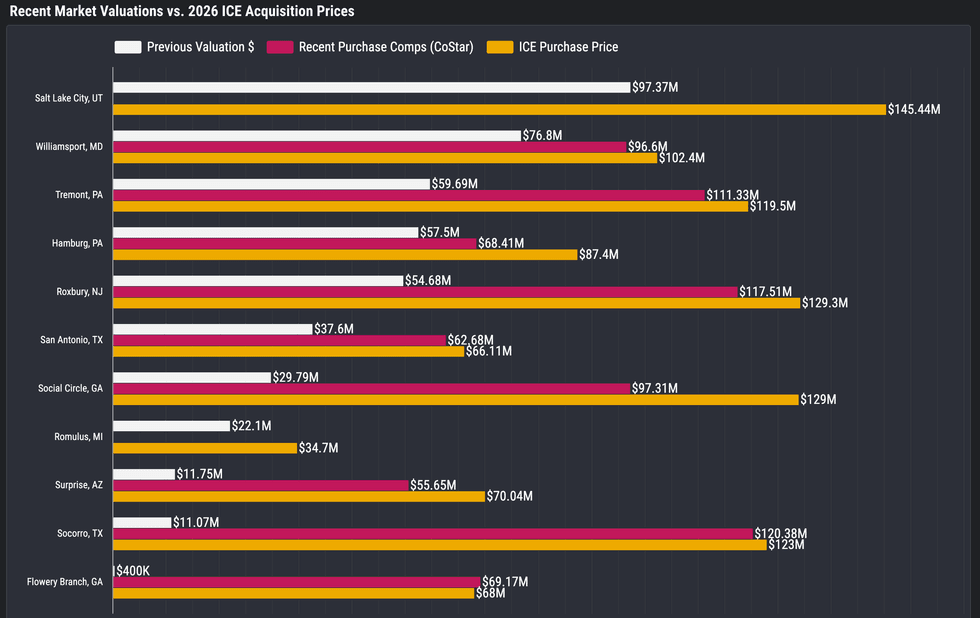 (Graphic by Project Salt Box)
Many of the warehouses that raked in obscene taxpayer-funded purchases by DHS were owned by financial institutions with deep connections to the Trump administration, Ryan explained.
One warehouse in Roxbury, New Jersey, valued at about $54.6 million in 2025, inexplicably sold to ICE for over $129 million, more than double. Its majority owner was the investment bank Goldman Sachs, where many Trump appointees during his first term—including former Treasury Secretary Steve Mnuchin and Trump financial adviser Gary Cohn—were formerly employed.
ICE paid double for another warehouse in Tremont, Pennsylvania, buying it for nearly $120 million despite a valuation of about $60 million. It was owned by the private capital firm Blue Owl, where at least 33 members of Trump's administration have investments in its funds, including the president himself, who has about $5 million invested in the firm.
Another in Salt Lake City, valued at just $97 million, was purchased by ICE for $145 million, and the agency now plans to convert it into a 10,000-bed facility. It was owned by Deutsche Bank, which has loaned Trump about $2.5 billion over the past two decades.
Wriston told More Perfect Union that the financial payout to Trump allies was top of mind for DHS as it drew up the controversial warehouse plan.
"ICE doesn't necessarily want to be using warehouses," he said. "The plan came from folks very close to the White House who were sitting on properties that were causing them losses every year. And the decision was made to buy them at taxpayer expense."
It's part of a larger pattern of ICE contracts being distributed to companies that have given major financial support to Trump.
According to an investigation in March by OpenSecrets, the GEO Group and CoreCivic, two private prison companies that have collectively received more than $2.8 billion in ICE contracts, each donated $500,000 to Trump's inaugural committee. The GEO Group's employee-funded political action committee contributed $1 million to the pro-Trump super PAC Make America Great Again, Inc. during his reelection campaign in 2024.
The vast majority of those who have been detained during Trump's second term have had no criminal records, despite claims by the administration that they are targeting "the worst of the worst" criminals for deportation.
Those who have been held in ICE detention centers—often without any due process or access to a lawyer—have consistently reported being held in horrendous conditions, denied access to basic food, sanitation, and medical care, and subject to torture and sexual assault by guards.
DHS has reportedly spent only about $1 billion of the more than $38 billion allotted for immigration detention warehouses so far. According to The New York Times, the administration is hoping to build a mass detention system that could stuff these warehouses with over 100,000 detainees at a time across more than 20 facilities.
According to Wriston's running tracker of ICE warehouse sales, at least 13 purchases have been canceled, in many cases due to public backlash. Still, the administration has already purchased enough warehouse space to hold more than 41,500 people at once.
"What we're seeing happen now—I never in a million years envisioned seeing this happen on US soil," Wriston said. "Never. Never once."

"Only by coming together and flexing our collective power as students, workers, tenants, and community members will we build a world for the 99%."
Gen Z's rightward shift in the 2024 election and the influence of Turning Point USA, the right-wing college organization co-founded by assassinated activist Charlie Kirk, have garnered considerable attention in the press—but a new project launched Wednesday by the labor-focused media group More Perfect Union makes the case that young voters across the country want an opportunity to strengthen "our collective power as the 99%."
While Turning Point USA has cast itself as an antidote to liberal viewpoints and "wokeness" on college campuses, Elise Joshi, who is leading the More Perfect University initiative, emphasized in The New York Times that Turning Point has demonstrated a steadfast “refusal to champion working-class issues.”
More Perfect University aims to mobilize young people in a movement centered on economic populism—turning their attention to the outsized power of corporations and ultrarich political donors while Turning Point USA is holding conventions where CEO Erika Kirk implores 20-something women to focus on finding a husband and condemns pro-immigration protesters as "demonic."
“The same corporations that are rigging the economy against young people are bankrolling the right’s campus operation,” Joshi told the Times.
In More Perfect University's launch video, released on Wednesday, Joshi said today's college students are "being robbed by Big... Everything."
From oil companies to private equity firms buying up housing, said Joshi, "elites have rigged the entire game. While they get billions in handouts, they squeeze us for profit, track our every move, and keep us too divided and exhausted to fight back."
NEW: More Perfect Union is opening up our newsroom, connecting with students everywhere, and equipping them with the tools needed to unrig our broken economic system. pic.twitter.com/oQT6sRqKC8
— MPUniversity (@MPUniversityUS) April 15, 2026
According to the group's website, More Perfect University will hold campus events that bring "all corners of campus life together" to build community and organize around efforts to fight for working people, offer virtual trainings where students can "connect with organizers already building power and winning," and open up More Perfect Union's newsroom to students, training them "to tell local stories that take on unchecked power."
"Mainstream media and establishment politicians are captured by corporate interests," said Joshi. "It's up to us to cover the issues our communities are facing and how everyday people are coming together to combat them.
The "student storytellers" with whom More Perfect University works, Joshi told the Times, will “understand our economy is not broken by accident.”
On April 20, US Sen. Bernie Sanders (I-Vt.) is set to co-host a virtual launch party for More Perfect University with journalist John Russell. The group is also planning an online event with former Federal Trade Commission chair Lina Khan, an outspoken critic of corporate monopolies and corruption.
The initiative comes as young voters express growing dissatisfaction with President Donald Trump's administration, less than a year and a half after voters ages 18-29 voted for former Democratic Vice President Kamala Harris by only four percentage points, signifying a major shift to the right following the 2020 election. Former President Joe Biden won the demographic by a 25-point margin in 2020.
The Yale Youth Poll, released on Wednesday, found that the views of voters ages 18-34 are heavily impacting Trump's overall sinking approval ratings. Sixty-eight percent of voters ages 18-22 disapprove of the president, according to the poll, as well as 72% of 23- to 29-year-olds.
More Perfect University is also launching as the Trump administration wages attacks on academic freedom on college campuses. Last month the US Department of Justice filed a lawsuit against Harvard University, alleging the school has "allowed antisemitism to flourish on campus."
Universities including Columbia and Northwestern have been criticized by students and faculty for capitulating to Trump, striking deals and agreeing to policy changes in order to restore federal funding that was cut.
"Mainstream media, politicians, and universities are capitulating to the 1%," reads More Perfect University's website. "The responsibility to tackle authoritarianism and corporate greed falls on us. We cannot do that scattered and isolated. Only by coming together and flexing our collective power as students, workers, tenants, and community members will we build a world for the 99%."

"The marketplace is fundamentally broken," one rancher explained.
Even as US beef prices have continued to surge, American cattle ranchers have come under increased financial pressure—and a new report from More Perfect Union claims that this is due in part to industry consolidation in the meat-packing industry.
Bill Bullard, the CEO of the trade association R-CALF USA, explained to More Perfect Union that cattle ranchers are essentially at the bottom of the pyramid in the beef-producing process, while the top is occupied by "four meat packers controlling 80% of the market."
"It's there that the meat packers are able to exert their market power in order to leverage down the price that the cattle feeder receives for the animals," Bullard said.
To illustrate the impact this has had on farmers, Bullard pointed out that cattle producers in 1980 received 63 cents for every dollar paid by consumers for beef, whereas four decades later they were receiving just 37 cents for every dollar.
"That allocation has flipped on its head because the marketplace is fundamentally broken," Bullard told More Perfect Union.
Angela Huffman, president of Farm Action, recently highlighted the role played by the four big meatpacking companies—Tyson, Cargill, National Beef, and JBS—in hurting US ranchers.
Writing on her Substack page earlier this month, Huffman zeroed in on Tyson's recent decision to close one of its meatpacking plants in Lexington, Nebraska to demonstrate the outsize power that big corporations have over the US food supply.
The Lexington plant employs more than 3,000 people and is capable of processing 5,000 head of cattle a day, and its closure is expected to both devastate the local economy and have a major impact on US ranchers throughout the region.
Huffman noted a report from the Associated Press estimating that the Lexington plant's closure, combined with projected job cuts at a Tyson plant in Amarillo, Texas, could cut national beef processing capacity by up to 9%.
"Ranchers were already dealing with high costs, drought, and years of uneven prices," Huffman wrote. "Now they face even less competition for their cattle. When there are fewer packers active in the market, ranchers have less bargaining power, and cattle prices fall even as beef prices in grocery stores stay near record highs."
Dan Osborn, an independent US Senate candidate running in Nebraska, has made the dangers of corporate consolidation a central theme of his campaign, and on Monday he released a video explaining why he spends so much time talking about monopolies, particularly in the agricultural industry.
"If you're a farmer, your inputs, your seed, your chemicals, you have to buy from monopolies," he said. "Sygenta, Chinese-owned company you've got to buy your seed from, they control and manipulate that market. And then when your production's over and you're selling it, you're selling it to monopolies as well."
Want to know why I talk about MONOPOLIES all the time? This is why. 👇 pic.twitter.com/MuYh0gZRVr
— Dan Osborn (@osbornforne) December 22, 2025
Osborn said that the trend of industry consolidation wasn't just limited to agriculture, but is now moving forward with major railroad and media mergers.
"We need to create an economic environment in this country that favors competition," he said. "That's what a free market is. A free market isn't three or four big people or big corporations controlling everything."

"Instacart is far from the only corporation using AI technologies to determine exactly how much profit they can extract from their customers by overcharging them," said the executive director of Groundwork Action.
The watchdog group that exposed Instacart's artificial intelligence pricing scheme is rejoicing after the company announced on Monday that it was ending the controversial program.
Earlier this month, Consumer Reports joined the Groundwork Collaborative and More Perfect Union to report that the grocery shopping app—which calls itself the "largest online grocery marketplace in North America"—was using the AI pricing software Eversight to charge up to 23% more for some customers than others for the same items, subjecting users to a "pricing experiment" that could cost them as much as $1,200 extra each year.
The Federal Trade Commission (FTC) took notice of the report, saying it was "disturbed" by the findings, and launched an investigation on Thursday, which caused the company's stock price to plummet by about 7%. It also attracted attention from members of Congress, including Senate Minority Leader Chuck Schumer (D-NY), who demanded government action on what he called "shakedown pricing."
Instacart agreed that same day to pay the FTC $60 million in a settlement for what the commission said was "a variety of deceptive tactics that misled consumers and caused them to pay more in fees." These included falsely advertising "free delivery" to consumers on their first order, implying that customers would receive a full refund if they were dissatisfied with their delivery, and failing to disclose membership charges.
The settlement does not mention Instacart's use of AI pricing experiments, but on Monday, the company said it would hit the brakes on that as well, following customer backlash.
"Effective immediately, Instacart is ending all item price tests on our platform. Retailers will no longer be able to use Eversight technology to run item price tests on Instacart," the company said in a statement. "Now, if two families are shopping for the same items, at the same time, from the same store location on Instacart, they see the same prices—period."
While it acknowledged that the pricing scheme "missed the mark for some customers," the company maintains that it was not using "dynamic pricing or surveillance pricing" and that it was not changing prices "based on supply or demand, personal data, demographics, or individual shopping behavior."
Alex Jacquez, Groundwork's chief of policy and advocacy, celebrated on social media that "Instacart has ended all item pricing experiments on its platform," calling it a "big win for consumers."
Groundwork Action's executive director, Lindsay Owens, likewise took pride in the fact that "once we pulled back the curtain on Instacart’s hidden pricing experiments, the company had no choice but to close the lab," but also said "it shouldn’t take investigative research, public outcry, and the threat of FTC action to convince companies not to treat consumers like lab rats."
"Instacart is far from the only corporation using AI technologies to determine exactly how much profit they can extract from their customers by overcharging them," she added.
Though the investigation did not find evidence that Instacart was using these methods, other companies—including Amazon, Delta Air Lines, and Home Depot—have been accused of fluctuating prices for consumers based on ZIP code or income level.
Owens said, "It’s time for regulators to put a stop to corporate pricing schemes and take action to restore fair, predictable, and transparent pricing.”
Meta is financing the data center using accounting tricks that the Wall Street Journal reports appear "too good to be true."
The tiny town of Holly Ridge, Louisiana will soon be home to a massive $27 billion artificial intelligence data center being built by Facebook parent company Meta that, when finished, will be the largest in the world.
However, residents of Holly Ridge do not feel honored that they are at the epicenter of Meta's ambitious data center buildout, which they say has upended their entire community.
As reported by New Orleans-based public radio station WWNO last week, the nonstop parade of trucks driving through Holly Ridge has led to a 600% increase in vehicle crashes over the last year, including three truck crashes that occurred just outside Holly Ridge Elementary School.
Penelope Hull, a fourth-grade student at the school, told WWNO that the data center construction trucks are highly disruptive to learning even on days when they don't get into accidents, as they often cause the classroom walls to shake.
"You can't pay attention," she said. "And then you get off track and you lose what the teacher was telling you to do."
Hull also said that the school has had to shut down its playground out of concern that Meta construction trucks will crash into children playing during recess.
The threat of trucks crashing into schools isn't the only problem that the data center has brought. Local residents Joseph and Robin Williams told WWNO that they've noticed their tap water is frequently rust colored since Meta started building the data center, and they say their electricity frequently goes off for hours on end with no warning.
Similar issues were documented by progressive media outlet More Perfect Union, which sent its reporters down to Holly Ridge and found residents felt their concerns were being completely ignored by both Meta and their local elected officials.
"We had no voting on it, no community meetings, no nothing," one local woman told More Perfect Union. "It was done all under the table."
Another local resident told More Perfect Union that Holly Ridge has become "totally different" ever since Meta began AI data center construction.
"Who wants to live like this?" he asked as he looked on at more construction trucks barreling through the community.
Zuckerberg is building a data center in Louisiana the size of Manhattan — while Meta runs ads about how small towns love their data centers, we found furious locals who plan to leave town completely. pic.twitter.com/xHLG4KJMLO
— More Perfect Union (@MorePerfectUS) November 19, 2025
According to a Monday report in the Wall Street Journal, the massive Meta Louisiana data center is being funded through debt that is being papered over with accounting gimmicks that the paper notes are likely "too good to be true."
Specifically, the Journal said that Meta has created a joint venture known as a variable interest entity with investment manager Blue Owl Capital, in which Meta will rent the data center for up to 20 years as a way to keep the debt from its construction off its books.
"This lease structure minimizes the lease liabilities and related assets Meta will recognize, and enables Meta to use 'operating lease,' rather than 'finance lease,' treatment," the Journal explained. "If Meta used the latter, it would look more like Meta owns the asset and is financing it with debt."
However, the report noted that Meta is relying on "some convenient assumptions" in justifying its use of this accounting tactic, some of which "appear implausible" and "are in tension with one another," which makes it hard to justify keeping debt from the data center off its books.
"Ultimately, the fact pattern Meta relies on to meet its conflicting objectives strains credibility," reports the Journal. "To believe Meta’s books, one must accept that Meta lacks the power to call the shots that matter most, that there’s reasonable doubt it will stay beyond four years, and that it probably won’t have to honor its guarantee—all at the same time."
Commenting on the Journal's story about the data center financing, Wired editor Tim Marchman described it in a post on Bluesky as "the equivalent of a 500-foot neon sign reading 'FRAUD.'"
One group noted who would actually complain: "Someone who depends on Social Security to buy groceries. Someone who depends on Social Security to pay rent. Someone who depends on Social Security to survive."
As U.S. President Donald Trump's temporary leader of the Social Security Administration threatened to shut down the agency over an unfavorable court ruling on Friday, the billionaire commerce secretary came under fire for suggesting that only "fraudsters" will complain if they don't get their earned benefits.
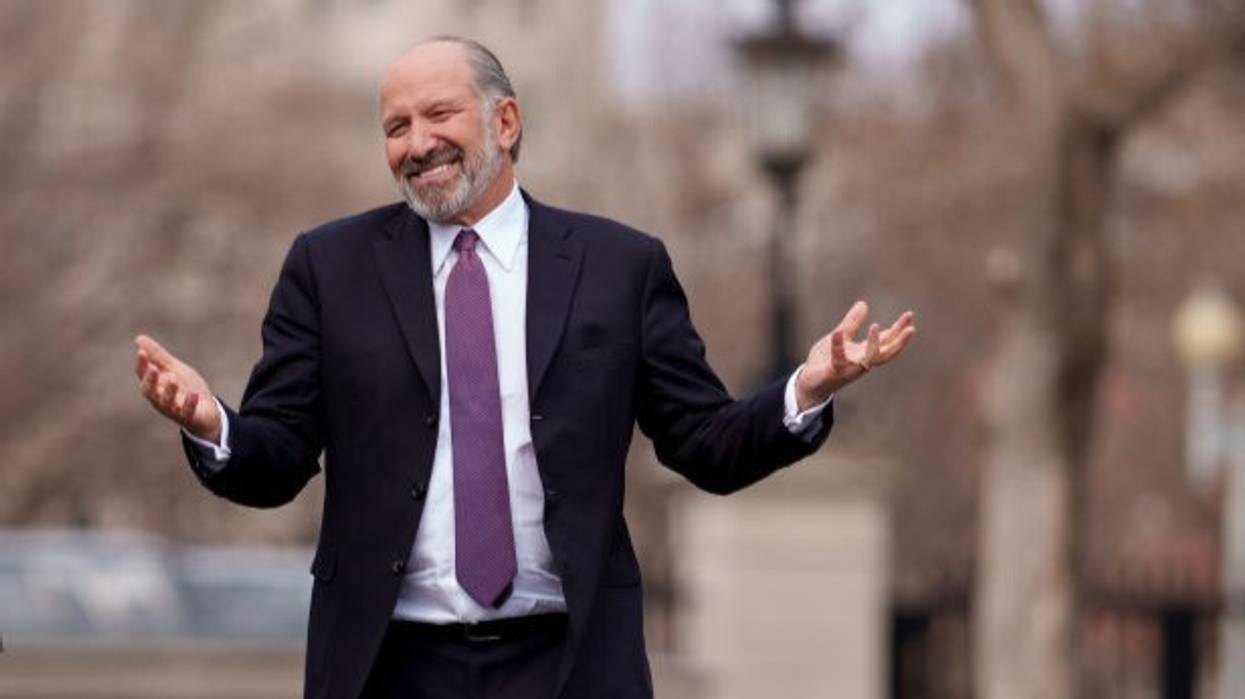
U.S. Commerce Secretary Howard Lutnick appeared on All-In—a podcast hosted by "four billionaire besties"—on Thursday. A brief clip of his interview, which lasted an hour and 45 minutes, made the rounds on social media Friday.
Lutnick told two of the hosts that if the SSA didn't send out checks this month, his 94-year-old mother-in-law "wouldn't call and complain," but "a fraudster always makes the loudest noise, screaming, yelling, and complaining."
Critics were quick to point out Lutnick's wealth. As More Perfect Union posted, "His net worth is estimated at $2 billion."
Richard Phillips, pensions and tax policy director for U.S. Senate Committee on Health, Education, Labor, and Pensions Ranking Member Bernie Sanders (I-Vt.),
called the commerce secretary's comments "shameful."
"Nearly 40% of seniors rely on Social Security for a majority of their income and nearly 1 in 7 rely on it for more than 90% of their income," according to Phillips. "These people would call due to missing checks because their very survival depends on it."
The watchdog group Public Citizen similarly pushed back on social media, saying: "You know who actually makes the loudest noise? Someone who depends on Social Security to buy groceries. Someone who depends on Social Security to pay rent. Someone who depends on Social Security to survive. But billionaires like Howard Lutnick don't care about those people."
Groundwork Collaborative chief of policy and advocacy Alex Jacquez said in a statement that "the Trump administration just told seniors that they should shut up and sit down if they don't receive their Social Security checks on time. The real 'fraudsters' are Trump's out-of-touch billionaire donors and advisers denying seniors their hard-earned benefits to pay for their next tax giveaway."
Everett Kelley, president of the American Federation of Government Employees, a union for federal workers, also tied Lutnick's remarks to Republican tax ambitions—as well as a broader attack on the federal bureaucracy by Trump and the de facto leader of his Department of Government Efficiency (DOGE), billionaire Elon Musk.
"First, Elon called Social Security a 'Ponzi scheme' and said we need to eliminate it," Kelley said. "Then DOGE started trying to cut SSA staff. Now Lutnick says 'don't complain' when the payments stop. They are taking money from working-class people in order to give it to their rich friends."
As Common Dreams reported earlier Friday, acting Social Security Administration Commissioner Leland Dudek is threatening to shut down the agency in response to a federal judge's Thursday order blocking DOGE's SSA "data grab." The Washington Post later revealed that the official "is consulting with agency lawyers and the Justice Department" about the possible shutdown.
Some political observers see the Republican administration's attacks on the SSA—and the rest of the federal government—as a major opportunity for the Democratic Party, which has minorities in both chambers of Congress.
"If Dems have any strategic mojo left, they will clip this and play it on a nonstop television ad loop in the two Florida districts holding special congressional elections," Helaine Olen of the American Economic Liberties Project said about the Lutnick interview. "Seniors will rightly whine when their checks don't show up."
Already, some seniors have publicly shared stories of benefits incorrectly shut off since Trump took office, and some congressional Democrats are taking aim at his administration. Rep. John Larson (D-Conn.), a longtime SSA defender who has framed the DOGE assault as a push toward privatization, posted the commerce secretary's video on social media.
"Trump and Musk's cuts to the Social Security Administration could lead to the delay, denial, and disruption of your EARNED BENEFITS," Larson said Friday. "For 40% of our seniors, Social Security is the only income they have. They can't just wait for their next check."
Also responding to the clip, Sen. Chris Murphy (D-Conn.) said, "They are getting ready to destroy Social Security. Because the billionaires don't need it. Prepping the ground here by shaming people who dare complain if their Social Security check disappears."
The Social Security comments aren't the only reason the commerce secretary is facing intense criticism this week. On Wednesday, he told viewers of Fox News' "Jesse Watters Primetime" to buy stock in Musk's electric vehicle maker, Tesla. One watchdog leader noted that Lutnick "conveniently forgot to mention his family business empire holds nearly $840 million in the company."
The nonpartisan Campaign Legal Center on Friday filed a complaint with the Office of Government Ethics and an ethics official at the U.S. Department of Commerce, urging them to investigate Lutnick's comments about Tesla stock—which has been crashing due to protests of the company resulting from Musk's work for the Trump administration.

"While Trump cuts programs you need to live, he's turning the White House into a car dealership to advertise his unelected shadow president's failing company," said one critic.
With Tesla's stock plummeting since the electric carmaker's CEO, Elon Musk, arrived in Washington, D.C. and began slashing federal jobs and programs, U.S. President Donald Trump on Tuesday was intent on helping his "special government employee" as he spent part of the afternoon inspecting five of the company's cars on the White House lawn.
The president declared the cars "beautiful" and expressed hope that his purchase of a Tesla will help the company's financial position.
More Perfect Union, the labor-focused media organization, cast doubt on Musk's claim that he will double production due to the president's interest, "given declining demand for his cars."
"This is just two corrupt oligarchs scratching each other's backs," said the group.
He also joined Musk in condemning protests that have broken out at Tesla dealerships over the CEO's work at the Trump-created Department of Government Efficiency (DOGE), which has pushed to dismantle agencies across the federal government and overseen the firing of about 30,000 federal employees.
"It's really terrible that there's so much violence being perpetrated against people at Tesla, Tesla supporters, Tesla owners, Tesla stores" said Musk after thanking Trump for displaying the cars. "These are innocent people who have done nothing wrong."
There have been at least 10 acts of vandalism reported against Tesla vehicles, charging stations, and dealerships in recent weeks as outrage has grown over the unelected Musk's enormous influence at the White House. No injuries have been reported in any of the incidents.
Shares of the company plummeted 15% on Monday—Tesla's worst day in four and a half years. Since peaking in mid-December after Musk poured nearly $300 million into Trump's election campaign, Tesla's shares have lost more than 50% of their value and the company has lost more than $800 billion.
Before parading Tesla's products in front of the press at the White House, the president took to his social media platform, Truth Social, to lambast "Radical Left Lunatics" for "trying to illegally and collusively boycott" his ally and benefactor's company.
"Why should he be punished for putting his tremendous skills to work in order to help make America great again?" asked Trump.
Podcast host Matt Bernstein called the scene at the White House "jaw-dropping."
"While Trump cuts programs you need to live, he's turning the White House into a car dealership to advertise his unelected shadow president's failing company," said Bernstein. "Dystopian levels of corruption."
At the White House, the president also suggested he may label any attacks against Musk's dealerships as domestic terrorism.
"Those people are going to go through a big problem when we catch them," said Trump. "And let me tell you, you do it to Tesla, and you do it to any company, we're going to catch you and you're going to go through hell."
Murtaza Hussain of Drop Site News projected that with the Trump administration pushing to deport visa holders who have participated in pro-Palestinian protests—with at least one abducted by immigration agents and detained in recent days—"we're maybe two years away from people deported for terrorism for keying a Tesla."
The recent race for DNC chair raises questions about how the progressive wing of the party can and should move forward toward 2028.
Just before starting to write my lament about what a dramatic step backward the recent campaign for Democratic National Committee chair had been, I opened an Our Revolution email that told me, “We beat back the party establishment at the DNC.”
Now Our Revolution being a direct organizational descendent of the 2020 Bernie Sanders presidential campaign, and me having been a 2016 Sanders convention delegate, I feel pretty confident that our ideas of who “we” means are pretty much the same. So what accounts for the widely divergent takes?
For those who haven’t been following this, Minnesota’s Democratic-Farmer-Labor Party Chair Ken Martin was just elected to lead the DNC for the next four years, defeating Wisconsin Democratic Party Chair Ben Wikler by a 246.5–134.5 vote margin. There was no contested election four years ago, because by tradition a just-elected president selects the new chair; contested elections generally follow defeats. In the last one, in 2017, former Obama administration Secretary of Labor Tom Perez won the job, beating Minnesota Rep. Keith Ellison in a second round of voting, 235--200.
At the moment there is no one obviously positioned to take up the Sanders’ mantle in the 2028 presidential campaign.
Ellison’s candidacy came in the wake of his having been just the second member of Congress to support Sanders in the prior year’s presidential primaries, and the fact that Sanders people harbored serious grievances with the DNC over its perceived favoritism for the ultimate nominee, Hillary Clinton, lent a distinct edge to the election, bringing it considerably more buzz than the one that just occurred. At the time, former Massachusetts Rep. Barney Frank, a vociferous opponent of Sanders’ run—who had once declared, “The most effective thing liberals and progressives can do to advance our public policy goals... is to help Clinton win our nomination early in the year”—now thought there was “a great deal to be said for putting an active Sanders supporter in there,” so as to clear the air “of suspicions and paranoia.” But Clinton and Barack Obama apparently didn’t think so, and Clinton’s past Obama cabinet colleague, Perez, took up the torch in a race that produced a level of grassroots involvement seldom if ever before seen in this contest.
Although the office is traditionally considered organizational rather than ideological and the 2017 candidates did run on those issues, the underlying political differences were obvious to all. This time around, the race was generally understood to involve little if any political disagreement on the issues. By way of explaining its support for new party chair Martin, Our Revolution characterized runner-up Wikler, as “an establishment candidate backed by Nancy Pelosi, Hakeem Jeffries, and Chuck Schumer, and bankrolled by the billionaire class.” We understand that election campaigns are about sharpening the perception of differences between the candidates, but still this seems a rather thin, flimsy basis for hailing the vote as an anti-establishment triumph, given that Martin has publicly stated that he doesn’t want the party to take money from "those bad billionaires" only from "good billionaires;”and one of the two billionaires who gave a quarter million dollars to Wikler’s campaign was George Soros—probably the DNC’s model “good billionaire.” Besides Musk/Bezos/Zuckerberg probably aren’t thinking of donating anyhow. Oh, and Chuck Schumer actually supported Ellison eight years ago.
Actually, “we” did have a horse in the race—2020 Sanders campaign manager Faiz Shakir. Shakir, who has been running a nonprofit news organization called More Perfect Union, dedicated to “building power for the working class,” argued that Democrats needed a pitch for building a pro-worker economy to go with their criticism of U.S. President Donald Trump’s policy proposals. His viewpoint presented a serious alternative to that of Martin, who told a candidates forum that “we’ve got the right message... What we need to do is connect it back with the voters,”—seemingly a tough position to maintain following an election in which NBC’s 20-state exit polling showed the majority of voters with annual household incomes under $100,000 voting Republican, while the majority of those from over-$100,000 households voted Democrat. But even though Shakir was a DNC member and thereby able to get the 40 signatures of committee members needed to run, he entered the race far too late to be taken for a serious contender and ultimately received but two votes.
Mind you, none of this critique comes as a criticism of the work of the two state party chairs who were the principal contenders. Martin touts the fact that Democrats have won every statewide election in Minnesota in the 14 years that he has chaired the party, and anyone who understands the effort that goes into political campaign work can only admire that achievement. Nor is Our Revolution to be criticized for taking the time to discern what they thought would be the best possible option in a not terribly exciting race that was nevertheless of some importance.
At the same time it’s hard not to regret the diminished DNC presence of the “we” that Our Revolution spoke of, after “we” legitimately contended for power in the last contested election. Certainly this lack of interest was in no small part a consequence of the extraordinary circumstances that produced a presidential nominee who had not gone before the voters in a single primary—for the first time since Hubert Humphrey in 1968.
More importantly, it raises a serious question for those of us who believe that the structure and history of the American political system require the left’s engagement in the Democratic Party—uncomfortable and unpleasant as that may be at times. As the social scientists like to say, politics abhors a vacuum, and absent a national Democratic Party presence for the perspective that motivated the Sanders campaigns, people seeking action on the big questions on the big stage may start to look elsewhere. And elsewhere always looms the possibility of the cul-de-sac of yet of another third party candidacy that holds interesting conventions and debates, but ultimately receives only a small share of the vote, but a large share of the blame for the election of a Republican president.
At the moment there is no one obviously positioned to take up the Sanders’ mantle in the 2028 presidential campaign. But we may have to make it our business to find one.
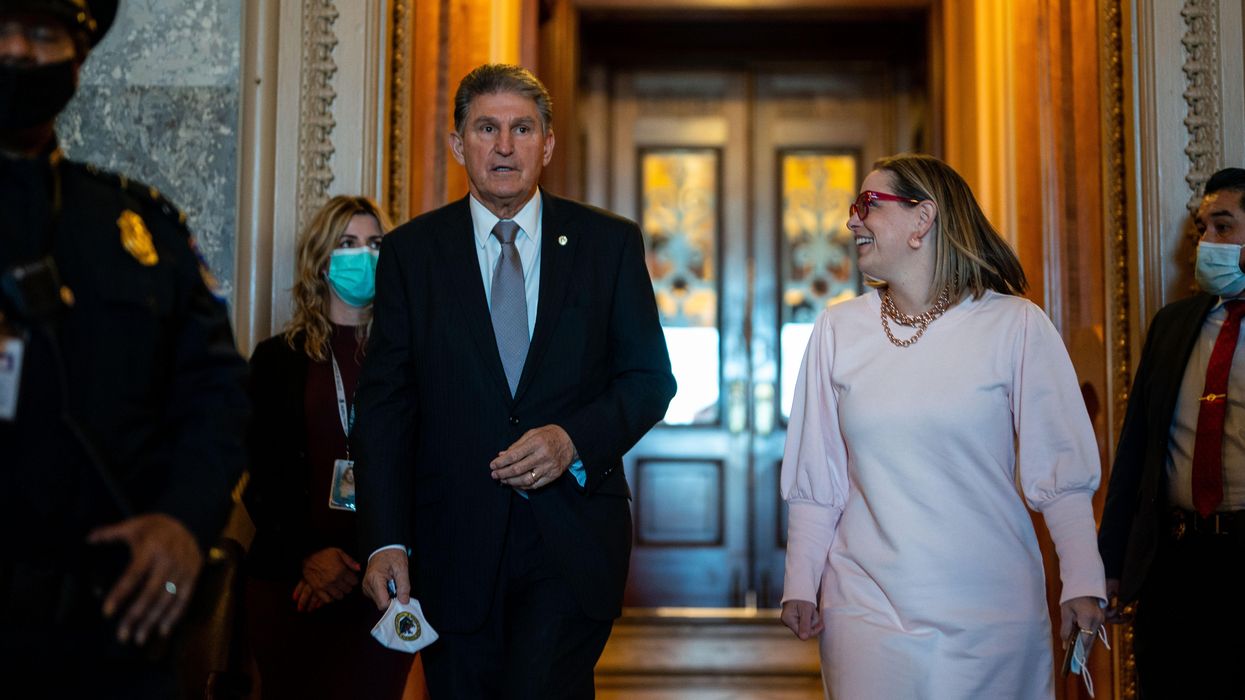
In a move likely fraught with major implications for worker rights during the impending second administration of Republican President-elect Donald Trump, Democratic-turned-Independent U.S. Sens. Joe Manchin and Kyrsten Sinema on Wednesday blocked Democrat Lauren McFerran's bid for a second term on the National Labor Relations Board.
With every Republican senator except Sen. Roger Marshall of Kansas voting against President Joe Biden's nomination of McFerran for a new five-year term, the fate of the woman who has led the agency since 2021 was up to Manchin and Sinema—who, as More Perfect Union founder and executive director Faiz Shakir put it on social media, "consistently spoiled the story of 'what could have been'" by years of fighting to thwart their own former party's agenda.
Sinema struck first, her "no" vote on McFerran grinding the confirmation tally to a 49-49 tie. Manchin, who showed up later, cast the decisive vote, negating speculation that Vice President Kamala Harris, the Senate president who lost the presidential contest to Trump last month, would break the stalemate.
"It is deeply disappointing, a direct attack on working people, and incredibly troubling that this highly qualified nominee—with a proven track record of protecting worker rights—did not have the votes," lamented Senate Majority Leader Chuck Schumer (D-N.Y.).
Chris Jackson, a former Democratic Lawrence County, Tennessee commissioner and longtime labor advocate, called Manchin and Sinema's votes "a crushing blow to the labor agenda."
"By casting decisive NO votes against President Biden's NLRB nominee, they've guaranteed Democrats will lose control of the national labor board until at least 2026," Jackson said. "Their votes effectively hand Donald Trump the keys to the board the moment he takes office again. This is a betrayal of working families—and a gift to corporate interests, which is par for the course for these two."
Sara Nelson, president of the Association of Flight Attendants-CWA union, said on social media that while "Manchin and Sinema are responsible for killing voting rights, worker rights, women's rights, LGBTQ rights, childcare, vision, and dental for seniors, and an economy built for the people," the two obstructionist senators "are not the story."
"Don't bury the lede," implored Nelson. "The entire GOP has relentlessly fought against anything good for the vast majority of the people of this country. The GOP shows once again their total disdain for their constituents."
"But they better watch what they do in implementing their plans to make it worse," she warned. "These laws are set up to mostly protect corporations and getting rid of the last pathetic bits of worker rights under the law will simply lead to more disruption and CHAOS."
Trump's first term saw relentless attacks on workers' rights. Critics fear a second Trump administration—whose officials and agenda are steeped in the anti-worker Project 2025—will roll back gains achieved under Biden and work to weaken the right to organize, water down workplace health and safety rules, and strip overtime pay, to name but a handful of GOP wish-list items.
The latest votes by Manchin and Sinema—who are both leaving Congress after this term—sparked widespread outrage among workers' rights defenders on social media, with one account on X, formerly known as Twitter, posting: "Manchin is geriatric and Sinema has a long fruitful career ahead of her in a consulting firm that advocates child slave labor, but at least they kicked the working class in the teeth one last time. Nothing to do now but hope there's a hell."

John Russell urged Democrats to serve working Americans "looking for a political home, after years of both parties putting profit above people."
The Democratic National Convention on Thursday featured a video and speech from More Perfect Union reporter John Russell, who stressed to the Chicago crowd that the party has an opportunity to win over working-class people.
"Thank you to the workers that make this convention happen," Russell began. "Let's never forget how essential all of our labor is."
"I come from Appalachia," he explained. "We kept the lights on in this country for generations. But the wealth made by our broken backs and our black lungs never did trickle down. And Washington listened to rich men demanding that we stick with dirty energy at any cost."
"Across the country, working-class people are looking for a political home, after years of both parties putting profit above people," he said before taking aim at the Republican nominee, former President Donald Trump—who has chosen Sen. JD Vance (R-Ohio), author of Hillbilly Elegy, as his running mate.
"Now Trump, a billionaire, says that he'll take on the elites, but then he promises handouts to Big Oil and he punches down at anyone with the guts to be different," Russell noted. "Populism that insists we are too different to get along is just divide and conquer by a different name."
More Perfect Union reporter @heyjohnrussell just spoke directly to the DNC crowd:
"It is our choice to build on this progress and to create a political home for the mass of working Americans fighting for control over their government, their workplaces, and their planet." pic.twitter.com/lbZaCpJKgw
— More Perfect Union (@MorePerfectUS) August 23, 2024
"There's another sort of populism, with roots in this party, that we—in West Virginia—know well," said Russell, a resident of the state. He pointed to a century ago, when the term "rednecks" was used to deride organized coal miners who "wore red bandanas around their necks as they fought and died for respect and a living wage."
"Their fight yesterday is our fight right now," Russell declared to a roaring crowd. "It is our choice to build on this progress and to create a political home for the mass of working Americans fighting for control over their government, their workplaces, and their planet. And it is our moment to live up to. Let's get after it."
The Nation president and Jacobin founding editor Bhaskar Sunkara said on social media: "I'm pretty sure that John Russell just made the most radical speech in the history of the DNC. A call for class solidarity and a world where working people control their workplaces and their futures."
Antonia Juhasz, a senior researcher on fossil fuels at Human Rights Watch, also responded with praise. Sharing the video, she said, "A great speech on climate action: Climate Action is action for workers, for justice, and for health from John Russell."
In addition to Russell's address, the DNC audience saw a two-minute More Perfect Union video in which he spoke to workers across the United States and highlighted positive impacts of the Inflation Reduction Act, which congressional Democrats passed and President Joe Biden signed two years ago.
Our team has traveled America documenting the impact of historic investments in clean energy, manufacturing, and infrastructure.
From Las Vegas to Tennessee, working people’s lives are changing.
Watch the video we aired at the DNC on why we need an agenda that centers workers: pic.twitter.com/cXio7CbzPm
— More Perfect Union (@MorePerfectUS) August 23, 2024
One of multiple "influencers" or content creators to take the stage this week, Russell has a significant social media following and a newsletter called The Holler. Before West Virginia, he lived in Ohio, where he ran for state House in 2016 and Congress two years later.
Russell told Justice Hudson of the Wheeling Free Press that "we need a populism that doesn't divide us, but unites us."
"That's the way forward, especially as we are fighting against right-wing politicians who are offering us a fake version of populism—and we know it's fake because they want us to point fingers at each other rather than at the wealthy," he continued.
Russell also acknowledged that "we have not heard Palestinian voices on the stage, even as this party claims to be working to stop the carnage unfolding in the Middle East," and urged Democrats to stop "silencing or burying their heads in the sand at protestors outside making the very simple ask of five minutes of speaking time so that Palestinians are represented."
Other champions of the working class who have addressed the DNC this week included United Auto Workers president Shawn Fain, U.S. Rep. Alexandria Ocasio-Cortez (D-N.Y.), and Sen. Bernie Sanders (I-Vt.)—who also spoke Monday at a Progressive Democrats of America event, where he celebrated people across the country who are organizing "on a class basis" and "prepared to take on big money interests."