

SUBSCRIBE TO OUR FREE NEWSLETTER
Daily news & progressive opinion—funded by the people, not the corporations—delivered straight to your inbox.
5
#000000
#FFFFFF
To donate by check, phone, or other method, see our More Ways to Give page.
Daily news & progressive opinion—funded by the people, not the corporations—delivered straight to your inbox.
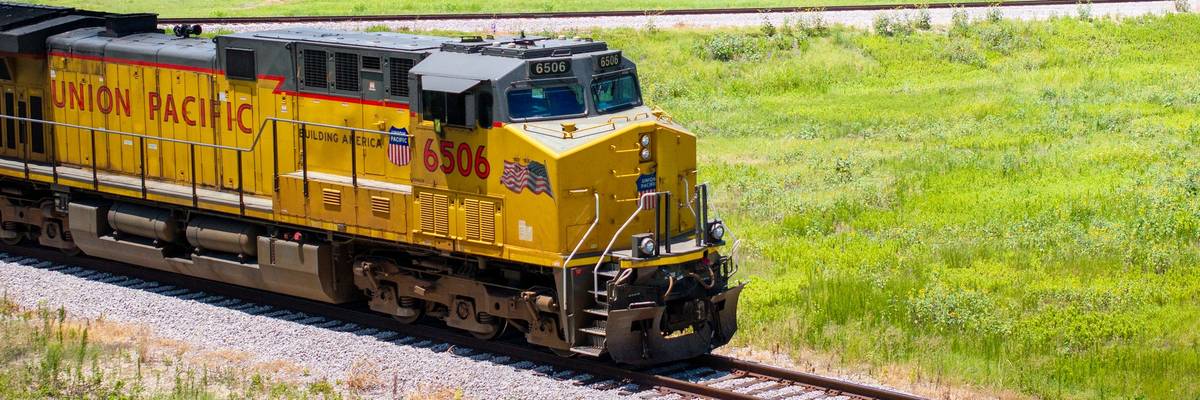
In an aerial view, a Union Pacific freight train travels on July 29, 2025 in Hutto, Texas.
"For rail customers, it will be a choice between ‘Hell or the highway,’” said Mark Wallace, the national president of the Brotherhood of Locomotive Engineers and Trainmen.
Two of America's largest railway workers unions have come out against the $85 billion merger of two major railroad conglomerates, warning that it will harm competition and worker safety.
The Brotherhood of Locomotive Engineers and Trainmen (BLET) and the Brotherhood of Maintenance of Way Employees Division (BMWED) represent more than half of the employees at the Union Pacific Railroad and the Norfolk Southern Corporation, which it plans to acquire.
The US Surface Transportation Board (STB) is expected to receive a formal proposal from the two companies on Friday. President Donald Trump said in September that the deal "sounds good" to him.
If approved, it would allow the two firms to merge into the largest railroad company in US history, controlling more than 50,000 miles of track across 43 states. According to the Associated Press, such a railroad would likely control over 40% of the nation's freight.
The unions warned on Wednesday that the deal would create a "de facto monopoly" in large swaths of the country.
“We believe this transcontinental railroad will make shipping by rail less attractive as the merged carrier passes off rail lines that serve small towns, factories, and farms to short line railroads while running miles-long slow-moving trains on the main line," said BLET national president Mark Wallace. "For rail customers, it will be a choice between ‘Hell or the highway.’”
Loosened merger regulations by Congress have allowed railway companies to consolidate over the past 40 years. As the unions point out, in 1980 there were roughly 40 different Class 1 railroads in the US, whereas in 2025 they have combined into just six entities.
An October analysis by the American Economic Liberties Project, which warned against the Norfolk Southern-Union Pacific merger, noted that as a result of this consolidation, "shippers reported a deterioration in service, fewer options with higher prices... while workers lost jobs and those who didn’t face strenuous working conditions."
While the unions credited Norfolk Southern’s spending on new safety measures following 2023’s catastrophic derailment in East Palestine, Ohio, they said that Union Pacific “continues to cut corners and oppose needed reforms.”
During the Biden administration, federal regulators found that Union Pacific made a concerted effort to undermine government safety assessments, including coaching employees on how to respond to questions from the Federal Railroad Administration and threatening them with discipline if they did not give the company's preferred responses.
The merger has received backing from SMART-TD, the nation's largest railroad union, which cited promises from Union Pacific CEO Jim Vena not to lay off workers as a result of the acquisition.
But BLET and BMWED say these promises are hollow and that the proposal given to unions still allows the company to have the ultimate say over which workers are protected and provides no guarantees for employees against being transferred to jobs hundreds of miles away or from having their lines sold to short line railroads that pay less.
“We don’t believe anything Vena says about how workers would be treated in the Supersized Union Pacific,” said Tony Cardwell, president of the BMWED. “The agreements reached with some other unions related to job protections post-merger have loopholes big enough to traverse freight trains through. We refuse to accept the same terms in return for our unions’ support for the merger.”
Dear Common Dreams reader, It’s been nearly 30 years since I co-founded Common Dreams with my late wife, Lina Newhouser. We had the radical notion that journalism should serve the public good, not corporate profits. It was clear to us from the outset what it would take to build such a project. No paid advertisements. No corporate sponsors. No millionaire publisher telling us what to think or do. Many people said we wouldn't last a year, but we proved those doubters wrong. Together with a tremendous team of journalists and dedicated staff, we built an independent media outlet free from the constraints of profits and corporate control. Our mission has always been simple: To inform. To inspire. To ignite change for the common good. Building Common Dreams was not easy. Our survival was never guaranteed. When you take on the most powerful forces—Wall Street greed, fossil fuel industry destruction, Big Tech lobbyists, and uber-rich oligarchs who have spent billions upon billions rigging the economy and democracy in their favor—the only bulwark you have is supporters who believe in your work. But here’s the urgent message from me today. It's never been this bad out there. And it's never been this hard to keep us going. At the very moment Common Dreams is most needed, the threats we face are intensifying. We need your support now more than ever. We don't accept corporate advertising and never will. We don't have a paywall because we don't think people should be blocked from critical news based on their ability to pay. Everything we do is funded by the donations of readers like you. When everyone does the little they can afford, we are strong. But if that support retreats or dries up, so do we. Will you donate now to make sure Common Dreams not only survives but thrives? —Craig Brown, Co-founder |
Two of America's largest railway workers unions have come out against the $85 billion merger of two major railroad conglomerates, warning that it will harm competition and worker safety.
The Brotherhood of Locomotive Engineers and Trainmen (BLET) and the Brotherhood of Maintenance of Way Employees Division (BMWED) represent more than half of the employees at the Union Pacific Railroad and the Norfolk Southern Corporation, which it plans to acquire.
The US Surface Transportation Board (STB) is expected to receive a formal proposal from the two companies on Friday. President Donald Trump said in September that the deal "sounds good" to him.
If approved, it would allow the two firms to merge into the largest railroad company in US history, controlling more than 50,000 miles of track across 43 states. According to the Associated Press, such a railroad would likely control over 40% of the nation's freight.
The unions warned on Wednesday that the deal would create a "de facto monopoly" in large swaths of the country.
“We believe this transcontinental railroad will make shipping by rail less attractive as the merged carrier passes off rail lines that serve small towns, factories, and farms to short line railroads while running miles-long slow-moving trains on the main line," said BLET national president Mark Wallace. "For rail customers, it will be a choice between ‘Hell or the highway.’”
Loosened merger regulations by Congress have allowed railway companies to consolidate over the past 40 years. As the unions point out, in 1980 there were roughly 40 different Class 1 railroads in the US, whereas in 2025 they have combined into just six entities.
An October analysis by the American Economic Liberties Project, which warned against the Norfolk Southern-Union Pacific merger, noted that as a result of this consolidation, "shippers reported a deterioration in service, fewer options with higher prices... while workers lost jobs and those who didn’t face strenuous working conditions."
While the unions credited Norfolk Southern’s spending on new safety measures following 2023’s catastrophic derailment in East Palestine, Ohio, they said that Union Pacific “continues to cut corners and oppose needed reforms.”
During the Biden administration, federal regulators found that Union Pacific made a concerted effort to undermine government safety assessments, including coaching employees on how to respond to questions from the Federal Railroad Administration and threatening them with discipline if they did not give the company's preferred responses.
The merger has received backing from SMART-TD, the nation's largest railroad union, which cited promises from Union Pacific CEO Jim Vena not to lay off workers as a result of the acquisition.
But BLET and BMWED say these promises are hollow and that the proposal given to unions still allows the company to have the ultimate say over which workers are protected and provides no guarantees for employees against being transferred to jobs hundreds of miles away or from having their lines sold to short line railroads that pay less.
“We don’t believe anything Vena says about how workers would be treated in the Supersized Union Pacific,” said Tony Cardwell, president of the BMWED. “The agreements reached with some other unions related to job protections post-merger have loopholes big enough to traverse freight trains through. We refuse to accept the same terms in return for our unions’ support for the merger.”
Two of America's largest railway workers unions have come out against the $85 billion merger of two major railroad conglomerates, warning that it will harm competition and worker safety.
The Brotherhood of Locomotive Engineers and Trainmen (BLET) and the Brotherhood of Maintenance of Way Employees Division (BMWED) represent more than half of the employees at the Union Pacific Railroad and the Norfolk Southern Corporation, which it plans to acquire.
The US Surface Transportation Board (STB) is expected to receive a formal proposal from the two companies on Friday. President Donald Trump said in September that the deal "sounds good" to him.
If approved, it would allow the two firms to merge into the largest railroad company in US history, controlling more than 50,000 miles of track across 43 states. According to the Associated Press, such a railroad would likely control over 40% of the nation's freight.
The unions warned on Wednesday that the deal would create a "de facto monopoly" in large swaths of the country.
“We believe this transcontinental railroad will make shipping by rail less attractive as the merged carrier passes off rail lines that serve small towns, factories, and farms to short line railroads while running miles-long slow-moving trains on the main line," said BLET national president Mark Wallace. "For rail customers, it will be a choice between ‘Hell or the highway.’”
Loosened merger regulations by Congress have allowed railway companies to consolidate over the past 40 years. As the unions point out, in 1980 there were roughly 40 different Class 1 railroads in the US, whereas in 2025 they have combined into just six entities.
An October analysis by the American Economic Liberties Project, which warned against the Norfolk Southern-Union Pacific merger, noted that as a result of this consolidation, "shippers reported a deterioration in service, fewer options with higher prices... while workers lost jobs and those who didn’t face strenuous working conditions."
While the unions credited Norfolk Southern’s spending on new safety measures following 2023’s catastrophic derailment in East Palestine, Ohio, they said that Union Pacific “continues to cut corners and oppose needed reforms.”
During the Biden administration, federal regulators found that Union Pacific made a concerted effort to undermine government safety assessments, including coaching employees on how to respond to questions from the Federal Railroad Administration and threatening them with discipline if they did not give the company's preferred responses.
The merger has received backing from SMART-TD, the nation's largest railroad union, which cited promises from Union Pacific CEO Jim Vena not to lay off workers as a result of the acquisition.
But BLET and BMWED say these promises are hollow and that the proposal given to unions still allows the company to have the ultimate say over which workers are protected and provides no guarantees for employees against being transferred to jobs hundreds of miles away or from having their lines sold to short line railroads that pay less.
“We don’t believe anything Vena says about how workers would be treated in the Supersized Union Pacific,” said Tony Cardwell, president of the BMWED. “The agreements reached with some other unions related to job protections post-merger have loopholes big enough to traverse freight trains through. We refuse to accept the same terms in return for our unions’ support for the merger.”

