

SUBSCRIBE TO OUR FREE NEWSLETTER
Daily news & progressive opinion—funded by the people, not the corporations—delivered straight to your inbox.
5
#000000
#FFFFFF
To donate by check, phone, or other method, see our More Ways to Give page.
Daily news & progressive opinion—funded by the people, not the corporations—delivered straight to your inbox.
Some Indiana Republicans vocally objected to the president's pressure campaign, with one saying Hoosiers "don’t like to be bullied in any fashion."
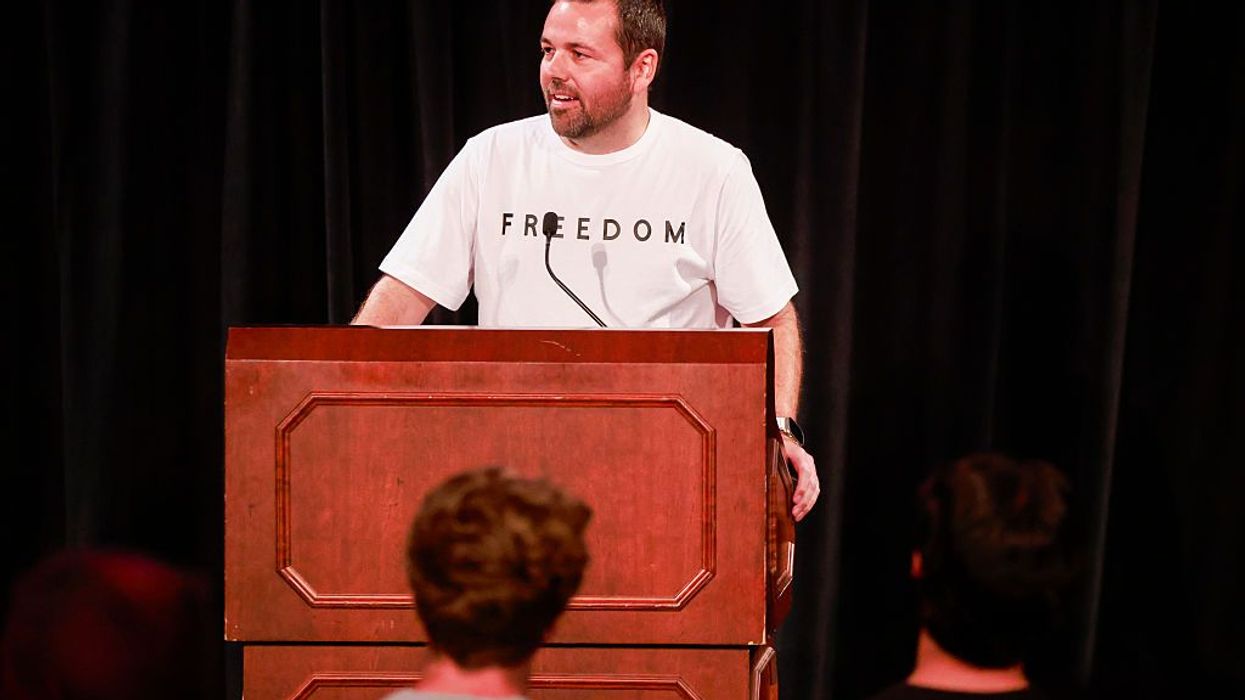
Republican Indiana Lt. Gov. Micah Beckwith posted and subsequently deleted a claim that President Donald Trump had threatened to cut off funding to his state unless its legislators approved a mid-decade gerrymander that would have changed the composition of its congressional map to further favor the GOP.
Just over four hours after the Republican-led Indiana state Senate on Thursday voted down the Trump-backed gerrymander—which would have changed the projected balance of Indiana’s current congressional makeup from seven Republicans and two Democrats to a 9-0 map in favor of the GOP—Beckwith took to X to warn that the Hoosier State would soon be feeling the president's wrath.
"The Trump admin was VERY clear about this," he wrote, referring to threats to take away federal funding for Indiana. "They told many lawmakers, cabinet members, and the [governor] and I that this would happen. The Indiana Senate made it clear to the Trump admin today that they do not want to be partners with the [White House]. The WH made it clear to them that they'd oblige."
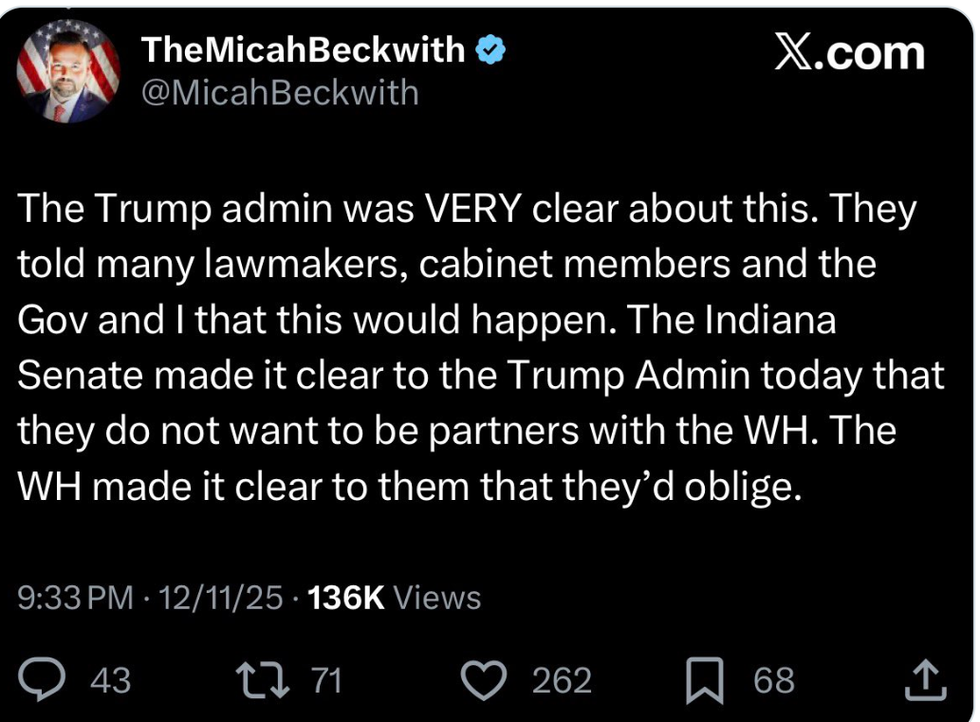
Although Beckwith deleted his post, he also confirmed to Politico reporter Adam Wren that the White House said that Indiana could lose out on funding for projects if the state did not approve the map, although Beckwith insisted that this was not a "threat" but merely "an honest conversation about who the White House does want to partner with."
Earlier on Thursday, the X account for right-wing advocacy group Heritage Action, a sister organization of the Heritage Foundation think tank, claimed that Trump had threatened to decimate Indiana's state finances unless the state Senate approved his proposed gerrymander.
"President Trump has made it clear to Indiana leaders: if the Indiana Senate fails to pass the map, all federal funding will be stripped from the state," Heritage Action wrote. "Roads will not be paved. Guard bases will close. Major projects will stop. These are the stakes and every NO vote will be to blame."
Trump has not yet publicly threatened to cut off Indiana's federal funds, and it's not clear that the administration actually plans to punish the state for defying the president.
According to a Thursday report from CNN, the Trump White House pressure campaign against Republican Indiana state senators backfired because many legislators resented being subjected to angry threats from Trump supporters, including some incidents in which lawmakers were swatted at their homes.
Republican Indiana state Sen. Jean Leising told CNN that the all-out pressure campaign waged by the president ended up pushing more people into opposing his agenda.
"You wouldn’t change minds by being mean," Leising said. "And the efforts were mean-spirited from the get-go. If you were wanting to change votes, you would probably try to explain why we should be doing this, in a positive way. That never happened, so, you know, I think they get what they get."
Fellow Republican Indiana state Sen. Sue Glick echoed Leinsing's assessment, and said that blunt-force threats against legislators were doomed to failure.
"Hoosiers are a hardy lot, and they don’t like to be threatened," Glick said. "They don’t like to be intimidated. They don’t like to be bullied in any fashion. And I think a lot of them responded with, ‘That isn’t going to work.' And it didn’t."
Indiana’s rejection of the proposed gerrymander this week was a major blow to Trump’s unprecedented mid-decade redistricting crusade, which began in Texas and subsequently spread to Missouri and North Carolina.
The vote came after an emotional debate in which some Republican lawmakers detailed threats and harassment they'd received for opposing the president's redistricting scheme.
President Donald Trump's push to get Indiana Republicans to redraw their congressional map ahead of the 2026 midterm elections went down in overwhelming defeat in the Indiana state Senate on Thursday.
As reported by Punchbowl News' Jake Sherman, the proposal to support a mid-decade gerrymander in Indiana was rejected by a vote of 19 in favor to 31 opposed, with 21 Republican state senators crossing the aisle to vote with all 10 Democrats to torpedo the measure, which would have changed the projected balance of Indiana's current congressional makeup from seven Republicans and two Democrats to a 9-0 map in favor of the GOP.
The Senate vote came after the state House's approval of the bill and an emotional debate in which some Indiana Republicans opposed to the president's plan detailed violent threats they'd received from his supporters.
According to a report published in the Atlantic on Thursday, Republican Indiana state Sen. Greg Walker (41) this week detailed having heavily armed police come to his home as the result of a false emergency call, a practice commonly known as swatting.
Walker said that he refused to be intimated by such tactics, and added that "I fear for all states if we allow threats and intimidation to become the norm."
Indiana's rejection of the effort is a major blow to Trump’s unprecedented mid-decade redistricting crusade, which began in Texas and subsequently spread to Missouri and North Carolina.
Christina Harvey, executive director for Stand Up America, said that the Indiana state Senate's rejection of the Trump plan was an "important victory for democracy."
"For weeks, Indiana residents have been pleading with their state leaders to stop mid-decade redistricting and the Senate listened," Harvey said. “Despite threats to themselves and their families, a majority of Indiana senators were steadfast in rejecting this gerrymandered map."
John Bisognano, president of the National Democratic Redistricting Committee, praised the Republicans who rejected the president's scheme despite enduring threats and harassment.
"Threats of violence are never acceptable, and no lawmakers should face violent threats for simply standing up for their constituents," Bisognano said. "Republicans in other states who are facing a similar choice—whether to listen to their constituents or follow orders from Washington—should follow Indiana’s lead in rejecting this charade and finally put an end to the national gerrymandering crisis."
Democratic State Sen. Fady Qaddoura, who immediately filed legislation to ban mid-decade redistricting, called the new map an illegal "racial gerrymander."
After months of escalating attacks against Indiana's Republican lawmakers by President Donald Trump, the state House GOP has revealed a new map for the 2026 midterms designed to hand every US House seat in the state to Republicans.
Republicans won 58% of the vote across Indiana's US House elections in 2024, granting them an already overrepresentative seven of the state's nine congressional seats. The new map, published Monday, would eliminate the remaining two seats in the state held by Democrats.
As Bolts magazine editor and founder Daniel Nichanian explained on social media, under the new map, "Indianapolis would be cracked into GOP seats, and Gary would be drowned in red." In other words, the new map would transparently dilute the power of Indiana's two largest concentrations of nonwhite voters.
The redrawing of Indiana's map comes amid a wider push spearheaded by Trump for Republican states to pursue unprecedented mid-decade gerrymandering in hopes of clinging to a governing trifecta against what is expected to be a wave year for Democrats in 2026.
A similar effort has been undertaken in Texas to potentially add five more seats to the GOP ranks, which is currently under appeal at the US Supreme Court. Trump has likewise pressured Republican lawmakers in Missouri, Utah, and North Carolina to draw maps that would net the GOP even more seats. This power grab has been met with redistricting efforts by some blue states, most notably California, which passed a new map last month, likely adding five more seats to the Democratic column.
Indiana's new map could be put to a vote in the state House as soon as December 8, where it would then be kicked up to the Senate. That is where Trump has run into some resistance, and he hasn't taken it well.
In mid-November, a group of 19 Republican state senators joined a united Democratic caucus to vote down the new map—one of the no votes, state Sen. Kyle Walker (R-33), said he'd "spent the past several months listening closely to [his] constituents on mid-decade redistricting" and found "93% opposed."
After the map was voted down, Trump lit into some of the holdouts in a rant on Truth Social. He said he was "disappointed" in the senators who voted against the map, adding that "any Republican that votes against this important redistricting, potentially having an impact on America itself, should be PRIMARIED," before calling to "get them out of office ASAP" if they failed.
Trump identified two specific lawmakers—Senate Pro Tem Rod Bray (R-37) and Sen. Greg Goode (R-38)—as the "RINO Senators" most responsible for the vote failing.
Within hours of the post, Goode was targeted by a "swatting" attack, in which an anonymous person placed a fraudulent emergency report in hopes of provoking a SWAT team or other large law enforcement response at the target's residence.
Four other Republicans, all of whom had voiced opposition to the map, were also swatted. Another received a bomb threat at his business. And on Monday, another opponent of the map, Sen. Jean Leising (R-42), said she'd received a pipe bomb threat over the weekend, which she blamed on "DC political pundits” in favor of redistricting.
As NBC News reported Monday, at least 10 Indiana Republican lawmakers have received violent threats since Trump's rant—most of whom have been opponents of redistricting.
Indiana Gov. Mike Braun (R) also received threats after catching heat in Trump's rant. But he joined Trump's attacks on the Republican caucus, specifically Bray, who he said "was forced to partner with DEMOCRATS to block an effort by the growing number of America First Senators who wanted to have a vote on passing fair maps.”
Fearful of the wrath of Trump and Braun, Indiana's House reconvened last week. And after saying that the Senate would not reconvene in December, Bray said it would do so on December 8 to "make a final decision… on any redistricting proposal sent from the House.”
Within an hour of Monday's announcement of the GOP map, Democrats, led by state Sen. Fady Qaddoura (D-30), said they planned to introduce legislation to ban mid-decade gerrymandering.
"Voters should choose their leaders, not the other way around," said Qaddoura, who added that the map was "racially gerrymandered."
If the map does pass the Senate, this may present an obstacle. Texas' map is under review by the US Supreme Court after a GOP-majority lower court ruled that the legislature had redrawn districts "based on their racial makeup,” which is illegal under Section 2 of the Voting Rights Act.
But its passage in the state Senate is far from certain. Despite continued pressure from the White House, Politico reports that Bray remains opposed. Meanwhile, Walker has accused the White House of violating the Hatch Act when it invited him to meet with Trump to discuss redistricting.
Trump also lost another ally this weekend in Sen. Mike Bohacek (R-8), who announced that he'd be voting no on redistricting after Trump referred to Minnesota Gov. Tim Walz (D) as "retarded" in an unhinged Thanksgiving Day social media rant.
"I have been an unapologetic advocate for people with intellectual disabilities since the birth of my second daughter," Bohacek said, noting that his daughter has Down syndrome. "This is not the first time our president has used these insulting and derogatory references, and his choices of words have consequences. I will be voting NO on redistricting, perhaps he can use the next 10 months to convince voters that his policies and behavior deserve a congressional majority."
The GOP map remains largely unpopular among Hoosiers. The most recent survey, conducted by the Virginia-based firm Bellwether Research, found that among its sample of 800 voters, "51% didn’t want redistricting now—with 45% 'strongly' opposed. About 39% supported the prospect, but just 23% 'strongly' backed it," as Indiana Public Media reported.
As the map was introduced on Monday, hundreds of Hoosiers gathered inside the State Capitol to voice their disapproval.
"At a time when Hoosiers are facing high costs for childcare, groceries, utilities, housing, and health care, the last thing needed is politicians manipulating maps instead of solving real issues," Qaddoura said. "Hoosiers deserve fair elections, stable districts, and a government that reflects them."
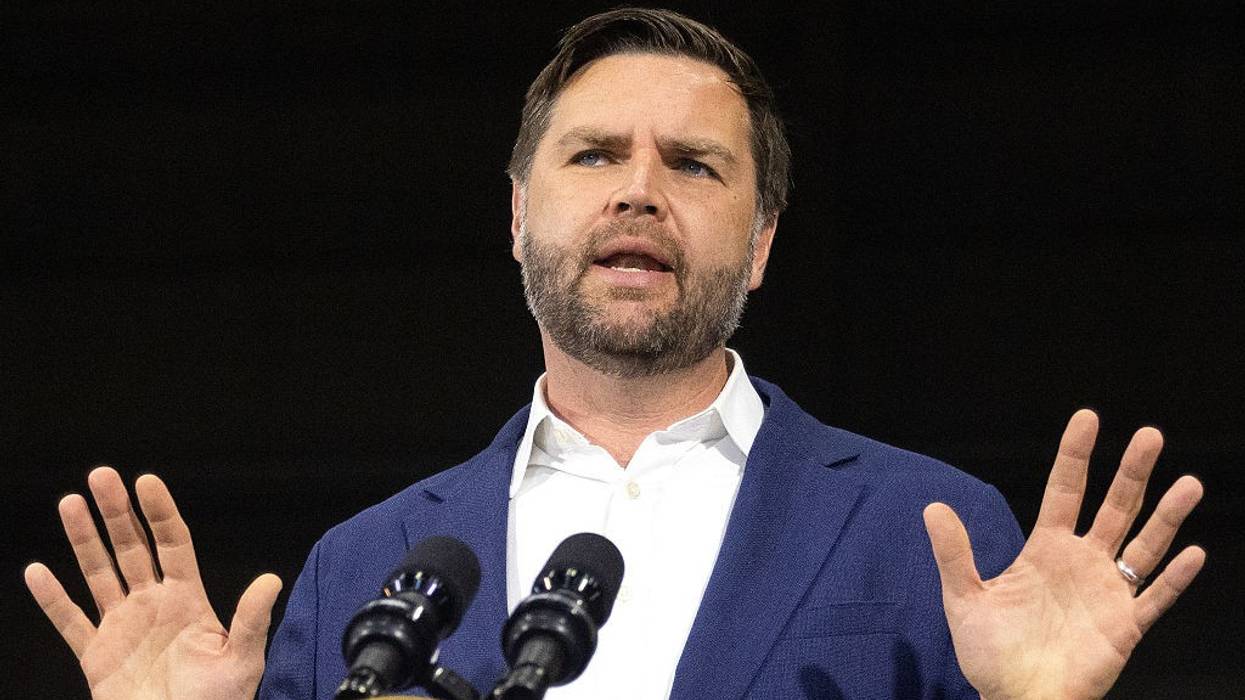
"We're in a knife fight for our democracy here in Indiana," said Democratic state lawmakers. "Trump is trying to bully the Indiana GOP into tearing apart our democracy."
Amid the specter of federal agents hunting down absconding Democratic state lawmakers resisting a Republican bid to gerrymander Texas' congressional map, U.S. Vice President JD Vance on Thursday traveled to Indiana, where his pitch for rigging that state's House districts was met with raucous opposition.
Vance met with Republican Indiana Gov. Mike Braun, who was reportedly "noncommittal" about redrawing the state's congressional map. In a Thursday interview on Fox News, Braun said that Indiana has "become more Republican over time, and these maps probably need to be looked at"—even as he admitted that a mid-decade redraw not linked to the decennial census would be "unusual."
Indiana Lt. Gov. Micah Beckwith, a Republican, took to social media to thank Vance for his visit and voice support for redistricting.
"Redistricting isn't just politics—it's about ensuring the voice of We the People is heard loud and clear," Beckwith said. "Indiana is proud to play a key role in shaping a stronger, freer future for our nation and as lieutenant governor I fully support this effort!"
According to the Indianapolis Star, protestors organized by the nonprofit group MADVoters booed for more than a minute after learning that Vance was in the State House. Opponents of gerrymandering, led by Democratic state lawmakers, staged an hourslong sit-in protest.
"This is clearly a power grab," state Rep. Cherrish Pryor (D-94) told the Indiana Capital Chronicle. "This is simply an attempt by the president to stay in power forever."
Julia Vaughn, executive director of the advocacy group Common Cause Indiana, said Republicans should be prepared for a legal fight over any redistricting.
"We will see you in court, Gov. Braun," she said. "Leave our congressional maps alone!"
More than 100 demonstrators also rallied outside the Indiana Governor's Mansion to protest Republican gerrymandering machinations.
Via IndyStar:Close to 100 people have gathered outside of the Indiana Governor’s Mansion to protest the state government, who floated the idea of redistricting the state in favor of Republican candidates.Indiana GOP already hold 7 of the state's 9 US. House seats. #indianapolis #hoosiersky
[image or embed]
— Noe Padilla (@noepadilla.bsky.social) August 7, 2025 at 1:42 PM
Republicans already occupy seven of Indiana's nine House seats. Any redistricting would likely target the state's 1st District, which is represented by Congressman Frank Mrvan, a Democrat.
"The Trump administration has recognized that their harmful policies to benefit wealthy elites at the expense of working families are wildly unpopular. They know that their only hope to maintain control is to pressure the Indiana General Assembly to violate the Indiana Constitution and redistrict U.S. House of Representative seats mid-decade," Mrvan said in a statement.
"My mission throughout my career as a public servant and as a member of the U.S. House is to advocate for the most vulnerable in our communities," Mrvan added. "Any attempt to redistrict now is simply an attempt to silence those very voices."
Indiana's other Democratic congressman, André Carson of the 7th District, said: "Redistricting attempts in Indiana are a power grab. It's unethical and the move of a dictator."
"We won't accept our democracy turning into a dictatorship," Carson added. "Attempts to silence our vote exist right now. We want our Republican friends to do the right thing."
Democrats in the Indiana House of Representatives also issued a statement, saying that "we're in a knife fight for our democracy here in Indiana."
"We're getting the word out that President [Donald] Trump is trying to bully the Indiana GOP into tearing apart our democracy—but we're not letting this happen without a big, public fight," the Democrats added.
Responding to the vice president's gerrymandering pitch, Brett Edkins, managing director for policy and political affairs at the pro-democracy group Stand Up America, said in a statement that "Vance didn't visit Indiana for a friendly chat—he was there on marching orders from Donald Trump to strong-arm and intimidate state leaders into rigging the electoral maps in his favor so that congressional Republicans can avoid accountability from the voters in next year's midterm elections."
"Hoosiers deserve leaders who listen to them—not bullies from Washington, D.C. doing Trump's bidding behind closed doors," Edkins added. "Gov. Braun and Indiana's leaders should reject any effort to redraw Indiana's political maps for partisan ends."
Republicans are weighing plans for congressional redistricting in other states, including Florida, Missouri, and Ohio, ahead of next year's midterm elections. Governors and lawmakers in some Democrat-controlled states have vowed to respond in kind, with New York Gov. Kathy Hochul saying earlier this week that members of her party should "fight fire with fire."
Vance's Indiana visit came amid an escalating standoff between Texas Democratic lawmakers who fled the state in a bid to stymie a vote on a GOP-grerrymandered congressional map and Republican officials who ordered their arrest and enlisted the FBI to help track them down and force them back to Austin.
"Let's call this what it is: a clear attempt to rig federal elections and cheat the American people out of a voice," National Democratic Redistricting Committee president John Bisognano said Thursday of the GOP gerrymandering push in Indiana and other states.
"Republicans in the Hoosier State have a choice," he added. "They can stand up against the authoritarian regime in Washington and help stop this attempt to steal an election—just as Republicans in Georgia and Arizona did in 2020—or they can roll over to Donald Trump, sacrificing the rights and freedoms of all Americans, and see the wall of resistance Texas Republicans are seeing right now."

"We are once again in court defending our patients and their right to privacy," the two doctors said.
Two Indiana OB-GYN physicians, Caitlin Bernard and Caroline Rouse, filed a lawsuit in Marion County Superior Court last week in an effort to halt the Indiana Department of Health from publicly releasing "terminated pregnancy reports," documents that physicians are required to submit in connection with every abortion performed in the state.
Specifically, the plaintiffs want the court to rule that the terminated pregnancy reports submitted to IDOH are exempt from disclosure under Indiana's Access to Public Records Act.
"We are once again in court defending our patients and their right to privacy," Bernard and Rouse said in a joint statement, according to The Hill.
"Everyone receiving medical care deserves to have their personal health decisions and pregnancy outcomes protected. There is no reason to release this sensitive information to the public. We will keep fighting to protect patients' privacy and the trust between doctors and patients," they wrote.
Bernard made headlines in 2022 after she performed an abortion for a 10-year-old Ohio girl who had been raped and shared that information with a reporter.
The terminated pregnancy reports don't include a patient's name, but they do include other information such as the patient's age, race, and the county where they live, as well as the name of the physicians performing the abortion.
In January 2024, following the state's imposition of a near-total abortion ban, IDOH decided it would no longer release individual terminated pregnancy reports, opting instead to release quarterly aggregated reports.
The number of abortions in the state dropped off sharply after the ban went into effect in August 2023, and "due to the small number and increased reporting requirements, the agency had concerns about violating patient confidentiality by releasing full individual records," according to The Indiana Capitol Chronicle. In particular, there was concern that there was enough information about patients that it would be possible to figure out their identity.
An anti-abortion group, Voices for Life, then sued the state seeking access to the individual reports. That case was dismissed by a Marion County judge in September 2024, and Voices of Life said it would appeal. But then in January 2025, Republican Indiana Gov. Mike Braun issued an executive order declaring the reports to be public.
IDOH entered into a settlement with Voices of Life to release the reports on February 3. Under the terms of the settlement, IDOH agrees to make redactions to the reports that "adequately protect personal health identifiers and that do not inhibit examination of the terminated pregnancy reports to determine whether a physician performed an abortion in accordance with Indiana law," per the Capitol Chronicle.
The court has set a hearing to consider the latest suit brought by Bernard and Rouse on Tuesday, according to the Capital Chronicle.

The latest Republican efforts include an Indiana bill to dissolve entire school districts where over half the students are enrolled in private or charter schools.
Critics are sounding the alarm on a fresh wave of attacks on public schools by Republican state lawmakers, calling their efforts part of a broader agenda to privatize public education.
Indiana's H.B. 1136—introduced by Reps. Jake Teshka (R-7), Jeffrey Thompson (R-28), and Timothy O'Brien (R-78)—would dissolve public school districts in which more than 50% of students attend private or charter schools based on fall 2024 averages. All remaining public schools in affected districts would be converted to charter schools, which are privately owned and operated but taxpayer-funded.
According to Capital B Gary, "The bill's provisions are estimated to dissolve five school corporations statewide, including Indianapolis Public Schools, Tri-Township Consolidated School Corporation in LaPorte County, Union School Corporation southeast of Muncie, and Cannelton City Schools near the Kentucky border in Perry County."
Indianapolis Public Schools (IPS) condemned the proposal,
saying it "strongly opposes House Bill 1136 or any bill this legislative session that threatens local authority and community control of public schools."
Anyone who believes that the Right only wants to bring "choice" and is not about destroying public schools, read this. (and please don't tell me that a charter school is a public school) www.chalkbeat.org/indiana/2025...
[image or embed]
— CarolCorbettBurris (@carolburris.bsky.social) January 8, 2025 at 5:16 AM
"H.B. 1136 proposes dissolving five school corporations, including IPS, by converting schools to charter status and eliminating local school boards," the district continued. "This harmful legislation would strip communities of their voice, destabilize our financial foundations, and further jeopardize the education of approximately 42,000 students."
IPS asserted: "H.B. 1136 threatens to cause massive disruption to our public school system, diverting attention and resources away from the vital education and support our students need to succeed. This legislation is not student-focused and fails to reflect the community's input on how they envision their public schools thriving."
"Instead of fostering growth and innovation, H.B. 1136 risks dismantling the very foundation that supports student success and community collaboration," the district added.
"H.B. 1136 threatens to cause massive disruption to our public school system."
The Indiana Democratic Partysaid on social media in response to the bill: "The GOP supermajority is continuing their attacks on local public schools. This time, they're threatening to dissolve dozens of schools across the state into charters, leaving around a million Hoosiers without a traditional public school option."
"For years, many public schools have struggled with funds being diverted to charter schools with no accountability," the party added in a separate post. "Our public schools are the backbone of communities across the state, and we must protect them. More charter schools means less oversight for taxpayers."
Indiana state Sen. Andrea Hunley (D-46), a former IPS teacher and principal, told Capital B Gary: "My children have been attending IPS schools for 11 years. And I am so concerned about the fact that in this place where the majority likes to say that they want choice for families, that they would be threatening to take away choice from a family like mine right here in the middle of our city."
"We've got to make sure that we stop this before it goes any further," she added.
Indiana state Sen. Fady Qaddoura (D-30), who also represents Indianapolis, told WXIN last week, "I think this bill has a racial component by advancing discriminatory policies that are targeting the two largest minority communities in the state of Indiana."
"In my view," he added, "this piece of legislation had nothing to do with choice and has everything to do to continue to dismantle public education as we know it today in Indiana."
It's not just Indiana. Attacks on public education are afoot in states across the nation, including neighboring Ohio and Kentucky.
At the national level, progressives are warning that the imminent Republican trifecta—with GOP control of both chambers of Congress and, later this month, the White House—likely portends a massive attack on public education that could include ending the Department of Education, as advised in Project 2025, the Heritage Foundation-led blueprint for a far-right overhaul of the federal government.

The three Republicans who didn't join the statement "presumably want violence," said one critic.
A bipartisan group of attorneys general on Monday led the vast majority of the United States' top state-level legal officials in releasing a statement calling for a peaceful transfer of power regardless of the presidential election results—but three Republican attorneys general were conspicuously absent from the list of signatories.
Ken Paxton of Texas, Todd Rokita of Indiana, and Austin Knudsen of Montana did not add their names to the statement, which condemned "any acts of violence related to the results."
"A peaceful transfer of power is the highest testament to the rule of law, a tradition that stands at the heart of our nation's stability," said the officials. "As attorneys general, we affirm our commitment to protect our communities and uphold the democratic principles we serve."
The statement was released a day after Republican presidential nominee Donald Trump said at a rally that he wouldn't mind journalists getting shot and that he "shouldn't have left" the White House after he was voted out of office in 2020.
Trump urged thousands of his supporters to descend on the U.S. Capitol on January 6, 2021 to try to stop Congress from certifying President Joe Biden's electoral victory, and has continued to claim he was the true winner of the 2020 election.
Election experts have said in recent weeks that Trump has been setting the stage for the same baseless claims of election fraud and vote-stealing that he and his allies spread in 2020—telling supporters that Democratic Vice President Kamala Harris will only win the election if Democrats cheat and saying, along with his running mate, Sen. JD Vance (R-Ohio), that he will only accept the election results if he views them as "fair and legal."
The attorneys general—representing 48 states, the District of Colombia, American Samoa, the Northern Mariana Islands, and the U.S. Virgin Islands—called on Americans "to vote, participate in civil discourse, and, above all, respect the integrity of the democratic process."
"Let us come together after this election not divided by outcomes but united in our shared commitment to the rule of law and safety of all Americans," they said. "Violence has no place in the democratic process; we will exercise our authority to enforce the law against any illegal acts that threaten it."
The statement was spearheaded by two Democrats—Ellen Rosenblum of Oregon and William Tong of Connecticut—and two Republicans, Dave Yost of Ohio and Kris Kobach of Kansas. Kobach notably led a so-called Election Integrity Commission during Trump's term in the White House, searching unsuccessfully for evidence that the Republican was the true winner of the national popular vote in 2016.
Of the attorneys general who did not join the statement, Rokita and Knudsen are up for reelection on Tuesday.
Indiana-based author Steve Tally said Rokita, Knudsen, and Paxton "presumably want violence" and urged voters to oppose the state attorneys general.
"Where is the Indiana secretary of state and attorney general on this one?" said Destiny Wells, the Democratic candidate challenging Rokita. "Oh that's right, it's their team."
In Texas, Paxton has been a vehement supporter of Trump, announcing Monday he would deploy an "Election Day Rapid Response Legal Team" to polling places and suing the Biden-Harris administration over plans to send federal election monitors to Texas.
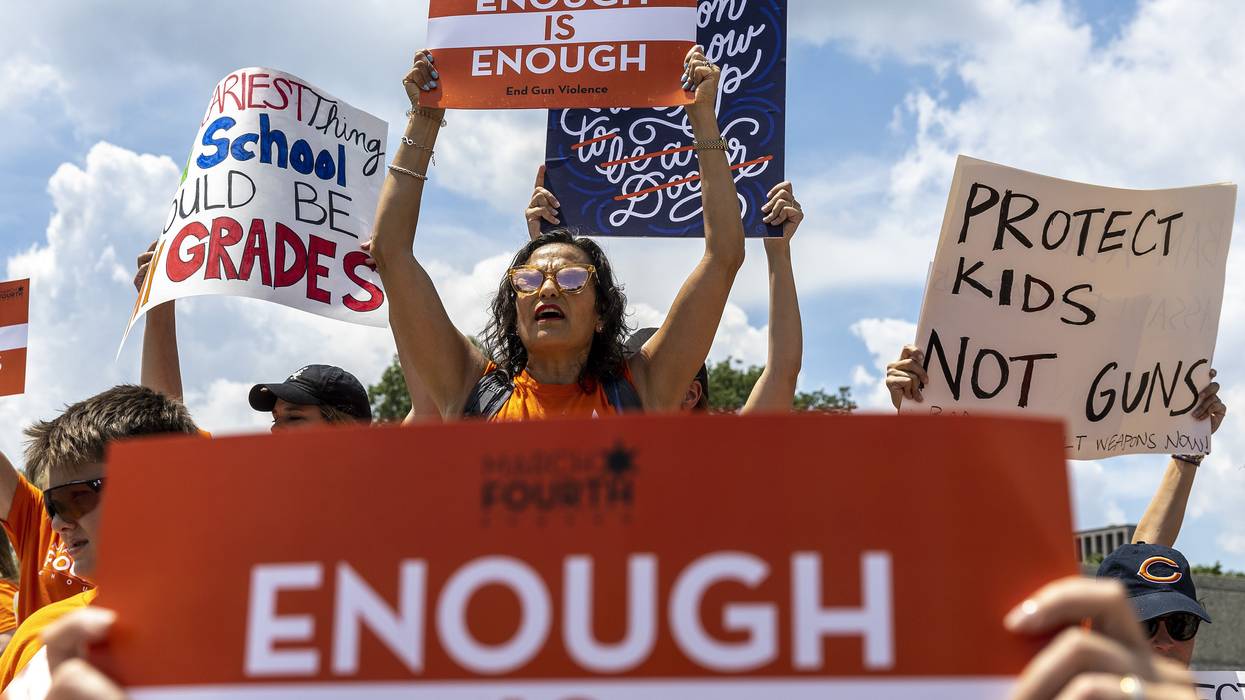
"How many more times do we have to wipe the blood off our streets before action is taken?" asked the Florida Democratic Party chair.
On the heels of Maine officials confirming that the shooter who killed 18 people in Lewiston earlier this week was found dead, shootings in Florida, Illinois, and Indianapolis early Sunday fueled further calls for action by U.S. lawmakers to reduce gun violence.
Around midnight, one person was killed and at least nine others were wounded at a Halloween party in Indianapolis, Indiana, local police said. The victims are ages 16-22 and it's not yet known who or how many people were shooting.
The Chicago Sun-Times reported that police said a suspected gunman is in custody after 15 people ages 26-53 were wounded near 1:00 am CT during a Halloween party in the North Lawndale neighborhood of Illinois' largest city.
Just before 3:00 am ET, "a fight between two groups turned deadly in Florida when a shooting in a Tampa street during Halloween festivities resulted in two deaths and 18 people hospitalized," according to The Associated Press.
As the AP detailed:
Police have not released the names of those killed, but Emmitt Wilson said his 14-year-old son, Elijah, was one of the fatalities. Wilson came to the scene Sunday after getting a call that his son was a victim.
"It's madness to me. I don't even feel like I'm here right now," Wilson said. "I hope the investigators do their job and find out who killed my son."
The Tampa Bay Times noted that "police said they have detained at least one person who surrendered into custody" and some injuries "might have been a result of the stampeding crowd and not necessarily gunshots."
Florida Democratic Party Chair Nikki Fried said in a statement: "This morning, we are waking up to news of another deadly shooting. Our communities are exhausted... My heart breaks for the victims' families whose children did not make it home, for the people who were injured in the gunfire, and hundreds of others who ran for their lives in Ybor City last night."
"Guns turned this night out into a nightmare," she added. "How many more times do we have to wipe the blood off our streets before action is taken? Once again, we urge Congress to do their jobs and pass responsible gun laws to protect all Americans from gun violence."
Moms Demand Action founder Shannon Watts called the incident "the logical outcome of Florida's permitless carry law, which went into effect in July" and means that "civilians no longer have to have background checks or training to carry hidden, loaded handguns in public."
Kris Brown, president of the gun violence prevention group Brady, declared in response to the violence in Tampa that "this isn't normal and we don't have to live this way," highlighting that the U.S. gun homicide rate is 26 times that of peer nations.
Since the massacre in Maine Wednesday night, the Illinois chapter of Moms Demand Action has also stressed in multiple social media posts that "we don't have to live like this."
After the mass shooting on Chicago's West Side early Sunday, the advocacy group said that "our thoughts are with all of those impacted by yet another senseless act of gun violence."
Moms Demand Action is among the organizations, gun violence survivors, and others who have urged Congress to reinstate the federal assault weapons ban that was in effect 1994-2004.
"By design, assault weapons kill as many people as quickly as possible," Everytown for Gun Safety said Sunday. "They don't belong in our communities. Congress enacted a lifesaving federal assault weapons ban before and they can do it again."
While U.S. Rep. Jared Golden (D-Maine) this week endorsed an assault weapons ban and sought forgiveness for his past opposition to the policy following the shootings in his hometown of Lewiston, any gun violence prevention legislation is unlikely to pass either chamber of Congress during this session.
Just hours before the violence in Lewiston, Republicans in the U.S. House of Representatives elected Louisiana Congressman Mike Johnson as speaker. The next day, in his first post-election interview, Johnson told Fox News' Sean Hannity that "the problem is the human heart. It's not guns. It's not the weapons."
"At the end of the day, we have to protect the right of the citizens to protect themselves and that's the Second Amendment, and that's why our party stands so strongly for that," the GOP leader continued, as the manhunt for the shooter was underway. "This is not the time to be talking legislation."
Responding Friday on social media, Congressman Emanuel Cleaver (D-Mo.) said: "America is not the only nation where evil exists. But we are the only nation on Earth that has more mass shootings than days on a calendar. It's the guns."
This post has been updated with reporting from the Tampa Bay Times.
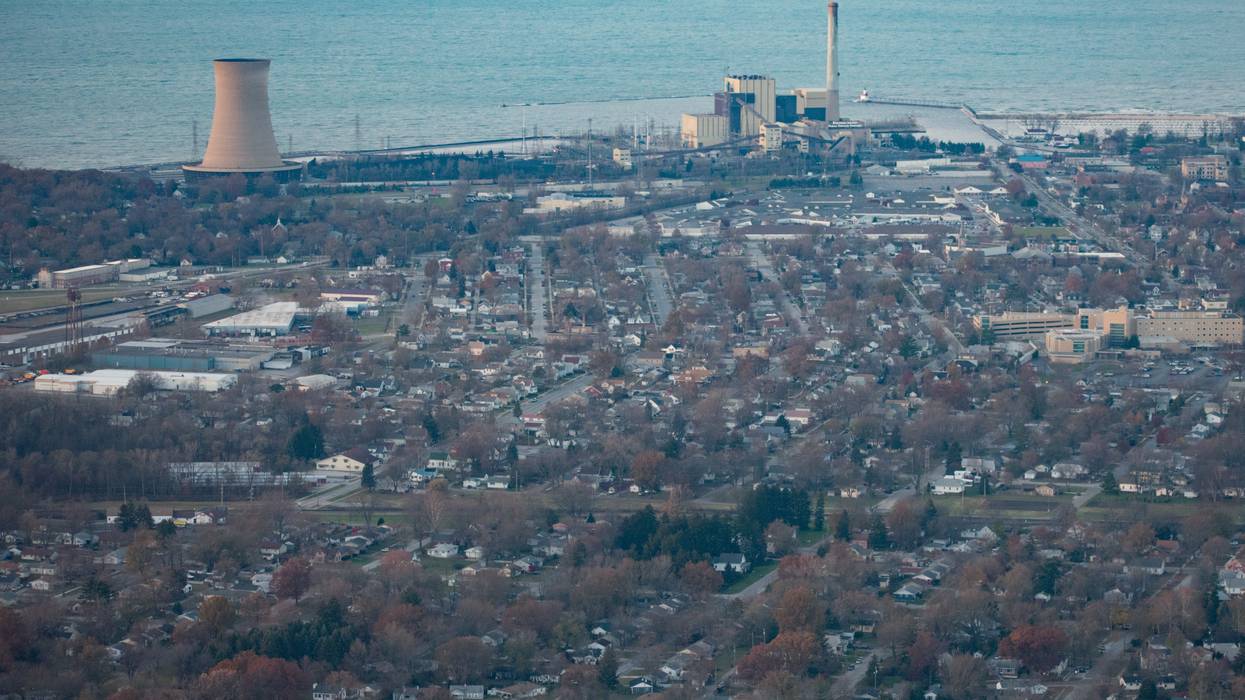
The Coal Combustion Residuals Rule is a historic opportunity to ensure that corporations are held responsible for cleaning up their mess and ensuring my community and many others have access to clean drinking water.
Water is what binds us all. Lake Michigan gives us life but is increasingly being commodified and plundered for corporate greed.
Unfortunately, I know this reality all too well. I grew up in a community with poisoned water and air in Ottawa, Illinois, home to a radium superfund cluster and an epicenter of the frac sand mining industry. Now calling Michigan City, Indiana, my home, I treasure Lake Michigan, which supplies drinking water to myself and more than 10 million people across four states.
A new proposed legacy rule (the Coal Combustion Residuals Rule or CCR rule) by the federal Environmental Protection Agency (EPA) concluded its public comment period on Monday, July 17—an historic opportunity to ensure that corporations are held responsible for cleaning up their mess and ensuring my community and many others have access to clean drinking water.
With each passing day, I fear that another industrial disaster will be too much for our lake and community to bear, a community where half of our population struggles to meet their basic needs.
Hundreds of toxic sites containing coal ash, the harmful waste from burning coal, sit just feet from the Great Lakes, including in Michigan City. Coal ash includes a poisonous soup of substances harmful to human health: arsenic, chromium, lead, and mercury among them. For decades, Northern Indiana Public Service Company has been operating its Michigan City Generating Station coal-burning plant along the lakeshore and is due to shut down by 2028. Here, a deteriorating steel seawall, battered by rising lake levels and shoreline erosion brought on by the worsening climate crisis, is the only barrier between the onsite coal ash fill and imminent catastrophe.
The CCR rule (the original 2015 rule governing coal ash waste disposal) was enacted in response to a lawsuit following the 2008 Kingston, Tennessee, coal ash spill that left more than 50 workers dead, hundreds ailing, and caused mass contamination across Uniontown, Alabama, a predominantly Black community. National Geographic reported this spill as the “largest industrial spill in the nation’s history–nearly ten times the size of the Deepwater Horizon oil spill two years later in the Gulf of Mexico.”
Despite this tragedy, and the ever-present reminders of the dangers of coal ash, many loopholes remain today that exempt half of the country’s toxic coal ash from federal regulation. Of the estimated 566 noxious landfills and ponds at 242 coal plants in 40 states that were excluded from the original rule, the vast majority of them are contaminating our drinking water, rivers, streams, and Great Lakes and harming the health of residents, environment, and economy nationwide. You might live near one without knowing it.
These loopholes have direct implications for us here in Michigan City. With each passing day, I fear that another industrial disaster will be too much for our lake and community to bear, a community where half of our population struggles to meet their basic needs. We do not have to look far to know what happens when disaster strikes the Great Lakes. In 2011, a bluff collapsed at the We Energies Oak Creek Power Plant in Wisconsin, dumping a pickup truck, dredging equipment, soil, and 120 yards of coal ash debris into the lake.
The clock ticks as the pollution in Michigan City continually seeps through the aging seawall. Yet the EPA has continuously stood idly by, failing in its mission to protect both people and the environment. So we sued them.
In 2023, led by Earthjustice, the Hoosier Environmental Council on behalf of Just Transition Northwest Indiana, the NAACP, and numerous other groups, we reached a settlement and won a commitment from the EPA to revisit the federal coal ash rule to consider closing the loopholes. This is our collective moment to get a law that truly protects communities, not corporations.
The EPA must close the remaining loopholes, most notably addressing inactive landfills at old power plant sites and ensuring robust implementation, monitoring, and enforcement of the CCR Rule. Otherwise, it will be more of the same, a useless draft rule that is only words on paper.
On June 28 the EPA held its first in-person hearing on the new proposed legacy rule. We mobilized hundreds of impacted residents and leaders from across the country, including our fellow members from the Climate Justice Alliance, to EPA’s public comment hearing in Chicago. Together, we braved the world’s worst air quality that day to share our stories and the impact of regulatory inaction. For nearly 8 hours, individuals from marginalized communities to health professionals, academics, organizations, and working-class residents took to the mic to give testimony. One by one, we bore witness to heart-wrenching accounts of cancers, rampant infertility, spoiled quality of life, loss, and betrayal.
This week, as public comment draws to a close, we demand, along with countless environmental justice communities, to see the EPA enact the strongest possible ruling. The EPA must close the remaining loopholes, most notably addressing inactive landfills at old power plant sites and ensuring robust implementation, monitoring, and enforcement of the CCR Rule. Otherwise, it will be more of the same, a useless draft rule that is only words on paper.
To date, the Biden Administration has set up historical commitments and resources to address environmental injustices such as Justice40 (reshaping hundreds of federal programs to ensure that 40% of the overall benefits of certain federal investments flow to “disadvantaged communities”) and the first-ever White House Office of Environmental Justice. Yet, we have not seen more vigorous enforcement and accountability of polluters and corporations who continue to profit at the expense of community and environmental health.
In fact, we have seen more support for the ailing fossil fuel industry from the Biden Administration, like relying heavily on carbon capture and storage (CCS) strategies and tax handouts that extend the life and profits of the fossil fuel corporations. Just one week before we rallied support at the EPA hearing, our fellow Climate Justice Alliance members were in Phoenix, Arizona, calling on the White House Environmental Justice Advisory Council to stop the Biden Administration’s overreliance on CCS and hydrogen projects to reduce emissions. These commitments mean nothing if the Biden Administration does not listen to those they are sworn to protect.
As the CCR Rule public comment period ends, this is a critical opportunity for the Biden Administration and the EPA to LISTEN to the powerful messages of impacted communities, meaningfully demonstrate their commitment to environmental justice, close ALL the loopholes in the federal rule, hold polluters accountable, and clean up our nation’s coal ash crisis for good.

"Attacks on reproductive freedom look like doctors being attacked and harassed for doing their job and providing essential abortion care," said one advocacy group.
Update (10:00 am ET, May 26):
The Indiana state medical licensing board voted to fine Dr. Caitlin Bernard $3,000 for speaking publicly about the abortion she provided to a 10-year-old patient in July 2022, and to serve her an official letter of reprimand. Board members rejected one count that she failed to follow patient privacy laws and another count that would have found her unfit to practice medicine in Indiana.
The Indianapolis Star reporter who Bernard spoke to after providing the care last year testified that she offered no unusual or private information about the patient.
Earlier:
Reproductive rights advocates on Thursday came to the defense of Dr. Caitlin Bernard, an obstetrician-gynecologist in Indianapolis who provided a 10-year-old girl with abortion care last year, as Bernard faced a disciplinary hearing before Indiana's state medical licensing board.
Indiana Attorney General Todd Rokita, a Republican, launched an investigation into the doctor last July after she provided a legal abortion to the patient, who had been denied care in her home state of Ohio. Bernard learned of the rape victim from an Ohio doctor shortly after the state enacted a six-week abortion ban following the U.S. Supreme Court's overturning of Roe v. Wade last June.
She provided the child with an abortion and was soon targeted by Rokita, whose office told the medical licensing board that Bernard violated Indiana law by speaking to The Indianapolis Star about the patient's case and by not reporting her abuse to law enforcement and child protective authorities in Indiana.
A video of the hearing is available below:
Bernard's lawyer has said the doctor did follow reporting requirements by informing a social worker about the 10-year-old patient, and has noted that the rape was already being investigated in the girl's home state. Bernard also maintains that she did not release any identifying information about the child to the press.
"Physicians can talk to the media," Bernard's attorney, Alice Morical, told NBC News.
During the hearing, Bernard was asked by the state whether she is an advocate for reproductive rights and whether she has a tattoo of a coat hanger—a symbol of unsafe, illegal abortions. Cory Voight, director of complex litigation for Rokita's office, also accused her of "pushing a narrative" when she spoke to the Star about the effect Ohio's abortion ban had on her patient.
Bernard responded that the hearing was a "political stunt" by the attorney general.
A number of doctors attended the hearing in support of Bernard.
The board is expected to vote on whether Bernard should face penalties, which could include a letter of reprimand or the suspension or revoking of her medical license.
Victoria Barrett, a writer based in Indiana, called the hearing "state-sponsored harassment."
"Attacks on reproductive freedom look like doctors being attacked and harassed for doing their job and providing essential abortion care," said the advocacy group Vote Pro-Choice. "We stand with Dr. Caitlin Bernard and all the providers fighting for abortion care."