

SUBSCRIBE TO OUR FREE NEWSLETTER
Daily news & progressive opinion—funded by the people, not the corporations—delivered straight to your inbox.
5
#000000
#FFFFFF
To donate by check, phone, or other method, see our More Ways to Give page.
Daily news & progressive opinion—funded by the people, not the corporations—delivered straight to your inbox.
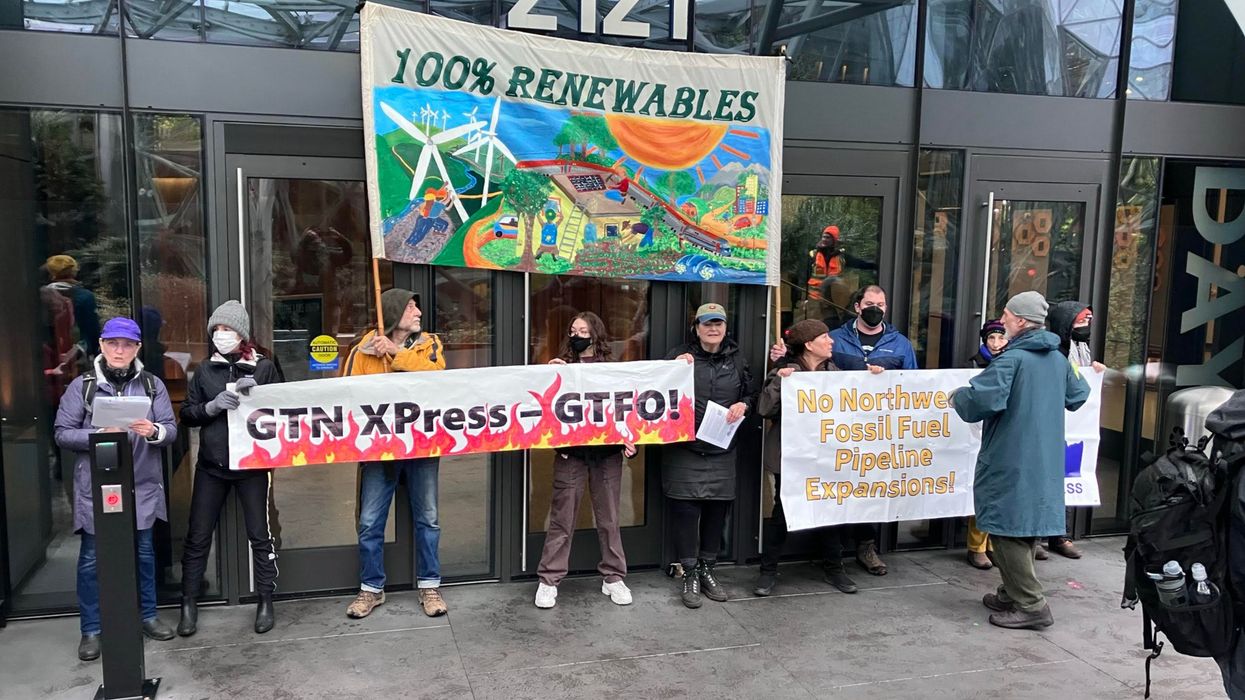
"Amazon is breaking its Climate Pledge by powering new data centers with fracked gas," said one member of the new activist group. "So we came to demand that they honor the pledge."
A recently formed group of climate activists on Wednesday shut down entrances to Amazon's downtown Seattle headquarters to protest the tech titan's plans to link some of its data centers with an upgraded fracked gas pipeline.
Members of the Troublemakers—who describe themselves as "an ever-growing community of people who are committed to taking action for life on Earth"—blockaded the doors to the Day 1 Building on 7th Ave. in opposition to Amazon Web Services' (AWS) plan to connect three data centers near Boardman, Oregon to TC Energy's Gas Transmission Northwest (GTN) XPress Project.
As Common Dreams reported last October, GTN XPress, which has been approved by the Federal Energy Regulatory Commission, would upgrade compressor stations in Kootenai County, Idaho; Sherman County, Oregon; and Walla Walla County, Washington. TC Energy plans to boost the 60-year-old pipeline's capacity by 150 million cubic feet of fracked gas by increasing the conduit's pressure.
"The decision to use fracked gas from the GTN XPress adds to Amazon's carbon emissions problems," the Troublemakers said in a statement. "Amazon's 2022 carbon emissions totaled 71.27 million metric tons, marking an 18% rise from 2020 and a 40% surge since 2019, the year Amazon unveiled its Climate Pledge. This alarming trend is in stark contrast to the global imperative to halve emissions by 2030."
The group wrote in a March 19 letter to Amazon CEO Andy Jassy:
Amazon prides itself on innovation. Using fossil fuel is not innovation... It is relying on a dying technology that is killing the planet. Utilizing GTN XPress would increase Amazon's carbon footprint and contribute greatly to climate change... We urge you to publicly commit to financing solar or wind projects to provide clean energy for Amazon's operations, and reject the GTN XPress.
The Troublemakers are calling on Amazon to:
"We see Amazon's greenwashing every time we pass by Climate Pledge Arena," said Troublemaker Valerie Costa, who was referring to the home of the Seattle Kraken and Seattle Storm professional sports franchises. "Until Amazon drops its plan to buy fracked gas from GTN XPress, we'll keep showing up. Every fossil fuel project in the [Pacific Northwest] will be met with fierce resistance."
Leonard Sklar, a scientist and Troublemaker, asserted that "Amazon is breaking its Climate Pledge by powering new data centers with fracked gas. So we came to demand that they honor the pledge."
"We know they have the power to be 100% renewable energy," he added, "and that's what this moment requires."

If fracked gas leaks, even a little, "it's as bad as coal," said the lead author. "It can't be considered a good bridge, or substitute."
The fossil fuel industry has long argued that fracked gas can serve as a "bridge" to a renewable-powered future, but a new study confirms that uncontrolled leaks make it as dangerous for the climate as coal.
So-called natural gas is derived from hydraulic fracturing (fracking) and composed mostly of methane—a planet-heating gas 80 times more potent than carbon dioxide over its first 20 years in the atmosphere. A methane leakage rate of as little as 0.2% is enough to render gas equivalent to coal in driving global warming, according to a peer-reviewed manuscript accepted last week in Environmental Research Letters.
The paper is set is be published next week. According to its abstract:
Global gas systems that leak over 4.7% of their methane (when considering a 20-year timeframe) or 7.6% (when considering a 100-year timeframe) are on par with lifecycle coal emissions from methane-leaking coal mines.
The net climate impact from coal is also influenced by SO2 [sulfur dioxide] emissions, which react to form sulfate aerosols that mask warming. We run scenarios that combine varying methane leakage rates from coal and gas with low to high SO2 emissions based on coal sulfur content, flue gas scrubber efficiency, and sulfate aerosol global warming potentials.
The methane and SO2 co-emitted with CO2 alter the emissions parity between gas and coal. We estimate that a gas system leakage rate as low as 0.2% is on par with coal, assuming 1.5% sulfur coal that is scrubbed at a 90% efficiency with no coal mine methane when considering climate effects over a 20-year timeframe.
Recent aerial measurement surveys of oil and gas production in the United States show methane leakage rates ranging from "0.65% to 66.2%, with similar leakage rates detected worldwide," the abstract states. "These numerous super-emitting gas systems being detected globally underscore the need to accelerate methane emissions detection, accounting, and management practices."
Lead author Deborah Gordon, an environmental policy expert at Brown University and the Rocky Mountain Institute, told The New York Times on Thursday that if fossil gas leaks, even a little, "it's as bad as coal."
"It can't be considered a good bridge, or substitute," Gordon emphasized.
"What the world requires is to move away from all fossil fuels as soon as possible, to a 100% renewable energy future."
As the Times noted, the study "adds to a substantial body of research that has poked holes in the idea that natural gas is a suitable transitional fuel to a future powered entirely by renewables, like solar and wind."
Despite mounting evidence that expanding fossil fuel extraction and combustion is incompatible with averting the worst consequences of the climate emergency, the Inflation Reduction Act passed last year by congressional Democrats "includes credits that would apply to some forms of natural gas," the Times reported.
"When power companies generate electricity by burning natural gas instead of coal, they emit only about half the amount of planet-warming carbon dioxide," the newspaper observed. "In the United States, the shift from coal to gas, driven by a boom in oil and gas fracking, has helped reduce carbon emissions from power plants by nearly 40% since 2005."
But that ignores the dangers posed by methane, the primary component of fossil gas. Emissions and atmospheric concentrations of methane continued to climb in 2022, thanks in large part to massive leaks from fossil fuel infrastructure. A study published in October found that pipelines transporting fracked gas in the Permian Basin oil field of the U.S. Southwest are leaking at least 14 times more methane than previously thought.
Another recent study found that more than 1,000 "super-emitter" incidents—human-caused methane leaks of at least one tonne per hour—were detected worldwide last year, mostly at oil and gas facilities, including in Louisiana and Pennsylvania. In addition, it identified 112 global "methane bombs," which are defined as fossil fuel extraction sites where gas leaks alone from future production would release what amounts to 30 years of U.S. greenhouse gas pollution.
Methane is responsible for an estimated 30% of global temperature rise today, and scientists have made clear that policymakers must prioritize cutting this short-lived heat-trapping gas to avoid climate chaos. Even a temporary breach of the 1.5°C threshold—something experts warn has a 50% chance of happening by 2026—could trigger irreversible harm from multiple tipping points.
Robert Howarth, an earth systems scientist at Cornell University who sounded the alarm about methane leaks more than a decade ago, praised the forthcoming study.
"Their conclusion is to once again point out that natural gas may not be any better at all for the climate than is coal, particularly when viewed through the lens of warming over the next 20 years or so, which of course is a critical time" for meeting climate targets, he told the Times.
"I do hope the policy world and the political leaders of the world pay attention to this, as I fear too many remain too fixated at simply reducing coal use, even if it results in more gas consumption," Howarth added. "What the world requires is to move away from all fossil fuels as soon as possible, to a 100% renewable energy future."
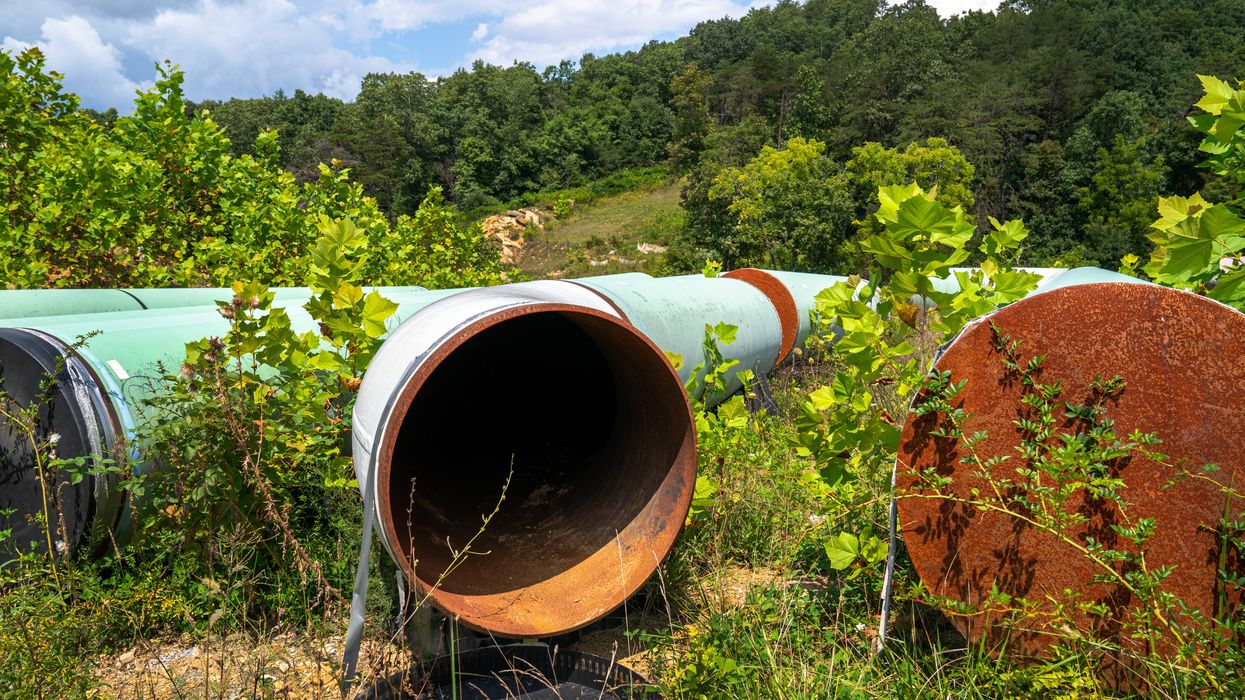
One climate advocate applauded the court for giving communities "a measure of reprieve" by stopping construction of the pipeline in Jefferson National Forest.
A three-judge panel from the U.S. Court of Appeals for the Fourth Circuit on Monday temporarily blocked the construction of a section of the Mountain Valley Pipeline that runs through Jefferson National Forest, pending a conservation group's petition to review the federal government's authorization of the fossil fuel infrastructure development.
"Time and time again, Mountain Valley has tried to force its dangerous pipeline through the Jefferson National Forest, devastating communities in its wake and racking up violations," Ben Tettlebaum, director and senior staff attorney at The Wilderness Society, said in a statement. "We're grateful that the court has given those communities a measure of reprieve by hitting the brakes on construction across our public lands, sparing them from further irreversible damage while this important case proceeds."
Work on unfinished portions of the 303-mile Mountain Valley Pipeline (MVP) was fast-tracked last month via the debt ceiling agreement that President Joe Biden, shunning his options for unilateral action, forged with House Republicans who took the global economy hostage.
Construction of the $6.6 billion fracked gas project—pushed hard by the GOP and Sen. Joe Manchin (D-W.Va.), a coal profiteer and Congress' top recipient of Big Oil money—has been halted by courts for years due to concerns about the harms it would unleash on people and ecosystems in Virginia, West Virginia, and beyond.
But Section 324 of the so-called Fiscal Responsibility Act of 2023 required federal authorities to approve all of MVP's outstanding permits, prohibited judicial review of those permits, and said only the D.C. Circuit Court of Appeals has jurisdiction to hear challenges to the provision's constitutionality.
Citing Section 324, MVP's developers and multiple government agencies filed motions last month to dismiss lawsuits against the pipeline. On behalf of The Wilderness Society, the Southern Environmental Law Center (SELC) filed a brief opposing those motions on June 26, arguing that Section 324 is unconstitutional because it violates the separation of powers.
In response to the stay issued by the Fourth Circuit on Monday, Mountain Valley Pipeline LLC said: "This is not the court to hear that claim. Congress, in plain terms, gave the D.C. Circuit 'exclusive jurisdiction' to hear such claims... Congress' message was crystal clear: If you want to challenge Section 324, you must do so in the D.C. Circuit."
In a similar vein, Manchin asserted that the Fourth Circuit lacks jurisdiction over MVP permits, rendering its new order unlawful.
But as The Wilderness Society and SELC explained last month, their two cases against the pipeline challenge "defective approvals by the United States Forest Service and the Bureau of Land Management allowing the MVP to cross the Jefferson National Forest in Virginia and West Virginia." Because both lawsuits predate the passage of Section 324 and allege violations of several environmental laws as well as the Administrative Procedure Act, the groups argued, the Fourth Circuit does have jurisdiction.
"Mountain Valley could not build their pipeline in compliance with the law, so they appealed to Congress to interfere with the courts, skirting both our legal system and Constitution," Chase Huntley, vice president of Strategy and Policy at The Wilderness Society, said two weeks ago. "The MVP rider buried in the Fiscal Responsibility Act attempts to ram through the pipeline, forcing it onto communities who have spoken out against its devastating impacts for nearly a decade."
"Because bedrock environmental laws stood in the pipeline's path, Mountain Valley convinced Congress to reach beyond its powers and decide in Mountain Valley's favor, circumventing the courts," said Huntley. "We're fighting to make sure our challenge to the Forest Service and Bureau of Land Management's approvals for the pipeline to cross the Jefferson National Forest has its rightful day in court."
The Wilderness Society and SELC weren't the only organizations to take action last month. Lawyers from the Sierra Club, Appalachian Mountain Advocates, and the Center for Biological Diversity filed a companion response opposing identical motions to dismiss another MVP case. That brief was submitted on behalf of 10 environmental groups—Wild Virginia, Appalachian Voices, Indian Creek Watershed Association, Preserve Bent Mountain, Preserve Giles County, West Virginia Highlands Conservancy, West Virginia Rivers Coalition, Chesapeake Climate Action Network, Sierra Club, and the Center for Biological Diversity.
In a Tuesday morning statement, Equitrans Midstream—which holds the largest interest among MVP stakeholders and plans to manage the pipeline once operational—said it was "disappointed" with the Fourth Circuit's stay and claimed the judges exceeded their authority.
"We are evaluating all legal options, which include filing an emergency appeal to the U.S. Supreme Court," the company said. "Unless this decision is promptly reversed, it would jeopardize Mountain Valley's ability to complete construction by year-end 2023."
MVP is one of several new fossil fuel projects being built or considered in the U.S. despite mounting evidence of the worsening climate crisis—and in direct conflict with the international scientific consensus, which has long warned that increasing the extraction and combustion of coal, oil, and gas will exacerbate deadly planetary heating.
As extreme weather disasters continue to wreak havoc across the U.S. and the world, Biden is facing growing pressure to declare a national climate emergency, which advocates say would unlock additional powers his administration could use to rein in the fossil fuel industry and ramp up clean energy production. Congressional Republicans, meanwhile, are currently trying to preempt the president from making such a move.
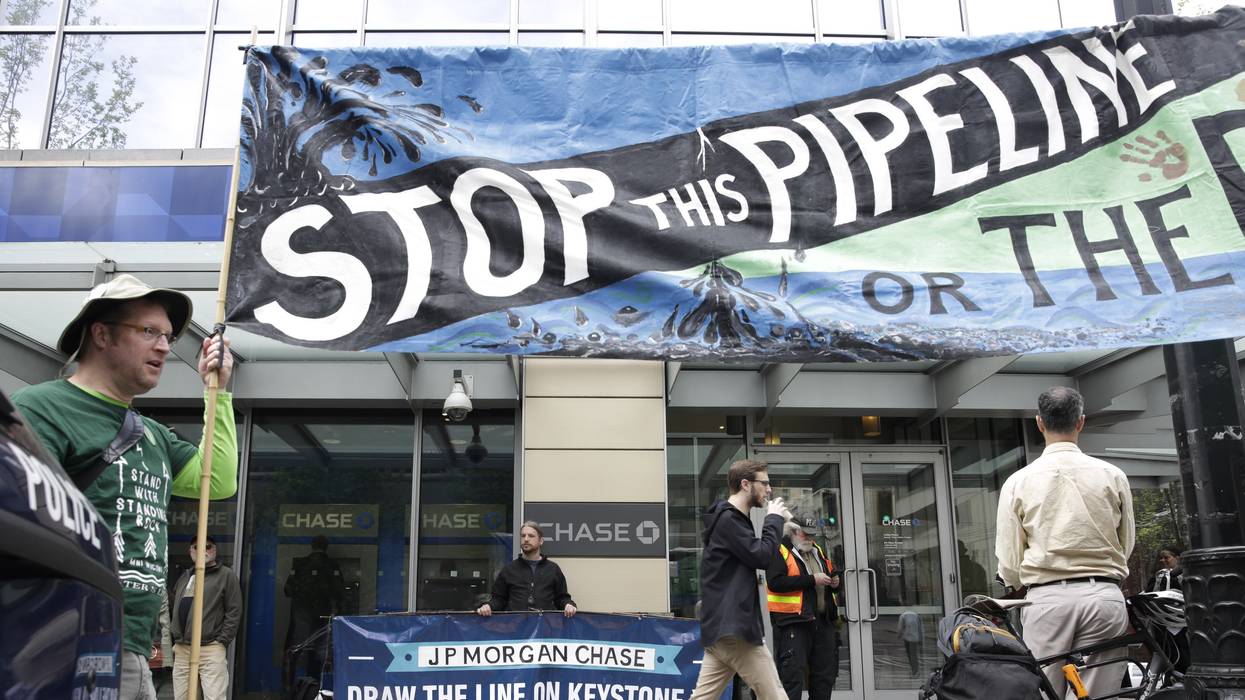
350 Seattle and the Stop GTN Xpress Coalition urge Washington Senators Maria Cantwell and Patty Murray to heed the warning of the International Energy Agency and oppose the GTN Xpress.
When I heard about the ongoing fires in eastern Canada, and the accompanying smoke that covered much of the U.S. East Coast, I was reminded of the Bob Dylan refrain from “Blowin’ in the Wind,” yet with different words: How many fires will it take ’til we know, that it’s past time to stop burning fossil fuels? Do we need the entire country to be covered in smoke before we take all necessary steps to turn the climate crisis around?
While President Joe Biden’s Inflation Reduction Act was a step in the right direction, the International Energy Administration (IEA) has been clear: “If governments are serious about the climate crisis, there can be no new investments in oil, gas, and coal.” Yet TC Energy, the company behind the Keystone Pipeline, seeks approval for a new gas project in the Pacific Northwest called the GTN Xpress. The project would increase the amount of gas coming into the region by expanding an existing pipeline.
350 Seattle and the Stop GTN Xpress Coalition urge Senators Maria Cantwell (D-Wash.) and Patty Murray (D-Wash.) to heed the warning of the IEA and oppose the GTN Xpress.
If the Federal Energy Regulatory Commission were to approve the expansion, it would result in more than 3.47 million tons of greenhouse gas emissions each year—that’s the equivalent of adding 754,000 cars to the road annually.
Here’s the background: GTN’s existing pipeline runs across eastern and southeast Washington, through central Oregon, and into California. The proposed expansion project would push more fracked gas through the existing pipeline by upgrading three existing compressor stations. Compressor stations are fracked gas-powered industrial facilities that control how much gas moves through the pipeline. If the Federal Energy Regulatory Commission (FERC) were to approve the expansion, it would result in more than 3.47 million tons of greenhouse gas emissions each year—that’s the equivalent of adding 754,000 cars to the road annually.
Yet is such a project needed? The answer is an overwhelming no. In a 2022 article, the Sightline Institute analyzed the gas demands of the Northwest in connection with the GTN proposal and concluded that the additional gas is not needed. The article noted that Washington and Oregon will require 100% renewable electricity generation by 2040 and 2045, respectively, meaning that gas will no longer be required for power generation. Additionally, in 2022 Washington passed legislation requiring all-electric heating in new commercial buildings.
Not only is the GTN Xpress unnecessary and bad for the climate, utility customers would likely face increased costs to pay for this expensive infrastructure upgrade. Additionally, nearby communities would see increased air pollution from the compressor stations, as well as face a heightened risk of explosions and fires in the event of an accident. In 2022, the attorneys general of Oregon, Washington, and California made similar arguments against the project in a motion to intervene in the GTN Xpress FERC proceedings.
Opposition to this project is growing. So far, more than 50 local and national organizations ranging from grassroots environmental groups to health professionals have opposed GTN Xpress. In addition to opposition from the attorneys general of Washington, Oregon, and California, several elected representatives from the region have also spoken out against the project; Democratic Oregon Senators Jeff Merkley and Ron Wyden, Governor Tina Kotek of Oregon, and Washington’s own Governor Jay Inslee have all expressed opposition to the GTN proposal.
The websites of both Senators Cantwell and Murray indicate that they see themselves as advocates for the environment. If so, they need to stand by their principles and speak out publicly now against the GTN Xpress. The addition of their voices to the growing opposition to the project could make a difference in FERC’s decision making. FERC is expected to approve or deny this project as early as mid-July, 2023.
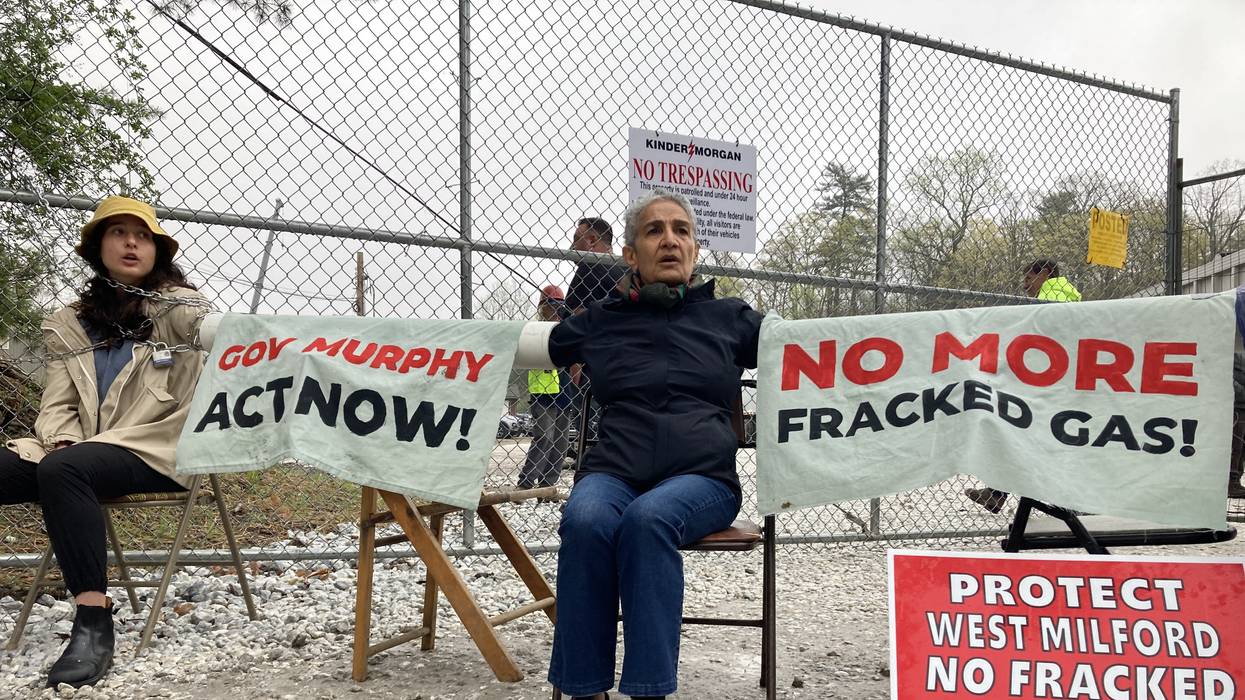
"My grandchild and all grandchildren deserve a future. So I'm out here today, risking arrest, to demand that Gov. Murphy stop fossil fuel buildout across N.J. which will only dig us deeper into the climate crisis!"
On the heels of a weekend rally, opponents of a fracked gas expansion project risked arrest Monday by blocking a construction site for a compressor station in New Jersey with signs calling on Democratic Gov. Phil Murphy to "protect West Milford."
"My grandchild and all grandchildren deserve a future," declared Ted Glick, president of 350 NJ-Rockland. "So I'm out here today, risking arrest, to demand that Gov. Murphy stop fossil fuel buildout across N.J. which will only dig us deeper into the climate crisis!"
"We need bold action NOW if we want to avoid the most disastrous impacts of the climate crisis, and that needs to start with the political courage to halt the buildout of the same dirty industries that got us here!" Glick added. "If Gov. Murphy means what he says about addressing the climate emergency, then he MUST act now to prevent this dangerous and completely unnecessary pipeline expansion project from moving forward."
The new compressor station is part of the East 300 Upgrade Project, which would increase the capacity of Kinder Morgan's Tennessee Gas Pipeline (TGP) system, parts of which are 65 years old. The project, which also involves modifying a pair of existing compressor stations in New Jersey and Pennsylvania, was initiated to send gas to Con Edison in New York.
"Who is this development even for? As New Yorkers, we reject the claim that any new dirty energy is 'needed' in our state, where gas from this pipeline is destined. There is literally no demand for more fracked gas in New York," said Reclaim Our Tomorrow organizer Teddy Ogbor.
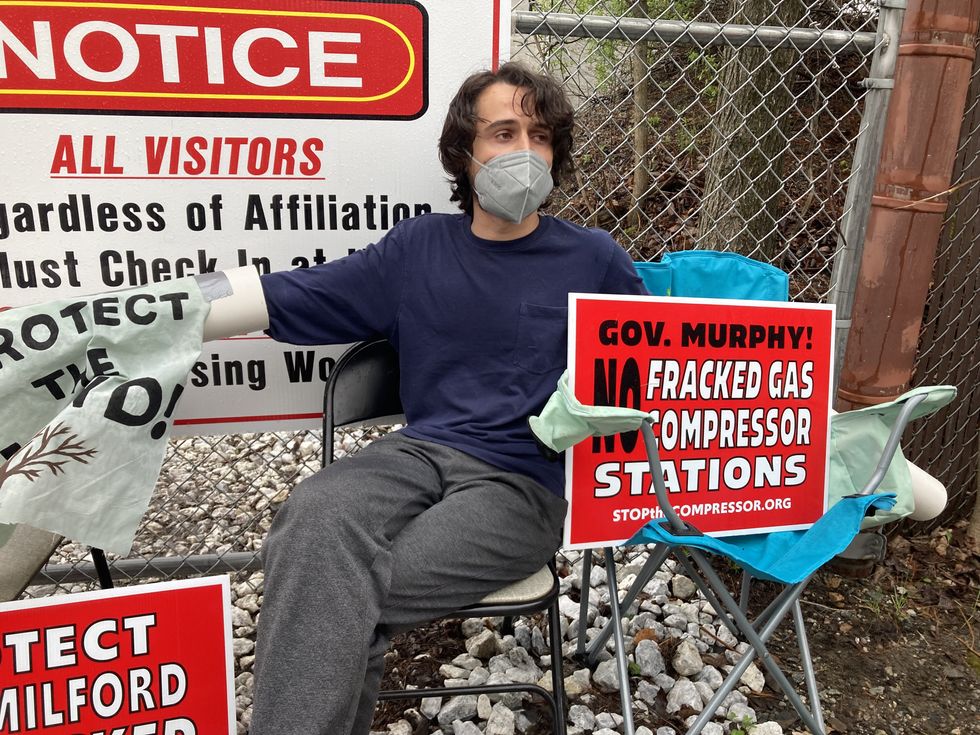
"The only purpose of any new fossil fuel infrastructure is the same as it always has been: To line the pockets of billionaires who are selling our future for profit," Obgor argued. "Gov. Murphy has got to stop taking such massive steps backwards while our planet burns."
Scientists continue to stress that humanity must stop extracting and burning fossil fuels to prevent global climate catastrophe—including in the most recent Intergovernmental Panel on Climate Change report, which warned last month that without dramatic cuts to planet-heating emissions, the world could hit the Paris agreement's 1.5°C threshold by the first half of the 2030s.
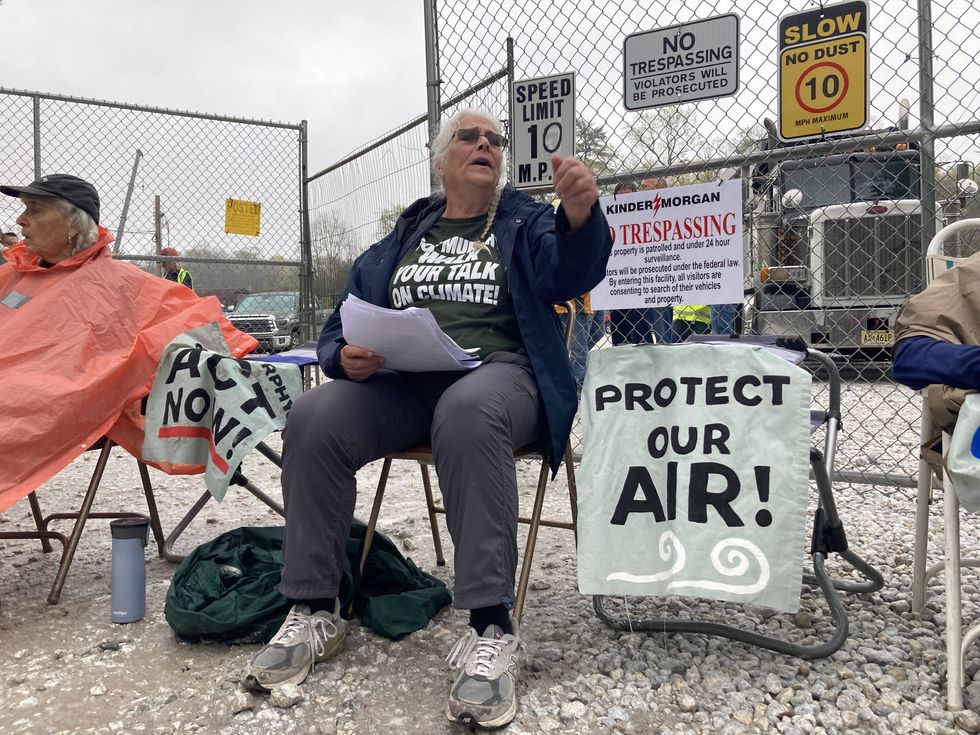
"Gov. Murphy can't seriously claim to be a climate leader if he keeps approving dirty energy expansion projects like this one," Food & Water Watch organizer Sam DiFalco said Monday. "We are in court challenging two of the permits for East 300, but Gov. Murphy could put a stop to this project himself."
Noting that the governor "regularly issues lofty rhetoric about the urgent need to address the climate crisis" and yet, with this project, his administration "has approved permit after permit," DiFalco and Brian D. Scanlan, a former mayor and council member from Wyckoff, also called him out in a November opinion piece for NorthJersey.com:
Murphy can still live up to his environmental commitments and stop this project. In his first term, he championed his Energy Master Plan to address what he called our state's "century-old addiction to fossil fuels," setting a goal of 100% clean energy by 2040. More recently, the governor signed an executive order calling for a 50% reduction in emissions by 2030, and a requirement for builders to consider climate change impacts if they want their projects approved. New Jersey is already not on track to meet these goals, and things could get worse if Murphy continues to approve dirty energy expansion schemes. There are seven major new fossil fuels projects proposed in our state, which could create a substantial increase in climate pollution.
With his promises to ramp up offshore wind, along with introducing the country's first climate curriculum for public schools and signing the strongest environmental justice law in the country, Murphy can leave a strong legacy as a climate champion. But he can't have it both ways. If Murphy allows TGP to proceed with this pipeline expansion, he will be sacrificing the health and safety of his constituents and our shared responsibility to rapidly confront the climate crisis.
"Climate change is a threat to New Jersey. We are seeing it in real time," said Renee Allessio, a 45-year resident of West Milford and co-chair of the Franciscan Response to Fossil Fuels. "This has been one of the driest winters on record, and this week we saw the biggest forest fire in over a decade right here in West Milford."
The blaze burned nearly 1,000 acres but was fully contained as of early Saturday, according to the New Jersey Forest Fire Service. The cause of the fire is under investigation.
Allessio said that "this fire underscores the major risk to the densely wooded highlands brought by piping higher volumes of flammable and toxic fracked gas through this pipeline system well beyond its useful life running through our region."
"Our firefighters who heroically fought last week's blaze will be at greater risk because of this project," she continued. "A leak or explosion could be the spark that devastates our region. In fact, last summer a fire caused by this very same pipeline in Pennsylvania caused a fire that burned through five acres before it could be contained. If Gov. Murphy wants to build a state resilient to the impacts of climate change, then he must stop this reckless pipeline expansion."
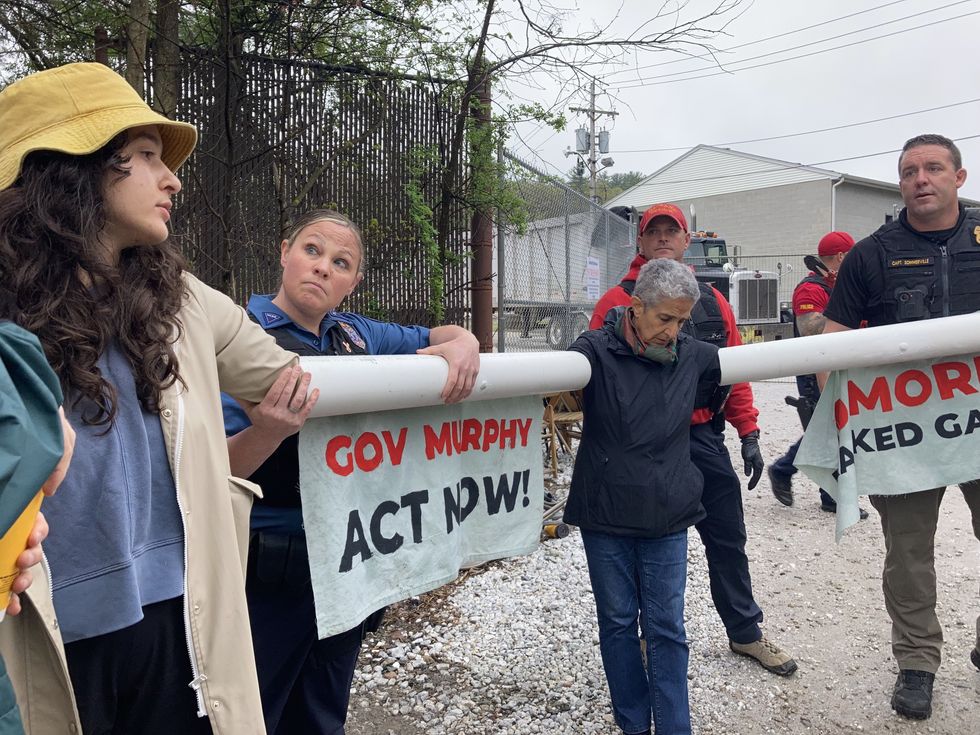
Paula Rogovin, a grandmother and longtime activist who risked arrest Monday, noted that the project also endangers local waters.
"If completed, this compressor station will sit less than 1,200 feet from the Monksville Reservoir, part of a system that provides clean drinking water to millions of N.J. residents," Rogovin said. "A leak or accident involving one of the chemicals stored on-site could be disastrous to our water supply!"
"The N.J. Highlands Act was passed to protect this region from development to protect the critical water resources here," she added. "That this toxic project is allowed to be built here is shameful! Gov. Murphy must STOP this project now!"
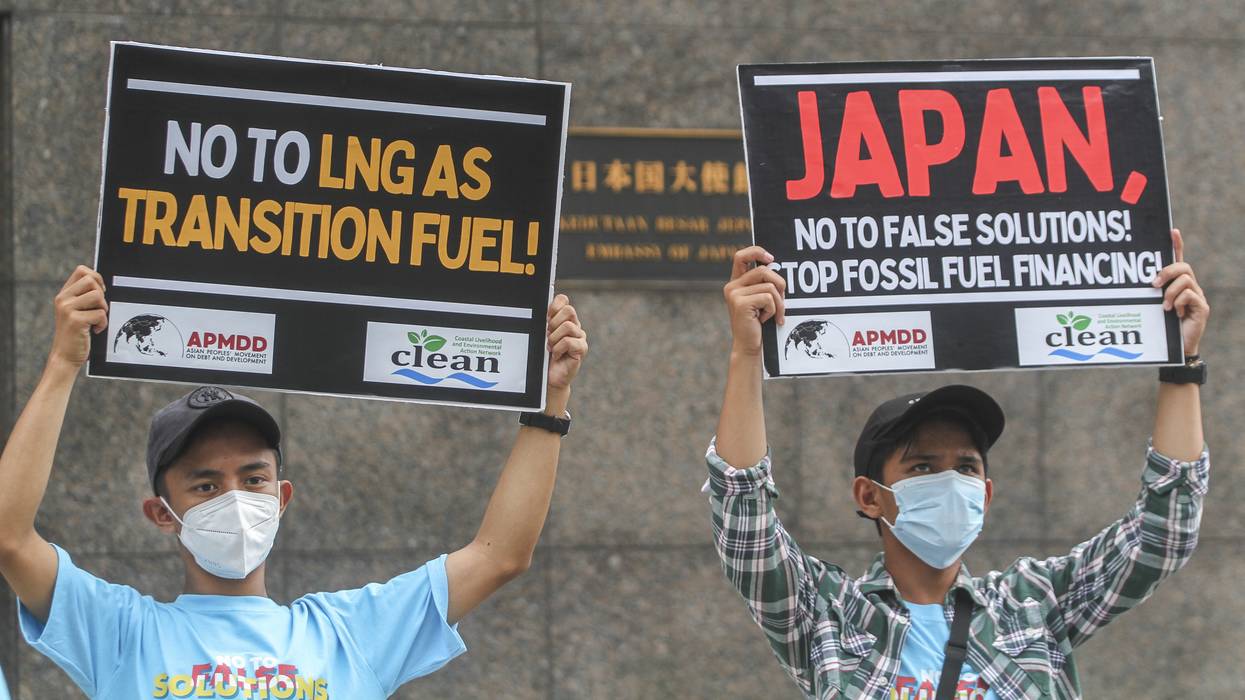
"As we seek solutions to mitigate climate change, we must prioritize investments that truly prioritize sustainability and justice for all, and put energy democracy at the center of the transition," said one campaigner.
The Organization for Economic Cooperation and Development has agreed in principle on a new list of purportedly "green or climate-friendly" projects that are set to benefit from more favorable financial terms for export support after years of closed-door negotiations.
But climate justice advocates on Tuesday denounced the club of high-income countries for including on the list several "fossil-based technologies" that generate planet-heating emissions and other "poorly defined" projects that could incentivize investments in fracked gas.
At issue is the OECD Arrangement on Officially Supported Export Credits, which governs the body's Export Credit Agencies (ECAs). Participants in the arrangement—Australia, Canada, the European Union, Japan, Korea, New Zealand, Norway, Switzerland, Türkiye, the United Kingdom, and the United States—have long debated revising the OECD's so-called Climate Change Sector Understanding, which was adopted in 2014 and determines eligibility for preferential financing.
"The OECD Export Credit Group should not be a piggy bank for the fossil fuel industry."
Under the new agreement, projects related to (1) environmentally sustainable energy production; (2) CO2 capture, storage, and transportation; (3) transmission, distribution, and storage of energy; (4) clean hydrogen and ammonia; (5) low-emissions manufacturing; (6) zero- and low-emissions transport; and (7) clean energy minerals and ores will qualify for longer repayment terms and other flexibilities.
In response, Nina Pušić of Oil Change International (OCI) said in a statement that "the new scope of 'green' incentives under the OECD Arrangement is completely contradictory to what we know is needed to keep 1.5°C within reach."
The Intergovernmental Panel on Climate Change and the International Energy Agency have stated unequivocally that expanding fossil fuel supply is incompatible with limiting global warming to 1.5°C above preindustrial levels, beyond which the planetary emergency's consequences will grow even deadlier, especially for people living in low-income nations who have contributed the least to the crisis.
"Labeling problematic technologies that extend the lifetime of fossil fuel projects, such as carbon capture and storage, ammonia, and hydrogen, as 'climate-friendly' detracts from the critical work needed to reach 100% renewable energy-based systems," said Pušić.
"Fossil-based technologies that are unproven at scale," including carbon capture and storage as well as ammonia, exacerbate greenhouse gas pollution, OCI noted. Moreover, the OECD's use of "vague, undefined terminology" such as "environmentally sustainable energy production" and "clean hydrogen" could open the door to bolstering ECA support for fracked gas, which has boomed since Russia invaded Ukraine last February.
Not only does the OECD's definition of what counts as "climate-friendly" run counter to peer-reviewed research showing the need to prohibit new fossil fuel projects and wind down existing ones, it also flies in the face of a recent joint position launched by more than 175 civil society organizations from around the world. That document outlines how the OECD Arrangement "can align with the Paris agreement warming target of 1.5°C by placing restrictions on export support for oil and gas projects and associated infrastructure."
OECD ECAs "provide more public finance to fossil fuel projects than any other type of public finance institution, including the Multilateral Development Banks (MDBs)," OCI pointed out Tuesday. "From 2019-2021, G20 ECAs provided seven times as much export finance to fossil fuel projects ($33.5 billion USD) than for renewable energy ($4.7 billion USD)."
In the words of Kate DeAngelis from Friends of the Earth, "The OECD Export Credit Group should not be a piggy bank for the fossil fuel industry."
"We reject the pretense that technologies like carbon capture and storage are 'climate-friendly,' which Export Credit Agencies would have us believe," said DeAngelis. "Exporting credit agencies supporting these technologies extends a lifeline to the fossil fuel industry rather than encouraging the necessary shift toward a just energy transition."
"The willingness of governments to extend favorable public financing terms to technologies that prolong reliance on fossil fuels... undermines climate action rather than advancing it."
Steven Feit, senior attorney at the Center for International Environmental Law, said that the update to the OECD Arrangement, which is expected to take effect later this year, "fails to reflect the urgent need to end fossil finance and transition away from fossil fuels."
"The willingness of governments to extend favorable public financing terms to technologies that prolong reliance on fossil fuels, such as carbon capture, or launder fossil gas into the economy, as do most hydrogen and ammonia projects, undermines climate action rather than advancing it," said Feit. "Carbon capture, hydrogen, and ammonia are the primary avenues through which the industry seeks to legitimize itself in the wake of escalating climate catastrophe and climate action. Labeling these projects as 'green or climate friendly' perpetuates a false narrative and brings us further away from the urgent action needed today to phase out fossil fuels."
Davide Maneschi, climate justice program officer for Swedwatch, said that "it is concerning to see the inclusion of technologies such as CO2 capture and storage, hydrogen and ammonia, and energy minerals and ores as climate-friendly investments by the OECD without fully considering their implications on the environment and human rights."
"While these technologies may have the potential to reduce emissions, we cannot ignore the fact that criteria for what is considered 'clean' or 'green' are repeatedly stretched beyond any reasonable limit, and can come to be loopholes exploited to maintain the status quo," said Maneschi. "When employed wrongly, these technologies have the potential to exacerbate climate change and further perpetuate inequalities in our society."
"As we seek solutions to mitigate climate change," he added, "we must prioritize investments that truly prioritize sustainability and justice for all, and put energy democracy at the center of the transition."
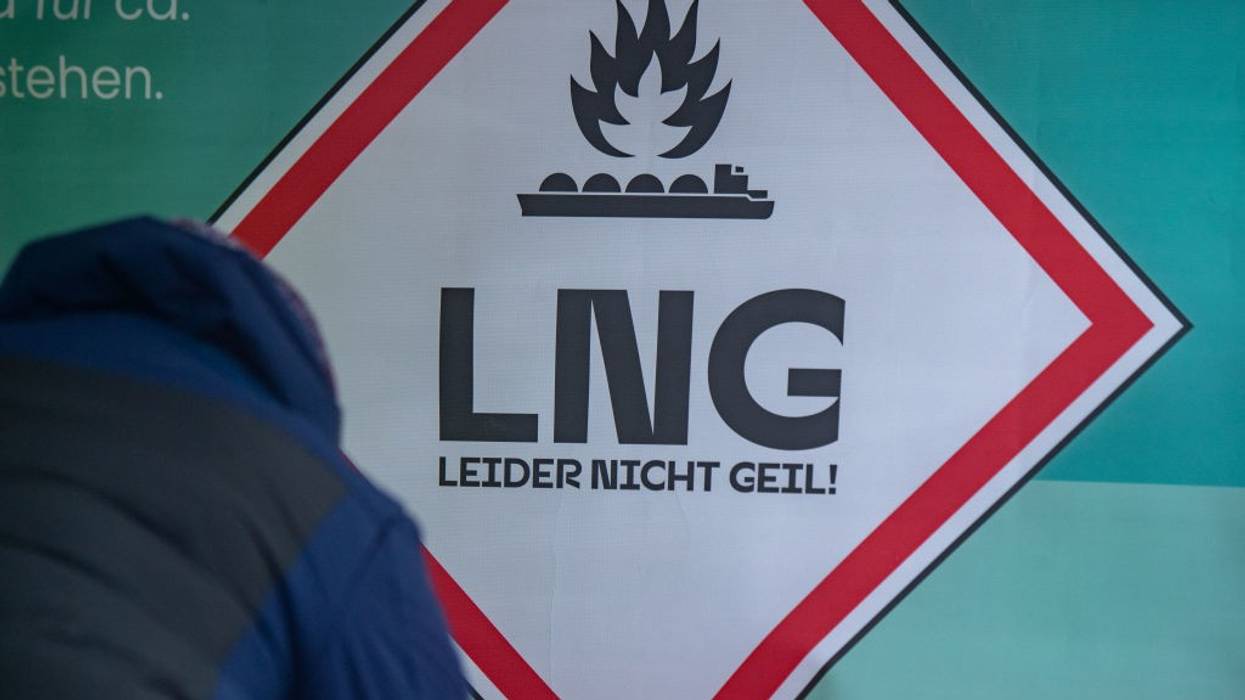
A way out of the energy crisis and toward energy security won't be achieved, now nor in the long term, by investing in new "natural" gas infrastructure. There is no energy security in a world of climate chaos.
Near the end of this month, from March 27 to 28, the European Gas Conference (EGC) organized by Energy Council takes place in Vienna. This conference brings together Europe's main gas suppliers to discuss "the security of supply and the new role for LNG on the continent" and how to "diversify supply and decarbonize supply chains to future-proof gas' role in the energy mix."
Total, Equinor, BP, BlackRock, and RWE are just some of the companies who will be represented in Vienna. These are also some of the companies who have registered record profits over the last year, mostly due to skyrocketing gas and oil prices. These are some of the companies whose conscious actions have pushed millions into energy poverty this winter, while pushing us all to climate collapse.
After their windfall profits, both Shell and BP have announced that they are slowing their energy transition. British Petroleum (BP) for example, is planning to invest $8 billion of their profits in fossil fuels, while also reducing their carbon reduction targets from 40% to 20% by 2030.
While announcing new investments in fossil fuels to secure the interests of profit-eager shareholders, these companies are smart enough to understand that they also need to secure their control over the renewable sector, and take advantage of the funding opportunities for the energy transition. This demands some social and greenwashing from their side.
That is why they organize conferences like the one I attended last January. I will try to give you a glimpse of the narratives and discourses that they are putting forward that expose greenwashing for what it is.
The conference in January—titled "Just Transition for the Gas Sector and its Workers"—organized by EuroGas saw the expression "social dialogue" repeated over and over throughout. As an activist with the Climate Jobs campaign, I acknowledge that an urgent phase-out of fossil fuels (including "natural" gas) cannot be conducted without a concrete just transition plan for the workers of this sector. This phrase apparently held distinct meanings for different people at the conference.
When they talk about the transition not happening without "the workers," they mean they need the right "skilled workforce," implying the need of the sector to anticipate the challenges in employment, jobs, skills, and plans for the future.
On the one hand, the need for a "skilled workforce" does not translate into current workers being ensured requalification or income and job guarantees in the transition. We saw many situations of fossil infrastructure closing down due to loss of profitability, companies moving on to new projects–often both in renewables but also in fossils, relocating fossil industry elsewhere—and the workers being left behind with no compensation, jobs, or income guarantee.
On the other hand, when it comes to planning and preparing for a world beyond fossil fuels, a disproportionate emphasis was placed on the challenges of doing so in small and medium companies, compared to big enterprises being better equipped for this task. In other words, some of the speakers interpreted the transition as a way for big companies to consolidate their power over the energy sector.
First, a just energy transition to stop climate change requires economic planning and preparation. This process should have started decades ago but has been constantly postponed due to intense investment by fossil companies to deny the climate change crisis or offer false solutions under greenwashing schemes.
The much-needed economic planning cannot be left to profit-driven mechanisms. On the contrary, it must be conducted with great public scrutiny and accountability towards civil society, especially workers.
Second, an energy transition to stop further damage on the climate and ecosystems requires a shift from extraction-intense and endless-growth economic and energy systems, to an economy based on people's needs and planetary boundaries. Private companies have, of course, a different view on this, resulting in an energy expansion—a growth in investment of both renewables and fossils—with greenhouse gas emissions still on the rise.
That is exactly why the Secretary General of Eurogas opened the conference by saying that "this is the beginning, not at all the end" and later said that "this is not a sunset sector." They do have plans to keep the sun shining for themselves. As it was explained in the conference, "the technologies to decarbonize the gas sector have been identified" and they are: 1) hydrogen and 2) biogas (mainly bio methane).
The strategy to add value to the existing infrastructure, while having an excuse to expand it, is to use it for biogas, as it can be transported and distributed via existing gas grids. Currently, bio methane accounts for only 1% of the gas production in Europe. Hydrogen, which is more complicated to transport and store, is their plan to expand energy infrastructure and energy production, while also being able to get their hands on the renewable energy production. Keeping in mind that an overwhelming majority of hydrogen is today produced using gas, we understand that both of these strategies came hand-in-hand with the prospects of extending the use of "natural" fossil gas as far out as possible.
Third, there was a common agreement that this transition is not possible without public subsidies and workers. When it comes to the subsidies, RePowerEU, the Resilience and Recovery Funds and the Just Transition Funds are the major subsidy packages of the European Union. The Just Transition funds are a good example of how European public funding has been been used as a way for companies to close fossil infrastructure that is no longer profitable instead of the money being used to ensure a social plan for workers, and to guarantee and plan their access to jobs in the new sectors. As for the RePowerEU, there are plans for large sums being used to support gas production and distribution, using the energy crisis as an excuse to delay the phase-out of fossil fuels.
A way out of the energy crisis and toward energy security won't be achieved, now nor in the long term, by investing in new "natural" gas infrastructure. There is no energy security in a world of climate chaos.
I would like to challenge the logic behind the mainstream discourse of public subsidies to support private investments, which then put workers in the hands of private companies' profit-oriented decisions, and thus the social dialogue becomes a way to avoid social unrest rather than a condition for fund allocation.
When it comes to key sectors for the transition and sectors providing essential services and goods—with the energy sector playing both roles—their future and of its workforce should never be left in the hands of private investments. Public funding should be channeled to public services and creation of good jobs in the public sector.
Just Transition Plans should be designed by putting the workers and communities at the forefront of the discussions, and should never be based on the interests of the companies who have for decades prolonged and benefited with the burning of fossil fuels, while well aware of their impacts on climate and livelihoods. This demands a shift towards renewable energy systems that are publicly owned, democratically managed, and freed from the imperatives of profit and economic growth.
Lastly, the conference I attended was closed by the Secretary General of Eurogas, expressing that "there is no gas sector, there are gas people" and wondering "what is the best way forward for gas people." Very well framed. I dare to suggest that the best way forward to the gas people is a planned phase-out of gas that guarantees 2024 is the last winter of gas. This plan should include massive public investment on the renewable sector, ensuring requalification and income guarantee for workers, and creating millions of Climate Jobs.
This is the plan to avoid cold houses in the winter and a burning planet in the future.
All of this proves why the climate justice movement needs to come together with other social movements—and specifically the labor movement—to create real social plans for a just energy transition. We need a strong program and a strong movement fighting for it, to make these industry conferences meaningless. That is also why we ought to come together from March 24 to 26 in Vienna, in the counter conference "Power to the People”—because we need to talk about how to make this the last winter of gas, and after that, blockade the European Gas Conference.
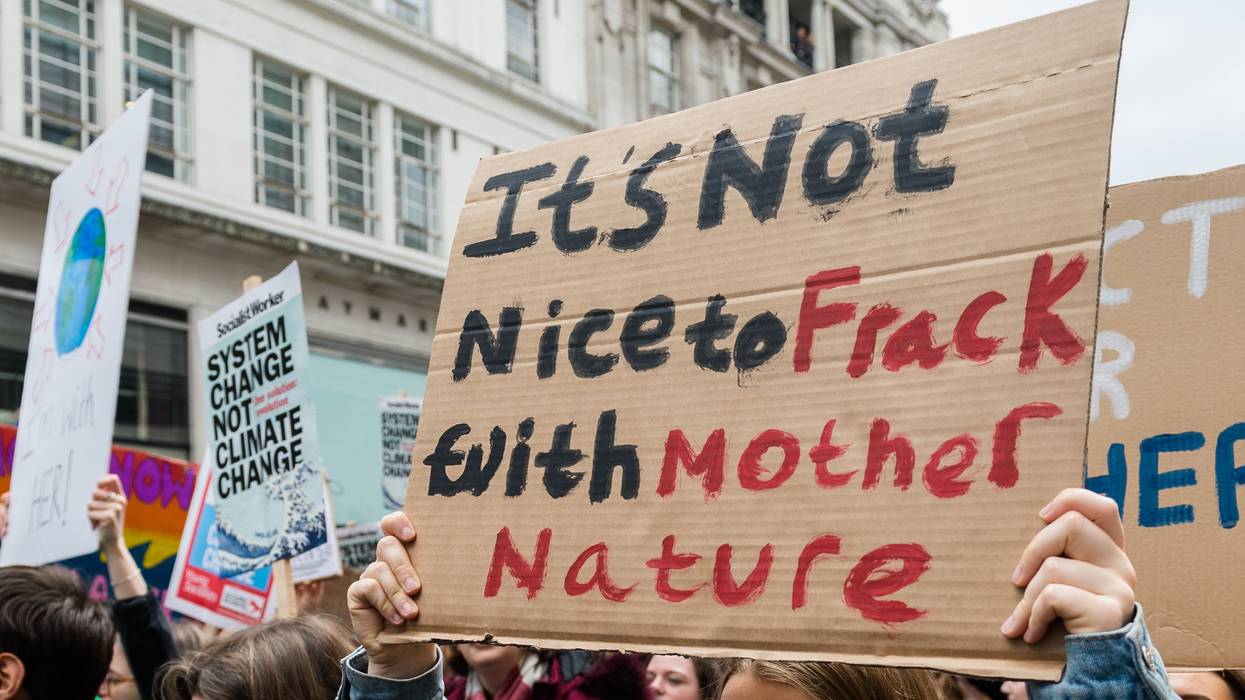
"We see the impact the climate crisis has on people each and every day. And we have a responsibility to sound the alarm," said one doctor. "We urge FERC to prioritize the health of our most vulnerable communities over profit."
As of Monday, more than 500 physicians and other medical professionals had signed on to a letter urging federal regulators to prevent the expansion of a fracked gas pipeline in the Pacific Northwest.
The sign-on campaign comes as the Federal Energy Regulatory Commission (FERC) is expected to weigh in on TC Energy's Gas Transmission Northwest (GTN) Xpress project as soon as this month.
The Canadian company's proposed expansion would boost the capacity of a pipeline that runs through British Columbia, Canada and the U.S. states of Idaho, Washington, Oregon, and California.
"FERC should deny the permit for this pipeline expansion proposal, which is both unnecessary to meet our energy needs and harmful to people in our communities."
"We are in a climate crisis, where we are already experiencing the devastating effects of rising temperatures, the direct result of burning fossil fuels, including so-called 'natural gas,' i.e., methane," the health professionals wrote, noting that methane has more than 80 times the warming power of carbon dioxide over its first 20 years.
Dr. Ann Turner of Oregon Physicians for Social Responsibility (PSR) said that "as medical practitioners, we see the impact the climate crisis has on people each and every day. And we have a responsibility to sound the alarm. We urge FERC to prioritize the health of our most vulnerable communities over profit."
As the letter explains:
TC Energy proposes to increase the amount of gas in its existing pipelines by expanding compressor stations which provide the force which propels gas through pipelines. These compressor stations emit significant amounts of air pollution, both from the operation of the engine which powers the pump as well as from venting. Compressor stations and meter stations vent methane, volatile organic compounds like formaldehyde, particulate matter, nitrogen dioxide, and carbon monoxide. All of these air pollutants have serious health impacts, including increased risks of stroke, cancer, asthma and low birth weight, and premature babies. Compressor stations also produce significant noise pollution. The air and noise pollution from these compressor stations disproportionately harms the rural, low-income, and minority communities that already experience significant health disparities, especially those that are living in proximity to the pipeline expansion project.
"In addition to the health consequences from the pipeline expansion project itself, gas in the GTN pipeline is extracted by fracking in Canada," the letter highlights. "Fracking degrades the environment including contamination of soil, water, and air by toxic chemicals. Communities exposed to these toxins experience elevated rates of birth defects, cancer, and asthma."
"The negative health impacts of methane gas, and its contribution to warming the climate and polluting the air, are unacceptable impacts that disproportionately affect Black, Indigenous, and people of color and low-income communities," the letter adds, arguing that the project is inconsistent with both global and regional goals to reduce planet-heating emissions.
Organizations supporting the letter include Wild Idaho Rising Tide as well as the San Francisco, Oregon, and Washington arms of PSR—which have previously joined other local groups in speaking out against the project alongside regional political figures including U.S. Democratic Sens. Jeff Merkley and Ron Wyden, both of Oregon.
"Idahoans dread FERC approval of the GTN Xpress expansion project, which would force greater fracked gas volumes and hazardous emissions through the aging GTN pipeline," according to Helen Yost of Wild Idaho Rising Tide.
"This expansion project would further threaten and harm the health and safety of rural communities, environments, and recreation economies for decades," she warned. "This proposed expansion does not support the best interests of concerned Northwesterners living and working near compressor stations and the pipeline route."
Dr. Mark Vossler, a board member at Washington PSR, pointed out that "states in the Northwest have made great strides in reducing our dependence on fossil fuels and creating healthier communities."
"I urge FERC to consider the human health impact of the proposed pipeline expansion and respect the leadership of local, state, and tribal governments in addressing the climate crisis," he said. "FERC should deny the permit for this pipeline expansion proposal, which is both unnecessary to meet our energy needs and harmful to people in our communities."

As climate campaigners and frontline community leaders prepared to converge on Capitol Hill Thursday to rally against a federal permitting overhaul pushed by Sen. Joe Manchin, a newly released report aimed to debunk the West Virginia senator's false claims about a long-stalled fracked gas pipeline that would likely benefit from the proposed reforms.
Titled Why Everything Manchin Says About the Mountain Valley Pipeline Is Wrong, the analysis by Oil Change International (OCI) spotlights and counters three prominent claims that Manchin has made about the pipeline project as he attempts to usher it toward completion despite the threat it poses to the environment and communities in its path.
"MVP is a false solution looking for a problem. It's out of date and out of time."
One claim OCI targets is the notion that the Mountain Valley Pipeline (MVP) could actually serve as a tool to fight the climate crisis, namely by displacing polluting coal facilities. As Manchin put it in an April statement, full approval of the pipeline set to run through his home state would enable the U.S. to "domestically produce the natural gas we need today and support our energy and climate goals for decades to come."
OCI responds that "if MVP is completed, it would add tens of millions of tons of greenhouse gas (GHG) pollution to the atmosphere every year for decades to come."
"These emissions would come from pipeline operations, methane gas leakage, and end users burning the pipeline's gas," report notes. "The United States has pledged to reduce GHG emissions at least 50% from 2005 levels by 2030. Manchin and MVP's owners try to resolve this contradiction by assuming the pipeline will help the Southeast replace coal-fired power with gas-fired power, ignoring the fact that cheap, clean renewable energy is increasingly displacing coal and gas."
"The pipeline would have to substantially displace coal emissions over and above the emissions it causes," the report continues. "MVP's operators ultimately plan to expand the pipeline's capacity--and thus its emissions--by 25%. This means MVP would need to replace 25 coal plants by 2030... That's a tall order for one pipeline."
OCI also rejects the narrative pushed by Manchin and other pipeline apologists that a completed and operational MVP would help free up gas for export to western European nations--which are currently attempting to wean themselves off Russian fossil fuels--and meet supposedly growing gas needs in the U.S.
"Expanding existing terminals or building new ones will take several years," OCI replies. "Even if the United States builds
new export capacity, it will arrive far too late to help European allies."
As for the claim that regions of the U.S., particularly the Southeast, are in need of gas that could be supplied by the MVP, OCI says that "demand in the Southeast, the region MVP would serve, is already well supplied by existing pipelines."
The report adds:
Further, gas demand in the region is expected to fall by at least 7% from 2019-2030. Nationally, the U.S. Energy Information Administration (EIA)--which has a long history of underestimating renewables growth--expects gas consumption to fall 2% between 2022 and 2023.
The EIA says increasing renewable energy generation in the coming years will displace gas (and coal) consumption in the power sector, busting the myth that gas is the primary way to displace coal from our power system.
Lorne Stockman, OCI's research co-director at Oil Change International and a co-author of the new report, said in a statement Thursday that Democratic leaders must "understand that Manchin's desire to see the Mountain Valley Pipeline completed is based on his fossil fuel donors' interests rather than any value the pipeline actually has for U.S. or European energy security or the climate."
"MVP is a false solution looking for a problem," said Stockman. "It's out of date and out of time."
Manchin, the top recipient of oil and gas industry donations in Congress, secured a commitment from Senate Majority Leader Chuck Schumer (D-N.Y.) to pursue the permitting reform package in exchange for the West Virginia Democrat's vote for the Inflation Reduction Act, legislation that included substantial renewable energy investments as well as limited drug pricing reforms and other changes.
Manchin said Wednesday that he expects permitting reforms--which would weaken environmental review requirements and pave the way for MVP and other dirty energy projects--to be included in a must-pass government funding measure set to receive a vote later this month.
But with the Inflation Reduction Act now law and reportedly spurring a surge in renewable energy projects, progressive lawmakers say they feel no obligation to support permitting changes--and some are actively speaking out against the Manchin deal.
"We will vote this dirty deal down, one way or another," Rep. Rashida Tlaib (D-Mich.) said last month.
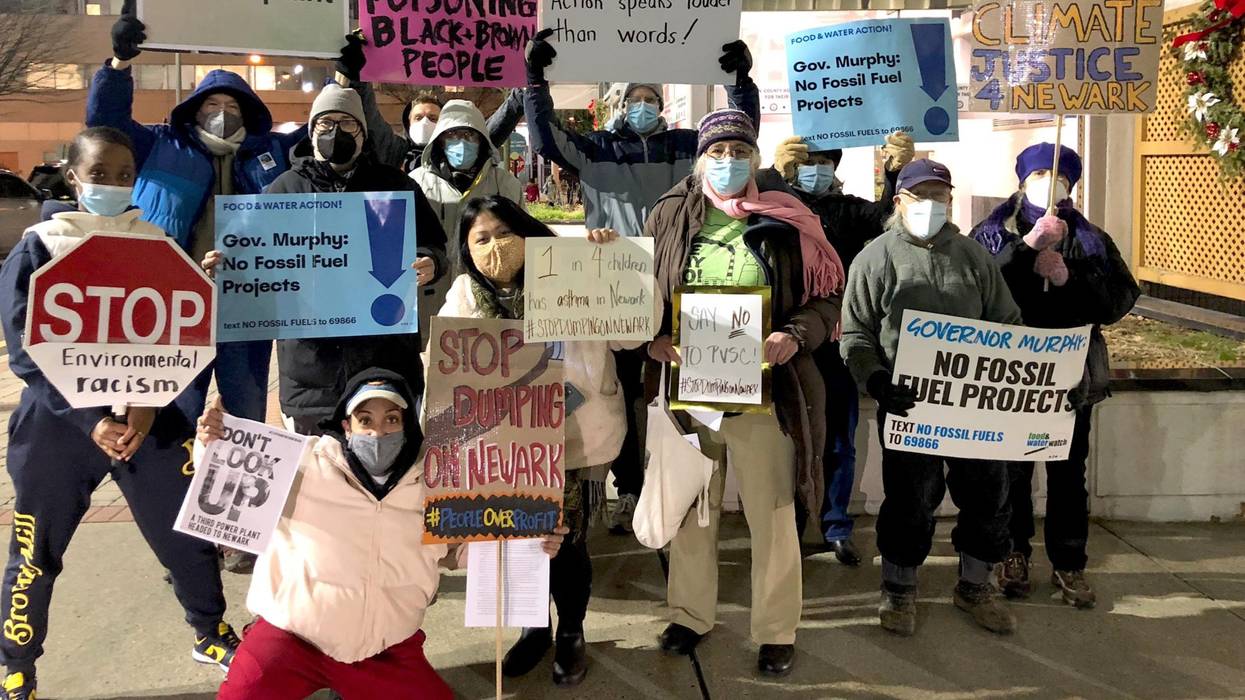
Faced with strident opposition from community and climate activists, New Jersey Gov. Phil Murphy on Thursday intervened to stop a vote on a controversial fracked gas power plant in Newark pending further review of the project's environmental impact.
"Delaying this project is the right thing to do because new facilities should serve and protect overburdened communities--not increase harm and pollution."
Insider NJ reports that the Passaic Valley Sewerage Commission (PVSC) heeded a request by Murphy, a Democrat, to cancel a scheduled Thursday vote on a contract for the $180 million plant in the ethnically diverse Ironbound neighborhood of Newark's East Ward. The Ironbound already has three power plants.
Murphy spokesperson Alex Altman said that "the pause will allow the project to undergo a more thorough environmental justice review and robust public engagement process, ensuring that the voices of the community are heard."
Maria Lopez-Nunez, director of environmental justice and community development at the Ironbound Community Corporation, said in a statement that "Gov. Murphy has reaffirmed his commitment to environmental justice by canceling today's vote."
"Our community needs a real process to evaluate alternatives to the power plant like the one N.J. Transit has initiated for their resiliency project right next door in Kearny," she continued, referring to the state-owned public transport system. "We need to bring in real resources and experts to find a solution that does not hurt the lungs of our children and in no way contributes to climate change."
Cynthia Mellon, co-chair of the Newark Environmental Commission, said that "delaying this project is the right thing to do because new facilities should serve and protect overburdened communities--not increase harm and pollution."
"We need a real process that centers robust community engagement to achieve a solution that protects public health today and a safe environment for future generations," she added.
The prospect of the new 84-megawatt plant--which would provide backup electricity in the event of emergencies like Hurricane Sandy in 2012--has ignited protests and other community opposition.
Gothamist reports more than 100 people joined a virtual meeting on Thursday at which PVSC chairman Thomas Tucci announced the vote would be suspended in order to "move forward in a realistic, responsible, and environmental way."
Local resident Michael Habib spoke at the meeting, saying: "I have a nine-month-old son. It's honestly scary to me to see more of this coming in. We already have dirty water and dirty air and it doesn't make sense to me."
"We're already overburdened so putting more on this community doesn't make sense," he added.
In a Wednesday interview on Democracy Now!, Lopez-Nunez said that "communities across New Jersey... have been dumped on, way before Murphy, for decades, by Republicans and Democrats."
"Our communities have been used as sacrifice zones. Here in the Ironbound we already have three power plants, three Superfund sites, fat rendering," she added. "During the Vietnam War... we had the largest production of Agent Orange. And it had a byproduct, dioxin, which is incredibly cancer-causing. That was being dumped into the river. "
"You name it, it's probably in our neighborhood," Lopez-Nunez continued. "We have thousands of trucks that serve New York City and the greater metropolitan area that barrel through the neighborhood to deliver things, putting that diesel pollution into the air."
She added, "A 4-year-old could stand on a street corner in Newark and look at the smokestacks and say, 'You shouldn't add one more."
Kim Gaddy, national environmental justice director at Clean Water Action and founder of the South Ward Environmental Alliance, said that Murphy has "demonstrated real environmental justice leadership" by postponing Thursday's planned vote.
"We have had enough," she said. "We cannot afford any new industrial smokestacks. Whatever their other intentions, they unavoidably poison our already too poisoned lungs and add to the climate emergency."
"There are better options out there for our lungs, our jobs, and our Newark Bay," Gaddy added. "We look forward to working with PVSC, the Murphy administration, and appreciate this pause to ensure we have the right process and get to the right result."
Lopez-Nunez noted that "our community is [a] majority Black and Latinx, working-class, immigrant community... And despite all of our socioeconomic issues, immigration issues, housing issues, we still fight to make sure that we're bettering our neighborhood."
"We have a vision for our community," she added. "We're just asking for a chance to fight for clean air and clean water."