

SUBSCRIBE TO OUR FREE NEWSLETTER
Daily news & progressive opinion—funded by the people, not the corporations—delivered straight to your inbox.
5
#000000
#FFFFFF
To donate by check, phone, or other method, see our More Ways to Give page.

Data is digital gold. Corporations know that. They're big into data mining.
But it's not just profits that data can yield.
Data is also mined by those who seek power.
Political candidates, political parties, Super PACS and dark-money groups are among the most ambitious data miners around. They use data to supercharge their fund-raising, to target multi-million dollar ad buys and to stir passions and fears at election time.
Data drives the money-and-media election complex that is rapidly turning American democracy into an American Dollarocracy, where election campaigns are long on technical savvy but short, very short, on vision.
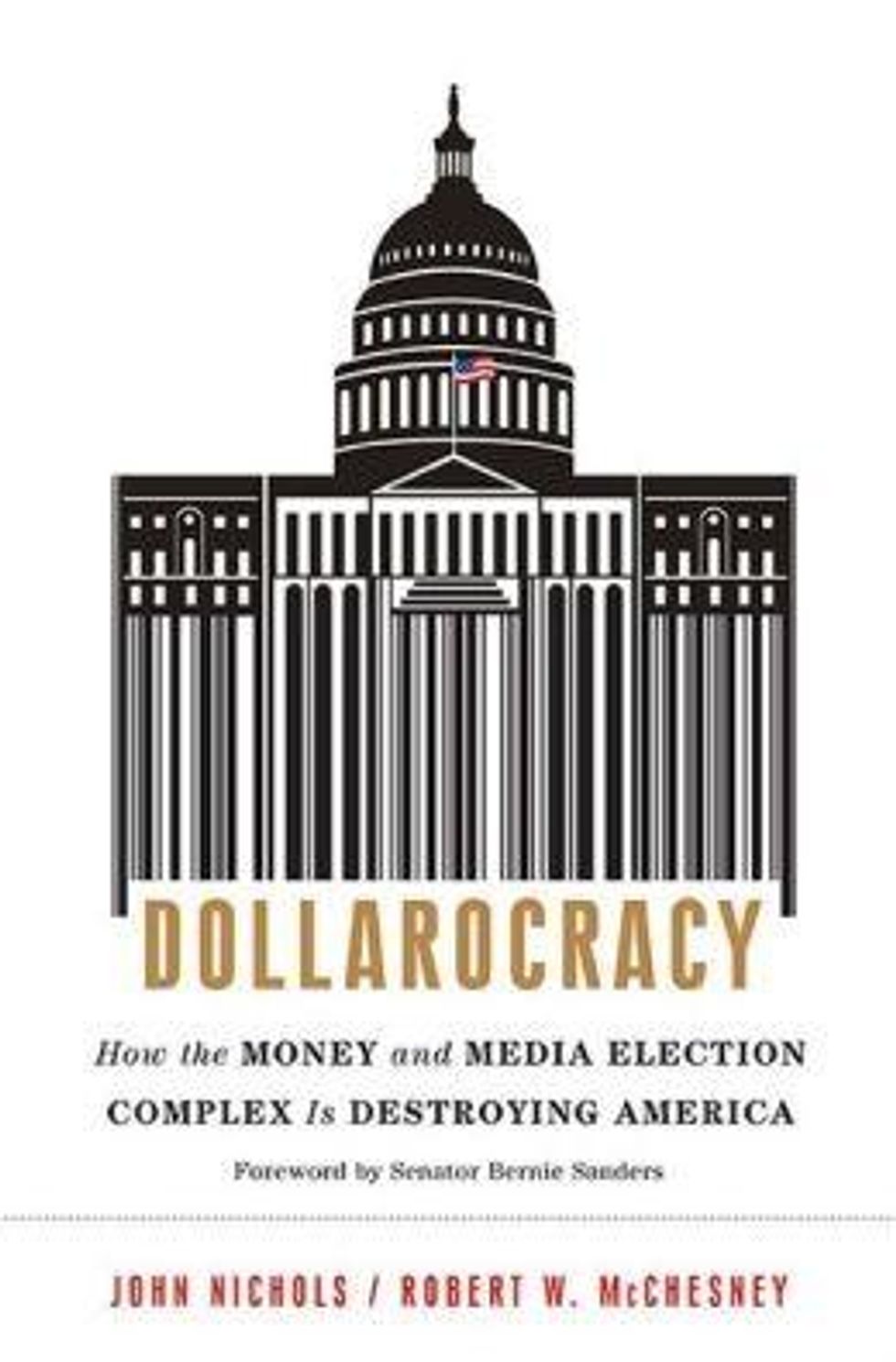
Here's a short excerpt from our new book, Dollarocracy: How the Money and Media Election Complex is Destroying America (Nation Books), which is published yesterday. It focuses on data mining by political campaigns:
If there was one assessment of the 2012 campaign that the campaign consultants loved above all others, it was the analysis that said, "Thar's gold in them thar iPhones." After two decades of trying to figure out how to monetize bits and bytes, the consulting class is now all in for the digitalization of our politics. Indeed, the final election-season issue of Campaigns & Elections ("the magazine for people in politics") featured "10 Bold Ideas for the Future of Consulting." This was the money-and-media election complex talking to itself, and there was no mistaking the message. Yes, of course, there were the calls for more spending: "Money in Politics: Time to Embrace It." And complaints about even the most minimal restraints on campaign donations: "Give Candidates the Ability to Fight Back: With Contribution Limits Intact, What's a Candidate to Do?"
But the primary focus of the "bold proposals" was on spreading the political pathologies of the "old media"--brutal negative campaigning, crude messaging, divisive tactics, and, above all big spending--to the "new media." "Political Technology Is Best Served Partisan," declared one headline, which was sandwiched between "The Future of Direct Mail Is Digital" and "Software Will Revolutionize Local Politics." Any fleeting talk of ideals and values was mostly muffled by the drooling over dollars: "The political technology field is still relatively new and whenever a new industry shows promise and money is being made, venture capitalists are quick to notice and search out promising opportunities for investment," noted one of the more thoughtful commentators. "Some in the political technology space have been quick to meet these new players with a ready grin and an open palm."
The political players who have mastered television and radio and direct mail, the Karl Roves and the David Axelrods, as well as the thousands of consultants you've never heard of, are deep into a process that they believe will allow them to master the Internet. The reality is that the consulting class no longer views the Internet as a "new frontier" or a tool that needs to be understood. Those are the discussions of ten, even fifteen years ago.
Now, their professional journals are packed with ads that scream "Big Data. Bigger Results" and "Canvassing Tools for the Mobile Campaign." The digital tipping point has not been reached, but we can see it from here--and so can the consultants, slow as they may once have been. They are now racing toward it because they have come to understand, thanks to the innovations and successes of the Obama campaign, that there could well be another pot of gold just beyond the tipping point.
Truth be told, there's already a good deal of gold being spread around. By our calculations, the total amount of campaign money spent online for political advertising in 2012 was in the range of $300-350 million. This was a good tenfold increase from 2008, and what was spent on the Internet in 2012 was almost twice what was spent on television candidate ads in the entirety of the 1972 election, even when inflation is factored in. Recall that in 1972 this level of TV advertising was widely considered scandalous and could have had no small number of Americans fantasizing about burning their TV sets in effigy. So 2012 Internet political advertising was hardly chopped liver, and by all accounts its exponential growth rate will continue through election cycles for the foreseeable future.
Online advertising is, of course, the easiest measure of political activity on the Internet. But it is neither the beginning nor the end of the Internet's role in American politics. In our view, the focus on advertising understates the Internet's overall role in campaigns. In 2012, the Pew Research Center determined that 47 percent of voters categorized the Internet as a "main campaign news source," second only to television, well ahead of newspapers and radio, and up from 36 percent in 2008 and 21 percent in 2004. Pew research also determined that 55 percent of registered voters watched political videos online and nearly 25 percent watched live videos online of candidate speeches, press conferences, or debates. Moreover, 45 percent of smartphone owners used their phones to read other people's comments about a campaign or candidate on a social networking site, while 35 percent of smartphone owners actually used their phones to "look up whether something they just heard about a candidate or the campaign in general was true." A Google poll found that 64 percent of battleground-state voters used the Internet to fact-check the candidates. After the first Obama-Romney debates, there were more than 10 million tweets, making it to that point the most tweeted about event ever in U.S. politics. By November 2012, there were 110,000 political Facebook pages in the United States and more than 11,000 pages just for American politicians. Nearly 25 percent of all the time that Americans spend online is spent on Facebook.
In short, these aren't your grandfather's elections, or your father's, or even your older sister's. "Shaking hands and all the traditional campaign stuff has not gone away. You must still do it to win," Alan Rosenblatt of the Center for American Progress put it, "but if you don't have a complementary online strategy you can't win either." Of course, digital political ad spending matters, and, yes, it will matter a whole lot more in the elections to come. But emphasizing digital political ad spending over all other aspects of the Internet as a source of political insight, inspiration and manipulation does a grave injustice to the digital revolution occurring in political campaigns. The Internet is already in the bone marrow of the American election system.
And not just at the grassroots.
The digital revolution has not rendered giant corporations clumsy dinosaurs on their way to extinction with a tidal wave of competition and consumer empowerment. In grand irony, the Internet has arguably become the greatest generator of monopoly power in the history of economics. Everywhere enormous firms all ranking among the most valuable in the world--Google, Apple, Amazon, and Microsoft, with eBay and Facebook not far behind--have monopolistic domination of huge digital markets often equal to or greater than what John D. Rockefeller enjoyed with Standard Oil in the Gilded Age. As The Economist put it, the Internet invariably generates "quasi-monopoly" through "winner-take-almost-all markets." The reasons for this development have been spelled out elsewhere and derive from network economics, the capacity of digital communication to collapse space, patents, standards, and, with time, good old barriers to entry with the enormous capital requirements of cloud computing.
The significance of this digital monopoly capitalism for our argument is twofold. There is the general issue of Dollarocracy versus democracy: this much-concentrated economic power and wealth inequality are invariably dangerous for the survival of credible self-government. And then there is the issue of how this new kind of economic power translates into political power. Given the titanic power these firms have in the overall global economy, their political power should soon approach untouchable status under Dollarocracy, if it is not there already. This is especially true for policy debates directly affecting the direction of the Internet, where a number of crucial issues are in play, ranging from copyright law, network neutrality, community broadband, and the digital divide to taxation, antitrust, and, arguably most important of all, privacy. The old saw in politics is that if you're not at the negotiating table when deals are being made, you're what's being served.
To address this new world, and to take advantage of cookies themselves, Internet publishers are increasingly "personalizing" their Web sites so that different users get different content at the sites depending upon what their personal data tell about them. Already Google search results for the same entry generate different responses for users depending on their extensive Google profile. Click on a major news site, and different people get different headlines and stories depending upon their demographics. Former Google CEO Eric Schmidt noted that individual targeting is "so good it will be very hard for people to watch or consume something that has not in some sense been tailored for them." The age of people sharing a similar digital experience or having a serendipitous experience online is fading, with all that loss suggests. We now experience a "filter bubble," as Eli Pariser put it. Jeffrey Rosen wrote that "a world of customized ads, news, and politics is one where advertisers, publishers and politicians rank and differentiate us. They evaluate us not as citizens but as consumers, putting us in different--and often secret--categories, based on the amount of money they predict we'll spend or the votes they predict we'll cast.
"Personal data is the oil of the information age," the New York Times observed, and that captures exactly where the most important transformation of election campaigns, digital or otherwise, is occurring. In 2012, digital data collection moved from the margins to the center for the presidential campaigns. "While the media coverage is focused on rallies and the last-minute dash by Obama and Romney through seven swing states," a reporter observed on the eve of the election, "the real work of the first ever billion-dollar campaign is being done behind closed doors."
Some, perhaps much, of the ease with which President Obama won reelection despite historically unfavorable metrics has been attributed to his decided advantage over the Romney campaign in the underpublicized development of data collection and its effective utilization. Although both sides fought to a draw with their carpet-bombing of TV political ads, Politico tech reporter Jennifer Martinez wrote, "Obama's treasure trove of data helped give him a notable edge over Republican Mitt Romney." It was striking that when Tim Dickinson did his postmortem of the 2012 presidential campaign, his top six most valuable Obama operatives were the folks in charge of or directly connected to the digital operation; strategist David Axelrod and the traditional TV ad managers and pollsters followed them well down the list.
Obama's Chicago-based campaign offices were dominated by his secretive analytics department, where hundreds of specialists crunched numbers. As one reporter who got an inside look put it, the football-field-sized office "looks like a corporate research and development lab." The "Chief Data Scientist" of the Obama team was Rayid Ghani, an expert in artificial intelligence who came from Accenture Technology Labs, where he was a trailblazer in consumer data mining for retail purposes. Ghani's directive "was to devise algorithms that could sift through the massive amounts of data collected by the campaign," as Dickinson put it. "If you used Facebook to log onto the Obama campaign's Web site, you revealed to them your entire social network."
Among other things, the Obama team consolidated all of its disparate databases from 2008, and placed nearly all of the material on the Amazon Web Services cloud, where Ghani and his staff could slice and dice the data as never before. "The biggest idea we brought to bear," said Dan Wagner, who ran Obama's analytics team, "was integrating data and then acting on what it told us."
The secrecy of the effort was such that we cannot accurately determine how much money the Obama campaign spent in this area--or what all the campaigns together spent. But we do know the Obama campaign cut no corners here. In 2008, the Obama campaign dominated Republicans on the burgeoning social media platforms, and that dominance on the increasingly ubiquitous Facebook, Twitter, and YouTube continued through 2012. But the campaign's 2012 initiative went much further. Obama campaign manager Jim Messina acknowledged that he made the 2012 analytics staff five times larger than the much-ballyhooed analytics staff in the 2008 campaign, because 2012 was going to be a "totally different, metric-driven kind of campaign." When asked for any specifics about the data work before the election, the campaign clammed up. "They are our nuclear codes," campaign spokesperson Ben LaBolt told reporters. Data accumulation and evaluation were the Obama campaign's Manhattan Project.
The Obama data operation took Schmidt's advice and drew heavily from private sector talent; one operative called the effort a $1 billion "disposable startup." No, it did not cost $1 billion to create or run; but it got that sort of bang for the buck. That is what so intrigued corporate observers. The Obama campaign was not only joined to the corporate data industry at the hip; it also proved to have been the dominant partner in the relationship.
"Until recently, everyone in politics thought the commercial sector knew better how to locate and engage with their customers, and tried to apply that to politics," a reporter for Britain's Spectator put it. Now experts believe "the Obama campaign has now leapfrogged the commercial world." The morning after the election, Messina said of his high-tech staff, "Corporate America, Silicon Valley were knocking down the door trying to hire these guys." Romney's campaign engaged in much the same activities. As the Wall Street Journal put it, both "presidential campaigns have gone further than commercial advertisers ever have in using online and offline data to target people." Obama's campaign, by most accounts, just did more of it and was better at it.
Sasha Issenberg said the great breakthrough in 2012 was "linking a person's offline political identity with their online presence." Both presidential campaigns had on average around one thousand data points on each voter. Strategists affiliated with the campaigns acknowledged they had "access to information about the personal lives of voters never before imagined." Whereas much of commercial online data collection tends to keep the actual identities of computer users anonymous--because advertisers target users by demographic criteria that do not require knowing the precise identity--political campaigns had every incentive to know who exactly was connected to the online profiles and where exactly they lived. There was no such thing as "too much information."
This is where the "fun" begins. As The Economist put it, "The point of all these data is to mine them for insights into the electorate and identify pockets of voters who can be won over--either to vote, spend or volunteer." Ghani's team plumbed the data for "motivations, attitudes, and protestations." As Bloomberg Businessweek described it, the "campaign's Orwellian knowledge of the electorate--its deep understanding of precisely what, or whom, would motivate someone to act on Obama's behalf--was such that it could get supporters to appeal to wavering or unreliable friends and acquaintances with individually tailored messages." The Obama team took the data to predict "which types of people would be persuaded by certain kinds of appeals." It created an "optimizer" that was able to crunch all the data to create a new rating system for all Americans based on their likelihood of being an Obama voter. The data-miners created support scores "for every single voter in battleground states," Messina explained after the election, on a scale of "1 to 100, on whether they would support us." This gave them a far superior means to evaluate where and how resources would be best deployed.
Even more importantly, the Obama campaign used its computer power to test and retest and retest again messages to see what worked best with specific sets of individuals and with individuals themselves. It developed the unprecedented "targeted-sharing program"--what Messina termed its "true innovation" -- to determine which person should contact another person to get that person to vote for Obama and precisely what type of message would be most effective. "People really trust their friends, not political advertising," Obama campaign digital director Teddy Goff said. Goff's team provided people with all the "high-quality, shareable content" they needed to be "effective ambassadors for the campaign." It was basically idiot-proof. The Obama campaign was able to use targeted sharing on 85 percent of its turnout targets aged twenty-nine and under, largely through Facebook, which was used to reach 5 million such prospects. "What businesses find so tantalizing about the Obama campaign is that it has advanced this phenomenon to its next iteration," Bloomberg Businessweek noted. "Your friend isn't just raving about Pepsi; he's telling you, in language and images likely to resonate with you, that you should be drinking Pepsi, too."
The significance of this observation cannot be underestimated, as if offers deep perspective on the extent to which the civic and democratic values that ought to underpin our politics are being replaced by commercial and entertainment values--so much so that businesses now emulate campaigns. We have come full circle from the days when Adlai Stevenson said in 1956, "The idea that you can merchandise candidates for high office like breakfast cereal is the ultimate indignity to the democratic process." Now the folks who sell breakfast cereal are taking marketing cues from the folks who do politics.
The lesson of 2012 was summed up by reporter Molly McHugh: "No interested candidate is going to see this campaign and not want to replicate what the Obama team was able to do by taking the mountains of information the Internet holds and turn it into deliverables." "Everyone will want to jump on the data train," ElectNext CEO Keya Dannenbaum said after the election. "Much like Obama pioneered campaigning on social media and now all politicians are there, so too it will be with big data." Or as Kantar Media president Ken Goldstein put it, "Future campaigns ignore the targeting strategy of the Obama campaign of 2012 at their peril." This is the next stop on the path of the money-and-media election complex.
At this point, the ethical and social implications of the digital transformation of campaigns are still mostly unexplored. It is a world where the guiding principle is, as Ghani put it, "Will it get me more votes? If not, I don't care." For some insiders, the seamy underside of digital data collection and microtargeting may be better left unsaid. "These are the kinds of things that I think smart people would keep to themselves," an interactive political consultant said. The process may be getting to the point where it cannot be ignored. An ad executive with experience on Republican campaigns provided a sober assessment: "They are tactics that are pretty standard in marketing, but they are nonetheless 'Orwellian.' Those of us who've read 1984 look at this and say, 'This is unbelievable.'" Nor should Democrats regard the digital transformation as not especially problematic because their guy won. The great political reporter David Broder interviewed LBJ staffers after their landslide election victory in 1964. Broder noted the "lip-smacking glee" they exhibited at how the revolutionary Daisy TV ad "had foisted on the American public a picture of Barry Goldwater as the nuclear-mad bomber who was going to saw off the eastern seaboard of the United States." "The only thing that worries me, Dave," one of the staffers confided to Broder, "is that some year an outfit as good as ours might go to work for the wrong candidate."