

SUBSCRIBE TO OUR FREE NEWSLETTER
Daily news & progressive opinion—funded by the people, not the corporations—delivered straight to your inbox.
5
#000000
#FFFFFF
To donate by check, phone, or other method, see our More Ways to Give page.
Daily news & progressive opinion—funded by the people, not the corporations—delivered straight to your inbox.
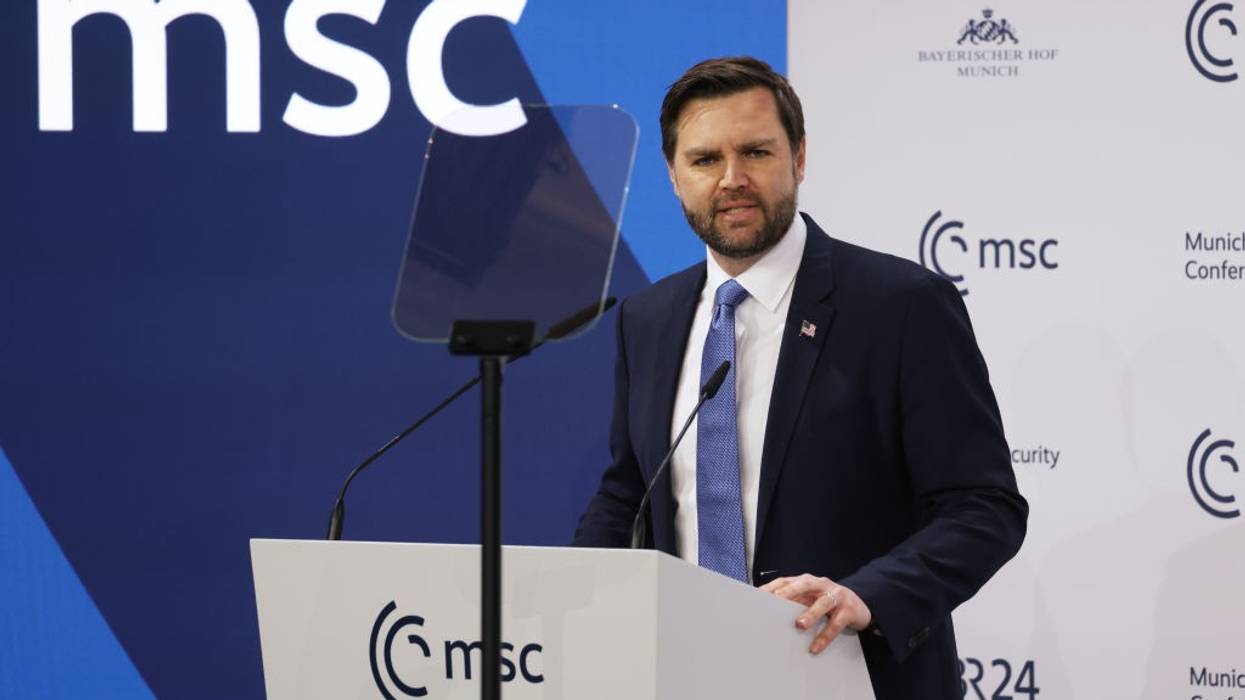
Rebuking the U.S. vice president, German Chancellor Olaf Scholz said that "a commitment to 'never again' is not reconcilable with support for the AfD."
U.S. Vice President JD Vance faced growing backlash on Saturday after scolding the European political establishment for shunning far-right parties and subsequently meeting with the leader of the neo-Nazi Alternative for Germany, just a week ahead of the country's general election.
While Vance did not explicitly mention Alternative for Germany, or AfD, during his remarks Friday at the Munich Security Conference, he declared that "there is no room for firewalls"—a reference to mainstream German political parties' refusal to work with AfD or include it in governing coalitions.
The Guardian reported that "a whisper of 'Jesus Christ' and the squirming in chairs could be heard in an overflow room" during the U.S. vice president's remarks, which he delivered a week after hundreds of thousands took to the streets of Munich to protest far-right extremism.
Following his speech, Vance met with AfD leader Alice Weidel, who praised the vice president's Munich address as "excellent" in a post on X—a social media platform owned by billionaire Elon Musk, who has also expressed support for AfD as he works to dismantle agencies throughout the U.S. government.
Reuters reported that Weidel—whose grandfather was a Nazi judge appointed directly by Adolf Hitler—met with Vance at his hotel "for about 30 minutes and discussed the Ukraine war, German domestic policy, and freedom of speech."
Vance was the highest-ranking U.S. official to ever meet with the leader of the AfD, which is seen as the most extreme of Europe's far-right parties.
On Saturday, German Chancellor Olaf Scholz rebuked Vance and said that "we will not accept outsiders intervening in our democracy," even "friends and allies."
"Never again fascism, never again racism, never again aggressive war," Scholz said in his speech at the Munich Security Conference. "That is why an overwhelming majority in our country opposes anyone who glorifies or justifies criminal National Socialism."
"A commitment to 'never again' is not reconcilable with support for the AfD," said Scholz.

Democrats see the win in Alabama as a sign that supporting reproductive rights will make a difference in November.
Marilyn Lands, a Democratic candidate for a state House seat in Alabama, won a special election on Tuesday, defeating Republican Teddy Powell.
Lands focused her campaign on reproductive rights, including support for access to in vitro fertilization and abortion. The election was for a seat in Madison City, and it was previously held by a Republican.
"Today, Alabama women and families sent a clear message that will be heard in Montgomery and across the nation. Our legislature must repeal Alabama's no-exceptions abortion ban, fully restore access to IVF, and protect the right to contraception," Lands said in a statement.
Congrats to my friend Marilyn Lands on her resounding victory in the Alabama House District 10 special election. She campaigned on women’s reproductive freedom and pushing back on the culture wars being waged by AL Republicans. This is a big win for a better, stronger Alabama.…
— Doug Jones (@DougJones) March 27, 2024
Alabama has a strict abortion ban, and a February Alabama Supreme Court ruling declared that frozen embryos are people, imperiling access to in vitro fertilization in the state following the U.S. Supreme Court’s overturning of Roe v. Wade in 2022. Lands' opponent supported the state's abortion ban.
"This special election is a harbinger of things to come—Republicans across the country have been put on notice that there are consequences to attacks on IVF—from the bluest blue state to the reddest red, voters are choosing to fight for their fundamental freedoms by electing Democrats across the country," Heather Williams, president of the Democratic Legislative Campaign Committee, told Politico.
Democrats see Lands' win as a sign that supporting reproductive rights could continue to be a winner in November, even in deeply red states like Alabama. President Joe Biden voiced his support for access to IVF and abortion in his State of the Union address earlier this month.
"Marilyn Lands' victory demonstrates that voters aren't going to sit idly by while MAGA Republicans lay the groundwork for a national abortion ban," Democratic National Committee Chair Jaime Harrison said in a statement.

"Secretaries of state now have a duty to uphold the Constitution and protect our democracy by ensuring Trump is barred from the ballot," one campaigner argued, pointing to the 14th Amendment.
Two years after supporters of former President Donald Trump's "Big Lie" stormed the U.S. Capitol, demonstrators gathered in Colorado on Friday to remind the American people—especially election officials—that "Trump is disqualified" from running for public office under Section 3 of the 14 Amendment to the Constitution.
Since January 6, 2021, some elected officials and advocacy groups have drawn attention to that section of the amendment, which bars from office anyone who has taken an oath to support the Constitution and then "engaged in insurrection or rebellion," to call for excluding Trump and some congressional Republicans from government.
"Trump's actions were a violation of his oath of office and therefore make him constitutionally ineligible for any future run for office."
"Insurrectionists do not belong in office," Rep. Ro Khanna (D-Calif.) said Friday. "And they do not belong on the ballot going forward. Elected officials who directly aided and abetted the deadly assault on our nation's democracy on January 6 must be held accountable."
The groups Free Speech for People (FSFP) and Mi Familia Vota Education Fund have launched TrumpIsDisqualified.org, a campaign pressuring secretaries of state and other U.S. election officials to exclude supporters of the insurrection—particularly the twice-impeached former president—from any future ballots.
As part of the "Jan. 6th Justice: Our Freedoms, Our Votes" day of action on Friday, Mi Familia Vota held a rally in Denver demanding that Democratic Colorado Secretary of State Jenna Griswold use her power to keep Trump—who formally launched his current presidential campaign in November—off the ballot in 2024.
" Donald Trump violated his oath of office when he led the charge to overturn the results of the 2020 election," declared Héctor Sánchez Barba, executive director and CEO of Mi Familia Vota, a national group that works to build Latino political power through civic participation.
"His actions only confirmed what the Latino community has long known: He is dangerous," Sanchez said of Trump. "The disqualification clause in the 14th Amendment is clear: Anyone who violates their oath of office is ineligible to run for higher office in the future."
"Secretaries of state have the power to bar Trump," he stressed. "There is ample evidence as to why he is not fit to hold office again, now all we are asking is for a secretary of state to act."
Ahead of the "divided and disoriented" GOP's disastrous takeover of the U.S. House of Representatives this week, the Democratic-led select committee that investigated the Capitol insurrection last month unanimously referred Trump to the U.S. Department of Justice (DOJ) on four criminal charges.
"The bipartisan House January 6th committee showed that Trump engaged in a criminal conspiracy to overturn the results of the 2020 election, culminating with his incitement of violent insurrection," FSFP campaign director Alexandra Flores-Quilty said Friday.
"The insurrectionist disqualification clause is clear: Trump's actions were a violation of his oath of office and therefore make him constitutionally ineligible for any future run for office under Section 3 of the 14th Amendment," she added. "Secretaries of state now have a duty to uphold the Constitution and protect our democracy by ensuring Trump is barred from the ballot."
Even before the House select committee referrals, Trump faced DOJ investigations into his handling of classified documents and his role in the 2021 attack on the Capitol. After Trump announced his 2024 campaign, U.S. Attorney General Merrick Garland appointed Jack Smith, a longtime federal prosecutor, as a special counsel for those probes.
FSFP legal director Ron Fein, president John Bonifaz, and chairman and senior legal adviser Ben Clements, jointly argued Friday in a piece for Jurist that "Garland has done something quietly sneaky" with his appointment of Smith.
"By announcing a special counsel appointment predicated on Trump's candidacy," the trio wrote, "then excluding from the special counsel's scope the 'shelf-ready' 'obstruction of justice crimes already identified by Special Counsel [Robert] Mueller and campaign finance crimes already identified by Manhattan prosecutors (in the Trump administration, no less), Garland is telling us between the lines that that he is giving up on all of Trump's pre-2020 crimes."
"Of course, Trump must be held accountable, in a timely fashion, for the crimes within the special counsel's scope," they added. "But Garland's absolution of Trump's earlier crimes—and unwillingness to even state openly, let alone provide a rationale, that he was doing so—is a serious blow to the once cherished principle that no one, not even the president, is above the law."
As for other political leaders who contributed to the Capitol attack, although the select committee last month referred Republican Congressmen Andy Biggs (Ariz.), Jim Jordan (Ohio), Kevin McCarthy (Calif.), and Scott Perry (R-Pa.) to the House Committee on Ethics for defying subpoenas, they are unlikely to face any consequences in a chamber narrowly controlled by the GOP, no matter who ultimately becomes speaker.
The House adjourned Friday afternoon after 13 failed speaker votes throughout the week—the most since before the U.S. Civil War—with plans to return at 10:00 pm ET. McCarthy just needs to flip two of the six Republicans who remain opposed to him—Biggs along with Reps. Lauren Boebert (Colo.), Eli Crane (Ariz.), Matt Gaetz (Fla.), Bob Good (Va.), and Matt Rosendale (Mont.)—to secure enough support to be elected to the leadership post.
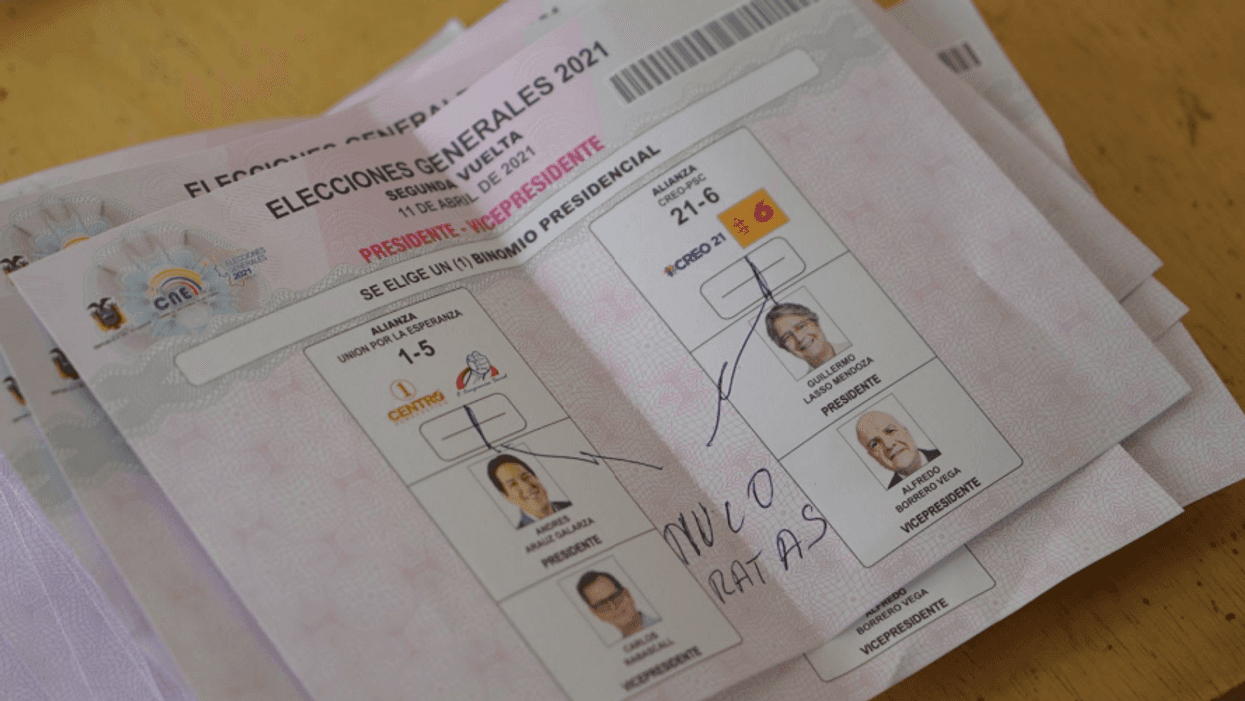
Ecuador's April 11 election that led to a 5-point victory by right-wing banker Guillermo Lasso over progressive candidate Andres Arauz was not what it appeared to be. On the surface, it was a surprisingly clean and professional election, as our CODEPINK official observer delegation witnessed. But a fraud-free process for casting and counting ballots does not mean that the election was free and fair. Behind the scenes was a monumentally unequal playing field and dirty campaign designed to quash an Arauz win.
For starters, Arauz--a 36-year-old follower of the political leanings of former president Rafael Correa and his Citizens Revolution--barely even got on the ballot. The political party he tried to run under was banned by the National Electoral Council (CNE). He and his supporters formed a new political party and that, too, was banned. Eventually they found a small party that let them borrow their slot, but by then it was late December and the first round of elections was on February 7. The other campaigns had a four or five month head start.
Arauz, who was virtually unknown, wanted to have Rafael Correa as his vice president, but the CNE banned Correa from being on the ticket. Even more astounding, the electoral authorities actually prohibited the Arauz campaign from even using Correa's voice or image. But in a show of blatant bias, they didn't banish Correa's image from being used in a negative way by his opponents.
Another intense obstacle was the role of the media. The corporate media dominate all the airwaves in Ecuador, and they were clearly in the Lasso camp. The media led a dirty campaign spreading fake news about Arauz, Correa and their supporters. They scared people by claiming that Arauz was going to de-dollarize the economy. Ecuador has been using the dollar as its currency since 2000, after a financial crisis saw the collapse of its former currency, the sucre. An economist, Arauz was well aware that dollarization had stabilized Ecuador's economy and he never even suggested going back to the sucre.
A particularly absurd accusation came from Colombia, where the country's right-wing attorney general claimed that the National Liberation Army, an armed insurgent group that has been operating in Colombia for decades, made an $80,000 loan to Arauz's campaign. Based on a doctored video that was proven to be false, this accusation nevertheless continued to circulate throughout the press to sully Arauz's character.
"The media smear campaign went hand-in-hand with attacks on the left that had been going on for the past four years under the presidency of Lenin Moreno."
A concerted smear campaign also attacked the legacy of Rafael Correa to scare people away from voting for Arauz. During his time in power from 2007 to 2017, Correa brought economic and political stability to a country that had had seven presidents in ten years. Correa, who has a Ph.D. in economics, completely transformed Ecuador into a modern democracy with a vibrant middle class. He also brought tremendous gains to the poor, reducing poverty from 37 percent to 22 percent, and built critical infrastructure, including highways, hospitals and schools. But the portrayal in the media made Correa out to be a corrupt authoritarian who was a threat to democracy, creating a dilemma for the Arauz campaign about how much to align itself with Correa's legacy.
The media smear campaign went hand-in-hand with attacks on the left that had been going on for the past four years under the presidency of Lenin Moreno. Ironically, Moreno had been Rafael Correa's vice president and ran on the ticket of Correa's Citizens Revolution. But once in power, he orchestrated a kind of "silent coup," betraying Correa, the Citizens Revolution and the progressive policies they stood for. Making common cause with the elites, including Guillermo Lasso, he imposed austerity policies and signed a terrible deal with the IMF that focused on budget cuts, deregulation and reducing workers' rights. In October 2019, there was an uprising against the elimination of a fuel subsidy that would have raised prices on everything from transportation to food. It was put down violently by Moreno's government and many of the protest leaders remain in prison today.
Lasso supported Moreno's austerity measures, the deal with the IMF and the violent crackdown on protesters, yet his campaign successfully managed to create distance between him and Moreno. The narrative spun in the media was that Arauz would continue in the footsteps of Moreno and Correa, as if Moreno had not betrayed the movement.
Moreno viciously lashed out at the left through the misuse of the legal system for political purposes, a tactic known as "lawfare." Jorge Glas, Moreno's vice president who spoke out against his betrayal of the Citizens Movement, was accused of corruption, convicted and put in jail, where he remains under dire conditions. Moreno's government attacked Correa himself, who went into exile in Belgium to avoid being thrown into prison. There are about 30 charges pending against Correa, including a farcical accusation that he had psychic influence over people that led them to become corrupt.
Other top party leaders were hounded and are now either jailed, under house arrest, or forced into exile. The decapitation of the Citizens Revolution meant that Arauz's campaign was significantly weaker than it would have been with their help.
Given all the strikes against Arauz, it is remarkable he did so well. Had it not been for lawfare, a biased CNE and a dirty campaign, he would have won. However, another major factor was the rift between the Citizens Revolution and the indigenous movement that happened under Correa's tenure, which led to calls for a "null vote."
The Confederation of Indigenous Nationalities of Ecuador (CONAIE) and its political party Pachikutik were represented in the first round of voting by Yaku Perez, who did well but didn't make the final cut. Feeling that neither of the two presidential candidates represented the indigenous community, Perez called for people to spoil their ballot by "voting null" (voting is mandatory in Ecuador so a spoiled ballot is the equivalent of boycotting the election).
There was some dissent from the "vote null" position--just days before the election, CONAIE President Jorge Vargas came out in favor of Arauz--but a significant percentage of indigenous peoples voted blank. Roughly 1.7 million Ecuadorians decided to either vote blank or to spoil their ballot. That was a critical factor in the election, given that Lasso won by only about 420,000 votes. Accused of enabling a right-wing victory, some members of Pachakutik argued that they voted null because they believe they can bring down the Lasso government through popular uprisings similar to what occurred in October 2019.
A victory by Arauz would have helped people struggling during this pandemic--Moreno so mismanaged the health situation that Ecuador has one of the world's worst COVID death rates and the economy has been devastated.
Arauz would have also strengthened the left throughout Latin America, promoting the kind of regional integration that took place during the so-called Pink Tide in the early 2000s when a succession of progressive governments took power in Latin America and the Caribbean. New institutions were created such as UNASUR, the Union of South American Nations, and CELAC, the Community of Latin American and Caribbean States. These became a counterbalance to the Organization of American States, which is used as a tool of the U.S. State Department to promote U.S. foreign policy throughout the region. These new regional organizations were part of a much broader vision of regional integration along the lines of the European Union.
If those organizations were as strong now as they had been several years ago, it's likely that Latin America would have been in a better position to deal with the pandemic because they could have bought vaccines together and cooperated on public health policies.
In the coming years, Ecuador's Citizens Revolution will have to use this time to regroup, repair frayed relations with indigenous and union groups, and build a strong social base of support. This social base is something they never really achieved, even under Correa's mandate. They do, however, still have a majority in the National Assembly. The second biggest assembly bloc is the indigenous party Pachakutik, which will undoubtedly be courted by Lasso's government but also has left tendencies. So there may be room to make alliances and fight back against Lasso's austerity policies.
On the regional level, it's a shame that Ecuador won't be helping to swell the ranks of the Pink Tide. But hopefully, other nations in Latin America--such as Peru, Chile, Brazil and even Colombia--have a chance in the coming years to keep the second wave of the Pink Tide afloat.
The democratic elections of President Rafael Correa in Ecuador have enraged the oligarchs, particularly the wealthiest bankers who ruled and predated on the nation for so many decades. That predation led to a massive banking crisis led by fraudulent elite bankers. Ecuadorians fled the nation in record numbers. Ecuador suffered the highest percentage of emigration in Latin America. Political crises became the norm, with a series of presidents forced to resign within months. Correa and his reform party, Alianza PAIS (AP), changed all this.
Correa has served his full elected terms of office largely because he met his campaign promises to more than double expenditures on education, health, and infrastructure that have transformed Ecuador and substantially reduced poverty, unemployment, and inequality. Ecuador's democracy is real. When rival parties won elections in a number of Ecuador's largest cities, there was a normal, peaceful transition of power to those parties. Ecuador has several major political parties and employs a common democratic means of determining whether the first round of the election results produce such a dominant winner that no run-off election is required. Despite the fact that Mr. Moreno, the AP candidate for the presidency, came within a razor-thin margin of reaching that decisive plurality in the first round, the government required a run-off election in accordance with the law.
The AP's reforms were so successful that immigration to Ecuador exceeded emigration from Ecuador. The AP reformed banking to reduce the frauds by elite bankers that drove Ecuador's financial crisis. The oligarchs and bankers have been weakening the Ecuadorian economy by moving their wealth to offshore tax havens. The AP has adopted legislation to limit such tax evasion.
The oligarch's candidate in the run-off election is Mr. Lasso. He is a wealthy banker who runs a bank in Panama that is a leader in aiding Ecuador's oligarchs to evade taxation through offshore tax havens. Lasso's platform is the standard right-wing recipe that caused Ecuador's recurrent economic, social, and political crises. Lasso proposes tax cuts for the wealthy, large cuts to education, health, and infrastructure, and financial deregulation.
Lasso complains of Ecuador's (small) budget deficit, but he is a leading cause of that deficit. He is under investigation by Ecuador's equivalent of the IRS for aiding tax evasion. In addition to Lasso's Panamanian bank that leads his efforts to help the wealthy evade taxes, investigative reporters have found that Lasso runs a maze of 49 companies to aid tax evasion.
Most Americans are appalled that President Trump has refused to disclose his tax returns. Lasso has deliberately weakened Ecuador's economy by profiting from helping thousands of Ecuador's wealthiest citizens evade taxation. In a recent plebiscite, Ecuadorians adopted a law that America should adopt as a model. It bans public officials from having assets or capital in tax havens. They have one year to bring home their money from the tax havens or leave office. Lasso and his supportive band of tax-evading oligarchs are desperate to retake control of Ecuador so that they can destroy this reform and continue to evade taxation.
Over the last couple of years an urgency has invigorated Turtle Island.... a call to action that has awoken all the First Nations. Idling no more against the destruction of our mother earth. Rallying against broken treaties and fighting to secure the future of our seven generations.
First Nations' peoples have been standing up across Canada. Both the government's and big oil's attempt to frack the earth to pump oil up and pipe it across Canada, all in the name of making a dollar, shows no thought to the devastation it would cause. It will poison the soil, the water, the air, the plants and animals, and the people.
Being a traditional Mohawk mother, who grew up on the Akwesasne Mohawk Reservation, I have always fought for the earth and our way of life with the rest of my nation. We have fought against the big companies Domtar, GM and ALCOA--corporations that surround our reserve and pollute the St. Lawrence River and the land. The pollution has been so bad our farm animals either could not reproduce or their offspring were so deformed they would have to be put down right after birth.
Currently, I live in British Columbia with my Squamish nation husband, actor and lacrosse player Wayne Baker. I've just done something I never thought I would do: I voted for the first time in the Canadian federal election. Many people I know will ask why I went against my beliefs and the teachings of the Two Row Wampum belt: "In our canoe we have all our laws, culture, and beliefs and in your vessel you shall have all your laws, culture, and beliefs, traveling side by side through life as equals never enforcing or interfering in each others affairs as long as the sun shall shine the grass shall grow and the rivers shall flow this will be everlasting."
But since this belt was made, the government of Canada and the Crown has not lived up to it or other treaties they have made with the First Nations people of Canada. This is why I voted. Who I voted for is no secret. After months of listening to election promises and looking at past track records of the candidates, and after the press conference the NDP had on the Enoch reserve that was broadcast live on APTN, I VOTED NDP with great hope that all Tom Monclair's promises to First Nations and to our environment are true.
With so many first-time Indigenous voters, I hope 2015 will bring a change for the good. I hope more treaties will be honored and the quality of life on reservations across Canada, particularly those with third-world conditions, will improve. Most of all, I hope Mother Earth can recover from the destruction wreaked on her and sustain our future generations.
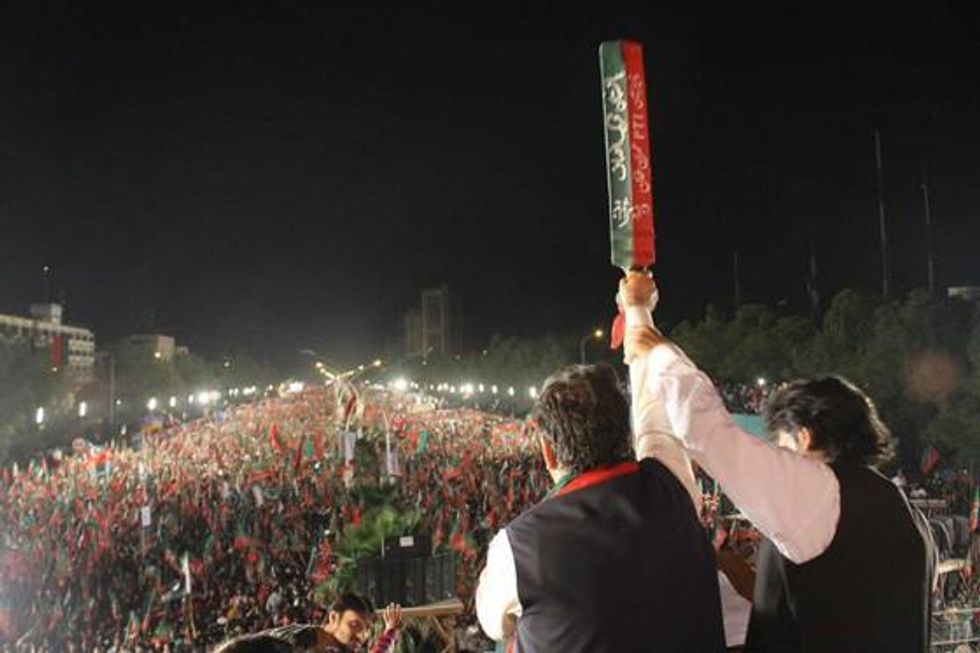
Hundreds of thousands of energized Pakistani voters filled Islamabad's Parade Avenue (D-Chowk) Thursday night for the final rally of the surging campaign of Pakistan's populist Imran Khan on the last day of campaigning ahead of Saturday's national election.
Kahn has captured the pulse of the nation with his anti-corruption, anti-US drone platform. Khan and his PTI party's 'Tsunami' campaign has drawn massive crowds and enthusiasm all over Pakistan in the closing days of campaigning. A poll earlier this week said Khan was nearly tied for support with the presumed front-runner Nawaz Sharif.
Imran Khan spoke to the massive Islamabad crowd via teleconference from his hospital bed. Khan sustained three fractured vertebrae and a broken rib during a rally on Tuesday night when he fell off a forklift while being lifted up to the stage.
Khan founded his PTI party in 1996. The party -- Pakistan Tehreek-i-Insaf (Pakistan's Movement for Justice) -- has a tagline of: Justice, Humanity, Self-Esteem. The Oxford-educated Khan is a national hero who captained the Pakistani cricket team to a World Cup victory in 1992.
While Khan has vowed to take a stand against drone strikes, clean up corruption, and push for justice, he has also made several specific campaign promises:
* * *
* * *
Imran Khans' Facebook page, Twitter feed and website.
* * *
From Reuters:
"Until recently people didn't have a choice, it was a case of choosing the best worst option," said Shafqat Mahmood, who is hoping to win a parliamentary seat for Khan's party in the city of Lahore."Now people have another choice, someone who is...a national hero in more ways than one."[...]
A senior diplomat said the military sees Khan, who has vowed to wipe out corruption, as a useful safety valve for popular anger over the graft and incompetence of the political class.
A survey by the Pew Research Center released this week found an "exceedingly grim" public mood in Pakistan, with roughly 90 percent saying their country is on the wrong track.
Six in 10 people surveyed by Pew said they had a positive view of Khan, who says he is one of the very few political leaders to declare his income and assets to the tax authorities.
In power, however, Khan could be a thorn in the side of the army, which is frustrated by the lack of support from politicians for its battle against Taliban insurgents in tribal areas that has killed and maimed thousands of soldiers.
Khan has vowed that, if he comes to power, he would end Pakistan's cooperation with Washington in the war on Islamist militancy, stop the American drone strikes targeting militants and refuse further U.S. aid. He also wants to stop the fight against the Taliban and seek a negotiated settlement.
* * *
President Rafael Correa handily won a third term as Ecuador's head of state Sunday in a landslide victory demonstrating what many are calling a "clear mandate" for the continuation of his progressive economic policies and widespread support for his growing "citizens' revolution."
"This victory is yours. It belongs to our families, to our wife, to our friends, our neighbors, the entire nation," said Correa on a state television broadcast. "We are only here to serve you. Nothing for us. Everything for you, a people who have become dignified in being free."
Thousands of supporters celebrated in the main square in the capital, Quito, as television stations began announcing the exit poll results shortly after polls closed.
Media reports confirm that Correa was re-elected with at least 58 percent of the vote with his closest challenger, a former banker named Guillermo Lasso, receiving 24 percent; Correa's Alianza Pais party also won a clear majority in the National Assembly, garnering 52 percent of the vote.
Since Correa initially took office in 2007, the country has experienced solid economic growth. Poverty has been reduced by 27 percent with unemployment reaching a record low of 4.1 percent last year. Reporting on the victory, the Guardian adds:
Correa has endeared himself to the poor and lower middle class by making education and health care more accessible, building or improving roads and creating 95,400 jobs in the past four years, according to government figures.[...]
The US-educated Correa gained an early reputation as a maverick, defying international financiers by defaulting on $3.9bn in foreign debt obligations and rewriting contracts with oil multinationals to secure a higher share of oil revenues for Ecuador.
He has also kept the United States at arm's length while upsetting Britain and Sweden in August by granting asylum at the Ecuadorean embassy in London to WikiLeaks founder Julian Assange.
Calling the re-election of both Correa and many members of his Alianza Pais party a "clear mandate for the continuation of [his] economic policies," Center for Economic and Policy Research Co-Director Mark Weisbrot said that media bias against South America's left wing governments has tainted some of Correa's successes thus far. "But this is what democracy looks like," he adds. "When a government succeeds, voters reward it at the polls."
"The banking class cannot run things here anymore," Correa declared after the win. "Nor party politics nor the media nor factions serving interest groups. The International Monetary Fund does not run things here, nor the international bureaucracies. Hegemonic countries do not run things here anymore. Despite whatever errors we could commit, you can rest assure that this revolution will be led by you, Ecuadorean men and women."