

SUBSCRIBE TO OUR FREE NEWSLETTER
Daily news & progressive opinion—funded by the people, not the corporations—delivered straight to your inbox.
5
#000000
#FFFFFF
To donate by check, phone, or other method, see our More Ways to Give page.
Daily news & progressive opinion—funded by the people, not the corporations—delivered straight to your inbox.
"What we found was crystal clear—any further investment in LNG is not compatible with a livable climate."
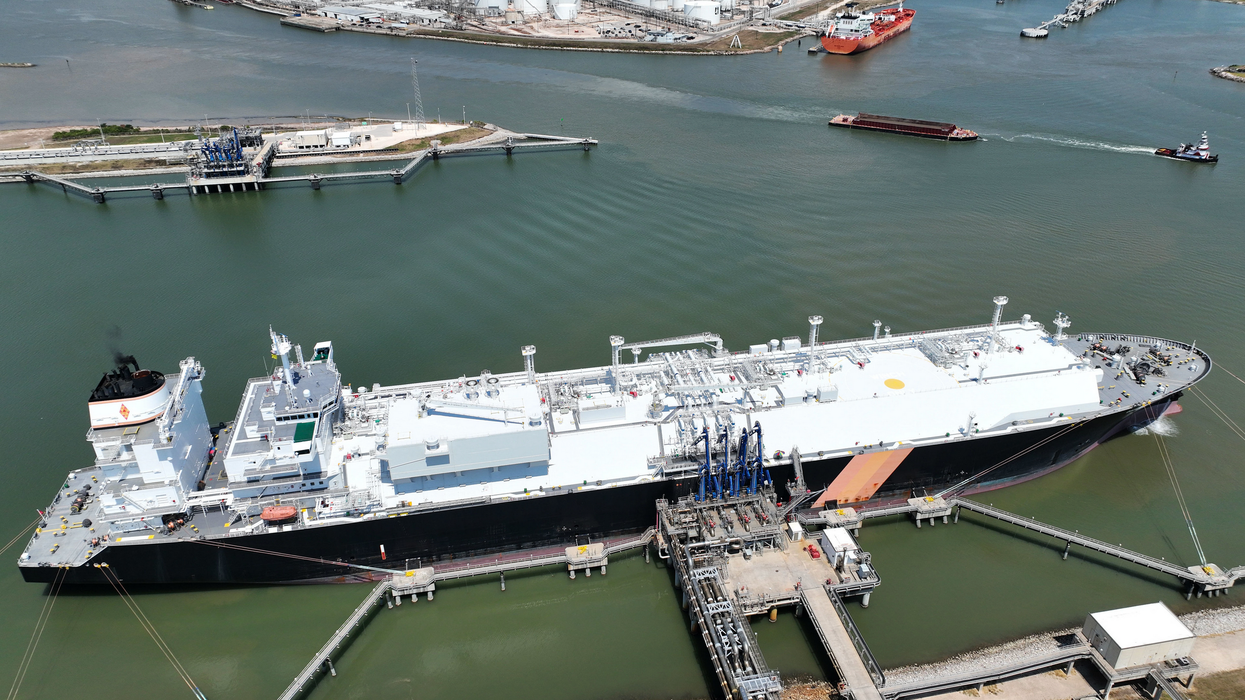
As U.S. President Donald Trump ramps up fossil fuel production under his "drill, baby, drill" energy policy, a report published Wednesday highlights the climate and financial harms posed by new liquefied natural gas export projects—all of which fail a "climate test" that the Department of Energy issued during the Biden administration.
The report—published by Greenpeace USA, Earthworks, and Oil Change International—examines five major U.S. LNG projects: Venture Global CP2, Cameron LNG Phase II, Sabine Pass Stage V, Cheniere Corpus Christi LNG Midscale 8-9, and Freeport LNG Expansion.
Instead of giving into Trump’s pressure to import + finance more LNG, leaders must invest in a just transition to renewable energy that will protect our communities from deadly pollution and climate disasters. Learn more: www.greenpeace.org/usa/failing-...
[image or embed]
— Oil Change International (@oilchange.bsky.social) July 9, 2025 at 6:57 AM
All but one of the projects is awaiting a final investment decision. None passes a "climate test" derived from the Department of Energy's (DOE) December 2024 LNG export public interest studies, as they all would result in a net increase in global greenhouse gas (GHG) emissions regardless of sustainability measures including supply basin switching, LNG terminal methane abatement, and powering liquefaction with renewable electricity.
"Increasing LNG exports from the Gulf Coast would still lead to global GHG emissions increases above the level consistent with the DOE's most stringent climate mitigation scenario," the report states. Data suggests "no realistic mitigation can make U.S. LNG exports aligned with limiting warming to 1.5ºC," the more ambitious goal of the Paris climate agreement. Trump has twice withdrawn the United States from the landmark accord.
"What we found was crystal clear—any further investment in LNG is not compatible with a livable climate," Greenpeace USA senior research specialist Andres Chang, the report's lead author, said in a statement.
"The massive growth in infrastructure along the Texas and Louisiana Gulf Coast has already created significant public health and ecosystem impacts, threatening entire coastal communities," Chang added. "But it doesn't stop there. This report shows that if built, these projects would put global climate goals even further out of reach."
"No realistic mitigation can make U.S. LNG exports aligned with limiting warming to 1.5ºC."
The United States is the world's leading natural gas producer and LNG exporter. While the fossil fuel industry often calls LNG a "bridge fuel"—a cleaner alternative to coal that will ease the transition to sustainable energy sources—critics have warned that the fossil gas actually hampers the transition to a green economy. LNG is mostly composed of methane, which has more than 80 times the planetary heating power of carbon dioxide during its first two decades in the atmosphere.
Despite his own DOE's acknowledgment that approving more LNG exports would raise domestic energy prices, increase pollution, and exacerbate the climate crisis, former President Joe Biden oversaw what climate campaigners called a "staggering" LNG expansion, including Venture Global's Calcasieu Pass 2 export terminal in Cameron Parish, Louisiana and more than a dozen other projects.
Trump—who during his 2024 campaign vowed to "frack, frack, frack; and drill, baby, drill" as fossil fuel interests poured $75 million into his campaign coffers—is planning to increase LNG exports even more, in part by invoking his bogus "energy emergency" to fast-track polluting projects.
A report published in January by Friends of the Earth and Public Citizen examined 14 proposed LNG export terminals that the Trump administration sought to fast-track and found they would create 510 million metric tons of climate pollution—equivalent to the annual emissions of 135 new coal plants.
Oil Change International noted Wednesday that "future administrations could revoke export authorizations that were rubber-stamped under Trump based on their failure to pass the DOE 'climate test,' which introduces a new layer of uncertainty to these already-risky projects."
The report also underscores that while the DOE climate test "is a major improvement upon previous federal analyses," its methodology "still fails to sufficiently account for emissions from large, accidental releases (such as 'super-emitter' events), equipment malfunction, and malpractice."
"High rates of methane emissions during the ocean transport stage of the LNG supply chain are also not represented," the report adds. "Incorporating measurement-based data and more realistic assumptions would make clearer the immense climate impact of building new liquefied gas infrastructure, especially in the near-term."
The report's authors call on the DOE to invoke the "climate test" to reject pending and future LNG export applications and exercise its authority under the Natural Gas Act "to reevaluate the public interest status of LNG projects that received authorizations without consideration of climate impacts or under analyses that predate the 2024 LNG Study."
The publication also calls on Congress to pass legislation "that makes it a statutory requirement under the Natural Gas Act to assess the climate impact of gas exports and reject applications that would increase global GHG emissions under a credible scenario to limit warming to 1.5ºC."
"Additionally, U.S. federal agencies should require all new proposed fossil fuel production and infrastructure projects to meet a similarly high standard under the National Environmental Policy Act," the report asserts.
"Energy purchasers, financial institutions, and foreign governments should refrain from entering into long-term offtake agreements for U.S. LNG and financing of LNG infrastructure," the authors wrote. "Instead, these parties should prioritize measures that accelerate the renewable energy transition and plan for a managed phase-out of fossil fuels. Group of Seven nations, in particular, should abide by their 2022 commitment to stop financing overseas fossil fuel infrastructure with taxpayer money."
James Hiatt, founder and director of the Lake Charles, Louisiana-based advocacy group For a Better Bayou, said Wednesday that "fossil fuel dependency has long externalized its true costs, forcing communities to bear the burden of pollution, sickness, and economic instability."
"For decades the oil and gas industry has known about the devastating health and climate impacts of its operations, yet it continues to expand, backed by billions in private and public financing," Hiatt continued. "These harms are not isolated—they're systemic, and they threaten all of us."
"This report is a call to conscience," he added. "It's time we stop propping up deadly false solutions and start investing in a transition to energy systems that sustain life, not sacrifice it."
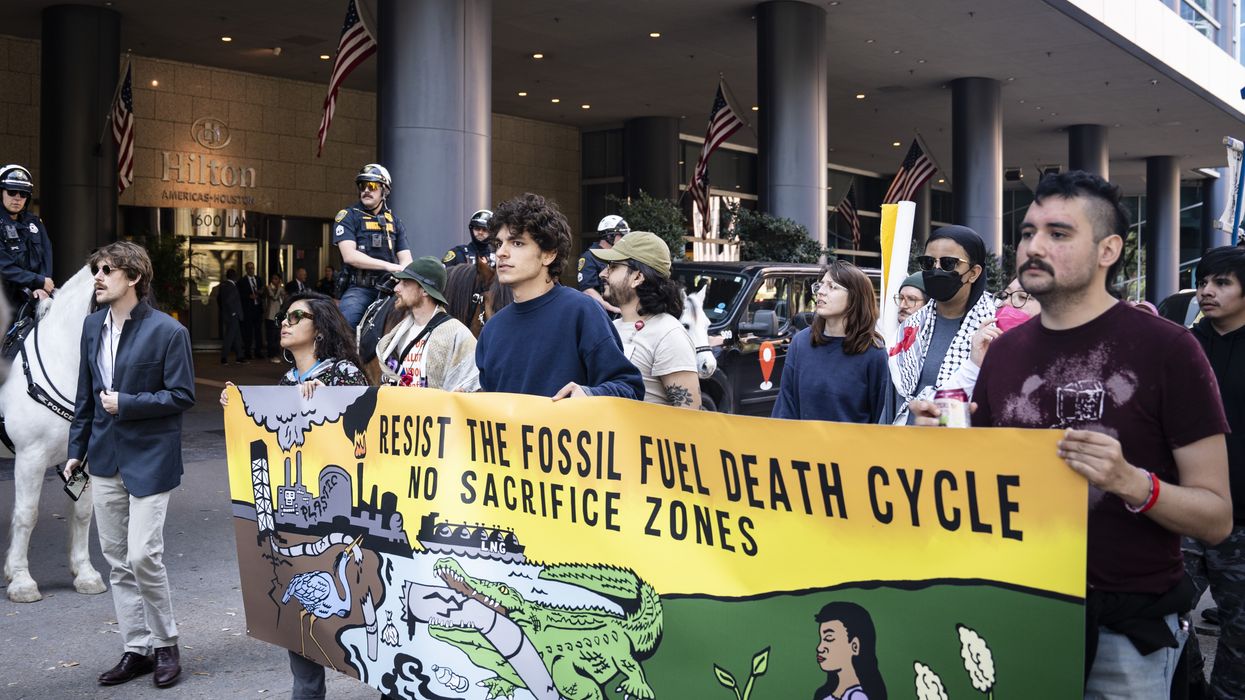
"As Wright speaks to industry insiders, members of impacted communities, faith leaders, youth, and others are assembling for a 'March for Future Generations,'" one campaigner said of the action at CERAWeek.
As environmental justice advocates were arrested outside a major energy conference in Houston on Monday, U.S. President Donald Trump's energy secretary faced criticism for his remarks to the government officials and oil and gas executives attending the event.
"Chris Wright, a former fracking CEO who essentially purchased his Cabinet position through $450,000 in Trump campaign contributions, personifies the deadly alliance between the Trump administration and the fossil fuel industry," said Oil Change International U.S. campaign manager Allie Rosenbluth, citing a figure that includes his wife's donations.
Wright's speech at CERAWeek, hosted by S&P Global, Rosenbluth continued, "made clear that he and the rest of the Trump administration are ready to sacrifice our communities and climate for the profits of the fossil fuel industry—which spent $445 million in total to influence Trump and Congress last election cycle."
"We have a human right to breathe clean air, drink clean water, and spread our roots in our homes. We cannot do that as long as these poisonous companies... continue to encroach on our communities."
CNBC reported that at the event, Wright vowed to support natural gas production and said that "the Trump administration will end the Biden administration's irrational, quasi-religious policies on climate change that imposed endless sacrifices on our citizens."
Despite his past comments about the fossil fuel-driven climate emergency, Wright rejected claims that he is a climate change denier and said that "the Trump administration will treat climate change for what it is—a global physical phenomenon that is a side effect of building the modern world."
"There is simply no physical way wind, solar and batteries could replace the myriad uses of natural gas," Wright claimed. He also singled out wind, saying that "it's incredibly high prices, incredibly huge investment, and a large footprint on the local communities, so it's been very unpopular for people that live near offshore wind turbines."
While in Texas, Wright announced a permit extension for Delfin LNG, an offshore liquefied natural gas export terminal proposal near the Louisiana coast—which Kelsey Crane, senior policy advocate at Earthworks, called "just a continuation of Chris Wright acting in the interest of Big Oil and Gas."
"Without hesitation he is advancing a project that has a different design, funding, contracts, and operational plans since it was first reviewed over six years ago," she said. "It is clear his only job is to make fossil fuel corporations rich by advancing oil and projects, which will leave families and small businesses to struggle with higher energy bills."
According to the Houston Chronicle, "It's the third Gulf Coast LNG project to receive support since Trump took office."
Rosenbluth similarly slammed the decision, saying that "his performative extension of Delfin LNG's export authorization during his speech represents just how deeply intertwined the Trump administration is with the fossil fuel CEOs at CERAWeek."
"As Wright speaks to industry insiders, members of impacted communities, faith leaders, youth, and others are assembling for a 'March for Future Generations,' where they're demanding an end to new fossil fuel projects and government subsidies for the fossil fuel industry," she noted. "The movement for a just transition away from fossil fuels, and towards a clean energy economy that works for all of us, is continuing to fight—regardless of how many fracking CEOs Trump puts in his Cabinet."
The Chronicle reported that "police arrested eight climate protesters Monday after they linked arms to briefly block a street next to CERAWeek by S&P Global... The activists were among hundreds who marched from nearby Root Memorial Square Park to the conference, which is hosted annually at the Hilton Americas-Houston and the George R. Brown Convention Center."
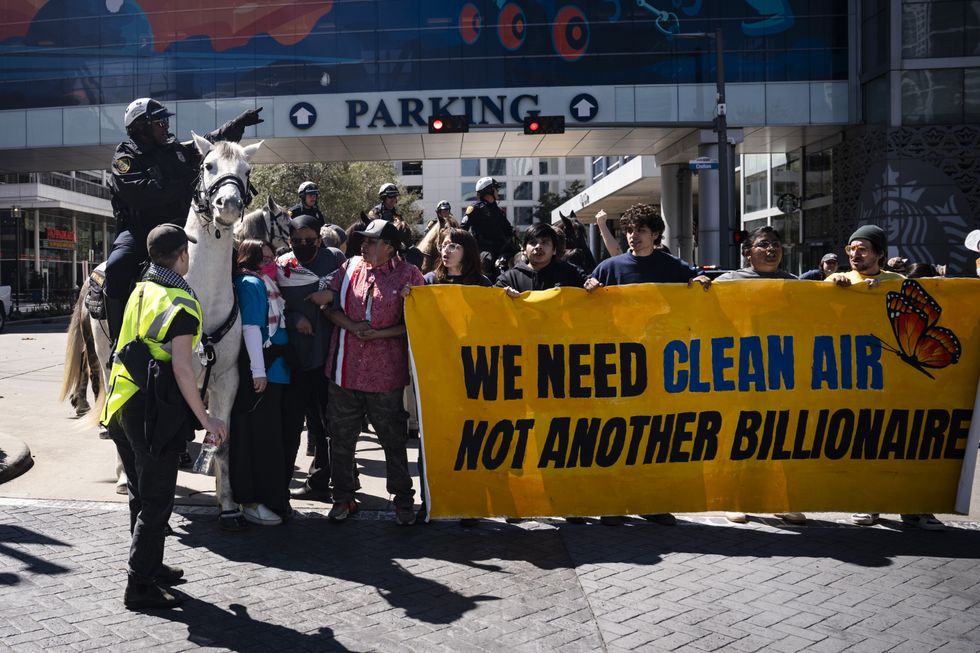 Climate advocates held a banner at CERAWeek by S&P Global in Houston, Texas on March 10, 2025. (Photo: Luigi W. Morris)
During a press conference at the park, Bekah Hinojosa, co-Founder of South Texas Environmental Justice Network in the Rio Grande Valley, said that "our community has been resisting LNG projects for over 10 years. Those projects are the Rio Grande LNG, Texas LNG, and the Rio Bravo pipeline. Last year, our community proved in court that these LNG facilities would be environmental racism. We are a low-income, brown, Native community, and LNG would be a cancer factory."
Jake Hernandez of Texas Campaign for the Environment declared that "we have a human right to breathe clean air, drink clean water, and spread our roots in our homes. We cannot do that as long as these poisonous companies, like Cheniere, continue to encroach on our communities. I've seen a lot of harms and consequences that LNG buildout can cause to our communities. This is just an earnest plea to help us put an end to LNG!"
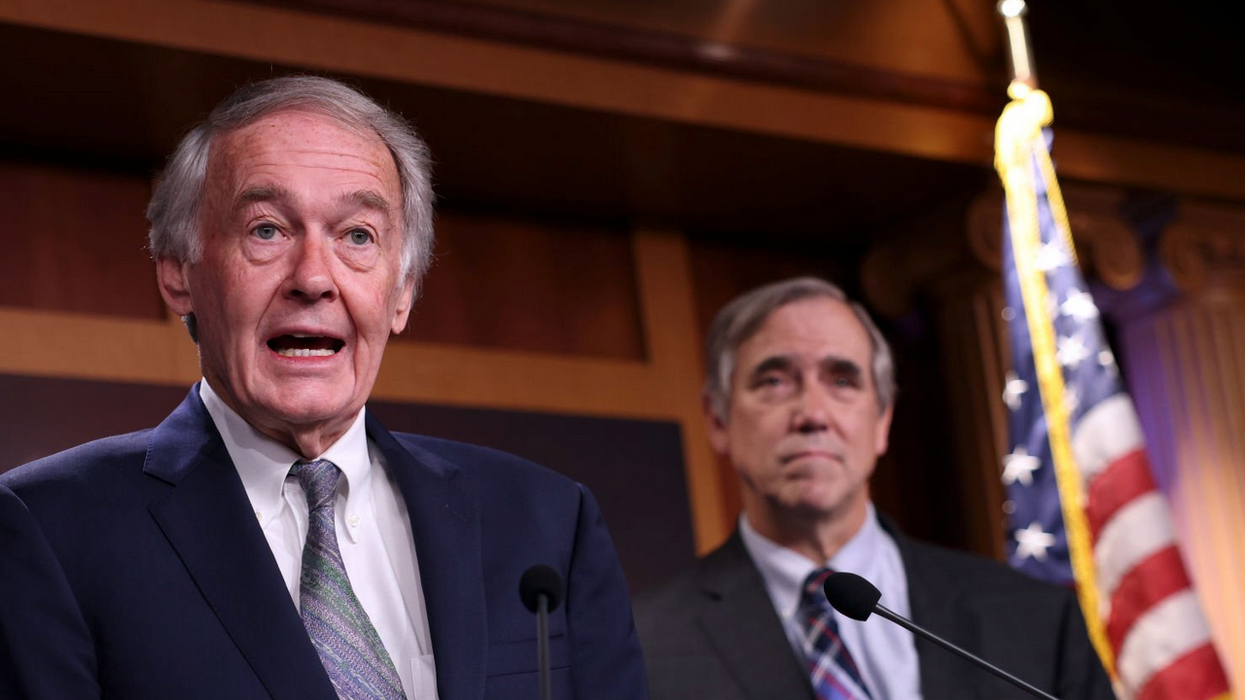
"Big Oil executives and fossil fuel lobbyists shouldn't be able to turn public agencies into private profit machines for fossil fuel shareholders," argued Sen. Ed Markey.
Faced with the imminent White House return of Republican President-elect Donald Trump and an administration stacked with fossil fuel industry veterans, a pair of progressive U.S. Senate Democrats on Thursday introduced legislation that would ban former oil, gas, and coal executives or lobbyists from leading numerous energy-related federal agencies for 10 years after leaving their private sector jobs.
The Banning In Government Oil Industry Lobbyists (BIG OIL) from the Cabinet Act—put forth by Sens. Ed Markey (D-Mass.) and Jeff Merkley (D-Ore.)—would apply to prospective secretaries of agriculture, defense, energy, the interior, state, and transportation; as well as key posts including administrator of the Environmental Protection Agency and National Oceanic and Atmospheric Administration; White House chief of staff; and directors of the White House's Office of Science and Technology Policy, and Office of Management and Budget.
"Let's pass this bill and get fossil fuel executives and their ill-gotten bucks out of our government."
"Donald Trump isn't building a Cabinet, he's installing a cartel. Big Oil executives and fossil fuel lobbyists shouldn't be able to turn public agencies into private profit machines for fossil fuel shareholders," said Markey. "This is a clear ethical line—their work polluting our environment, destroying our climate, and prioritizing corporate profits over democracy must not be rewarded with even more power over the very safeguards set to protect American households from their influence."
"Especially in the wake of the Los Angeles wildfires and more frequent and dangerous disasters fueled by climate change, we can't afford to have a fossil fuel CEO like Chris Wright help the industry capture our federal agencies further for oil profits," Markey added, referring to the fracking services company chief executive nominated by Trump to head the Department of Energy. "We must have government agencies helmed by responsible, qualified executives without blatant conflicts of interest."
Merkley said: "Climate chaos fueled by dirty energy is humanity's greatest challenge, and Trump wants to make sure we fail that challenge by handing our government over to Big Oil. Let's pass this bill and get fossil fuel executives and their ill-gotten bucks out of our government."
Scores of climate, environmental justice, government transparency, and other groups have endorsed the bill.
"The fossil fuel revolving door has dominated American energy policy for decades and could poison our environment for centuries to come," Food & Water Watch policy adviser Drew Guillory said in a statement Thursday. "Oil and gas companies cannot be allowed to regulate themselves and use the government to guarantee their profits. The BIG OIL from the Cabinet Act is a crucial step in returning control of our climate to the American people."
Kelsey Crane, senior policy advocate at Earthworks, said: "The fossil fuel industry is notorious for spending millions of dollars to delay climate action and undermine progress on environmental justice. This bill ensures big polluters are not granted positions of power where it is guaranteed they would degrade environmental protections and block investments in a clean energy future."
Sunrise Movement executive director Aru Shiney-Ajay noted that "Los Angeles is on fire. Asheville is just starting to rebuild."
"The climate crisis is here and it's happening because oil and gas CEOs disregarded science and chose to keep burning fossil fuels," Shiney-Ajay added. "They chose to sacrifice millions of homes and lives so they could keep profiting. Those same people should not be in charge of creating energy policy."
"Hundreds of hours of on-the-ground research has made it more clear than ever that certifiers are not living up to their claims," one report author said.
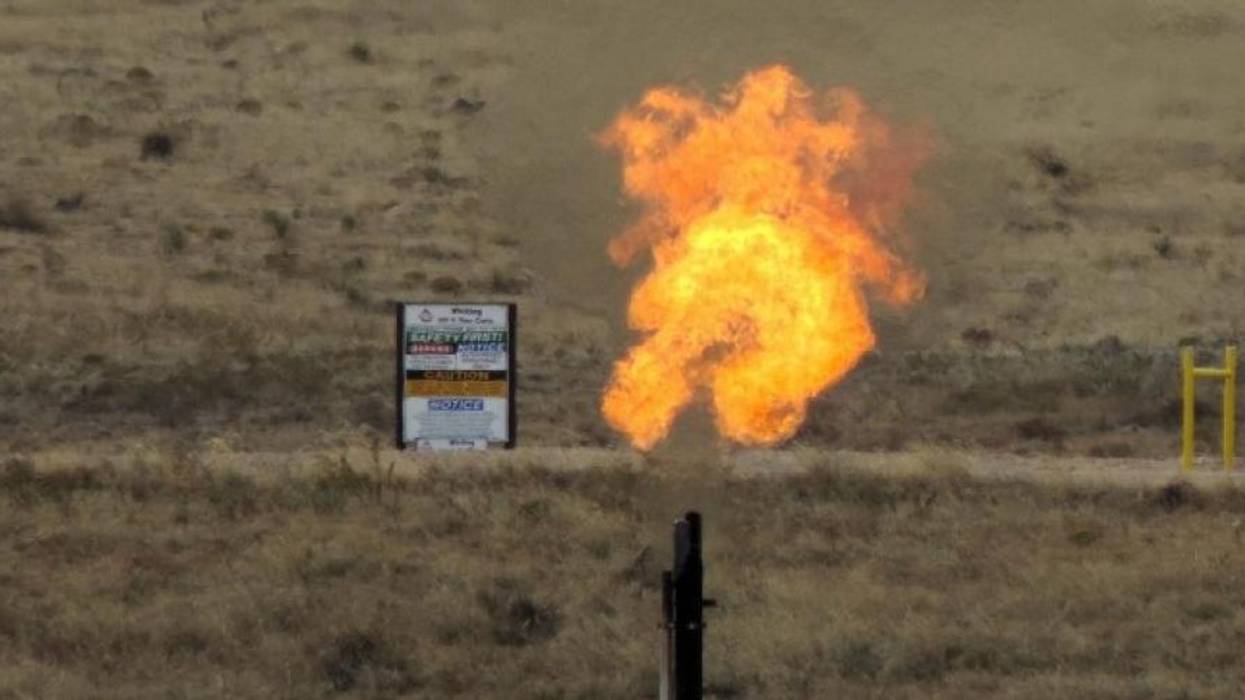
Methane emissions monitors operated by third-party gas certification companies only picked up one of the 23 pollution events detected by anti-extraction group Earthworks.
That's one of the findings in Certified Gaslighting, a report published by Earthworks and Oil Change International on Tuesday that reveals how fossil fuel companies are increasingly turning to private gas certification companies to prove that they are reducing their methane emissions.
The evidence indicates that the "certified gas" label is just another industry smokescreen thrown up by climate arsonists to shield themselves from public pressure.
"'Certified' gas is the industry's latest effort at greenwashing, not an earnest effort at halting the accelerating climate crisis," Dakota Raynes, report author and Earthworks research and policy manager, said in a statement. "Hundreds of hours of on-the-ground research has made it more clear than ever that certifiers are not living up to their claims."
"If we want to stop rising methane emissions, then we must stop the gas certification farce."
For the report, Earthworks carried out 81 surveys at 38 oil and gas sites in Colorado over the course of 10 months in 2023, reviewing both pollution levels and the continuous emissions monitors (CEMS) designed to detect it. While Earthworks detected pollution events during a quarter of its site visits, the CEMs only caught one.
What's more, Earthworks looked at the monitors operated by Project Canary, one of the leading gas-certification companies. The environmental group found that the company's monitors, advertised as "continuous," were actually offline more than 25% of the time.
"Fossil fuel companies are scrambling to maintain relevance amid mounting pressure from communities and climate advocates, so they resort to third-party 'certification' schemes as a last-ditch effort to portray their operations as 'clean,'" Oil Change International research director Lorne Stockman said in a statement. "Our research reveals these certification scams are deceptive, enabling gas companies to expand under the false pretense of emission reductions. This greenwashing scam must end so we can focus on what's urgently needed—phasing out oil and gas."
Tuesday's report builds on a growing body of evidence that "gas certification" is another trick from what Raynes described as the "industry's grab bag of dangerous distractions." While private companies certify almost 40% of U.S. gas, the nation's oil and gas sector emits more methane than any other country's. In 2023, it released 13.8 million metric tons, translating to almost 1.2 billion tons of CO2 equivalent or the emissions of 301 coal plants, according to International Energy Agency figures. Globally, the oil and gas industry spewed more than 79.5 million metric tons of methane last year.
The report also follows previous research from Earthworks and Oil Change, which found that Project Canary monitors failed to detect every pollution event picked up by Earthworks' Optical Gas Imaging cameras.
The fact that the monitors only picked up one Earthworks-detected event a year later "suggests that operators have made minimal changes to monitoring efforts to account for the findings in our report," the authors of Tuesday's report wrote.
The latest report also points out what it terms a "dangerous loophole": The companies are not required by Colorado law or by certification standards to address pollution events that occur due to normal operations as opposed to malfunctions. Yet most of the events detected by Earthworks were part of normal operations.
"These emissions are no less harmful to communities exposed to the pollution nor less impactful with respect to the climate crisis," the authors wrote.
Despite the many problems with the gas-certification process, the industry is rushing to adopt it as the U.S. Department of Energy, Environmental Protection Agency, and Treasury Department are considering incorporating it into regulations. Some public utilities are also buying certified gas and then charging customers more to deliver it as they claim to make progress on climate goals.
"As they have for decades, the fossil fuel industry is deliberately lying, manipulating, and gaslighting the public," Leah Qusba, executive director for Action for the Climate Emergency, said in a statement. "Before 'certified gas' there was 'next-gen gas,' before that there was 'natural gas,' and before that there was the myth of 'clean coal.' All these fancy terms to hide the truth: Fossil fuels are deadly, and they're stealing our future."
In response to their findings, the report authors recommended that methane-reduction efforts should be carried out under government overview and within a regulatory framework that prioritizes the well-being of communities and consumers. Further, they advised that regulators should not include certification schemes as part of their efforts and that CEMs should be used transparently and in accordance with peer-reviewed best practices and with all of their data made publicly available.
"It's no surprise that the same industry that has spent decades marketing gas as 'safe,' 'clean,' and 'natural' is now looking for new ways to greenwash its product," said Gas Leaks Project executive director James Hadgis. "Third-party gas certification schemes are unable, or unwilling, to capture emissions events that intensify the climate crisis while poisoning nearby communities. If we want to stop rising methane emissions, then we must stop the gas certification farce."
Moreover, the report emphasizes that, while important, simply reducing oil-and-gas methane emissions is not enough. The government must encourage and facilitate a rapid and just transition away from fossil fuels.
This includes resisting the industry push to increase the production and export of liquefied natural gas (LNG). LNG has emerged as a major front in the battle to combat the climate emergency, as the Biden administration has announced a pause on export approvals to assess their impact on the climate and consumers, even as fossil fuel companies and allied politicians protest.
"LNG exports are a certified disaster. No amount of greenwashing changes the fact that continuing to expand fossil fuels will perpetuate harms to our climate and the communities in the path of the fracking industry's drilling pads, pipelines, and export facilities," Jim Walsh, the policy director of Food & Water Watch and Food & Water Action, said in a statement.
"We continue to see major fossil fuel companies move forward plans to increase exports of fracked gas, despite the limited pause on new export approvals," Walsh continued. "The health of our communities and the planet depends on President Biden rejecting these misleading industry certification schemes and starting a real and robust effort to phase out fossil fuels."

"The Biden administration has clearly fallen for this scam hook, line, and sinker," said one campaigner. "This multibillion-dollar bet on greenwashed dirty energy will undermine efforts to address the climate crisis."
As U.S. Energy Secretary Jennifer Granholm on Friday celebrated the "historic investment" of up to $7 billion for seven regional hydrogen hubs as a key to achieving President Joe Biden's "goal of American industry powered by American clean energy," some climate campaigners warned that the administration is falling for—or participating in—a fossil fuel industry scam.
Roughly two-thirds of the H2Hubs investment will go toward green hydrogen, which is made using renewable energy, according to the White House. However, the bipartisan infrastructure legislation Biden signed in 2021 requires broader support, including for pink (nuclear) and blue (gas) hydrogen projects, the latter of which includes carbon capture, utilization, and storage.
"At face value—and according to the Biden playbook—the hydrogen hub grants aim to help transition the United States to clean energy. In reality, they amount to another corporate scam, one that preserves and extends the life of the extractive economy and prevents the frontline communities most impacted by climate disaster from having input," said Marion Gee, co-executive director at the Climate Justice Alliance, representing 89 rural and urban environmental justice groups.
"Hydrogen development is energy intensive to produce, could present a public safety risk in transit, can produce health-damaging air pollution when combusted, and is a play by the fossil fuel industry to extend its viability and profits," Gee stressed. "We must work to move capital and power into the hands of local communities who will center traditional ecological and cultural knowledge and create a pathway toward a regenerative future."
"The fossil fuel industry is working to continue our nation's reliance on fossil fuels by any means necessary—and hydrogen offers yet another possible inroad for Big Oil and Gas."
Earthworks policy director Lauren Pagel also asserted that "prioritizing hydrogen hubs across the United States is more about extending the life of oil and gas companies than addressing the climate crisis. These hubs are a dangerous distraction from the obvious consensus solution that the world must stop expanding fossil fuels that are warming the atmosphere."
Food & Water Watch policy director Jim Walsh was similarly critical, declaring that "the massive build-out of hydrogen infrastructure is little more than an industry ploy to rebrand fracked gas. The Biden administration has clearly fallen for this scam hook, line, and sinker. This multibillion-dollar bet on greenwashed dirty energy will undermine efforts to address the climate crisis, while increasing pollution of our air and water, and milking taxpayers for billions in new fossil fuel subsidies."
"Even the cleanest forms of hydrogen present serious problems—most notably the massive amount of water that would be waste," Walsh added. "As groundwater sources are drying up across the country, there is no reason to waste precious drinking water resources on hydrogen when there are cheaper, cleaner energy sources that can facilitate a real transition off fossil fuels."
The seven selected projects are the Appalachian (West Virginia, Ohio, and Pennsylvania), California, Gulf Coast (Texas), Heartland (Minnesota, North Dakota, and South Dakota), Mid-Atlantic (Pennsylvania, Delaware, and New Jersey), Midwest (Illinois, Indiana, and Michigan), and Pacific Northwest (Washington, Oregon, and Montana) hydrogen hubs.
As The New York Times detailed:
Not all of the $7 billion in funding will be spent at once. As a first step, the Energy Department will give awardees initial grants to create more detailed proposals for their hydrogen hubs. If the agency deems the projects viable, it will disburse more money over time—but that money is not guaranteed if any of the hubs prove unworkable.
"We're still a long, long ways away from creating a large-scale hydrogen economy," said Alex Kizer, a senior vice president at the Energy Futures Initiative, a Washington nonprofit organization. "Think of these hubs as laboratories of sorts to experiment with potential business models for hydrogen and to try to figure out some of the technological and infrastructure hurdles."
Even groups that support green hydrogen raised concerns over funding longtime polluters. Sierra Club executive director Ben Jealous warned that "the fossil fuel industry is working to continue our nation's reliance on fossil fuels by any means necessary—and hydrogen offers yet another possible inroad for Big Oil and Gas to lock in polluting and noneconomic uses of gas for decades to come."
"Decision-makers in the administration and at the local level must be wary of these attempts and ensure as much hydrogen-specific funding as possible goes to green hydrogen and its most efficient end uses to ensure this investment actually addresses climate change," he said.
Jill Tauber, vice president of litigation for climate and energy at Earthjustice, suggested that "hydrogen can be a clean energy solution, or it can drive us deeper into the climate crisis and hurt communities," and that green projects powered by renewables "can play an important role cleaning up what we cannot electrify, like steel manufacturing."
Julie McNamara, deputy policy director of the Climate and Energy Program at the Union of Concerned Scientists, joined the chorus of alarmed critics on Friday, saying that "billions of taxpayer dollars are at risk of perpetuating fossil fuel industry injustices and harms while subsidizing fossil fuel greenwashing."
"Today's announcement also sets in stark relief the significance of upcoming administration decisions around implementation of the Inflation Reduction Act's hydrogen production tax credit, which could be a bulwark against heavily polluting hydrogen—or a backdoor subsidizing it," she noted. "The Department of Energy and the Biden administration now must set rigorous implementation, evaluation, and engagement criteria to ensure the development of a hydrogen industry that is unequivocally aligned with our climate objectives and that serves our collective goal to secure a safe, clean, just, and healthy future for all."

One campaigner said the IEA report "discredits any attempt to use methane reduction efforts as an excuse to further permit fossil fuel expansion."
As the International Energy Agency released a report warning that immediate cuts to methane gas pollution caused by fossil fuel production are critical for averting climate catastrophe, an environmental advocacy group on Wednesday said the IEA publication gives U.S. President Joe Biden "sufficient justification to declare a climate emergency."
The IEA report states that "immediate reductions in methane emissions are needed to limit warming to 1.5°C," the more ambitious objective of the Paris agreement.
Methane—which has more than 80 times the warming power of carbon dioxide during its first two decades in the atmosphere—is emitted during the production and transportation of oil, gas, and coal, as well as from municipal landfills and livestock.
The report continues:
Rapid cuts in methane emissions from fossil fuels through targeted abatement measures—alongside deep cuts in carbon dioxide (CO2) emissions—are essential to achieve global climate targets. Without targeted action on methane, even with deep reductions in fossil fuel use, the increase in the global average surface temperature will likely exceed 1.6°C by 2050.
Responding to the report, Lauren Pagel, policy director at Earthworks, a Washington, D.C.-based environmental nonprofit, said in a statement that "the IEA says what Earthworks has long known: Preventing climate catastrophe requires the world to stop fossil fuel expansion and to do everything we can right now to cut methane gas pollution."
"In order to right historical injustices for those who have disproportionately experienced the harms of extraction—Indigenous and Black and Latino and poorer white communities in the U.S., specifically—we must aggressively and immediately cut pollution and manage the decline of the fossil fuel industry," she continued.
"This report discredits any attempt to use methane reduction efforts as an excuse to further permit fossil fuel expansion," Pagel added. "It also gives President Biden sufficient justification to declare a climate emergency and steer the U.S. toward a sustainable, just energy future."
Declaring a climate emergency unlocks certain executive powers that the Biden administration could use the battle the crisis without congressional action.
While Biden said in August that he has "practically" declared a climate emergency, campaigners note that his administration has approved more new permits for fossil fuel drilling on public lands during his first two years in office than former President Donald Trump did in 2017 and 2018.
The Biden administration has also held a massive fossil fuel lease sale in the Gulf of Mexico, approved the highly controversial Willow project and Mountain Valley Pipeline, and increased liquefied natural gas production and export.
Hundreds of thousands of Americans have also urged the U.S. Environmental Protection Agency to strengthen and expand a draft rule on methane reduction. The Inflation Reduction Act signed into law by Biden last year provides hundreds of millions of dollars for reducing methane emissions.
On Wednesday, climate activists confronted U.S. Transportation Secretary Pete Buttigieg over his department's approval of the Sea Port and GulfLink oil terminals along the Texas Gulf Coast.
According to the new IEA report, the good news is that "more than 75% of methane emissions from oil and gas operations and half of emissions from coal today can be abated with existing technology, often at low cost. The oil and gas sector has the greatest share of ready-to-implement and cost-effective technical opportunities to reduce methane emissions."
However, as the IEA's Global Methane Tracker shows, the energy industry worldwide spewed 135 million tons of the potent greenhouse gas into the atmosphere last year, just short of a record set in 2019.
"Reducing methane emissions from the energy sector is one of the best—and most affordable—opportunities to limit global warming in the near term," IEA executive director Fatih Birol said in a statement. "Early actions by governments and industry to drive down methane emissions need to go hand-in-hand with reductions in fossil fuel demand and CO2 emissions."

"Promoting more fracking and increasing fossil fuel exports are not the actions of an administration that is serious about climate," said one activist.
As the Biden administration on Wednesday convened the first-ever White House Methane Summit, advocacy groups stressed that actually combating the potent pollutant's significant contribution to the global climate emergency requires ditching fossil fuels.
Methane—the main component of "natural" gas—is over 80 times more potent than carbon dioxide during its first two decades in the atmosphere and is responsible for nearly a third of global warming since the Industrial Revolution. Months after taking office, U.S. President Joe Biden and the European Union launched an international pledge to cut methane emissions by at least 30% by 2030.
In line with that pledge—and the president's broader goal to at least halve all U.S. planet-heating emissions by the end of this decade, relative to 2005 levels—the Biden administration on Wednesday announced the creation of a new Cabinet-level Methane Task Force. The summit also focused on efforts to mitigate and detect emissions, including from super-emitting events.
"While reducing methane will buy the world more time to address the climate crisis, only a rapid transition to renewable energy will stave off the worst effects of climate disaster."
The White House fact sheet for the summit highlights a new BlueGreen Alliance analysis that found fully adopting the administration's "proposed leak-reducing actions will create 10,000 net direct and indirect jobs each year, in sectors like manufacturing, construction, and operations and maintenance."
While some campaigners and experts praised or even participated in the White House's summit, green groups also emphasized that the administration is not doing nearly enough to tackle methane problems, and is contributing to it by supporting fossil fuel pipelines, liquefied natural gas (LNG) exports, and new leasing public lands—which Biden, as a candidate, had pledged to end.
"The importance of President Biden making it a major priority of his administration to cut oil and gas methane pollution cannot be understated," said Earthworks policy director Lauren Pagel. "The harms to climate and the health of communities on the frontline of oil and gas extraction are nothing short of dire. This administration is right to harness more of its existing resources to reduce oil and gas air pollution."
"However, it must move forward with more accountability for industry and the inclusion of environmental justice communities as stakeholders," she continued. "More broadly, missing in the president's announcement is acknowledgment of what climate science clearly shows. There is no climate fix without stopping fossil fuel expansion. While reducing methane will buy the world more time to address the climate crisis, only a rapid transition to renewable energy will stave off the worst effects of climate disaster."
Pagel concluded that "the administration's commitment to methane reduction is important. But in order to live up to President Biden's climate and justice goals, he must declare a climate emergency and stop the buildout of fossil fuel infrastructure."
During his presidency and particularly amid recent extreme heat, Biden—who is seeking reelection next year—has faced pressure to declare a climate emergency, which would unlock certain powers to confront the crisis. Among the groups pushing for such a declaration is Food & Water Watch, which responded critically to Biden's latest moves on the "climate super pollutant" methane.
"If the White House is serious about reducing methane pollution, it should implement policies that would have immediate impact—banning fracking and prohibiting the use of methane for heating in new construction," said the group's executive director, Wenonah Hauter.
"President Biden should also use his executive authority to stop the buildout of new gas infrastructure, ban the export of methane in the form of liquefied natural gas, and stop fracking on federal lands as he promised during the campaign," she added. "The White House could also take steps to transition away from the destructive factory farm model that harms the environment and drives up methane emissions."
Hauter charged that "so far, White House policies have bolstered the interests of corporate polluters by dramatically increasing fossil fuel permits and aggressively promoting the growth of fracked gas exports—a catastrophic move that will increase methane pollution and keep countries hooked on fossil fuels for decades."
"Promoting more fracking and increasing fossil fuel exports are not the actions of an administration that is serious about climate," she argued. "President Biden should live up to his campaign promise to stop fracking on public lands, and he must stop approving new gas export schemes that pose threats to our air, water, and climate. These are concrete steps that would cut methane pollution; everything else is window dressing."

"Our research shows that gas producers and LNG exporters cannot be trusted to clean up their methane emissions," said Oil Change International's research co-director.
On the heels of a "damning exposé" of U.S. companies' so-called "certified gas" programs, a pair of green groups this week told members of the European Parliament that "it is crucial to strengthen the measures to regulate methane emissions from fossil fuel imports."
Earthworks and Oil Change International (OCI) sent a two-page summary of the report they released last week, Certified Disaster: How Project Canary & Gas Certification Are Misleading Gas Markets & Governments, with their letter to MEPs, who are discussing rules to reduce methane emissions in the energy sector.
Methane, a potent greenhouse gas with more than 80 times the warming power of carbon dioxide during its first two decades in the atmosphere, is to blame for roughly 30% of the rise in global temperatures since the Industrial Revolution, according to the International Energy Agency.
The European Parliament's environment and industry committees on Wednesday backed legislation aimed at cutting methane emissions.
As Reuters reported:
The committees said the E.U. should require oil and gas companies to check their above-ground infrastructure every two to four months, and repair any methane leaks they discover.
From 2026, the lawmakers said importers of oil and gas into Europe must prove that the overseas suppliers of those fossil fuels do the same.
Given the difficulty of procuring that proof, importers who made "all reasonable endeavors" to get the information, but failed, may be exempted from penalties for failing to comply with the E.U. law.
German MEP Jutta Paulus of the Greens/European Free Alliance parliamentary group warned after Wednesday's vote that "without ambitious measures to reduce methane emissions, Europe will miss its climate targets and valuable energy will continue to be wasted."
"We call for ambitious and stringent methane reduction measures," Paulus added. "In the energy sector, three-quarters of methane emissions can be avoided by simple measures and without large investments. As Europe imports more than 80% of the fossil fuels it burns, [it] is essential to expand the scope of these rules to energy imports."
After a planned vote by the full European Parliament next month, the body and bloc members "will negotiate the final methane law," Reuters explained. "E.U. countries want weaker rules for European companies, and only a few—including Germany and Poland—have said they would be willing to extend the E.U. rules to cover fossil fuel imports."
The United States is the world's top producer of natural gas—and as the green groups' letter to MEPs notes, last year, the European Union "was the primary destination" for U.S. exports of liquefied natural gas (LNG).
"Certified gas is a new scheme that U.S. gas producers and LNG exporters are pushing to help clean up America's reputation for producing dirty methane gas," the letter states. As the summary details:
Only recently, oil and gas companies have transitioned from denying their methane pollution to trying to rebrand themselves as part of the "solution." To support those claims, producers are increasingly turning to third-party gas certifiers—companies hired to measure pollution and verify lower-methane emissions.
There is currently no regulation of gas certification. In fact, each certification company uses different criteria, technology, and methodology to certify a client's gas. Once emissions are measured and determined to be below a certain threshold, their gas is considered "certified."
The report and subsequent summary specifically highlight "the failures of Project Canary," which monitors oil and gas wells in Colorado.
"Our research shows that gas producers and LNG exporters cannot be trusted to clean up their methane emissions," said OCI research co-director Lorne Stockman in a statement. "This strengthens the case for rigorous regulation for gas certification programs that ensure the protection of communities and the accuracy of emissions reductions."
"The report recommends greater transparency and accountability for gas certification, a verifiable commitment to transition away from methane gas, and governmental oversight to ensure accurate emissions reductions," he added. "We urge the E.U. and other importers to adopt our recommendations as minimum criteria for documentation of methane emissions associated with gas imports."

One campaigner argued that rather than serving mining companies, Congress should pass "meaningful reforms that will protect communities, special places, and sacred sites from unnecessary destruction."
Green groups on Tuesday blasted U.S. Sen. Catherine Cortez Masto for introducing legislation that would reverse a recent judicial decision and alter federal mining policy in ways welcomed by industry but lambasted by land defenders.
Noting the 9th Circuit Court of Appeals decision last year that upheld an earlier ruling against the Rosemont copper mine in Arizona, Cortez Masto (D-Nev.) and Sen. Jim Risch (R-Idaho) unveiled the Mining Regulatory Clarity Act, which is also co-sponsored by Sens. Mike Crapo (R-Idaho), Jacky Rosen (D-Nev.), and Kyrsten Sinema (I-Ariz.).
"The bill would amend a 1993 budget reconciliation act but primarily clarifies definitions of activities and rights central to the 1872 Mining Law," The Associated Press explained. "The language is intended to insulate mines from the more onerous and likely most expensive standards imposed on the industry by the 9th Circuit ruling, which was a significant departure from long-established mining practices that environmentalists have fought for decades."
"Instead of making it easier for irresponsible mining companies to exploit our public lands, we should modernize our mining laws to deliver a more fair, just, and equitable hardrock mine permitting process."
While Cortez Masto—who last year narrowly won reelection and last month joined a failed GOP effort to gut water protections—highlighted that Nevada is home to "critical minerals... key to our clean energy future," and what the mining industry means for jobs in her state, environmentalists stressed that her bill would make it easier for companies to dump rock waste on and further disrupt public lands.
"This legislation is an unprecedented giveaway to the mining industry, one that would further entrench the legacy of injustice to Indigenous communities and damage to public lands held in trust for future generations," declared Earthworks policy director Lauren Pagel.
"We need mining reform that serves the needs of mining-impacted communities and taxpayers," she argued. "Instead of making it easier for irresponsible mining companies to exploit our public lands, we should modernize our mining laws to deliver a more fair, just, and equitable hardrock mine permitting process."
Earthjustice senior legislative representative Blaine Miller-McFeeley agreed that the bill "is a wholesale giveaway to mining companies" that "have long abused" the 1872 law by "unlawfully claiming a right to destroy public lands to maximize profits."
Cortez Masto's bill "would condone that illegal practice, essentially giving mining companies a free pass to occupy our public lands and lock out other uses—including for recreation, conservation, clean energy, and cultural purposes," Miller-McFeeley said.
"Mining companies have left a trail of environmental destruction and human health catastrophes as a direct result of poorly regulated practices and corporate greed," he added. "As we prepare to source the raw materials needed to build out the clean energy infrastructure of the future, we urge Congress to stop doing the bidding of greedy mining corporations and instead, work on meaningful reforms that will protect communities, special places, and sacred sites from unnecessary destruction."
Patrick Donnelly, Great Basin director at the Center for Biological Diversity, also called out the Nevada Democrat's push, charging that "Sen. Cortez Masto has become a mining-industry puppet and is throwing communities, tribes, and wildlife under the bus."
"The United States should be leading the world in setting the highest environmental standards for mining, especially for minerals needed for the renewable energy transition," Donnelly continued. "Instead, she's leading a race to the bottom where the only winners are mining company shareholders."
The proposal exposes local divisions: The Nevada Mining Association, the Northern Nevada Central Labor Council, and the company Nevada Vanadium all applauded it, but other groups, such as Save the Scenic Santa Ritas Association, slammed the bill.
"Sen. Cortez Masto's legislation would betray U.S. taxpayers by greenlighting a project that would foreclose recreation opportunities, including hiking, biking, fishing, hunting, and bird-watching, and threaten the water supply of ranches and nearby homeowners," said Thomas Nelson, the association's board president. "Corporate, industrial extraction industries should never be given free rein to damage public lands for the purpose of making profits. We must not exclude the public from the public lands that their tax dollars sustain."
John Hadder, director of Great Basin Resource Watch, warned that the legislation "would allow New Moly Mining Corp. to cover over federally protected public springs at Mount Hope here in Nevada with millions of tons of waste rock and create a forever source of water pollution."
"Given the enormous ecological and significant climate footprint of mining, the permitting needs to be careful and judicious," Hadder asserted. "This bill does just the opposite."
The Rosemont decision has already been cited in two other judicial decisions. As the AP detailed:
U.S. District Judge Miranda Du in Reno ruled in February that the Bureau of Land Management had violated the law when it approved Lithium Americas' plans for the Thacker Pass mine near the Nevada-Oregon line. But she allowed construction to begin last month while the bureau works to bring the project into compliance with federal law.
The 9th Circuit has scheduled oral arguments June 26 on environmentalists' appeal of Du's refusal to halt the mine even though she found it was approved illegally.
Last month, U.S. Judge Larry Hicks in Reno also adopted the Rosemont standard in his ruling that nullified Bureau of Land Management approval of a Nevada molybdenum mine and prohibited any construction.
As Cortez Masto and the other co-sponsors unveiled their bill on Tuesday, Native elders and other land defenders blocked construction on the Thacker Pass mine, with some holding a banner that said: "Enough is enough! Stop the destruction."

"We cannot afford to put support behind the next Theranos of climate solutions," said one campaigner.
The rapidly growing gas certification industry claims to accurately measure methane pollution and verify lower emissions from fracking operations.
But according to Earthworks and Oil Change International, so-called "certified gas" programs—an emerging frontier in the effort to greenwash fossil fuel production—are "likely highly unreliable and ineffective, resulting in increased threats to health and climate."
Certified Disaster: How Project Canary & Gas Certification are Misleading Gas Markets & Governments, a report the two groups published Monday, exposes "on-the-ground failures" to detect methane pollution by Project Canary—one of the largest certifiers of fracked gas in the United States—and implores policymakers to "avoid these follies and shift their time and energy toward facilitating a safe, managed decline in the production, distribution, and use of fossil fuels."
Given that methane traps 80 times as much heat as carbon dioxide during its first 20 years in the atmosphere, emissions of the potent greenhouse gas must be slashed substantially this decade to avert the worst effects of the climate crisis. The fossil fuel industry is the leading source of global methane pollution.
"History shows us that global problems attract snake oil salesmen, trying to make money pawning off false solutions... Gas certification is unproven, unregulated nonsense."
In an attempt to justify continued fossil fuel expansion despite mounting scientific evidence of the need to urgently phase out coal, oil, and gas extraction, the industry is pushing to label fracked gas as "responsibly sourced," by which it means less polluting.
To this end, fossil fuel producers are "increasingly hiring companies like Project Canary to certify their operations as meeting a certain standard," Earthworks and Oil Change International explain. "While no standards exist for the certification process, companies are racing ahead to charge a premium for certified gas and secure contracts and expand markets for a greenwashed product."
"Project Canary's marketing aggressively positions its certification services as a conduit to a 'net-zero' emissions world," the report notes. The Colorado-based firm's CEO, Chris Romer, "has openly discussed fixing the gas industry's 'brand problem,'" admitting that "Project Canary's 'goal' is to allow the oil and gas industry to maintain 'a social license to operate' and that 'clean' certified carbon will allow the industry to operate 'for many decades to come.'"
"We are going to be able to solve climate change with measurement," Romer asserted last year. And yet, as the report points out, "Project Canary monitors consistently fail to detect pollution events."
During a seven-month field investigation (May-November 2022) of 30 different oil and gas production sites along Colorado's Front Range where Project Canary and similar monitors are installed, Earthworks' trained thermographers recorded 22 significant pollution events using Optical Gas Imaging (OGI) cameras capable of detecting emissions invisible to the naked eye.
None of the 22 OGI-documented pollution events were detected by the Continuous Emissions Monitors (CEMs) used by Project Canary and other companies.
The following video shows how Project Canary and similar monitoring technologies fail to detect methane pollution.
"How can Project Canary measure and certify methane emissions if it can't even detect them?" the video asks.
Other key findings of the report include:
"History shows us that global problems attract snake oil salesmen, trying to make money pawning off false solutions," report co-author Josh Eisenfeld, corporate accountability campaign manager at Earthworks, said in a statement. "We cannot afford to put support behind the next Theranos of climate solutions."
"Over and over again we found that the monitors Project Canary uses to certify gas were failing to detect significant pollution events in the field, the very pollution that they claim to be monitoring," said Eisenfeld. "What we found in the field is just further evidence of what we have been hearing from industry insiders: Gas certification is unproven, unregulated nonsense."
Earthworks and Oil Change International call for "federal oversight for gas certification programs that ensure the protection of communities and the accuracy of emissions reductions." In addition, they demand "greater transparency and accountability for gas certification and a verifiable commitment to transition away from methane gas to truly clean and renewable energy sources in line with climate science."
As the groups note: "The report comes just as the European Parliament considers methane regulations requiring fossil fuel imports into the E.U., such as U.S. liquefied natural gas (LNG), to meet emissions criteria. This report makes clear that current efforts by U.S. gas producers and exporters to quantify and report the emissions associated with their cargoes cannot be trusted. It is imperative that the E.U. and other importers adopt the recommendations in this report as minimum criteria for documentation of methane emissions associated with gas imports."
"It's time to end the greenwashing of gas and focus on genuine climate solutions such as energy efficiency, electrification, and renewable energy."
Last year, the U.S. became the world's top exporter of LNG, which is methane gas that has been chilled and liquefied after being extracted through fracking or conventional drilling. Ahead of last week's G7 meeting, climate justice advocates told the Biden administration, which has helped Big Oil secure dozens of long-term fracked gas export contracts amid Russia's war on Ukraine, that "the global LNG boom must be stopped in its tracks"—a demand that went ignored.
On Monday, Lorne Stockman, co-director of research at Oil Change International and co-author of the new report, warned that "certified gas is being used to greenwash U.S. gas and LNG, creating a false narrative that expanded use of methane gas plays a role in the energy transition."
"This is simply not true," said Stockman. "Our report shows that Project Canary is misleading the public and investors about the true impacts of methane gas and must be held accountable."
"It's time," he added, "to end the greenwashing of gas and focus on genuine climate solutions such as energy efficiency, electrification, and renewable energy."