

SUBSCRIBE TO OUR FREE NEWSLETTER
Daily news & progressive opinion—funded by the people, not the corporations—delivered straight to your inbox.
5
#000000
#FFFFFF
To donate by check, phone, or other method, see our More Ways to Give page.
Daily news & progressive opinion—funded by the people, not the corporations—delivered straight to your inbox.
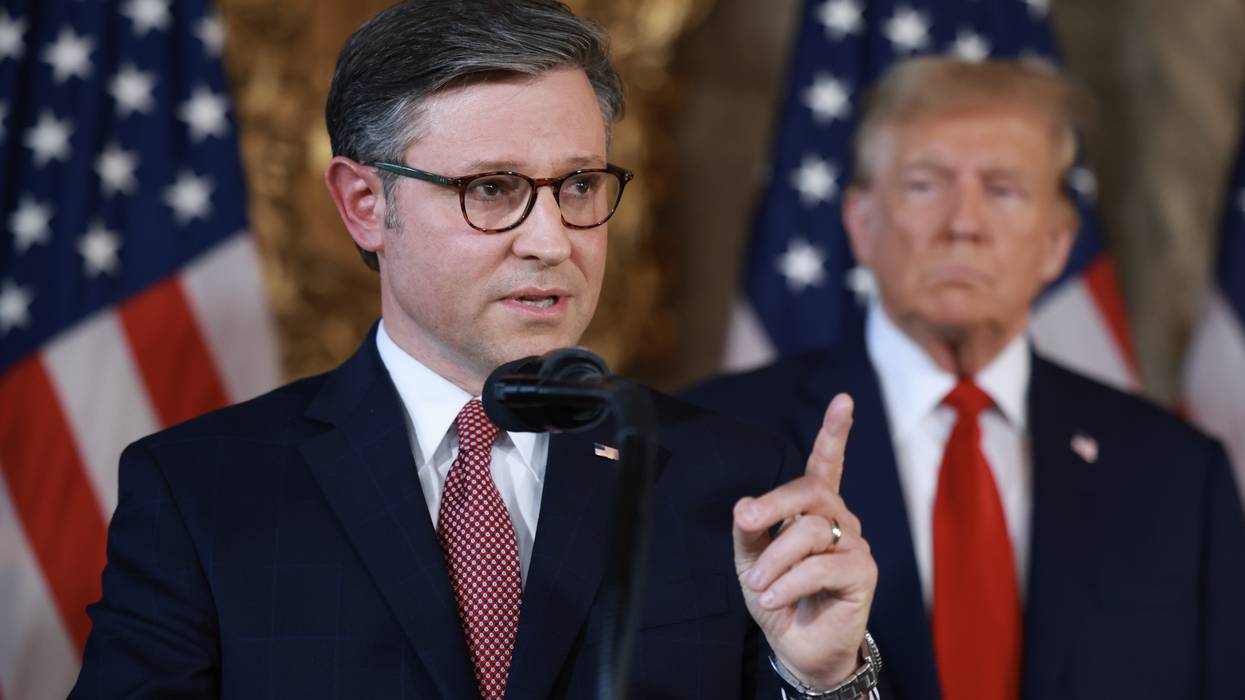
The president and GOP House speaker wanted a 5-year extension of a despised domestic spying bill. Instead, they got just two weeks. "Now, they will have to fight in daylight tomorrow!" said one Democratic lawmaker
A dramatic series of votes in the US House of Representatives resulted in a dead-of-night extension of what critics describe as a "deceitful proposal" to continue a controversial domestic spying program, known as Section 702, that allows federal agencies to spy on the communications of Americans without a warrant.
While US President Donald Trump and his allies on the issue have pushed aggressively for a longer agreement to continue the controversial provision of the Foreign Intelligence Surveillance Act, or FISA, most of the Democratic caucus and a band of renegade, more libertarian-leaning Republicans have resisted.
In the 228-197 final vote, a total of four Democrats—Reps. Jared Golden of Maine, Josh Gottheimer of New Jersey, Marie Gluesenkamp Perez of Washington, and Thomas R. Suozzi of New York—joined with all but 25 Republicans who voted to pass a 10-day extension. Twenty GOP members voted against it, while five did not vote.
Ahead of the votes—including on separate versions asking for a 5-year and then 18-month extensions of Section 702—opponents of any clean extension, including Rep. Ro Khanna (D-Calif.), said anyone opposed to warrantless spying on Americans must vote no.
"They have called us back at midnight to cast a secret vote to reauthorize FISA while America sleeps," said Khanna in a late-night social media post. "A yes vote gives Trump more power to surveil Americans. Every Democrat must vote no. Everyone who loves the constitution must vote no."
They have called us back at midnight to cast a secret vote to reauthorize FISA while America sleeps. A yes vote gives Trump more power to surveil Americans.
Every Democrat must vote no. Everyone who loves the constitution must vote no. pic.twitter.com/kJGQm5EWW3
— Ro Khanna (@RoKhanna) April 17, 2026
The bloc of 20 Republicans who voted against the shorter extension also refused to budge on the push, despite heavy lobbying from the Trump White House and pressure from House Speaker Mike Johnson, for the 18-month and 5-year versions.
The holdouts on both sides of the aisle, meanwhile, have been demanding privacy reforms to make sure the communications of US citizens are not swept up in the surveillance of noncitizens targeted abroad by the nation's spy agencies and law enforcement.
"Let me be clear," said Rep. Pramila Jayapal (D-Wash.) explaining her no vote in a statement. "There is no new warrant requirement in tonight's amendment to FISA reauthorization. It does absolutely nothing to fix the massive loopholes in 702 collection that allow the government to spy on Americans without a warrant. It does nothing to fix the data broker loophole. And it slaps a 5-year extension on this bill so that this White House can continue to spy on Americans and violate our privacy rights for an even longer time."
Speaker Johnson, she charged, "is trying to pass it in the middle of the night—like so many of other pieces of his agenda—because he knows it is not what the American people want. Don't be fooled: this bill simply continues to the spying and surveillance of the American people."
Outside critics of the clean extension effort have criticized Democratic lawmakers, including Reps. Gregory Meeks of New York and Jim Hines of Connecticut—the latter of whom was reportedly conferring with the Republican whip team on the floor of the House late Thursday night—with sabotaging efforts to get a bill with stronger protections.
Sean Vitka, executive director of Demand Progress, which has led a bipartisan coalition against a clean extension of the FISA provision, said serious questions must be asked about the role some Democrats are playing in the current fight to win significant reforms.
“Speaker Johnson’s failure to ram through an 18-month FISA extension creates time for Congress to vote on critical privacy protections, namely closing the backdoor search and data broker loopholes," Vitka said after the short-term extension was passed overnight. "This failure of Himes and House Republican leaders is a testament to the good-faith, bipartisan movement fighting tirelessly for Americans’ privacy rights. This is a major opportunity to protect Americans’ civil liberties, and the Republicans who withstood this pressure should be celebrated for putting privacy over party.
"Extraordinarily, four Democrats chose to back Speaker Johnson over Leader Jeffries on this critical privacy vote," Vitka added. "Given that top Intelligence Democrat Jim Himes was caught speaking with Speaker Johnson before the vote, reporters should be asking whether he engineered these defections in an effort to sabotage the mere chance for the House to enact key, broadly bipartisan civil liberties protections. It would be unconscionable for someone with a critical oversight role like Himes to do so."
For his part, Khanna said the battle for meaningful reforms to the FISA law continues.
"We just defeated Johnson's efforts to sneak through a 5-year FISA authorization tonight," said Khanna. "Now, they will have to fight in daylight tomorrow!"
Vitka said that from now until the end of the month, when the short-term extension expires, lawmakers "fighting against privacy reform to face reality: the American people don’t want FISA to continue as-is and are watching like hawks."
"If you want to renew FISA," he added, "you must come to the table and agree to real privacy reforms that stop the government from bypassing the courts to collect private information on Americans.”
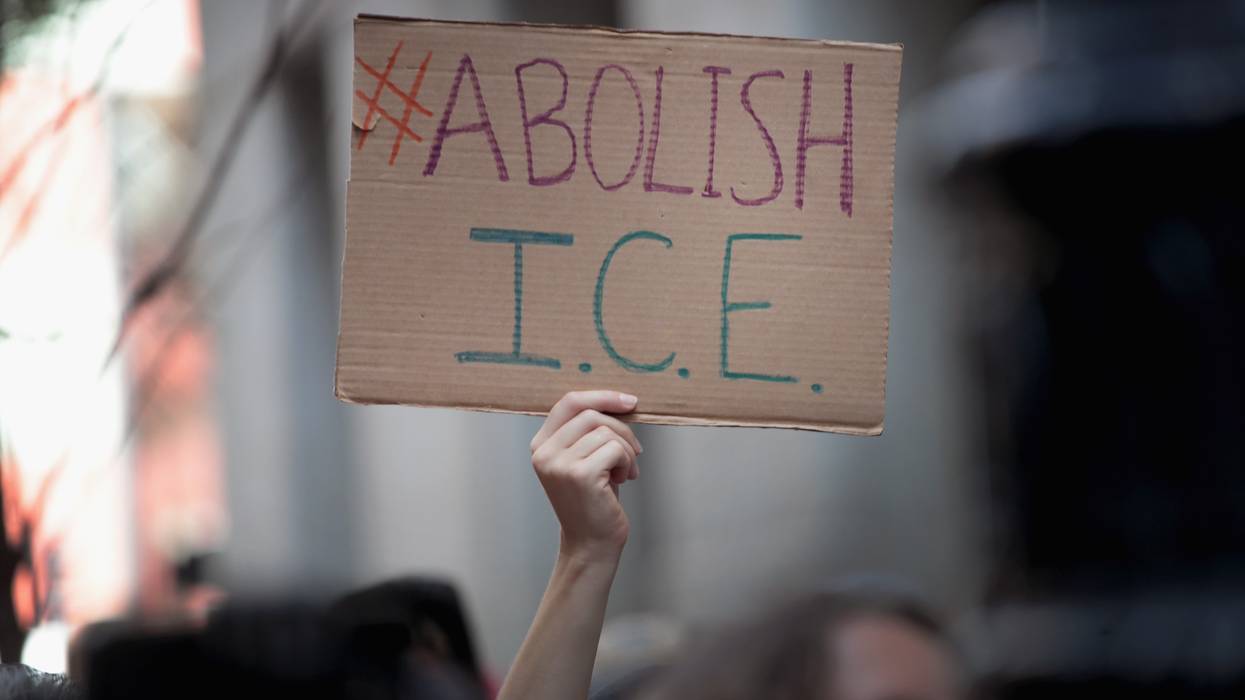
The reality is that while ICE’s violence has become more public, what we are seeing today is not a deviation from how it has always acted. For ICE, mass surveillance, assaults, arrests, prolonged detainment, and killings of citizens and noncitizens alike are normal.
On a September morning, armed Immigration and Customs Enforcement agents broke in and raided the home of 15-year-old Marie Justeen Mancha while her mother was running an errand. They blocked the door, accused her of being an “illegal,” and questioned Marie about her and her mother’s legal status. They are both US citizens.
This break-in was part of a widespread sweep targeting Hispanic communities in southeast Georgia. The Southern Poverty Law Center (SPLC) accused ICE of using “Gestapo-like” tactics to trample “on the constitutional rights of every person of Hispanic descent who was unfortunate to be in their way.”
SPLC filed a class-action lawsuit against ICE on behalf of five US citizens. In addition to compensation for property damages, the lawsuit sought a court order to stop ICE from conducting similar raids in the future.
Sound familiar? That occurred in 2006—20 years ago.
ICE is not broken. It is not reformable. It must be abolished.
The reality is that while ICE’s violence has become more public, what we are seeing today is not a deviation from how it has always acted. For ICE, mass surveillance, assaults, arrests, prolonged detainment, and killings of citizens and noncitizens alike are normal.
Between 2015 and 2021, ICE agents were involved in at least 59 shootings across 26 states and two US territories. At least 24 people were injured and 23 were killed.
A 2018 Los Angeles Times review of ICE activities found more than 1,500 cases of the agency wrongfully arresting and targeting US citizens for deportation and prolonged detainment. This includes Davino Watson, a US citizen, who was illegally detained by ICE in 2008 and spent 1,273 days in their custody. The agency faced no consequences for this grave injustice.
Between 1994 and 2019, the average daily population of detained immigrants grew from 7,000 to 50,000. In December 2025, the number was nearly 66,000—the highest level ever recorded. While President Donald Trump alleges that ICE is “removing some of the most violent criminals in the World from our Country,” 73% of those arrested by ICE have no criminal convictions.
ICE is not broken. It is not reformable. It must be abolished.
ICE has always relied on violent tactics, racial profiling, and increasingly invasive surveillance technology. It has faced persistent criticism from activists, nonprofits, and news outlets for its discriminatory practices. Yet, over the years, ICE has only become more aggressive.
There are many reasons for this: first, ICE agents, like other officers, have qualified immunity to prosecution. If they are involved in a potentially criminal incident, that case is reviewed by ICE’s Office of Professional Responsibility. This office lacks the authority to discipline agents. Instead, any suggestion on disciplinary measures goes back to the agent’s supervisor, who then decides whether to administer it. If they do, the ICE agent can still appeal. This triggers a lengthy process that can take years to resolve.
Second, most of their work targets undocumented immigrants and people of color—populations that are both exceedingly vulnerable to police violence and to have their suffering ignored by America’s white-dominated political institutions.
Turns out, state-sanctioned violence—not healthcare, welfare, education, or housing—has broad bipartisan support.
Third, ICE operates according to the immigration-control strategy known as “attrition through enforcement.” The goal is to compel undocumented immigrants to self-deport by making their lives increasingly more difficult. This is accomplished by limiting their access to jobs, housing, and social services; utilizing aggressive policing methods (e.g. workplace raids, home surveillance, coercion, ruses, and targeting family and friends); as well as public displays of state-sanctioned violence. This is why the Department of Homeland Security (DHS) launched an aerial and ground assault on a Chicago apartment building in November 2025. For DHS and ICE, the more violent they become, the more likely that immigrants in the US will self-deport. That violence will also deter people from entering the country in the first place. Violence and state terror are core components of ICE’s formal policing strategy.
Fourth, ICE has been strongly and consistently supported by both Democrats and Republicans. Between 2003 and 2024, ICE’s annual budget grew from $3.3 billion to $9.6 billion. As part of the One Big Beautiful Act (OBBA), Congress allocated $75 billion to ICE over four years, approximately $18.7 billion per year. Even now, despite growing public outcry against ICE, Democrats, including Senate Minority Leader Chuck Schumer (D-NY) and House Minority Leader Hakeem Jeffries (D-NY), refuse to commit to defunding the agency. Turns out, state-sanctioned violence—not healthcare, welfare, education, or housing—has broad bipartisan support.
Fifth, but perhaps most importantly, is the reason why ICE and DHS were initially created. As the Department of Justice (DOJ) noted in 2004, “The primary mission of ICE is to prevent acts of terrorism by targeting the people, money, and materials that support terrorists and criminal activities.” Under DHS, immigration control is first and foremost about counterterrorism.
This is why ICE has such broad and invasive policing powers; why Republicans have insisted for years that terrorists are entering the country via the US-Mexico border; why the Trump administration designated groups like Tren de Aragua and La Mara Salvatrucha (MS-13) as terrorist organizations; and why Homeland Security Secretary Kristi Noem and Border Czar Tom Homan have been so quick to label Renee Nicole Good a “domestic terrorist.”
It's also why simply abolishing ICE doesn’t go far enough. DHS must be abolished too.
For the Bush administration, DHS “would make Americans safer” by creating a department “whose primary mission is to protect the American homeland.” To this end, DHS “would unify authority over major federal security operations related to our borders” thereby “allowing a single government entity to manage entry into the United States. It would ensure that all aspects of border control, including the issuing of visas, are informed by a central information-sharing clearinghouse and compatible databases.”
Importantly, for DHS, the goal of defending “the American homeland” is about more than protecting US citizens, preventing destruction of property, or policing criminal offenses. It is about protecting the identity of America.
As President George W. Bush noted in his 9/11 address, “Today, our fellow citizens, our way of life, our very freedom came under attack in a series of deliberate and deadly terrorist acts.” A month later, he remarked that, “The [9/11] attack took place on American soil, but it was an attack on the heart and soul of the civilized world.” In the same speech, he announced the establishment of the Office of Homeland Security.
We must completely sever immigration services from a national security apparatus designed to police all immigrants as potential terrorists.
DHS was created to protect “our way of life” and “our freedom.” To defend “the heart and soul” of America. This sentiment is echoed by Trump’s DHS: “Protect your homeland, defend your culture.” More recently, on January 9, DHS posted on Twitter-X, “We’ll have our home again.”
From its inception, DHS has been tied to an image of the “homeland” as continuously under existential and physical threat from invaders both at our gates and already here. A key rationale for integrating immigration enforcement and control agencies within DHS was that the 9/11 hijackers entered the US legally. They were, as President Trump would describe them, “the enemy within.” This is still the rationale with which DHS and ICE currently operate. Anyone who threatens “civilizational erasure” and the loss of America’s Christian, English-speaking, and Western identity is a legitimate target of surveillance and violence.
Abolishing ICE is insufficient. We must completely sever immigration services from a national security apparatus designed to police all immigrants as potential terrorists. Abolishing DHS is necessary. This does not, however, entail dissolving all its agencies, most of which predate the department. Some, like the United States Citizenship and Immigration Services (USCIS) that processes asylum requests and issues visas, should be preserved and transferred to a department better suited to serving immigrant communities.
One might object that abolishing DHS would make America vulnerable to terrorism; however, three points are worth emphasizing: First, prior to DHS, the US already had counterterrorism measures. For instance, the CIA reported to President Bill Clinton in December 1998 about a potential terrorist attack in the US that might involve hijacking an aircraft. White House Counterterrorism Chief Richard Clark testified that the Bush national security team was not sufficiently concerned about that information.
Second, since 9/11, the majority of terrorist attacks have been thwarted by traditional law enforcement tools. In recent years, most cases of terrorism stem from domestic threats, predominantly “white supremacist and anti-government extremist individuals and groups.” Yet, DHS has been slow to acknowledge and properly tackle these threats.
Third, as an organization, DHS was always flawed. It was hastily put together using arbitrary and questionable criteria. Moreover, as former Secretary of Homeland Security Michael Chertoff acknowledged, because the entire purpose of the department is preventing terrorism, DHS officials inevitably feel pressured to exaggerate the threats facing the nation. This “security theater” creates more public fear that results in greater government spending on oftentimes expensive and wasteful preventative measures.
Even at the time of DHS’s founding, there were concerns that the US was creating an all-encompassing domestic surveillance apparatus that would eventually undermine civil liberties and endanger the public. Seth Stodder, who served in Customs and Border Protection (CBP) under President Bush and DHS under President Barack Obama, had largely dismissed such concerns. He argued that the Constitution would ultimately safeguard Americans. Now he recognizes the threat: “To suddenly see DHS become this kind of mechanism of authoritarian intimidation and incipient fascism [under the Trump administration] is disorienting, and frightening. It makes me think that maybe DHS was a bad idea.”
But arguably the Trump administration’s disregard for the Constitution and the rule of law have only made the problems of DHS and ICE more blatant. They didn’t become a mechanism of authoritarian intimidation under Trump—they always were.
Now is the time for action. For the sake of all those who have been assaulted, wrongfully detained, and killed, we must abolish ICE and DHS.

Behind all the law enforcement mumbo-jumbo is a commitment to racist broken-windows policing.
This exercise of fitting a square into a circular peg is precisely what now guides New Jersey’s contemporary policing regime. The Regional Operations Intelligence Center (ROIC), the only Department of Homeland Security-affiliated fusion center within the Garden State is led by a former CIA agent trained in international espionage, not state and municipal law enforcement tactics that must adhere to constitutional rights. As New Jersey's experience makes clear, the way fusion centers operate render them rife for abuse, and offer outdated models of policing.
The Rutgers Center for Security, Race and Rights’ (CSRR) recent report Shining a Light on New Jersey’s Secret Intelligence System shows how the ROIC wastes limited state resources doubling down on “broken windows policing” – a method consistently rebuked by legal and criminal justice scholars as a tool of mass incarceration. Broken windows models emphasize aggressive enforcement of misdemeanor and non-violent “quality of life” offenses. ROIC intelligence gathering focuses on these methods, as the example of the City of Camden attests. There, ROIC intelligence has given rise to open season on privacy and petty offenses, with police issuing fines for offenses like riding a bicycle without a bell. Invariably, such tactics overwhelmingly target minority communities. Rather than fight terrorism, ROIC intelligence furthers the overreach of the carceral state with little benefit.
This misalignment of input and outcome is not innocuous, but by design. The architecture of the ROIC is not vested in proven or progressive policing, but by the methods native to global spy networks. Indeed, the last two directors of the New Jersey Office of Homeland Security and Preparedness, the body overseeing the ROIC, are former CIA agents.
Over the past six months, CSRR has sought accountability for the ROIC’s overreach, by filing several dozen Open Records Act (OPRA) requests into the ROIC’s relationship with county and state law enforcement agencies. Regrettably, those requests were almost summarily stonewalled, allowing the ROIC and its partners to operate in an accountability-free zone.
Shining a Light on New Jersey’s Secret Intelligence System exposes the extent of secrecy shrouding the ROIC and expansively documents those efforts. The report highlights the lack of transparency, the legal regimes that allow agencies to push back against basic public information requests, and the general apparatus that promotes this wall of secrecy.
Like with so many fusion centers across the country, the ROIC is engaging in mission creep far from its original purpose of fighting terrorism by over-policing non-violent crimes and justifying its budget behind closed-off series of feedback loops.
Open-source research shows the ROIC operating in ways banal and embarrassing – and less than strictly observant of civil liberties and civil rights. But even the most basic questions surrounding the ROIC’s budget and role in local and state information-sharing and structure are routinely ignored by various local, state, and county law enforcement agencies.
Responses from law enforcement to basic questions we posed could have provided an opportunity for public discourse on ROIC’s role, policies, and costs. Instead, CSRR received opaque responses, Kafkaesque riddles, and flimsy legal arguments. New Jersey's law enforcement agencies collectively flouted transparency duties under state open records law with only one law enforcement agency providing one substantive response to exactly one request.
The litany of unpersuasive rejections may have varied in form but the results were the same: obstructive and non-transparent. In one combination of denials, agencies would offer to provide some requested information for an exorbitant sum of money while denying the rest.
The underlying theme put forth was an adherence to a regime of secrecy to protect law enforcement’s long-standing preference of substantially operating in the dark. Law enforcement agencies’ lawyers, across the state, using substantially similar language from various jurisdictions, rely on understandings of case law that, divorced of all the typical chicanery, allows the government to deny a request because the person or group making the request has asked for: (1) something that is too specific; and/or (2) not specific enough.
The irony, of course, is that the purpose of an OPRA request is to shine light into hidden troves being kept from citizens. To pinpoint a specific detailed description of a document when the government entity claiming the exemptions continues to hide behind the same wall of secrecy that gives rise to the request flies in the face of the object and purpose of the OPRA statute.
For example, to date, and despite multiple rounds of open records requests, CSRR could not get a clear answer on what the ROIC budget is, what its basic structure looks like, and what mechanisms are in place to protect civil rights and civil liberties.
This kind of secrecy is precisely what empowers the ROIC’s insidious commitment to broken windows policing. The ROIC serves as what Professor Brendan McQuade describes as an “outsourced intelligence division” for local police departments. Rather than meaningfully contributing to policing, the ROIC’s major efforts are instead aimed at “information sharing” and the creation and provision of “higher level intelligence products” like crime mapping, data on so-called “hot spots,” and predictive analyses.
This sort of language is anodyne and important-sounding but little more than the jargon of spy craft let loose on historically hollowed-out communities of color. Behind all the law enforcement mumbo-jumbo is a commitment to racist broken-windows policing.
New Jersey’s laws meant to ensure that state agencies can be held accountable to the public are failing. It is thus long overdue for the New Jersey legislature to engage in robust oversight of the state’s fusion center – and to reformulate the basic OPRA law at a statutory level to undo years of bad, anti-transparency activist precedent. Otherwise, New Jersey’s Secret Surveillance System will continue to operate with no regard, much less accountability, for civil liberties violations.
The full report, titled "Shining a Light on New Jersey’s Secret Intelligence System," can be downloaded here.In case you weren't already convinced that CISA is a surveillance bill masquerading as a cybersecurity bill, today, the Senate rejected four separate amendments to the bill that attempted to protect Americans' privacy better. Senator Wyden had an amendment to require the removal of personal information before information could be shared, which was voted down 55 to 41. Senator Heller had an amendment that was a backstop against the Wyden amendment, saying that if the Wyden amendment didn't pass, Homeland Security would be responsible for removing such personal information. That amendment also failed with 49 to 47 votes. Senator Leahy had an amendment that would have removed FOIA exemptions in the bill (making it much less transparent how CISA was used). That amendment was voted down 59 to 37. Senator Franken then had an amendment that would have "tightened" the definition of cybersecurity threats so that the shared information needed to be "reasonably likely" to cause damage, as opposed to the current "may" cause damage. And (you guessed it because you're good at this), it was also voted down by a 60 to 35 vote.
Meanwhile, Marcy Wheeler notes that the revised version of the bill by Senators Burr and Feinstein, which claimed to incorporate greater transparency requirements proposed by Senator Tester, actually takes away a lot of transparency and actually makes it more difficult for Congress to learn whether or not CISA is being used for domestic surveillance:
That Burr and DiFi watered down Tester's measures so much makes two things clear. First, they don't want to count some of the things that will be most important to count to see whether corporations and agencies are abusing this bill. They don't want to count measures that will reveal if this bill does harm.
Most importantly, though, they want to keep this information from Congress. This information would almost certainly not show up to us in unclassified form, it would just be shared with some members of Congress (and on the House side, just be shared with the Intelligence Committee unless someone asks nicely for it).
But Richard Burr and Dianne Feinstein want to ensure that Congress doesn't get that information. Which would suggest they know the information would reveal things Congress might not approve of.
Once again, these actions only make sense if CISA is being used to justify warrantless domestic surveillance. This raises the question of why Congress is willing to proceed with such a surveillance bill. We just went through a process showing that the public is uncomfortable with secret laws and interpretations that lead to surveillance. Why would they immediately push for a new secret law that expands surveillance and rejects any attempts to protect the privacy of the American public or any sort of transparency and accountability in how the bill is used?
The bill is positioned as a cybersecurity bill, but you'd be hard-pressed to find a single computer security expert who thinks it is useful or necessary. I've been trying, and so far, I can't find any.
The current debate about government surveillance has largely overlooked the CIA, possibly because we know little about the agency's activities within the United States. While the relevant legal authorities governing the CIA, including Executive Order 12333, set out the CIA's mandate, they do so in broad terms. Beyond the generalities in EO 12333 and other laws, the public has had few opportunities to examine the rules governing the CIA's activities.
The current debate about government surveillance has largely overlooked the CIA, possibly because we know little about the agency's activities within the United States. While the relevant legal authorities governing the CIA, including Executive Order 12333, set out the CIA's mandate, they do so in broad terms. Beyond the generalities in EO 12333 and other laws, the public has had few opportunities to examine the rules governing the CIA's activities.
But we know more today than we did a few weeks ago. In response to a Freedom of Information Act lawsuit filed by the ACLU and Yale Law School's Media Freedom and Information Access Clinic, the CIA has released a slew of documents concerning CIA surveillance under EO 12333. (The Justice Department has also recently released a set of documents related to the executive order.)
The national debate in the 1970s about the proper limits of U.S. government spying on its own citizens was, to a large extent, about the CIA. In the wake of the Watergate scandal and news stories about other illegal CIA activity, President Gerald Ford and Congress launched investigations into the full range of CIA misdeeds -- from domestic spying programs and infiltration of leftist organizations to experimentation on non-consenting human subjects and attempts to assassinate foreign leaders.
Although the CIA's legal authority to spy on Americans was very narrow, these investigative committees -- chaired by Sen. Frank Church, Vice President Nelson Rockefeller, and Rep. Otis Pike -- discovered that the CIA had engaged in a massive domestic spying project, "Operation CHAOS," which targeted anti-war activists and political dissenters. The committee reports also revealed that, for more than 20 years, the CIA had indiscriminately intercepted and opened hundreds of thousands of Americans' letters. In addition to documenting the intelligence agencies' extensive violations of the law, the Church Committee concluded that the constitutional system of checks and balances "has not adequately controlled intelligence activities."
The Church Committee's conclusion -- at core, an admonition -- still resonates today. While the documents that the CIA has released are heavily redacted, raising more questions than they answer, they strongly suggest that the agency's domestic activities are extensive.
Some highlights from the documents:
AR 2-2, which has never been publicly released before, includes rules governing a wide range of activities, including surveillance of U.S. persons, human experimentation, contracts with academic institutions, relations with journalists and staff of U.S. news media, and relations with clergy and missionaries.
Several annexes to AR 2-2 contain the agency's EO 12333 implementing procedures. For example, Annex A, "Guidance for CIA Activities Outside the United States," sets forth the procedures that apply to CIA activity directed toward U.S. citizens and permanent residents who are abroad. Much of the relevant information is redacted. Annex F, "Procedures Governing Conduct and Coordination by CIA and DEA of Narcotics Activities Abroad," is similarly redacted in key sections, including the section discussing the agencies' "Specific Agreement Concerning Electronic Surveillance."
Domestically, the CIA's spying is governed by Annex B to AR 2-2, "Guidance for CIA Activities Within the United States." This document explains:
Although EO 12333, AR 2-2, and Annex B prohibit the agency from engaging in electronic surveillance within the United States, the CIA can nevertheless ask the FBI to do its bidding:
Annex B and the CIA-FBI memorandum of understanding comport with past reporting that the Foreign Intelligence Surveillance Court authorized the FBI to work with the CIA to collect Americans' financial records in bulk under Patriot Act Section 215.
In addition, Annex B explains that the CIA may "use a monitoring device within the United States under circumstances in which a warrant would not be required for law enforcement purposes if the CIA General Counsel concurs."
But what qualifies as a "monitoring device"? And how exactly does monitoring differ from "electronic surveillance," which the CIA is prohibited from doing domestically? We don't know. In the newly released documents, the definition of "monitoring" (as distinct from "electronic surveillance") is redacted.
The CIA also turned over several years' worth of annual reports to Congress about the agency's activities under EO 12333. These reports begin by discussing "Intelligence Activities Conducted by CIA Within the United States." This header is followed by dozens of entirely redacted pages -- once again suggesting that the agency is engaged in a significant amount of intelligence activity here at home.
A 2002 report by the CIA inspector general, "Intelligence Activity Assessment: Compliance with Executive Order 12333: The Use of [redacted] Collection [redacted] from 1995-2000," observed "a general and widespread lack of understanding" within the CIA of the rules governing the retention and sharing of U.S. citizens' and permanent residents' information. In particular, the OIG found that few managers or other officers "could accurately state the appropriate procedures for retaining or disseminating U.S. person information," and it concluded that these rules were "not being applied consistently" by the agency.
* * *
The independent and bi-partisan Privacy and Civil Liberties Oversight Board is currently examining the intelligence community's counterterrorism-related activities under EO 12333. Notably, one of the topics the board plans to focus on is the CIA's collection of information within the United States. We hope that, when the board eventually issues its public report about the agencies' activities under EO 12333, it sheds a little more light on what exactly the CIA is doing here at home.
Two years since he met with a trio of journalists in a Hong Kong hotel room and explained for the first time why he leaked some of the NSA's most closely-guarded secrets about its global surveillance empire, whistleblower Edward Snowden has penned an op-ed for the New York Times declaring relief that his decision was not in vain and championed those who have picked up the fight against the expansive practices of the world's most powerful intelligence agencies.
"As a society, we rediscover that the value of a right is not in what it hides, but in what it protects." --Edward SnowdenThough recognizing that he and the key journalists who assisted him--including Laura Poitras and Glenn Greenwald--put their own "privileged lives at risk" by bringing the documents to the world, Snowden said his initial worries that the world would respond with "indifference, or practiced cynicism" to the information they contained were fortunately not realized.
"Never have I been so grateful to have been so wrong," Snowden writes. "Two years on, the difference is profound. In a single month, the N.S.A.'s invasive call-tracking program was declared unlawful by the courts and disowned by Congress. After a White House-appointed oversight board investigation found that this program had not stopped a single terrorist attack, even the president who once defended its propriety and criticized its disclosure has now ordered it terminated."
Earlier this week, thanks to the firestorm created since the public first became aware of its existence, one of the most contested portions of the NSA's domestic surveillance--the bulk collection of American's phone records--was put to an end. But for Snowden, the impact and power of what he describes as an "informed public" has--like the NSA operations themselves--had truly global reach.
"Ending the mass surveillance of private phone calls under the Patriot Act is a historic victory for the rights of every [American] citizen," Snowden writes, "but it is only the latest product of a change in global awareness. Since 2013, institutions across Europe have ruled similar laws and operations illegal and imposed new restrictions on future activities. The United Nations declared mass surveillance an unambiguous violation of human rights. In Latin America, the efforts of citizens in Brazil led to the Marco Civil, an Internet Bill of Rights. Recognizing the critical role of informed citizens in correcting the excesses of government, the Council of Europe called for new laws to protect whistle-blowers."
But even with that progress, he warns the need for much deeper reform remains. According to Snowden:
Though we have come a long way, the right to privacy -- the foundation of the freedoms enshrined in the United States Bill of Rights -- remains under threat. Some of the world's most popular online services have been enlisted as partners in the N.S.A.'s mass surveillance programs, and technology companies are being pressured by governments around the world to work against their customers rather than for them. Billions of cellphone location records are still being intercepted without regard for the guilt or innocence of those affected. We have learned that our government intentionally weakens the fundamental security of the Internet with "back doors" that transform private lives into open books. Metadata revealing the personal associations and interests of ordinary Internet users is still being intercepted and monitored on an unprecedented scale: As you read this online, the United States government makes a note.
Despite his continued political asylum status in Russia, where he continues to speak and work on issues related to digital privacy and civil liberties, Snowden argues that the people of the world have made a collective declaration against the need for mass surveillance and the various tangled programs operated by the NSA, the UK's GCHQ, and the other powerful agencies of the 'Five Eyes' nations and others.
"Yet the balance of power is beginning to shift," he concludes. "We are witnessing the emergence of a post-terror generation, one that rejects a worldview defined by a singular tragedy. For the first time since the attacks of Sept. 11, 2001, we see the outline of a politics that turns away from reaction and fear in favor of resilience and reason. With each court victory and every law change, we demonstrate facts are more convincing than fear. As a society, we rediscover that the value of a right is not in what it hides, but in what it protects."