SUBSCRIBE TO OUR FREE NEWSLETTER
Daily news & progressive opinion—funded by the people, not the corporations—delivered straight to your inbox.
5
#000000
#FFFFFF
To donate by check, phone, or other method, see our More Ways to Give page.
Daily news & progressive opinion—funded by the people, not the corporations—delivered straight to your inbox.
“These verdicts are a huge blow to government ministers who have tried to portray Palestine Action as a violent group to justify banning it under badly drafted terrorism legislation," said one campaigner.
In what one campaigner called a "huge blow" to the UK government's efforts to crush Palestine Action, a London jury on Wednesday cleared six members of the direct action group of aggravated burglary—even after they admitted to breaking into and vandalizing an Israel-linked weapons facility.
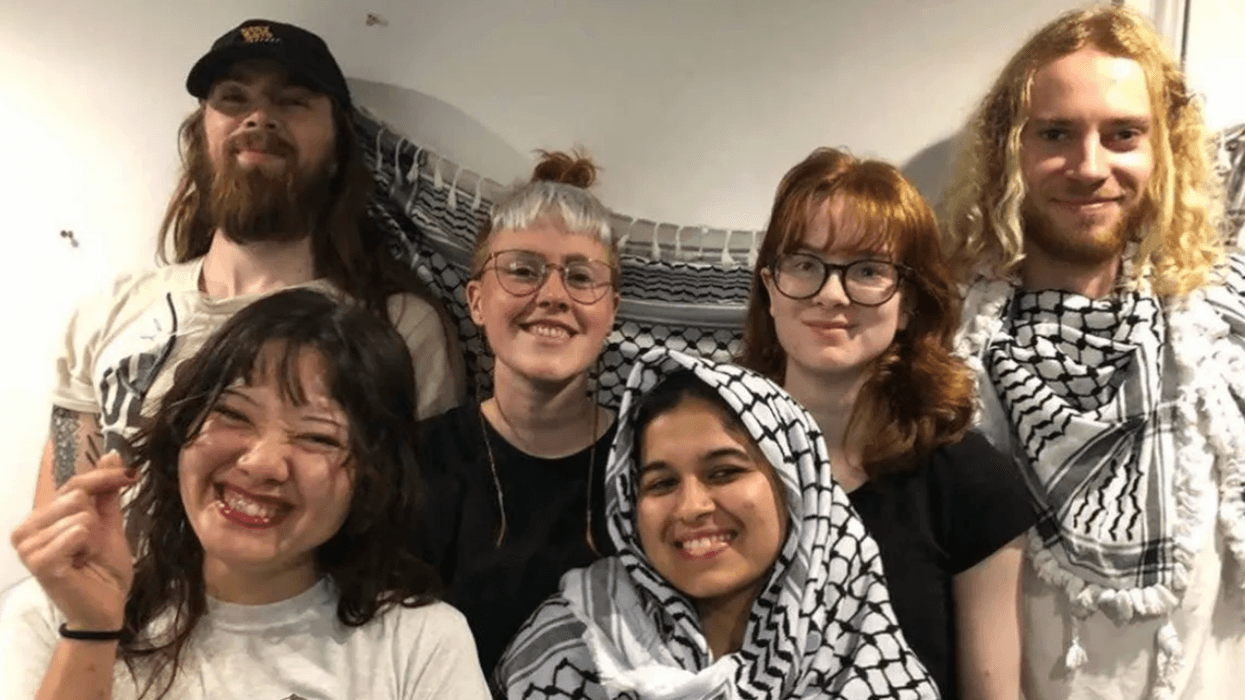
Zoe Rogers, Fatema Zainab Rajwani, Charlotte Head, Samuel Corner, Leona Kamio, and Jordan Devlin—six of the so-called "Filton 24"—were found not guilty of aggravated burglary and criminal damage by a jury at Woolwich Crown Court after eight days of deliberation. Devlin, Rajwani, and Rogers were found not guilty of violent disorder, although verdicts were not reached for the three others on the charge.
Prosecutors alleged that the six activists drove a van like a "battering ram" to smash their way into the Elbit Systems UK research, development, and manufacturing facility in Bristol early on August 6, 2024 in a "meticulously organized" attack targeting the subsidiary of the Israeli arms firm Elbit Systems.
❗️BREAKING -- Palestine Action protesters found not guilty of burglary at Elbit weapons factory in Bristol.The six activists were also not convicted of other charges, having spent 18 months in jail awaiting trial.realmedia.press/filton-verdi...
[image or embed]
— Declassified UK (@declassifieduk.org) February 4, 2026 at 5:02 AM
The defendants—who had been imprisoned on remand for 17 months—were also accused of using fire extinguishers to spray red paint throughout the facility and of using crowbars and hammers to break computers and other equipment.
The activists admitted to breaking into the facility, only disputing that the sledgehammers were offensive weapons and arguing that they were only meant to damage property.
After the verdicts were announced, the courtroom erupted in cheers and the six cleared activists hugged in the dock.
“These verdicts are a huge blow to government ministers who have tried to portray Palestine Action as a violent group to justify banning it under badly drafted terrorism legislation," said a spokesperson for the group Defend Our Juries, which has organized numerous protests in support of Palestine Action.
“Despite government efforts to prejudice this trial, citing the allegations of violence to justify treating Palestine Action as ‘terrorists’, as if they were already proved, the jury which heard the evidence has refused to find the defendants guilty of anything, not even criminal damage," the spokesperson added. "It shows how out of step this government is with public opinion, which is revulsed by the government and Elbit’s complicity in genocide.”
The jury failed to reach a verdict on an additional charge against Corner, who allegedly caused grievous bodily harm by hitting Police Sgt. Kate Evans in the back with a sledgehammer as she laid on the floor, fracturing her spine.
Journalist Adam Ramsay pointed out that Corner's altercation with Evans "was widely used to justify the proscription of Palestine Action."
"The fact that the jury, who heard the full story, didn’t convict him of a crime leaves the case for proscription in tatters," Ramsay added.
Corner—and possibly other defendants—could face new trials on certain charges if the Crown Prosecution Service determines that there is a realistic chance of conviction and if further action serves the public interest.
Eighteen other alleged Palestine Action members are currently awaiting trials scheduled for later this year.
Numerous observers said the verdicts obliterate the government's rationale for banning Palestine Action under the highly contentious Terrorism Act of 2000.
"I'm not sure people appreciate quite what a blow to [UK Prime Minister Keir] Starmer's government the acquittal of the Palestine Action protestors is," East Anglia Law School professor Paul Bernal said on Bluesky. "It both blows apart the whole proscription idea and demonstrates how out of touch they are."
"This was a jury," Bernal added. "Juries represent the public."
Journalist Jonathan Cook noted that "the UK government pinned its case for declaring Palestine Action a terrorist organization largely on the trial of the so-called Filton Six, claiming they had proved the group to be violent. A jury today found none of them guilty of any of the charges."
A declassified UK intelligence report published last September by the New York Times acknowledged that “the majority” of Palestine Action’s activities “would not be classified as terrorism” under the country's highly contentious Terrorism Act of 2000.
In addition to the Filton break-in, Palestine Action's direct action protests have also including spray-painting warplanes at a British military base and defacing US President Donald Trump’s Turnberry golf resort in Scotland—acts experts say do not constitute terrorism.
Britain's Terrorism Act has long been condemned by civil liberties defenders, who decry the law’s “vague and overbroad” definition of terrorism, chilling effect on free speech and expression, invasive stop-and-search powers, pre-charge detention and control orders, sweeping surveillance and data collection, and other provisions.
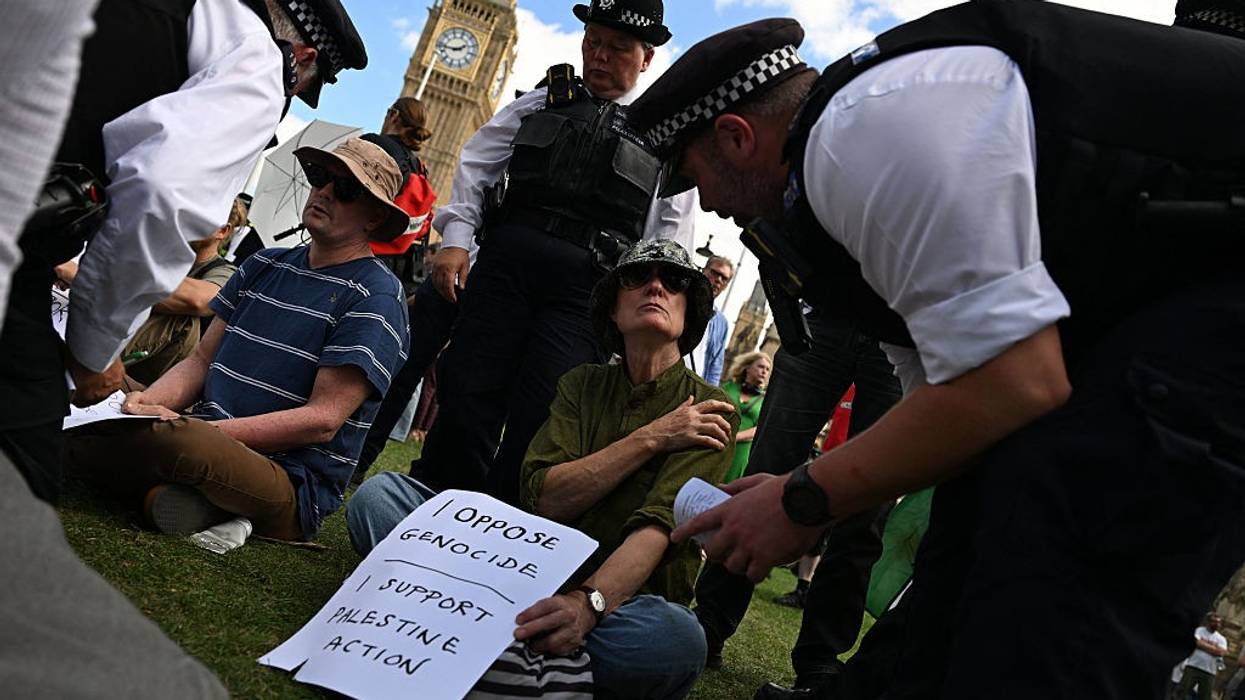
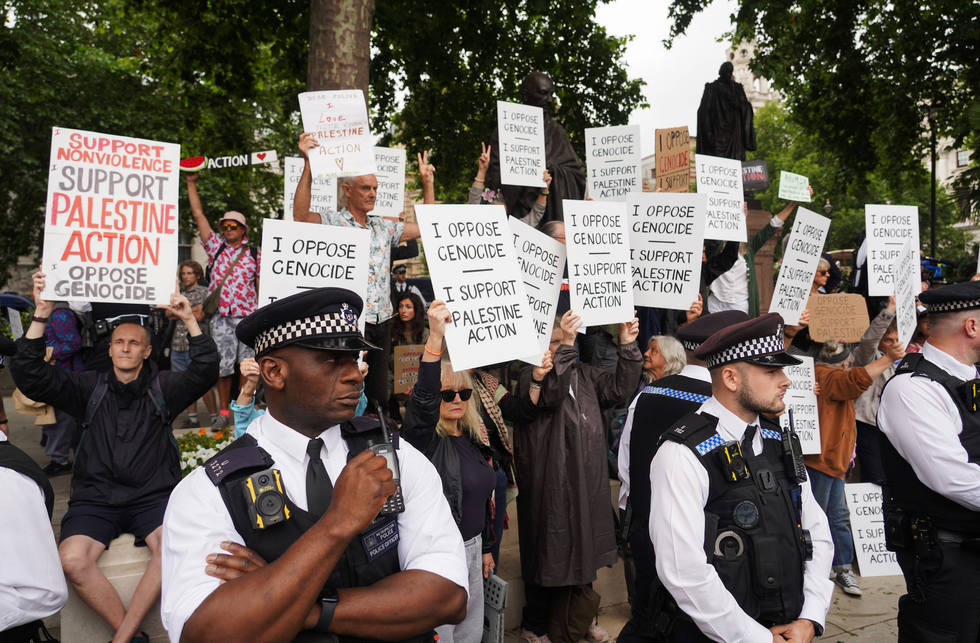
According to rights groups, more than 2,700 people have been arrested during demonstrations of support for Palestine Action since the group’s proscription. Many of those arrested did nothing more than hold up signs reading: “I Oppose Genocide. I Support Palestine Action.”
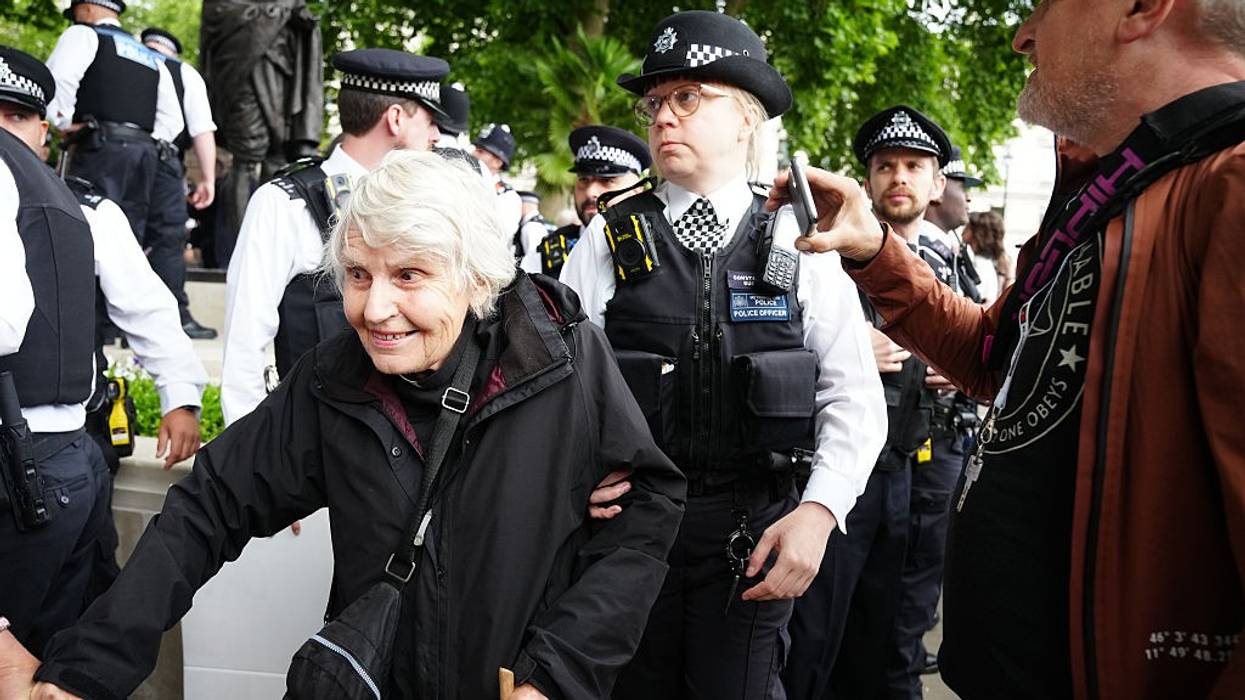
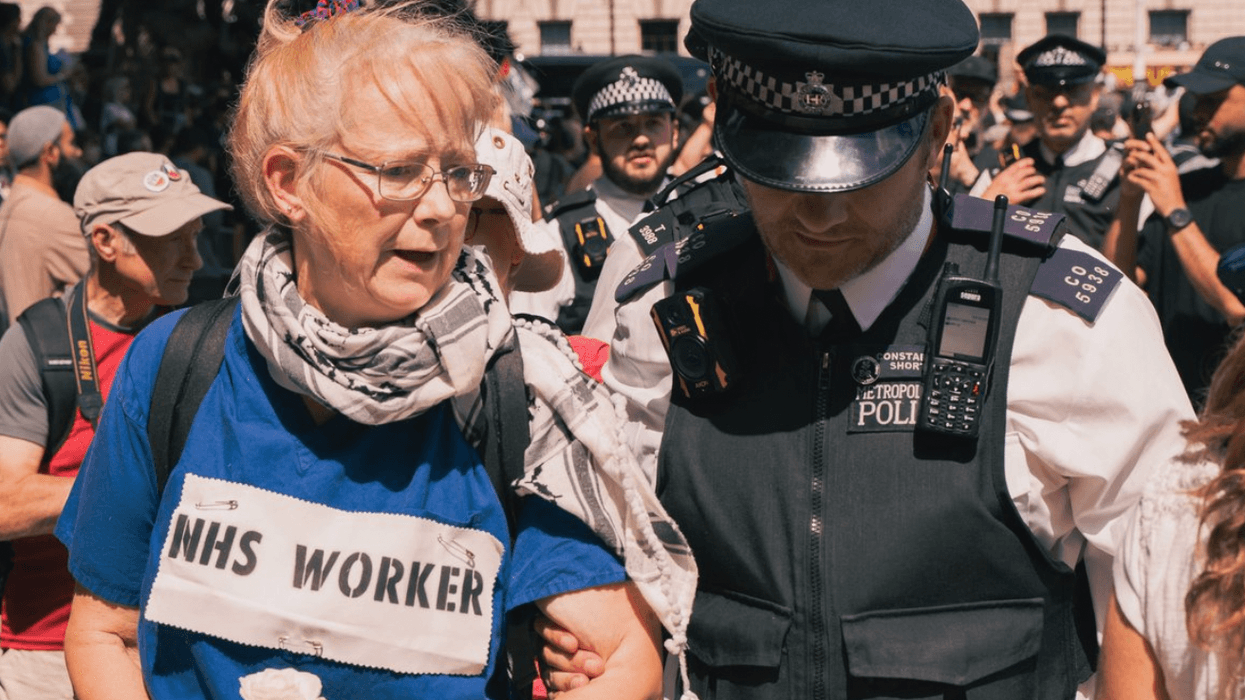
Arrestees include many elders, including 83-year-old Rev. Sue Parfitt, who argued that “we cannot be bystanders” in the face of Israel’s US and UK-backed genocide in Gaza, which has left more than 250,000 Palestinians dead, maimed, or missing; nearly 2 million people forcibly displaced; and hundreds of thousands starved by design.
The Filton trial tells us two things: 1. The justice system cannot defeat us. If we trust in the inherent goodness of people, of empathy, of those of us willing to fight against oppression and genocide, we can and will be free.2. Direct action gets the fucking goods.
— BASH BACK (@bashback.bsky.social) February 4, 2026 at 8:28 AM
Last September, a panel of United Nations experts concluded that Israel is committing genocide in Gaza. The International Court of Justice (ICJ) in The Hague is currently reviewing a genocide case filed against Israel by South Africa.
The International Criminal Court (ICC), also located in the Dutch city, issued warrants in November 2024 for the arrest of Israeli Prime Minister Benjamin Netanyahu and former Defense Minister Yoav Gallant for alleged crimes against humanity and war crimes committed during the 27-month assault and siege on Gaza.
Numerous Palestine Action members and supporters have gone on a monthslong life-threatening hunger strike to protest the defendants' imprisonment on remand and to demand a fair trial, lifting of the ban on Palestine Action, and closure of Elbit Systems’ UK facilities.
Late last month, Muhammad Umer Khalid, the last of the Palestine Action hunger strikers, began eating again after he was hospitalized with multiple organ failure.
Naila Ahmed, head of campaigns at CAGE International, said in a statement Wednesday that the Filton verdicts are "a powerful affirmation of jury independence and moral courage in the face of extraordinary political pressure."
"Though they cannot get back the 17 months of their life taken from them unlawfully, they should all be compensated and the remaining 18 defendants of the Filton 24 should also be released on bail," she added. "This case was used to justify the ban against Palestine Action, a decision that should now be overturned."
The report acknowledges that "the majority" of Palestine Action's activities "would not be classified as terrorism" under the highly contentious Terrorism Act of 2000.
A declassified British intelligence report published Friday by The New York Times undermined the UK government's claims and rationale for banning the direct action group Palestine Action under the country's dubious anti-terrorism law.
Speaking earlier this week, UK State Security Minister Dan Jarvis defended the government's terror designation for Palestine Action under the Terrorism Act of 2000, accusing the group and its supporters of an "escalating campaign involving intimidation and sustained criminal damage, including to Britain's national security infrastructure."
The report was published by the Times as former Labour Party leader Neil Kinnock condemned the government of Prime Minister Keir Starmer's stance on Palestine Action, telling Middle East Eye that "simply, I can't see how belonging to or demonstrating for a group that is rightly extremely concerned about the appalling situation in Gaza is terrorism."
Former Labour leader Neil Kinnock says Palestine Action are not terrorists in split with StarmerMost high-profile divide so far: Kinnock tells @MiddleEastEye people have a right to be appalled at situation in Gaza and proscription 'blunting' terror lawswww.middleeasteye.net/news/exclusi...
[image or embed]
— Defend Our Juries (@defendourjuries.bsky.social) September 12, 2025 at 8:31 AM
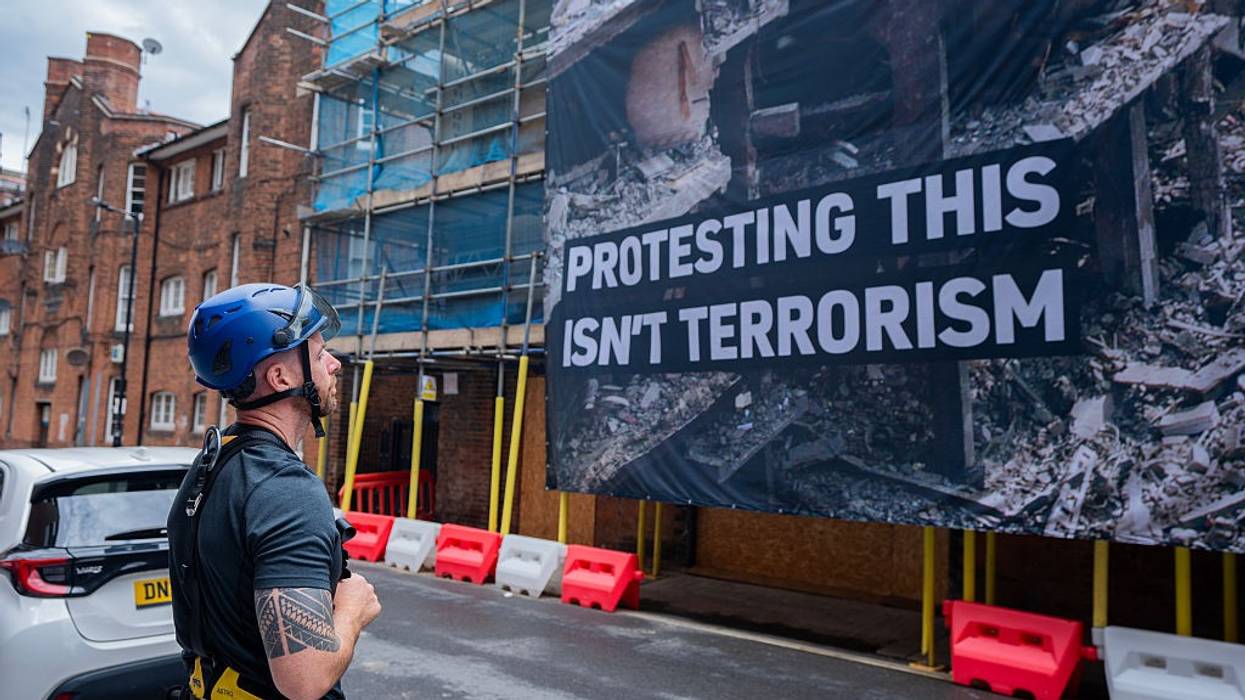
But the leaked report, issued March 7 by the UK's Joint Terrorism Analysis Center (JTAC) and first reported by journalist Craig Murray in August, acknowledges that "the majority" of activities by Palestine Action "would not be classified as terrorism" under the law because they typically involve relatively "minor" property damage, such as "graffiti, petty vandalism, occupation, and lock-ons."
The group's actions include damaging property belonging to weapons makers such as the Israeli firm Elbit Systems, spray-painting warplanes at a British military base, and defacing US President Donald Trump's Turnberry golf resort in Scotland—acts experts say do not constitute terrorism.
"UK domestic counterterrorism legislation defines terrorist acts broadly to include 'serious damage to property.' But, according to international standards, terrorist acts should be confined to criminal acts intended to cause death or serious injury or to the taking of hostages, for purpose of intimidating a population or to compel a government to take a certain action or not," United Nations human rights chief Volker Türk said in July.
Türk added that the UK legislation "misuses the gravity and impact of terrorism to expand it beyond those clear boundaries, to encompass further conduct that is already criminal under the law."
Still, JTAC asserted that Palestine Action "commits or participates in acts of terrorism" under the law by perpetrating "incidents that have resulted in serious property damage with the aim of progressing its political cause."
The report accuses Palestine Action members of "using weapons, including sledgehammers, axes, and whips, to cause a significant amount of property damage" in one action, during which "two responding police officers and a security guard were assaulted and suffered injuries."
However, JTAC noted that it is "highly unlikely" that Palestine Action would ever "advocate for violence against persons."
"Any such call for action would constitute a significant escalation" of Palestine Action's "strategy and intent," the report states.
At least 138 people have been charged with terrorism offenses under Section 13 of the Terrorism Act, which bans displays of symbols or wearing clothing that "arouse reasonable suspicion that [a person] is a member or supporter of a proscribed organization."
The Terrorism Act has long been condemned by civil liberties defenders, who decry the law's "vague and overbroad" definition of terrorism, chilling effect on free speech and expression, invasive stop-and-search powers, pre-charge detention and control orders, sweeping surveillance and data collection, and other provisions.
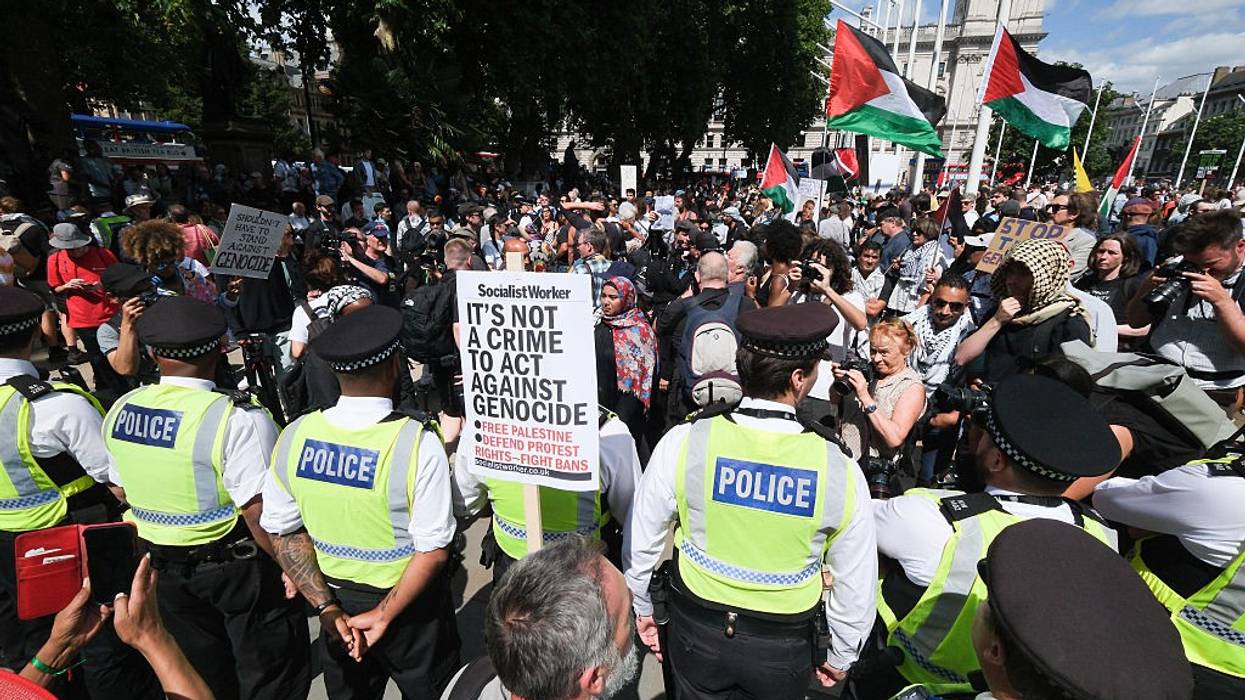
More than 1,600 people have been arrested during demonstrations of support for Palestine Action—mostly organized by the group Defend Our Juries—since the group's proscription, including nearly 900 attendees of a September 6 rally in London's Parliament Square.
Many of those arrested did nothing more than hold up signs reading: "I Oppose Genocide. I Support Palestine Action."
Arrestees include many elders, including 83-year-old Rev. Sue Parfitt, who argued that "we cannot be bystanders" in the face of Israel's US-backed genocide in Gaza, which has left more than 237,000 Palestinians dead, maimed, or missing, hundreds of thousands more starving by design, and around 1 million others under the threat of imminent ethnic cleansing as Israeli forces move to conquer and occupy the coastal strip.
"I know that we are in the right place doing the right thing," said Parfitt, who was arrested at a July 6 Defend Our Juries protest in Parliament Square against the terror designation for Palestine Action.
Last week, two Metropolitan Police officers speaking under condition of anonymity said they felt guilty and ashamed of having to arrest peaceful Palestine Action supporters.
“Instead of catching real criminals and terrorists," one of the officers told Novara Media, "we are arresting pensioners and disabled people calling for the saving of children’s lives."
"Instead of catching real criminals and terrorists, we are arresting pensioners and disabled people calling for the saving of children's lives," said one Metropolitan Police officer.
A pair of British police officers on Thursday expressed feelings of shame and guilt over having to arrest peaceful protesters—many of them elderly—for showing solidarity with Palestine Action as seven more of the anti-genocide group's supporters were charged with terrorism offenses.
"Instead of catching real criminals and terrorists, we are arresting pensioners and disabled people calling for the saving of children's lives," one Metropolitan Police member, identified as "Officer A," told Novara Media's Harriet Williamson under condition of anonymity. "It makes me question why I'm even in this career anymore."
While Metropolitan Police Commissioner Sir Mark Rowley said he is "proud" of how the department is handling the situation, Officer A said they felt "ashamed and sick" about having to arrest Palestine Action defenders—nearly half of whom are over age 60, with many older than 70 or even 80—under orders they did not believe in.
"I was told to help in the arrest of a disabled person for holding up the sign stating they opposed genocide and supported Palestine Action, which I did," they said. "I did it knowing it had nothing to do with upholding justice or our professional values, just to protect my job and livelihood."
"My father was an officer, and the reason I came into the police," Officer A continued. "I know he would be ashamed and turning in his grave if he saw what I did."
"I was at the protests and stood there with people shouting in my face calling me a pig and other names. I don't blame the public at all," Officer A confided. "In my silence, they didn't realize I agreed with everything they were saying but stating that openly would mean the end of my job."
The officer added that "my managers don't support what we have to do either, but they don't make the law and just have to follow what the ministers decide."
Another Met officer—identified as "Officer B"—told Williamson that "many officers are stuck between what everyone is witnessing in terms of genocide" and their orders to arrest supporters of Palestine Action.
"It causes a moral and ethical dilemma," said the officer, who is Muslim, as well as considerable "guilt for not being able to have a say on genocide."
More than 700 people have been arrested for showing support for Palestine Action ever since the group's recent ban under the Terrorism Act of 2000.
A spokesperson for the Police Federation of England and Wales told Novara Media that there aren't enough officers to police Palestine Action protests.
"Officers are emotionally and physically exhausted," the spokesperson said. "The demand is relentless. And it's not sustainable."
All told, at least 73 people have been charged with showing support for the banned group. They could face up to 14 years behind bars if fully convicted.
The Palestine Action ban resulted from Labour Home Secretary Yvette Cooper's introduction of parliamentary legislation after members of the direct action group broke into a Royal Air Force base in Oxfordshire and sprayed two planes with red paint.
Defend Our Juries—an advocacy group that staunchly supports Palestine Action—said it is expecting more than 1,000 demonstrators to turn out for a Saturday rally near Parliament at which participants are set to hold signs reading, "I Oppose Genocide" and "I Support Palestine Action," an action that could result in a record number of arrests.
🚨 BREAKING: September 6th Action to go ahead as 1,000+ pledge to hold signs in defiance of Labour’s authoritarian banJoin the 1000+ by signing up at wedonotcomply.orgThis announcement comes after counter-terrorism police arrested five spokespeople in dawn raids today.
[image or embed]
— Defend Our Juries (@defendourjuries.bsky.social) September 2, 2025 at 5:55 AM
On Thursday, seven members of Defend Our Juries who were recently arrested and charged with terrorism offenses for encouraging support for Palestine Action pleaded not guilty in Westminster Magistrates' Court in London.
Former government attorney Timothy Crosland, 55; gardener Dawn Manners, 61; David Nixon, 39; student Patrick Friend, 26; Gwen Harrison, 48; and Melanie Griffith, 62 allegedly arranged public protests and managed a series of 13 recent Zoom meetings in support of Palestine Action. Anthony Harvey, a 59-year-old man from the Oban area of Scotland, was also charged under the anti-terrorism law and released on bail after appearing in a Scottish court.
The seven activists were set to hold a Tuesday press conference to promote Saturday's demonstration; however, they were preemptively arrested. Journalist and author George Monbiot, who was also set to speak at Tuesday's event, called the arrests "classic police state stuff."
"We all have a stake in this because we're seeing a slippage from a nominally broadly democratic nation into one with very strong, authoritarian characteristics, and this is something I feel we all have a duty to resist," Monbiot told Middle East Eye on Wednesday.
The Defend Our Juries spokesperson asserted Thursday that "the mass defiance of the ban cannot be stopped and is growing all the time."
"It will only stop when the UK government abandons this grossly unjust proscription and ends its complicity in Israel's horrific atrocities," they added.
This isn't the first time that Met Police have reportedly voiced frustration at having to persecute Palestine Action supporters. According to Williamson, climate writer Donnachadh McCarthy "described multiple interactions" with officers "who said they were unhappy with the Palestine Action ban."
"One officer told me, 'This is not the work I came into the police to be doing. I would far prefer to be doing my proper job catching real thieves,'" McCarthy recalled, adding that his arresting officer "paused as he was about to close the [cell] door on me and said, 'This is mad. I can understand them arresting Hamas members, but for people holding a placard, this doesn't make any sense to me.'"