SUBSCRIBE TO OUR FREE NEWSLETTER
Daily news & progressive opinion—funded by the people, not the corporations—delivered straight to your inbox.
5
#000000
#FFFFFF
To donate by check, phone, or other method, see our More Ways to Give page.
Daily news & progressive opinion—funded by the people, not the corporations—delivered straight to your inbox.
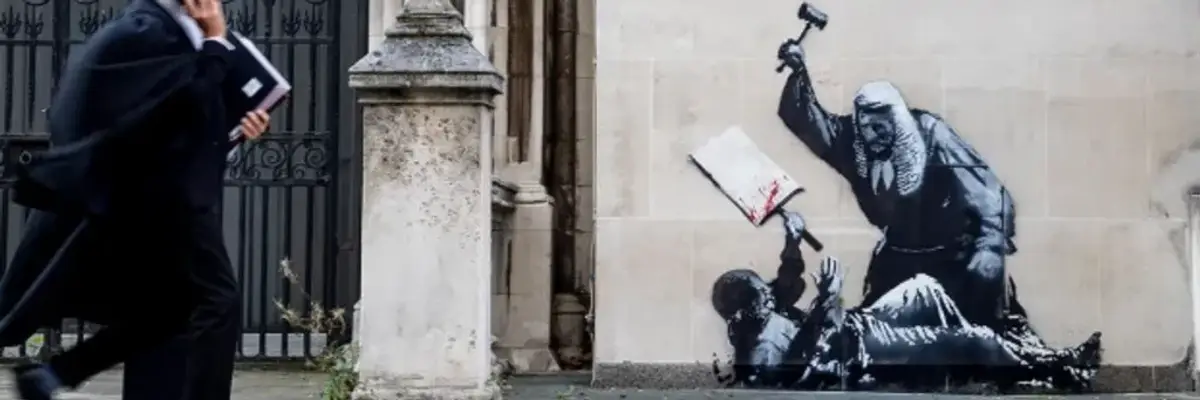
A photographed, posted by the artist himself, of a new Banksy mural that appeared outside the High Court in London on Monday, September 9, 2025.
"When the law is used as a tool to crush civil liberties, it does not extinguish dissent—it strengthens it," said the group who faced nearly 900 arrests over the weekend for peaceful protest.
A mural by the world-renowned street artist Banksy depicting a judge magistrate beating a bloodied demonstrator on the ground with his gavel appeared Monday morning outside the Royal Courts of Justice building in London—a piece of commentary on the ongoing controversy surrounding the right to free speech in the UK when it comes to Palestinian rights.
The new artwork, which the artist confirmed was his in an Instagram post, comes amid uproar over a UK government law that has been used to ban individuals and entire groups from protesting under anti-terrorism laws.
On Saturday, nearly 900 people were arrested during a protest led by a group called Defend Our Juries, which has been calling for the lifting of a blanket ban on a separate group, the nonviolent Palestine Action, deemed a terrorist supporter in relation to its advocacy of Palestinian rights and a demand for an end to the genocide in Gaza.
The Met Police reported that 890 people were arrested in total on Saturday. Of those, 857 were arrested for the sole offense of voicing their support for Palestine Action, now a crime in the UK. The other 33 arrests were for various infractions, including 17 for assault of police officers.
Banksy's artwork was seen as a keen commentary on the subject.
London-based journalist Barry Malone called the piece "extremely powerful," especially given the context. "The timing, the placement," he said. "It's perfect."
In a statement Sunday about the weekend's arrest, Amnesty International's director of campaigns and communications, Kerry Mascogiuri, said the "staggering number of arrests" by police at a "peaceful protest marks a new low for protest rights in this country."
"It's completely ridiculous for police to be targeting and arresting people for sitting down, quietly holding a sign," Mascogiuri said.
She said observers from Amnesty witnessed how the crowd was "entirely peaceful," despite some people hurling insults at officers. She said it was a misrepresentation to say that protesters became violent, though some did try to prevent those targeted for arrest from being carried away.
"Police officers, on a number of occasions, were aggressive towards supporters of the protest," Mascogiuri added. "This included violently shoving people away and pulling out batons to make space whilst protesters were arrested and hauled into police vans.
"Peaceful protest is a fundamental right," she concluded. "The scenes yesterday were a shocking demonstration of how the UK's overly broad terrorism laws are being used to suppress free speech."
Meanwhile, outside the High Court in London on Monday, security guards and metal barriers were promptly dispatched to cover up the mural.
In a statement, a spokesperson for Defend Our Juries said the work by Banksy "powerfully depicts the brutality unleashed" on peaceful protesters by the former Home Secretary Yvette Cooper, who led the prohibition against Palestine Action.
"When the law is used as a tool to crush civil liberties, it does not extinguish dissent–it strengthens it," the spokesperson continued.
"As Banksy's artwork shows, the state can try to strip away our civil liberties, but we are too many in number and our resolve to stand against injustice cannot be beaten—our movement against the ban is unstoppable and growing every day," they said. "We hope everyone who is moved by Banksy’s inspiring work of art will join our next action, which will be announced soon.”
Dear Common Dreams reader, It’s been nearly 30 years since I co-founded Common Dreams with my late wife, Lina Newhouser. We had the radical notion that journalism should serve the public good, not corporate profits. It was clear to us from the outset what it would take to build such a project. No paid advertisements. No corporate sponsors. No millionaire publisher telling us what to think or do. Many people said we wouldn't last a year, but we proved those doubters wrong. Together with a tremendous team of journalists and dedicated staff, we built an independent media outlet free from the constraints of profits and corporate control. Our mission has always been simple: To inform. To inspire. To ignite change for the common good. Building Common Dreams was not easy. Our survival was never guaranteed. When you take on the most powerful forces—Wall Street greed, fossil fuel industry destruction, Big Tech lobbyists, and uber-rich oligarchs who have spent billions upon billions rigging the economy and democracy in their favor—the only bulwark you have is supporters who believe in your work. But here’s the urgent message from me today. It's never been this bad out there. And it's never been this hard to keep us going. At the very moment Common Dreams is most needed, the threats we face are intensifying. We need your support now more than ever. We don't accept corporate advertising and never will. We don't have a paywall because we don't think people should be blocked from critical news based on their ability to pay. Everything we do is funded by the donations of readers like you. When everyone does the little they can afford, we are strong. But if that support retreats or dries up, so do we. Will you donate now to make sure Common Dreams not only survives but thrives? —Craig Brown, Co-founder |
A mural by the world-renowned street artist Banksy depicting a judge magistrate beating a bloodied demonstrator on the ground with his gavel appeared Monday morning outside the Royal Courts of Justice building in London—a piece of commentary on the ongoing controversy surrounding the right to free speech in the UK when it comes to Palestinian rights.
The new artwork, which the artist confirmed was his in an Instagram post, comes amid uproar over a UK government law that has been used to ban individuals and entire groups from protesting under anti-terrorism laws.
On Saturday, nearly 900 people were arrested during a protest led by a group called Defend Our Juries, which has been calling for the lifting of a blanket ban on a separate group, the nonviolent Palestine Action, deemed a terrorist supporter in relation to its advocacy of Palestinian rights and a demand for an end to the genocide in Gaza.
The Met Police reported that 890 people were arrested in total on Saturday. Of those, 857 were arrested for the sole offense of voicing their support for Palestine Action, now a crime in the UK. The other 33 arrests were for various infractions, including 17 for assault of police officers.
Banksy's artwork was seen as a keen commentary on the subject.
London-based journalist Barry Malone called the piece "extremely powerful," especially given the context. "The timing, the placement," he said. "It's perfect."
In a statement Sunday about the weekend's arrest, Amnesty International's director of campaigns and communications, Kerry Mascogiuri, said the "staggering number of arrests" by police at a "peaceful protest marks a new low for protest rights in this country."
"It's completely ridiculous for police to be targeting and arresting people for sitting down, quietly holding a sign," Mascogiuri said.
She said observers from Amnesty witnessed how the crowd was "entirely peaceful," despite some people hurling insults at officers. She said it was a misrepresentation to say that protesters became violent, though some did try to prevent those targeted for arrest from being carried away.
"Police officers, on a number of occasions, were aggressive towards supporters of the protest," Mascogiuri added. "This included violently shoving people away and pulling out batons to make space whilst protesters were arrested and hauled into police vans.
"Peaceful protest is a fundamental right," she concluded. "The scenes yesterday were a shocking demonstration of how the UK's overly broad terrorism laws are being used to suppress free speech."
Meanwhile, outside the High Court in London on Monday, security guards and metal barriers were promptly dispatched to cover up the mural.
In a statement, a spokesperson for Defend Our Juries said the work by Banksy "powerfully depicts the brutality unleashed" on peaceful protesters by the former Home Secretary Yvette Cooper, who led the prohibition against Palestine Action.
"When the law is used as a tool to crush civil liberties, it does not extinguish dissent–it strengthens it," the spokesperson continued.
"As Banksy's artwork shows, the state can try to strip away our civil liberties, but we are too many in number and our resolve to stand against injustice cannot be beaten—our movement against the ban is unstoppable and growing every day," they said. "We hope everyone who is moved by Banksy’s inspiring work of art will join our next action, which will be announced soon.”
A mural by the world-renowned street artist Banksy depicting a judge magistrate beating a bloodied demonstrator on the ground with his gavel appeared Monday morning outside the Royal Courts of Justice building in London—a piece of commentary on the ongoing controversy surrounding the right to free speech in the UK when it comes to Palestinian rights.
The new artwork, which the artist confirmed was his in an Instagram post, comes amid uproar over a UK government law that has been used to ban individuals and entire groups from protesting under anti-terrorism laws.
On Saturday, nearly 900 people were arrested during a protest led by a group called Defend Our Juries, which has been calling for the lifting of a blanket ban on a separate group, the nonviolent Palestine Action, deemed a terrorist supporter in relation to its advocacy of Palestinian rights and a demand for an end to the genocide in Gaza.
The Met Police reported that 890 people were arrested in total on Saturday. Of those, 857 were arrested for the sole offense of voicing their support for Palestine Action, now a crime in the UK. The other 33 arrests were for various infractions, including 17 for assault of police officers.
Banksy's artwork was seen as a keen commentary on the subject.
London-based journalist Barry Malone called the piece "extremely powerful," especially given the context. "The timing, the placement," he said. "It's perfect."
In a statement Sunday about the weekend's arrest, Amnesty International's director of campaigns and communications, Kerry Mascogiuri, said the "staggering number of arrests" by police at a "peaceful protest marks a new low for protest rights in this country."
"It's completely ridiculous for police to be targeting and arresting people for sitting down, quietly holding a sign," Mascogiuri said.
She said observers from Amnesty witnessed how the crowd was "entirely peaceful," despite some people hurling insults at officers. She said it was a misrepresentation to say that protesters became violent, though some did try to prevent those targeted for arrest from being carried away.
"Police officers, on a number of occasions, were aggressive towards supporters of the protest," Mascogiuri added. "This included violently shoving people away and pulling out batons to make space whilst protesters were arrested and hauled into police vans.
"Peaceful protest is a fundamental right," she concluded. "The scenes yesterday were a shocking demonstration of how the UK's overly broad terrorism laws are being used to suppress free speech."
Meanwhile, outside the High Court in London on Monday, security guards and metal barriers were promptly dispatched to cover up the mural.
In a statement, a spokesperson for Defend Our Juries said the work by Banksy "powerfully depicts the brutality unleashed" on peaceful protesters by the former Home Secretary Yvette Cooper, who led the prohibition against Palestine Action.
"When the law is used as a tool to crush civil liberties, it does not extinguish dissent–it strengthens it," the spokesperson continued.
"As Banksy's artwork shows, the state can try to strip away our civil liberties, but we are too many in number and our resolve to stand against injustice cannot be beaten—our movement against the ban is unstoppable and growing every day," they said. "We hope everyone who is moved by Banksy’s inspiring work of art will join our next action, which will be announced soon.”