
SUBSCRIBE TO OUR FREE NEWSLETTER
Daily news & progressive opinion—funded by the people, not the corporations—delivered straight to your inbox.
5
#000000
#FFFFFF
To donate by check, phone, or other method, see our More Ways to Give page.


Daily news & progressive opinion—funded by the people, not the corporations—delivered straight to your inbox.
"Remember the next time that a mass shooting happens," said one gun control advocate, "Trump did everything in his power to enable it, not prevent it."
An executive order issued Friday by President Donald Trump that aims to rollback gun control measures instituted by his predecessor received a swift rebuke from critics who said the order should be seen as a giveaway to the profit-hungry gun industry at the expense of a society ruthlessly harmed by gun violence year after year after year.
Trump's order tasks U.S. Attorney General Pam Bondi with conducting a sweeping review of the policies and positions of the previous administration and Justice Department as it relates to gun policies, including any executive orders issued by President Joe Biden during his term and the DOJ's positions taken on "all ongoing and potential litigation" related to firearms.
"On the chopping block," reports The Trace, "are several high-profile attempts by [Biden] to reduce gun violence, including regulations on ghost guns, expanded background checks on gun sales, and tougher regulatory oversight of lawbreaking gun dealers."
"Trump's priorities couldn't be more clear. Spoiler: it's not protecting kids."
According to the outlet, which focuses on the nation's gun violence crisis:
While most of Biden’s policies have taken effect, lawsuits against them are ongoing. In his executive order, Trump directed the attorney general to also review the Justice Department’s decision to defend those regulations, as well as all other gun-related litigation in which the government is involved. From age limits on firearm sales to the ban on gun possession by people convicted of felonies, federal gun laws have been under constant threat in the courts since a 2022 Supreme Court decision dramatically expanded gun rights.
If the Justice Department declines to defend the current federal laws in court, it would significantly raise the chances of them being ruled unconstitutional.
Gun control advocates widely rebuked the executive order, warning that Trump's reversal of the minimal amount of progress Biden was able to make was an endorsement of more death, pain, and suffering for the American people, including children, who too often find themselves at the deadly end of a gun's barrel.
"Trump's priorities couldn't be more clear. Spoiler: it's not protecting kids," said Natalie Fall, March For Our Lives executive director. "Gun deaths finally went down last year, and Trump just moved to undo the rules and laws that helped make that happen."
Trump's right-wing MAGA movement, she continued, "loves to rage about 'keeping kids safe,' but it’s all a smokescreen. They don’t care about what is actually killing and maiming thousands of American kids every year: gun violence. He is going to get Americans killed in his thirst for vengeance and eagerness to please the gun lobby and rally armed extremists. Remember, the next time that a mass shooting happens, Trump did everything in his power to enable it, not prevent it."
Hudson Munoz, executive director of the advocacy group Guns Down America, shared similar sentiments and said the president's latest order "is as reckless as it is predictable."
Not for the first time, he argued, Trump is "proving that he cares more about appeasing the gun industry than protecting the American people. This order is downright dangerous. His incompetence and Attorney General Pam Bondi's blind loyalty to the Trump agenda will lead to more violence while a few shareholders and gun industry executives line their pockets."
Referencing public polls, Munoz said more than 70% of people in the U.S. approve of common-sense gun safety laws that Trump and the gun lobby are attempting to destroy.
"Make no mistake, this executive order is about business," he said. "Trump is working to unleash more guns into American public life to boost the profits of gun manufacturers. This order leaves Americans to foot the bill with more gun deaths, more taxpayer dollars spent on emergency responses, and more families shattered by violence—while a handful of businesses cash in."
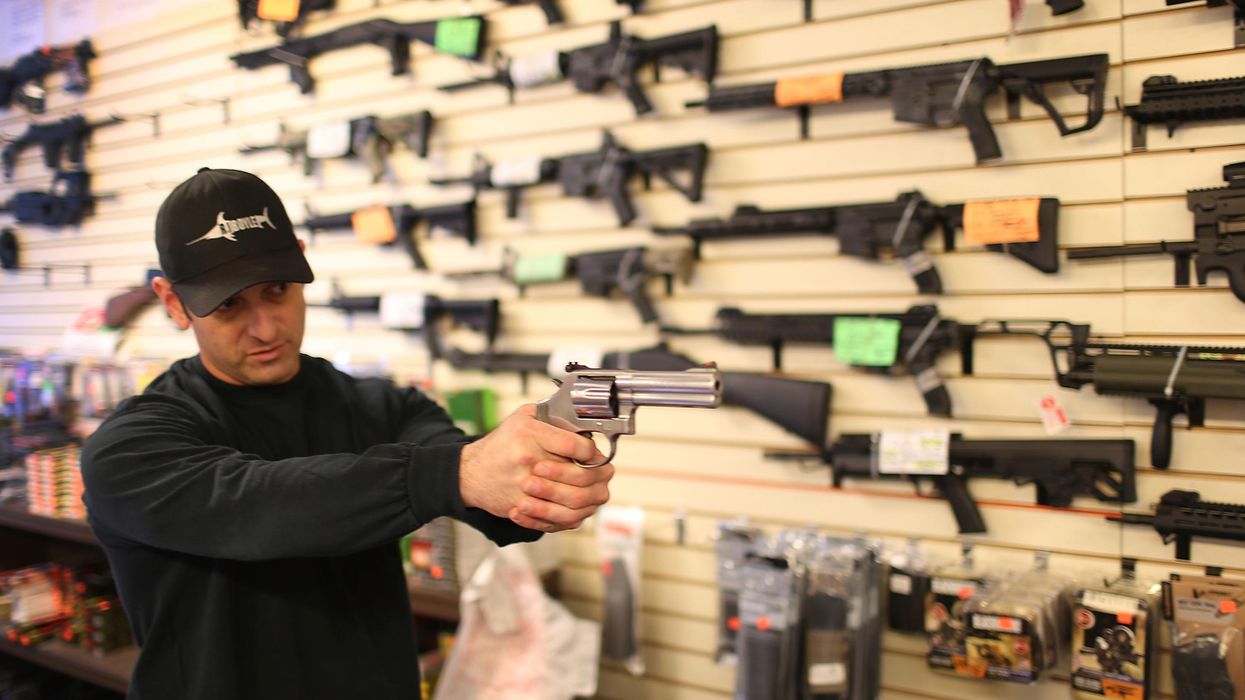
With under 5% of the world’s population, the U.S. has 40% of the world’s civilian-owned guns, as well as a comparatively higher number of gun deaths per 100,000 people than peer countries.
For most of us a “near miss”—whether a car wreck or a marriage breakup—calls on us to ask, “Why” and to seek answers. So, certainly the near assassination of former U.S. President Donald Trump calls for similar digging into root causes we can address.
Nearly two-thirds of Americans agree that crime is a big, national problem, and no doubt this near tragedy reinforces our worry. But what many of us may not grasp is how much more serious our crime challenge is relative to nations we assume to be our peers. In assassinations alone, we are one of just three countries sharing top place for the number of presidents killed between 1875 and 2004.
The U.S. by far leads the world in gun ownership per capita, with a rate of 121 guns per 100 people. With under 5% of the world’s population, the U.S. has 40% of the world’s civilian-owned guns. Among our peer countries, Canada is second with 35 guns per 100 people, or roughly one-third our rate. But note this big difference: Canada suffers just over two gun-related deaths per 100,000 while our rate is 11 deaths. Closely following Canada in number of guns owned are Finland, Iceland, Norway, and Switzerland. All have fewer than three gun-related deaths per 100,000 people. That’s almost a quarter of our rate.
Since the solution to gun violence goes well beyond addressing mental health, let’s begin with the most basic gun reforms advocated by the Democratic Party: strengthening background checks and keeping guns out of the hands of those with a history of violent crime.
Our country is also plagued by mass shootings—defined as the killing or injuring of four or more. By this measure, in 2023 America experienced almost two a day—totaling more than 650 such shootings.
Among the young in America—those 1 to 17—more now die from firearms than by any other type of injury or illness; and this death rate doubled in just eight years, from 2013 to 2021. And Black, Latino, and Indigenous people in the U.S. are more than 10 times, more than two times, and nearly 3.5 times (respectively) to die of homicide by firearms compared with whites.
So, what are possible solutions?
We can start by seeking lessons from our peer countries.
In Canada stricter gun control includes a ban on civilian ownership of automatic weapons. Handguns require a permit that is issued only on a temporary basis, and only for gun-club members and gun collectors and anyone demonstrating a need for self-defense purposes. Magazine capacity is limited to 10 rounds. Purchase of rifles and shotguns requires an official certificate and involves a 28-day waiting period. Purchase is denied to people with certain criminal histories or who have mental-health disorders associated with violence. Canada also has “red flag” laws, where an emergency prohibition can be issued for anyone judged to be a danger to themselves or others.
In Finland, gun ownership requires a license and registration, an aptitude test for the license, and a minimum age of 20. Guns can only be carried for a specific purpose, and gun owners bear the responsibility for ensuring that the gun and ammunition don’t end up in the wrong hands.
In Norway, semiautomatic weapons are banned, a license is required by the police, as well as a “valid” reason for obtaining it—such as membership in a gun club or use for hunting. Self-defense isn’t considered a valid reason. An applicant also must pass an exam after extensive firearm training, and firearms must be securely stored in an approved safe. With a 48-hour notice, police are allowed to enter to inspect the safe.
In the U.S., domestic abusers can now be barred from owning a firearm, as well as felons, fugitives, drug users, those involuntarily hospitalized for mental health, and those dishonorably discharged from the military. Youth under 18 cannot possess a handgun, but they can still own a rifle or shotgun in the majority of states. Prohibited firearms include those with serial numbers erased, machine guns produced after 1986, short-barreled shotguns or rifles, and silencers. Federal law doesn’t require licenses or permits to own firearms, but 10 states do require them, dependent on completing background checks.
Note that federal law now requires background checks only on purchases from a federally licensed gun dealer. So, more background checks could help.
The problem? Only 40% of gun sales in the U.S. are through such a federally licensed dealer.
Note that the 17 states that now do require prior universal background checks also require all sales of firearms to go through a licensed dealer who can perform such checks prior to sale.
Additional protection could come from expanding bans on the most dangerous weapons. For example, approximately two-thirds of U.S. states allow civilian ownership of machine guns.
Note that, overall, gun laws vary widely by state—with California being the strongest with a score of 89.5 out of 100 while most southern states receive a score of 20 and below.
Might gun violence ultimately be a mental health problem, as Republicans like to claim? It’s true that Finland and Norway, among the happiest nations, have a low rate of gun violence. On the other hand, Canada—ranking lower than the U.S. in mental health—has much lower rates of gun-related deaths despite having among the world’s highest rates of gun ownership. Of course when it comes to suicide, the link between mental health and gun violence is undeniable. As evidence, Greenland has a high suicide rate and gun-related deaths (18 deaths per 100,000 people) despite its low gun-ownership rate.
And if poor mental health is one root of the problem, all the more reason to pass laws requiring tougher mental health screenings for gun ownership. Currently, a person can be barred if declared mentally incompetent by a court or government body. And if Republicans truly believe gun violence is a mental health problem, they need to actually vote for government support for mental health initiatives rather than defunding them.
Plus, if better mental health is foundational to reducing gun violence, all of us should also be backing policies to alleviate stress created by low wages and high-housing costs, for example—precisely the changes that Republicans resist.
Since the solution to gun violence goes well beyond addressing mental health, let’s begin with the most basic gun reforms advocated by the Democratic Party: strengthening background checks and keeping guns out of the hands of those with a history of violent crime or posing a danger to themselves or others, such as domestic abusers.
Our upcoming national election offers a great opportunity to highlight these crucial steps for public safety, as the Democratic candidate for vice-president—Minnesota Gov. Tim Walz—became a gun-control advocate in response to the 2018 Parkland high-school shooting.
Commonsense gun reforms are the least we can do as a nation to protect ourselves—especially children in schools, the minority members of our population, and our own politicians—while still protecting our right to bear arms.
"To be clear, that 'gun show loophole' has been a death sentence for countless Americans, and that will change with this action," said one gun violence prevention advocacy leader.
The White House on Thursday honored "the will of the vast majority of the American people," one Democratic lawmaker said, as President Joe Biden announced a final rule closing a loophole that has left tens of thousands of firearms dealers able to sell guns without running background checks on purchasers.
The Bureau of Alcohol, Tobacco, Firearms, and Explosives (ATF) will require anyone "engaged in the business" of selling firearms for a profit to register as a federally licensed firearms dealer, which will require them to conduct background criminal and mental health checks on their customers.
Previously, dealers who sell guns online, at gun shows, and through private transactions had been required to register with the federal government only if their gun sales were the primary provider of their livelihood—the so-called "gun show loophole," which allowed roughly 23,000 private sellers in 29 states to conduct their business without determining if buyers had a history of abuse, violence, or mental health struggles.
Sellers who fail to register will risk being fined $250,000 and a potential prison sentence of up to five years.
The ATF released firearms trafficking data last week showing that four in 10 illegal gun cases tracked by the agency between 2017-21 involved sales through private dealers, which account for 40% of all gun sales in the U.S. according to some estimates.
"This rule will save lives by ensuring those who engage in the business of selling firearms are taking the necessary precautions we require of all other licensed gun sellers."
The gunman in a 2019 mass shooting in Midland, Texas, obtained his AR-style rifle through a private sale, allowing him to kill seven people. He had previously been blocked from buying a gun in 2014 due to a background check that showed a court had determined he had a mental illness.
A 2022 shooting at a high school in St. Louis was also made possible by a private online sale; the gunman had struggled with severe mental health issues and had been automatically rejected by the federal background check system when he tried to purchase a gun 16 days before the attack. He then purchased a gun without undergoing a background check, and later killed a 15-year-old student as well as a teacher.
"To be clear, that 'gun show loophole' has been a death sentence for countless Americans, and that will change with this action," said Kris Brown, president of the gun violence prevention group Brady. "This rule will save lives by ensuring those who engage in the business of selling firearms are taking the necessary precautions we require of all other licensed gun sellers. In doing so, we can mitigate the proliferation of firearms in our communities and keep weapons out of the hands of those most at risk of harm."
"I am elated that President Biden continues to deliver on his promise to represent the will of the people and make progress to free America from gun violence," she added. "I urge Congress to follow suit and pass universal background checks without delay."
Brown noted that 90% of Americans support universal background checks for gun purchases, and that the new rule is the direct result of the Bipartisan Safer Communities Act, which was passed in 2022.
U.S. Sen. Chris Murphy (D-Conn.) called the rule "the most impactful change made possible by the 2022 gun safety bill."
March for Our Lives, the advocacy group established by young survivors of the 2018 Parkland, Florida school shooting, credited gun control supporters who submitted public comments supporting the new rule.
"For years, this glaring loophole let people who shouldn't have access to a gun otherwise slip through the cracks to get a deadly weapon and cause harm," said the group. "Not anymore."
House Democratic Whip Katherine Clark (Mass.) called on Congress to build on the Biden administration's progress "by fully closing the boyfriend loophole, enacting a nationwide red flag law, getting high-capacity magazines off the street, and reenacting the federal assault weapons ban."
"Thanks to the non-stop advocacy of survivors across the country, the leadership of the Biden-Harris administration, and the persistence of Democrats in Congress," she said, "America has taken the greatest strides against gun violence that we've seen in three decades."
Congresswoman Lucy McBath, whose son was killed by gun violence, said she filed a discharge petition for an assault weapons ban "because we have been sent to Congress to use every tool to help save American lives."
As most U.S. House Republicans and two Democrats on Tuesday voted to block the Biden administration's regulation of pistols with stabilizing braces, several other Democratic lawmakers renewed a fight for gun control policies unlikely to pass the GOP-controlled chamber.
Democratic Reps. Jared Golden (Maine) and Mary Peltola (Alaska) joined with all Republicans present except Congressmen Brian Fitzpatrick (Pa.) and Thomas Kean (N.J.) to pass a resolution disapproving of the Bureau of Alcohol, Tobacco, Firearms, and Explosives (ATF) rule, which was finalized in January.
Under the federal bureau's rule, gun owners who install stabilizing braces on their pistols so the firearms can be used one-handed must register the weapons as short-barreled rifles. Alternatively, they can permanently remove and dispose of the accessory, turn in the firearm at an ATF office, or destroy the gun.
The gun accessories have gained national attention after being used by the perpetrators of mass shootings such as a 2021 rampage at a grocery store in Boulder, Colorado as well as a massacre at a Nashville, Tennessee school earlier this year.
" Gun violence is the challenge of our lifetime and the issue of our era."
"The regulation has become a sticking point among conservatives, and gun rights groups like the Gun of Owners of America have urged Congress to pass the disapproval resolution," Roll Call noted Tuesday. "The rule would have gone into effect June 1, but the U.S. Court of Appeals for the 5th Circuit temporarily stayed the rule while a challenge plays out in the courts."
Even if the House GOP's measure also passes the Democrat-controlled Senate, President Joe Biden would veto it, the White House said Monday, stressing that "this administration has no higher priority than keeping the American people safe, which is jeopardized with a vote in support of a resolution that makes it easier for mass shooters to obtain these deadly weapons."
While Republican lawmakers—and a handful of Democrats—battle the pistol brace policy, Democratic Reps. James Clyburn (S.C.), Lucy McBath, (Ga.), and Mike Thompson (Calif.) are hoping to force votes on gun control legislation with discharge petitions, which allow legislators to bypass GOP House Speaker Kevin McCarthy (Calif.) and bring bills to the floor with simple majority support.
The trio filed discharge petitions Tuesday related to an assault weapons ban and background check legislation. However, actually holding votes on those bills would require winning over not only most—if not all—Democrats but also a handful of Republicans.
As The Washington Post detailed Tuesday:
Of all three bills, the Bipartisan Background Checks Act, which Thompson first introduced after the 2012 Sandy Hook Elementary shooting, has previously received the most support from across the aisle. The bill, which would require background checks on those looking to transfer or buy a gun, is sponsored by... Fitzpatrick... and received eight Republican votes in 2021.
The proposal from Clyburn would require background checks to be completed 10 days after someone buys a firearm, increasing the current review period by seven days. It would close the "Charleston loophole," a reference to how Dylann Roof, a white supremacist, was able to obtain a firearm in 2015 after the three-day review period expired but before the background check was completed. He went on to murder nine Black worshippers in South Carolina at a church in Charleston.
[...]
Taking on the herculean pursuit of enacting an assault weapons ban into law is personal for McBath. Her 17-year-old son, Jordan Davis, was killed after being confronted by Michael Dunn for playing loud music in a parked car at a Jacksonville, Florida, gas station in 2012.
Various other Democrats announced that they had signed the discharge petitions on Tuesday. Rep. Maxwell Frost (D-Fla.)—who was previously the national organizing director for March for Our Lives, formed after the 2018 school shooting in Parkland, Florida—said that he was "proud to have been one of the first to sign all three this morning."
Specifically signaling her support for the assault weapons ban, Rep. Rashida Tlaib (D-Mich.) tweeted: "Gun violence is an epidemic touching every community. Firearms are now the leading cause of death for children and teenagers in America. This is unacceptable."
It is shameful and unconscionable that this country has allowed gun violence to become the leading cause of death among children in the United States--but that is the reality. The legislation, including gun measures, recently proposed by a bipartisan group of senators represents a step in the right direction: it does some good things, such as provide money to encourage states to pass and implement "red flag" laws to remove guns from potentially dangerous people, as well as money for school safety and mental health resources; it expands background checks for gun purchases for people between the ages of 18 and 21 and penalties for illegal straw purchases by convicted criminals.
If Americans are truly fed up, disgusted, and unwilling to let this terrible carnage continue then let them stand together and call for the Second Amendment to be repealed and replaced by a constitutional provision that is more relevant to the times in which we live.
Still, the proposed legislation falls woefully short of what is needed to bring an end to the epidemic of gun violence--an epidemic that will not abate until we are prepared to grapple with the Second Amendment, and how it has been co-opted by the private interests of a powerful gun lobby that includes the National Rifle Association, among other organizations. These groups maintain that the right to bear arms is not simply one right alongside others, but the palladium or guarantor of all our other freedoms.
The Second Amendment has in fact a long history of being referred to as the "palladium of liberty," going as far back as St. George Tucker's Blackstone Commentaries (1803):
"This may be considered as the true palladium of liberty... The right of self-defence is the first law of nature: in most governments, it has been the study of rulers to confine this right within the narrowest limits possible. Wherever standing armies are kept up, and the right of the people to keep and bear arms is, under any color or pretext whatsoever, prohibited, liberty, if not already annihilated, is on the brink of destruction."
For the supporters of gun rights, Tucker's comments provide incontrovertible proof that "the right to bear arms was originally understood to protect an individual right to keep and use firearms for personal self-defense, hunting, and any other lawful activity." As it turns out the individual rights misreading of Tucker, and by extension, the Second Amendment, is a stark example of how constitutional scholarship can be "hijacked for ideological purposes..."
Far from being a right of personal defense, as modern gun advocates urge, Tucker saw the Second Amendment provision protecting the right to bear arms as necessary to mitigate anti-Federalist worries that the federal government might threaten the states; to assuage their fears about the potential disarmament of the state militias.
Tucker was by no means alone in describing the Second Amendment as the "palladium of liberty," a remarkable phrase the origin of which we should take a moment to ponder. The Palladium goes back to Ancient Troy and the statue of Pallas Athena which was believed to ensure the safety and survival of the city. In other words, the Palladium was a wooden idol, thought to guarantee the well-being of the Trojan state. As anyone who has read their Homer knows, the Palladium did not protect Troy from utter ruin, and in fact, the goddess who did most to bring about the fall of Troy was Athena herself. The Palladium turned out to be no more than a fetish, an object accorded special powers that it does not in reality possess. Meanwhile, the actual goddess Athena was bent on Troy's downfall.
The Second Amendment, we are told by Tucker is and his followers, is the palladium, the guarantor or safeguard of our freedom. My thesis is quite simple: Those who wish to defend the Second Amendment as the palladium of liberty are right about one thing. The Second Amendment is indeed an idol, a false idol it turns out--and rather than guaranteeing our liberty it is daily guaranteeing our death and self-destruction. The Second Amendment is not the palladium, the guarantor of liberty, but the palladium of meaningless death and carnage.
We have made a fetish out of the Second Amendment: it has become a loathsome idol for which no amount of American blood is sufficient. Republican legislators are prepared to sacrifice our youngest, most vulnerable, and most innocent on the altar of the Second Amendment, lest they are excommunicated and banished from the temple and its coffers. Such legislators are far worse than mere cowards: they are complicit in the endless cycle of bloodletting; they have betrayed those who are most in need of protection and safety.
The Second Amendment of the United States Constitution provides that "a well-regulated Militia, being necessary to the security of a free state, the right of the people to keep and bear Arms, shall not be infringed." As former Supreme Court Justice John Paul Stevens observed, "Today that concern is a relic of the 18th century."
How many Americans, how many children, how many innocents need to be slaughtered on this wretched altar, as if our Founding Fathers cared more for the right of an 18-year-old to purchase a military-style assault rifle than for the right an 8-year-old to live free from unspeakable terror, senseless violence, and a horrifying death? Increasing the minimum age to buy a gun from 18 to 21 years old might well have prevented the slaughter in Uvalde, Texas which was perpetrated by an 18-year-old who purchased an assault rifle days after his birthday.
If Americans are truly fed up, disgusted, and unwilling to let this terrible carnage continue then let them stand together and call for the Second Amendment to be repealed and replaced by a constitutional provision that is more relevant to the times in which we live. The Second Amendment's staunch defenders refer to it as the touchstone and guarantee of all our other rights. But is this correct? By turning this right into the palladium of liberty what are we doing but reifying it, transforming it into a fetish, an object of our creation which now lords over us, demanding absolute devotion and blood sacrifice? Do we exist for the sake of protecting this single right, are we here to serve the right to bear arms or does the right exist for our sakes, for our benefit?
What needs to be emphasized is that there is nothing even remotely conservative about the gun lobby's position or the position of those that would turn the Second Amendment into an absolute right of individuals 'to keep and bear arms.' Indeed, it is the very antithesis of conservatism, and it is in the name of genuine conservatism that we should demand that the Second Amendment is repealed. Former Chief Justice Warren Burger was certainly a conservative and he said explicitly that the idea that there was an individual right to bear arms was "a fraud." Referring to the NRA, Berger claimed on PBS that the Second Amendment, "has been the subject of one of the greatest pieces of fraud, I repeat the word fraud, on the American public by special interest groups that I have ever seen in my lifetime."
For nearly two hundred years the general legal consensus was that the right to bear arms was not an individual right but the right for those called to military service--that is, the militia. And as Burger points out, if according to the Second Amendment "the militia--which was going to be the State army--was going to be 'well regulated,' why shouldn't 16, and 17 and 18, or any other age persons, be regulated in the use of arms, the way an automobile is regulated?" If he were writing the Bill of Rights now, he said in 1991, "There wouldn't be any such thing as the Second Amendment."
Let us takes those words to heart, once and for all, and move to repeal and replace the Second Amendment lest this dreadful idol we have made continues to demand ever more innocent blood.
I'm sitting here typing away at the dining room table in the home of friends a few miles along the road from Newtown, Connecticut. In a span of just thirteen hours, there have been mass killings in El Paso, Texas, and Dayton, Ohio. Many more are wounded.
Lone, young white gunmen have murdered more than thirty men, women and children. In Texas, the dead were shopping for back-to-school sale bargains at Wal-Mart. In Ohio, they were enjoying a weekend evening out.
Each assailant legally obtained his weapon. The killer in Dayton's AR-15-style rifle used a double drum magazine that holds 100 rounds of ammo for non-stop shooting. You can order it online for $129.95.
I sat at this same table less than seven years ago during the weekend of the 27 murders at Newtown's Sandy Hook Elementary School and wrote, "As many as 100 bullets were fired in Newtown; last year, a total of 85 were fired at people by the police in all of Germany and 49 of them were warning shots. We will hear all these and other statistics in the days ahead, and in a week or so they will fade until the next time. Unless this time we stand up and say no."
There have been, of course, too many next times. And so far, as hard as we try, every time it happens again we apparently have not stood up in sufficient numbers or shouted loud enough to make the massacres stop. What does it take? The story keeps repeating.
July 2012: In the wake of the killings at a Colorado movie theater, my colleague Bill Moyers and I wrote, "We are fooling ourselves. Fooling ourselves that the law could allow even an inflamed lunatic to easily acquire murderous weapons and not expect murderous consequences. Fooling ourselves that the Second Amendment's guarantee of a 'well-regulated militia' be construed as a God-given right to purchase and own just about any weapon of destruction you like, a license for murder and mayhem. A great fraud has entered our history."
January 2013: Less than a month after the Newtown murders, we wrote, "Naturally, in a country where even life and death are measured by the profit margin, the cure for gun violence is, yes, more guns! Bigger profits."
October 2017: After 57 were killed in Las Vegas, I said, "To claim as a constitutional right the possession of firearms intended for nothing less than brutal, gruesome warfare strains credulity. These are killing machines with no purpose other than to maim and destroy. Of course, we've said this time and again and will doubtless say it again because the foolish cycle remains unchanging."
February 2018: I wrote, "An AR-15 is what 19-year old Nikolas Cruz bought for his rampage at Marjory Stoneman Douglas High in Parkland [Florida]... These are not sports weapons and they sure as hell don't belong in the hands of any civilian, much less the mentally disturbed."
And so it goes. A pizzeria owner who was at the murder scene in Dayton tells The New York Times he had watched the news from El Paso earlier in the day but thought it was, "just another mass shooting that we hear about all the time, and you never think it's going to hit home."
Is that what needs to happen? Must every community endure a tragedy of its own to understand that gun violence not only slays individuals but also kills us as a society?
Rather than face the truth, our elected leaders try to cover it all up, pointing fingers at everyone but themselves and blaming the gun deaths on video games and mental problems. When their hands are not fraudulently folded in prayer, they greedily reach out for more and more campaign cash from the National Rifle Association.
Here's a truth for you. This is domestic terrorism. Here's another: According to the NRA Campaign Spending Tracker run by The Trace, an independent news organization that investigates guns in the United States, "In the 2018 election cycle, the NRA... spent $5,362,861 supporting 265 candidates... and $4,369,083 opposing 71 candidates... in congressional races across 44 states." Over the past decade, they've spent more than $100 million.
The NRA donated $30.3 million to Trump's 2016 presidential campaign. Where it all came from remains a secret. Keep that cash in mind; then remember how he incites white supremacist crowds at his rallies. Never forget all the vicious things Donald Trump has said about people of color, the constant anti-immigrant rhetoric, much of it in the past few days leading up to the shootings.
In characteristic cover-his-ass mode, he now lies and tells the public, "Hate has no place in our country," and that when it comes to guns, "We have done much more than most administrations. That's not talked about very much. But we've done actually a lot. But perhaps more has to be done." Perhaps?
Monday morning, Trump, bowing to pressure, called for "strong background checks," but naturally then blamed the media for the problem--"Fake News has contributed greatly to the anger and rage that has built up over many years," he tweeted--as ever, misleading and trying to divert the blame away from the leading offender, himself.
Yet he's just the latest in a long list of culprits. More than twelve years ago--twelve years!--the day after 32 were shot and killed at Virginia Tech in April 2007, I asked, "How many times do mass killings... have to occur before we get it through our thick, wired for the Stone Age skulls? For that matter, how many times do people have to write a column like this one decrying the insanity of gun violence in America?"
Here's that column once again. Will I ever be able to stop writing it?
Keeping and bearing arms is a constitutional right, but the Supreme Court has gone to great lengths to emphasize that it is not absolute. In 2008, the late Justice Antonin Scalia wrote in District of Columbia v. Heller that "the right secured by the Second Amendment is not unlimited."
In the wake of the Parkland, Florida school shooting, major U.S. retailers have decided to raise the minimum age to buy a gun to 21. Lawmakers and reform advocates, meanwhile, are offering several laws to regulate guns--but opponents of at least some of those reforms have cited the Second Amendment's 27 words to reject such proposals out of hand.
So do these recent proposals pass constitutional muster? Here, I analyze a handful of these policy suggestions to see if they are in line with recent federal court rulings on the Second Amendment.
Every federal appeals court that's ruled on assault rifle and large-capacity magazine bans has concluded that they comply with the Constitution. One court held that assault rifles aren't covered by the Second Amendment at all; others that even if they are covered, they still can be banned because doing so sufficiently advances public safety. No matter the reasoning, the outcome has been the same: the Second Amendment doesn't prevent these types of bans.
The Supreme Court, meanwhile, has had opportunities to overrule the lower courts, but the justices have consistently declined to do so.
Even the National Rifle Association has voiced support for restrictions on bump stocks--an attachment that allows semiautomatic weapons to fire faster.
A ban wouldn't directly restrict anyone's ability to have a firearm; it would just prohibit them from modifying firearms into something more like a machine gun. And in Heller, the Supreme Court strongly suggested that machine guns can be prohibited.
The constitutionality of this restriction is a closer call; many rights come into effect at age 18. One common comparison is to the right to vote--but there, the Twenty-Sixth Amendment expressly sets the age at 18. Besides obvious differences between ballots and guns that could justify different treatment, no such language is in the Second Amendment.
Meanwhile, the leading Second Amendment case on age restrictions upheld a federal prohibition on handgun sales to people under 21. The court's conclusion turned on the fact that, historically, the age of majority was 21, not 18.
What's more, some have proposed raising the age for purchasing assault rifles only. As noted, complete bans on assault rifles are regularly upheld, so a less restrictive age requirement should be even safer under the Second Amendment.
There appears to be no serious debate about whether requiring background checks for gun purchasers presents Second Amendment problems. In any event, no courts have held that the current background check system violates the right to keep and bear arms. The expansion of that system to more firearm transfers shouldn't affect that conclusion.
Waiting periods vary, but the 3-day period proposed in Florida is quite standard. Recently, in Silvester v. Harris, the Ninth Circuit Court of Appeals upheld California's 10-day waiting period, and in February the Supreme Court opted not to disrupt that ruling. Under the Silvester analysis, the shorter 3-day period proposed in Florida is constitutional. Justice Clarence Thomas dissented from the Supreme Court's decision not to hear Silvester, arguing that the lower court's reasoning was flawed. No other justices signed on to his opinion.
The Second Amendment presents a significant constitutional obstacle to some regulation, and we should not underestimate the powerful symbolic role it plays in gun politics. But if the tragic shooting in Parkland can overcome the perennial gridlock and spur a new round of legislating, and if recent federal court cases serve as our guide, these gun restrictions likely would not be struck down as unconstitutional.
In a failure reminiscent of previous attempts to tighten gun laws following a mass shooting, the U.S. Senate on Monday night roundly rejected four measures to enact stricter gun control laws in the wake of last week's massacre in Orlando, Florida.
"Democrats and Republicans had put forth competing amendments to both strengthen background checks and prevent suspected terrorists from purchasing firearms," the Guardian reported. "But all four bills fell short of the 60 votes needed to clear a procedural hurdle in the Senate, in a near replica of a vote held in December when a pair of shooters killed 14 people and wounded 22 more in San Bernardino, California."
Sen. Elizabeth Warren (D.-Mass.) decried the vote in a Tweet:
The much-publicized Democratic-led filibuster in the Senate last week, which pushed for measures that critics derided as "not going far enough," resulted in an agreement to vote on new gun control legislation.
The Hill reports that many were pessimistic about the proposals' chances of success from the start:
All four measures--two dealt with background checks and two sought to prevent people on terrorist watchlists from buying guns--were expected to fail.
All four required 60 votes to move forward, and Republicans and Democrats offered dueling amendments on both issues. The National Rifle Association opposed the two Democratic measures.
The climactic vote was on a measure sponsored by Sen. Dianne Feinstein (D-Calif.) that would have prohibited people on terrorist watchlists from buying guns or explosives. It failed 47-53.
Before the vote, Sen. Bernie Sanders (I-Vt.) characterized the vote as a "no-brainer."
"Frankly, these Democratic amendments are no-brainers," Sanders wrote. "It is incomprehensible to me, and I believe to the vast majority of Americans, as to why Republicans would oppose them."
None of the measures were the ban on assault weapons sales that "so many are calling for," as Common Dreams reported.
Hillary Clinton released a statement that simply read, "Enough," and then proceeded to list the names of the 49 victims of the Orlando shooting, the Hill reported.
"Sen. Feinstein's and Sen. Murphy's proposals are commonsense," Sanders added. "In light of the terrible tragedies that have taken place in Orlando and other cities, it's not very hard to understand that terrorists or potential terrorists, criminals, and the dangerously mentally ill should not have access to guns. We have got to do everything we can to stop guns from falling into the hands of people who should not have them."
"What am I going to tell 49 grieving families?" asked Florida Sen. Bill Nelson after the measures were voted down, according to the Guardian. "What am I going to tell the families of those who are still in the hospital fighting for their lives?"