

SUBSCRIBE TO OUR FREE NEWSLETTER
Daily news & progressive opinion—funded by the people, not the corporations—delivered straight to your inbox.
5
#000000
#FFFFFF
To donate by check, phone, or other method, see our More Ways to Give page.
Daily news & progressive opinion—funded by the people, not the corporations—delivered straight to your inbox.
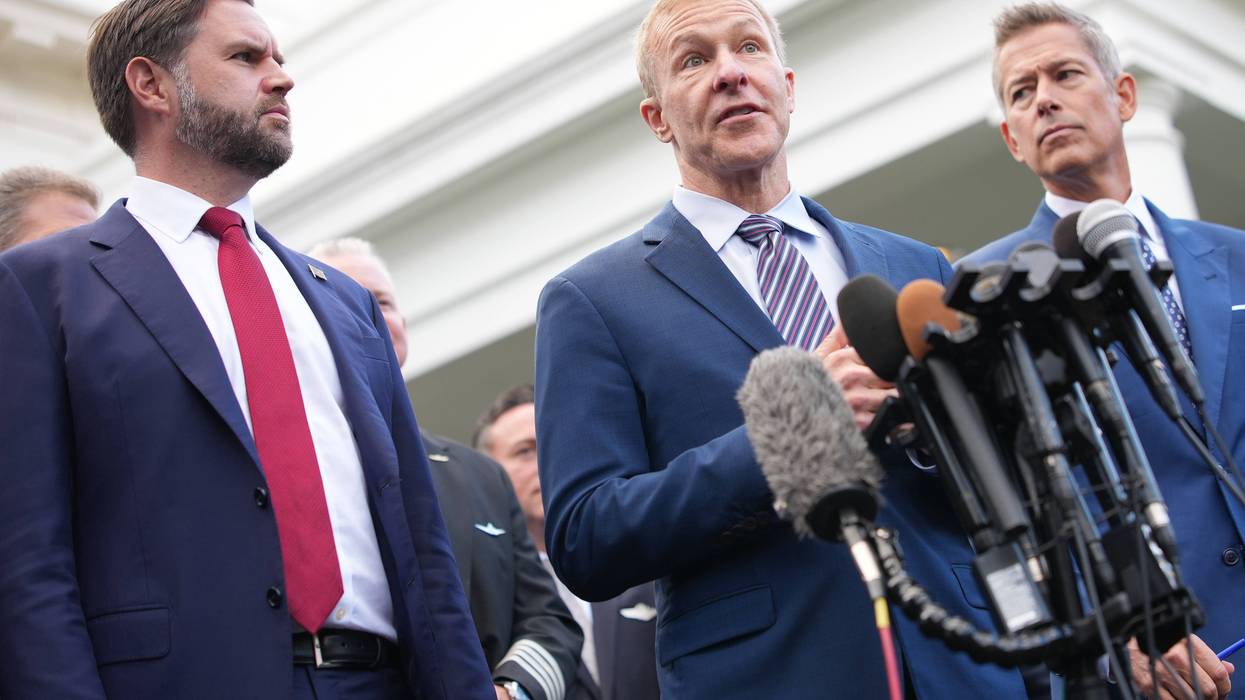
The heads of the congressional Monopoly-Busters Caucus warned that a future administration could "break up" a merger of United and American Airlines if it is approved by Trump regulators.
The Democratic leaders of the congressional Monopoly-Busters Caucus said Wednesday that a recently floated megamerger of two of the largest airlines in the US—United and American—would be so awful for consumers that it shouldn't even be considered, let alone approved by federal regulators.
"The rumored scheme to merge United and American should never see the light of day," said Reps. Pramila Jayapal (D-Wash.), Chris Deluzio (D-Pa.), Pat Ryan (D-NY), and Angie Craig (D-Minn.). "This disaster of a merger would be illegal, consolidating more than a third of the US airline market, eliminating direct competitors on hundreds of routes across the country, and creating a near-monopoly on flights in many cities."
The House Democrats went on to say that if a United-American merger is formally proposed and approved by President Donald Trump's regulators, a future Democratic administration could break up the resulting airline behemoth.
"In a time when too many Americans just struggle to even go on vacation, much less afford their housing, childcare, and healthcare, these airline executives should not mistake the corruption of this administration as a green light to break the law," the lawmakers said. "They should also remember that there is no statute of limitations on breaking up bad deals."
"In case it is not crystal clear," they added, "that is absolutely a threat to break up this merger should it ever happen."
The lawmakers' statement came a day after Bloomberg reported that United Airlines (UA) CEO Scott Kirby floated the idea of merging his company with American Airlines (AA) "directly" to Trump during a meeting in late February. Kirby also pitched the merger idea to other "senior government officials," the outlet noted, without providing names.
"A combination would create the largest airline on the planet," Bloomberg observed. "As a result, any merger between the two aviation giants would pose serious antitrust concerns and likely face significant backlash from consumers, politicians and rival US airlines."
"That the United CEO raised the idea of a merger with American directly with Donald Trump suggests he thinks he might obtain direct approval from the president for a merger that would otherwise never be permitted.”
Contrary to claims of a "surging MAGA antitrust movement" in the early days of Trump's second White House term, the president's administration has proven friendly to corporate merger efforts, from Paramount-Skydance to UnitedHealth-Amedisys and more. Reuters reported Wednesday that "investment banking fees—earned from advising on mergers and acquisitions and underwriting deals—surged an average of 27% across six major US banks in the first quarter, with record dealmaking a key profit driver."
William McGee, senior fellow for aviation and travel at the American Economic Liberties Project, said Wednesday that "thanks to the federal preemption clause in the 1978 Airline Deregulation Act, states have virtually no airline oversight."
"So effectively the only sheriffs overseeing airlines are [the Department of Transportation] and [Department of Justice]," McGee observed. "Under Trump they've been derelict in policing competition."
"To be clear: A UA-AA merger is absurd," McGee added. "A monolith mega-mega-carrier operating 4 of every 10 domestic flights is so harmful that anyone favoring it doesn't understand airlines. Or is a regulator eager to please a president who 'loves to see big deals.'"
Robert Weissman, co-president of the consumer advocacy group Public Citizen, said in a statement Tuesday that "it would be easy to dismiss the prospect of such a merger passing antitrust scrutiny—except that the Trump Department of Justice seems content to bless dangerously high levels of corporate concentration, so long as administration cronies, allies, or flatterers are in charge of corporate goliath."
"That the United CEO raised the idea of a merger with American directly with Donald Trump," Weissman added, "suggests he thinks he might obtain direct approval from the president for a merger that would otherwise never be permitted.”
"Maybe in the DOGE boys' video game simulations, it doesn't matter if they lay off hundreds of staff from the FAA. In the real world, however, it will make flying less safe," said Public Citizen's Robert Weissman.
As the Trump administration began firing hundreds of Federal Aviation Administration employees amid a surge in plane crashes, a leading U.S. consumer advocacy group warned Monday that the slash-and-burn approach of Elon Musk's Department of Government Efficiency is making the "next air travel disaster more likely."
While Musk recently said that DOGE will "aim to make rapid safety upgrades to the air traffic control system," critics have countered that the Trump administration's termination of FAA personnel, including critical air traffic control maintenance staff, poses major risks.
"Maybe in the DOGE boys' video game simulations, it doesn't matter if they lay off hundreds of staff from the FAA. In the real world, however, it will make flying less safe," Public Citizen co-president Robert Weissman said in a statement. "Just like having fewer people safeguarding the nation's nuclear arsenal will make the risk of a nuclear accident much greater."
Elon’s DOGE rampage will be a wake up call for what a decimated government really means. Cuts to FAA? Higher risk of plane crashes. Cuts to Forest Service? Higher fire risk. Cuts to the CDC? Higher pandemic risk. Cuts to the EPA? Higher toxic exposures risk — and on and on.
[image or embed]
— Public Citizen (@publiccitizen.bsky.social) February 17, 2025 at 11:03 AM
Weissman continued:
The Musk rampage through government is making it virtually certain that we will suffer through otherwise avoidable health, safety, and economic catastrophes. Cutting the Forest Service increases fire risk, cutting the [Centers for Disease Control and Prevention] and blocking information-sharing risks worsening infectious disease outbreaks, cutting the [Consumer Financial Protection Bureau] guarantees Big Bank and predatory loan ripoffs, cutting [Food and Drug Administration] staff increases the risk for dangerous devices, drugs, and food additives, cutting the [Environmental Protection Agency] will increase the risk of mass toxic exposures, and on and on.
"If permitted to proceed, the mindless Musk-Trump governmental annihilation is going to touch every American community, imposing tragedy upon tragedy," Weissman added.
In a Monday social media post, U.S. Congressman Don Beyer (D-Va.) said that "mass firings of FAA workers—at a time when they already have serious staffing problems—would be dangerous at any time," but "Musk and Trump doing this weeks after the deadliest crash in years is stupid beyond belief."
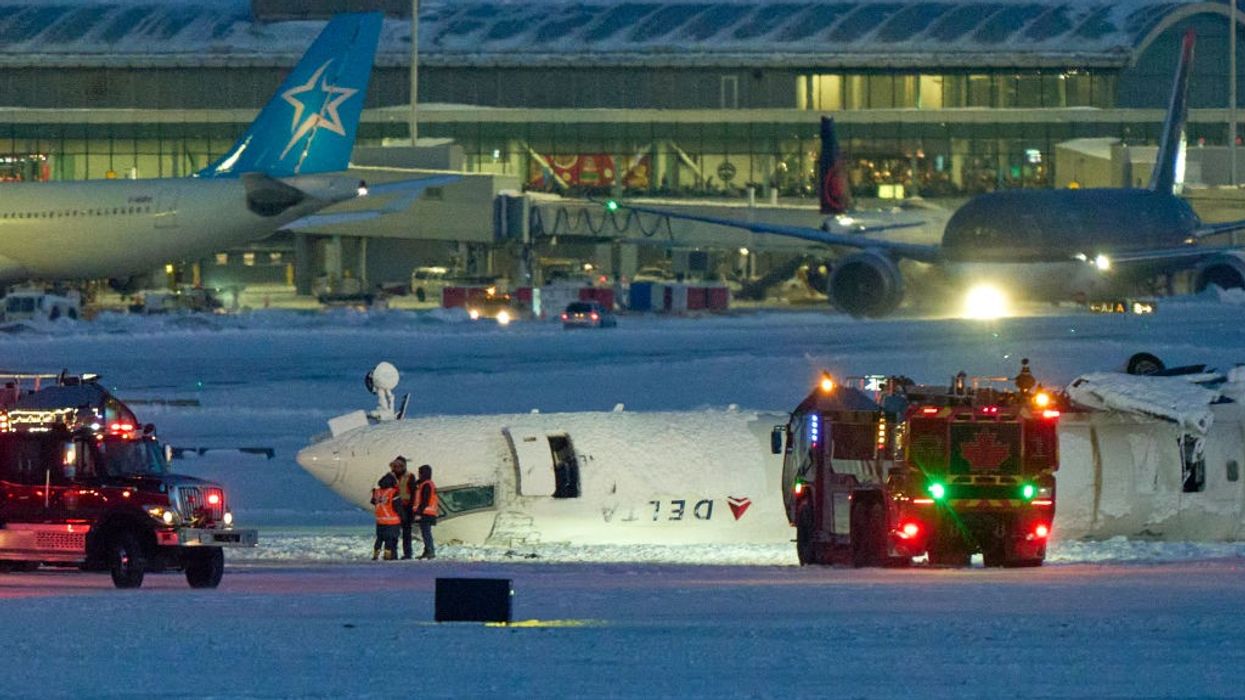
Public Citizen's warning came on the same day that a Delta Air Lines flight from Minneapolis to Toronto crashed and overturned on landing. The FAA said all 80 people aboard the flight were rescued. At least a dozen people were injured in the crash, three of them critically, according to the Toronto Star.
While the FAA firings were not a factor in Monday's accident, the Toronto crash was the latest in a recent surge in air disasters. Last month, 67 people were killed when an American Airlines jet and an army helicopter collided at Ronald Reagan Washington National Airport in Washington, D.C. According to initial reports, only one air traffic controller was working both civilian and military flights when the crash occurred.
On January 31, seven people died when a medical transport jet crashed near Philadelphia, 10 people were killed in a February 6 Bering Air commuter flight crash in Alaska, and one person died when a private plane belonging to Mötley Crüe singer Vince Neil crashed during landing in Arizona last Monday after its landing gear failed to properly deploy.
We condemn the decision to fire these safety inspectors. Everywhere I go I am asked, “is it safe to fly?” My response is yes because thousands of frontline workers ask that all day long. If federal workers can’t do their jobs, we can’t do ours. 1/2 www.passnational.org/index.php/ne...
[image or embed]
— Sara Nelson (@flyingwithsara.bsky.social) February 15, 2025 at 1:59 PM
David Spero, national president of Professional Aviation Safety Specialists, the union representing more than 11,000 FAA and Defense Department personnel who install, inspect, and maintain air traffic control systems, said in a statement Saturday that the Trump administration's terminations "will increase the workload and place new responsibilities on a workforce that is already stretched thin."
"This decision did not consider the staffing needs of the FAA, which is already challenged by understaffing," Spero added. "Staffing decisions should be based on an individual agency's mission-critical needs. To do otherwise is dangerous when it comes to public safety. And it is especially unconscionable in the aftermath of three deadly aircraft accidents in the past month."
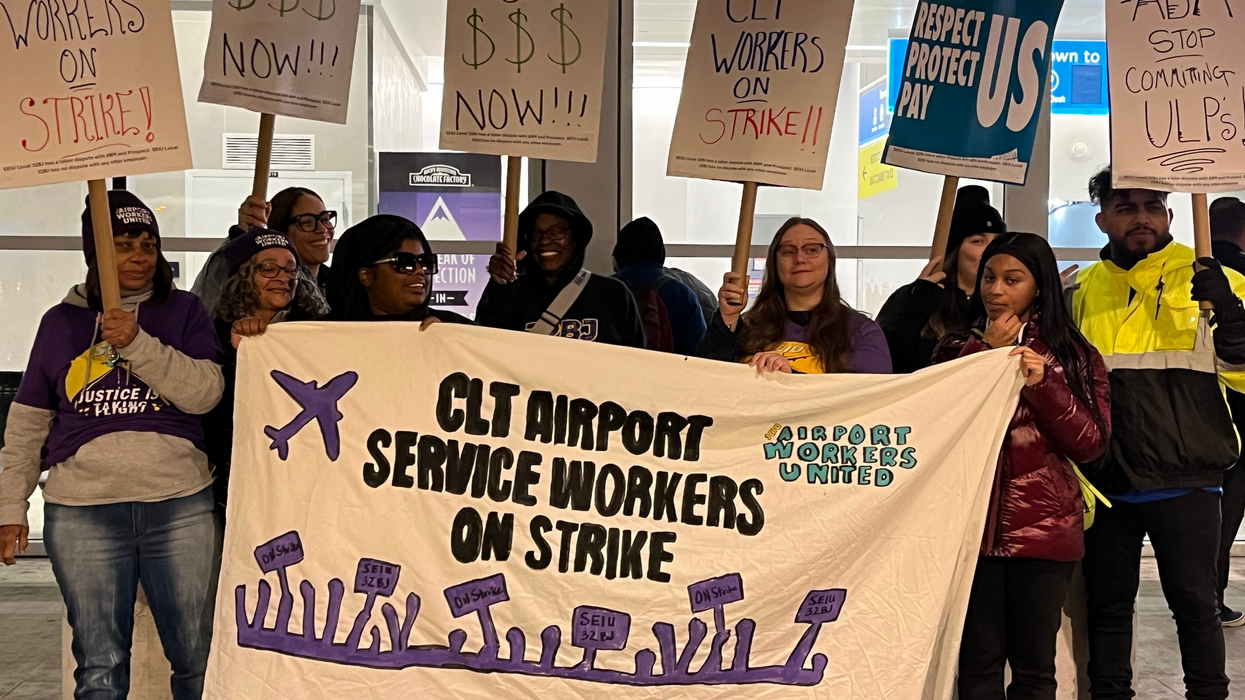
"We're on strike today because this is our last resort. We can't keep living like this," one cabin cleaner said.
Service workers at Charlotte Douglas International Airport walked off the job Monday in order to protest low wages and unfair labor practices.
The employees work for two American Airlines subcontractors, ABM and Prospect Airport Services, and carry out essential tasks like cleaning airplane interiors, collecting trash, and escorting passengers who are in wheelchairs. They voted to authorize a 24-hour strike this past Friday.
The workers are represented by Service Employees International Union (SEIU), which released a statement Monday announcing the strike and saying that the employees are demanding "an end to poverty wages and respect on the job during the holiday travel season," according to WCCB Charlotte. SEIU represents about 700 workers at CLT, a spokesman told the The Charlotte Ledger Monday.
In addition to a late-morning rally, the workers plan to hold a "Strikesgiving" lunch "in place of the Thanksgiving meal that many of the workers won't be able to afford later this week," union officials said. WCNC Charlotte showed workers picketing early Monday morning with signs that read "Poverty Doesn't Fly" and "Respect Black and Brown Workers."
The strike could be disruptive, given that the Charlotte airport estimates that it will process upwards of a million passengers between this past Thursday and the Monday following Thanksgiving.
In a statement sent around to press, the union said that most workers earn between $12.50 and $19 and hour, which they called insufficient.
According to the Massachusetts Institute of Technology's Living Wage Calculator, a living wage in the Charlotte metropolitan area is $23.26 an hour for one adult with no children.
"We're on strike today because this is our last resort. We can't keep living like this," ABM cabin cleaner Priscilla Hoyle said in a statement, according to CBS News. "We're taking action because our families can't survive."
Workers picketed on Friday to draw attention to their labor action. At the picket, one worker told local news that he's currently living in a storage unit, and that his current wage isn't enough to get a one- or two-bedroom apartment.

"We are not alone," said the Association of Professional Flight Attendants. "Our struggle is part of a larger struggle by working people standing up against corporate greed."
The nationwide U.S. strike wave that has seen hundreds of thousands of autoworkers, screenwriters, actors, hotel workers, baristas, and others walk off the job to win better wages and benefits could soon get even bigger, as tens of thousands of flight attendants and Kaiser Permanente employees prepare to take action amid stalled contract talks.
"We are not alone," the Association of Professional Flight Attendants (APFA), which represents more than 26,000 American Airlines flight attendants, told its members in an update on contract negotiations earlier this week. "Our struggle is part of a larger struggle by working people standing up against corporate greed. Autoworkers are on strike against the Big Three, as are actors and screenwriters."
Late last month, APFA members voted overwhelmingly to authorize a strike if management stands by a contract proposal that the union criticized as inadequate.
More than 6,500 Alaska Airlines flight attendants represented by the Association of Flight Attendants-CWA are also threatening walkouts as they push for substantial wage increases. The flight attendants have been working under the same contract since 2014.
Flight attendants with Southwest and United Airlines are also fighting for new contracts.
Meanwhile, the largest healthcare strike in U.S. history is looming as 85,000 Kaiser Permanente employees represented by the Coalition of Kaiser Permanente Unions demand a new contract that addresses understaffing and insufficient pay. Their current contract expires on September 30.
In recent weeks, Kaiser Permanente workers in Colorado, Oregon, California, and the Washington, D.C. area have voted to authorize strikes.
"We will take action if Kaiser Permanente does not come to the bargaining table to properly address our priorities—including staffing, patient care, and a consistent national wage increase to reward and retain our healthcare workers," the Office and Professional Employees International Union Local 2 said in a statement earlier this week after 98% of its members voted to authorize a strike.
Caroline Lucas, the executive director of the Coalition of Kaiser Permanente Unions, told The Washington Post that "we hope that there will be no work stoppage, that there will be no need to strike, and that we'll reach a resolution this week."
"But our workers are so burned out and so pushed to the brink that they’re ready to walk off for up to two weeks if that's what it takes to get a respectful contract," Lucas added.
Management of Kaiser Permanente—which reported roughly $3.3 billion in net income during the first half of 2023—and union negotiators are currently holding a two-day national bargaining session.
More than 50,000 Las Vegas hotel workers could also soon be joining the wave of labor action, with the Culinary and Bartenders Unions set to hold a strike authorization vote on September 26.
"The current wave of strikes isn't bad for America. It's good for America."
More than 350,000 workers have gone on strike across the U.S. this year in pursuit of higher wages, improved benefits, and better working conditions that reflect the surging profits of their employers. Recent data from the U.S. Labor Department showed that 4.1 million days of work were lost nationwide last month due to strikes—the highest monthly total in more than two decades.
Last week, nearly 13,000 autoworkers walked out at three General Motors, Ford, and Stellantis facilities as the profitable companies refused to meet the United Auto Workers' demands, which
include a 36% wage increase, an end to tiered compensation structures, and improved pension and healthcare benefits.
On Friday, the UAW is expected to announce strikes at additional locations as it ramps up pressure on the automakers, and the union's president has stressed that an all-out strike involving around 150,000 autoworkers remains an option.
With the UAW strike just beginning, it appears as if the monthslong writer and actor strike could be moving toward a conclusion.
CNBC reported that writers represented by the Writers Guild of America and Hollywood producers are "near an agreement" following a bargaining session on Wednesday.
"If a deal is not reached," the outlet noted, "the strike could last through the end of the year."
In a column for The Guardian earlier this week, former U.S. Labor Secretary Robert Reich argued that "the current wave of strikes isn't bad for America. It's good for America."
"American workers still have little to no countervailing power relative to large American corporations. Unionized workers now comprise only 6% of the private-sector workforce—down from over a third in the 1960s," Reich wrote. "Which is why the activism of the UAW, the Writers Guild, SAG-AFTRA, the Teamsters, flight attendants, Amazon warehouse workers, and Starbucks workers is so important."
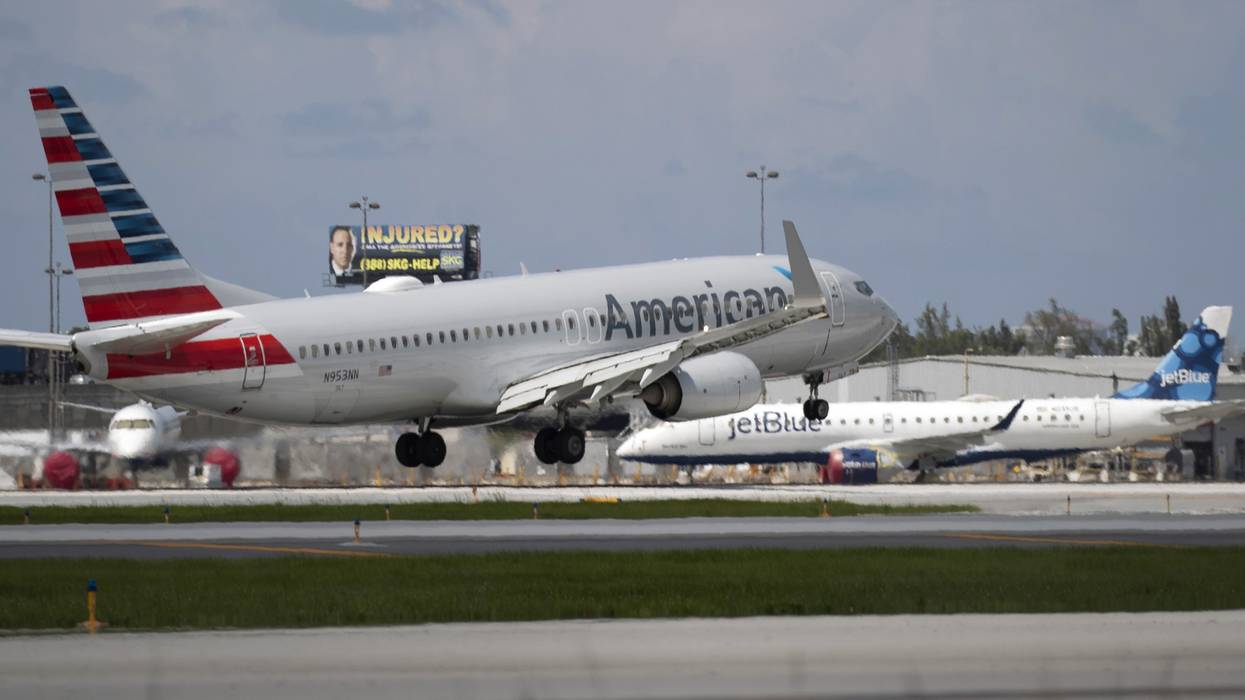
The ruling forces the airlines "to continue competing, eliminating anti-competitive revenue-sharing incentives and setting an important precedent against future consolidation in the industry," said one expert.
A Massachusetts-based federal judge on Friday sided with the Biden administration plus six states and the District of Columbia, which launched an antitrust challenge to American Airlines and JetBlue Airways' "de facto merger" for Boston and New York City.
The U.S. Department of Justice (DOJ) along with the attorneys general of Arizona, California, Florida, Massachusetts, Pennsylvania, Virginia, and D.C. filed a civil lawsuit over the airlines' Northeast Alliance (NEA) in September 2021.
"This case turns on what 'competition' means," U.S. District Court Judge Leo Sorokin, an appointee of former President Barack Obama, wrote Friday. "To the defendants, competition is enhanced if they join forces to unseat a powerful rival. The Sherman Act, however, has a different focus."
"Federal antitrust law is not concerned with making individual competitors larger or more powerful. It aims to preserve the free functioning of markets and foster participation by a diverse array of competitors," the judge added. "Those principles are generally undermined, rather than promoted, by agreements among horizontal competitors to dispense with competition and cooperate instead. That is precisely what happened here."
Sorokin stressed that "American and JetBlue are two of the four largest carriers operating in New York, and two of the largest three in Boston. Delta Air Lines is the only other carrier with a large presence in Boston. Besides Delta and United Airlines, no other carrier matches or approaches in size the defendants' respective positions in New York."
After noting that the pair established the "first-of-its-kind alliance" in 2020, he explained:
This was a sea change in the relationship between two airlines that were direct and aggressive competitors with decidedly different business models and cost structures. There is no doubt that savvy executives representing both defendants earnestly believe the NEA promotes the interests of their respective shareholders and will strengthen American and JetBlue in their rivalry against Delta (and, to a lesser extent, United) in New York and Boston. It is similarly beyond dispute that the NEA involves substantial coordination by two powerful competitors in an industry that, on a domestic level, is closely regulated, highly concentrated, and often volatile.
Reuters reported that after Sorokin ordered the end of the alliance within 30 days, "JetBlue shares fell 1.8% for the day, while American closed down 1.5%," and both airlines said "they were evaluating their next steps."
Meanwhile, the DOJ, its state partners, and other critics of consolidation celebrated the initial court victory.
"Today's decision is a win for Americans who rely on competition between airlines to travel affordably," said Attorney General Merrick Garland in a statement. "The Justice Department will continue to protect competition and enforce our antitrust laws in the heavily consolidated airline industry and across every industry."
American Economic Liberties Project senior fellow for aviation and travel William McGee agreed that the DOJ Antitrust Division's successful challenge of the NEA "is a win for passengers and the public."
"Blocking this de facto merger forces JetBlue and American to continue competing, eliminating anti-competitive revenue-sharing incentives and setting an important precedent against future consolidation in the industry," McGee said. "We hope to see a similar ruling in favor of the Justice Department's suit against the JetBlue-Spirit merger, another illegal deal that would accelerate concentration and drive up fares nationwide."
As Common Dreams reported in March, the DOJ joined with the attorneys general of Massachusetts, New York, and D.C. to file a civil suit against the JetBlue-Spirit merger, arguing that "by eliminating that competition and further consolidating the United States airlines industry, the proposed transaction will increase fares and reduce choice on routes across the country, raising costs for the flying public and harming cost-conscious fliers most acutely."
McGee said at the time that by "blocking this blatantly anti-competitive deal, the Department of Justice is standing up for passengers, workers, and communities across the country."
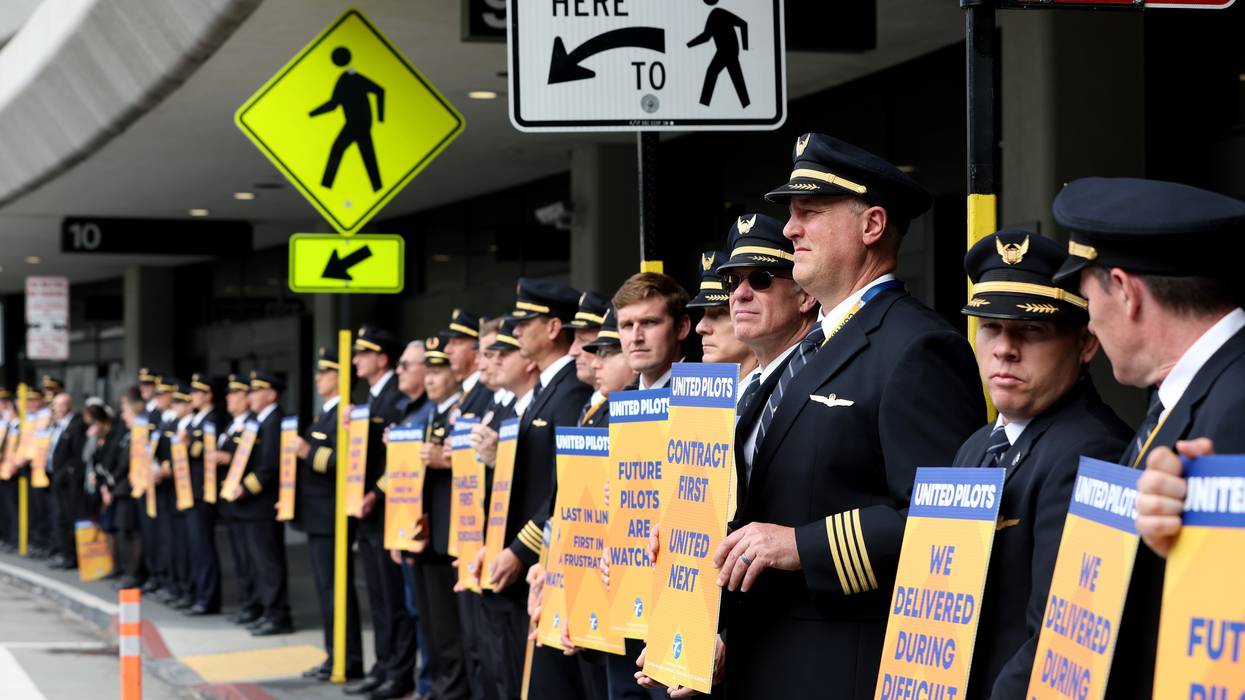
On the heels of strike-authorization votes by American and Southwest pilots, United pilots protested at airports across the U.S. on Friday to tell management that "enough is enough."
Following what the Air Line Pilots Association called "more than four years of empty promises," 3,000 off-duty United Airlines pilots represented by the union protested at major airports across the U.S. on Friday, demanding the finalization of a contract with higher pay and humane scheduling practices.
"Thousands of United pilots are picketing coast-to-coast today to deliver management a message they cannot ignore: Enough is enough," Capt. Garth Thompson, chair of the United ALPA master executive council, said in a statement.
"United management needs to stop slow-rolling negotiations... and do the right thing for their pilots."
"We have been stuck with an antiquated scheduling system and a contract nowhere near industry-leading standards," said Thompson. "We want United to succeed as industry leaders, and every day that passes without an agreement is another day the best and brightest future aviators go elsewhere."
United pilots—joined by ALPA president Capt. Jason Ambrosi, fellow ALPA pilots, and union supporters—demonstrated in front of terminals at airports in 10 cities as well as outside the company's flight training center in Denver.
Association of Flight Attendants-CWA president Sara Nelson was among those who participated in an act of solidarity.
"I am proud to stand here today to send United Airlines management a message that the airline's pilots have the full backing of their international union in their fight for the contract they have earned," said Ambrosi, who leads the 69,000-member union and joined a picket line in Chicago. "United management needs to stop slow-rolling negotiations that have dragged into their fifth year and do the right thing for their pilots."
Management has failed "to recognize the value pilots bring to the overall success of the airline," ALPA said. "United pilots were there for customers during one of the worst times for travel in recent history, and they also helped United Airlines emerge from the pandemic stronger than before."
Thompson, who called Friday's nationwide informational picket a "resounding success," stressed that "United pilots will always be there for our customers."
"Unfortunately," he added, "the same cannot be said about management, who seems to think that a last-minute cancellation of a United pilot's scheduled day off, or abrupt trip reassignments that extend into planned days off, is acceptable for a United pilot's family."
"This old pilot contract impacts our ability to maintain a healthy work-life balance," Thompson continued. "United pilots will deal with this adversity in our usual professional and safe manner. We will continue to work in 2023 despite staffing shortages in Air Traffic Control facilities, aggressive summer schedules, capacity constraints, and weather." However, he noted, "United pilots want the company and the public to know that the bold 'United Next' growth plans cannot work without an updated pilot contract."
"This old pilot contract impacts our ability to maintain a healthy work-life balance."
The action by United pilots comes in the wake of a pair of successful strike-authorization votes by pilots at other airlines.
On May 1, 95% of American Airlines pilots voted to authorize a strike. (Of the airline's 15,000 pilots, 96% participated, with 99% expressing support for a possible strike).
"We will strike if necessary to secure the industry-leading contract that our pilots have earned and deserve—a contract that will position American Airlines for success," said Capt. Ed Sicher, president of the Allied Pilots Association. "Our pilots' resolve is unmistakable. We will not be deterred from our goal of an industry-leading contract."
"The strike-authorization vote is one of several steps APA has taken to prepare for any eventuality and use all legal avenues available to us for contract improvement and resolution," Sicher noted. "The best outcome is for APA and management to agree on an industry-leading contract—achieved through good-faith bargaining—benefiting our pilots, American Airlines, and the passengers we serve."
On Thursday, 97% of Southwest pilots voted to authorize a strike. (Of the airline's 10,000-plus pilots, 98% participated, with 99% expressing support for a possible strike).
"This is a historic day, not only for our pilots but for Southwest Airlines," said Capt. Casey Murray, president of the Southwest Airlines Pilots Association. "The lack of leadership and the unwillingness to address the failures of our organization have led us to this point. Our pilots are tired of apologizing to our passengers."
Murray and other union leaders have attributed Southwest's meltdown last winter to executives' yearslong refusal to invest in much-needed technological upgrades despite benefiting from billions of dollars in federal aid during the first two years of the Covid-19 pandemic.
"We want our passengers to understand that we do not take this path lightly," Murray said Thursday. "We want our customers to be prepared for the path ahead and make arrangements on other carriers so that their plans through the summer and fall are not disrupted."
United's 14,000 pilots could be next in line to vote on strike authorization.
As The Associated Press reported Saturday, "Pilots at all three carriers are looking to match or beat the deal that Delta Air Lines reached with its pilots earlier this year, which raised pay rates by 34% over four years."
"United has proposed to match the Delta increase, but that might not be enough for a deal," AP observed. Citing Thompson, the outlet noted that "discussion about wages has been held up while the two sides negotiate over scheduling, including the union’s wish to limit United's ability to make pilots work on their days off."
The nation's pilots "are unlikely to strike anytime soon, however," AP reported. "Federal law makes it very difficult for unions to conduct strikes in the airline industry, and the last walkout at a U.S. carrier was more than a decade ago."
"Under U.S. law, airline and railroad workers can't legally strike, and companies can't lock them out, until federal mediators determine that further negotiations are pointless," the outlet explained. It continued:
The National Mediation Board rarely declares a dead end to bargaining, and even if it does, there is a no-strikes "cooling-off" period during which the White House and Congress can block a walkout. That's what President Bill Clinton did minutes after pilots began striking against American in 1997. In December, President Joe Biden signed a bill that Congress passed to impose contract terms on freight railroad workers, ending a strike threat.
Regardless of the legal hurdles to a walkout, unions believe that strike votes give them leverage during bargaining, and they have become more common. A shortage of pilots is also putting those unions in particularly strong bargaining position.
Although Congress is highly unlikely to permit an airline strike, disgruntled pilots could still cause disruption through "work to rule," Arthur Wheaton, director of labor studies at Cornell University, told AP.
"They could say, 'We're not working any overtime,'" said Wheaton. "I don't anticipate the pilots trying to screw up travel for everybody intentionally, but bargaining is about leverage and power... having the ability to do that can be a negotiating tactic."