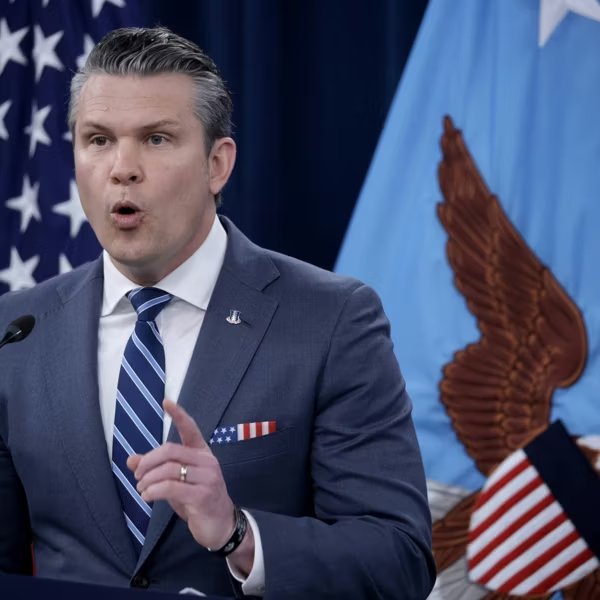
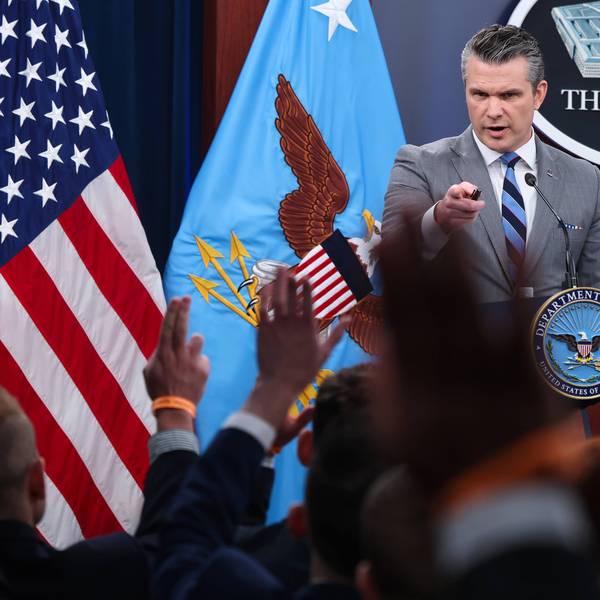
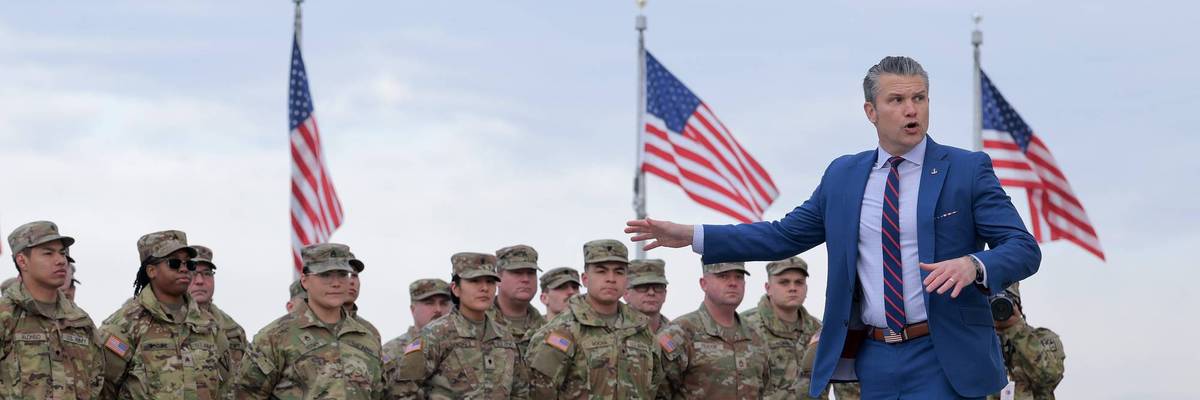
US Secretary of War Pete Hegseth addresses a group of National Guard troops before conducting their re-enlistment ceremony at the base of the Washington Monument on February 06, 2026 in Washington, DC.
(Photo by Chip Somodevilla/Getty Images)
Violence Is the USA's True God and Pete Hegseth Is High Priest
How can it be that the hell of war is so fully a part of the American identity, preparation for which consumes half the national budget every year?
Apr 30, 2026
Perhaps theologian Walter Wink can help us understand Pete Hegseth, America’s self-declared “secretary of war” and spokesman, for God’s sake... for God. At a recent prayer service at the Department of Defense, for instance, Hegseth, after calling the Iranians “barbaric savages” who deserve no mercy, called on the citizens of his country to pray for victory “in the name of Jesus Christ.”
Love thy neighbor, folks! Earlier he had boasted that the American bombing campaign had “unleashed twice the firepower in its first five days as the initial ‘shock and awe’ bombing phase of the Iraq War in 2003.” You might recall, of course, that this campaign included the devastation of a school in Minab, which killed—murdered—around 170 people, including over 100 children. God bless America.
Wink, in his book The Powers That Be, discusses what he calls “the myth of redemptive violence”—the belief that violence saves us. Indeed, “It doesn’t seem to be mythic in the least,” he writes. “Violence simply appears to be in the nature of things. It’s what works. It seems inevitable, the last and, often, the first resort in conflicts. If a god is what you turn to when all else fails, violence certainly functions as a god.”
And when we use it, that’s God with an uppercase G. Just ask Hegseth. All of which leaves me emotionally shredded, as I think about the country, the world, the future. How can it be that the hell of war is so fully a part of the American identity, preparation for which consumes half the national budget every year? How can it be that the waging of war—the consequences of war—so easily morphs into an abstraction, at least over here where the bombs aren’t falling, and most discussions of it (not counting the fervor of the anti-war protesters) focus on strategic and political rather than moral issues? Just check out the media.
Unlike dead schoolchildren, harm to Vance’s political future can’t be written off as collateral damage, apparently.
Here, for instance, are some fragments of a recent article in The Atlantic, which, while it was hardly gung ho about the Iran war, oozed, you might say, an abstract neutrality about it—and about all the wars we have to be ready to wage in the future. Worry NO. 1 the article addressed concerned how many American weapons were being used up:
Vice President Vance “has also expressed his concerns about the availability of certain missile systems in discussions with President Trump, several people familiar with the situation told us. The consequences of a dramatic drawdown in munitions reserves are potentially dire: US forces would need to draw from these same stockpiles to defend Taiwan against China, South Korea against North Korea, and Europe against Russia.”
The unquestioned assumption is that war is inevitable—ho hum. No larger questioning occurs, no mention of the looming environmental disaster these coming wars will inflict on the planet. Just an academic shrug. A few paragraphs later:
Pentagon leaders’ positive portrayals present an incomplete picture at best, people familiar with intelligence assessments told us. According to those internal estimates, Iran retains two-thirds of its air force, the bulk of its missile-launching capability, and most of its small, fast boats, which can lay mines and harass traffic in the Strait of Hormuz. At least in terms of resuming stalled maritime commerce, "those are the real threat," one person told us.
The world being presented to the reader seems like a video game. At least that’s the case in this article, which detaches war from any mention of blood and destruction, any mention of schoolchildren lying dead beneath collapsed infrastructure as loved ones dig for their bodies. I’m not saying strategic data doesn’t belong in war reporting, just that if it’s not part of the larger context of the moral realities of war, it turns hell into nothing more than an abstraction. This is the role the mainstream media has long claimed for itself.
But some people are affected by the war, we learn:
The vice president was skeptical about the merits of attacking Iran before the war started; Trump has acknowledged that Vance was "maybe less enthusiastic" about a conflict that has proved deeply unpopular among American voters. But the vice president has multiple factors to balance: his desire to work smoothly with other senior officials, his track record of opposing "forever wars," and his prospects should he mount a presidential run in 2028.
Vance and Hegseth both have a major stake in the war’s outcome... Several people close to Trump believe Vance now sees his political future as tied to what happens in Iran.
Unlike dead schoolchildren, harm to Vance’s political future can’t be written off as collateral damage, apparently.
And the myth of redemptive violence marches on.
Urgent. It's never been this bad.
Dear Common Dreams reader, It’s been nearly 30 years since I co-founded Common Dreams with my late wife, Lina Newhouser. We had the radical notion that journalism should serve the public good, not corporate profits. It was clear to us from the outset what it would take to build such a project. No paid advertisements. No corporate sponsors. No millionaire publisher telling us what to think or do. Many people said we wouldn't last a year, but we proved those doubters wrong. Together with a tremendous team of journalists and dedicated staff, we built an independent media outlet free from the constraints of profits and corporate control. Our mission from the outset was simple. To inform. To inspire. To ignite change for the common good. Building Common Dreams was not easy. Our survival was never guaranteed. When you take on the most powerful forces—Wall Street greed, fossil fuel industry destruction, Big Tech lobbyists, and uber-rich oligarchs who have spent billions upon billions rigging the economy and democracy in their favor—the only bulwark you have is supporters who believe in your work. But here’s the urgent message from me today. It’s never been this bad out there. And it’s never been this hard to keep us going. At the very moment Common Dreams is most needed and doing some of its best and most important work, the threats we face are intensifying. Right now, with just two days to go in our Spring Campaign, we're falling short of our make-or-break goal. When everyone does the little they can afford, we are strong. But if that support retreats or dries up, so do we. Can you make a gift right now to make sure Common Dreams not only survives but thrives? There is no backup plan or rainy day fund. There is only you. —Craig Brown, Co-founder |
Our work is licensed under Creative Commons (CC BY-NC-ND 3.0). Feel free to republish and share widely.
Robert Koehler is an award-winning, Chicago-based journalist and nationally syndicated writer. Koehler has been the recipient of multiple awards for writing and journalism from organizations including the National Newspaper Association, Suburban Newspapers of America, and the Chicago Headline Club. He's a regular contributor to such high-profile websites as Common Dreams and the Huffington Post. Eschewing political labels, Koehler considers himself a "peace journalist. He has been an editor at Tribune Media Services and a reporter, columnist and copy desk chief at Lerner Newspapers, a chain of neighborhood and suburban newspapers in the Chicago area. Koehler launched his column in 1999. Born in Detroit and raised in suburban Dearborn, Koehler has lived in Chicago since 1976. He earned a master's degree in creative writing from Columbia College and has taught writing at both the college and high school levels. Koehler is a widower and single parent. He explores both conditions at great depth in his writing. His book, "Courage Grows Strong at the Wound" (2016). Contact him or visit his website at commonwonders.com.
Perhaps theologian Walter Wink can help us understand Pete Hegseth, America’s self-declared “secretary of war” and spokesman, for God’s sake... for God. At a recent prayer service at the Department of Defense, for instance, Hegseth, after calling the Iranians “barbaric savages” who deserve no mercy, called on the citizens of his country to pray for victory “in the name of Jesus Christ.”
Love thy neighbor, folks! Earlier he had boasted that the American bombing campaign had “unleashed twice the firepower in its first five days as the initial ‘shock and awe’ bombing phase of the Iraq War in 2003.” You might recall, of course, that this campaign included the devastation of a school in Minab, which killed—murdered—around 170 people, including over 100 children. God bless America.
Wink, in his book The Powers That Be, discusses what he calls “the myth of redemptive violence”—the belief that violence saves us. Indeed, “It doesn’t seem to be mythic in the least,” he writes. “Violence simply appears to be in the nature of things. It’s what works. It seems inevitable, the last and, often, the first resort in conflicts. If a god is what you turn to when all else fails, violence certainly functions as a god.”
And when we use it, that’s God with an uppercase G. Just ask Hegseth. All of which leaves me emotionally shredded, as I think about the country, the world, the future. How can it be that the hell of war is so fully a part of the American identity, preparation for which consumes half the national budget every year? How can it be that the waging of war—the consequences of war—so easily morphs into an abstraction, at least over here where the bombs aren’t falling, and most discussions of it (not counting the fervor of the anti-war protesters) focus on strategic and political rather than moral issues? Just check out the media.
Unlike dead schoolchildren, harm to Vance’s political future can’t be written off as collateral damage, apparently.
Here, for instance, are some fragments of a recent article in The Atlantic, which, while it was hardly gung ho about the Iran war, oozed, you might say, an abstract neutrality about it—and about all the wars we have to be ready to wage in the future. Worry NO. 1 the article addressed concerned how many American weapons were being used up:
Vice President Vance “has also expressed his concerns about the availability of certain missile systems in discussions with President Trump, several people familiar with the situation told us. The consequences of a dramatic drawdown in munitions reserves are potentially dire: US forces would need to draw from these same stockpiles to defend Taiwan against China, South Korea against North Korea, and Europe against Russia.”
The unquestioned assumption is that war is inevitable—ho hum. No larger questioning occurs, no mention of the looming environmental disaster these coming wars will inflict on the planet. Just an academic shrug. A few paragraphs later:
Pentagon leaders’ positive portrayals present an incomplete picture at best, people familiar with intelligence assessments told us. According to those internal estimates, Iran retains two-thirds of its air force, the bulk of its missile-launching capability, and most of its small, fast boats, which can lay mines and harass traffic in the Strait of Hormuz. At least in terms of resuming stalled maritime commerce, "those are the real threat," one person told us.
The world being presented to the reader seems like a video game. At least that’s the case in this article, which detaches war from any mention of blood and destruction, any mention of schoolchildren lying dead beneath collapsed infrastructure as loved ones dig for their bodies. I’m not saying strategic data doesn’t belong in war reporting, just that if it’s not part of the larger context of the moral realities of war, it turns hell into nothing more than an abstraction. This is the role the mainstream media has long claimed for itself.
But some people are affected by the war, we learn:
The vice president was skeptical about the merits of attacking Iran before the war started; Trump has acknowledged that Vance was "maybe less enthusiastic" about a conflict that has proved deeply unpopular among American voters. But the vice president has multiple factors to balance: his desire to work smoothly with other senior officials, his track record of opposing "forever wars," and his prospects should he mount a presidential run in 2028.
Vance and Hegseth both have a major stake in the war’s outcome... Several people close to Trump believe Vance now sees his political future as tied to what happens in Iran.
Unlike dead schoolchildren, harm to Vance’s political future can’t be written off as collateral damage, apparently.
And the myth of redemptive violence marches on.
From Your Site Articles
- The US's Inalienable Right to Violence ›
- Reclaiming God from Empire: Nonviolence in an Age of Religious Nationalism ›
- The Myth of Redemptive Violence ›
- Assassination Attempt No. 2 in a Land That Worships the God of Violence ›
- Our Journey Beyond the God of Violence ›
- In the US, Violence Has Always Been the Answer ›
Robert Koehler is an award-winning, Chicago-based journalist and nationally syndicated writer. Koehler has been the recipient of multiple awards for writing and journalism from organizations including the National Newspaper Association, Suburban Newspapers of America, and the Chicago Headline Club. He's a regular contributor to such high-profile websites as Common Dreams and the Huffington Post. Eschewing political labels, Koehler considers himself a "peace journalist. He has been an editor at Tribune Media Services and a reporter, columnist and copy desk chief at Lerner Newspapers, a chain of neighborhood and suburban newspapers in the Chicago area. Koehler launched his column in 1999. Born in Detroit and raised in suburban Dearborn, Koehler has lived in Chicago since 1976. He earned a master's degree in creative writing from Columbia College and has taught writing at both the college and high school levels. Koehler is a widower and single parent. He explores both conditions at great depth in his writing. His book, "Courage Grows Strong at the Wound" (2016). Contact him or visit his website at commonwonders.com.
Perhaps theologian Walter Wink can help us understand Pete Hegseth, America’s self-declared “secretary of war” and spokesman, for God’s sake... for God. At a recent prayer service at the Department of Defense, for instance, Hegseth, after calling the Iranians “barbaric savages” who deserve no mercy, called on the citizens of his country to pray for victory “in the name of Jesus Christ.”
Love thy neighbor, folks! Earlier he had boasted that the American bombing campaign had “unleashed twice the firepower in its first five days as the initial ‘shock and awe’ bombing phase of the Iraq War in 2003.” You might recall, of course, that this campaign included the devastation of a school in Minab, which killed—murdered—around 170 people, including over 100 children. God bless America.
Wink, in his book The Powers That Be, discusses what he calls “the myth of redemptive violence”—the belief that violence saves us. Indeed, “It doesn’t seem to be mythic in the least,” he writes. “Violence simply appears to be in the nature of things. It’s what works. It seems inevitable, the last and, often, the first resort in conflicts. If a god is what you turn to when all else fails, violence certainly functions as a god.”
And when we use it, that’s God with an uppercase G. Just ask Hegseth. All of which leaves me emotionally shredded, as I think about the country, the world, the future. How can it be that the hell of war is so fully a part of the American identity, preparation for which consumes half the national budget every year? How can it be that the waging of war—the consequences of war—so easily morphs into an abstraction, at least over here where the bombs aren’t falling, and most discussions of it (not counting the fervor of the anti-war protesters) focus on strategic and political rather than moral issues? Just check out the media.
Unlike dead schoolchildren, harm to Vance’s political future can’t be written off as collateral damage, apparently.
Here, for instance, are some fragments of a recent article in The Atlantic, which, while it was hardly gung ho about the Iran war, oozed, you might say, an abstract neutrality about it—and about all the wars we have to be ready to wage in the future. Worry NO. 1 the article addressed concerned how many American weapons were being used up:
Vice President Vance “has also expressed his concerns about the availability of certain missile systems in discussions with President Trump, several people familiar with the situation told us. The consequences of a dramatic drawdown in munitions reserves are potentially dire: US forces would need to draw from these same stockpiles to defend Taiwan against China, South Korea against North Korea, and Europe against Russia.”
The unquestioned assumption is that war is inevitable—ho hum. No larger questioning occurs, no mention of the looming environmental disaster these coming wars will inflict on the planet. Just an academic shrug. A few paragraphs later:
Pentagon leaders’ positive portrayals present an incomplete picture at best, people familiar with intelligence assessments told us. According to those internal estimates, Iran retains two-thirds of its air force, the bulk of its missile-launching capability, and most of its small, fast boats, which can lay mines and harass traffic in the Strait of Hormuz. At least in terms of resuming stalled maritime commerce, "those are the real threat," one person told us.
The world being presented to the reader seems like a video game. At least that’s the case in this article, which detaches war from any mention of blood and destruction, any mention of schoolchildren lying dead beneath collapsed infrastructure as loved ones dig for their bodies. I’m not saying strategic data doesn’t belong in war reporting, just that if it’s not part of the larger context of the moral realities of war, it turns hell into nothing more than an abstraction. This is the role the mainstream media has long claimed for itself.
But some people are affected by the war, we learn:
The vice president was skeptical about the merits of attacking Iran before the war started; Trump has acknowledged that Vance was "maybe less enthusiastic" about a conflict that has proved deeply unpopular among American voters. But the vice president has multiple factors to balance: his desire to work smoothly with other senior officials, his track record of opposing "forever wars," and his prospects should he mount a presidential run in 2028.
Vance and Hegseth both have a major stake in the war’s outcome... Several people close to Trump believe Vance now sees his political future as tied to what happens in Iran.
Unlike dead schoolchildren, harm to Vance’s political future can’t be written off as collateral damage, apparently.
And the myth of redemptive violence marches on.
From Your Site Articles
- The US's Inalienable Right to Violence ›
- Reclaiming God from Empire: Nonviolence in an Age of Religious Nationalism ›
- The Myth of Redemptive Violence ›
- Assassination Attempt No. 2 in a Land That Worships the God of Violence ›
- Our Journey Beyond the God of Violence ›
- In the US, Violence Has Always Been the Answer ›
We've had enough. The 1% own and operate the corporate media. They are doing everything they can to defend the status quo, squash dissent and protect the wealthy and the powerful. The Common Dreams media model is different. We cover the news that matters to the 99%. Our mission? To inform. To inspire. To ignite change for the common good. How? Nonprofit. Independent. Reader-supported. Free to read. Free to republish. Free to share. With no advertising. No paywalls. No selling of your data. Thousands of small donations fund our newsroom and allow us to continue publishing. Can you chip in? We can't do it without you. Thank you.