SUBSCRIBE TO OUR FREE NEWSLETTER
Daily news & progressive opinion—funded by the people, not the corporations—delivered straight to your inbox.
5
#000000
#FFFFFF
To donate by check, phone, or other method, see our More Ways to Give page.
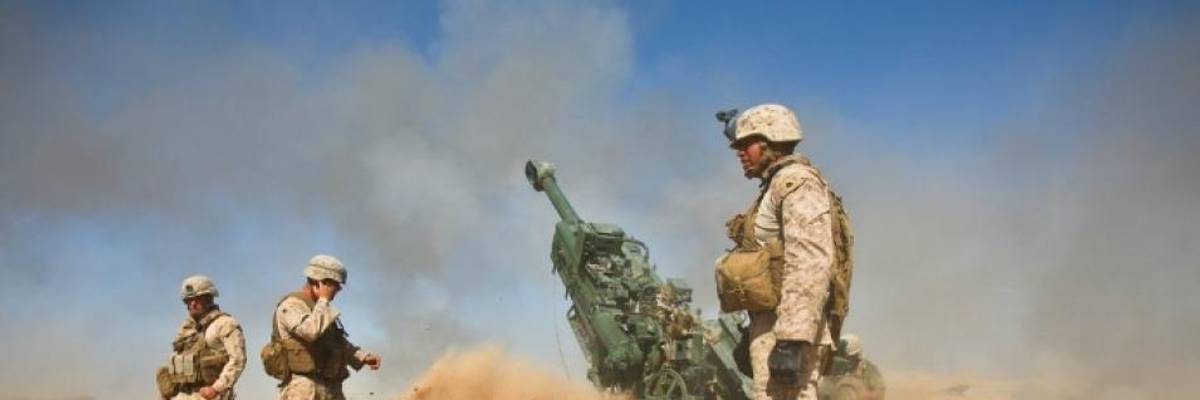
Even when critical of US actions, media commentary on recent US bombings and assassinations in the Middle East is premised on the assumption that the US has the right to use violence (or the threat of it) to assert its will, anytime, anywhere. Conversely, corporate media coverage suggests that any countermeasure--such as resistance to the US presence in Iraq--is inherently illegitimate, criminal and/or terroristic.
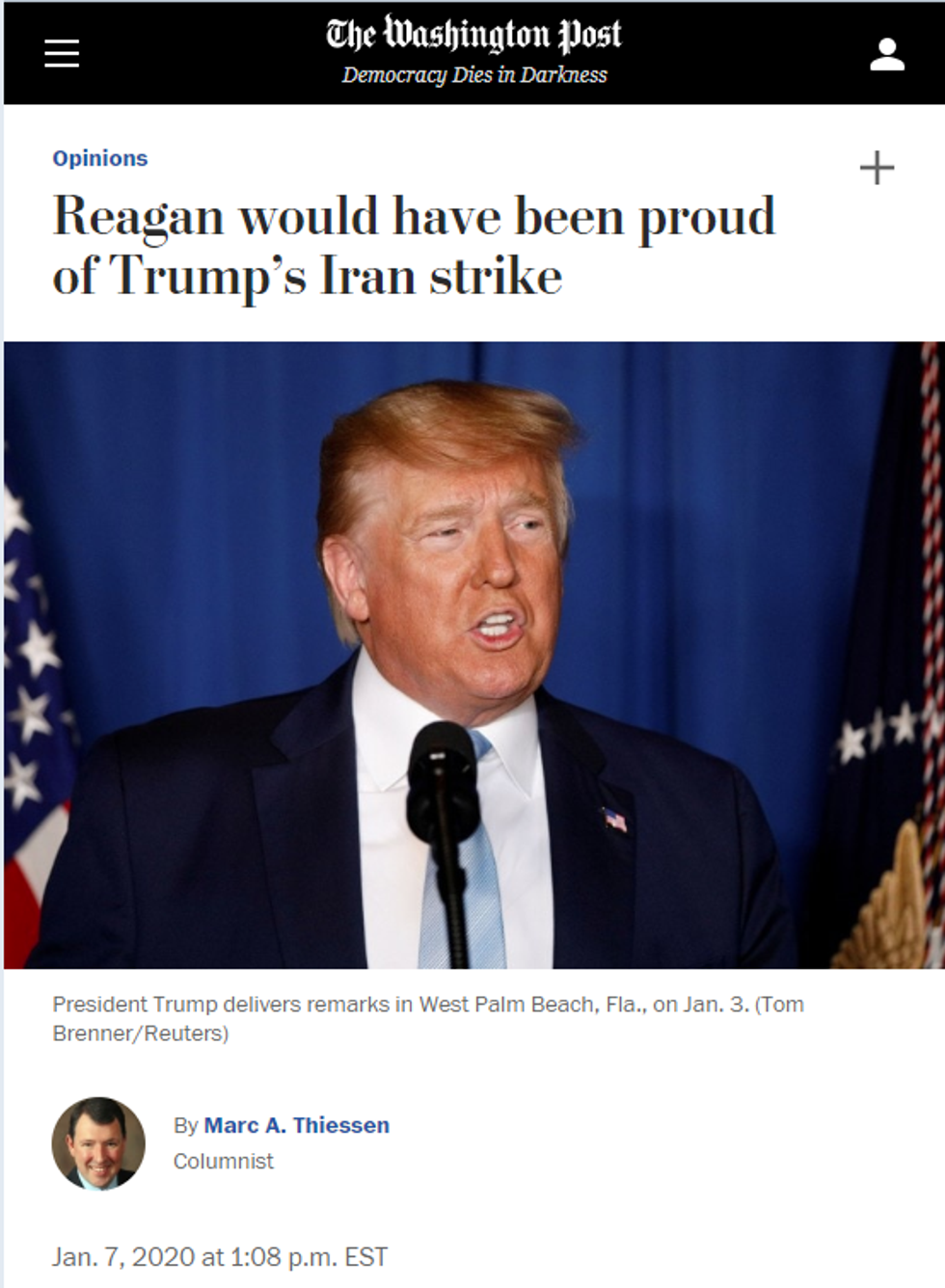
One step in this dance is depicting US military forces in Iraq as innocent bystanders under attack by sadistic Iranian puppetmasters. Media analysis of the US murder of Iranian Gen. Qassem Soleimani consistently asserted that he was "an architect of international terrorism responsible for the deaths of hundreds of Americans" (New York Times, 1/3/20) or "a terrorist with the blood of hundreds of Americans on his hands" (Washington Post, 1/7/20). According to Leon Panetta (Washington Post, 1/7/20), a former Defense secretary and CIA director,
The death of Soleimani should not be mourned, given his responsibility for the killing of thousands of innocent people and hundreds of US military personnel over the years.
There is little evidence for this contention that Iran in general or Soleimani personally is responsible for killing hundreds of Americans. When the State Department claimed last April that Iran was responsible for the deaths of 608 American servicemembers in Iraq between 2003 and 2011, investigative journalist Gareth Porter (Truthout, 7/9/19) asked Navy Commander Sean Robertson for evidence, and Robertson "acknowledged that the Pentagon doesn't have any study, documentation or data to provide journalists that would support such a figure."
Porter showed that the US attribution of deaths in Iraq to Iran is an unsubstantiated government talking point from the Cheney era, one that was exposed at the time when Lt. Gen. Ray Odierno admitted that, though the US had attributed Iraqi resistance fighters' weapons to Iran, US troops found many sites in Iraq at which such weapons were being manufactured.
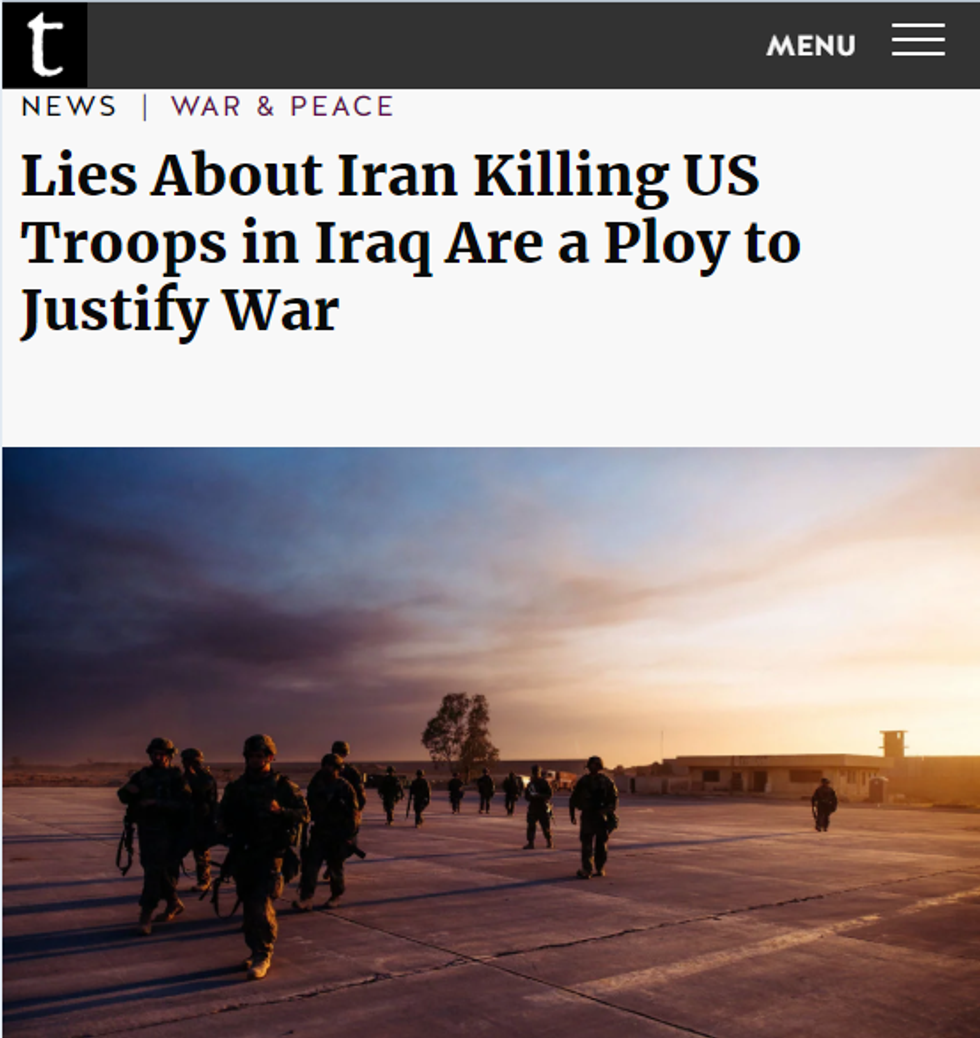
Scholar Stephen Zunes (Progressive, 1/7/20) similarly demonstrated the lack of evidence for the idea that Iran is behind the killing of US forces in Iraq. Zunes noted that the National Intelligence Estimate on Iraq, compiled by America's 16 intelligence agencies, downplayed Iran's role in Iraq's violence at roughly the same time that the Bush administration was saying that Iran was culpable.
As Porter pointed out, there was a much simpler explanation for American deaths in the period: The US targeted Muqtada al-Sadr's Mahdi Army and the Mahdi Army fought back, imposing more casualties on US troops.
That the pundits dusted off 13-year-old propaganda to rationalize killing Soleimani is a clear indication that they were desperately grasping for any imperialist apologia within reach. If the American public is led to believe that Soleimani killed hundreds of Americans, large swathes of it are likely to regard his assassination as justified, necessary, or at worst a feature of the tit-for-tat ugliness inherent to war.
The narrative also ideologically shores up the US war on Iran in the American popular consciousness by presenting Iranians as primordially violent savages out to spill the blood of Americans, notably those in the military who are in the Middle East, presumably doing nothing but minding their own business. Presenting Iran as the reason for attacks on US forces in Iraq also implies that Iraqis had little objection to the US invasion, legitimizing the US's ongoing military presence in the country. The most obvious point about the deaths of US soldiers in Iraq is that they wouldn't happen if US soldiers weren't in Iraq.
Another media dance move is to condemn anti-imperial violence while naturalizing imperialist violence. An editorial in the New York Times (1/3/20) said that Soleimani
no doubt had a role in the campaign of provocations by Shiite militias against American forces in Iraq that recently led to the death of an American defense contractor and a retaliatory American airstrike against the militia responsible for the attack.
Having US troops in Iraq, a country in which the US is responsible for the deaths of hundreds of thousands, is not a "provocation," in the Times' perspective; opposition to their presence is the provocation.
The December 27 attack that killed the US contractor did not occur in a vacuum. In 2018, the US was suspected of bombing affiliates of Kataib Hezbollah, the group the US blames for killing the contractor. Israel is suspected of carrying out a string of deadly bombings of the Iraqi Popular Mobilization Forces, of which Kataib Hezbollah is a key component, between July and September, a scenario at which Israeli Prime Minister Benjamin Netanyahu hinted.
The US reportedly confirmed that Israel was behind at least one of the bombings, and said it supports Israel's actions while denying direct participation. In any case, the US's lavish military support for Israel means that the former is effectively a party to the latter's bombing. Thus, the Kataib Hezbollah attack that killed the contractor can be seen as "retaliatory," which complicates the notion that the subsequent US attack was as well.
Another Times editorial (1/4/20) describes Soleimani as "one of the region's most powerful and, yes, blood-soaked military commanders." At no point is Trump or any other US leader described as "blood-soaked" or anything comparable--here, or in any of the mainstream media coverage I can find--even as he and his predecessors are sopping with that of Afghans, Iraqis, Libyans and Syrians, to cite only a few recent cases. Evidently imperial violence is so righteous it leaves no trace behind.
Stephen Hadley, national security adviser in the George W Bush administration, wrote in the Washington Post (1/5/20):
What is clear is that one of the PMFs, Kataib Hezbollah, has been behind the escalating violence over the past several months as part of a campaign (assuredly with Iranian approval) to force out US troops. The campaign culminated in the December 31 attack on the US Embassy in Baghdad. (The head of Kataib Hezbollah, Abu Mahdi al-Muhandis, was killed with Soleimani.)
By expelling US forces, the Iraqi government would be falling into Kataib Hezbollah's trap: rewarding the militia's violent campaign, strengthening the Iranian-backed PMFs, weakening the Iraqi government and state sovereignty, and jeopardizing the fight against the Islamic State.
Kataib Hezbollah's actions are called "violence" twice in these three sentences, with their apex apparently being "the December 31 attack on the US Embassy in Baghdad." Remarkably, the author makes no mention of the December 29 US airstrikes on five sites in Iraq and Syria that the US says belong to Kataib Hezbollah, bombings that reportedly killed 25 and injured 55. Those, it would seem, do not constitute "violence." Iraqis damaging the embassy of the country whose economic sanctions killed half a million Iraqi children is "violence," but the US's lethal air raids are not. And expelling foreign armies weakens state sovereignty!
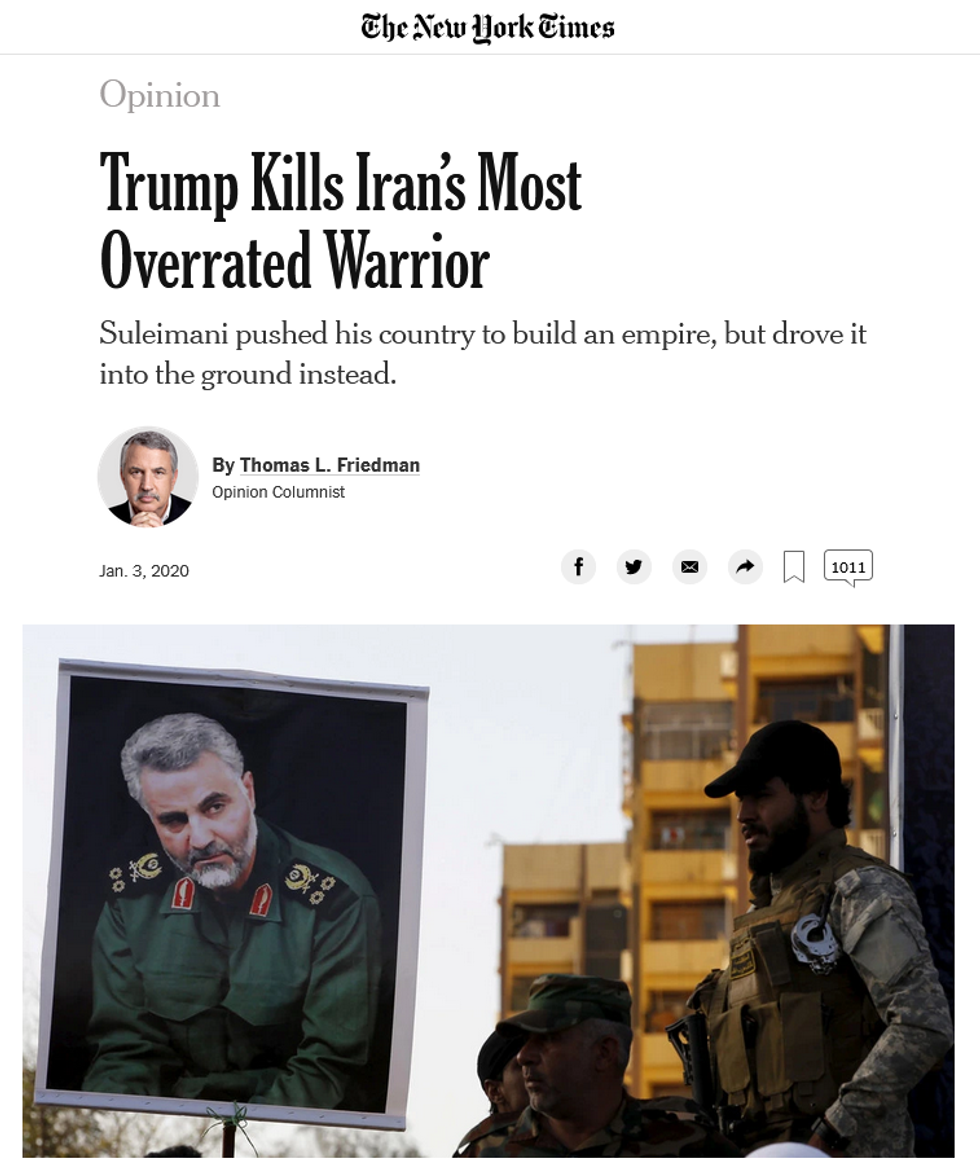
Thomas Friedman's Times article (1/3/20) on Soleimani's murder was bad even by Thomas Friedman standards. He dismissed the protests at the US embassy:
The whole "protest" against the United States Embassy compound in Baghdad last week was almost certainly a Soleimani-staged operation to make it look as if Iraqis wanted America out when in fact it was the other way around. The protesters were paid pro-Iranian militiamen. No one in Baghdad was fooled by this.
In a way, it's what got Soleimani killed. He so wanted to cover his failures in Iraq he decided to start provoking the Americans there by shelling their forces, hoping they would overreact, kill Iraqis and turn them against the United States. Trump, rather than taking the bait, killed Soleimani instead.
That there were thousands of protesters at the US embassy and that the Iraqi security forces stood aside to allow them to demonstrate suggests that what happened at the embassy cannot be reduced to a hoax stage-managed and paid for by Iran. Furthermore, the US did kill Iraqis two days before the protests, and that's what ignited them (to say nothing of the longer term record of the US devastating Iraq). Like Hadley, however, Friedman pretends that the US's December 27 bombings didn't happen.
In the imperial imagination, the US has the right to violently pursue its objectives wherever it wants, and any resistance is illegitimate.
Even when critical of US actions, media commentary on recent US bombings and assassinations in the Middle East is premised on the assumption that the US has the right to use violence (or the threat of it) to assert its will, anytime, anywhere. Conversely, corporate media coverage suggests that any countermeasure--such as resistance to the US presence in Iraq--is inherently illegitimate, criminal and/or terroristic.
One step in this dance is depicting US military forces in Iraq as innocent bystanders under attack by sadistic Iranian puppetmasters. Media analysis of the US murder of Iranian Gen. Qassem Soleimani consistently asserted that he was "an architect of international terrorism responsible for the deaths of hundreds of Americans" (New York Times, 1/3/20) or "a terrorist with the blood of hundreds of Americans on his hands" (Washington Post, 1/7/20). According to Leon Panetta (Washington Post, 1/7/20), a former Defense secretary and CIA director,
The death of Soleimani should not be mourned, given his responsibility for the killing of thousands of innocent people and hundreds of US military personnel over the years.
There is little evidence for this contention that Iran in general or Soleimani personally is responsible for killing hundreds of Americans. When the State Department claimed last April that Iran was responsible for the deaths of 608 American servicemembers in Iraq between 2003 and 2011, investigative journalist Gareth Porter (Truthout, 7/9/19) asked Navy Commander Sean Robertson for evidence, and Robertson "acknowledged that the Pentagon doesn't have any study, documentation or data to provide journalists that would support such a figure."
Porter showed that the US attribution of deaths in Iraq to Iran is an unsubstantiated government talking point from the Cheney era, one that was exposed at the time when Lt. Gen. Ray Odierno admitted that, though the US had attributed Iraqi resistance fighters' weapons to Iran, US troops found many sites in Iraq at which such weapons were being manufactured.
Scholar Stephen Zunes (Progressive, 1/7/20) similarly demonstrated the lack of evidence for the idea that Iran is behind the killing of US forces in Iraq. Zunes noted that the National Intelligence Estimate on Iraq, compiled by America's 16 intelligence agencies, downplayed Iran's role in Iraq's violence at roughly the same time that the Bush administration was saying that Iran was culpable.
As Porter pointed out, there was a much simpler explanation for American deaths in the period: The US targeted Muqtada al-Sadr's Mahdi Army and the Mahdi Army fought back, imposing more casualties on US troops.
That the pundits dusted off 13-year-old propaganda to rationalize killing Soleimani is a clear indication that they were desperately grasping for any imperialist apologia within reach. If the American public is led to believe that Soleimani killed hundreds of Americans, large swathes of it are likely to regard his assassination as justified, necessary, or at worst a feature of the tit-for-tat ugliness inherent to war.
The narrative also ideologically shores up the US war on Iran in the American popular consciousness by presenting Iranians as primordially violent savages out to spill the blood of Americans, notably those in the military who are in the Middle East, presumably doing nothing but minding their own business. Presenting Iran as the reason for attacks on US forces in Iraq also implies that Iraqis had little objection to the US invasion, legitimizing the US's ongoing military presence in the country. The most obvious point about the deaths of US soldiers in Iraq is that they wouldn't happen if US soldiers weren't in Iraq.
Another media dance move is to condemn anti-imperial violence while naturalizing imperialist violence. An editorial in the New York Times (1/3/20) said that Soleimani
no doubt had a role in the campaign of provocations by Shiite militias against American forces in Iraq that recently led to the death of an American defense contractor and a retaliatory American airstrike against the militia responsible for the attack.
Having US troops in Iraq, a country in which the US is responsible for the deaths of hundreds of thousands, is not a "provocation," in the Times' perspective; opposition to their presence is the provocation.
The December 27 attack that killed the US contractor did not occur in a vacuum. In 2018, the US was suspected of bombing affiliates of Kataib Hezbollah, the group the US blames for killing the contractor. Israel is suspected of carrying out a string of deadly bombings of the Iraqi Popular Mobilization Forces, of which Kataib Hezbollah is a key component, between July and September, a scenario at which Israeli Prime Minister Benjamin Netanyahu hinted.
The US reportedly confirmed that Israel was behind at least one of the bombings, and said it supports Israel's actions while denying direct participation. In any case, the US's lavish military support for Israel means that the former is effectively a party to the latter's bombing. Thus, the Kataib Hezbollah attack that killed the contractor can be seen as "retaliatory," which complicates the notion that the subsequent US attack was as well.
Another Times editorial (1/4/20) describes Soleimani as "one of the region's most powerful and, yes, blood-soaked military commanders." At no point is Trump or any other US leader described as "blood-soaked" or anything comparable--here, or in any of the mainstream media coverage I can find--even as he and his predecessors are sopping with that of Afghans, Iraqis, Libyans and Syrians, to cite only a few recent cases. Evidently imperial violence is so righteous it leaves no trace behind.
Stephen Hadley, national security adviser in the George W Bush administration, wrote in the Washington Post (1/5/20):
What is clear is that one of the PMFs, Kataib Hezbollah, has been behind the escalating violence over the past several months as part of a campaign (assuredly with Iranian approval) to force out US troops. The campaign culminated in the December 31 attack on the US Embassy in Baghdad. (The head of Kataib Hezbollah, Abu Mahdi al-Muhandis, was killed with Soleimani.)
By expelling US forces, the Iraqi government would be falling into Kataib Hezbollah's trap: rewarding the militia's violent campaign, strengthening the Iranian-backed PMFs, weakening the Iraqi government and state sovereignty, and jeopardizing the fight against the Islamic State.
Kataib Hezbollah's actions are called "violence" twice in these three sentences, with their apex apparently being "the December 31 attack on the US Embassy in Baghdad." Remarkably, the author makes no mention of the December 29 US airstrikes on five sites in Iraq and Syria that the US says belong to Kataib Hezbollah, bombings that reportedly killed 25 and injured 55. Those, it would seem, do not constitute "violence." Iraqis damaging the embassy of the country whose economic sanctions killed half a million Iraqi children is "violence," but the US's lethal air raids are not. And expelling foreign armies weakens state sovereignty!
Thomas Friedman's Times article (1/3/20) on Soleimani's murder was bad even by Thomas Friedman standards. He dismissed the protests at the US embassy:
The whole "protest" against the United States Embassy compound in Baghdad last week was almost certainly a Soleimani-staged operation to make it look as if Iraqis wanted America out when in fact it was the other way around. The protesters were paid pro-Iranian militiamen. No one in Baghdad was fooled by this.
In a way, it's what got Soleimani killed. He so wanted to cover his failures in Iraq he decided to start provoking the Americans there by shelling their forces, hoping they would overreact, kill Iraqis and turn them against the United States. Trump, rather than taking the bait, killed Soleimani instead.
That there were thousands of protesters at the US embassy and that the Iraqi security forces stood aside to allow them to demonstrate suggests that what happened at the embassy cannot be reduced to a hoax stage-managed and paid for by Iran. Furthermore, the US did kill Iraqis two days before the protests, and that's what ignited them (to say nothing of the longer term record of the US devastating Iraq). Like Hadley, however, Friedman pretends that the US's December 27 bombings didn't happen.
In the imperial imagination, the US has the right to violently pursue its objectives wherever it wants, and any resistance is illegitimate.
Even when critical of US actions, media commentary on recent US bombings and assassinations in the Middle East is premised on the assumption that the US has the right to use violence (or the threat of it) to assert its will, anytime, anywhere. Conversely, corporate media coverage suggests that any countermeasure--such as resistance to the US presence in Iraq--is inherently illegitimate, criminal and/or terroristic.
One step in this dance is depicting US military forces in Iraq as innocent bystanders under attack by sadistic Iranian puppetmasters. Media analysis of the US murder of Iranian Gen. Qassem Soleimani consistently asserted that he was "an architect of international terrorism responsible for the deaths of hundreds of Americans" (New York Times, 1/3/20) or "a terrorist with the blood of hundreds of Americans on his hands" (Washington Post, 1/7/20). According to Leon Panetta (Washington Post, 1/7/20), a former Defense secretary and CIA director,
The death of Soleimani should not be mourned, given his responsibility for the killing of thousands of innocent people and hundreds of US military personnel over the years.
There is little evidence for this contention that Iran in general or Soleimani personally is responsible for killing hundreds of Americans. When the State Department claimed last April that Iran was responsible for the deaths of 608 American servicemembers in Iraq between 2003 and 2011, investigative journalist Gareth Porter (Truthout, 7/9/19) asked Navy Commander Sean Robertson for evidence, and Robertson "acknowledged that the Pentagon doesn't have any study, documentation or data to provide journalists that would support such a figure."
Porter showed that the US attribution of deaths in Iraq to Iran is an unsubstantiated government talking point from the Cheney era, one that was exposed at the time when Lt. Gen. Ray Odierno admitted that, though the US had attributed Iraqi resistance fighters' weapons to Iran, US troops found many sites in Iraq at which such weapons were being manufactured.
Scholar Stephen Zunes (Progressive, 1/7/20) similarly demonstrated the lack of evidence for the idea that Iran is behind the killing of US forces in Iraq. Zunes noted that the National Intelligence Estimate on Iraq, compiled by America's 16 intelligence agencies, downplayed Iran's role in Iraq's violence at roughly the same time that the Bush administration was saying that Iran was culpable.
As Porter pointed out, there was a much simpler explanation for American deaths in the period: The US targeted Muqtada al-Sadr's Mahdi Army and the Mahdi Army fought back, imposing more casualties on US troops.
That the pundits dusted off 13-year-old propaganda to rationalize killing Soleimani is a clear indication that they were desperately grasping for any imperialist apologia within reach. If the American public is led to believe that Soleimani killed hundreds of Americans, large swathes of it are likely to regard his assassination as justified, necessary, or at worst a feature of the tit-for-tat ugliness inherent to war.
The narrative also ideologically shores up the US war on Iran in the American popular consciousness by presenting Iranians as primordially violent savages out to spill the blood of Americans, notably those in the military who are in the Middle East, presumably doing nothing but minding their own business. Presenting Iran as the reason for attacks on US forces in Iraq also implies that Iraqis had little objection to the US invasion, legitimizing the US's ongoing military presence in the country. The most obvious point about the deaths of US soldiers in Iraq is that they wouldn't happen if US soldiers weren't in Iraq.
Another media dance move is to condemn anti-imperial violence while naturalizing imperialist violence. An editorial in the New York Times (1/3/20) said that Soleimani
no doubt had a role in the campaign of provocations by Shiite militias against American forces in Iraq that recently led to the death of an American defense contractor and a retaliatory American airstrike against the militia responsible for the attack.
Having US troops in Iraq, a country in which the US is responsible for the deaths of hundreds of thousands, is not a "provocation," in the Times' perspective; opposition to their presence is the provocation.
The December 27 attack that killed the US contractor did not occur in a vacuum. In 2018, the US was suspected of bombing affiliates of Kataib Hezbollah, the group the US blames for killing the contractor. Israel is suspected of carrying out a string of deadly bombings of the Iraqi Popular Mobilization Forces, of which Kataib Hezbollah is a key component, between July and September, a scenario at which Israeli Prime Minister Benjamin Netanyahu hinted.
The US reportedly confirmed that Israel was behind at least one of the bombings, and said it supports Israel's actions while denying direct participation. In any case, the US's lavish military support for Israel means that the former is effectively a party to the latter's bombing. Thus, the Kataib Hezbollah attack that killed the contractor can be seen as "retaliatory," which complicates the notion that the subsequent US attack was as well.
Another Times editorial (1/4/20) describes Soleimani as "one of the region's most powerful and, yes, blood-soaked military commanders." At no point is Trump or any other US leader described as "blood-soaked" or anything comparable--here, or in any of the mainstream media coverage I can find--even as he and his predecessors are sopping with that of Afghans, Iraqis, Libyans and Syrians, to cite only a few recent cases. Evidently imperial violence is so righteous it leaves no trace behind.
Stephen Hadley, national security adviser in the George W Bush administration, wrote in the Washington Post (1/5/20):
What is clear is that one of the PMFs, Kataib Hezbollah, has been behind the escalating violence over the past several months as part of a campaign (assuredly with Iranian approval) to force out US troops. The campaign culminated in the December 31 attack on the US Embassy in Baghdad. (The head of Kataib Hezbollah, Abu Mahdi al-Muhandis, was killed with Soleimani.)
By expelling US forces, the Iraqi government would be falling into Kataib Hezbollah's trap: rewarding the militia's violent campaign, strengthening the Iranian-backed PMFs, weakening the Iraqi government and state sovereignty, and jeopardizing the fight against the Islamic State.
Kataib Hezbollah's actions are called "violence" twice in these three sentences, with their apex apparently being "the December 31 attack on the US Embassy in Baghdad." Remarkably, the author makes no mention of the December 29 US airstrikes on five sites in Iraq and Syria that the US says belong to Kataib Hezbollah, bombings that reportedly killed 25 and injured 55. Those, it would seem, do not constitute "violence." Iraqis damaging the embassy of the country whose economic sanctions killed half a million Iraqi children is "violence," but the US's lethal air raids are not. And expelling foreign armies weakens state sovereignty!
Thomas Friedman's Times article (1/3/20) on Soleimani's murder was bad even by Thomas Friedman standards. He dismissed the protests at the US embassy:
The whole "protest" against the United States Embassy compound in Baghdad last week was almost certainly a Soleimani-staged operation to make it look as if Iraqis wanted America out when in fact it was the other way around. The protesters were paid pro-Iranian militiamen. No one in Baghdad was fooled by this.
In a way, it's what got Soleimani killed. He so wanted to cover his failures in Iraq he decided to start provoking the Americans there by shelling their forces, hoping they would overreact, kill Iraqis and turn them against the United States. Trump, rather than taking the bait, killed Soleimani instead.
That there were thousands of protesters at the US embassy and that the Iraqi security forces stood aside to allow them to demonstrate suggests that what happened at the embassy cannot be reduced to a hoax stage-managed and paid for by Iran. Furthermore, the US did kill Iraqis two days before the protests, and that's what ignited them (to say nothing of the longer term record of the US devastating Iraq). Like Hadley, however, Friedman pretends that the US's December 27 bombings didn't happen.
In the imperial imagination, the US has the right to violently pursue its objectives wherever it wants, and any resistance is illegitimate.