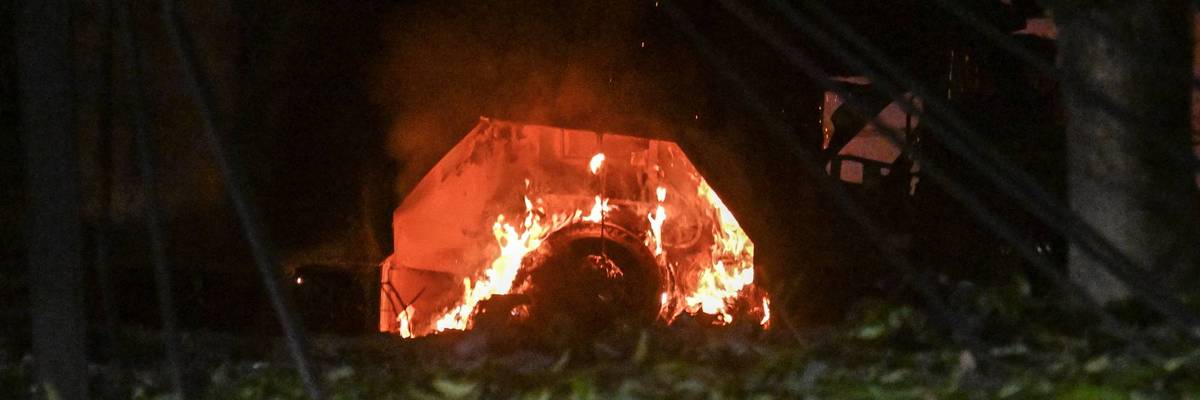
A vehicle burns at La Carlota air base in Caracas after a series of explosions on January 3, 2026.
The US Is Committing Terrorism in Venezuela; Why Will Nobody Say That?
Despite the candor with which US officials have stated their intent “to intimidate or coerce” Venezuelans and Cubans, US reporters and commentators seem unwilling to use the word “terror.”
The US government’s official definition of “international terrorism” includes “violent acts” intended “to influence the policy of a government by intimidation or coercion,” including through “kidnapping.” By the US definition, it’s hard to find a more textbook example than US actions toward Venezuela. Yet few US reporters or commentators seem willing to call the policy what it is.
Until the Government Cries Uncle
The aerial murder of at least 110 people in boats off the Venezuelan coast starting in September 2025 was aimed at toppling the Maduro government. As White House Chief of Staff Susie Wiles said on November 2, President Donald Trump “wants to keep on blowing boats up until Maduro cries uncle.” The phrasing recalls Ronald Reagan’s 1985 demand that the Nicaraguan government “say uncle” while he bombed the Nicaraguan coast, a campaign the International Court of Justice ruled to be terrorism.
Since bombing the Venezuela mainland and kidnapping President Nicolás Maduro and his wife Cilia Flores on January 3, top US officials have repeatedly reiterated their terrorist intentions. They plan to use the “tremendous leverage” afforded by a US naval blockade to ensure that the remaining government “does what we want”: Fork over billions of dollars in “our oil”; give US companies control over your resources; and help us reestablish “dominance in the Western Hemisphere,” starting with your cooperation in starving Cuba of oil.
Keeping It on Venezuelan Civilians
The US definition of terrorism also includes actions intended “to intimidate or coerce a civilian population” for political objectives. For nearly a decade the US government has pursued a bipartisan policy of making Venezuelan civilians suffer enough that they’ll rise up and overthrow their president.
In their first year alone, from 2017 to 2018, US financial sanctions led to tens of thousands of civilian deaths from lack of medicine and other essentials. The continuation and expansion of the sanctions under Presidents Trump and Joe Biden also foreclosed any possibility of resuscitating the Venezuelan economy after the depression that began in the mid-2010s.
Over just a 10-year period, from 2012–2021, economic sanctions have killed around 5.6 million people.
The official line is that Venezuelans’ economic suffering is the result of Maduro’s “mismanagement.” Periodically, however, US officials have claimed credit. In 2018 a State Department spokesperson crowed that “the financial sanctions we have placed on the Venezuelan Government has [sic] forced it to begin becoming in default.” Critics could shove it. “Our strategy is working and we’re going to keep it on the Venezuelans.”
In 2019 Secretary of State Mike Pompeo rejoiced that “the circle is tightening” around the Maduro government and “the humanitarian crisis is increasing by the hour.” His colleague Elliott Abrams warned that “a Venezuela in recovery” was “not going to happen under the Maduro regime.”
Five Million Other Times the Strategy Worked
Intimidating and coercing civilian populations has always been the conscious strategy of broad-based economic sanctions.
An early version of this policy was used by British colonizers, and later the US government, in their wars against Indigenous populations in North America. As military historian John Grenier details in his indispensable book The First Way of War, conquering the continent for the Anglo race involved systematically targeting noncombatants and their food, water, and shelter.
The strategy was refined in the 20th century. After World War I sanctions on a country’s economy were marketed by Western governments as a humane alternative to military warfare. In reality sanctions were an adaptation of the earlier terrorist strategy. They could be even more lethal than the earlier version, since the expansion of global capitalism left nations more dependent on imports and exports.
The authoritative study of sanctions’ impact on human welfare was published in The Lancet Global Health in 2025. Upon evaluating mortality rates in 152 countries, the authors found that unilateral economic sanctions like the ones on Venezuela and Cuba “were associated with an annual toll of 564,258 deaths.” That’s roughly equal to the death toll from military conflicts.
Over just a 10-year period, from 2012–2021, economic sanctions have killed around 5.6 million people.
So That the Cuban People Take Care of Their Government
Cuba has been the target of a US economic blockade since 1960, far longer than any other country. Although its healthcare system has greatly limited the death toll as compared with other countries targeted by US sanctions, no other case reveals the terroristic logic of sanctions with such clarity.
In October 1960, soon after the Eisenhower administration initiated its sanctions against Cuba, Vice President Richard Nixon boasted on national TV that “we are cutting off the significant items that the Cuban regime needs in order to survive. By cutting off trade, by cutting off our diplomatic relations as we have, we will quarantine this regime so that the people of Cuba themselves will take care of Mr. Castro.”
And that was the language approved for TV audiences. Six months prior, Deputy Assistant Secretary of State Lester Mallory wrote privately that “every possible means should be undertaken promptly to weaken the economic life of Cuba.” He proposed an embargo “which, while as adroit and inconspicuous as possible, makes the greatest inroads in denying money and supplies to Cuba, to decrease monetary and real wages, to bring about hunger, desperation and overthrow of government.”
Why is a fascist sociopath more honest than the press corps tasked with holding him to account?
This economic warfare proceeded in parallel with bombings and biological warfare carried out by right-wing Cuban exiles, acting with the consent and often direct sponsorship of the US government. Those terrorist operations have killed hundreds of Cubans since 1959.
Mallory and his colleagues candidly explained why these policies were necessary. “Latin America today is in a state of deep unrest,” noted the State Department in 1961, because “the poor and underprivileged, stimulated by the example of the Cuban revolution, are now demanding opportunities for a decent living.”
The “major threat” of Cuba, said another 1961 memo, was “the example and stimulus of a working communist revolution.” If the revolution “thrives,” hungry people around the world might believe they too could challenge capitalism. Maybe “a blacklist of Cuban commercial activities in Latin America,” including Cuba’s trade “in foodstuffs and medicines,” could disabuse the hungry of their fantasy.
The Kennedy administration liked that idea. In 1962 it expanded Eisenhower’s sanctions on Cuba into a full economic embargo. That policy remains intact today, now more brutal and punitive than ever.
The economic blockade against Cuba hasn’t yet toppled the government. But whatever happens in the future, the US strategy has already succeeded in its larger goal of preventing a “working communist revolution” that might inspire others.
Sanctions on Venezuela have similarly helped crush any chance of a functioning socialism, or even a robust social democracy, for the foreseeable future.
See No (US) Terror
Despite the candor with which US officials have stated their intent “to intimidate or coerce” Venezuelans and Cubans, US reporters and commentators seem unwilling to use the word “terror.” As of this writing, no one at the New York Times, Washington Post, National Public Radio, or CNN has labeled the January 3 invasion of Venezuela as terrorism.
The only mentions of terror are in reference to President Nicolás Maduro, whom the US government labels a “narco-terrorist.” The latter term is rarely defined, let alone coherently. Maduro’s recent indictment on “narco-terrorism” charges in the Southern District of New York has been widely mentioned as a legal rationale for the invasion. None of the four outlets listed above have mentioned that the US attorney who signed the indictment, Jay Clayton, was appointed by Trump, had no previous prosecutorial experience, and has behaved like Trump’s lapdog since he was installed. Failing to scrutinize Clayton lends legitimacy to the claim that the US was merely enforcing the law.
Maybe editors have forbidden use of the T word. The BBC has prohibited its writers from saying that Maduro and Flores were “kidnapped” on January 3. Trump himself has no objection to using the term. Why is a fascist sociopath more honest than the press corps tasked with holding him to account?
Even in the Orwellian dystopia of today’s United States, words still have meanings. If rational debate is to be possible we must defend them.
Correction: An earlier version of this piece mistakenly confused the time period of the overall 2025 Lancet study (1971-2021) with the specific time period that the authors used to calculate the finding of 564,258 annual deaths (2012-2021). The author had multiplied that figure by 50 to obtain a figure of "28 million" sanction deaths. While it is possible that the 28 million figure for 1971-2021 is still approximately accurate, the author has updated the piece with the sure calculation of 5.6 million sanction deaths for the years 2012-2021 (i.e., 564,258 x 10 years).
We are at a crossroads
This country and this world are at a monumental crossroads. In a few short weeks, US voters will have an opportunity to beat back the forces of fascism and confront the billionaires who are rigging the economy, our media system, and our democracy, making it increasingly impossible for ordinary people to get by. We’re not just talking about the election. We’re talking about what must be done once these fascist elements are vanquished from power. We need a bolder set of solutions than what either major party has so far been willing to offer and a working-class movement ready to fight like hell for it. Trump didn't emerge from nowhere. The conditions that fueled MAGA authoritarianism were created by decades of radical neoliberal economic policies and a corrupt political system dominated by corporate interests. They slashed taxes on the super-rich, promising that the benefits would trickle down. They said giveaways to the corporate titans would make life more affordable for the rest of us. It was all bullshit. And when a bitter, betrayed populace searches for someone to blame, right-wing demagogues have little trouble finding scapegoats. People know when they're being lied to, but you won't hear any of this from the corporate media. Only independent journalism—powered and funded by people who believe in building a better world—can deliver truly trustworthy daily news. Our Fall Campaign is underway, and we need your help. To power our newsroom through the rest of the year, we need to raise $125,000 by midnight on October 31. So if you share our vision, please contribute whatever you can to sustain our work. |
The US government’s official definition of “international terrorism” includes “violent acts” intended “to influence the policy of a government by intimidation or coercion,” including through “kidnapping.” By the US definition, it’s hard to find a more textbook example than US actions toward Venezuela. Yet few US reporters or commentators seem willing to call the policy what it is.
Until the Government Cries Uncle
The aerial murder of at least 110 people in boats off the Venezuelan coast starting in September 2025 was aimed at toppling the Maduro government. As White House Chief of Staff Susie Wiles said on November 2, President Donald Trump “wants to keep on blowing boats up until Maduro cries uncle.” The phrasing recalls Ronald Reagan’s 1985 demand that the Nicaraguan government “say uncle” while he bombed the Nicaraguan coast, a campaign the International Court of Justice ruled to be terrorism.
Since bombing the Venezuela mainland and kidnapping President Nicolás Maduro and his wife Cilia Flores on January 3, top US officials have repeatedly reiterated their terrorist intentions. They plan to use the “tremendous leverage” afforded by a US naval blockade to ensure that the remaining government “does what we want”: Fork over billions of dollars in “our oil”; give US companies control over your resources; and help us reestablish “dominance in the Western Hemisphere,” starting with your cooperation in starving Cuba of oil.
Keeping It on Venezuelan Civilians
The US definition of terrorism also includes actions intended “to intimidate or coerce a civilian population” for political objectives. For nearly a decade the US government has pursued a bipartisan policy of making Venezuelan civilians suffer enough that they’ll rise up and overthrow their president.
In their first year alone, from 2017 to 2018, US financial sanctions led to tens of thousands of civilian deaths from lack of medicine and other essentials. The continuation and expansion of the sanctions under Presidents Trump and Joe Biden also foreclosed any possibility of resuscitating the Venezuelan economy after the depression that began in the mid-2010s.
Over just a 10-year period, from 2012–2021, economic sanctions have killed around 5.6 million people.
The official line is that Venezuelans’ economic suffering is the result of Maduro’s “mismanagement.” Periodically, however, US officials have claimed credit. In 2018 a State Department spokesperson crowed that “the financial sanctions we have placed on the Venezuelan Government has [sic] forced it to begin becoming in default.” Critics could shove it. “Our strategy is working and we’re going to keep it on the Venezuelans.”
In 2019 Secretary of State Mike Pompeo rejoiced that “the circle is tightening” around the Maduro government and “the humanitarian crisis is increasing by the hour.” His colleague Elliott Abrams warned that “a Venezuela in recovery” was “not going to happen under the Maduro regime.”
Five Million Other Times the Strategy Worked
Intimidating and coercing civilian populations has always been the conscious strategy of broad-based economic sanctions.
An early version of this policy was used by British colonizers, and later the US government, in their wars against Indigenous populations in North America. As military historian John Grenier details in his indispensable book The First Way of War, conquering the continent for the Anglo race involved systematically targeting noncombatants and their food, water, and shelter.
The strategy was refined in the 20th century. After World War I sanctions on a country’s economy were marketed by Western governments as a humane alternative to military warfare. In reality sanctions were an adaptation of the earlier terrorist strategy. They could be even more lethal than the earlier version, since the expansion of global capitalism left nations more dependent on imports and exports.
The authoritative study of sanctions’ impact on human welfare was published in The Lancet Global Health in 2025. Upon evaluating mortality rates in 152 countries, the authors found that unilateral economic sanctions like the ones on Venezuela and Cuba “were associated with an annual toll of 564,258 deaths.” That’s roughly equal to the death toll from military conflicts.
Over just a 10-year period, from 2012–2021, economic sanctions have killed around 5.6 million people.
So That the Cuban People Take Care of Their Government
Cuba has been the target of a US economic blockade since 1960, far longer than any other country. Although its healthcare system has greatly limited the death toll as compared with other countries targeted by US sanctions, no other case reveals the terroristic logic of sanctions with such clarity.
In October 1960, soon after the Eisenhower administration initiated its sanctions against Cuba, Vice President Richard Nixon boasted on national TV that “we are cutting off the significant items that the Cuban regime needs in order to survive. By cutting off trade, by cutting off our diplomatic relations as we have, we will quarantine this regime so that the people of Cuba themselves will take care of Mr. Castro.”
And that was the language approved for TV audiences. Six months prior, Deputy Assistant Secretary of State Lester Mallory wrote privately that “every possible means should be undertaken promptly to weaken the economic life of Cuba.” He proposed an embargo “which, while as adroit and inconspicuous as possible, makes the greatest inroads in denying money and supplies to Cuba, to decrease monetary and real wages, to bring about hunger, desperation and overthrow of government.”
Why is a fascist sociopath more honest than the press corps tasked with holding him to account?
This economic warfare proceeded in parallel with bombings and biological warfare carried out by right-wing Cuban exiles, acting with the consent and often direct sponsorship of the US government. Those terrorist operations have killed hundreds of Cubans since 1959.
Mallory and his colleagues candidly explained why these policies were necessary. “Latin America today is in a state of deep unrest,” noted the State Department in 1961, because “the poor and underprivileged, stimulated by the example of the Cuban revolution, are now demanding opportunities for a decent living.”
The “major threat” of Cuba, said another 1961 memo, was “the example and stimulus of a working communist revolution.” If the revolution “thrives,” hungry people around the world might believe they too could challenge capitalism. Maybe “a blacklist of Cuban commercial activities in Latin America,” including Cuba’s trade “in foodstuffs and medicines,” could disabuse the hungry of their fantasy.
The Kennedy administration liked that idea. In 1962 it expanded Eisenhower’s sanctions on Cuba into a full economic embargo. That policy remains intact today, now more brutal and punitive than ever.
The economic blockade against Cuba hasn’t yet toppled the government. But whatever happens in the future, the US strategy has already succeeded in its larger goal of preventing a “working communist revolution” that might inspire others.
Sanctions on Venezuela have similarly helped crush any chance of a functioning socialism, or even a robust social democracy, for the foreseeable future.
See No (US) Terror
Despite the candor with which US officials have stated their intent “to intimidate or coerce” Venezuelans and Cubans, US reporters and commentators seem unwilling to use the word “terror.” As of this writing, no one at the New York Times, Washington Post, National Public Radio, or CNN has labeled the January 3 invasion of Venezuela as terrorism.
The only mentions of terror are in reference to President Nicolás Maduro, whom the US government labels a “narco-terrorist.” The latter term is rarely defined, let alone coherently. Maduro’s recent indictment on “narco-terrorism” charges in the Southern District of New York has been widely mentioned as a legal rationale for the invasion. None of the four outlets listed above have mentioned that the US attorney who signed the indictment, Jay Clayton, was appointed by Trump, had no previous prosecutorial experience, and has behaved like Trump’s lapdog since he was installed. Failing to scrutinize Clayton lends legitimacy to the claim that the US was merely enforcing the law.
Maybe editors have forbidden use of the T word. The BBC has prohibited its writers from saying that Maduro and Flores were “kidnapped” on January 3. Trump himself has no objection to using the term. Why is a fascist sociopath more honest than the press corps tasked with holding him to account?
Even in the Orwellian dystopia of today’s United States, words still have meanings. If rational debate is to be possible we must defend them.
Correction: An earlier version of this piece mistakenly confused the time period of the overall 2025 Lancet study (1971-2021) with the specific time period that the authors used to calculate the finding of 564,258 annual deaths (2012-2021). The author had multiplied that figure by 50 to obtain a figure of "28 million" sanction deaths. While it is possible that the 28 million figure for 1971-2021 is still approximately accurate, the author has updated the piece with the sure calculation of 5.6 million sanction deaths for the years 2012-2021 (i.e., 564,258 x 10 years).
- Estimated Cost of Trump Naval Blockade of Venezuela Climbs Toward $1 Billion ›
- Western Media Continue to Defend Washington’s Deadly Venezuela Agenda ›
- 'Terrorists in Imperial Uniform': US Forces Kill 32 Cubans During Venezuela Invasion ›
- More Countries Condemn Trump's 'Imperialist' Saber-Rattling Against Venezuela ›
- Trump’s Venezuela Drug War Gambit and the Militarization Playbook at Home ›
- 'This Is State Terrorism': Global Outrage as Trump Launches Illegal Assault on Venezuela ›
- Advocates Renew Call for End to US Sanctions After Devastating Venezuela Earthquakes | Common Dreams ›
The US government’s official definition of “international terrorism” includes “violent acts” intended “to influence the policy of a government by intimidation or coercion,” including through “kidnapping.” By the US definition, it’s hard to find a more textbook example than US actions toward Venezuela. Yet few US reporters or commentators seem willing to call the policy what it is.
Until the Government Cries Uncle
The aerial murder of at least 110 people in boats off the Venezuelan coast starting in September 2025 was aimed at toppling the Maduro government. As White House Chief of Staff Susie Wiles said on November 2, President Donald Trump “wants to keep on blowing boats up until Maduro cries uncle.” The phrasing recalls Ronald Reagan’s 1985 demand that the Nicaraguan government “say uncle” while he bombed the Nicaraguan coast, a campaign the International Court of Justice ruled to be terrorism.
Since bombing the Venezuela mainland and kidnapping President Nicolás Maduro and his wife Cilia Flores on January 3, top US officials have repeatedly reiterated their terrorist intentions. They plan to use the “tremendous leverage” afforded by a US naval blockade to ensure that the remaining government “does what we want”: Fork over billions of dollars in “our oil”; give US companies control over your resources; and help us reestablish “dominance in the Western Hemisphere,” starting with your cooperation in starving Cuba of oil.
Keeping It on Venezuelan Civilians
The US definition of terrorism also includes actions intended “to intimidate or coerce a civilian population” for political objectives. For nearly a decade the US government has pursued a bipartisan policy of making Venezuelan civilians suffer enough that they’ll rise up and overthrow their president.
In their first year alone, from 2017 to 2018, US financial sanctions led to tens of thousands of civilian deaths from lack of medicine and other essentials. The continuation and expansion of the sanctions under Presidents Trump and Joe Biden also foreclosed any possibility of resuscitating the Venezuelan economy after the depression that began in the mid-2010s.
Over just a 10-year period, from 2012–2021, economic sanctions have killed around 5.6 million people.
The official line is that Venezuelans’ economic suffering is the result of Maduro’s “mismanagement.” Periodically, however, US officials have claimed credit. In 2018 a State Department spokesperson crowed that “the financial sanctions we have placed on the Venezuelan Government has [sic] forced it to begin becoming in default.” Critics could shove it. “Our strategy is working and we’re going to keep it on the Venezuelans.”
In 2019 Secretary of State Mike Pompeo rejoiced that “the circle is tightening” around the Maduro government and “the humanitarian crisis is increasing by the hour.” His colleague Elliott Abrams warned that “a Venezuela in recovery” was “not going to happen under the Maduro regime.”
Five Million Other Times the Strategy Worked
Intimidating and coercing civilian populations has always been the conscious strategy of broad-based economic sanctions.
An early version of this policy was used by British colonizers, and later the US government, in their wars against Indigenous populations in North America. As military historian John Grenier details in his indispensable book The First Way of War, conquering the continent for the Anglo race involved systematically targeting noncombatants and their food, water, and shelter.
The strategy was refined in the 20th century. After World War I sanctions on a country’s economy were marketed by Western governments as a humane alternative to military warfare. In reality sanctions were an adaptation of the earlier terrorist strategy. They could be even more lethal than the earlier version, since the expansion of global capitalism left nations more dependent on imports and exports.
The authoritative study of sanctions’ impact on human welfare was published in The Lancet Global Health in 2025. Upon evaluating mortality rates in 152 countries, the authors found that unilateral economic sanctions like the ones on Venezuela and Cuba “were associated with an annual toll of 564,258 deaths.” That’s roughly equal to the death toll from military conflicts.
Over just a 10-year period, from 2012–2021, economic sanctions have killed around 5.6 million people.
So That the Cuban People Take Care of Their Government
Cuba has been the target of a US economic blockade since 1960, far longer than any other country. Although its healthcare system has greatly limited the death toll as compared with other countries targeted by US sanctions, no other case reveals the terroristic logic of sanctions with such clarity.
In October 1960, soon after the Eisenhower administration initiated its sanctions against Cuba, Vice President Richard Nixon boasted on national TV that “we are cutting off the significant items that the Cuban regime needs in order to survive. By cutting off trade, by cutting off our diplomatic relations as we have, we will quarantine this regime so that the people of Cuba themselves will take care of Mr. Castro.”
And that was the language approved for TV audiences. Six months prior, Deputy Assistant Secretary of State Lester Mallory wrote privately that “every possible means should be undertaken promptly to weaken the economic life of Cuba.” He proposed an embargo “which, while as adroit and inconspicuous as possible, makes the greatest inroads in denying money and supplies to Cuba, to decrease monetary and real wages, to bring about hunger, desperation and overthrow of government.”
Why is a fascist sociopath more honest than the press corps tasked with holding him to account?
This economic warfare proceeded in parallel with bombings and biological warfare carried out by right-wing Cuban exiles, acting with the consent and often direct sponsorship of the US government. Those terrorist operations have killed hundreds of Cubans since 1959.
Mallory and his colleagues candidly explained why these policies were necessary. “Latin America today is in a state of deep unrest,” noted the State Department in 1961, because “the poor and underprivileged, stimulated by the example of the Cuban revolution, are now demanding opportunities for a decent living.”
The “major threat” of Cuba, said another 1961 memo, was “the example and stimulus of a working communist revolution.” If the revolution “thrives,” hungry people around the world might believe they too could challenge capitalism. Maybe “a blacklist of Cuban commercial activities in Latin America,” including Cuba’s trade “in foodstuffs and medicines,” could disabuse the hungry of their fantasy.
The Kennedy administration liked that idea. In 1962 it expanded Eisenhower’s sanctions on Cuba into a full economic embargo. That policy remains intact today, now more brutal and punitive than ever.
The economic blockade against Cuba hasn’t yet toppled the government. But whatever happens in the future, the US strategy has already succeeded in its larger goal of preventing a “working communist revolution” that might inspire others.
Sanctions on Venezuela have similarly helped crush any chance of a functioning socialism, or even a robust social democracy, for the foreseeable future.
See No (US) Terror
Despite the candor with which US officials have stated their intent “to intimidate or coerce” Venezuelans and Cubans, US reporters and commentators seem unwilling to use the word “terror.” As of this writing, no one at the New York Times, Washington Post, National Public Radio, or CNN has labeled the January 3 invasion of Venezuela as terrorism.
The only mentions of terror are in reference to President Nicolás Maduro, whom the US government labels a “narco-terrorist.” The latter term is rarely defined, let alone coherently. Maduro’s recent indictment on “narco-terrorism” charges in the Southern District of New York has been widely mentioned as a legal rationale for the invasion. None of the four outlets listed above have mentioned that the US attorney who signed the indictment, Jay Clayton, was appointed by Trump, had no previous prosecutorial experience, and has behaved like Trump’s lapdog since he was installed. Failing to scrutinize Clayton lends legitimacy to the claim that the US was merely enforcing the law.
Maybe editors have forbidden use of the T word. The BBC has prohibited its writers from saying that Maduro and Flores were “kidnapped” on January 3. Trump himself has no objection to using the term. Why is a fascist sociopath more honest than the press corps tasked with holding him to account?
Even in the Orwellian dystopia of today’s United States, words still have meanings. If rational debate is to be possible we must defend them.
Correction: An earlier version of this piece mistakenly confused the time period of the overall 2025 Lancet study (1971-2021) with the specific time period that the authors used to calculate the finding of 564,258 annual deaths (2012-2021). The author had multiplied that figure by 50 to obtain a figure of "28 million" sanction deaths. While it is possible that the 28 million figure for 1971-2021 is still approximately accurate, the author has updated the piece with the sure calculation of 5.6 million sanction deaths for the years 2012-2021 (i.e., 564,258 x 10 years).
- Estimated Cost of Trump Naval Blockade of Venezuela Climbs Toward $1 Billion ›
- Western Media Continue to Defend Washington’s Deadly Venezuela Agenda ›
- 'Terrorists in Imperial Uniform': US Forces Kill 32 Cubans During Venezuela Invasion ›
- More Countries Condemn Trump's 'Imperialist' Saber-Rattling Against Venezuela ›
- Trump’s Venezuela Drug War Gambit and the Militarization Playbook at Home ›
- 'This Is State Terrorism': Global Outrage as Trump Launches Illegal Assault on Venezuela ›
- Advocates Renew Call for End to US Sanctions After Devastating Venezuela Earthquakes | Common Dreams ›