SUBSCRIBE TO OUR FREE NEWSLETTER
Daily news & progressive opinion—funded by the people, not the corporations—delivered straight to your inbox.
5
#000000
#FFFFFF
To donate by check, phone, or other method, see our More Ways to Give page.
Daily news & progressive opinion—funded by the people, not the corporations—delivered straight to your inbox.
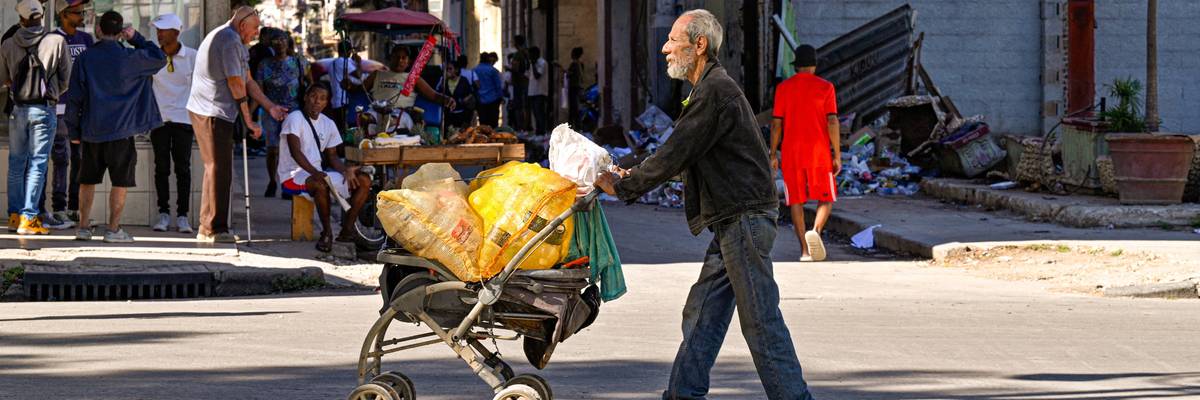
An elderly man transports recyclable material on a cart in Havana on January 6, 2026.
The US embargo, as well as new sanctions ordered by Trump, is partly rooted in leftover Cold War ideology and geopolitical posturing, but largely appears to reflect personal vendetta and financial gain.
The Trump administration’s latest threat to impose secondary tariffs on any nation selling oil to Cuba represents a dramatic and catastrophic tightening of the six-decade-long, deliberate chokehold the United States has maintained on Cuba’s access to essential resources. This act of collective punishment against the Cuban people, for alleged crimes the US government has scarcely attempted to substantiate, will be felt across every aspect of daily life.
According to Trump’s January 29 executive order, this latest escalation in economic warfare is framed as a response to the “unusual and extraordinary threat” the Cuban government allegedly poses to US national security. The order revives familiar Cold War language, including references to an obsolete Soviet-era listening station outside Havana, alongside sweeping allegations of harboring terrorism, fomenting regional instability, and engaging in hostile activity. While these all-too-familiar claims remain largely unfounded, debating the rhetoric is ultimately beside the point when the underlying policy objective is stated plainly by the Administration. “We would love to see the regime there [in Cuba] change,” Secretary of State Marco Rubio told the Senate Foreign Relations Committee last week, dispelling whatever ambiguity might have remained.
Sanctions have been a blunt, heavy-handed, and ultimately unsuccessful weapon of US policy toward Cuba. As the State Department admitted in 1960, they were intended to “bring about hunger, desperation, and the overthrow of government.” Enforced unilaterally and extraterritorially, US sanctions restrict not only Cuba’s ability to import and export goods, but also the willingness and feasibility of third countries to engage in trade with the island nation. In practice, sanctions function as a blockade encompassing food, medicine, and life-saving medical equipment.
Cuba’s remaining energy access has rapidly unraveled amid the US government’s latest military escalation in the region. Following the US kidnapping of Venezuelan President Nicolás Maduro and the Trump administration’s effective seizure of Venezuela’s oil sector, President Trump declared on Truth Social that “there will be NO MORE OIL OR MONEY GOING TO CUBA—ZERO.”
While restrictions on oil are often portrayed through images of rolling blackouts and hours-long diesel lines, the full humanitarian and economic consequences are far more severe.
In the weeks since Venezuelan supplies were abruptly cut off, Mexico became Cuba’s last remaining external source of fuel. In 2025, Mexico had already surpassed Venezuela as Cuba’s main oil supplier, exporting roughly 12,300 barrels per day, or about 44 percent of the island’s crude imports. Following the imposition of the tariff, Trump has effectively cut off that lifeline. Mexican President Claudia Sheinbaum has neither denied reports that shipments were halted amid fears of reprisals nor downplayed her government’s efforts to explore alternatives to support the island. Beneath the geopolitical headlines, Cubans already living with the cascading impacts of prolonged blackouts now face an acute energy crisis. Estimates suggest the country has no more than two weeks of oil reserves at current demand, making widespread power outages inevitable and pushing essential services to the brink of collapse.
The international community has long condemned the United States’ cruel and anachronistic policies toward Cuba. For more than 33 years, the United Nations General Assembly has overwhelmingly voted to call for an end to the US economic embargo. In November 2025, Alena Douhan, UN Special Rapporteur on the negative impact of unilateral coercive measures, likewise urged the US government to end sanctions and economic restrictions that isolate Cuba from international cooperation and financial systems, and instead to “settle disputes in accordance with the principles and norms of international law.” In the formal report, Douhan underscored the human toll on Cubans: shortages of fuel, electricity, water, food, medicine, and essential machinery, combined with the emigration of skilled workers, are inflicting “severe consequences for the enjoyment of human rights, including the rights to life, food, health, and development.”
While restrictions on oil are often portrayed through images of rolling blackouts and hours-long diesel lines, the full humanitarian and economic consequences are far more severe. Fuel powers irrigation pumps and farm machinery, electricity keeps processing plants and refrigeration running, and diesel moves food from fields to markets and ports. Energy and fuel shortages constrain farm-level production and disrupt processing, preservation, and distribution, delaying or reducing food availability and causing perishable goods to spoil. The result is serious losses for both markets and households. Reporting from the Food and Agriculture Organization (FAO) underscores a global pattern, including in Cuba, where energy shortages directly trigger food insecurity, disrupting production, milling, and distribution networks.
Cuba’s limited access to foreign currency and global markets further compounds these pressures. Rising transport costs, canceled shipping contracts, and banking restrictions delay even UN technical assistance projects, including food aid. Diplomatic missions, humanitarian organizations, and individuals regularly report difficulties in sending essential goods—and face the risk of losing Electronic System for Travel Authorization (ESTA) status simply for working in Cuba. Cuban enterprises also struggle to pay for certifications or purchase goods from US companies, forcing longer and more expensive alternative routes. For example, the World Food Program has faced delays in procuring and shipping fortified foods to Cuba in recent years, in part because companies are unwilling to send shipments to Cuban ports. In another striking case, only 9 of 518 requests from the Cuban agricultural sector for tractors, motors, batteries, forklifts, and spare parts were approved in 2022, as foreign suppliers feared US retribution.
Since 2000, food and agricultural products have technically been exempt from the US trade embargo on Cuba—a concession often cited by officials to argue that sanctions do not target the Cuban population. In practice, however, this exemption is largely illusory. Under the Trade Sanctions Reform and Export Enhancement Act, Cuba is prohibited from purchasing US food on credit; all transactions must be paid in cash and in advance, before shipment. For a country with chronic foreign exchange shortages and virtually no access to international credit, this is punitive. Additionally, because Cuba remains on US sanctions watch lists, foreign banks face legal and financial risk for facilitating transactions. The result is that Cuba has almost no access to trade credit, short-term financing, or conventional loans that most countries rely on to import food. Even when food is legally available, cash-only prepayment forces the government to divert scarce hard currency from other essential needs or to forgo imports entirely. This is not a neutral or humanitarian exception, but a structural barrier that both intensifies and contributes to Cuba’s domestic challenges, including limited access to credit for producers, volatile food prices, and inadequate infrastructure for distributing agricultural goods. Under Trump’s latest measure, many Cubans will struggle even more to secure even their most basic food needs—a crisis that has been building steadily over the past year.
The public health risks of these new restrictions are also grave. Cuba’s health care system is already under immense pressure from chronic energy shortages. Pharmaceutical plants struggle to operate, power outages threaten the spoilage of critical medications and vaccines, and despite government priority afforded to ambulances and mobile medical units, fuel shortages remain a consistent challenge. Hospitals have been forced to make impossible choices, prioritizing ICUs and operating rooms over general wards. Across the country, patients have gone without oxygen, dialysis treatments have been interrupted, and have been forced to rely on cellphone flashlights during prolonged blackout caused by a lack of oil for generators.
As early as the late 1990s, public health experts at the American Public Health Association warned that Cuba’s comparatively sophisticated and comprehensive healthcare system was “being systematically stripped of essential resources” due to US sanctions. Their year-long study concluded that the embargo had led to a significant rise in suffering, and even deaths, and placed severe strain on healthcare infrastructure by limiting access to electricity, oil, diesel, and gasoline.
Energy shortages also threaten Cubans’ access to water. Outages directly disrupt pumps that supply households in the capital, and without fuel and reliable transportation, emergency cistern deliveries are severely limited. Once more, US sanctions compound these shortages through long-standing restrictions on water treatment chemicals and spare parts for infrastructure, resulting in serious reductions in the availability of safe drinking water and elevated risks of waterborne diseases.
Ultimately, Trump’s latest tariff is not an abstract “coercive” policy—it is a deliberate attack designed to destabilize life for ordinary Cubans. It functions as a state-sanctioned mechanism of harm, forcing citizens to shoulder the costs of political pressure. While the Cuban government may try to adapt through rationing, subsidies, or resource reallocation, ordinary people are facing the life-altering consequences of scarcity and energy insecurity.
The Cuban government has responded with fierce condemnation. On January 30th, President Miguel Díaz-Canel wrote on social media that Trump’s action “exposes the fascist, criminal, and genocidal nature” of the administration, which has “hijacked the interests of the American people for purely personal gain.” Cuban Foreign Minister Bruno Rodríguez also denounced the measure, calling it part of a broader US strategy to dominate the hemisphere. He wrote, the US seeks to “submit them [the Americas’ to its dictates, deprive them of their resources, mutilate their sovereignty and deprive them of their independence,” and warned that “every day there is new evidence showing that the only threat to peace, security and stability in the region…is the one exerted by the US government against the peoples and nations of our America.”
In essence, the US is inciting chaos by restricting basic necessities of life—supposedly to stop the Cuban government from “incit[ing] chaos by spreading communist ideology across the region.” The policy is partly rooted in leftover Cold War ideology and geopolitical posturing, but largely appears to reflect personal vendetta and financial gain.
The consequences, regardless, are unmistakably humanitarian–and Trump himself seems unconcerned. “It doesn't have to be a humanitarian crisis,” he told reporters on Saturday, January 31, dressed in a tuxedo aboard Air Force One, adding, “I think, you know, we'll be kind.” The Cuban people bear the full brunt of that ‘kindness.’
Dear Common Dreams reader, It’s been nearly 30 years since I co-founded Common Dreams with my late wife, Lina Newhouser. We had the radical notion that journalism should serve the public good, not corporate profits. It was clear to us from the outset what it would take to build such a project. No paid advertisements. No corporate sponsors. No millionaire publisher telling us what to think or do. Many people said we wouldn't last a year, but we proved those doubters wrong. Together with a tremendous team of journalists and dedicated staff, we built an independent media outlet free from the constraints of profits and corporate control. Our mission has always been simple: To inform. To inspire. To ignite change for the common good. Building Common Dreams was not easy. Our survival was never guaranteed. When you take on the most powerful forces—Wall Street greed, fossil fuel industry destruction, Big Tech lobbyists, and uber-rich oligarchs who have spent billions upon billions rigging the economy and democracy in their favor—the only bulwark you have is supporters who believe in your work. But here’s the urgent message from me today. It's never been this bad out there. And it's never been this hard to keep us going. At the very moment Common Dreams is most needed, the threats we face are intensifying. We need your support now more than ever. We don't accept corporate advertising and never will. We don't have a paywall because we don't think people should be blocked from critical news based on their ability to pay. Everything we do is funded by the donations of readers like you. When everyone does the little they can afford, we are strong. But if that support retreats or dries up, so do we. Will you donate now to make sure Common Dreams not only survives but thrives? —Craig Brown, Co-founder |
The Trump administration’s latest threat to impose secondary tariffs on any nation selling oil to Cuba represents a dramatic and catastrophic tightening of the six-decade-long, deliberate chokehold the United States has maintained on Cuba’s access to essential resources. This act of collective punishment against the Cuban people, for alleged crimes the US government has scarcely attempted to substantiate, will be felt across every aspect of daily life.
According to Trump’s January 29 executive order, this latest escalation in economic warfare is framed as a response to the “unusual and extraordinary threat” the Cuban government allegedly poses to US national security. The order revives familiar Cold War language, including references to an obsolete Soviet-era listening station outside Havana, alongside sweeping allegations of harboring terrorism, fomenting regional instability, and engaging in hostile activity. While these all-too-familiar claims remain largely unfounded, debating the rhetoric is ultimately beside the point when the underlying policy objective is stated plainly by the Administration. “We would love to see the regime there [in Cuba] change,” Secretary of State Marco Rubio told the Senate Foreign Relations Committee last week, dispelling whatever ambiguity might have remained.
Sanctions have been a blunt, heavy-handed, and ultimately unsuccessful weapon of US policy toward Cuba. As the State Department admitted in 1960, they were intended to “bring about hunger, desperation, and the overthrow of government.” Enforced unilaterally and extraterritorially, US sanctions restrict not only Cuba’s ability to import and export goods, but also the willingness and feasibility of third countries to engage in trade with the island nation. In practice, sanctions function as a blockade encompassing food, medicine, and life-saving medical equipment.
Cuba’s remaining energy access has rapidly unraveled amid the US government’s latest military escalation in the region. Following the US kidnapping of Venezuelan President Nicolás Maduro and the Trump administration’s effective seizure of Venezuela’s oil sector, President Trump declared on Truth Social that “there will be NO MORE OIL OR MONEY GOING TO CUBA—ZERO.”
While restrictions on oil are often portrayed through images of rolling blackouts and hours-long diesel lines, the full humanitarian and economic consequences are far more severe.
In the weeks since Venezuelan supplies were abruptly cut off, Mexico became Cuba’s last remaining external source of fuel. In 2025, Mexico had already surpassed Venezuela as Cuba’s main oil supplier, exporting roughly 12,300 barrels per day, or about 44 percent of the island’s crude imports. Following the imposition of the tariff, Trump has effectively cut off that lifeline. Mexican President Claudia Sheinbaum has neither denied reports that shipments were halted amid fears of reprisals nor downplayed her government’s efforts to explore alternatives to support the island. Beneath the geopolitical headlines, Cubans already living with the cascading impacts of prolonged blackouts now face an acute energy crisis. Estimates suggest the country has no more than two weeks of oil reserves at current demand, making widespread power outages inevitable and pushing essential services to the brink of collapse.
The international community has long condemned the United States’ cruel and anachronistic policies toward Cuba. For more than 33 years, the United Nations General Assembly has overwhelmingly voted to call for an end to the US economic embargo. In November 2025, Alena Douhan, UN Special Rapporteur on the negative impact of unilateral coercive measures, likewise urged the US government to end sanctions and economic restrictions that isolate Cuba from international cooperation and financial systems, and instead to “settle disputes in accordance with the principles and norms of international law.” In the formal report, Douhan underscored the human toll on Cubans: shortages of fuel, electricity, water, food, medicine, and essential machinery, combined with the emigration of skilled workers, are inflicting “severe consequences for the enjoyment of human rights, including the rights to life, food, health, and development.”
While restrictions on oil are often portrayed through images of rolling blackouts and hours-long diesel lines, the full humanitarian and economic consequences are far more severe. Fuel powers irrigation pumps and farm machinery, electricity keeps processing plants and refrigeration running, and diesel moves food from fields to markets and ports. Energy and fuel shortages constrain farm-level production and disrupt processing, preservation, and distribution, delaying or reducing food availability and causing perishable goods to spoil. The result is serious losses for both markets and households. Reporting from the Food and Agriculture Organization (FAO) underscores a global pattern, including in Cuba, where energy shortages directly trigger food insecurity, disrupting production, milling, and distribution networks.
Cuba’s limited access to foreign currency and global markets further compounds these pressures. Rising transport costs, canceled shipping contracts, and banking restrictions delay even UN technical assistance projects, including food aid. Diplomatic missions, humanitarian organizations, and individuals regularly report difficulties in sending essential goods—and face the risk of losing Electronic System for Travel Authorization (ESTA) status simply for working in Cuba. Cuban enterprises also struggle to pay for certifications or purchase goods from US companies, forcing longer and more expensive alternative routes. For example, the World Food Program has faced delays in procuring and shipping fortified foods to Cuba in recent years, in part because companies are unwilling to send shipments to Cuban ports. In another striking case, only 9 of 518 requests from the Cuban agricultural sector for tractors, motors, batteries, forklifts, and spare parts were approved in 2022, as foreign suppliers feared US retribution.
Since 2000, food and agricultural products have technically been exempt from the US trade embargo on Cuba—a concession often cited by officials to argue that sanctions do not target the Cuban population. In practice, however, this exemption is largely illusory. Under the Trade Sanctions Reform and Export Enhancement Act, Cuba is prohibited from purchasing US food on credit; all transactions must be paid in cash and in advance, before shipment. For a country with chronic foreign exchange shortages and virtually no access to international credit, this is punitive. Additionally, because Cuba remains on US sanctions watch lists, foreign banks face legal and financial risk for facilitating transactions. The result is that Cuba has almost no access to trade credit, short-term financing, or conventional loans that most countries rely on to import food. Even when food is legally available, cash-only prepayment forces the government to divert scarce hard currency from other essential needs or to forgo imports entirely. This is not a neutral or humanitarian exception, but a structural barrier that both intensifies and contributes to Cuba’s domestic challenges, including limited access to credit for producers, volatile food prices, and inadequate infrastructure for distributing agricultural goods. Under Trump’s latest measure, many Cubans will struggle even more to secure even their most basic food needs—a crisis that has been building steadily over the past year.
The public health risks of these new restrictions are also grave. Cuba’s health care system is already under immense pressure from chronic energy shortages. Pharmaceutical plants struggle to operate, power outages threaten the spoilage of critical medications and vaccines, and despite government priority afforded to ambulances and mobile medical units, fuel shortages remain a consistent challenge. Hospitals have been forced to make impossible choices, prioritizing ICUs and operating rooms over general wards. Across the country, patients have gone without oxygen, dialysis treatments have been interrupted, and have been forced to rely on cellphone flashlights during prolonged blackout caused by a lack of oil for generators.
As early as the late 1990s, public health experts at the American Public Health Association warned that Cuba’s comparatively sophisticated and comprehensive healthcare system was “being systematically stripped of essential resources” due to US sanctions. Their year-long study concluded that the embargo had led to a significant rise in suffering, and even deaths, and placed severe strain on healthcare infrastructure by limiting access to electricity, oil, diesel, and gasoline.
Energy shortages also threaten Cubans’ access to water. Outages directly disrupt pumps that supply households in the capital, and without fuel and reliable transportation, emergency cistern deliveries are severely limited. Once more, US sanctions compound these shortages through long-standing restrictions on water treatment chemicals and spare parts for infrastructure, resulting in serious reductions in the availability of safe drinking water and elevated risks of waterborne diseases.
Ultimately, Trump’s latest tariff is not an abstract “coercive” policy—it is a deliberate attack designed to destabilize life for ordinary Cubans. It functions as a state-sanctioned mechanism of harm, forcing citizens to shoulder the costs of political pressure. While the Cuban government may try to adapt through rationing, subsidies, or resource reallocation, ordinary people are facing the life-altering consequences of scarcity and energy insecurity.
The Cuban government has responded with fierce condemnation. On January 30th, President Miguel Díaz-Canel wrote on social media that Trump’s action “exposes the fascist, criminal, and genocidal nature” of the administration, which has “hijacked the interests of the American people for purely personal gain.” Cuban Foreign Minister Bruno Rodríguez also denounced the measure, calling it part of a broader US strategy to dominate the hemisphere. He wrote, the US seeks to “submit them [the Americas’ to its dictates, deprive them of their resources, mutilate their sovereignty and deprive them of their independence,” and warned that “every day there is new evidence showing that the only threat to peace, security and stability in the region…is the one exerted by the US government against the peoples and nations of our America.”
In essence, the US is inciting chaos by restricting basic necessities of life—supposedly to stop the Cuban government from “incit[ing] chaos by spreading communist ideology across the region.” The policy is partly rooted in leftover Cold War ideology and geopolitical posturing, but largely appears to reflect personal vendetta and financial gain.
The consequences, regardless, are unmistakably humanitarian–and Trump himself seems unconcerned. “It doesn't have to be a humanitarian crisis,” he told reporters on Saturday, January 31, dressed in a tuxedo aboard Air Force One, adding, “I think, you know, we'll be kind.” The Cuban people bear the full brunt of that ‘kindness.’
The Trump administration’s latest threat to impose secondary tariffs on any nation selling oil to Cuba represents a dramatic and catastrophic tightening of the six-decade-long, deliberate chokehold the United States has maintained on Cuba’s access to essential resources. This act of collective punishment against the Cuban people, for alleged crimes the US government has scarcely attempted to substantiate, will be felt across every aspect of daily life.
According to Trump’s January 29 executive order, this latest escalation in economic warfare is framed as a response to the “unusual and extraordinary threat” the Cuban government allegedly poses to US national security. The order revives familiar Cold War language, including references to an obsolete Soviet-era listening station outside Havana, alongside sweeping allegations of harboring terrorism, fomenting regional instability, and engaging in hostile activity. While these all-too-familiar claims remain largely unfounded, debating the rhetoric is ultimately beside the point when the underlying policy objective is stated plainly by the Administration. “We would love to see the regime there [in Cuba] change,” Secretary of State Marco Rubio told the Senate Foreign Relations Committee last week, dispelling whatever ambiguity might have remained.
Sanctions have been a blunt, heavy-handed, and ultimately unsuccessful weapon of US policy toward Cuba. As the State Department admitted in 1960, they were intended to “bring about hunger, desperation, and the overthrow of government.” Enforced unilaterally and extraterritorially, US sanctions restrict not only Cuba’s ability to import and export goods, but also the willingness and feasibility of third countries to engage in trade with the island nation. In practice, sanctions function as a blockade encompassing food, medicine, and life-saving medical equipment.
Cuba’s remaining energy access has rapidly unraveled amid the US government’s latest military escalation in the region. Following the US kidnapping of Venezuelan President Nicolás Maduro and the Trump administration’s effective seizure of Venezuela’s oil sector, President Trump declared on Truth Social that “there will be NO MORE OIL OR MONEY GOING TO CUBA—ZERO.”
While restrictions on oil are often portrayed through images of rolling blackouts and hours-long diesel lines, the full humanitarian and economic consequences are far more severe.
In the weeks since Venezuelan supplies were abruptly cut off, Mexico became Cuba’s last remaining external source of fuel. In 2025, Mexico had already surpassed Venezuela as Cuba’s main oil supplier, exporting roughly 12,300 barrels per day, or about 44 percent of the island’s crude imports. Following the imposition of the tariff, Trump has effectively cut off that lifeline. Mexican President Claudia Sheinbaum has neither denied reports that shipments were halted amid fears of reprisals nor downplayed her government’s efforts to explore alternatives to support the island. Beneath the geopolitical headlines, Cubans already living with the cascading impacts of prolonged blackouts now face an acute energy crisis. Estimates suggest the country has no more than two weeks of oil reserves at current demand, making widespread power outages inevitable and pushing essential services to the brink of collapse.
The international community has long condemned the United States’ cruel and anachronistic policies toward Cuba. For more than 33 years, the United Nations General Assembly has overwhelmingly voted to call for an end to the US economic embargo. In November 2025, Alena Douhan, UN Special Rapporteur on the negative impact of unilateral coercive measures, likewise urged the US government to end sanctions and economic restrictions that isolate Cuba from international cooperation and financial systems, and instead to “settle disputes in accordance with the principles and norms of international law.” In the formal report, Douhan underscored the human toll on Cubans: shortages of fuel, electricity, water, food, medicine, and essential machinery, combined with the emigration of skilled workers, are inflicting “severe consequences for the enjoyment of human rights, including the rights to life, food, health, and development.”
While restrictions on oil are often portrayed through images of rolling blackouts and hours-long diesel lines, the full humanitarian and economic consequences are far more severe. Fuel powers irrigation pumps and farm machinery, electricity keeps processing plants and refrigeration running, and diesel moves food from fields to markets and ports. Energy and fuel shortages constrain farm-level production and disrupt processing, preservation, and distribution, delaying or reducing food availability and causing perishable goods to spoil. The result is serious losses for both markets and households. Reporting from the Food and Agriculture Organization (FAO) underscores a global pattern, including in Cuba, where energy shortages directly trigger food insecurity, disrupting production, milling, and distribution networks.
Cuba’s limited access to foreign currency and global markets further compounds these pressures. Rising transport costs, canceled shipping contracts, and banking restrictions delay even UN technical assistance projects, including food aid. Diplomatic missions, humanitarian organizations, and individuals regularly report difficulties in sending essential goods—and face the risk of losing Electronic System for Travel Authorization (ESTA) status simply for working in Cuba. Cuban enterprises also struggle to pay for certifications or purchase goods from US companies, forcing longer and more expensive alternative routes. For example, the World Food Program has faced delays in procuring and shipping fortified foods to Cuba in recent years, in part because companies are unwilling to send shipments to Cuban ports. In another striking case, only 9 of 518 requests from the Cuban agricultural sector for tractors, motors, batteries, forklifts, and spare parts were approved in 2022, as foreign suppliers feared US retribution.
Since 2000, food and agricultural products have technically been exempt from the US trade embargo on Cuba—a concession often cited by officials to argue that sanctions do not target the Cuban population. In practice, however, this exemption is largely illusory. Under the Trade Sanctions Reform and Export Enhancement Act, Cuba is prohibited from purchasing US food on credit; all transactions must be paid in cash and in advance, before shipment. For a country with chronic foreign exchange shortages and virtually no access to international credit, this is punitive. Additionally, because Cuba remains on US sanctions watch lists, foreign banks face legal and financial risk for facilitating transactions. The result is that Cuba has almost no access to trade credit, short-term financing, or conventional loans that most countries rely on to import food. Even when food is legally available, cash-only prepayment forces the government to divert scarce hard currency from other essential needs or to forgo imports entirely. This is not a neutral or humanitarian exception, but a structural barrier that both intensifies and contributes to Cuba’s domestic challenges, including limited access to credit for producers, volatile food prices, and inadequate infrastructure for distributing agricultural goods. Under Trump’s latest measure, many Cubans will struggle even more to secure even their most basic food needs—a crisis that has been building steadily over the past year.
The public health risks of these new restrictions are also grave. Cuba’s health care system is already under immense pressure from chronic energy shortages. Pharmaceutical plants struggle to operate, power outages threaten the spoilage of critical medications and vaccines, and despite government priority afforded to ambulances and mobile medical units, fuel shortages remain a consistent challenge. Hospitals have been forced to make impossible choices, prioritizing ICUs and operating rooms over general wards. Across the country, patients have gone without oxygen, dialysis treatments have been interrupted, and have been forced to rely on cellphone flashlights during prolonged blackout caused by a lack of oil for generators.
As early as the late 1990s, public health experts at the American Public Health Association warned that Cuba’s comparatively sophisticated and comprehensive healthcare system was “being systematically stripped of essential resources” due to US sanctions. Their year-long study concluded that the embargo had led to a significant rise in suffering, and even deaths, and placed severe strain on healthcare infrastructure by limiting access to electricity, oil, diesel, and gasoline.
Energy shortages also threaten Cubans’ access to water. Outages directly disrupt pumps that supply households in the capital, and without fuel and reliable transportation, emergency cistern deliveries are severely limited. Once more, US sanctions compound these shortages through long-standing restrictions on water treatment chemicals and spare parts for infrastructure, resulting in serious reductions in the availability of safe drinking water and elevated risks of waterborne diseases.
Ultimately, Trump’s latest tariff is not an abstract “coercive” policy—it is a deliberate attack designed to destabilize life for ordinary Cubans. It functions as a state-sanctioned mechanism of harm, forcing citizens to shoulder the costs of political pressure. While the Cuban government may try to adapt through rationing, subsidies, or resource reallocation, ordinary people are facing the life-altering consequences of scarcity and energy insecurity.
The Cuban government has responded with fierce condemnation. On January 30th, President Miguel Díaz-Canel wrote on social media that Trump’s action “exposes the fascist, criminal, and genocidal nature” of the administration, which has “hijacked the interests of the American people for purely personal gain.” Cuban Foreign Minister Bruno Rodríguez also denounced the measure, calling it part of a broader US strategy to dominate the hemisphere. He wrote, the US seeks to “submit them [the Americas’ to its dictates, deprive them of their resources, mutilate their sovereignty and deprive them of their independence,” and warned that “every day there is new evidence showing that the only threat to peace, security and stability in the region…is the one exerted by the US government against the peoples and nations of our America.”
In essence, the US is inciting chaos by restricting basic necessities of life—supposedly to stop the Cuban government from “incit[ing] chaos by spreading communist ideology across the region.” The policy is partly rooted in leftover Cold War ideology and geopolitical posturing, but largely appears to reflect personal vendetta and financial gain.
The consequences, regardless, are unmistakably humanitarian–and Trump himself seems unconcerned. “It doesn't have to be a humanitarian crisis,” he told reporters on Saturday, January 31, dressed in a tuxedo aboard Air Force One, adding, “I think, you know, we'll be kind.” The Cuban people bear the full brunt of that ‘kindness.’