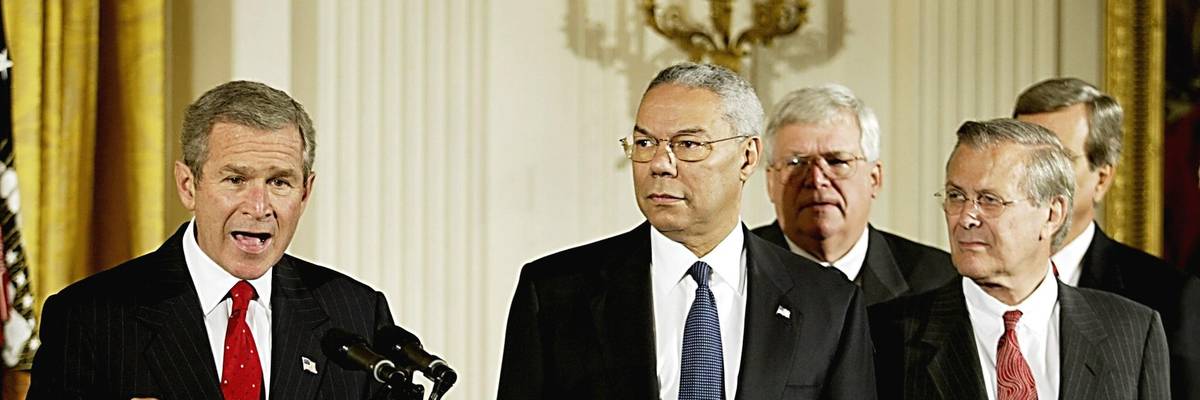
Former U.S. President George W. Bush speaks before signing the joint congressional resolution authorizing the US use of force against Iraq if needed 16 October, 2002 at the White House in Washington, DC. Secretary of Defense Donald Rumsfeld (R), House Speaker Dennis Hastert, R-IL (2nd R), and Secretary of State Colin Powell (C) look on during speech.
The Urbanity of Evil: 20 Years After the US Invasion of Iraq
Vast quantities of lies from top U.S. government officials led up to the Iraq invasion. Now, marking its 20th anniversary, the same media outlets that eagerly boosted those lies are offering retrospectives. Don't expect them to shed light on the most difficult truths, including their own complicity in pushing for war.
What propelled the United States to start the war on Iraq in March 2003 were dynamics of media and politics that are still very much with us today.
Soon after 9/11, one of the rhetorical whips brandished by President George W. Bush was an unequivocal assertion while speaking to a joint session of Congress on Sept. 20, 2001: "Every nation, in every region, now has a decision to make. Either you are with us, or you are with the terrorists." Thrown down, that gauntlet received adulation and scant criticism in the United States. Mainstream media and members of Congress were almost all enthralled with a Manichean worldview that has evolved and persisted.
Our current era is filled with echoes of such oratory from the current president. A few months before fist-bumping Saudi Arabia's de facto ruler Mohammed bin Salman—who's been in charge of a tyrannical regime making war on Yemen, causing several hundred thousand deaths since 2015 with U.S. government help—Joe Biden mounted a pulpit of supreme virtue during his 2022 State of the Union address.
Biden proclaimed "an unwavering resolve that freedom will always triumph over tyranny." And he added that "in the battle between democracy and autocracies, democracies are rising to the moment." Of course, there was no mention of his support for Saudi autocracy and war.
In that State of the Union speech, Biden devoted much emphasis to condemning Russia's war on Ukraine, as he has many times since. Biden's presidential hypocrisies do not in any way justify the horrors that Russian forces are inflicting in Ukraine. Nor does that war justify the deadly hypocrisies that pervade U.S. foreign policy.
This week, don't hold your breath for media retrospectives about the Iraq invasion to include basic facts about the key roles of Biden and the man who is now secretary of state, Antony Blinken. When they each denounce Russia while solemnly insisting that it is absolutely unacceptable for one country to invade another, the Orwellian efforts are brazen and shameless.
Last month, speaking to the UN Security Council, Blinken invoked "the principles and rules that make all countries safer and more secure"—such as "no seizing land by force" and "no wars of aggression." But Biden and Blinken were crucial accessories to the massive war of aggression that was the invasion of Iraq. On the very rare occasions when Biden has been put on the spot for how he helped make the invasion politically possible, his response has been to dissemble and tell outright lies.
"Biden has a long history of inaccurate claims" regarding Iraq, scholar Stephen Zunes pointed out four years ago. "For example, in the lead-up to the critical Senate vote authorizing the invasion, Biden used his role as chair of the Senate Foreign Relations Committee to insist that Iraq somehow reconstituted a vast arsenal of chemical and biological weapons, a nuclear weapons program and sophisticated delivery systems that had long since been eliminated." The false claim of supposed weapons of mass destruction in Iraq was the main pretext for the invasion.
That falsehood was challenged in real time, many months before the invasion, by numerous experts. But then-Senator Biden, wielding the gavel of the Foreign Relations Committee, excluded them all from two days of high-impact sham hearings in mid-summer 2002.
And who was the chief of staff of the committee at that time? The current secretary of state, Antony Blinken.
We're apt to put Biden and Blinken in a completely different category than someone like Tariq Aziz, who was Iraq's deputy prime minister under despot Saddam Hussein. But, thinking back to the three meetings with Aziz that I attended in Baghdad during the months before the invasion, I have some doubts.
Aziz wore nicely tailored business suits. Speaking excellent English in measured tones and well-crafted sentences, he had an erudite air with no lack of politesse as he greeted our four-member delegation (which I had organized with colleagues at the Institute for Public Accuracy). Our group included Congressman Nick Rahall of West Virginia, former South Dakota senator James Abourezk and Conscience International president James Jennings. As it turned out, the meeting occurred six months before the invasion.
At the time of that meeting in mid-September 2002, Aziz was able to concisely sum up a reality that few U.S. media outlets were acknowledging. "It's doomed if you do, doomed if you don't," Aziz said, referring to the Iraqi government's choice of whether to let UN weapons inspectors back into the country.
After meetings with Aziz and other Iraqi officials, I told the Washington Post: "If it was strictly a matter of the inspections and they felt there was a light at the end of the tunnel, this would be a totally fixable problem." But it was far from being strictly a matter of the inspections. The Bush administration was determined to make war on Iraq.
A couple of days after the Aziz meeting, Iraq's regime—which was accurately stating that it had no weapons of mass destruction—announced that it would allow UN inspectors back into the country. (They had been withdrawn four years earlier for their safety on the eve of an anticipated U.S. bombing attack that took place for four days.) But compliance with the United Nations was to no avail. The U.S. government leaders wanted to launch an invasion of Iraq, no matter what.
During two later meetings with Aziz, in December 2002 and January 2003, I was repeatedly struck by his capacity to seem cultured and refined. While the main spokesperson for a vicious dictator, he exuded sophistication. I thought of the words "the urbanity of evil."
A well-informed source told me that Saddam Hussein maintained some kind of leverage over Aziz by keeping his son in jeopardy of imprisonment or worse, lest Aziz become a defector. Whether or not that was the case, Deputy Prime Minister Aziz remained loyal to the end. As someone in Jean Renoir's film The Rules of the Game says, "The awful thing about life is this: Everybody has their reasons."
Tariq Aziz had good reasons to fear for his life—and the lives of loved ones—if he ran afoul of Saddam. In contrast, many politicians and officials in Washington have gone along with murderous policies when dissenting might cost them only re-election, prestige, money or power.
I last saw Aziz in January 2003, while accompanying a former UN Humanitarian Coordinator in Iraq to meet with him. Talking to the two of us in his Baghdad office, Aziz seemed to know an invasion was virtually certain. It began two months later. The Pentagon was pleased to brand its horrific air attacks on the city "shock and awe."
On July 1, 2004, appearing before an Iraqi judge in a courtroom located on a U.S. military base near Baghdad airport, Aziz said: "What I want to know is, are these charges personal? Is it Tariq Aziz carrying out these killings? If I am a member of a government that makes the mistake of killing someone, then there can't justifiably be an accusation against me personally. Where there is a crime committed by the leadership, the moral responsibility rests there, and there shouldn't be a personal case just because somebody belongs to the leadership." And, Aziz went on to say, "I never killed anybody, by the acts of my own hand."
The invasion that Joe Biden helped to inflict on Iraq resulted in a war that directly killed several hundred thousand civilians. If he were ever really called to account for his role, Biden's words might resemble those of Tariq Aziz.
We are at a crossroads
This country and this world are at a monumental crossroads. In a few short weeks, US voters will have an opportunity to beat back the forces of fascism and confront the billionaires who are rigging the economy, our media system, and our democracy, making it increasingly impossible for ordinary people to get by. We’re not just talking about the election. We’re talking about what must be done once these fascist elements are vanquished from power. We need a bolder set of solutions than what either major party has so far been willing to offer and a working-class movement ready to fight like hell for it. Trump didn't emerge from nowhere. The conditions that fueled MAGA authoritarianism were created by decades of radical neoliberal economic policies and a corrupt political system dominated by corporate interests. They slashed taxes on the super-rich, promising that the benefits would trickle down. They said giveaways to the corporate titans would make life more affordable for the rest of us. It was all bullshit. And when a bitter, betrayed populace searches for someone to blame, right-wing demagogues have little trouble finding scapegoats. People know when they're being lied to, but you won't hear any of this from the corporate media. Only independent journalism—powered and funded by people who believe in building a better world—can deliver truly trustworthy daily news. Our Fall Campaign is underway, and we need your help. To power our newsroom through the rest of the year, we need to raise $125,000 by midnight on October 31. So if you share our vision, please contribute whatever you can to sustain our work. |
Norman Solomon is the national director of RootsAction.org and executive director of the Institute for Public Accuracy. The paperback edition of his latest book, War Made Invisible: How America Hides the Human Toll of Its Military Machine, includes an afterword about the Gaza war.
Vast quantities of lies from top U.S. government officials led up to the Iraq invasion. Now, marking its 20th anniversary, the same media outlets that eagerly boosted those lies are offering retrospectives. Don't expect them to shed light on the most difficult truths, including their own complicity in pushing for war.
What propelled the United States to start the war on Iraq in March 2003 were dynamics of media and politics that are still very much with us today.
Soon after 9/11, one of the rhetorical whips brandished by President George W. Bush was an unequivocal assertion while speaking to a joint session of Congress on Sept. 20, 2001: "Every nation, in every region, now has a decision to make. Either you are with us, or you are with the terrorists." Thrown down, that gauntlet received adulation and scant criticism in the United States. Mainstream media and members of Congress were almost all enthralled with a Manichean worldview that has evolved and persisted.
Our current era is filled with echoes of such oratory from the current president. A few months before fist-bumping Saudi Arabia's de facto ruler Mohammed bin Salman—who's been in charge of a tyrannical regime making war on Yemen, causing several hundred thousand deaths since 2015 with U.S. government help—Joe Biden mounted a pulpit of supreme virtue during his 2022 State of the Union address.
Biden proclaimed "an unwavering resolve that freedom will always triumph over tyranny." And he added that "in the battle between democracy and autocracies, democracies are rising to the moment." Of course, there was no mention of his support for Saudi autocracy and war.
In that State of the Union speech, Biden devoted much emphasis to condemning Russia's war on Ukraine, as he has many times since. Biden's presidential hypocrisies do not in any way justify the horrors that Russian forces are inflicting in Ukraine. Nor does that war justify the deadly hypocrisies that pervade U.S. foreign policy.
This week, don't hold your breath for media retrospectives about the Iraq invasion to include basic facts about the key roles of Biden and the man who is now secretary of state, Antony Blinken. When they each denounce Russia while solemnly insisting that it is absolutely unacceptable for one country to invade another, the Orwellian efforts are brazen and shameless.
Last month, speaking to the UN Security Council, Blinken invoked "the principles and rules that make all countries safer and more secure"—such as "no seizing land by force" and "no wars of aggression." But Biden and Blinken were crucial accessories to the massive war of aggression that was the invasion of Iraq. On the very rare occasions when Biden has been put on the spot for how he helped make the invasion politically possible, his response has been to dissemble and tell outright lies.
"Biden has a long history of inaccurate claims" regarding Iraq, scholar Stephen Zunes pointed out four years ago. "For example, in the lead-up to the critical Senate vote authorizing the invasion, Biden used his role as chair of the Senate Foreign Relations Committee to insist that Iraq somehow reconstituted a vast arsenal of chemical and biological weapons, a nuclear weapons program and sophisticated delivery systems that had long since been eliminated." The false claim of supposed weapons of mass destruction in Iraq was the main pretext for the invasion.
That falsehood was challenged in real time, many months before the invasion, by numerous experts. But then-Senator Biden, wielding the gavel of the Foreign Relations Committee, excluded them all from two days of high-impact sham hearings in mid-summer 2002.
And who was the chief of staff of the committee at that time? The current secretary of state, Antony Blinken.
We're apt to put Biden and Blinken in a completely different category than someone like Tariq Aziz, who was Iraq's deputy prime minister under despot Saddam Hussein. But, thinking back to the three meetings with Aziz that I attended in Baghdad during the months before the invasion, I have some doubts.
Aziz wore nicely tailored business suits. Speaking excellent English in measured tones and well-crafted sentences, he had an erudite air with no lack of politesse as he greeted our four-member delegation (which I had organized with colleagues at the Institute for Public Accuracy). Our group included Congressman Nick Rahall of West Virginia, former South Dakota senator James Abourezk and Conscience International president James Jennings. As it turned out, the meeting occurred six months before the invasion.
At the time of that meeting in mid-September 2002, Aziz was able to concisely sum up a reality that few U.S. media outlets were acknowledging. "It's doomed if you do, doomed if you don't," Aziz said, referring to the Iraqi government's choice of whether to let UN weapons inspectors back into the country.
After meetings with Aziz and other Iraqi officials, I told the Washington Post: "If it was strictly a matter of the inspections and they felt there was a light at the end of the tunnel, this would be a totally fixable problem." But it was far from being strictly a matter of the inspections. The Bush administration was determined to make war on Iraq.
A couple of days after the Aziz meeting, Iraq's regime—which was accurately stating that it had no weapons of mass destruction—announced that it would allow UN inspectors back into the country. (They had been withdrawn four years earlier for their safety on the eve of an anticipated U.S. bombing attack that took place for four days.) But compliance with the United Nations was to no avail. The U.S. government leaders wanted to launch an invasion of Iraq, no matter what.
During two later meetings with Aziz, in December 2002 and January 2003, I was repeatedly struck by his capacity to seem cultured and refined. While the main spokesperson for a vicious dictator, he exuded sophistication. I thought of the words "the urbanity of evil."
A well-informed source told me that Saddam Hussein maintained some kind of leverage over Aziz by keeping his son in jeopardy of imprisonment or worse, lest Aziz become a defector. Whether or not that was the case, Deputy Prime Minister Aziz remained loyal to the end. As someone in Jean Renoir's film The Rules of the Game says, "The awful thing about life is this: Everybody has their reasons."
Tariq Aziz had good reasons to fear for his life—and the lives of loved ones—if he ran afoul of Saddam. In contrast, many politicians and officials in Washington have gone along with murderous policies when dissenting might cost them only re-election, prestige, money or power.
I last saw Aziz in January 2003, while accompanying a former UN Humanitarian Coordinator in Iraq to meet with him. Talking to the two of us in his Baghdad office, Aziz seemed to know an invasion was virtually certain. It began two months later. The Pentagon was pleased to brand its horrific air attacks on the city "shock and awe."
On July 1, 2004, appearing before an Iraqi judge in a courtroom located on a U.S. military base near Baghdad airport, Aziz said: "What I want to know is, are these charges personal? Is it Tariq Aziz carrying out these killings? If I am a member of a government that makes the mistake of killing someone, then there can't justifiably be an accusation against me personally. Where there is a crime committed by the leadership, the moral responsibility rests there, and there shouldn't be a personal case just because somebody belongs to the leadership." And, Aziz went on to say, "I never killed anybody, by the acts of my own hand."
The invasion that Joe Biden helped to inflict on Iraq resulted in a war that directly killed several hundred thousand civilians. If he were ever really called to account for his role, Biden's words might resemble those of Tariq Aziz.
- Opinion | 20 Years After the Invasion of Iraq, Will the Media's Complicity Be Flushed Down the Memory Hole? | Common Dreams ›
- Opinion | Rebuilding the Iraqi Economy 20 Years After US Invasion | Common Dreams ›
- Opinion | How US Media Hide Truths About the Gaza War | Common Dreams ›
Norman Solomon is the national director of RootsAction.org and executive director of the Institute for Public Accuracy. The paperback edition of his latest book, War Made Invisible: How America Hides the Human Toll of Its Military Machine, includes an afterword about the Gaza war.
Vast quantities of lies from top U.S. government officials led up to the Iraq invasion. Now, marking its 20th anniversary, the same media outlets that eagerly boosted those lies are offering retrospectives. Don't expect them to shed light on the most difficult truths, including their own complicity in pushing for war.
What propelled the United States to start the war on Iraq in March 2003 were dynamics of media and politics that are still very much with us today.
Soon after 9/11, one of the rhetorical whips brandished by President George W. Bush was an unequivocal assertion while speaking to a joint session of Congress on Sept. 20, 2001: "Every nation, in every region, now has a decision to make. Either you are with us, or you are with the terrorists." Thrown down, that gauntlet received adulation and scant criticism in the United States. Mainstream media and members of Congress were almost all enthralled with a Manichean worldview that has evolved and persisted.
Our current era is filled with echoes of such oratory from the current president. A few months before fist-bumping Saudi Arabia's de facto ruler Mohammed bin Salman—who's been in charge of a tyrannical regime making war on Yemen, causing several hundred thousand deaths since 2015 with U.S. government help—Joe Biden mounted a pulpit of supreme virtue during his 2022 State of the Union address.
Biden proclaimed "an unwavering resolve that freedom will always triumph over tyranny." And he added that "in the battle between democracy and autocracies, democracies are rising to the moment." Of course, there was no mention of his support for Saudi autocracy and war.
In that State of the Union speech, Biden devoted much emphasis to condemning Russia's war on Ukraine, as he has many times since. Biden's presidential hypocrisies do not in any way justify the horrors that Russian forces are inflicting in Ukraine. Nor does that war justify the deadly hypocrisies that pervade U.S. foreign policy.
This week, don't hold your breath for media retrospectives about the Iraq invasion to include basic facts about the key roles of Biden and the man who is now secretary of state, Antony Blinken. When they each denounce Russia while solemnly insisting that it is absolutely unacceptable for one country to invade another, the Orwellian efforts are brazen and shameless.
Last month, speaking to the UN Security Council, Blinken invoked "the principles and rules that make all countries safer and more secure"—such as "no seizing land by force" and "no wars of aggression." But Biden and Blinken were crucial accessories to the massive war of aggression that was the invasion of Iraq. On the very rare occasions when Biden has been put on the spot for how he helped make the invasion politically possible, his response has been to dissemble and tell outright lies.
"Biden has a long history of inaccurate claims" regarding Iraq, scholar Stephen Zunes pointed out four years ago. "For example, in the lead-up to the critical Senate vote authorizing the invasion, Biden used his role as chair of the Senate Foreign Relations Committee to insist that Iraq somehow reconstituted a vast arsenal of chemical and biological weapons, a nuclear weapons program and sophisticated delivery systems that had long since been eliminated." The false claim of supposed weapons of mass destruction in Iraq was the main pretext for the invasion.
That falsehood was challenged in real time, many months before the invasion, by numerous experts. But then-Senator Biden, wielding the gavel of the Foreign Relations Committee, excluded them all from two days of high-impact sham hearings in mid-summer 2002.
And who was the chief of staff of the committee at that time? The current secretary of state, Antony Blinken.
We're apt to put Biden and Blinken in a completely different category than someone like Tariq Aziz, who was Iraq's deputy prime minister under despot Saddam Hussein. But, thinking back to the three meetings with Aziz that I attended in Baghdad during the months before the invasion, I have some doubts.
Aziz wore nicely tailored business suits. Speaking excellent English in measured tones and well-crafted sentences, he had an erudite air with no lack of politesse as he greeted our four-member delegation (which I had organized with colleagues at the Institute for Public Accuracy). Our group included Congressman Nick Rahall of West Virginia, former South Dakota senator James Abourezk and Conscience International president James Jennings. As it turned out, the meeting occurred six months before the invasion.
At the time of that meeting in mid-September 2002, Aziz was able to concisely sum up a reality that few U.S. media outlets were acknowledging. "It's doomed if you do, doomed if you don't," Aziz said, referring to the Iraqi government's choice of whether to let UN weapons inspectors back into the country.
After meetings with Aziz and other Iraqi officials, I told the Washington Post: "If it was strictly a matter of the inspections and they felt there was a light at the end of the tunnel, this would be a totally fixable problem." But it was far from being strictly a matter of the inspections. The Bush administration was determined to make war on Iraq.
A couple of days after the Aziz meeting, Iraq's regime—which was accurately stating that it had no weapons of mass destruction—announced that it would allow UN inspectors back into the country. (They had been withdrawn four years earlier for their safety on the eve of an anticipated U.S. bombing attack that took place for four days.) But compliance with the United Nations was to no avail. The U.S. government leaders wanted to launch an invasion of Iraq, no matter what.
During two later meetings with Aziz, in December 2002 and January 2003, I was repeatedly struck by his capacity to seem cultured and refined. While the main spokesperson for a vicious dictator, he exuded sophistication. I thought of the words "the urbanity of evil."
A well-informed source told me that Saddam Hussein maintained some kind of leverage over Aziz by keeping his son in jeopardy of imprisonment or worse, lest Aziz become a defector. Whether or not that was the case, Deputy Prime Minister Aziz remained loyal to the end. As someone in Jean Renoir's film The Rules of the Game says, "The awful thing about life is this: Everybody has their reasons."
Tariq Aziz had good reasons to fear for his life—and the lives of loved ones—if he ran afoul of Saddam. In contrast, many politicians and officials in Washington have gone along with murderous policies when dissenting might cost them only re-election, prestige, money or power.
I last saw Aziz in January 2003, while accompanying a former UN Humanitarian Coordinator in Iraq to meet with him. Talking to the two of us in his Baghdad office, Aziz seemed to know an invasion was virtually certain. It began two months later. The Pentagon was pleased to brand its horrific air attacks on the city "shock and awe."
On July 1, 2004, appearing before an Iraqi judge in a courtroom located on a U.S. military base near Baghdad airport, Aziz said: "What I want to know is, are these charges personal? Is it Tariq Aziz carrying out these killings? If I am a member of a government that makes the mistake of killing someone, then there can't justifiably be an accusation against me personally. Where there is a crime committed by the leadership, the moral responsibility rests there, and there shouldn't be a personal case just because somebody belongs to the leadership." And, Aziz went on to say, "I never killed anybody, by the acts of my own hand."
The invasion that Joe Biden helped to inflict on Iraq resulted in a war that directly killed several hundred thousand civilians. If he were ever really called to account for his role, Biden's words might resemble those of Tariq Aziz.
- Opinion | 20 Years After the Invasion of Iraq, Will the Media's Complicity Be Flushed Down the Memory Hole? | Common Dreams ›
- Opinion | Rebuilding the Iraqi Economy 20 Years After US Invasion | Common Dreams ›
- Opinion | How US Media Hide Truths About the Gaza War | Common Dreams ›