SUBSCRIBE TO OUR FREE NEWSLETTER
Daily news & progressive opinion—funded by the people, not the corporations—delivered straight to your inbox.
5
#000000
#FFFFFF
To donate by check, phone, or other method, see our More Ways to Give page.
Daily news & progressive opinion—funded by the people, not the corporations—delivered straight to your inbox.
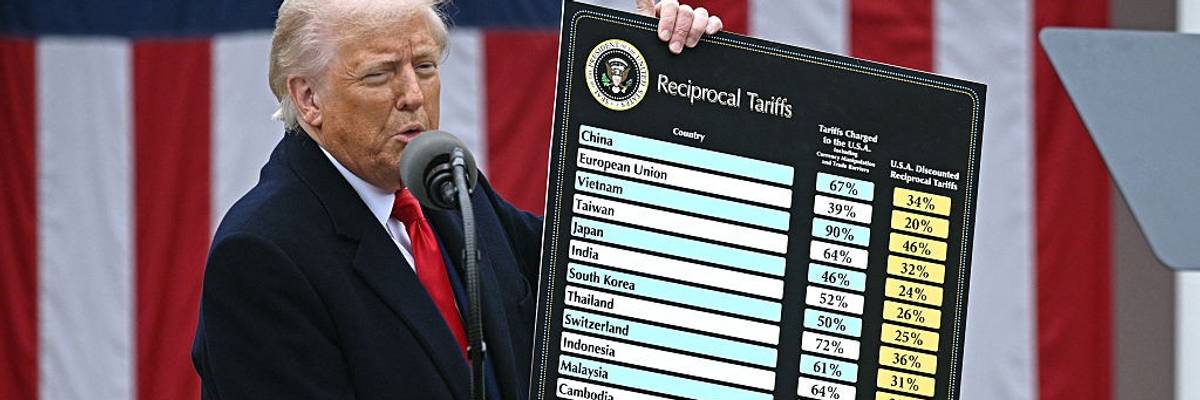
US President Donald Trump delivers remarks on reciprocal tariffs as US Secretary of Commerce Howard Lutnick holds a chart during an event in the Rose Garden entitled "Make America Wealthy Again" at the White House in Washington, DC, on April 2, 2025.
The decision is a sign that US institutions are attempting to claw back authority from an overreaching executive.
The Supreme Court’s decision is clear. The president did not have the authority to impose most of his tariffs.
President Donald Trump argued that, under the International Emergency Economic Powers Act, his actions were justified because of a national emergency caused by a foreign threat. In the 6-3 ruling, the court said that, on the contrary, that act provides Congress with that authority, which hadn’t delegated it to the president. The tariffs left standing are largely by sector: cars, semiconductors, steel.
Trump, like the infamous honey badger, don’t care.
The president immediately insulted the six justices who ruled against him, calling them “disloyal, unpatriotic” and “lapdogs… for the radical left Democrats.” Then he turned around and reimposed a global 15% tariff rate.
The court decision—on top of other judicial setbacks Trump has faced—may well mark the high tide of the president’s overreach.
For a lot of countries, that new rate is actually an improvement. Mexico and Canada have faced higher tariffs, at least for products not covered under the existing US-Mexico-Canada Agreement. China, Brazil, and India will also benefit from the court decision. But for countries that negotiated lower rates with the Trump team—Japan, Indonesia—it’s a slap in the face. That should teach them to made deals with the devil.
To justify his reassertion of tariffs, Trump is using another law, which establishes a ceiling of 15% and a 150-day limit before Congress can weigh in. No previous president has invoked this law to impose tariffs. For good reason: its provisions reference not a trade deficit but an “international payments problem” connected to fixed exchange rates and the gold standard, a world that no longer exists. As such, Trump is simply graduating from one illegality to another. It may not be long before Trump dispenses altogether with his misinterpretation of esoteric laws to sanctify his lawlessness.
A sensible president might have used the court decision as an opportunity to jettison an unpopular policy and pivot toward “affordability” in the run-up to the midterm elections in November, as his advisers have been urging. But that’s not Trump’s style. He almost always doubles down in the face of resistance.
And resistance there will be. The court ruling opens up the possibility for companies to file suit against the US government to recover costs associated with the tariffs. In his dissenting opinion, Brett “OG Lapdog” Kavanagh warned that this could usher in a “mess.” Perhaps Kavanagh slept through his econ classes at Yale, because the “mess” was already created by Trump’s chaotic approach to trade in the first place.
Trump’s intransigence will naturally interfere with a court-driven effort to restore a measure of predictability to US trade policy. However, perhaps the court decision—on top of other judicial setbacks Trump has faced—may well mark the high tide of the president’s overreach. Low approval ratings, pushback by some Republicans against Trump’s federal diktats, intimations of rebellion from countries like Canada: These are signs that guardrails are going back up to protect against a presidential monster truck gone amok.
The United States continues to run a huge trade deficit—in goods and services—of roughly $901 billion. There was a slight decline last year—of $2 billion—that amounted to a reduction of 0.2%—a far cry from the 78% decline that Trump has claimed. Worse, from Trump’s point of view, the deficit in goods—which his tariffs were supposed to target—went up 2.1%.
Okay, but hasn’t the United States pulled in a lot of revenue from these tariffs? With an effective rate of 11.7%—the average for the previous two years was 2.7%—tariffs brought in $194.8 billion in 2025. That’s not a small figure. It ends up in the same place as domestic taxes: the US treasury. From there, Congress makes decisions regarding spending (which the Trump administration has, on occasion, unconstitionally ignored).
The more important concern is: Who pays?
The president imposed these tariffs in order to help American businesses. Those same businesses are saying pretty clearly, “No, thank you.”
A majority of Republicans believes that foreigners pay the cost of these tariffs. They are just following the president, who argued this week in his State of the Union that “tariffs, paid for by foreign countries, will, like in the past, substantially replace the modern-day system of income tax.”
However, since they apply to goods entering the United States from other countries, it’s actually American importers who pay the tax. That includes car manufacturers that are using foreign-made components, big retailers like Walmart that are selling foreign-made products, and service providers like FedEx that deliver goods across borders.
Ordinarily, US companies will pass on the cost of tariffs to the consumer. And there has been an overall increase in inflation over the last year: an uptick of 2.7% in consumer prices in December 2025 from the year before. The rising cost of autos is a case in point. The average cost of a car hit a new record in December at just over $50,000. And that’s with car companies making the decision not to pass on to the consumer many of the additional costs associated with imported components. Companies are not likely to continue swallowing their losses in 2026.
It’s not just consumers who are paying for the tariffs in the form of higher costs. It’s also American farmers who aren’t selling their soybeans to China because of the reciprocal tariffs that Beijing has imposed. This year, crop farmers in the United States lost nearly $35 billion, though not all of that can be connected to tariffs. The $12 billion the Trump administration has pledged in agricultural assistance this year only goes part of the way to limit the damage.
The Supreme Court decision opens up the possibility for companies to sue the federal government to recover some of the costs inflated by the tariffs. According to economists at Wharton, the total could reach as high as $175 billion. If companies went after that full amount, that would leave only $20 billion of the tariff revenues in the federal kitty.
To get the issue to the Supreme Court, thousands of companies, including Costco, Revlon, and Goodyear Tires, had already sued the Trump administration. Ford says that it has lost $2 billion because of the tariffs.
Like most bullies, Trump backs down if confronted with comparable power and resolve.
The president imposed these tariffs in order to help American businesses. Those same businesses are saying pretty clearly, “No, thank you.”
FedEx is the first company to take the administration to the US Court of International Trade after the Supreme Court ruling. This federal court, located in New York, already ruled against Trump’s tariffs back in May, with even Trump’s appointee to the court siding against him. Illinois Gov. JB Pritzker has also sent Washington a bill for $8.6 billion, the proceeds to be distributed to all of the state’s households.
Trump promised to run the country like a business. But he has more experience navigating bankruptcy than posting genuine profits.
The US president is still exercising his erratic unilateralism in the global arena. He continues to threaten Iran with military strikes if it doesn’t bend to his will. He has encircled Cuba with a new embargo covering oil shipments. The Pentagon is still bombing alleged narco-traffickers in the Caribbean and eastern Pacific, with six strikes this month alone.
But the Supreme Court decision is a sign that US institutions are attempting to claw back authority from an overreaching executive. Some Republicans have pushed back against Trump’s insane moves to seize Greenland. CEOs and the Chamber of Commerce are starting to test the waters with mild criticisms of Trump’s economically destabilizing policies. Back in December, the Republican-controlled Senate in Idaho rejected the redistricting plan the Trump administration was trying to push down the state’s throat.
It’s not as if Trump will mature into the job of president. He is, after all, already well into his second childhood.
The president has abysmal approval ratings. But it’s not so much fear of public disapproval as of Trump’s retribution that has kept critics within his party and in the economic elite in line. Politicians prefer to retire—Marjorie Taylor Greene from the House, Thom Tillis from the Senate—rather than face the outpouring of hate and death threats that Trump unleashes when he wants you out of office.
Like most bullies, Trump backs down if confronted with comparable power and resolve. China played chicken with Trump over tariffs, and the US president swerved out of the way. The power of the street in Minnesota forced the administration to reduce its Immigration and Customs Enforcement presence in the state. And some independent-thinking Republicans are standing firm—Lisa Murkowski from Alaska, Thomas Massie and Rand Paul from Kentucky.
Trump seems to be growing increasingly erratic. He has threatened Iran with not just a targeted attack but a rapid escalation. He has lashed out against his judicial allies (like Neil Gorsuch on the court). Rather than deal with all the backlash against his heavy-handed approach to the Kennedy Center programming, he decided just to close down the center “for repairs.”
The president’s attention-deficit problems are legendary. His unlimited capacity to insult people goes all the way back to his youth. But his most recent tirades seem to be tinged with desperation, like the tantrums of a child who can’t get out of the crib no matter how much it screams and shakes its rattle.
It’s not as if Trump will mature into the job of president. He is, after all, already well into his second childhood. The only solution is to take away his toys before he hurts himself and everyone else. The Supreme Court has shown the way.
Dear Common Dreams reader, It’s been nearly 30 years since I co-founded Common Dreams with my late wife, Lina Newhouser. We had the radical notion that journalism should serve the public good, not corporate profits. It was clear to us from the outset what it would take to build such a project. No paid advertisements. No corporate sponsors. No millionaire publisher telling us what to think or do. Many people said we wouldn't last a year, but we proved those doubters wrong. Together with a tremendous team of journalists and dedicated staff, we built an independent media outlet free from the constraints of profits and corporate control. Our mission has always been simple: To inform. To inspire. To ignite change for the common good. Building Common Dreams was not easy. Our survival was never guaranteed. When you take on the most powerful forces—Wall Street greed, fossil fuel industry destruction, Big Tech lobbyists, and uber-rich oligarchs who have spent billions upon billions rigging the economy and democracy in their favor—the only bulwark you have is supporters who believe in your work. But here’s the urgent message from me today. It's never been this bad out there. And it's never been this hard to keep us going. At the very moment Common Dreams is most needed, the threats we face are intensifying. We need your support now more than ever. We don't accept corporate advertising and never will. We don't have a paywall because we don't think people should be blocked from critical news based on their ability to pay. Everything we do is funded by the donations of readers like you. When everyone does the little they can afford, we are strong. But if that support retreats or dries up, so do we. Will you donate now to make sure Common Dreams not only survives but thrives? —Craig Brown, Co-founder |
The Supreme Court’s decision is clear. The president did not have the authority to impose most of his tariffs.
President Donald Trump argued that, under the International Emergency Economic Powers Act, his actions were justified because of a national emergency caused by a foreign threat. In the 6-3 ruling, the court said that, on the contrary, that act provides Congress with that authority, which hadn’t delegated it to the president. The tariffs left standing are largely by sector: cars, semiconductors, steel.
Trump, like the infamous honey badger, don’t care.
The president immediately insulted the six justices who ruled against him, calling them “disloyal, unpatriotic” and “lapdogs… for the radical left Democrats.” Then he turned around and reimposed a global 15% tariff rate.
The court decision—on top of other judicial setbacks Trump has faced—may well mark the high tide of the president’s overreach.
For a lot of countries, that new rate is actually an improvement. Mexico and Canada have faced higher tariffs, at least for products not covered under the existing US-Mexico-Canada Agreement. China, Brazil, and India will also benefit from the court decision. But for countries that negotiated lower rates with the Trump team—Japan, Indonesia—it’s a slap in the face. That should teach them to made deals with the devil.
To justify his reassertion of tariffs, Trump is using another law, which establishes a ceiling of 15% and a 150-day limit before Congress can weigh in. No previous president has invoked this law to impose tariffs. For good reason: its provisions reference not a trade deficit but an “international payments problem” connected to fixed exchange rates and the gold standard, a world that no longer exists. As such, Trump is simply graduating from one illegality to another. It may not be long before Trump dispenses altogether with his misinterpretation of esoteric laws to sanctify his lawlessness.
A sensible president might have used the court decision as an opportunity to jettison an unpopular policy and pivot toward “affordability” in the run-up to the midterm elections in November, as his advisers have been urging. But that’s not Trump’s style. He almost always doubles down in the face of resistance.
And resistance there will be. The court ruling opens up the possibility for companies to file suit against the US government to recover costs associated with the tariffs. In his dissenting opinion, Brett “OG Lapdog” Kavanagh warned that this could usher in a “mess.” Perhaps Kavanagh slept through his econ classes at Yale, because the “mess” was already created by Trump’s chaotic approach to trade in the first place.
Trump’s intransigence will naturally interfere with a court-driven effort to restore a measure of predictability to US trade policy. However, perhaps the court decision—on top of other judicial setbacks Trump has faced—may well mark the high tide of the president’s overreach. Low approval ratings, pushback by some Republicans against Trump’s federal diktats, intimations of rebellion from countries like Canada: These are signs that guardrails are going back up to protect against a presidential monster truck gone amok.
The United States continues to run a huge trade deficit—in goods and services—of roughly $901 billion. There was a slight decline last year—of $2 billion—that amounted to a reduction of 0.2%—a far cry from the 78% decline that Trump has claimed. Worse, from Trump’s point of view, the deficit in goods—which his tariffs were supposed to target—went up 2.1%.
Okay, but hasn’t the United States pulled in a lot of revenue from these tariffs? With an effective rate of 11.7%—the average for the previous two years was 2.7%—tariffs brought in $194.8 billion in 2025. That’s not a small figure. It ends up in the same place as domestic taxes: the US treasury. From there, Congress makes decisions regarding spending (which the Trump administration has, on occasion, unconstitionally ignored).
The more important concern is: Who pays?
The president imposed these tariffs in order to help American businesses. Those same businesses are saying pretty clearly, “No, thank you.”
A majority of Republicans believes that foreigners pay the cost of these tariffs. They are just following the president, who argued this week in his State of the Union that “tariffs, paid for by foreign countries, will, like in the past, substantially replace the modern-day system of income tax.”
However, since they apply to goods entering the United States from other countries, it’s actually American importers who pay the tax. That includes car manufacturers that are using foreign-made components, big retailers like Walmart that are selling foreign-made products, and service providers like FedEx that deliver goods across borders.
Ordinarily, US companies will pass on the cost of tariffs to the consumer. And there has been an overall increase in inflation over the last year: an uptick of 2.7% in consumer prices in December 2025 from the year before. The rising cost of autos is a case in point. The average cost of a car hit a new record in December at just over $50,000. And that’s with car companies making the decision not to pass on to the consumer many of the additional costs associated with imported components. Companies are not likely to continue swallowing their losses in 2026.
It’s not just consumers who are paying for the tariffs in the form of higher costs. It’s also American farmers who aren’t selling their soybeans to China because of the reciprocal tariffs that Beijing has imposed. This year, crop farmers in the United States lost nearly $35 billion, though not all of that can be connected to tariffs. The $12 billion the Trump administration has pledged in agricultural assistance this year only goes part of the way to limit the damage.
The Supreme Court decision opens up the possibility for companies to sue the federal government to recover some of the costs inflated by the tariffs. According to economists at Wharton, the total could reach as high as $175 billion. If companies went after that full amount, that would leave only $20 billion of the tariff revenues in the federal kitty.
To get the issue to the Supreme Court, thousands of companies, including Costco, Revlon, and Goodyear Tires, had already sued the Trump administration. Ford says that it has lost $2 billion because of the tariffs.
Like most bullies, Trump backs down if confronted with comparable power and resolve.
The president imposed these tariffs in order to help American businesses. Those same businesses are saying pretty clearly, “No, thank you.”
FedEx is the first company to take the administration to the US Court of International Trade after the Supreme Court ruling. This federal court, located in New York, already ruled against Trump’s tariffs back in May, with even Trump’s appointee to the court siding against him. Illinois Gov. JB Pritzker has also sent Washington a bill for $8.6 billion, the proceeds to be distributed to all of the state’s households.
Trump promised to run the country like a business. But he has more experience navigating bankruptcy than posting genuine profits.
The US president is still exercising his erratic unilateralism in the global arena. He continues to threaten Iran with military strikes if it doesn’t bend to his will. He has encircled Cuba with a new embargo covering oil shipments. The Pentagon is still bombing alleged narco-traffickers in the Caribbean and eastern Pacific, with six strikes this month alone.
But the Supreme Court decision is a sign that US institutions are attempting to claw back authority from an overreaching executive. Some Republicans have pushed back against Trump’s insane moves to seize Greenland. CEOs and the Chamber of Commerce are starting to test the waters with mild criticisms of Trump’s economically destabilizing policies. Back in December, the Republican-controlled Senate in Idaho rejected the redistricting plan the Trump administration was trying to push down the state’s throat.
It’s not as if Trump will mature into the job of president. He is, after all, already well into his second childhood.
The president has abysmal approval ratings. But it’s not so much fear of public disapproval as of Trump’s retribution that has kept critics within his party and in the economic elite in line. Politicians prefer to retire—Marjorie Taylor Greene from the House, Thom Tillis from the Senate—rather than face the outpouring of hate and death threats that Trump unleashes when he wants you out of office.
Like most bullies, Trump backs down if confronted with comparable power and resolve. China played chicken with Trump over tariffs, and the US president swerved out of the way. The power of the street in Minnesota forced the administration to reduce its Immigration and Customs Enforcement presence in the state. And some independent-thinking Republicans are standing firm—Lisa Murkowski from Alaska, Thomas Massie and Rand Paul from Kentucky.
Trump seems to be growing increasingly erratic. He has threatened Iran with not just a targeted attack but a rapid escalation. He has lashed out against his judicial allies (like Neil Gorsuch on the court). Rather than deal with all the backlash against his heavy-handed approach to the Kennedy Center programming, he decided just to close down the center “for repairs.”
The president’s attention-deficit problems are legendary. His unlimited capacity to insult people goes all the way back to his youth. But his most recent tirades seem to be tinged with desperation, like the tantrums of a child who can’t get out of the crib no matter how much it screams and shakes its rattle.
It’s not as if Trump will mature into the job of president. He is, after all, already well into his second childhood. The only solution is to take away his toys before he hurts himself and everyone else. The Supreme Court has shown the way.
The Supreme Court’s decision is clear. The president did not have the authority to impose most of his tariffs.
President Donald Trump argued that, under the International Emergency Economic Powers Act, his actions were justified because of a national emergency caused by a foreign threat. In the 6-3 ruling, the court said that, on the contrary, that act provides Congress with that authority, which hadn’t delegated it to the president. The tariffs left standing are largely by sector: cars, semiconductors, steel.
Trump, like the infamous honey badger, don’t care.
The president immediately insulted the six justices who ruled against him, calling them “disloyal, unpatriotic” and “lapdogs… for the radical left Democrats.” Then he turned around and reimposed a global 15% tariff rate.
The court decision—on top of other judicial setbacks Trump has faced—may well mark the high tide of the president’s overreach.
For a lot of countries, that new rate is actually an improvement. Mexico and Canada have faced higher tariffs, at least for products not covered under the existing US-Mexico-Canada Agreement. China, Brazil, and India will also benefit from the court decision. But for countries that negotiated lower rates with the Trump team—Japan, Indonesia—it’s a slap in the face. That should teach them to made deals with the devil.
To justify his reassertion of tariffs, Trump is using another law, which establishes a ceiling of 15% and a 150-day limit before Congress can weigh in. No previous president has invoked this law to impose tariffs. For good reason: its provisions reference not a trade deficit but an “international payments problem” connected to fixed exchange rates and the gold standard, a world that no longer exists. As such, Trump is simply graduating from one illegality to another. It may not be long before Trump dispenses altogether with his misinterpretation of esoteric laws to sanctify his lawlessness.
A sensible president might have used the court decision as an opportunity to jettison an unpopular policy and pivot toward “affordability” in the run-up to the midterm elections in November, as his advisers have been urging. But that’s not Trump’s style. He almost always doubles down in the face of resistance.
And resistance there will be. The court ruling opens up the possibility for companies to file suit against the US government to recover costs associated with the tariffs. In his dissenting opinion, Brett “OG Lapdog” Kavanagh warned that this could usher in a “mess.” Perhaps Kavanagh slept through his econ classes at Yale, because the “mess” was already created by Trump’s chaotic approach to trade in the first place.
Trump’s intransigence will naturally interfere with a court-driven effort to restore a measure of predictability to US trade policy. However, perhaps the court decision—on top of other judicial setbacks Trump has faced—may well mark the high tide of the president’s overreach. Low approval ratings, pushback by some Republicans against Trump’s federal diktats, intimations of rebellion from countries like Canada: These are signs that guardrails are going back up to protect against a presidential monster truck gone amok.
The United States continues to run a huge trade deficit—in goods and services—of roughly $901 billion. There was a slight decline last year—of $2 billion—that amounted to a reduction of 0.2%—a far cry from the 78% decline that Trump has claimed. Worse, from Trump’s point of view, the deficit in goods—which his tariffs were supposed to target—went up 2.1%.
Okay, but hasn’t the United States pulled in a lot of revenue from these tariffs? With an effective rate of 11.7%—the average for the previous two years was 2.7%—tariffs brought in $194.8 billion in 2025. That’s not a small figure. It ends up in the same place as domestic taxes: the US treasury. From there, Congress makes decisions regarding spending (which the Trump administration has, on occasion, unconstitionally ignored).
The more important concern is: Who pays?
The president imposed these tariffs in order to help American businesses. Those same businesses are saying pretty clearly, “No, thank you.”
A majority of Republicans believes that foreigners pay the cost of these tariffs. They are just following the president, who argued this week in his State of the Union that “tariffs, paid for by foreign countries, will, like in the past, substantially replace the modern-day system of income tax.”
However, since they apply to goods entering the United States from other countries, it’s actually American importers who pay the tax. That includes car manufacturers that are using foreign-made components, big retailers like Walmart that are selling foreign-made products, and service providers like FedEx that deliver goods across borders.
Ordinarily, US companies will pass on the cost of tariffs to the consumer. And there has been an overall increase in inflation over the last year: an uptick of 2.7% in consumer prices in December 2025 from the year before. The rising cost of autos is a case in point. The average cost of a car hit a new record in December at just over $50,000. And that’s with car companies making the decision not to pass on to the consumer many of the additional costs associated with imported components. Companies are not likely to continue swallowing their losses in 2026.
It’s not just consumers who are paying for the tariffs in the form of higher costs. It’s also American farmers who aren’t selling their soybeans to China because of the reciprocal tariffs that Beijing has imposed. This year, crop farmers in the United States lost nearly $35 billion, though not all of that can be connected to tariffs. The $12 billion the Trump administration has pledged in agricultural assistance this year only goes part of the way to limit the damage.
The Supreme Court decision opens up the possibility for companies to sue the federal government to recover some of the costs inflated by the tariffs. According to economists at Wharton, the total could reach as high as $175 billion. If companies went after that full amount, that would leave only $20 billion of the tariff revenues in the federal kitty.
To get the issue to the Supreme Court, thousands of companies, including Costco, Revlon, and Goodyear Tires, had already sued the Trump administration. Ford says that it has lost $2 billion because of the tariffs.
Like most bullies, Trump backs down if confronted with comparable power and resolve.
The president imposed these tariffs in order to help American businesses. Those same businesses are saying pretty clearly, “No, thank you.”
FedEx is the first company to take the administration to the US Court of International Trade after the Supreme Court ruling. This federal court, located in New York, already ruled against Trump’s tariffs back in May, with even Trump’s appointee to the court siding against him. Illinois Gov. JB Pritzker has also sent Washington a bill for $8.6 billion, the proceeds to be distributed to all of the state’s households.
Trump promised to run the country like a business. But he has more experience navigating bankruptcy than posting genuine profits.
The US president is still exercising his erratic unilateralism in the global arena. He continues to threaten Iran with military strikes if it doesn’t bend to his will. He has encircled Cuba with a new embargo covering oil shipments. The Pentagon is still bombing alleged narco-traffickers in the Caribbean and eastern Pacific, with six strikes this month alone.
But the Supreme Court decision is a sign that US institutions are attempting to claw back authority from an overreaching executive. Some Republicans have pushed back against Trump’s insane moves to seize Greenland. CEOs and the Chamber of Commerce are starting to test the waters with mild criticisms of Trump’s economically destabilizing policies. Back in December, the Republican-controlled Senate in Idaho rejected the redistricting plan the Trump administration was trying to push down the state’s throat.
It’s not as if Trump will mature into the job of president. He is, after all, already well into his second childhood.
The president has abysmal approval ratings. But it’s not so much fear of public disapproval as of Trump’s retribution that has kept critics within his party and in the economic elite in line. Politicians prefer to retire—Marjorie Taylor Greene from the House, Thom Tillis from the Senate—rather than face the outpouring of hate and death threats that Trump unleashes when he wants you out of office.
Like most bullies, Trump backs down if confronted with comparable power and resolve. China played chicken with Trump over tariffs, and the US president swerved out of the way. The power of the street in Minnesota forced the administration to reduce its Immigration and Customs Enforcement presence in the state. And some independent-thinking Republicans are standing firm—Lisa Murkowski from Alaska, Thomas Massie and Rand Paul from Kentucky.
Trump seems to be growing increasingly erratic. He has threatened Iran with not just a targeted attack but a rapid escalation. He has lashed out against his judicial allies (like Neil Gorsuch on the court). Rather than deal with all the backlash against his heavy-handed approach to the Kennedy Center programming, he decided just to close down the center “for repairs.”
The president’s attention-deficit problems are legendary. His unlimited capacity to insult people goes all the way back to his youth. But his most recent tirades seem to be tinged with desperation, like the tantrums of a child who can’t get out of the crib no matter how much it screams and shakes its rattle.
It’s not as if Trump will mature into the job of president. He is, after all, already well into his second childhood. The only solution is to take away his toys before he hurts himself and everyone else. The Supreme Court has shown the way.