SUBSCRIBE TO OUR FREE NEWSLETTER
Daily news & progressive opinion—funded by the people, not the corporations—delivered straight to your inbox.
5
#000000
#FFFFFF
To donate by check, phone, or other method, see our More Ways to Give page.
Daily news & progressive opinion—funded by the people, not the corporations—delivered straight to your inbox.
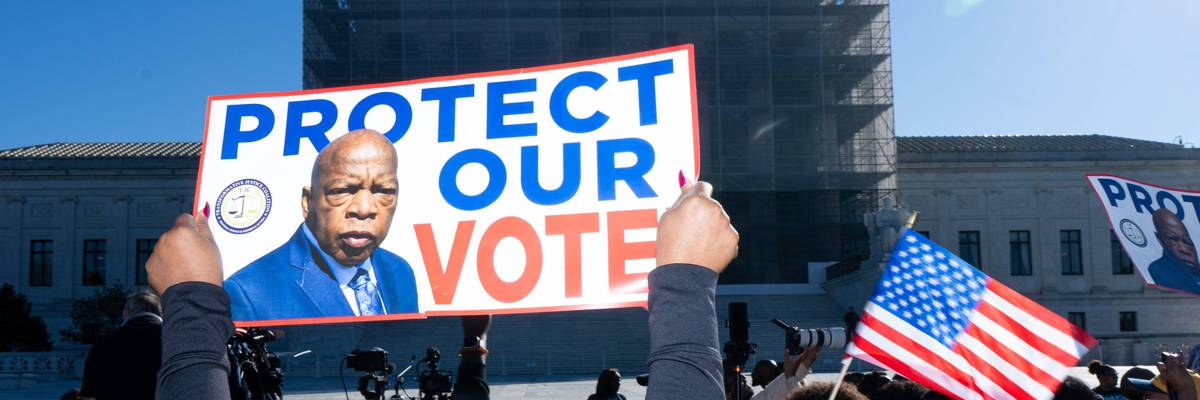
Voting rights activists protest outside the US Supreme Court as the court prepares to hear arguments in a case challenging Louisiana's congressional map in Washington on Wednesday, October 15, 2025.
With the Supreme Court’s rulings against the Voting Rights Act and the Trump administration’s refusal to enforce the Civil Rights Act, they are trying to repeal the legacy of the civil rights movement.
On December 18 1865, Congressman Thaddeus Stevens, Republican from Pennsylvania, during debate on how to treat the traitorous Confederate states and on support for newly freed people who had been enslaved in the United States and in British North America for almost 250 years, warned, “If we fail in this great duty now, when we have the power, we shall deserve and receive the execration of history and of all future ages." The United States failed to rectify injustice in the past, and it is failing once again.
Nikole Hannah-Jones, a key contributor to The New York Times’ award winning The 1619 Project, recently wrote that “The Civil Rights Era Is Collapsing Before Our Eyes.” In Tennessee, the white-dominated Republican controlled state legislature eliminated the state’s only Black majority congressional district after the MAGA-dominated Supreme Court ruled that congressional maps that ensured political representation for African Americans and other racial minorities now violated the Constitution. Other white-dominated, Republican-controlled states are racing to make similar changes. It is as if the Republican Party, with the aid of the Supreme Court, is trying to return the United States to the level of racism that dominated the country in the 19th and first half of the 20th century.
After the Civil War, Congress passed and the states ratified the 13th, 14th, and 15th Reconstruction Amendments to the United States Constitution. The 13th Amendment ended chattel slavery in the United States. The 14th Amendment defined citizenship to include people born in the United States with very limited exceptions and ensured that all persons, whether citizens or not, were entitled to legal due process. The 15th Amendment prevented states and localities from denying Black men the right to vote. Each amendment included a clause that “Congress shall have the power to enforce, by appropriate legislation, the provisions of this article.” Rebelling Confederate states were required to approve the 14th and 15th Amendments to fully reenter the Union.
A right-wing dominated Supreme Court then proceeded to systematically emasculate the amendments and supporting legislation including the Civil Rights Act of 1866, the Reconstruction Acts of 1867, the Enforcement Acts of 1870 and 1871, and the Civil Rights Act of 1875. The first Civil Rights Act enforced the 13th Amendment after a number of Southern states passed "Black Codes" to limit the rights of freedmen, and the Reconstruction Acts required the former Confederate states to accept the 14th Amendment. The Enforcement Acts provided federal protection for voting rights that were being interfered with by organizations like the Ku Klux Klan. The Civil Rights Act of 1875 targeted racial segregation and guaranteed African Americans equal treatment in public accommodations including hotels and theaters and transportation and prohibited attempts to exclude them from juries. To put teeth in enforcement, violations were tried in federal, not state courts.
The Trump administration has launched a systematic campaign to undermine civil rights protections passed into law and approved by the Supreme Court in the 1950s and I960s.
In 1873, in the Slaughter-House Cases, the Supreme Court limited the ability of African Americans to sue in federal courts against discriminatory state laws. In 1876, in the United States v. Cruikshank, the court ruled that the 14th Amendment did not apply to private acts of violence, preventing federal authorities from prosecuting hate crimes, and in the 1883 United States v. Harris case the Court threw out the Enforcement Acts because Congress did not have the authority to punish private groups like the Ku Klux Klan for conspiring to violate the civil rights of African Americans.
The most damaging court decision was in a consolidated case known as the Civil Rights Cases. In 1883, by an 8-to-1 majority, the Supreme Court declared the Civil Rights Act of 1875 unconstitutional. The majority ruled that the 14th Amendment only applied to discrimination by state or local governments and did not permit the federal government to prohibit discrimination by private individuals. The only dissenting justice was John Harlan, who argued that government and individual actions often overlapped and the court was interpreting the 14th Amendment too narrowly. Harlan was also the only justice to vote against the majority decision in Plessy v. Ferguson (1896) that established that the Constitution permitted racially segregated “separate-but-equal” facilities.
It was not until the 1950s and 1960s, in what has been called the Second Reconstruction, that Supreme Court decisions and federal legislation, under intense pressure from the African-American civil rights movement, restored civil rights for African Americans stolen by a conservative Supreme Court in the 1870s, 1880s, and 1890s. The best known Supreme Court decision was in Brown v. Board of Education of Topeka in 1954. Brown combined five cases challenging the legality of school segregation pursued by the NAACP and the legal team headed by Thurgood Marshall. In a unanimous decision, the Supreme Court under the leadership of Chief Justice Earl Warren ruled that segregated schools established a racial caste system and violated the equal protection clause of the 14th Amendment. In other decisions, the Warren Court ruled that Mexican Americans and all other racial groups had equal protection under the 14th Amendment (Hernandez v.Texas, 1954); that segregation in facilities serving interstate transport was illegal (Boynton v. Virginia, 1960); that election districts intended to prevent the election of Black representatives violated the 15th Amendment by disenfranchising Black voters (Gomillion v. Lightfoot, 1960); against segregation in public accommodations overturning the 1883 Civil Rights Cases decision (Heart of Atlanta Motel, Inc. v. United States, 1964); the federal government had the authority to abolish discriminatory literacy testing for voter registration (South Carolina v. Katzenbach, 1966); state laws banning interracial marriages were unconstitutional (Loving v. Virginia, 1967); and that the Fair Housing Act of 1968 banning discrimination in the sale of rent of housing was constitutional (Jones v. Alfred H. Mayer Co., 1968).
Federal civil rights legislation passed in the Second Reconstruction included the Civil Rights Act of 1957. It was the first federal civil rights law passed by Congress since 1875. This law established the United States Commission on Civil Rights and a Justice Department Civil Rights division to investigate charges of racial discrimination. A 1960 law established federal penalties for interfering with someone’s ability to vote. Federal courts were authorized to appoint officials to assist African Americans in registering to vote in states and localities with a documented history of discrimination, and the 24th Amendment, ratified in 1964, outlawed poll taxes.
The two most important pieces of federal legislation during this period were the Civil Rights Act of 1964 and the Voting Rights Act of 1965. The Civil Rights Act outlawed segregation in public accommodations including hotels, restaurants, and theaters; ended discrimination in employment based on race, color, religion, sex, or national origin; and created the Equal Employment Opportunity Commission to enforce these regulations. Title VII of the Civil Rights Act established the “disparate impact” legal standard which was upheld by the Supreme Court in Griggs v. Duke Power Co. (1971). The disparate impact standard prohibits policies that disproportionately impact protected groups and does not require proof of discriminatory intent. It was later codified in the Civil Rights Act of 1991.
The Voting Rights Act included a number of key provisions. It allowed people to sue to overturn discriminatory laws and voter registration and candidate nomination procedures and provided for federal legal assistance. It also required states and localities with histories of discrimination to obtain prior approval from the Department of Justice or a federal court before changing voting rules. As a result of the Voting Rights Act, the racial disparity in voting registration rates declined from about 30% to 8% 10 years later. As a result of the Voting Right Acts, In addition, the number of Blacks serving in Congress increased from four in 1960 to 62 in 2023. In 2006, the Voting Rights Act was reauthorized by Congress with wide bipartisan support.
However, since 2013, the Supreme Court has whittled away at voter protection for minority groups. In a 2013 decision in Shelby County v. Holder, the court eliminated the pre-clearance requirement of the Voting Rights Act of 1965. In 2021 the Supreme Court made it more difficult to bring lawsuits challenging discriminatory voting rules, and in 2026, in Louisiana v. Callais, the court further gutted the Voting Rights Act, allowing state governments to redraw election districts dividing up Black communities so it would be more difficult to elect Black officials.
The Trump administration has launched a systematic campaign to undermine civil rights protections passed into law and approved by the Supreme Court in the 1950s and I960s. In an attack on the Civil Rights Act of 1964, President Donald Trump issued an executive order in April 2025 ordering federal agencies not to support or enforce disparate impact claims, arguing that it was discrimination against white people and violated its interpretation of the equal protection of the law. The administration has cut funding for enforcement of fair housing laws, equal employment opportunities, and environmental justice for minority communities disprotortionately impacted by climate change and pollution.
With the Supreme Court’s rulings against the Voting Rights Act and the Trump administration’s refusal to enforce the Civil Rights Act, they are trying to repeal the legacy of the Second Reconstruction and return the United States to the era of Jim Crow segregation and racism institutionalized in the 19th century.
Dear Common Dreams reader, It’s been nearly 30 years since I co-founded Common Dreams with my late wife, Lina Newhouser. We had the radical notion that journalism should serve the public good, not corporate profits. It was clear to us from the outset what it would take to build such a project. No paid advertisements. No corporate sponsors. No millionaire publisher telling us what to think or do. Many people said we wouldn't last a year, but we proved those doubters wrong. Together with a tremendous team of journalists and dedicated staff, we built an independent media outlet free from the constraints of profits and corporate control. Our mission has always been simple: To inform. To inspire. To ignite change for the common good. Building Common Dreams was not easy. Our survival was never guaranteed. When you take on the most powerful forces—Wall Street greed, fossil fuel industry destruction, Big Tech lobbyists, and uber-rich oligarchs who have spent billions upon billions rigging the economy and democracy in their favor—the only bulwark you have is supporters who believe in your work. But here’s the urgent message from me today. It's never been this bad out there. And it's never been this hard to keep us going. At the very moment Common Dreams is most needed, the threats we face are intensifying. We need your support now more than ever. We don't accept corporate advertising and never will. We don't have a paywall because we don't think people should be blocked from critical news based on their ability to pay. Everything we do is funded by the donations of readers like you. When everyone does the little they can afford, we are strong. But if that support retreats or dries up, so do we. Will you donate now to make sure Common Dreams not only survives but thrives? —Craig Brown, Co-founder |
On December 18 1865, Congressman Thaddeus Stevens, Republican from Pennsylvania, during debate on how to treat the traitorous Confederate states and on support for newly freed people who had been enslaved in the United States and in British North America for almost 250 years, warned, “If we fail in this great duty now, when we have the power, we shall deserve and receive the execration of history and of all future ages." The United States failed to rectify injustice in the past, and it is failing once again.
Nikole Hannah-Jones, a key contributor to The New York Times’ award winning The 1619 Project, recently wrote that “The Civil Rights Era Is Collapsing Before Our Eyes.” In Tennessee, the white-dominated Republican controlled state legislature eliminated the state’s only Black majority congressional district after the MAGA-dominated Supreme Court ruled that congressional maps that ensured political representation for African Americans and other racial minorities now violated the Constitution. Other white-dominated, Republican-controlled states are racing to make similar changes. It is as if the Republican Party, with the aid of the Supreme Court, is trying to return the United States to the level of racism that dominated the country in the 19th and first half of the 20th century.
After the Civil War, Congress passed and the states ratified the 13th, 14th, and 15th Reconstruction Amendments to the United States Constitution. The 13th Amendment ended chattel slavery in the United States. The 14th Amendment defined citizenship to include people born in the United States with very limited exceptions and ensured that all persons, whether citizens or not, were entitled to legal due process. The 15th Amendment prevented states and localities from denying Black men the right to vote. Each amendment included a clause that “Congress shall have the power to enforce, by appropriate legislation, the provisions of this article.” Rebelling Confederate states were required to approve the 14th and 15th Amendments to fully reenter the Union.
A right-wing dominated Supreme Court then proceeded to systematically emasculate the amendments and supporting legislation including the Civil Rights Act of 1866, the Reconstruction Acts of 1867, the Enforcement Acts of 1870 and 1871, and the Civil Rights Act of 1875. The first Civil Rights Act enforced the 13th Amendment after a number of Southern states passed "Black Codes" to limit the rights of freedmen, and the Reconstruction Acts required the former Confederate states to accept the 14th Amendment. The Enforcement Acts provided federal protection for voting rights that were being interfered with by organizations like the Ku Klux Klan. The Civil Rights Act of 1875 targeted racial segregation and guaranteed African Americans equal treatment in public accommodations including hotels and theaters and transportation and prohibited attempts to exclude them from juries. To put teeth in enforcement, violations were tried in federal, not state courts.
The Trump administration has launched a systematic campaign to undermine civil rights protections passed into law and approved by the Supreme Court in the 1950s and I960s.
In 1873, in the Slaughter-House Cases, the Supreme Court limited the ability of African Americans to sue in federal courts against discriminatory state laws. In 1876, in the United States v. Cruikshank, the court ruled that the 14th Amendment did not apply to private acts of violence, preventing federal authorities from prosecuting hate crimes, and in the 1883 United States v. Harris case the Court threw out the Enforcement Acts because Congress did not have the authority to punish private groups like the Ku Klux Klan for conspiring to violate the civil rights of African Americans.
The most damaging court decision was in a consolidated case known as the Civil Rights Cases. In 1883, by an 8-to-1 majority, the Supreme Court declared the Civil Rights Act of 1875 unconstitutional. The majority ruled that the 14th Amendment only applied to discrimination by state or local governments and did not permit the federal government to prohibit discrimination by private individuals. The only dissenting justice was John Harlan, who argued that government and individual actions often overlapped and the court was interpreting the 14th Amendment too narrowly. Harlan was also the only justice to vote against the majority decision in Plessy v. Ferguson (1896) that established that the Constitution permitted racially segregated “separate-but-equal” facilities.
It was not until the 1950s and 1960s, in what has been called the Second Reconstruction, that Supreme Court decisions and federal legislation, under intense pressure from the African-American civil rights movement, restored civil rights for African Americans stolen by a conservative Supreme Court in the 1870s, 1880s, and 1890s. The best known Supreme Court decision was in Brown v. Board of Education of Topeka in 1954. Brown combined five cases challenging the legality of school segregation pursued by the NAACP and the legal team headed by Thurgood Marshall. In a unanimous decision, the Supreme Court under the leadership of Chief Justice Earl Warren ruled that segregated schools established a racial caste system and violated the equal protection clause of the 14th Amendment. In other decisions, the Warren Court ruled that Mexican Americans and all other racial groups had equal protection under the 14th Amendment (Hernandez v.Texas, 1954); that segregation in facilities serving interstate transport was illegal (Boynton v. Virginia, 1960); that election districts intended to prevent the election of Black representatives violated the 15th Amendment by disenfranchising Black voters (Gomillion v. Lightfoot, 1960); against segregation in public accommodations overturning the 1883 Civil Rights Cases decision (Heart of Atlanta Motel, Inc. v. United States, 1964); the federal government had the authority to abolish discriminatory literacy testing for voter registration (South Carolina v. Katzenbach, 1966); state laws banning interracial marriages were unconstitutional (Loving v. Virginia, 1967); and that the Fair Housing Act of 1968 banning discrimination in the sale of rent of housing was constitutional (Jones v. Alfred H. Mayer Co., 1968).
Federal civil rights legislation passed in the Second Reconstruction included the Civil Rights Act of 1957. It was the first federal civil rights law passed by Congress since 1875. This law established the United States Commission on Civil Rights and a Justice Department Civil Rights division to investigate charges of racial discrimination. A 1960 law established federal penalties for interfering with someone’s ability to vote. Federal courts were authorized to appoint officials to assist African Americans in registering to vote in states and localities with a documented history of discrimination, and the 24th Amendment, ratified in 1964, outlawed poll taxes.
The two most important pieces of federal legislation during this period were the Civil Rights Act of 1964 and the Voting Rights Act of 1965. The Civil Rights Act outlawed segregation in public accommodations including hotels, restaurants, and theaters; ended discrimination in employment based on race, color, religion, sex, or national origin; and created the Equal Employment Opportunity Commission to enforce these regulations. Title VII of the Civil Rights Act established the “disparate impact” legal standard which was upheld by the Supreme Court in Griggs v. Duke Power Co. (1971). The disparate impact standard prohibits policies that disproportionately impact protected groups and does not require proof of discriminatory intent. It was later codified in the Civil Rights Act of 1991.
The Voting Rights Act included a number of key provisions. It allowed people to sue to overturn discriminatory laws and voter registration and candidate nomination procedures and provided for federal legal assistance. It also required states and localities with histories of discrimination to obtain prior approval from the Department of Justice or a federal court before changing voting rules. As a result of the Voting Rights Act, the racial disparity in voting registration rates declined from about 30% to 8% 10 years later. As a result of the Voting Right Acts, In addition, the number of Blacks serving in Congress increased from four in 1960 to 62 in 2023. In 2006, the Voting Rights Act was reauthorized by Congress with wide bipartisan support.
However, since 2013, the Supreme Court has whittled away at voter protection for minority groups. In a 2013 decision in Shelby County v. Holder, the court eliminated the pre-clearance requirement of the Voting Rights Act of 1965. In 2021 the Supreme Court made it more difficult to bring lawsuits challenging discriminatory voting rules, and in 2026, in Louisiana v. Callais, the court further gutted the Voting Rights Act, allowing state governments to redraw election districts dividing up Black communities so it would be more difficult to elect Black officials.
The Trump administration has launched a systematic campaign to undermine civil rights protections passed into law and approved by the Supreme Court in the 1950s and I960s. In an attack on the Civil Rights Act of 1964, President Donald Trump issued an executive order in April 2025 ordering federal agencies not to support or enforce disparate impact claims, arguing that it was discrimination against white people and violated its interpretation of the equal protection of the law. The administration has cut funding for enforcement of fair housing laws, equal employment opportunities, and environmental justice for minority communities disprotortionately impacted by climate change and pollution.
With the Supreme Court’s rulings against the Voting Rights Act and the Trump administration’s refusal to enforce the Civil Rights Act, they are trying to repeal the legacy of the Second Reconstruction and return the United States to the era of Jim Crow segregation and racism institutionalized in the 19th century.
On December 18 1865, Congressman Thaddeus Stevens, Republican from Pennsylvania, during debate on how to treat the traitorous Confederate states and on support for newly freed people who had been enslaved in the United States and in British North America for almost 250 years, warned, “If we fail in this great duty now, when we have the power, we shall deserve and receive the execration of history and of all future ages." The United States failed to rectify injustice in the past, and it is failing once again.
Nikole Hannah-Jones, a key contributor to The New York Times’ award winning The 1619 Project, recently wrote that “The Civil Rights Era Is Collapsing Before Our Eyes.” In Tennessee, the white-dominated Republican controlled state legislature eliminated the state’s only Black majority congressional district after the MAGA-dominated Supreme Court ruled that congressional maps that ensured political representation for African Americans and other racial minorities now violated the Constitution. Other white-dominated, Republican-controlled states are racing to make similar changes. It is as if the Republican Party, with the aid of the Supreme Court, is trying to return the United States to the level of racism that dominated the country in the 19th and first half of the 20th century.
After the Civil War, Congress passed and the states ratified the 13th, 14th, and 15th Reconstruction Amendments to the United States Constitution. The 13th Amendment ended chattel slavery in the United States. The 14th Amendment defined citizenship to include people born in the United States with very limited exceptions and ensured that all persons, whether citizens or not, were entitled to legal due process. The 15th Amendment prevented states and localities from denying Black men the right to vote. Each amendment included a clause that “Congress shall have the power to enforce, by appropriate legislation, the provisions of this article.” Rebelling Confederate states were required to approve the 14th and 15th Amendments to fully reenter the Union.
A right-wing dominated Supreme Court then proceeded to systematically emasculate the amendments and supporting legislation including the Civil Rights Act of 1866, the Reconstruction Acts of 1867, the Enforcement Acts of 1870 and 1871, and the Civil Rights Act of 1875. The first Civil Rights Act enforced the 13th Amendment after a number of Southern states passed "Black Codes" to limit the rights of freedmen, and the Reconstruction Acts required the former Confederate states to accept the 14th Amendment. The Enforcement Acts provided federal protection for voting rights that were being interfered with by organizations like the Ku Klux Klan. The Civil Rights Act of 1875 targeted racial segregation and guaranteed African Americans equal treatment in public accommodations including hotels and theaters and transportation and prohibited attempts to exclude them from juries. To put teeth in enforcement, violations were tried in federal, not state courts.
The Trump administration has launched a systematic campaign to undermine civil rights protections passed into law and approved by the Supreme Court in the 1950s and I960s.
In 1873, in the Slaughter-House Cases, the Supreme Court limited the ability of African Americans to sue in federal courts against discriminatory state laws. In 1876, in the United States v. Cruikshank, the court ruled that the 14th Amendment did not apply to private acts of violence, preventing federal authorities from prosecuting hate crimes, and in the 1883 United States v. Harris case the Court threw out the Enforcement Acts because Congress did not have the authority to punish private groups like the Ku Klux Klan for conspiring to violate the civil rights of African Americans.
The most damaging court decision was in a consolidated case known as the Civil Rights Cases. In 1883, by an 8-to-1 majority, the Supreme Court declared the Civil Rights Act of 1875 unconstitutional. The majority ruled that the 14th Amendment only applied to discrimination by state or local governments and did not permit the federal government to prohibit discrimination by private individuals. The only dissenting justice was John Harlan, who argued that government and individual actions often overlapped and the court was interpreting the 14th Amendment too narrowly. Harlan was also the only justice to vote against the majority decision in Plessy v. Ferguson (1896) that established that the Constitution permitted racially segregated “separate-but-equal” facilities.
It was not until the 1950s and 1960s, in what has been called the Second Reconstruction, that Supreme Court decisions and federal legislation, under intense pressure from the African-American civil rights movement, restored civil rights for African Americans stolen by a conservative Supreme Court in the 1870s, 1880s, and 1890s. The best known Supreme Court decision was in Brown v. Board of Education of Topeka in 1954. Brown combined five cases challenging the legality of school segregation pursued by the NAACP and the legal team headed by Thurgood Marshall. In a unanimous decision, the Supreme Court under the leadership of Chief Justice Earl Warren ruled that segregated schools established a racial caste system and violated the equal protection clause of the 14th Amendment. In other decisions, the Warren Court ruled that Mexican Americans and all other racial groups had equal protection under the 14th Amendment (Hernandez v.Texas, 1954); that segregation in facilities serving interstate transport was illegal (Boynton v. Virginia, 1960); that election districts intended to prevent the election of Black representatives violated the 15th Amendment by disenfranchising Black voters (Gomillion v. Lightfoot, 1960); against segregation in public accommodations overturning the 1883 Civil Rights Cases decision (Heart of Atlanta Motel, Inc. v. United States, 1964); the federal government had the authority to abolish discriminatory literacy testing for voter registration (South Carolina v. Katzenbach, 1966); state laws banning interracial marriages were unconstitutional (Loving v. Virginia, 1967); and that the Fair Housing Act of 1968 banning discrimination in the sale of rent of housing was constitutional (Jones v. Alfred H. Mayer Co., 1968).
Federal civil rights legislation passed in the Second Reconstruction included the Civil Rights Act of 1957. It was the first federal civil rights law passed by Congress since 1875. This law established the United States Commission on Civil Rights and a Justice Department Civil Rights division to investigate charges of racial discrimination. A 1960 law established federal penalties for interfering with someone’s ability to vote. Federal courts were authorized to appoint officials to assist African Americans in registering to vote in states and localities with a documented history of discrimination, and the 24th Amendment, ratified in 1964, outlawed poll taxes.
The two most important pieces of federal legislation during this period were the Civil Rights Act of 1964 and the Voting Rights Act of 1965. The Civil Rights Act outlawed segregation in public accommodations including hotels, restaurants, and theaters; ended discrimination in employment based on race, color, religion, sex, or national origin; and created the Equal Employment Opportunity Commission to enforce these regulations. Title VII of the Civil Rights Act established the “disparate impact” legal standard which was upheld by the Supreme Court in Griggs v. Duke Power Co. (1971). The disparate impact standard prohibits policies that disproportionately impact protected groups and does not require proof of discriminatory intent. It was later codified in the Civil Rights Act of 1991.
The Voting Rights Act included a number of key provisions. It allowed people to sue to overturn discriminatory laws and voter registration and candidate nomination procedures and provided for federal legal assistance. It also required states and localities with histories of discrimination to obtain prior approval from the Department of Justice or a federal court before changing voting rules. As a result of the Voting Rights Act, the racial disparity in voting registration rates declined from about 30% to 8% 10 years later. As a result of the Voting Right Acts, In addition, the number of Blacks serving in Congress increased from four in 1960 to 62 in 2023. In 2006, the Voting Rights Act was reauthorized by Congress with wide bipartisan support.
However, since 2013, the Supreme Court has whittled away at voter protection for minority groups. In a 2013 decision in Shelby County v. Holder, the court eliminated the pre-clearance requirement of the Voting Rights Act of 1965. In 2021 the Supreme Court made it more difficult to bring lawsuits challenging discriminatory voting rules, and in 2026, in Louisiana v. Callais, the court further gutted the Voting Rights Act, allowing state governments to redraw election districts dividing up Black communities so it would be more difficult to elect Black officials.
The Trump administration has launched a systematic campaign to undermine civil rights protections passed into law and approved by the Supreme Court in the 1950s and I960s. In an attack on the Civil Rights Act of 1964, President Donald Trump issued an executive order in April 2025 ordering federal agencies not to support or enforce disparate impact claims, arguing that it was discrimination against white people and violated its interpretation of the equal protection of the law. The administration has cut funding for enforcement of fair housing laws, equal employment opportunities, and environmental justice for minority communities disprotortionately impacted by climate change and pollution.
With the Supreme Court’s rulings against the Voting Rights Act and the Trump administration’s refusal to enforce the Civil Rights Act, they are trying to repeal the legacy of the Second Reconstruction and return the United States to the era of Jim Crow segregation and racism institutionalized in the 19th century.