SUBSCRIBE TO OUR FREE NEWSLETTER
Daily news & progressive opinion—funded by the people, not the corporations—delivered straight to your inbox.
5
#000000
#FFFFFF
To donate by check, phone, or other method, see our More Ways to Give page.
Daily news & progressive opinion—funded by the people, not the corporations—delivered straight to your inbox.
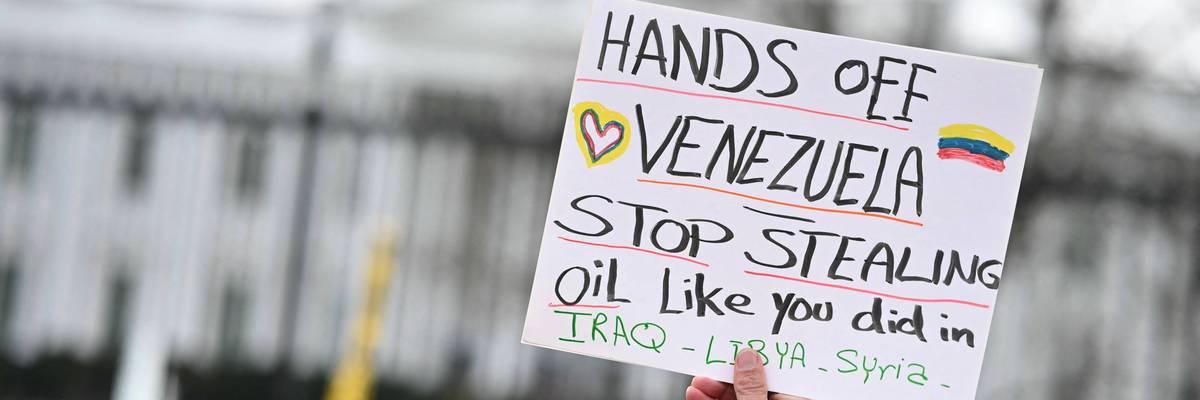
Protesters take part in a demonstration against US military action in Venezuela in Lafayette Square in front of the White House in Washington, DC, on January 3, 2026.
Venezuela was not liberated. Overnight, it became a US-occupied colony whose lands and resources will be stolen and exploited; whose people will be subjugated to a hostile foreign power; and whose future will remain uncertain.
On January 3, the US launched an illegal attack in Venezuela that resulted in the kidnapping of President Nicolás Maduro and his wife. Attorney General Pamela Bondi wrote via Twitter-X that the couple has been indicted and will “soon face the full wrath of American justice on American soil in American courts.”
For Vice President JD Vance, because “Maduro has multiple indictments in the United States for narcoterrorism,” these military strikes were legal. This, despite the fact that these strikes were conducted without congressional approval in a clear violation of the Constitution and the separation of powers.
With Maduro out of power, President Donald Trump announced that, “We’re going to run the country until such time as we can do a safe, proper, and judicious transition.” The crucial detail that Trump leaves out here is that what constitutes “such time” is left entirely up to his administration.
Let us be very clear here: Venezuela was not liberated. Overnight, it became a US-occupied colony whose lands and resources will be stolen and exploited; whose people will be subjugated to a hostile foreign power; and whose future will remain uncertain.
The threat to American sovereignty is Trump himself.
Whether Maduro was a dictator is irrelevant to this equation. Even leaving aside the fraught history of US regime change in countries like Iraq, Afghanistan, and Libya, the US is not the world’s judge, jury and executioner. The US does not get to invade other nations simply because it decides they are not “good neighbors.”
Latin America is not “our backyard.” This language is inherently colonialist. It symbolically reduces a region of the world that contains over 30 nations into America’s property. With this metaphor, the US gives itself the license to do as it pleases: It may trim the weeds (eliminate anti-American leaders), plant a garden (install a puppet government), and harvest what it grows (plunder their resources). The weight of this metaphor is visible when Trump causally refers to Venezuela’s natural oil reserves as “our oil.” In his mind, he is not seizing foreign resources, but rather reclaiming what Venezuela unjustly took away. After all, a backyard has no right to deny its owner access.
What Venezuela needed was a people’s revolution. The removal of Maduro and the destiny of Venezuela should have been left to the Venezuelan people to decide.
The fundamental error with the belief that invading a country will somehow "bring" freedom to it is that "freedom" is not an object that can be given. This is not to say that material conditions cannot limit the scope of one’s opportunities and freedoms—they most certainly can. But, at its core, freedom is an act of the will, not property to be transferred. The US cannot make Venezuela free. Only Venezuelans can.
Instead of freedom, Venezuela has been forcibly taken by a country that couldn’t care less about its people. Trump’s Department of Homeland Security (DHS) spent the bulk of 2025 arbitrarily designating Venezuelans as members of Tren de Aragua and then deporting them to the Centro de Confinamiento del Terrorismo (CECOT) in El Salvador—a literal “torture-enslavement detention center.”
For Trump, Venezuela—like any other colonized territory—is simply a resource to be exploited. Trump doesn’t even hide this. He has already announced that “we’re going to have our very large United States oil companies—the biggest anywhere in the world—go in, spend billions of dollars, fix the badly broken infrastructure, the oil infrastructure.” Venezuela is an investment for Trump. He and his ultra-wealthy donors will strip Venezuela of its wealth and then leave what’s left to whoever remains.
This is also not about the drug crisis as some Trump allies suggest. Rep. Brian Mast (R-Fla.), chair of the House Foreign Affairs Committee, claimed that because of this invasion, “Drug lords and terrorists will no longer operate freely in our hemisphere and drugs and illegals will not flow into our country.”
In December 2025, Trump pardoned former President of Honduras Juan Orlando Hernández. Hernández was sentenced to 45 years in prison for his role in an almost two-decades long drug-trafficking scheme that funneled over 400 tons of cocaine to the US. Apparently, this cocaine wasn’t dangerous enough for Trump and his supporters.
Ultimately, whether it’s removing Maduro or invading Cuba, Mexico, or Colombia, none of these actions will solve the drug crisis because they fail to tackle the root cause: public suffering. While there are many reasons people turn to drugs, the lack of adequate healthcare, poverty, homelessness, social stigmas about drug use, and criminalization are the leading factors. People turn to drugs when their governments and communities turn their back on them. Drug cartels, like any other capitalist enterprise, exploit these people’s hopes and desires for their own gain.
If Trump really cared about the drug crisis, then his administration would not be actively working to dismantle the Substance Abuse and Mental Health Services Administration (SAMHSA). If Trump really cared about the drug crisis, he would not withhold federal funding for Supplemental Nutrition Assistance Program benefits or childcare. If Trump really cared about the drug crisis, he would be working tirelessly to solve the affordability crisis—not denying its existence or spending billions on battleships.
Trump touted that this “extremely successful operation should serve as a warning to anyone who would threaten American sovereignty or endanger American lives.” But the threat to American sovereignty is Trump himself. Trump’s decision to bypass Congress and invade Venezuela is a further attack on a crumbling system of checks and balances. While many factors have fueled this deterioration, the failure of Congress to meaningfully hold Trump accountable looms large here.
The irony of this invasion is that Trump invaded Venezuela to overthrow a “dictator and terrorist” by acting like a dictator and terrorist. A habit that Trump is becoming increasingly comfortable with. Already the Trump administration has targeted people for their political beliefs, established a secret police, sent people to prison camps (CECOT, Alligator Alcatraz), deployed the National Guard in US cities, and, of course, invaded a foreign nation at his own discretion. Like Maduro, Trump has even been accused of human right abuses by organizations like Amnesty International, Human Rights Watch, and the American Civil Liberties Union (ACLU).
Substituting Maduro for Trump will not “make Venezuela great again.” It will only make Venezuelans, Americans, and the rest of the world more vulnerable to the whims of an increasingly authoritarian madman. If there is one regime that desperately needs to change, it’s Trump’s.
Dear Common Dreams reader, It’s been nearly 30 years since I co-founded Common Dreams with my late wife, Lina Newhouser. We had the radical notion that journalism should serve the public good, not corporate profits. It was clear to us from the outset what it would take to build such a project. No paid advertisements. No corporate sponsors. No millionaire publisher telling us what to think or do. Many people said we wouldn't last a year, but we proved those doubters wrong. Together with a tremendous team of journalists and dedicated staff, we built an independent media outlet free from the constraints of profits and corporate control. Our mission has always been simple: To inform. To inspire. To ignite change for the common good. Building Common Dreams was not easy. Our survival was never guaranteed. When you take on the most powerful forces—Wall Street greed, fossil fuel industry destruction, Big Tech lobbyists, and uber-rich oligarchs who have spent billions upon billions rigging the economy and democracy in their favor—the only bulwark you have is supporters who believe in your work. But here’s the urgent message from me today. It's never been this bad out there. And it's never been this hard to keep us going. At the very moment Common Dreams is most needed, the threats we face are intensifying. We need your support now more than ever. We don't accept corporate advertising and never will. We don't have a paywall because we don't think people should be blocked from critical news based on their ability to pay. Everything we do is funded by the donations of readers like you. When everyone does the little they can afford, we are strong. But if that support retreats or dries up, so do we. Will you donate now to make sure Common Dreams not only survives but thrives? —Craig Brown, Co-founder |
On January 3, the US launched an illegal attack in Venezuela that resulted in the kidnapping of President Nicolás Maduro and his wife. Attorney General Pamela Bondi wrote via Twitter-X that the couple has been indicted and will “soon face the full wrath of American justice on American soil in American courts.”
For Vice President JD Vance, because “Maduro has multiple indictments in the United States for narcoterrorism,” these military strikes were legal. This, despite the fact that these strikes were conducted without congressional approval in a clear violation of the Constitution and the separation of powers.
With Maduro out of power, President Donald Trump announced that, “We’re going to run the country until such time as we can do a safe, proper, and judicious transition.” The crucial detail that Trump leaves out here is that what constitutes “such time” is left entirely up to his administration.
Let us be very clear here: Venezuela was not liberated. Overnight, it became a US-occupied colony whose lands and resources will be stolen and exploited; whose people will be subjugated to a hostile foreign power; and whose future will remain uncertain.
The threat to American sovereignty is Trump himself.
Whether Maduro was a dictator is irrelevant to this equation. Even leaving aside the fraught history of US regime change in countries like Iraq, Afghanistan, and Libya, the US is not the world’s judge, jury and executioner. The US does not get to invade other nations simply because it decides they are not “good neighbors.”
Latin America is not “our backyard.” This language is inherently colonialist. It symbolically reduces a region of the world that contains over 30 nations into America’s property. With this metaphor, the US gives itself the license to do as it pleases: It may trim the weeds (eliminate anti-American leaders), plant a garden (install a puppet government), and harvest what it grows (plunder their resources). The weight of this metaphor is visible when Trump causally refers to Venezuela’s natural oil reserves as “our oil.” In his mind, he is not seizing foreign resources, but rather reclaiming what Venezuela unjustly took away. After all, a backyard has no right to deny its owner access.
What Venezuela needed was a people’s revolution. The removal of Maduro and the destiny of Venezuela should have been left to the Venezuelan people to decide.
The fundamental error with the belief that invading a country will somehow "bring" freedom to it is that "freedom" is not an object that can be given. This is not to say that material conditions cannot limit the scope of one’s opportunities and freedoms—they most certainly can. But, at its core, freedom is an act of the will, not property to be transferred. The US cannot make Venezuela free. Only Venezuelans can.
Instead of freedom, Venezuela has been forcibly taken by a country that couldn’t care less about its people. Trump’s Department of Homeland Security (DHS) spent the bulk of 2025 arbitrarily designating Venezuelans as members of Tren de Aragua and then deporting them to the Centro de Confinamiento del Terrorismo (CECOT) in El Salvador—a literal “torture-enslavement detention center.”
For Trump, Venezuela—like any other colonized territory—is simply a resource to be exploited. Trump doesn’t even hide this. He has already announced that “we’re going to have our very large United States oil companies—the biggest anywhere in the world—go in, spend billions of dollars, fix the badly broken infrastructure, the oil infrastructure.” Venezuela is an investment for Trump. He and his ultra-wealthy donors will strip Venezuela of its wealth and then leave what’s left to whoever remains.
This is also not about the drug crisis as some Trump allies suggest. Rep. Brian Mast (R-Fla.), chair of the House Foreign Affairs Committee, claimed that because of this invasion, “Drug lords and terrorists will no longer operate freely in our hemisphere and drugs and illegals will not flow into our country.”
In December 2025, Trump pardoned former President of Honduras Juan Orlando Hernández. Hernández was sentenced to 45 years in prison for his role in an almost two-decades long drug-trafficking scheme that funneled over 400 tons of cocaine to the US. Apparently, this cocaine wasn’t dangerous enough for Trump and his supporters.
Ultimately, whether it’s removing Maduro or invading Cuba, Mexico, or Colombia, none of these actions will solve the drug crisis because they fail to tackle the root cause: public suffering. While there are many reasons people turn to drugs, the lack of adequate healthcare, poverty, homelessness, social stigmas about drug use, and criminalization are the leading factors. People turn to drugs when their governments and communities turn their back on them. Drug cartels, like any other capitalist enterprise, exploit these people’s hopes and desires for their own gain.
If Trump really cared about the drug crisis, then his administration would not be actively working to dismantle the Substance Abuse and Mental Health Services Administration (SAMHSA). If Trump really cared about the drug crisis, he would not withhold federal funding for Supplemental Nutrition Assistance Program benefits or childcare. If Trump really cared about the drug crisis, he would be working tirelessly to solve the affordability crisis—not denying its existence or spending billions on battleships.
Trump touted that this “extremely successful operation should serve as a warning to anyone who would threaten American sovereignty or endanger American lives.” But the threat to American sovereignty is Trump himself. Trump’s decision to bypass Congress and invade Venezuela is a further attack on a crumbling system of checks and balances. While many factors have fueled this deterioration, the failure of Congress to meaningfully hold Trump accountable looms large here.
The irony of this invasion is that Trump invaded Venezuela to overthrow a “dictator and terrorist” by acting like a dictator and terrorist. A habit that Trump is becoming increasingly comfortable with. Already the Trump administration has targeted people for their political beliefs, established a secret police, sent people to prison camps (CECOT, Alligator Alcatraz), deployed the National Guard in US cities, and, of course, invaded a foreign nation at his own discretion. Like Maduro, Trump has even been accused of human right abuses by organizations like Amnesty International, Human Rights Watch, and the American Civil Liberties Union (ACLU).
Substituting Maduro for Trump will not “make Venezuela great again.” It will only make Venezuelans, Americans, and the rest of the world more vulnerable to the whims of an increasingly authoritarian madman. If there is one regime that desperately needs to change, it’s Trump’s.
On January 3, the US launched an illegal attack in Venezuela that resulted in the kidnapping of President Nicolás Maduro and his wife. Attorney General Pamela Bondi wrote via Twitter-X that the couple has been indicted and will “soon face the full wrath of American justice on American soil in American courts.”
For Vice President JD Vance, because “Maduro has multiple indictments in the United States for narcoterrorism,” these military strikes were legal. This, despite the fact that these strikes were conducted without congressional approval in a clear violation of the Constitution and the separation of powers.
With Maduro out of power, President Donald Trump announced that, “We’re going to run the country until such time as we can do a safe, proper, and judicious transition.” The crucial detail that Trump leaves out here is that what constitutes “such time” is left entirely up to his administration.
Let us be very clear here: Venezuela was not liberated. Overnight, it became a US-occupied colony whose lands and resources will be stolen and exploited; whose people will be subjugated to a hostile foreign power; and whose future will remain uncertain.
The threat to American sovereignty is Trump himself.
Whether Maduro was a dictator is irrelevant to this equation. Even leaving aside the fraught history of US regime change in countries like Iraq, Afghanistan, and Libya, the US is not the world’s judge, jury and executioner. The US does not get to invade other nations simply because it decides they are not “good neighbors.”
Latin America is not “our backyard.” This language is inherently colonialist. It symbolically reduces a region of the world that contains over 30 nations into America’s property. With this metaphor, the US gives itself the license to do as it pleases: It may trim the weeds (eliminate anti-American leaders), plant a garden (install a puppet government), and harvest what it grows (plunder their resources). The weight of this metaphor is visible when Trump causally refers to Venezuela’s natural oil reserves as “our oil.” In his mind, he is not seizing foreign resources, but rather reclaiming what Venezuela unjustly took away. After all, a backyard has no right to deny its owner access.
What Venezuela needed was a people’s revolution. The removal of Maduro and the destiny of Venezuela should have been left to the Venezuelan people to decide.
The fundamental error with the belief that invading a country will somehow "bring" freedom to it is that "freedom" is not an object that can be given. This is not to say that material conditions cannot limit the scope of one’s opportunities and freedoms—they most certainly can. But, at its core, freedom is an act of the will, not property to be transferred. The US cannot make Venezuela free. Only Venezuelans can.
Instead of freedom, Venezuela has been forcibly taken by a country that couldn’t care less about its people. Trump’s Department of Homeland Security (DHS) spent the bulk of 2025 arbitrarily designating Venezuelans as members of Tren de Aragua and then deporting them to the Centro de Confinamiento del Terrorismo (CECOT) in El Salvador—a literal “torture-enslavement detention center.”
For Trump, Venezuela—like any other colonized territory—is simply a resource to be exploited. Trump doesn’t even hide this. He has already announced that “we’re going to have our very large United States oil companies—the biggest anywhere in the world—go in, spend billions of dollars, fix the badly broken infrastructure, the oil infrastructure.” Venezuela is an investment for Trump. He and his ultra-wealthy donors will strip Venezuela of its wealth and then leave what’s left to whoever remains.
This is also not about the drug crisis as some Trump allies suggest. Rep. Brian Mast (R-Fla.), chair of the House Foreign Affairs Committee, claimed that because of this invasion, “Drug lords and terrorists will no longer operate freely in our hemisphere and drugs and illegals will not flow into our country.”
In December 2025, Trump pardoned former President of Honduras Juan Orlando Hernández. Hernández was sentenced to 45 years in prison for his role in an almost two-decades long drug-trafficking scheme that funneled over 400 tons of cocaine to the US. Apparently, this cocaine wasn’t dangerous enough for Trump and his supporters.
Ultimately, whether it’s removing Maduro or invading Cuba, Mexico, or Colombia, none of these actions will solve the drug crisis because they fail to tackle the root cause: public suffering. While there are many reasons people turn to drugs, the lack of adequate healthcare, poverty, homelessness, social stigmas about drug use, and criminalization are the leading factors. People turn to drugs when their governments and communities turn their back on them. Drug cartels, like any other capitalist enterprise, exploit these people’s hopes and desires for their own gain.
If Trump really cared about the drug crisis, then his administration would not be actively working to dismantle the Substance Abuse and Mental Health Services Administration (SAMHSA). If Trump really cared about the drug crisis, he would not withhold federal funding for Supplemental Nutrition Assistance Program benefits or childcare. If Trump really cared about the drug crisis, he would be working tirelessly to solve the affordability crisis—not denying its existence or spending billions on battleships.
Trump touted that this “extremely successful operation should serve as a warning to anyone who would threaten American sovereignty or endanger American lives.” But the threat to American sovereignty is Trump himself. Trump’s decision to bypass Congress and invade Venezuela is a further attack on a crumbling system of checks and balances. While many factors have fueled this deterioration, the failure of Congress to meaningfully hold Trump accountable looms large here.
The irony of this invasion is that Trump invaded Venezuela to overthrow a “dictator and terrorist” by acting like a dictator and terrorist. A habit that Trump is becoming increasingly comfortable with. Already the Trump administration has targeted people for their political beliefs, established a secret police, sent people to prison camps (CECOT, Alligator Alcatraz), deployed the National Guard in US cities, and, of course, invaded a foreign nation at his own discretion. Like Maduro, Trump has even been accused of human right abuses by organizations like Amnesty International, Human Rights Watch, and the American Civil Liberties Union (ACLU).
Substituting Maduro for Trump will not “make Venezuela great again.” It will only make Venezuelans, Americans, and the rest of the world more vulnerable to the whims of an increasingly authoritarian madman. If there is one regime that desperately needs to change, it’s Trump’s.