SUBSCRIBE TO OUR FREE NEWSLETTER
Daily news & progressive opinion—funded by the people, not the corporations—delivered straight to your inbox.
5
#000000
#FFFFFF
To donate by check, phone, or other method, see our More Ways to Give page.
Daily news & progressive opinion—funded by the people, not the corporations—delivered straight to your inbox.
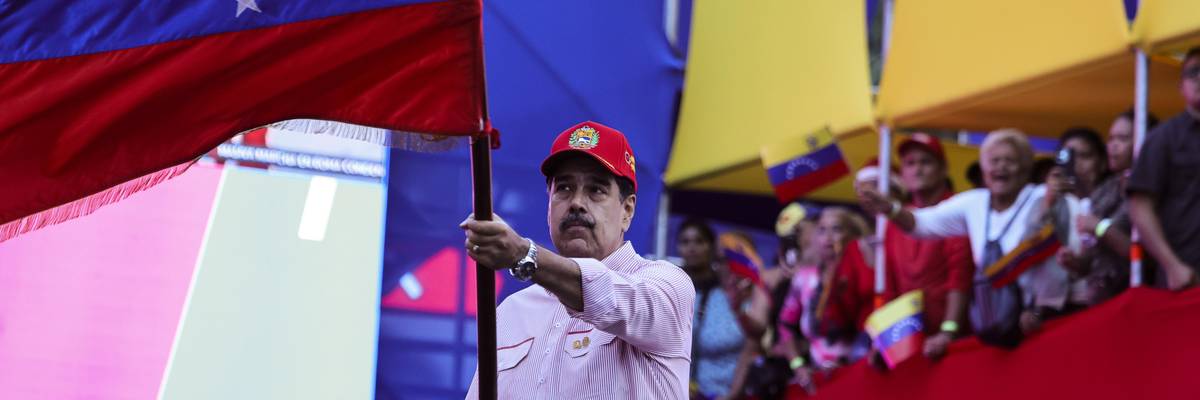
President Nicolás Maduro of Venezuela waves a Venezuelan flag during a protest to support him on December 1, 2025, in Caracas, Venezuela.
He has described President Donald Trump's push for regime change as a "colonial threat" to "seize" Venezuela's oil.
Venezuelan President Nicolás Maduro remained defiant on Monday as US President Donald Trump plotted "next steps" against the South American nation with top national security brass.
Before thousands of Venezuelans at a rally in Caracas, the nation’s embattled president said he would not accept peace on US terms unless it came “with sovereignty, equality, and freedom.”
“We do not want a slave’s peace, nor the peace of colonies! Colony, never! Slaves, never!” he said.
The speech came days after Trump announced that the US would close Venezuelan airspace, which many interpreted as a final step before a series of strikes on the mainland.
The US has framed its military buildup in the Southern Caribbean as part of a campaign to stop drug smuggling, the same justification it has used to carry out the extrajudicial bombings of more than 20 boats in the region—which have killed at least 83 people—while disclosing zero proof of the victims' involvement with drug trafficking.
Trump has also accused Maduro of being the leader of the so-called "Cartel de los Soles," which he slapped with the label of “Foreign Terrorist Organization” last month, even though it is not an "organization" at all, but a media shorthand to refer to alleged connections between Venezuelan leaders and the drug trade.
Meanwhile, both US and international assessments have found that Venezuela is but a minor player in the global drug trade.
The US has amassed more than 15,000 troops outside Venezuela, the most it's sent to the region since 1989, when the administration of former President George H.W. Bush launched a land invasion of Panama to overthrow its drug-running dictator Manuel Noriega. Documents obtained by The Intercept last week suggested that the US seeks to maintain "a massive military presence in the Caribbean" for years to come.
"By a factor of at least 10, the US presence is too great for even an intensified anti-drug operation," wrote US national editor Edward Luce in the Financial Times on Tuesday.
Trump's motive for stopping drug trafficking was further called into question after he pardoned former Honduran President Juan Orlando Hernández, a onetime US ally who was sentenced last year to 45 years in prison for helping to traffic at least 400 tons of cocaine to the US. The pardon was issued as part of Trump's efforts to influence Honduras' upcoming election to secure the victory of right-wing candidate Nasry “Tito” Asfura.
The goal of regime change was essentially confirmed on Monday when Reuters reported that Trump had offered Maduro safe passage out of Venezuela if he were willing to abdicate power during a phone call on November 21.
“You can save yourself and those closest to you, but you must leave the country now,” Trump reportedly told Maduro.
Maduro reportedly said he'd be willing to accept the offer if his family members were granted complete amnesty and the US removed sanctions against them, as well as over 100 other Venezuelan officials. He also asked for the case against him before the International Criminal Court (ICC) to be dropped.
Trump rejected that deal, and his offer of safe passage expired on Friday, the day before the US announced it had closed Venezuelan airspace. Trump confirmed to the press on Sunday that the talks had happened, but provided few additional details.
Maduro has categorically denied involvement with drug trafficking and has portrayed the White House's sabre-rattling as a "colonial threat." Last week, while brandishing the sword of South American anticolonial hero Simón Bolívar, he pledged that Venezuela would be a "colony never again."
On Sunday, he accused Trump of trying to "seize" the nation's oil reserves. He has called for the Organization of the Petroleum Exporting Countries (OPEC) to step in to help the country counter what he said were “growing and illegal threats” from Trump.
Venezuela has the world’s largest proven oil reserves—about a fifth of the Earth’s total, and more than Iraq had at the time of the George W. Bush administration's 2003 invasion. However, US sanctions against Venezuela largely block American oil companies from accessing the reserves, which are controlled by the nation’s state-owned oil company Petróleos de Venezuela. These sanctions, which have limited Venezuela's ability to export its most valuable natural resource, are considered one of the primary reasons for the nation's economic instability in recent years.
While at a rally in 2023, Trump said he regretted not having "taken [Venezuela] over" during his first term. "We would have gotten to all that oil; it would have been right next door,” he said.
"We’ve seen this tragic play before," wrote Richard Steiner, a former marine professor with the University of Alaska, this weekend in Common Dreams. "The Bush administration justified its disastrous 2003 invasion of Iraq with the pretext that Iraq had weapons of mass destruction, which, as it turned out, it didn’t. And as US Central Command commander General John Abizaid admitted about the Iraq war at the time: 'Of course it’s about oil, it’s very much about oil, and we can’t really deny that.'"
"A similar pretext—this time 'drug interdiction'—is being used to justify a potential US invasion and regime change in Venezuela," he continued. "But this is not about stopping the flow of dangerous drugs, it is about actually increasing the flow of the dangerous drug some pushers want to keep us all hooked on—oil."
Dear Common Dreams reader, It’s been nearly 30 years since I co-founded Common Dreams with my late wife, Lina Newhouser. We had the radical notion that journalism should serve the public good, not corporate profits. It was clear to us from the outset what it would take to build such a project. No paid advertisements. No corporate sponsors. No millionaire publisher telling us what to think or do. Many people said we wouldn't last a year, but we proved those doubters wrong. Together with a tremendous team of journalists and dedicated staff, we built an independent media outlet free from the constraints of profits and corporate control. Our mission has always been simple: To inform. To inspire. To ignite change for the common good. Building Common Dreams was not easy. Our survival was never guaranteed. When you take on the most powerful forces—Wall Street greed, fossil fuel industry destruction, Big Tech lobbyists, and uber-rich oligarchs who have spent billions upon billions rigging the economy and democracy in their favor—the only bulwark you have is supporters who believe in your work. But here’s the urgent message from me today. It's never been this bad out there. And it's never been this hard to keep us going. At the very moment Common Dreams is most needed, the threats we face are intensifying. We need your support now more than ever. We don't accept corporate advertising and never will. We don't have a paywall because we don't think people should be blocked from critical news based on their ability to pay. Everything we do is funded by the donations of readers like you. When everyone does the little they can afford, we are strong. But if that support retreats or dries up, so do we. Will you donate now to make sure Common Dreams not only survives but thrives? —Craig Brown, Co-founder |
Venezuelan President Nicolás Maduro remained defiant on Monday as US President Donald Trump plotted "next steps" against the South American nation with top national security brass.
Before thousands of Venezuelans at a rally in Caracas, the nation’s embattled president said he would not accept peace on US terms unless it came “with sovereignty, equality, and freedom.”
“We do not want a slave’s peace, nor the peace of colonies! Colony, never! Slaves, never!” he said.
The speech came days after Trump announced that the US would close Venezuelan airspace, which many interpreted as a final step before a series of strikes on the mainland.
The US has framed its military buildup in the Southern Caribbean as part of a campaign to stop drug smuggling, the same justification it has used to carry out the extrajudicial bombings of more than 20 boats in the region—which have killed at least 83 people—while disclosing zero proof of the victims' involvement with drug trafficking.
Trump has also accused Maduro of being the leader of the so-called "Cartel de los Soles," which he slapped with the label of “Foreign Terrorist Organization” last month, even though it is not an "organization" at all, but a media shorthand to refer to alleged connections between Venezuelan leaders and the drug trade.
Meanwhile, both US and international assessments have found that Venezuela is but a minor player in the global drug trade.
The US has amassed more than 15,000 troops outside Venezuela, the most it's sent to the region since 1989, when the administration of former President George H.W. Bush launched a land invasion of Panama to overthrow its drug-running dictator Manuel Noriega. Documents obtained by The Intercept last week suggested that the US seeks to maintain "a massive military presence in the Caribbean" for years to come.
"By a factor of at least 10, the US presence is too great for even an intensified anti-drug operation," wrote US national editor Edward Luce in the Financial Times on Tuesday.
Trump's motive for stopping drug trafficking was further called into question after he pardoned former Honduran President Juan Orlando Hernández, a onetime US ally who was sentenced last year to 45 years in prison for helping to traffic at least 400 tons of cocaine to the US. The pardon was issued as part of Trump's efforts to influence Honduras' upcoming election to secure the victory of right-wing candidate Nasry “Tito” Asfura.
The goal of regime change was essentially confirmed on Monday when Reuters reported that Trump had offered Maduro safe passage out of Venezuela if he were willing to abdicate power during a phone call on November 21.
“You can save yourself and those closest to you, but you must leave the country now,” Trump reportedly told Maduro.
Maduro reportedly said he'd be willing to accept the offer if his family members were granted complete amnesty and the US removed sanctions against them, as well as over 100 other Venezuelan officials. He also asked for the case against him before the International Criminal Court (ICC) to be dropped.
Trump rejected that deal, and his offer of safe passage expired on Friday, the day before the US announced it had closed Venezuelan airspace. Trump confirmed to the press on Sunday that the talks had happened, but provided few additional details.
Maduro has categorically denied involvement with drug trafficking and has portrayed the White House's sabre-rattling as a "colonial threat." Last week, while brandishing the sword of South American anticolonial hero Simón Bolívar, he pledged that Venezuela would be a "colony never again."
On Sunday, he accused Trump of trying to "seize" the nation's oil reserves. He has called for the Organization of the Petroleum Exporting Countries (OPEC) to step in to help the country counter what he said were “growing and illegal threats” from Trump.
Venezuela has the world’s largest proven oil reserves—about a fifth of the Earth’s total, and more than Iraq had at the time of the George W. Bush administration's 2003 invasion. However, US sanctions against Venezuela largely block American oil companies from accessing the reserves, which are controlled by the nation’s state-owned oil company Petróleos de Venezuela. These sanctions, which have limited Venezuela's ability to export its most valuable natural resource, are considered one of the primary reasons for the nation's economic instability in recent years.
While at a rally in 2023, Trump said he regretted not having "taken [Venezuela] over" during his first term. "We would have gotten to all that oil; it would have been right next door,” he said.
"We’ve seen this tragic play before," wrote Richard Steiner, a former marine professor with the University of Alaska, this weekend in Common Dreams. "The Bush administration justified its disastrous 2003 invasion of Iraq with the pretext that Iraq had weapons of mass destruction, which, as it turned out, it didn’t. And as US Central Command commander General John Abizaid admitted about the Iraq war at the time: 'Of course it’s about oil, it’s very much about oil, and we can’t really deny that.'"
"A similar pretext—this time 'drug interdiction'—is being used to justify a potential US invasion and regime change in Venezuela," he continued. "But this is not about stopping the flow of dangerous drugs, it is about actually increasing the flow of the dangerous drug some pushers want to keep us all hooked on—oil."
Venezuelan President Nicolás Maduro remained defiant on Monday as US President Donald Trump plotted "next steps" against the South American nation with top national security brass.
Before thousands of Venezuelans at a rally in Caracas, the nation’s embattled president said he would not accept peace on US terms unless it came “with sovereignty, equality, and freedom.”
“We do not want a slave’s peace, nor the peace of colonies! Colony, never! Slaves, never!” he said.
The speech came days after Trump announced that the US would close Venezuelan airspace, which many interpreted as a final step before a series of strikes on the mainland.
The US has framed its military buildup in the Southern Caribbean as part of a campaign to stop drug smuggling, the same justification it has used to carry out the extrajudicial bombings of more than 20 boats in the region—which have killed at least 83 people—while disclosing zero proof of the victims' involvement with drug trafficking.
Trump has also accused Maduro of being the leader of the so-called "Cartel de los Soles," which he slapped with the label of “Foreign Terrorist Organization” last month, even though it is not an "organization" at all, but a media shorthand to refer to alleged connections between Venezuelan leaders and the drug trade.
Meanwhile, both US and international assessments have found that Venezuela is but a minor player in the global drug trade.
The US has amassed more than 15,000 troops outside Venezuela, the most it's sent to the region since 1989, when the administration of former President George H.W. Bush launched a land invasion of Panama to overthrow its drug-running dictator Manuel Noriega. Documents obtained by The Intercept last week suggested that the US seeks to maintain "a massive military presence in the Caribbean" for years to come.
"By a factor of at least 10, the US presence is too great for even an intensified anti-drug operation," wrote US national editor Edward Luce in the Financial Times on Tuesday.
Trump's motive for stopping drug trafficking was further called into question after he pardoned former Honduran President Juan Orlando Hernández, a onetime US ally who was sentenced last year to 45 years in prison for helping to traffic at least 400 tons of cocaine to the US. The pardon was issued as part of Trump's efforts to influence Honduras' upcoming election to secure the victory of right-wing candidate Nasry “Tito” Asfura.
The goal of regime change was essentially confirmed on Monday when Reuters reported that Trump had offered Maduro safe passage out of Venezuela if he were willing to abdicate power during a phone call on November 21.
“You can save yourself and those closest to you, but you must leave the country now,” Trump reportedly told Maduro.
Maduro reportedly said he'd be willing to accept the offer if his family members were granted complete amnesty and the US removed sanctions against them, as well as over 100 other Venezuelan officials. He also asked for the case against him before the International Criminal Court (ICC) to be dropped.
Trump rejected that deal, and his offer of safe passage expired on Friday, the day before the US announced it had closed Venezuelan airspace. Trump confirmed to the press on Sunday that the talks had happened, but provided few additional details.
Maduro has categorically denied involvement with drug trafficking and has portrayed the White House's sabre-rattling as a "colonial threat." Last week, while brandishing the sword of South American anticolonial hero Simón Bolívar, he pledged that Venezuela would be a "colony never again."
On Sunday, he accused Trump of trying to "seize" the nation's oil reserves. He has called for the Organization of the Petroleum Exporting Countries (OPEC) to step in to help the country counter what he said were “growing and illegal threats” from Trump.
Venezuela has the world’s largest proven oil reserves—about a fifth of the Earth’s total, and more than Iraq had at the time of the George W. Bush administration's 2003 invasion. However, US sanctions against Venezuela largely block American oil companies from accessing the reserves, which are controlled by the nation’s state-owned oil company Petróleos de Venezuela. These sanctions, which have limited Venezuela's ability to export its most valuable natural resource, are considered one of the primary reasons for the nation's economic instability in recent years.
While at a rally in 2023, Trump said he regretted not having "taken [Venezuela] over" during his first term. "We would have gotten to all that oil; it would have been right next door,” he said.
"We’ve seen this tragic play before," wrote Richard Steiner, a former marine professor with the University of Alaska, this weekend in Common Dreams. "The Bush administration justified its disastrous 2003 invasion of Iraq with the pretext that Iraq had weapons of mass destruction, which, as it turned out, it didn’t. And as US Central Command commander General John Abizaid admitted about the Iraq war at the time: 'Of course it’s about oil, it’s very much about oil, and we can’t really deny that.'"
"A similar pretext—this time 'drug interdiction'—is being used to justify a potential US invasion and regime change in Venezuela," he continued. "But this is not about stopping the flow of dangerous drugs, it is about actually increasing the flow of the dangerous drug some pushers want to keep us all hooked on—oil."