SUBSCRIBE TO OUR FREE NEWSLETTER
Daily news & progressive opinion—funded by the people, not the corporations—delivered straight to your inbox.
5
#000000
#FFFFFF
To donate by check, phone, or other method, see our More Ways to Give page.
Daily news & progressive opinion—funded by the people, not the corporations—delivered straight to your inbox.
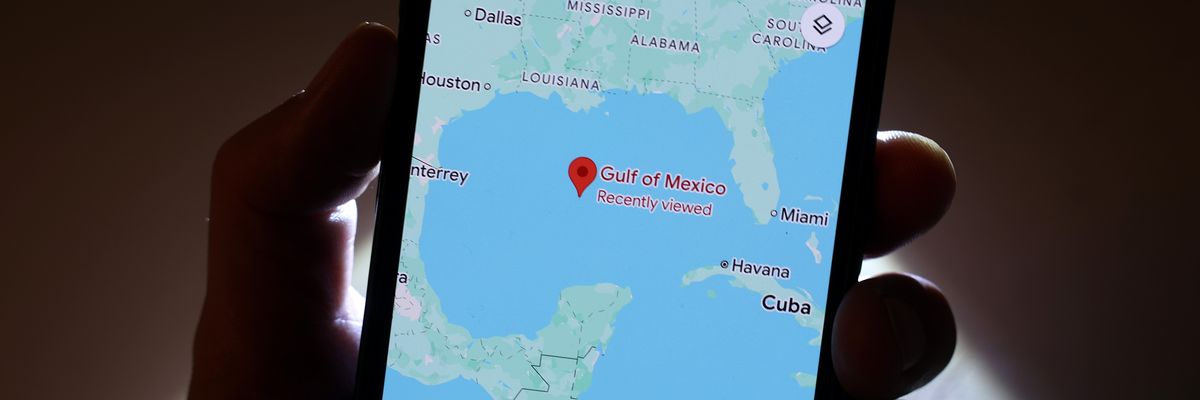
In this photo illustration, the Gulf of Mexico is displayed on the Google Maps app on January 28, 2025 in San Anselmo, California.
The name change signals a territorial and economic claim over these waters and their resources, further cementing U.S. imperial ambitions in the region.
U.S. President Donald Trump's executive order to rename the Gulf of Mexico the "Gulf of America" isn't just another absurd stunt or another example of his outlandish behavior. It signals a much deeper, more troubling agenda that seeks to erase historical identity and assert imperial domination over a region already suffering under a long history of interventionist policies. At its core, this is a move to expand the U.S. empire by erasing Mexico's presence from a geographical feature recognized for centuries.
The name "Gulf of Mexico" has existed since the 16th century. Its recognition is supported by international organizations such as the International Hydrographic Organization (IHO) and the United Nations Group of Experts on Geographical Names (UNGEGN). These organizations ensure that place names remain neutral and historically accurate, preventing nations from distorting or erasing cultural and historical ties to specific regions. Mexico has formally rejected this renaming, emphasizing that no country has the right to unilaterally change the identity of a shared natural resource that spans multiple borders. This is a matter of respect for international law and sovereignty, which the Trump administration has ignored in favor of pursuing nationalistic expansionism.
Erasing "Mexico" from our maps isn't an aberration. It's part of a long pattern of anti-Mexican racism in the U.S., ranging from political scapegoating and border militarization to violent rhetoric that fuels hate crimes. But this move goes beyond that. It fits into a much larger U.S. strategy of controlling the Western Hemisphere, which dates back to the Monroe Doctrine of 1823, which claimed the U.S. had the right to dictate who influences Latin America. Over time, this ideology has come to justify U.S.-backed military interventions, coups, and economic manipulations in the region aimed at securing U.S. interests and ensuring that Latin America remains in a subordinate position.
While Trump's attempt to erase "Mexico" from the Gulf of Mexico may appear symbolic, it could have devastating consequences.
Not only is the Gulf of Mexico a site of historical importance, but it is also rich in oil and natural resources. This fact is no coincidence. The United States has a long history of trying to control these resources including backing oil company boycotts against Mexico’s nationalized industry in the 1930s and signing trade agreements that favor U.S. companies over Mexican sovereignty. Renaming the Gulf of Mexico signals a territorial and economic claim over these waters and their resources, further cementing U.S. imperial ambitions in the region.
Companies like Google Maps, which has announced plans to rename the Gulf of Mexico to the Gulf of America after Trump's executive order, are just playing into the billionaire-fueled power grab that advances a racist, nationalist agenda of domination and imperialism. Even if Google only applies this change in the U.S., it still normalizes the idea that facts can be rewritten to serve a political agenda. At a time when diplomacy and mutual respect should be prioritized, honoring the internationally recognized name would send a clear message that Google values historical accuracy, global cooperation, and good neighborly relations.
The Gulf of Mexico is more than just a body of water; it is a shared resource of immense ecological, economic, and cultural significance for Mexico, the United States, and the world. It plays a critical role in regional trade, fisheries, and energy production, hosting some of North America's most important offshore oil reserves. The United States has long considered Latin America its "backyard," and this is another proof that its imperial ambitions are still alive.
The environmental devastation already occurring in the Gulf region is evidenced by devastating oil spills and the degradation of marine ecosystems. This destruction is further compounded as U.S. and foreign companies continue to exploit the region's resources with no regard for the long-term damage.
The movement to rename the Gulf of Mexico fits into a broader pattern of anti-Mexican sentiment in the United States that has often manifested in political scapegoating, hateful rhetoric, and border militarization. Such rhetoric fuels violence and hate crimes against Mexican and Latino communities. While Trump's attempt to erase "Mexico" from the Gulf of Mexico may appear symbolic, it could have devastating consequences. It reflects a disregard for historical truth, an aggressive assertion of U.S. superiority, and the continuation of exploitative colonialist practices that harm both the environment and Latin American people.
Dear Common Dreams reader, It’s been nearly 30 years since I co-founded Common Dreams with my late wife, Lina Newhouser. We had the radical notion that journalism should serve the public good, not corporate profits. It was clear to us from the outset what it would take to build such a project. No paid advertisements. No corporate sponsors. No millionaire publisher telling us what to think or do. Many people said we wouldn't last a year, but we proved those doubters wrong. Together with a tremendous team of journalists and dedicated staff, we built an independent media outlet free from the constraints of profits and corporate control. Our mission has always been simple: To inform. To inspire. To ignite change for the common good. Building Common Dreams was not easy. Our survival was never guaranteed. When you take on the most powerful forces—Wall Street greed, fossil fuel industry destruction, Big Tech lobbyists, and uber-rich oligarchs who have spent billions upon billions rigging the economy and democracy in their favor—the only bulwark you have is supporters who believe in your work. But here’s the urgent message from me today. It's never been this bad out there. And it's never been this hard to keep us going. At the very moment Common Dreams is most needed, the threats we face are intensifying. We need your support now more than ever. We don't accept corporate advertising and never will. We don't have a paywall because we don't think people should be blocked from critical news based on their ability to pay. Everything we do is funded by the donations of readers like you. When everyone does the little they can afford, we are strong. But if that support retreats or dries up, so do we. Will you donate now to make sure Common Dreams not only survives but thrives? —Craig Brown, Co-founder |
U.S. President Donald Trump's executive order to rename the Gulf of Mexico the "Gulf of America" isn't just another absurd stunt or another example of his outlandish behavior. It signals a much deeper, more troubling agenda that seeks to erase historical identity and assert imperial domination over a region already suffering under a long history of interventionist policies. At its core, this is a move to expand the U.S. empire by erasing Mexico's presence from a geographical feature recognized for centuries.
The name "Gulf of Mexico" has existed since the 16th century. Its recognition is supported by international organizations such as the International Hydrographic Organization (IHO) and the United Nations Group of Experts on Geographical Names (UNGEGN). These organizations ensure that place names remain neutral and historically accurate, preventing nations from distorting or erasing cultural and historical ties to specific regions. Mexico has formally rejected this renaming, emphasizing that no country has the right to unilaterally change the identity of a shared natural resource that spans multiple borders. This is a matter of respect for international law and sovereignty, which the Trump administration has ignored in favor of pursuing nationalistic expansionism.
Erasing "Mexico" from our maps isn't an aberration. It's part of a long pattern of anti-Mexican racism in the U.S., ranging from political scapegoating and border militarization to violent rhetoric that fuels hate crimes. But this move goes beyond that. It fits into a much larger U.S. strategy of controlling the Western Hemisphere, which dates back to the Monroe Doctrine of 1823, which claimed the U.S. had the right to dictate who influences Latin America. Over time, this ideology has come to justify U.S.-backed military interventions, coups, and economic manipulations in the region aimed at securing U.S. interests and ensuring that Latin America remains in a subordinate position.
While Trump's attempt to erase "Mexico" from the Gulf of Mexico may appear symbolic, it could have devastating consequences.
Not only is the Gulf of Mexico a site of historical importance, but it is also rich in oil and natural resources. This fact is no coincidence. The United States has a long history of trying to control these resources including backing oil company boycotts against Mexico’s nationalized industry in the 1930s and signing trade agreements that favor U.S. companies over Mexican sovereignty. Renaming the Gulf of Mexico signals a territorial and economic claim over these waters and their resources, further cementing U.S. imperial ambitions in the region.
Companies like Google Maps, which has announced plans to rename the Gulf of Mexico to the Gulf of America after Trump's executive order, are just playing into the billionaire-fueled power grab that advances a racist, nationalist agenda of domination and imperialism. Even if Google only applies this change in the U.S., it still normalizes the idea that facts can be rewritten to serve a political agenda. At a time when diplomacy and mutual respect should be prioritized, honoring the internationally recognized name would send a clear message that Google values historical accuracy, global cooperation, and good neighborly relations.
The Gulf of Mexico is more than just a body of water; it is a shared resource of immense ecological, economic, and cultural significance for Mexico, the United States, and the world. It plays a critical role in regional trade, fisheries, and energy production, hosting some of North America's most important offshore oil reserves. The United States has long considered Latin America its "backyard," and this is another proof that its imperial ambitions are still alive.
The environmental devastation already occurring in the Gulf region is evidenced by devastating oil spills and the degradation of marine ecosystems. This destruction is further compounded as U.S. and foreign companies continue to exploit the region's resources with no regard for the long-term damage.
The movement to rename the Gulf of Mexico fits into a broader pattern of anti-Mexican sentiment in the United States that has often manifested in political scapegoating, hateful rhetoric, and border militarization. Such rhetoric fuels violence and hate crimes against Mexican and Latino communities. While Trump's attempt to erase "Mexico" from the Gulf of Mexico may appear symbolic, it could have devastating consequences. It reflects a disregard for historical truth, an aggressive assertion of U.S. superiority, and the continuation of exploitative colonialist practices that harm both the environment and Latin American people.
U.S. President Donald Trump's executive order to rename the Gulf of Mexico the "Gulf of America" isn't just another absurd stunt or another example of his outlandish behavior. It signals a much deeper, more troubling agenda that seeks to erase historical identity and assert imperial domination over a region already suffering under a long history of interventionist policies. At its core, this is a move to expand the U.S. empire by erasing Mexico's presence from a geographical feature recognized for centuries.
The name "Gulf of Mexico" has existed since the 16th century. Its recognition is supported by international organizations such as the International Hydrographic Organization (IHO) and the United Nations Group of Experts on Geographical Names (UNGEGN). These organizations ensure that place names remain neutral and historically accurate, preventing nations from distorting or erasing cultural and historical ties to specific regions. Mexico has formally rejected this renaming, emphasizing that no country has the right to unilaterally change the identity of a shared natural resource that spans multiple borders. This is a matter of respect for international law and sovereignty, which the Trump administration has ignored in favor of pursuing nationalistic expansionism.
Erasing "Mexico" from our maps isn't an aberration. It's part of a long pattern of anti-Mexican racism in the U.S., ranging from political scapegoating and border militarization to violent rhetoric that fuels hate crimes. But this move goes beyond that. It fits into a much larger U.S. strategy of controlling the Western Hemisphere, which dates back to the Monroe Doctrine of 1823, which claimed the U.S. had the right to dictate who influences Latin America. Over time, this ideology has come to justify U.S.-backed military interventions, coups, and economic manipulations in the region aimed at securing U.S. interests and ensuring that Latin America remains in a subordinate position.
While Trump's attempt to erase "Mexico" from the Gulf of Mexico may appear symbolic, it could have devastating consequences.
Not only is the Gulf of Mexico a site of historical importance, but it is also rich in oil and natural resources. This fact is no coincidence. The United States has a long history of trying to control these resources including backing oil company boycotts against Mexico’s nationalized industry in the 1930s and signing trade agreements that favor U.S. companies over Mexican sovereignty. Renaming the Gulf of Mexico signals a territorial and economic claim over these waters and their resources, further cementing U.S. imperial ambitions in the region.
Companies like Google Maps, which has announced plans to rename the Gulf of Mexico to the Gulf of America after Trump's executive order, are just playing into the billionaire-fueled power grab that advances a racist, nationalist agenda of domination and imperialism. Even if Google only applies this change in the U.S., it still normalizes the idea that facts can be rewritten to serve a political agenda. At a time when diplomacy and mutual respect should be prioritized, honoring the internationally recognized name would send a clear message that Google values historical accuracy, global cooperation, and good neighborly relations.
The Gulf of Mexico is more than just a body of water; it is a shared resource of immense ecological, economic, and cultural significance for Mexico, the United States, and the world. It plays a critical role in regional trade, fisheries, and energy production, hosting some of North America's most important offshore oil reserves. The United States has long considered Latin America its "backyard," and this is another proof that its imperial ambitions are still alive.
The environmental devastation already occurring in the Gulf region is evidenced by devastating oil spills and the degradation of marine ecosystems. This destruction is further compounded as U.S. and foreign companies continue to exploit the region's resources with no regard for the long-term damage.
The movement to rename the Gulf of Mexico fits into a broader pattern of anti-Mexican sentiment in the United States that has often manifested in political scapegoating, hateful rhetoric, and border militarization. Such rhetoric fuels violence and hate crimes against Mexican and Latino communities. While Trump's attempt to erase "Mexico" from the Gulf of Mexico may appear symbolic, it could have devastating consequences. It reflects a disregard for historical truth, an aggressive assertion of U.S. superiority, and the continuation of exploitative colonialist practices that harm both the environment and Latin American people.