SUBSCRIBE TO OUR FREE NEWSLETTER
Daily news & progressive opinion—funded by the people, not the corporations—delivered straight to your inbox.
5
#000000
#FFFFFF
To donate by check, phone, or other method, see our More Ways to Give page.
Daily news & progressive opinion—funded by the people, not the corporations—delivered straight to your inbox.
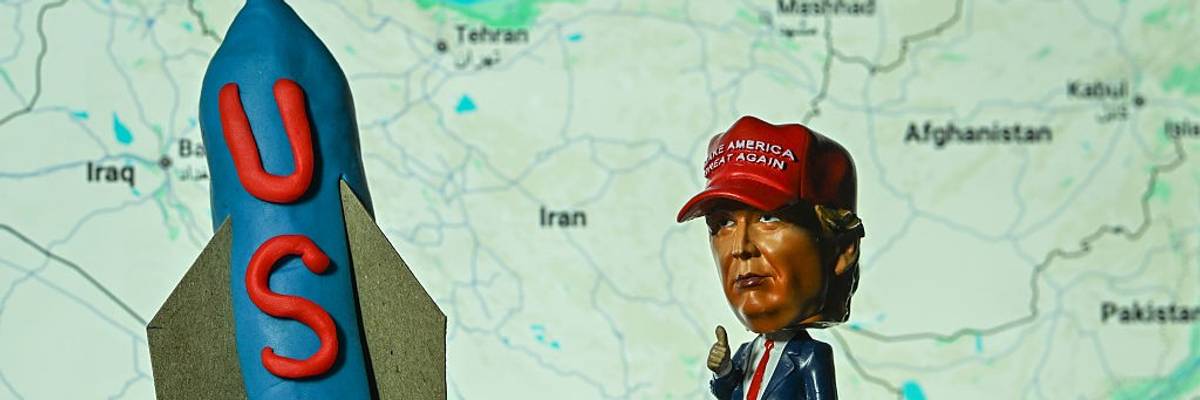
A miniature statue of US President Donald Trump stands beside a model bunker-buster bomb, set against a backdrop featuring a map of the Middle East and Iran, displayed in Kananaskis, Alberta, Canada, on June 19, 2025.
With a complete disregard for multilateral diplomatic agreements and international coalition building, the United States has once again entered into a violent conflict in the Middle East, providing no clear objective and contributing to the country’s instability.
On May 11, 2026, President Donald Trump spoke in a press conference, dismissing claims of a successful ceasefire deal with Iran, calling the most recent agreement “garbage” and describing the ceasefire agreement as “being on life support.” Trump's rejection of the ceasefire agreement reflects a common theme in his second term: favoring military aggression over diplomatic processes.
Trump has been acting through unilateral strategies as he has failed to work through international institutions (such as the United Nations or the United Arab Emirates) and to secure approval from Congress or the international community regarding going to war with Iran.
Instead, the US has joined hands with Israel, supporting Israel’s over 40-year-old goal to destabilize Iran while discarding their own diplomatic relations with Iran. But the question is, why? Why is it that the US can so quickly withdraw from Iran’s nuclear agreement when the Arms Control Association has reported: “The International Atomic Energy Agency (IAEA) released its quarterly report on Iran’s nuclear program June 6, and, unsurprisingly, the report found that Iran is complying with its commitments under the multilateral deal known as the Joint Comprehensive Plan of Action (JCPOA).”
These questions point to a growing issue: Multilateral diplomacy in the Middle East has been weakened and replaced by large-scale combat operations. Trump’s actions reflect a historical pattern in US foreign policy that has persisted since the post-Cold War Era, when the United States emerged as a global superpower. This trend of unilateral intervention by the United States was accelerated after the 9/11 attacks that resulted in the launch of the “War on Terror.”
Powerful leaders are bypassing systems of global cooperation and disregarding international law, undermining multilateral agreements while civilians die as a result.
Donald Trump’s unilateral approach to Iran reflects and intensifies these historical trends.
The partnership between Trump and Israeli Prime Minister Benjamin Netanyahu has demonstrated that the United States’ foreign policy is not the result of international consensus but rather a bilateral political agreement between the two leaders, driven by their own self-interests rather than collective security. We are witnessing a dangerous shift away from multilateral decision-making and toward decision-making concentrated in the hands of a few leaders for their own personal and national interests. The dangers of this shift are already coming to fruition. According to Al Jazeera, Iranian civilians are being impacted by the war, with a deadly attack on school children ages 7-12 being one of the most notable of the war. Amnesty International’s senior director of research, advocacy, policy, and campaigns states, “This harrowing attack on a school, with classrooms full of children, is a sickening illustration of the catastrophic and entirely predictable price civilians are paying during this armed conflict.”
There are also negative impacts on Gulf States and their relationship to the US due to the military presence in these regions. Al Jazeera reports: “At their closest points, Israel and Iran are less than 1,000km (620 miles) apart. The distance from Tel-Aviv to Iran’s capital, Tehran, is about 1,600km (1,000 miles). Iran has retaliated by attacking US bases across the Middle East. Most of these attacks have been intercepted.” The United States is now contributing to the region’s instability, as they fear retaliatory attacks from Iran. Without a defined military objective, support from the United Nations, or any international coalition, the potential of another drawn-out and morally corrupt Middle Eastern conflict becomes a frightening reality.
Some of the most concerning aspects of this conflict are its ideological drivers. Trump claims that Iran poses an imminent threat to the United States because of its missiles and nuclear program. Trump also claims that he has entered this war to bring about regime change for the Iranian people. According to a video published by Channel 4 News, none of these “concerns” actually hold up. This source reports the US Defense Intelligence Agency saying, as of May 2025, Iran had no missiles capable of striking the US. It is also reported in an Associated Press article that there was no US intelligence indicating a preemptive strike by Iran. These so-called threats are unsupported by available intelligence, which leads us to believe that Trump had different reasons for starting this war, such as distracting the US public from his poor handling of the Epstein files. One speaker, Azadeh Moaveni, in the same Channel 4 News segment, hypothesizes that Trump is acting rashly in war because of his declining popularity in domestic politics. Trump’s disapproval ratings have continued to rise, and with the midterm elections nearing, he is acting out of desperation to gain popularity.
However, this hypothesis is critiqued, as many of his supporters are angered by the hypocrisy in his actions—claiming to put America first while initiating wars in other countries. So even though the war waged with Iran has garnered him even more disapproval, why won’t he stop it? Well, the same speaker hypothesizes that Donald Trump wants Ronald Reagan's political stature. “He wants to be remembered,” she says. The ego of Donald Trump and the United States’ enduring romance with Israel is proving to be a recipe for instability in the Middle East as unilateralism becomes more normalized, international law weakens, and civilians are left in cycles of prolonged violence.
Trump’s war on Iran has exposed how dangerous situations can get when the restraints of multilateralism are not utilized. We are currently living in a period in which the direction of many nations rests in the hands of a few powerful ones—who have proven themselves willing to disregard humanity, order, and the balance of power. This underscores the broader issue at hand, where multilateral diplomatic agreements in the Middle East are being weakened and disregarded in favor of ultimately resorting to military pressure.
Egotistical leaders like Donald Trump, who leads the administration of one of the world's most powerful countries, are proving disastrous for the Middle East. Powerful leaders are bypassing systems of global cooperation and disregarding international law, undermining multilateral agreements while civilians die as a result. The Middle East and other vulnerable regions face perpetual instability as systems of global cooperation are increasingly undermined in favor of powerful nations’ self-interests.
Dear Common Dreams reader, It’s been nearly 30 years since I co-founded Common Dreams with my late wife, Lina Newhouser. We had the radical notion that journalism should serve the public good, not corporate profits. It was clear to us from the outset what it would take to build such a project. No paid advertisements. No corporate sponsors. No millionaire publisher telling us what to think or do. Many people said we wouldn't last a year, but we proved those doubters wrong. Together with a tremendous team of journalists and dedicated staff, we built an independent media outlet free from the constraints of profits and corporate control. Our mission has always been simple: To inform. To inspire. To ignite change for the common good. Building Common Dreams was not easy. Our survival was never guaranteed. When you take on the most powerful forces—Wall Street greed, fossil fuel industry destruction, Big Tech lobbyists, and uber-rich oligarchs who have spent billions upon billions rigging the economy and democracy in their favor—the only bulwark you have is supporters who believe in your work. But here’s the urgent message from me today. It's never been this bad out there. And it's never been this hard to keep us going. At the very moment Common Dreams is most needed, the threats we face are intensifying. We need your support now more than ever. We don't accept corporate advertising and never will. We don't have a paywall because we don't think people should be blocked from critical news based on their ability to pay. Everything we do is funded by the donations of readers like you. When everyone does the little they can afford, we are strong. But if that support retreats or dries up, so do we. Will you donate now to make sure Common Dreams not only survives but thrives? —Craig Brown, Co-founder |
On May 11, 2026, President Donald Trump spoke in a press conference, dismissing claims of a successful ceasefire deal with Iran, calling the most recent agreement “garbage” and describing the ceasefire agreement as “being on life support.” Trump's rejection of the ceasefire agreement reflects a common theme in his second term: favoring military aggression over diplomatic processes.
Trump has been acting through unilateral strategies as he has failed to work through international institutions (such as the United Nations or the United Arab Emirates) and to secure approval from Congress or the international community regarding going to war with Iran.
Instead, the US has joined hands with Israel, supporting Israel’s over 40-year-old goal to destabilize Iran while discarding their own diplomatic relations with Iran. But the question is, why? Why is it that the US can so quickly withdraw from Iran’s nuclear agreement when the Arms Control Association has reported: “The International Atomic Energy Agency (IAEA) released its quarterly report on Iran’s nuclear program June 6, and, unsurprisingly, the report found that Iran is complying with its commitments under the multilateral deal known as the Joint Comprehensive Plan of Action (JCPOA).”
These questions point to a growing issue: Multilateral diplomacy in the Middle East has been weakened and replaced by large-scale combat operations. Trump’s actions reflect a historical pattern in US foreign policy that has persisted since the post-Cold War Era, when the United States emerged as a global superpower. This trend of unilateral intervention by the United States was accelerated after the 9/11 attacks that resulted in the launch of the “War on Terror.”
Powerful leaders are bypassing systems of global cooperation and disregarding international law, undermining multilateral agreements while civilians die as a result.
Donald Trump’s unilateral approach to Iran reflects and intensifies these historical trends.
The partnership between Trump and Israeli Prime Minister Benjamin Netanyahu has demonstrated that the United States’ foreign policy is not the result of international consensus but rather a bilateral political agreement between the two leaders, driven by their own self-interests rather than collective security. We are witnessing a dangerous shift away from multilateral decision-making and toward decision-making concentrated in the hands of a few leaders for their own personal and national interests. The dangers of this shift are already coming to fruition. According to Al Jazeera, Iranian civilians are being impacted by the war, with a deadly attack on school children ages 7-12 being one of the most notable of the war. Amnesty International’s senior director of research, advocacy, policy, and campaigns states, “This harrowing attack on a school, with classrooms full of children, is a sickening illustration of the catastrophic and entirely predictable price civilians are paying during this armed conflict.”
There are also negative impacts on Gulf States and their relationship to the US due to the military presence in these regions. Al Jazeera reports: “At their closest points, Israel and Iran are less than 1,000km (620 miles) apart. The distance from Tel-Aviv to Iran’s capital, Tehran, is about 1,600km (1,000 miles). Iran has retaliated by attacking US bases across the Middle East. Most of these attacks have been intercepted.” The United States is now contributing to the region’s instability, as they fear retaliatory attacks from Iran. Without a defined military objective, support from the United Nations, or any international coalition, the potential of another drawn-out and morally corrupt Middle Eastern conflict becomes a frightening reality.
Some of the most concerning aspects of this conflict are its ideological drivers. Trump claims that Iran poses an imminent threat to the United States because of its missiles and nuclear program. Trump also claims that he has entered this war to bring about regime change for the Iranian people. According to a video published by Channel 4 News, none of these “concerns” actually hold up. This source reports the US Defense Intelligence Agency saying, as of May 2025, Iran had no missiles capable of striking the US. It is also reported in an Associated Press article that there was no US intelligence indicating a preemptive strike by Iran. These so-called threats are unsupported by available intelligence, which leads us to believe that Trump had different reasons for starting this war, such as distracting the US public from his poor handling of the Epstein files. One speaker, Azadeh Moaveni, in the same Channel 4 News segment, hypothesizes that Trump is acting rashly in war because of his declining popularity in domestic politics. Trump’s disapproval ratings have continued to rise, and with the midterm elections nearing, he is acting out of desperation to gain popularity.
However, this hypothesis is critiqued, as many of his supporters are angered by the hypocrisy in his actions—claiming to put America first while initiating wars in other countries. So even though the war waged with Iran has garnered him even more disapproval, why won’t he stop it? Well, the same speaker hypothesizes that Donald Trump wants Ronald Reagan's political stature. “He wants to be remembered,” she says. The ego of Donald Trump and the United States’ enduring romance with Israel is proving to be a recipe for instability in the Middle East as unilateralism becomes more normalized, international law weakens, and civilians are left in cycles of prolonged violence.
Trump’s war on Iran has exposed how dangerous situations can get when the restraints of multilateralism are not utilized. We are currently living in a period in which the direction of many nations rests in the hands of a few powerful ones—who have proven themselves willing to disregard humanity, order, and the balance of power. This underscores the broader issue at hand, where multilateral diplomatic agreements in the Middle East are being weakened and disregarded in favor of ultimately resorting to military pressure.
Egotistical leaders like Donald Trump, who leads the administration of one of the world's most powerful countries, are proving disastrous for the Middle East. Powerful leaders are bypassing systems of global cooperation and disregarding international law, undermining multilateral agreements while civilians die as a result. The Middle East and other vulnerable regions face perpetual instability as systems of global cooperation are increasingly undermined in favor of powerful nations’ self-interests.
On May 11, 2026, President Donald Trump spoke in a press conference, dismissing claims of a successful ceasefire deal with Iran, calling the most recent agreement “garbage” and describing the ceasefire agreement as “being on life support.” Trump's rejection of the ceasefire agreement reflects a common theme in his second term: favoring military aggression over diplomatic processes.
Trump has been acting through unilateral strategies as he has failed to work through international institutions (such as the United Nations or the United Arab Emirates) and to secure approval from Congress or the international community regarding going to war with Iran.
Instead, the US has joined hands with Israel, supporting Israel’s over 40-year-old goal to destabilize Iran while discarding their own diplomatic relations with Iran. But the question is, why? Why is it that the US can so quickly withdraw from Iran’s nuclear agreement when the Arms Control Association has reported: “The International Atomic Energy Agency (IAEA) released its quarterly report on Iran’s nuclear program June 6, and, unsurprisingly, the report found that Iran is complying with its commitments under the multilateral deal known as the Joint Comprehensive Plan of Action (JCPOA).”
These questions point to a growing issue: Multilateral diplomacy in the Middle East has been weakened and replaced by large-scale combat operations. Trump’s actions reflect a historical pattern in US foreign policy that has persisted since the post-Cold War Era, when the United States emerged as a global superpower. This trend of unilateral intervention by the United States was accelerated after the 9/11 attacks that resulted in the launch of the “War on Terror.”
Powerful leaders are bypassing systems of global cooperation and disregarding international law, undermining multilateral agreements while civilians die as a result.
Donald Trump’s unilateral approach to Iran reflects and intensifies these historical trends.
The partnership between Trump and Israeli Prime Minister Benjamin Netanyahu has demonstrated that the United States’ foreign policy is not the result of international consensus but rather a bilateral political agreement between the two leaders, driven by their own self-interests rather than collective security. We are witnessing a dangerous shift away from multilateral decision-making and toward decision-making concentrated in the hands of a few leaders for their own personal and national interests. The dangers of this shift are already coming to fruition. According to Al Jazeera, Iranian civilians are being impacted by the war, with a deadly attack on school children ages 7-12 being one of the most notable of the war. Amnesty International’s senior director of research, advocacy, policy, and campaigns states, “This harrowing attack on a school, with classrooms full of children, is a sickening illustration of the catastrophic and entirely predictable price civilians are paying during this armed conflict.”
There are also negative impacts on Gulf States and their relationship to the US due to the military presence in these regions. Al Jazeera reports: “At their closest points, Israel and Iran are less than 1,000km (620 miles) apart. The distance from Tel-Aviv to Iran’s capital, Tehran, is about 1,600km (1,000 miles). Iran has retaliated by attacking US bases across the Middle East. Most of these attacks have been intercepted.” The United States is now contributing to the region’s instability, as they fear retaliatory attacks from Iran. Without a defined military objective, support from the United Nations, or any international coalition, the potential of another drawn-out and morally corrupt Middle Eastern conflict becomes a frightening reality.
Some of the most concerning aspects of this conflict are its ideological drivers. Trump claims that Iran poses an imminent threat to the United States because of its missiles and nuclear program. Trump also claims that he has entered this war to bring about regime change for the Iranian people. According to a video published by Channel 4 News, none of these “concerns” actually hold up. This source reports the US Defense Intelligence Agency saying, as of May 2025, Iran had no missiles capable of striking the US. It is also reported in an Associated Press article that there was no US intelligence indicating a preemptive strike by Iran. These so-called threats are unsupported by available intelligence, which leads us to believe that Trump had different reasons for starting this war, such as distracting the US public from his poor handling of the Epstein files. One speaker, Azadeh Moaveni, in the same Channel 4 News segment, hypothesizes that Trump is acting rashly in war because of his declining popularity in domestic politics. Trump’s disapproval ratings have continued to rise, and with the midterm elections nearing, he is acting out of desperation to gain popularity.
However, this hypothesis is critiqued, as many of his supporters are angered by the hypocrisy in his actions—claiming to put America first while initiating wars in other countries. So even though the war waged with Iran has garnered him even more disapproval, why won’t he stop it? Well, the same speaker hypothesizes that Donald Trump wants Ronald Reagan's political stature. “He wants to be remembered,” she says. The ego of Donald Trump and the United States’ enduring romance with Israel is proving to be a recipe for instability in the Middle East as unilateralism becomes more normalized, international law weakens, and civilians are left in cycles of prolonged violence.
Trump’s war on Iran has exposed how dangerous situations can get when the restraints of multilateralism are not utilized. We are currently living in a period in which the direction of many nations rests in the hands of a few powerful ones—who have proven themselves willing to disregard humanity, order, and the balance of power. This underscores the broader issue at hand, where multilateral diplomatic agreements in the Middle East are being weakened and disregarded in favor of ultimately resorting to military pressure.
Egotistical leaders like Donald Trump, who leads the administration of one of the world's most powerful countries, are proving disastrous for the Middle East. Powerful leaders are bypassing systems of global cooperation and disregarding international law, undermining multilateral agreements while civilians die as a result. The Middle East and other vulnerable regions face perpetual instability as systems of global cooperation are increasingly undermined in favor of powerful nations’ self-interests.