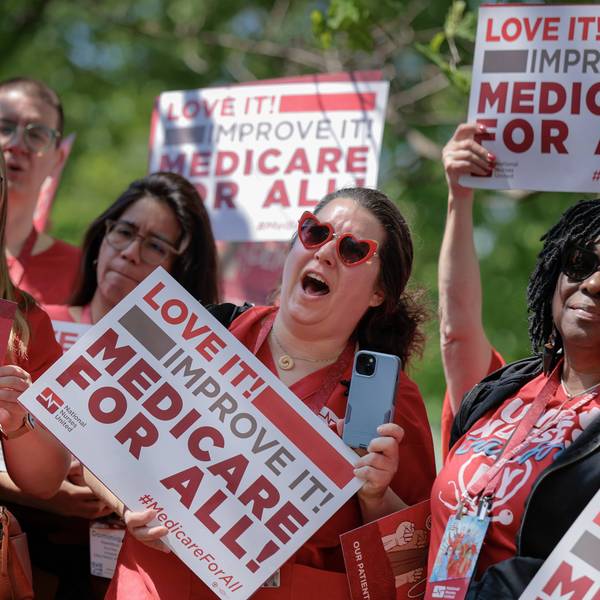
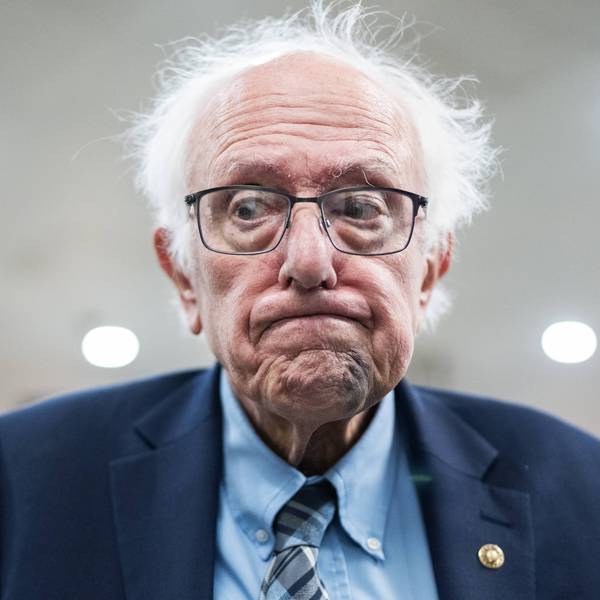
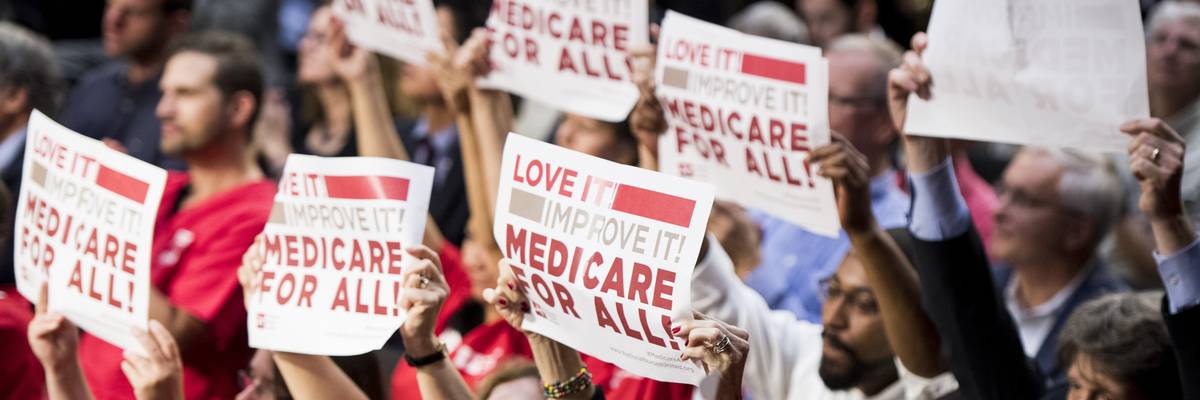
The audience waves signs as Sen. Bernie Sanders, I-Vt., speaks during his event to introduce the Medicare for All Act of 2017 on Wednesday, Sept. 13, 2017.
The Simplicity of Medicare for All: Better, Cheaper, and Less Cruel
The current for-profit insurance system is designed to keep people from getting care. The failure of that is twofold. It's cruel on the one hand and on the other hand, it's inefficient and extremely expensive.
With soaring health care costs and a plunge in coverage rates, there is growing interest in Medicare for All. Polls show that a large majority of the public now favors a universal Medicare system, with even a substantial share of Republicans now backing it.
A universal Medicare system has a huge amount to recommend it. Of course, the main point is to ensure that people can get the health care that they need, but it also eliminates a vast amount of waste in the national health care system.
In addition to the $300 billion a year that we spend directly on operating the nation’s health insurance system, another $1.6 trillion is spent on administrative costs running our health care system by providers like hospitals and doctors’ offices, according to analysis by David Himmelstein, Terry Campbell, and Steffie Woolhandler. These additional costs are all the office personnel and various navigators involved in assisting patients in dealing with insurers. They found that in the United States we spend roughly 31 percent of each dollar in health care spending on administrative costs, whereas under Canada’s universal Medicare system, the cost is just 16 percent of spending.
The difference would come to around $900 billion a year, or $6,700 per household. Even that may be an understatement. Even if the United States spent the same share of health care costs on insurers as Canada, it would still be spending far more per person on these costs, because our expenditures on drugs, medical equipment, and doctors are close to twice as high. In short, there is a huge amount to be saved by having a universal Medicare system.
But the other part of this picture is also enormously important. Much, perhaps most, of the insurance system is designed to keep people from getting care. That’s not a conspiracy; it’s just how insurers work. They make money by not paying claims.
Sometimes this takes the form of nickel-and-diming people on claims, adding deductibles that may not be appropriate, or raising co-pays as high as possible. But it often means making it difficult for people to get access to expensive drugs or medical equipment or high-priced medical tests. Given the current structure of these industries, that may actually be desirable.
To be specific, suppose a doctor recommends a new cancer drug with a price tag of $100,000 a year, when it’s possible that an older generic drug, available at 1-2 percent of this price, could be just as good. Wouldn’t we want someone to be asking questions before making such a large commitment of public money?
The same story applies to tests like an MRI. Hospitals can charge several thousand dollars for an MRI. Wouldn’t it be reasonable to ask if an X-Ray for a couple hundred dollars is just as good?
But drugs, medical equipment, and medical tests don’t actually have to cost huge amounts of money. They are expensive because the government grants the pharmaceutical industry and the medical equipment industry patent monopolies.
Without these government-granted monopolies, both drugs and medical equipment would be cheap. It’s rare that a drug is expensive to manufacture and distribute. In a free market, the vast majority of drugs would sell for $20 or $30 a prescription, and many for less. We currently are spending around $750 billion a year on prescription drugs and other pharmaceutical products. That would likely fall to around $150 billion in a free market, for savings of close to $600 billion, or $4,500 per household.
The cost of medical tests and medical equipment would have a similar plunge. In that world, there would be little reason to keep a doctor from prescribing the drug they considered best for their patient, or the tests likely to produce the most accurate diagnosis. The difference in price between newly developed drugs and old generics would usually be negligible, as would the savings from using an X-Ray as opposed to the latest MRI.
This is just the Econ 101 principle that we maximize economic efficiency when items are available at their marginal cost. As the econ textbook tells us, the government-granted patent monopoly both raises prices and creates an enormous incentive for corruption (see “opioid crisis”).
It is necessary to pay for the research and development process that leads to new drugs and medical equipment, but this is not an impossible lift. We just pay for the research upfront. We already do this to the tune of more than $50 billion a year through the National Institutes of Health and other government agencies.
This sum would have to be tripled or quadrupled to make up for the loss of patent-supported research, but there is no reason to think that paying for research with direct public funding would be any less effective than with government-granted patent monopolies. In addition to eliminating much spending on pointless me-too drugs, there would also be the advantage that all research can be fully open. That means that instead of squirreling results away to be the first to secure a patent monopoly, researchers would be promptly sharing results (that would be a condition of funding) so that others could quickly benefit from successes and be warned away from dead ends.
I recently reviewed analyses of the work behind the development of four breakthrough drugs or treatments. In all four cases, all the key breakthroughs were the results of research funded by either the government or private charities. The pharmaceutical industry only came in to secure patent monopolies and do late-stage testing. The government can pick up the tab for the late-stage testing, which is not high science. And we don’t need the patent monopolies when the research is already paid for.
Replacing the system of patent-supported research with public funding will be a big undertaking and will face massive political opposition. The pharmaceutical industry would be prepared to spend billions to defeat a change to a system that has earned it trillions of dollars over the last decade. But this is a change that is a necessary part of moving to a healthcare system that provides quality healthcare to all at a reasonable price.
There will be other issues in moving to Medicare for All. We need to get out doctors’ pay (primarily specialists) more in line with the rest of the world. They currently get more than twice as much as doctors in other wealthy countries. And we will have to pace the transition; doing it overnight is likely to be a disaster. But it is long past time we start to go down this road.
We are at a crossroads
This country and this world are at a monumental crossroads. In a few short weeks, US voters will have an opportunity to beat back the forces of fascism and confront the billionaires who are rigging the economy, our media system, and our democracy, making it increasingly impossible for ordinary people to get by. We’re not just talking about the election. We’re talking about what must be done once these fascist elements are vanquished from power. We need a bolder set of solutions than what either major party has so far been willing to offer and a working-class movement ready to fight like hell for it. Trump didn't emerge from nowhere. The conditions that fueled MAGA authoritarianism were created by decades of radical neoliberal economic policies and a corrupt political system dominated by corporate interests. They slashed taxes on the super-rich, promising that the benefits would trickle down. They said giveaways to the corporate titans would make life more affordable for the rest of us. It was all bullshit. And when a bitter, betrayed populace searches for someone to blame, right-wing demagogues have little trouble finding scapegoats. People know when they're being lied to, but you won't hear any of this from the corporate media. Only independent journalism—powered and funded by people who believe in building a better world—can deliver truly trustworthy daily news. Our Fall Campaign is underway, and we need your help. To power our newsroom through the rest of the year, we need to raise $125,000 by midnight on October 31. So if you share our vision, please contribute whatever you can to sustain our work. |
With soaring health care costs and a plunge in coverage rates, there is growing interest in Medicare for All. Polls show that a large majority of the public now favors a universal Medicare system, with even a substantial share of Republicans now backing it.
A universal Medicare system has a huge amount to recommend it. Of course, the main point is to ensure that people can get the health care that they need, but it also eliminates a vast amount of waste in the national health care system.
In addition to the $300 billion a year that we spend directly on operating the nation’s health insurance system, another $1.6 trillion is spent on administrative costs running our health care system by providers like hospitals and doctors’ offices, according to analysis by David Himmelstein, Terry Campbell, and Steffie Woolhandler. These additional costs are all the office personnel and various navigators involved in assisting patients in dealing with insurers. They found that in the United States we spend roughly 31 percent of each dollar in health care spending on administrative costs, whereas under Canada’s universal Medicare system, the cost is just 16 percent of spending.
The difference would come to around $900 billion a year, or $6,700 per household. Even that may be an understatement. Even if the United States spent the same share of health care costs on insurers as Canada, it would still be spending far more per person on these costs, because our expenditures on drugs, medical equipment, and doctors are close to twice as high. In short, there is a huge amount to be saved by having a universal Medicare system.
But the other part of this picture is also enormously important. Much, perhaps most, of the insurance system is designed to keep people from getting care. That’s not a conspiracy; it’s just how insurers work. They make money by not paying claims.
Sometimes this takes the form of nickel-and-diming people on claims, adding deductibles that may not be appropriate, or raising co-pays as high as possible. But it often means making it difficult for people to get access to expensive drugs or medical equipment or high-priced medical tests. Given the current structure of these industries, that may actually be desirable.
To be specific, suppose a doctor recommends a new cancer drug with a price tag of $100,000 a year, when it’s possible that an older generic drug, available at 1-2 percent of this price, could be just as good. Wouldn’t we want someone to be asking questions before making such a large commitment of public money?
The same story applies to tests like an MRI. Hospitals can charge several thousand dollars for an MRI. Wouldn’t it be reasonable to ask if an X-Ray for a couple hundred dollars is just as good?
But drugs, medical equipment, and medical tests don’t actually have to cost huge amounts of money. They are expensive because the government grants the pharmaceutical industry and the medical equipment industry patent monopolies.
Without these government-granted monopolies, both drugs and medical equipment would be cheap. It’s rare that a drug is expensive to manufacture and distribute. In a free market, the vast majority of drugs would sell for $20 or $30 a prescription, and many for less. We currently are spending around $750 billion a year on prescription drugs and other pharmaceutical products. That would likely fall to around $150 billion in a free market, for savings of close to $600 billion, or $4,500 per household.
The cost of medical tests and medical equipment would have a similar plunge. In that world, there would be little reason to keep a doctor from prescribing the drug they considered best for their patient, or the tests likely to produce the most accurate diagnosis. The difference in price between newly developed drugs and old generics would usually be negligible, as would the savings from using an X-Ray as opposed to the latest MRI.
This is just the Econ 101 principle that we maximize economic efficiency when items are available at their marginal cost. As the econ textbook tells us, the government-granted patent monopoly both raises prices and creates an enormous incentive for corruption (see “opioid crisis”).
It is necessary to pay for the research and development process that leads to new drugs and medical equipment, but this is not an impossible lift. We just pay for the research upfront. We already do this to the tune of more than $50 billion a year through the National Institutes of Health and other government agencies.
This sum would have to be tripled or quadrupled to make up for the loss of patent-supported research, but there is no reason to think that paying for research with direct public funding would be any less effective than with government-granted patent monopolies. In addition to eliminating much spending on pointless me-too drugs, there would also be the advantage that all research can be fully open. That means that instead of squirreling results away to be the first to secure a patent monopoly, researchers would be promptly sharing results (that would be a condition of funding) so that others could quickly benefit from successes and be warned away from dead ends.
I recently reviewed analyses of the work behind the development of four breakthrough drugs or treatments. In all four cases, all the key breakthroughs were the results of research funded by either the government or private charities. The pharmaceutical industry only came in to secure patent monopolies and do late-stage testing. The government can pick up the tab for the late-stage testing, which is not high science. And we don’t need the patent monopolies when the research is already paid for.
Replacing the system of patent-supported research with public funding will be a big undertaking and will face massive political opposition. The pharmaceutical industry would be prepared to spend billions to defeat a change to a system that has earned it trillions of dollars over the last decade. But this is a change that is a necessary part of moving to a healthcare system that provides quality healthcare to all at a reasonable price.
There will be other issues in moving to Medicare for All. We need to get out doctors’ pay (primarily specialists) more in line with the rest of the world. They currently get more than twice as much as doctors in other wealthy countries. And we will have to pace the transition; doing it overnight is likely to be a disaster. But it is long past time we start to go down this road.