SUBSCRIBE TO OUR FREE NEWSLETTER
Daily news & progressive opinion—funded by the people, not the corporations—delivered straight to your inbox.
5
#000000
#FFFFFF
To donate by check, phone, or other method, see our More Ways to Give page.
Daily news & progressive opinion—funded by the people, not the corporations—delivered straight to your inbox.
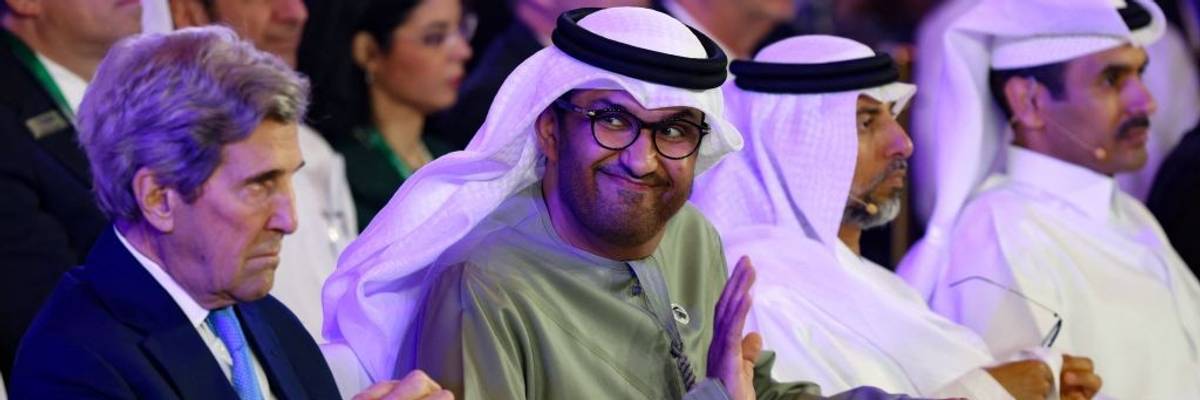
United Arab Emirates minister of industry and CEO of the Abu Dhabi National Oil Company, Sultan Ahmed al-Jaber, attends an event alongside U.S. Special Presidential Envoy for Climate John Kerry on January 14, 2023.
It is hard not to be deeply sceptical of the idea that the head of an oil company will be able to drive the 28th summit of COP towards an outcome which gives the world hope about its future in the shadow of a devastating climate crisis.
There is a big difference between national leaders and global leaders. The former push national interests on the global stage, often using the rhetoric of global solutions. The latter carry a vision that extends beyond personal interests, election cycles or profit margins to do the best for humanity.
The position of president of the Conference of the Parties (COP), the United Nations’ annual climate summit, requires a global leader. This year’s conference will be held in the United Arab Emirates under the presidency of Sultan al-Jaber, CEO of the Abu Dhabi National Oil Company.
It is hard not to be deeply sceptical of the idea that the head of an oil company will be able to drive the 28th summit of COP towards an outcome which gives the world hope about its future in the shadow of a devastating climate crisis. That is because fossil fuels account for 75% of global greenhouse gas emissions, and, in order to have some hope, we must end the use of oil, gas, and coal in a rapid and just manner.
This year’s summit must signal the beginning of this rapid shift away from fossil fuels, towards clean energy. To do this, the UAE has to facilitate an agreement between the world’s nations on phasing out all fossil fuels.
Unfortunately, with only six months to go until COP28 begins in Dubai, al-Jaber is living up to widespread low expectations. In a speech earlier this month, he spoke of “phasing out fossil fuel emissions”—a reference to using carbon capture and storage technology to reduce the emissions from burning fossil fuels, instead of phasing out fossil fuels themselves.
Such an approach is unrealistic and incompatible with the Paris Agreement. The United Nations has made it clear that the world needs to cut its emissions by 45% by 2030 to have a chance at staying under the 1.5°C. warming threshold. Currently, carbon capture and storage technology is highly expensive and simply does not exist at the necessary scale to make even a scratch on that target. We do not have time for fairy-tale solutions designed to save the oil and gas industry.
The U.N. Secretary-General António Guterres has called investing in new fossil fuel projects “moral and economic madness.” The International Energy Agency says we cannot afford to put in any new finance for coal, oil, or gas if we are to meet net-zero targets; instead, we need a massive deployment of renewable energy. The science is clear and the goal is clear, but we are still missing the global leadership to take us there.
COP28 must change that. For too long, U.N. climate summits have ignored the central cause of the climate crisis; no longer can they afford to. This year’s summit must signal the beginning of this rapid shift away from fossil fuels, towards clean energy. To do this, the UAE has to facilitate an agreement between the world’s nations on phasing out all fossil fuels.
COP28 also needs to ensure that finance going to the Global South to fund this transition is massively increased. Currently, Africa has 39% of the world’s potential for renewable energy, yet it receives just 2% of global investment in the sector.
COP28 should also secure real money for the Loss and Damage Fund which was agreed upon at COP27 and which still sits empty despite increasingly devastating climate events hitting the poorest countries.
Still, funding for loss and damage will never be enough to compensate for the chaos and destruction that the climate crisis will cause if we keep burning fossil fuels.
That is why we cannot have a COP presidency that puts national or corporate interests over the interests of humanity. In taking on this role, al-Jaber has promised to represent us all. His priority must be people—and particularly the people suffering the worst effects of climate change—not the fossil fuel industry.
In East Africa, the climate crisis is having a devastating impact. Last September, I went to Turkana, Kenya, with UNICEF to visit children suffering from severe acute malnutrition. Twenty million people are currently facing starvation in the region, largely because of an unprecedented drought that, scientists say, was made 100 times more likely by climate change.
In Turkana, I met a six-year-old boy at a hospital where the worst cases of severe acute malnutrition are referred. His grandmother had not been able to access the life-saving care he needed in time. Tragically, he passed away later that same day.
We can no longer prevent the climate crisis, but every fraction of a degree of further warming will make heatwaves more intense, droughts more prolonged, and storms more powerful. Every year that passes without a rapid transformation of our economies away from fossil fuels means more will be lost to the climate crisis.
In June, the world’s climate negotiators will meet in Bonn, Germany, to assess progress towards COP28. Its president, al-Jaber, must head to Bonn with a credible plan for decarbonisation. This will be his opportunity to save countless lives, he must not miss it.
Dear Common Dreams reader, It’s been nearly 30 years since I co-founded Common Dreams with my late wife, Lina Newhouser. We had the radical notion that journalism should serve the public good, not corporate profits. It was clear to us from the outset what it would take to build such a project. No paid advertisements. No corporate sponsors. No millionaire publisher telling us what to think or do. Many people said we wouldn't last a year, but we proved those doubters wrong. Together with a tremendous team of journalists and dedicated staff, we built an independent media outlet free from the constraints of profits and corporate control. Our mission has always been simple: To inform. To inspire. To ignite change for the common good. Building Common Dreams was not easy. Our survival was never guaranteed. When you take on the most powerful forces—Wall Street greed, fossil fuel industry destruction, Big Tech lobbyists, and uber-rich oligarchs who have spent billions upon billions rigging the economy and democracy in their favor—the only bulwark you have is supporters who believe in your work. But here’s the urgent message from me today. It's never been this bad out there. And it's never been this hard to keep us going. At the very moment Common Dreams is most needed, the threats we face are intensifying. We need your support now more than ever. We don't accept corporate advertising and never will. We don't have a paywall because we don't think people should be blocked from critical news based on their ability to pay. Everything we do is funded by the donations of readers like you. When everyone does the little they can afford, we are strong. But if that support retreats or dries up, so do we. Will you donate now to make sure Common Dreams not only survives but thrives? —Craig Brown, Co-founder |
There is a big difference between national leaders and global leaders. The former push national interests on the global stage, often using the rhetoric of global solutions. The latter carry a vision that extends beyond personal interests, election cycles or profit margins to do the best for humanity.
The position of president of the Conference of the Parties (COP), the United Nations’ annual climate summit, requires a global leader. This year’s conference will be held in the United Arab Emirates under the presidency of Sultan al-Jaber, CEO of the Abu Dhabi National Oil Company.
It is hard not to be deeply sceptical of the idea that the head of an oil company will be able to drive the 28th summit of COP towards an outcome which gives the world hope about its future in the shadow of a devastating climate crisis. That is because fossil fuels account for 75% of global greenhouse gas emissions, and, in order to have some hope, we must end the use of oil, gas, and coal in a rapid and just manner.
This year’s summit must signal the beginning of this rapid shift away from fossil fuels, towards clean energy. To do this, the UAE has to facilitate an agreement between the world’s nations on phasing out all fossil fuels.
Unfortunately, with only six months to go until COP28 begins in Dubai, al-Jaber is living up to widespread low expectations. In a speech earlier this month, he spoke of “phasing out fossil fuel emissions”—a reference to using carbon capture and storage technology to reduce the emissions from burning fossil fuels, instead of phasing out fossil fuels themselves.
Such an approach is unrealistic and incompatible with the Paris Agreement. The United Nations has made it clear that the world needs to cut its emissions by 45% by 2030 to have a chance at staying under the 1.5°C. warming threshold. Currently, carbon capture and storage technology is highly expensive and simply does not exist at the necessary scale to make even a scratch on that target. We do not have time for fairy-tale solutions designed to save the oil and gas industry.
The U.N. Secretary-General António Guterres has called investing in new fossil fuel projects “moral and economic madness.” The International Energy Agency says we cannot afford to put in any new finance for coal, oil, or gas if we are to meet net-zero targets; instead, we need a massive deployment of renewable energy. The science is clear and the goal is clear, but we are still missing the global leadership to take us there.
COP28 must change that. For too long, U.N. climate summits have ignored the central cause of the climate crisis; no longer can they afford to. This year’s summit must signal the beginning of this rapid shift away from fossil fuels, towards clean energy. To do this, the UAE has to facilitate an agreement between the world’s nations on phasing out all fossil fuels.
COP28 also needs to ensure that finance going to the Global South to fund this transition is massively increased. Currently, Africa has 39% of the world’s potential for renewable energy, yet it receives just 2% of global investment in the sector.
COP28 should also secure real money for the Loss and Damage Fund which was agreed upon at COP27 and which still sits empty despite increasingly devastating climate events hitting the poorest countries.
Still, funding for loss and damage will never be enough to compensate for the chaos and destruction that the climate crisis will cause if we keep burning fossil fuels.
That is why we cannot have a COP presidency that puts national or corporate interests over the interests of humanity. In taking on this role, al-Jaber has promised to represent us all. His priority must be people—and particularly the people suffering the worst effects of climate change—not the fossil fuel industry.
In East Africa, the climate crisis is having a devastating impact. Last September, I went to Turkana, Kenya, with UNICEF to visit children suffering from severe acute malnutrition. Twenty million people are currently facing starvation in the region, largely because of an unprecedented drought that, scientists say, was made 100 times more likely by climate change.
In Turkana, I met a six-year-old boy at a hospital where the worst cases of severe acute malnutrition are referred. His grandmother had not been able to access the life-saving care he needed in time. Tragically, he passed away later that same day.
We can no longer prevent the climate crisis, but every fraction of a degree of further warming will make heatwaves more intense, droughts more prolonged, and storms more powerful. Every year that passes without a rapid transformation of our economies away from fossil fuels means more will be lost to the climate crisis.
In June, the world’s climate negotiators will meet in Bonn, Germany, to assess progress towards COP28. Its president, al-Jaber, must head to Bonn with a credible plan for decarbonisation. This will be his opportunity to save countless lives, he must not miss it.
There is a big difference between national leaders and global leaders. The former push national interests on the global stage, often using the rhetoric of global solutions. The latter carry a vision that extends beyond personal interests, election cycles or profit margins to do the best for humanity.
The position of president of the Conference of the Parties (COP), the United Nations’ annual climate summit, requires a global leader. This year’s conference will be held in the United Arab Emirates under the presidency of Sultan al-Jaber, CEO of the Abu Dhabi National Oil Company.
It is hard not to be deeply sceptical of the idea that the head of an oil company will be able to drive the 28th summit of COP towards an outcome which gives the world hope about its future in the shadow of a devastating climate crisis. That is because fossil fuels account for 75% of global greenhouse gas emissions, and, in order to have some hope, we must end the use of oil, gas, and coal in a rapid and just manner.
This year’s summit must signal the beginning of this rapid shift away from fossil fuels, towards clean energy. To do this, the UAE has to facilitate an agreement between the world’s nations on phasing out all fossil fuels.
Unfortunately, with only six months to go until COP28 begins in Dubai, al-Jaber is living up to widespread low expectations. In a speech earlier this month, he spoke of “phasing out fossil fuel emissions”—a reference to using carbon capture and storage technology to reduce the emissions from burning fossil fuels, instead of phasing out fossil fuels themselves.
Such an approach is unrealistic and incompatible with the Paris Agreement. The United Nations has made it clear that the world needs to cut its emissions by 45% by 2030 to have a chance at staying under the 1.5°C. warming threshold. Currently, carbon capture and storage technology is highly expensive and simply does not exist at the necessary scale to make even a scratch on that target. We do not have time for fairy-tale solutions designed to save the oil and gas industry.
The U.N. Secretary-General António Guterres has called investing in new fossil fuel projects “moral and economic madness.” The International Energy Agency says we cannot afford to put in any new finance for coal, oil, or gas if we are to meet net-zero targets; instead, we need a massive deployment of renewable energy. The science is clear and the goal is clear, but we are still missing the global leadership to take us there.
COP28 must change that. For too long, U.N. climate summits have ignored the central cause of the climate crisis; no longer can they afford to. This year’s summit must signal the beginning of this rapid shift away from fossil fuels, towards clean energy. To do this, the UAE has to facilitate an agreement between the world’s nations on phasing out all fossil fuels.
COP28 also needs to ensure that finance going to the Global South to fund this transition is massively increased. Currently, Africa has 39% of the world’s potential for renewable energy, yet it receives just 2% of global investment in the sector.
COP28 should also secure real money for the Loss and Damage Fund which was agreed upon at COP27 and which still sits empty despite increasingly devastating climate events hitting the poorest countries.
Still, funding for loss and damage will never be enough to compensate for the chaos and destruction that the climate crisis will cause if we keep burning fossil fuels.
That is why we cannot have a COP presidency that puts national or corporate interests over the interests of humanity. In taking on this role, al-Jaber has promised to represent us all. His priority must be people—and particularly the people suffering the worst effects of climate change—not the fossil fuel industry.
In East Africa, the climate crisis is having a devastating impact. Last September, I went to Turkana, Kenya, with UNICEF to visit children suffering from severe acute malnutrition. Twenty million people are currently facing starvation in the region, largely because of an unprecedented drought that, scientists say, was made 100 times more likely by climate change.
In Turkana, I met a six-year-old boy at a hospital where the worst cases of severe acute malnutrition are referred. His grandmother had not been able to access the life-saving care he needed in time. Tragically, he passed away later that same day.
We can no longer prevent the climate crisis, but every fraction of a degree of further warming will make heatwaves more intense, droughts more prolonged, and storms more powerful. Every year that passes without a rapid transformation of our economies away from fossil fuels means more will be lost to the climate crisis.
In June, the world’s climate negotiators will meet in Bonn, Germany, to assess progress towards COP28. Its president, al-Jaber, must head to Bonn with a credible plan for decarbonisation. This will be his opportunity to save countless lives, he must not miss it.