SUBSCRIBE TO OUR FREE NEWSLETTER
Daily news & progressive opinion—funded by the people, not the corporations—delivered straight to your inbox.
5
#000000
#FFFFFF
To donate by check, phone, or other method, see our More Ways to Give page.
Daily news & progressive opinion—funded by the people, not the corporations—delivered straight to your inbox.
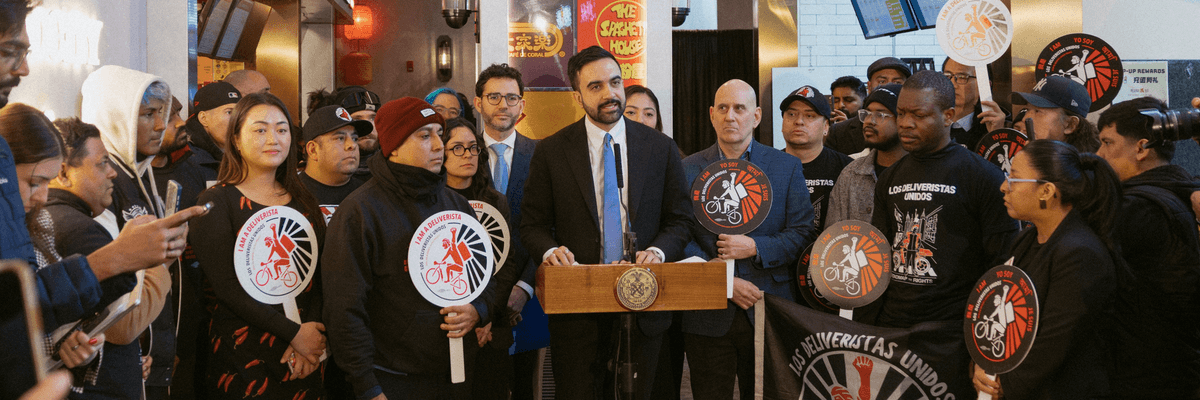
What kind of power and solidarity is built and transformed in New York City’s municipalist moment will depend on whether or not the remaking of public and civic infrastructures is guided by participatory democracy.
It is an inspiring time to be a New Yorker. Over the last year, thousands have been mobilized by a vision for a more just city, where the interests of the people, not the 1%, are at the center of social and economic policies. Driving this vision is a city that is affordable, one where public infrastructures are not indicative of neglect, exclusion or harm, but are life-affirming institutions grounded in principles of participatory democracy: where everyday residents have a direct say over the public policies that govern their lives.
It is a beautiful vision, especially in a city that has long been plagued by corporate and private interests, and one that draws from models of what is termed new or radical municipalism and experiments with mass and co-governance in cities including Barcelona, Jackson, and Porto Alegre, among others.
Distinguishing New York City’s municipalist moment is its political geography: It is a global city, a center of global finance; a metropole in the Global North, at the center of the imperialist core, and the home of Wall Street; and it is an urban center long defined by uneven development and inequity. The city with the highest concentration of wealth in the world runs on a workforce where only 33% of workers have “good jobs” (qualified by living wage pay, full-time, and year-round employment, employer sponsored health insurance, and safe working conditions). Over one-quarter of New Yorkers struggle with poverty, and nearly two-thirds are economically precarious. Adding to this context is intensified fascism, integral to which has been the bipartisan project of what Ruth Wilson Gilmore has termed the anti-state state: The structured expansion of corporate interests and privatization schemes coupled with the shrinkage of the public infrastructures, entitlements, and services alongside the increased entanglement of policing, surveillance, and punishment into nearly every vestige of the public that remains.
On one hand, the renewed interest in public infrastructures grounding radical municipalism signals an important turn from neoliberal consumer citizenship, exemplified recently by former New York City Public Schools Chancellor Carmen Farina’s description of parents as the Department of Education’s “clients.” On the other hand, New York’s wealth, part and parcel of its long-standing and structured class- and race-based inequity, presents a real challenge to the reinvigoration of civic and public life, to what kind of power, what kind of public, will be built and transformed—and to what ends. How do we ensure that the promise of a more just city is truly and actively guided (not just informed) by New Yorkers whose experience of the public has long been shaped by histories of organized abandonment (or the intentional divestment of state and private capital that shape particular places), by the harm, exclusion, and violence of the anti-state state?
Often, what people are fighting for is not a “failing school” but rather, a place through which they have grown community and practiced care, where they have made meaning and collective life despite and within state divestment.
The promise of radical municipalism to enliven deliberative spaces that build capacity for protagonism and expand practices of citizenship needs to be guided by what Celina Su understands as epistemic justice, “actively questioning what bodies of knowledge are counted as expert, rational, and valuable.” More than an advisory role, epistemic justice must actively structure deliberative spaces. In its absence, Su notes, deliberative spaces run the risk of perpetuating already existing inequities. The urgency of this approach is captured by the now infamous New York City District 3 CEC (Community Education Council) meeting, when City University of New York Professor Allyson Friedman’s racist remarks, in response to an eighth grade student who was speaking out against their school being closed, were captured by an open mic. As many recognize, Friedman’s remarks are not a unique case, but emblematic of the changing same in the district.
The district, among the most segregated and unequal in the city, is where I have worked with others to build power, organizing, and leadership among low-income families of color for just and equitable public schools. There have been countless occasions in which “concerned parents” broadcast their racism sometimes in official testimony, sometimes in unofficial remarks. Most often, these remarks have not captured headlines. And in that mix (which included CEC, district, Community Board, and school-site meetings) poor and working class families of color were regularly told that they didn’t “understand” or might be “confused” by their own experiences—their own stories—and dismissed. Friedman’s comments implied the same: that the student speaking out against their school being closed simply did not understand (and, according to Friedman’s racist analysis, could not understand) their own circumstances or the value of their school community. Yet students, teachers, parents, and school workers have long recognized and resisted school closures as a mechanism of dispossession, racist violence, encroachment, and displacement. Often, what people are fighting for is not a “failing school” but rather, a place through which they have grown community and practiced care, where they have made meaning and collective life despite and within state divestment.
In our municipalist moment, deliberative spaces need to be reinvigorated and also reassessed. Gianpaolo Baiocchi, Sumathy Kumar, and Celina Su write that New York City has an extensive infrastructure for civic participation (which includes CECs, community boards, the Civic Engagement Commission, and more). However, they assess, “much of it is shallow, uncoordinated, fragmented, and symbolic. New Yorkers are rightly skeptical of consultations that go nowhere.” They note the need for an audit of such structures with a goal of repurposing and revitalization, guided by the knowledge and experience of community organizers and organizations. As such, the question raised by the winter meeting that went viral is not only if such remarks should be tolerated, but rather, how to intentionally transform the CEC and other infrastructures that are supposed to enliven participatory democracy from places that too often confirm and perpetuate inequity into places where the long-standing violence enacted by austerity and mechanized through school closures is interrupted. To do so, the voices, experiences, and analyses of those who have experienced such violence need to be active, understood as credible, and prioritized.
The transformation of our public and civic infrastructures requires both deep local knowledge and an understanding that such spaces are not static. Bonnie Honig reminds us that public things—libraries, schools, healthcare, and housing—as well as civic infrastructures through which they are governed, are “holding environments.” That is, they are simultaneously containers through which life is reproduced in the everyday (including making sure that all students have warm winter coats, that access to ultrasound mammograms is universal, and that lighting and heat work in public and subsidized housing) and spaces of contestation over what democracy, citizenship, and our social relations—not yet determined—might be.
These holding environments have been contradictory at best. More often, they have been vehicles through which the silencing, exclusion, and disenfranchisement that liberalism relies upon are administered, and where scarcity engenders social relations of competition and individuation, where it is assumed that one’s needs are only confirmed in opposition to the security of others.
Radical municipalism offers the promise to shift that configuration, and actualize Ruth Wilson Gilmore’s insight that “abolition is not absence, it is presence.” This insight directs us to the need not just to dismantle, but to build practices, structures, institutions, and experiments that affirm life. The perspectives of structurally marginalized communities are essential to determining what kind of presence is necessary: to mapping not only how harm works, but also to what kinds of alternatives are needed and might be capable of transforming our social relations.
A good example of why this is true comes from Communities United for Police Reform (CPR) and the Public Science Project’s (CUNY) report, We Deserve to Be Safe. Rooted in Participatory Action-Research (PAR), the project’s leadership team included CPR member-led organizations in over-policed communities, was grounded in long-standing relationships and an understanding of the multi-layered harms of policing, and anchored by the shared principle that highly policed communities need to be at the center of how safety and harm are understood and re-imagined. As they note:
Our findings illuminate that people in highly policed New York neighborhoods often hold deeply complex beliefs, attitudes and proposals for community safety, supporting this report’s approach of presenting data about the multiple truths that communities hold. Notably, our findings suggest that while police officers have provided moments of successful intervention and important services for New Yorkers, for many respondents the police are also a constant threat to safety.
The perspectives and findings outlined by the report provide insight that, as the authors note, reach beyond an “overly simplistic duality of either decreased policing and lawlessness or increased policing and safety.” The stories and experiences outlined make painfully clear the violence of policing while also centering participants' complex personhood not simply as anecdote, but as analysis and insight to understanding what kinds of alternatives to policing—informed by place-based histories and realities—might actually be transformative. Bound up in the stories that the report documents is the sobering reality that understanding what “successful interventions and important services” have actually meant is integral to disentangling policing with the provision of social services.
Examples of radical municipalism in other cities show the meeting of our material and everyday needs is deeply connected to the transformation of our social relations, rooted in structures and practices that expand (rather than shrink) how we understand ourselves in relationship to one another, and how we value life, its reproduction, and sustainability. Drawing on her work with the Movimento dos Trabalhadores Rurais Sem Terra or Landless Workers' Movement (MST), Rebecca Tarlau terms this process contentious co-governance which “is not simply [about] more resources or policy changes but, rather, the prefiguration of alternative social and economic relations within… public institutions.” Importantly, in the case of the MST, Tarlau finds that prefiguration need not be outside of the state and that participation is not simply a means to an end, but rather invokes practices that expand and transform social relations through and within public and civic infrastructures, while also strengthening social movements.
New York City’s political geography—as a global city, as a metropole in the Global North and center of the imperialist core, and as an urban center long defined by uneven development and inequity—matters to how we navigate our current conjuncture. Chaumtoli Haq reminds us that in the context of the global city, radical municipalism presents a “powerful strategy for change… [that] enables communities, given their proximity to local governance, to mobilize for changes in law and policy.”
The strength of this strategy has already been demonstrated by the historic campaign to elect Zohran Mamdani as mayor. Rooted in strong partnerships with grassroots organizations including CAAAV Voice, DRUM Beats, and New York City Communities for Change, the material conditions of these organizations’ members shaped the policy platforms of the campaign. What kind of power and solidarity is built and transformed in New York City’s municipalist moment will depend on whether or not the remaking of public and civic infrastructures is guided by participatory democracy and deliberative spaces that are grounded in epistemic justice and contentious cogovernance: whose knowledge, experience, and know-how actively shapes those processes; what kind of protagonism and popular shared analysis propels momentum and movement; and what kinds of social relations are enlivened to expand political horizons and protracted struggle.
Dear Common Dreams reader, It’s been nearly 30 years since I co-founded Common Dreams with my late wife, Lina Newhouser. We had the radical notion that journalism should serve the public good, not corporate profits. It was clear to us from the outset what it would take to build such a project. No paid advertisements. No corporate sponsors. No millionaire publisher telling us what to think or do. Many people said we wouldn't last a year, but we proved those doubters wrong. Together with a tremendous team of journalists and dedicated staff, we built an independent media outlet free from the constraints of profits and corporate control. Our mission has always been simple: To inform. To inspire. To ignite change for the common good. Building Common Dreams was not easy. Our survival was never guaranteed. When you take on the most powerful forces—Wall Street greed, fossil fuel industry destruction, Big Tech lobbyists, and uber-rich oligarchs who have spent billions upon billions rigging the economy and democracy in their favor—the only bulwark you have is supporters who believe in your work. But here’s the urgent message from me today. It's never been this bad out there. And it's never been this hard to keep us going. At the very moment Common Dreams is most needed, the threats we face are intensifying. We need your support now more than ever. We don't accept corporate advertising and never will. We don't have a paywall because we don't think people should be blocked from critical news based on their ability to pay. Everything we do is funded by the donations of readers like you. When everyone does the little they can afford, we are strong. But if that support retreats or dries up, so do we. Will you donate now to make sure Common Dreams not only survives but thrives? —Craig Brown, Co-founder |
It is an inspiring time to be a New Yorker. Over the last year, thousands have been mobilized by a vision for a more just city, where the interests of the people, not the 1%, are at the center of social and economic policies. Driving this vision is a city that is affordable, one where public infrastructures are not indicative of neglect, exclusion or harm, but are life-affirming institutions grounded in principles of participatory democracy: where everyday residents have a direct say over the public policies that govern their lives.
It is a beautiful vision, especially in a city that has long been plagued by corporate and private interests, and one that draws from models of what is termed new or radical municipalism and experiments with mass and co-governance in cities including Barcelona, Jackson, and Porto Alegre, among others.
Distinguishing New York City’s municipalist moment is its political geography: It is a global city, a center of global finance; a metropole in the Global North, at the center of the imperialist core, and the home of Wall Street; and it is an urban center long defined by uneven development and inequity. The city with the highest concentration of wealth in the world runs on a workforce where only 33% of workers have “good jobs” (qualified by living wage pay, full-time, and year-round employment, employer sponsored health insurance, and safe working conditions). Over one-quarter of New Yorkers struggle with poverty, and nearly two-thirds are economically precarious. Adding to this context is intensified fascism, integral to which has been the bipartisan project of what Ruth Wilson Gilmore has termed the anti-state state: The structured expansion of corporate interests and privatization schemes coupled with the shrinkage of the public infrastructures, entitlements, and services alongside the increased entanglement of policing, surveillance, and punishment into nearly every vestige of the public that remains.
On one hand, the renewed interest in public infrastructures grounding radical municipalism signals an important turn from neoliberal consumer citizenship, exemplified recently by former New York City Public Schools Chancellor Carmen Farina’s description of parents as the Department of Education’s “clients.” On the other hand, New York’s wealth, part and parcel of its long-standing and structured class- and race-based inequity, presents a real challenge to the reinvigoration of civic and public life, to what kind of power, what kind of public, will be built and transformed—and to what ends. How do we ensure that the promise of a more just city is truly and actively guided (not just informed) by New Yorkers whose experience of the public has long been shaped by histories of organized abandonment (or the intentional divestment of state and private capital that shape particular places), by the harm, exclusion, and violence of the anti-state state?
Often, what people are fighting for is not a “failing school” but rather, a place through which they have grown community and practiced care, where they have made meaning and collective life despite and within state divestment.
The promise of radical municipalism to enliven deliberative spaces that build capacity for protagonism and expand practices of citizenship needs to be guided by what Celina Su understands as epistemic justice, “actively questioning what bodies of knowledge are counted as expert, rational, and valuable.” More than an advisory role, epistemic justice must actively structure deliberative spaces. In its absence, Su notes, deliberative spaces run the risk of perpetuating already existing inequities. The urgency of this approach is captured by the now infamous New York City District 3 CEC (Community Education Council) meeting, when City University of New York Professor Allyson Friedman’s racist remarks, in response to an eighth grade student who was speaking out against their school being closed, were captured by an open mic. As many recognize, Friedman’s remarks are not a unique case, but emblematic of the changing same in the district.
The district, among the most segregated and unequal in the city, is where I have worked with others to build power, organizing, and leadership among low-income families of color for just and equitable public schools. There have been countless occasions in which “concerned parents” broadcast their racism sometimes in official testimony, sometimes in unofficial remarks. Most often, these remarks have not captured headlines. And in that mix (which included CEC, district, Community Board, and school-site meetings) poor and working class families of color were regularly told that they didn’t “understand” or might be “confused” by their own experiences—their own stories—and dismissed. Friedman’s comments implied the same: that the student speaking out against their school being closed simply did not understand (and, according to Friedman’s racist analysis, could not understand) their own circumstances or the value of their school community. Yet students, teachers, parents, and school workers have long recognized and resisted school closures as a mechanism of dispossession, racist violence, encroachment, and displacement. Often, what people are fighting for is not a “failing school” but rather, a place through which they have grown community and practiced care, where they have made meaning and collective life despite and within state divestment.
In our municipalist moment, deliberative spaces need to be reinvigorated and also reassessed. Gianpaolo Baiocchi, Sumathy Kumar, and Celina Su write that New York City has an extensive infrastructure for civic participation (which includes CECs, community boards, the Civic Engagement Commission, and more). However, they assess, “much of it is shallow, uncoordinated, fragmented, and symbolic. New Yorkers are rightly skeptical of consultations that go nowhere.” They note the need for an audit of such structures with a goal of repurposing and revitalization, guided by the knowledge and experience of community organizers and organizations. As such, the question raised by the winter meeting that went viral is not only if such remarks should be tolerated, but rather, how to intentionally transform the CEC and other infrastructures that are supposed to enliven participatory democracy from places that too often confirm and perpetuate inequity into places where the long-standing violence enacted by austerity and mechanized through school closures is interrupted. To do so, the voices, experiences, and analyses of those who have experienced such violence need to be active, understood as credible, and prioritized.
The transformation of our public and civic infrastructures requires both deep local knowledge and an understanding that such spaces are not static. Bonnie Honig reminds us that public things—libraries, schools, healthcare, and housing—as well as civic infrastructures through which they are governed, are “holding environments.” That is, they are simultaneously containers through which life is reproduced in the everyday (including making sure that all students have warm winter coats, that access to ultrasound mammograms is universal, and that lighting and heat work in public and subsidized housing) and spaces of contestation over what democracy, citizenship, and our social relations—not yet determined—might be.
These holding environments have been contradictory at best. More often, they have been vehicles through which the silencing, exclusion, and disenfranchisement that liberalism relies upon are administered, and where scarcity engenders social relations of competition and individuation, where it is assumed that one’s needs are only confirmed in opposition to the security of others.
Radical municipalism offers the promise to shift that configuration, and actualize Ruth Wilson Gilmore’s insight that “abolition is not absence, it is presence.” This insight directs us to the need not just to dismantle, but to build practices, structures, institutions, and experiments that affirm life. The perspectives of structurally marginalized communities are essential to determining what kind of presence is necessary: to mapping not only how harm works, but also to what kinds of alternatives are needed and might be capable of transforming our social relations.
A good example of why this is true comes from Communities United for Police Reform (CPR) and the Public Science Project’s (CUNY) report, We Deserve to Be Safe. Rooted in Participatory Action-Research (PAR), the project’s leadership team included CPR member-led organizations in over-policed communities, was grounded in long-standing relationships and an understanding of the multi-layered harms of policing, and anchored by the shared principle that highly policed communities need to be at the center of how safety and harm are understood and re-imagined. As they note:
Our findings illuminate that people in highly policed New York neighborhoods often hold deeply complex beliefs, attitudes and proposals for community safety, supporting this report’s approach of presenting data about the multiple truths that communities hold. Notably, our findings suggest that while police officers have provided moments of successful intervention and important services for New Yorkers, for many respondents the police are also a constant threat to safety.
The perspectives and findings outlined by the report provide insight that, as the authors note, reach beyond an “overly simplistic duality of either decreased policing and lawlessness or increased policing and safety.” The stories and experiences outlined make painfully clear the violence of policing while also centering participants' complex personhood not simply as anecdote, but as analysis and insight to understanding what kinds of alternatives to policing—informed by place-based histories and realities—might actually be transformative. Bound up in the stories that the report documents is the sobering reality that understanding what “successful interventions and important services” have actually meant is integral to disentangling policing with the provision of social services.
Examples of radical municipalism in other cities show the meeting of our material and everyday needs is deeply connected to the transformation of our social relations, rooted in structures and practices that expand (rather than shrink) how we understand ourselves in relationship to one another, and how we value life, its reproduction, and sustainability. Drawing on her work with the Movimento dos Trabalhadores Rurais Sem Terra or Landless Workers' Movement (MST), Rebecca Tarlau terms this process contentious co-governance which “is not simply [about] more resources or policy changes but, rather, the prefiguration of alternative social and economic relations within… public institutions.” Importantly, in the case of the MST, Tarlau finds that prefiguration need not be outside of the state and that participation is not simply a means to an end, but rather invokes practices that expand and transform social relations through and within public and civic infrastructures, while also strengthening social movements.
New York City’s political geography—as a global city, as a metropole in the Global North and center of the imperialist core, and as an urban center long defined by uneven development and inequity—matters to how we navigate our current conjuncture. Chaumtoli Haq reminds us that in the context of the global city, radical municipalism presents a “powerful strategy for change… [that] enables communities, given their proximity to local governance, to mobilize for changes in law and policy.”
The strength of this strategy has already been demonstrated by the historic campaign to elect Zohran Mamdani as mayor. Rooted in strong partnerships with grassroots organizations including CAAAV Voice, DRUM Beats, and New York City Communities for Change, the material conditions of these organizations’ members shaped the policy platforms of the campaign. What kind of power and solidarity is built and transformed in New York City’s municipalist moment will depend on whether or not the remaking of public and civic infrastructures is guided by participatory democracy and deliberative spaces that are grounded in epistemic justice and contentious cogovernance: whose knowledge, experience, and know-how actively shapes those processes; what kind of protagonism and popular shared analysis propels momentum and movement; and what kinds of social relations are enlivened to expand political horizons and protracted struggle.
It is an inspiring time to be a New Yorker. Over the last year, thousands have been mobilized by a vision for a more just city, where the interests of the people, not the 1%, are at the center of social and economic policies. Driving this vision is a city that is affordable, one where public infrastructures are not indicative of neglect, exclusion or harm, but are life-affirming institutions grounded in principles of participatory democracy: where everyday residents have a direct say over the public policies that govern their lives.
It is a beautiful vision, especially in a city that has long been plagued by corporate and private interests, and one that draws from models of what is termed new or radical municipalism and experiments with mass and co-governance in cities including Barcelona, Jackson, and Porto Alegre, among others.
Distinguishing New York City’s municipalist moment is its political geography: It is a global city, a center of global finance; a metropole in the Global North, at the center of the imperialist core, and the home of Wall Street; and it is an urban center long defined by uneven development and inequity. The city with the highest concentration of wealth in the world runs on a workforce where only 33% of workers have “good jobs” (qualified by living wage pay, full-time, and year-round employment, employer sponsored health insurance, and safe working conditions). Over one-quarter of New Yorkers struggle with poverty, and nearly two-thirds are economically precarious. Adding to this context is intensified fascism, integral to which has been the bipartisan project of what Ruth Wilson Gilmore has termed the anti-state state: The structured expansion of corporate interests and privatization schemes coupled with the shrinkage of the public infrastructures, entitlements, and services alongside the increased entanglement of policing, surveillance, and punishment into nearly every vestige of the public that remains.
On one hand, the renewed interest in public infrastructures grounding radical municipalism signals an important turn from neoliberal consumer citizenship, exemplified recently by former New York City Public Schools Chancellor Carmen Farina’s description of parents as the Department of Education’s “clients.” On the other hand, New York’s wealth, part and parcel of its long-standing and structured class- and race-based inequity, presents a real challenge to the reinvigoration of civic and public life, to what kind of power, what kind of public, will be built and transformed—and to what ends. How do we ensure that the promise of a more just city is truly and actively guided (not just informed) by New Yorkers whose experience of the public has long been shaped by histories of organized abandonment (or the intentional divestment of state and private capital that shape particular places), by the harm, exclusion, and violence of the anti-state state?
Often, what people are fighting for is not a “failing school” but rather, a place through which they have grown community and practiced care, where they have made meaning and collective life despite and within state divestment.
The promise of radical municipalism to enliven deliberative spaces that build capacity for protagonism and expand practices of citizenship needs to be guided by what Celina Su understands as epistemic justice, “actively questioning what bodies of knowledge are counted as expert, rational, and valuable.” More than an advisory role, epistemic justice must actively structure deliberative spaces. In its absence, Su notes, deliberative spaces run the risk of perpetuating already existing inequities. The urgency of this approach is captured by the now infamous New York City District 3 CEC (Community Education Council) meeting, when City University of New York Professor Allyson Friedman’s racist remarks, in response to an eighth grade student who was speaking out against their school being closed, were captured by an open mic. As many recognize, Friedman’s remarks are not a unique case, but emblematic of the changing same in the district.
The district, among the most segregated and unequal in the city, is where I have worked with others to build power, organizing, and leadership among low-income families of color for just and equitable public schools. There have been countless occasions in which “concerned parents” broadcast their racism sometimes in official testimony, sometimes in unofficial remarks. Most often, these remarks have not captured headlines. And in that mix (which included CEC, district, Community Board, and school-site meetings) poor and working class families of color were regularly told that they didn’t “understand” or might be “confused” by their own experiences—their own stories—and dismissed. Friedman’s comments implied the same: that the student speaking out against their school being closed simply did not understand (and, according to Friedman’s racist analysis, could not understand) their own circumstances or the value of their school community. Yet students, teachers, parents, and school workers have long recognized and resisted school closures as a mechanism of dispossession, racist violence, encroachment, and displacement. Often, what people are fighting for is not a “failing school” but rather, a place through which they have grown community and practiced care, where they have made meaning and collective life despite and within state divestment.
In our municipalist moment, deliberative spaces need to be reinvigorated and also reassessed. Gianpaolo Baiocchi, Sumathy Kumar, and Celina Su write that New York City has an extensive infrastructure for civic participation (which includes CECs, community boards, the Civic Engagement Commission, and more). However, they assess, “much of it is shallow, uncoordinated, fragmented, and symbolic. New Yorkers are rightly skeptical of consultations that go nowhere.” They note the need for an audit of such structures with a goal of repurposing and revitalization, guided by the knowledge and experience of community organizers and organizations. As such, the question raised by the winter meeting that went viral is not only if such remarks should be tolerated, but rather, how to intentionally transform the CEC and other infrastructures that are supposed to enliven participatory democracy from places that too often confirm and perpetuate inequity into places where the long-standing violence enacted by austerity and mechanized through school closures is interrupted. To do so, the voices, experiences, and analyses of those who have experienced such violence need to be active, understood as credible, and prioritized.
The transformation of our public and civic infrastructures requires both deep local knowledge and an understanding that such spaces are not static. Bonnie Honig reminds us that public things—libraries, schools, healthcare, and housing—as well as civic infrastructures through which they are governed, are “holding environments.” That is, they are simultaneously containers through which life is reproduced in the everyday (including making sure that all students have warm winter coats, that access to ultrasound mammograms is universal, and that lighting and heat work in public and subsidized housing) and spaces of contestation over what democracy, citizenship, and our social relations—not yet determined—might be.
These holding environments have been contradictory at best. More often, they have been vehicles through which the silencing, exclusion, and disenfranchisement that liberalism relies upon are administered, and where scarcity engenders social relations of competition and individuation, where it is assumed that one’s needs are only confirmed in opposition to the security of others.
Radical municipalism offers the promise to shift that configuration, and actualize Ruth Wilson Gilmore’s insight that “abolition is not absence, it is presence.” This insight directs us to the need not just to dismantle, but to build practices, structures, institutions, and experiments that affirm life. The perspectives of structurally marginalized communities are essential to determining what kind of presence is necessary: to mapping not only how harm works, but also to what kinds of alternatives are needed and might be capable of transforming our social relations.
A good example of why this is true comes from Communities United for Police Reform (CPR) and the Public Science Project’s (CUNY) report, We Deserve to Be Safe. Rooted in Participatory Action-Research (PAR), the project’s leadership team included CPR member-led organizations in over-policed communities, was grounded in long-standing relationships and an understanding of the multi-layered harms of policing, and anchored by the shared principle that highly policed communities need to be at the center of how safety and harm are understood and re-imagined. As they note:
Our findings illuminate that people in highly policed New York neighborhoods often hold deeply complex beliefs, attitudes and proposals for community safety, supporting this report’s approach of presenting data about the multiple truths that communities hold. Notably, our findings suggest that while police officers have provided moments of successful intervention and important services for New Yorkers, for many respondents the police are also a constant threat to safety.
The perspectives and findings outlined by the report provide insight that, as the authors note, reach beyond an “overly simplistic duality of either decreased policing and lawlessness or increased policing and safety.” The stories and experiences outlined make painfully clear the violence of policing while also centering participants' complex personhood not simply as anecdote, but as analysis and insight to understanding what kinds of alternatives to policing—informed by place-based histories and realities—might actually be transformative. Bound up in the stories that the report documents is the sobering reality that understanding what “successful interventions and important services” have actually meant is integral to disentangling policing with the provision of social services.
Examples of radical municipalism in other cities show the meeting of our material and everyday needs is deeply connected to the transformation of our social relations, rooted in structures and practices that expand (rather than shrink) how we understand ourselves in relationship to one another, and how we value life, its reproduction, and sustainability. Drawing on her work with the Movimento dos Trabalhadores Rurais Sem Terra or Landless Workers' Movement (MST), Rebecca Tarlau terms this process contentious co-governance which “is not simply [about] more resources or policy changes but, rather, the prefiguration of alternative social and economic relations within… public institutions.” Importantly, in the case of the MST, Tarlau finds that prefiguration need not be outside of the state and that participation is not simply a means to an end, but rather invokes practices that expand and transform social relations through and within public and civic infrastructures, while also strengthening social movements.
New York City’s political geography—as a global city, as a metropole in the Global North and center of the imperialist core, and as an urban center long defined by uneven development and inequity—matters to how we navigate our current conjuncture. Chaumtoli Haq reminds us that in the context of the global city, radical municipalism presents a “powerful strategy for change… [that] enables communities, given their proximity to local governance, to mobilize for changes in law and policy.”
The strength of this strategy has already been demonstrated by the historic campaign to elect Zohran Mamdani as mayor. Rooted in strong partnerships with grassroots organizations including CAAAV Voice, DRUM Beats, and New York City Communities for Change, the material conditions of these organizations’ members shaped the policy platforms of the campaign. What kind of power and solidarity is built and transformed in New York City’s municipalist moment will depend on whether or not the remaking of public and civic infrastructures is guided by participatory democracy and deliberative spaces that are grounded in epistemic justice and contentious cogovernance: whose knowledge, experience, and know-how actively shapes those processes; what kind of protagonism and popular shared analysis propels momentum and movement; and what kinds of social relations are enlivened to expand political horizons and protracted struggle.