
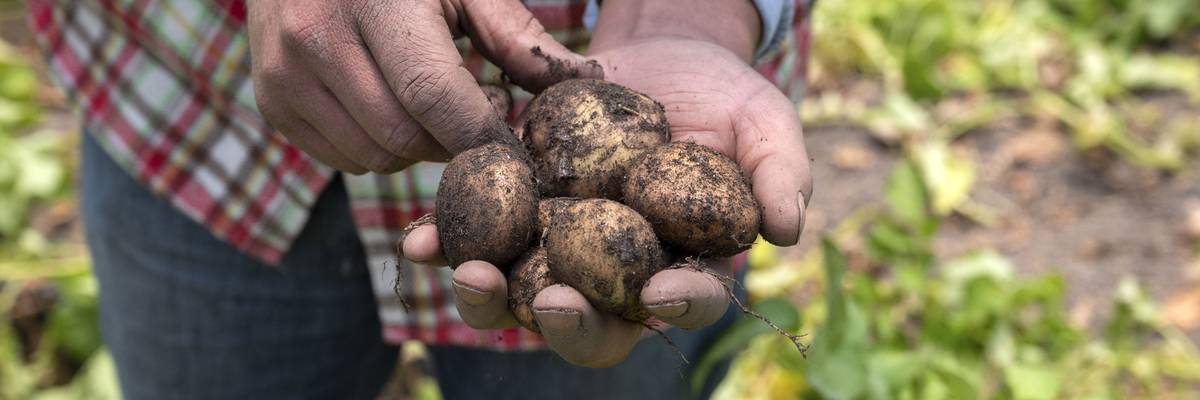
Agroecology technician Yin Rangel, 49, checks seed and potato crops in one of PROINPA (Productores Integrales del Paramo) greenhouses in Mucuchies in Merida State, Venezuela, on August 4, 2023.
How Public Finance for Agriculture Can Improve Food Security, Health, and Climate
By supporting agroecology, multilateral development banks can stop fueling harm and start financing a just and sustainable food systems transition.
Agriculture is essential to human life. How we feed ourselves matters for nutrition, health, climate, biodiversity, and livelihoods. Nearly 928 million people are employed in farming globally, and food systems are responsible for one-third of global greenhouse gas emissions and most new deforestation.
Multilateral development banks (MDBs), like the World Bank Group (WBG), play a critical role. The WBG has committed to double its agricultural financing to $9 billion a year by 2030. In October it launched AgriConnect, an initiative seeking to transform small-scale farming into an engine of sustainable growth, jobs, and food security.
However, while some MDB investments support equitable and sustainable transformation, too many still fuel environmental destruction and inequity. The World Bank’s private sector arm, IFC, recently invested $47 million in a multi-story pig factory farm in China, for example.
A new report from the University of Vermont Institute for Agroecology analyses MDB agricultural investments and sets out a road map for how banks can support, rather than hinder, sustainable farming. The research finds that the World Bank and other public-sector lenders can drive systemic change by supporting governments with policy reforms, rural extension services, and enabling environments. For example, a $70 million Inter-American Development Bank project in Paraíba, Brazil is promoting inclusive, low-carbon agriculture, and strengthening family farmers and traditional communities through technical assistance and climate-resilient infrastructure.
MDBs’ private sector operations must reform their lending criteria and stop financing destructive projects.
MDBs are better placed than other financial institutions to take long-term, lower-return investments aligned with climate and food security goals. Agroecological farming, a holistic, community-based approach to food systems that applies ecological and social food sovereignty concepts, along with long-term productivity, provides a channel for public sector arms of MDBs to support needed agricultural transformation. MDBs and other public banks therefore, should seek to become the enablers of agroecology. The International Fund for Agricultural Development (IFAD) and the Agence Française de Développement (AFD) are already leading efforts in this direction.
MDB Private Sector Operations: Profit-Driven Harms
In contrast to the IFAD and AFD models, the University of Vermont's Institute for Agroecology’s report found that the majority of private-focused MDBs prioritize “bankable” projects—typically large-scale, industrial, profit-driven agribusiness. This model steers money toward factory farms that use human-edible food as feed, pollute nearby communities, raise the risks of zoonotic disease and antimicrobial resistance, and engage in animal cruelty. In 2023, a report by Stop Financing Factory Farming found that public finance institutions invested US$2.27 billion in factory farming, 68% of the total investment in animal agriculture projects that year.
As evidenced by multiple complaints from impacted communities, these investments undermine poverty reduction, Sustainable Development Goals (SDGs), and Paris Agreement climate goals. MDBs’ private sector operations must reform their lending criteria and stop financing destructive projects.
The opportunity: Public Sector Banks Can Pave the Way for Private-Sector Transformation
Rich country governments currently subsidize agriculture, mostly industrial, at a level of $842 billion per year. According to the IMF, only a quarter is dedicated to support for public goods in the sector. Shifting this support to incentivize investments in agroecology is crucial to sustain the agricultural transformation that public banks themselves have called for.
Public banks have the opportunity to join a growing number of organisations already advancing an ecological approach to meet the SDGs and wider social, cultural, and economic, and environmental objectives. To do so, they must shift from treating agroecology as merely a niche solution and instead invest in it as a priority means for achieving food systems transformation.
Agroecology puts an end to costly and harmful practices, replacing animal cruelty with humane, safe, and fair standards.
By taking this approach, public banks can better support just transitions in food systems, something that is already beginning to take shape. Earlier this year, for example, the World Bank backed an $800 million loan to the Colombian government to advance a greener and more resilient economic transformation.
The private-sector arms of MDBs, such as IFC and IDB Invest, also have a role to play in aligning with the transition. Most importantly, they can support governments with policy advice and financing criteria that break from entrenched models and exclude industrial animal agriculture from eligibility for finance.
While MDBs have taken steps to make agricultural production and rural incomes less vulnerable to climate change, they have yet to commit to agroecological farming as the most effective pathway. In contrast, IFAD is already demonstrating what this can look like, driving agroecological transitions through private-sector incentives in Ethiopia, Peru, and Vietnam. Similarly, AFD is applying agroecology to support family farming in Ethiopia, Haiti, Madagascar, Malawi, and Sierra Leone.
Agroecology as the Future of Sustainable Farming—and Public Agricultural Finance?
If MDBs are looking to advance the SDGs and solve the polycrisis (climate, biodiversity, pandemic risk, and food security), one of the most effective ways in which this can be done is for the public sector to mobilize policy support and significant capital investment into agroecology. Meanwhile, MDB private sector arms can enable this transition by providing policy advice and finance for interventions that break from entrenched models.
Agroecology puts an end to costly and harmful practices, replacing animal cruelty with humane, safe, and fair standards. But it's not just about farming practices. It also helps transform food systems, building resilient, reparative, low-emission economies and improves livelihoods in line with the 2030 SDGs.
By supporting agroecology, MDBs can stop fueling harm and start financing a just and sustainable food systems transition. If they are serious about the SDGs, food security, and climate goals, the road map is clear—MDBs’ public sector operations must enable, their private sector operations must reform, and both must support a transition away from industrial agriculture toward a more just and sustainable food system.
We are at a crossroads
This country and this world are at a monumental crossroads. In a few short weeks, US voters will have an opportunity to beat back the forces of fascism and confront the billionaires who are rigging the economy, our media system, and our democracy, making it increasingly impossible for ordinary people to get by. We’re not just talking about the election. We’re talking about what must be done once these fascist elements are vanquished from power. We need a bolder set of solutions than what either major party has so far been willing to offer and a working-class movement ready to fight like hell for it. Trump didn't emerge from nowhere. The conditions that fueled MAGA authoritarianism were created by decades of radical neoliberal economic policies and a corrupt political system dominated by corporate interests. They slashed taxes on the super-rich, promising that the benefits would trickle down. They said giveaways to the corporate titans would make life more affordable for the rest of us. It was all bullshit. And when a bitter, betrayed populace searches for someone to blame, right-wing demagogues have little trouble finding scapegoats. People know when they're being lied to, but you won't hear any of this from the corporate media. Only independent journalism—powered and funded by people who believe in building a better world—can deliver truly trustworthy daily news. Our Fall Campaign is underway, and we need your help. To power our newsroom through the rest of the year, we need to raise $125,000 by midnight on October 31. So if you share our vision, please contribute whatever you can to sustain our work. |
Agriculture is essential to human life. How we feed ourselves matters for nutrition, health, climate, biodiversity, and livelihoods. Nearly 928 million people are employed in farming globally, and food systems are responsible for one-third of global greenhouse gas emissions and most new deforestation.
Multilateral development banks (MDBs), like the World Bank Group (WBG), play a critical role. The WBG has committed to double its agricultural financing to $9 billion a year by 2030. In October it launched AgriConnect, an initiative seeking to transform small-scale farming into an engine of sustainable growth, jobs, and food security.
However, while some MDB investments support equitable and sustainable transformation, too many still fuel environmental destruction and inequity. The World Bank’s private sector arm, IFC, recently invested $47 million in a multi-story pig factory farm in China, for example.
A new report from the University of Vermont Institute for Agroecology analyses MDB agricultural investments and sets out a road map for how banks can support, rather than hinder, sustainable farming. The research finds that the World Bank and other public-sector lenders can drive systemic change by supporting governments with policy reforms, rural extension services, and enabling environments. For example, a $70 million Inter-American Development Bank project in Paraíba, Brazil is promoting inclusive, low-carbon agriculture, and strengthening family farmers and traditional communities through technical assistance and climate-resilient infrastructure.
MDBs’ private sector operations must reform their lending criteria and stop financing destructive projects.
MDBs are better placed than other financial institutions to take long-term, lower-return investments aligned with climate and food security goals. Agroecological farming, a holistic, community-based approach to food systems that applies ecological and social food sovereignty concepts, along with long-term productivity, provides a channel for public sector arms of MDBs to support needed agricultural transformation. MDBs and other public banks therefore, should seek to become the enablers of agroecology. The International Fund for Agricultural Development (IFAD) and the Agence Française de Développement (AFD) are already leading efforts in this direction.
MDB Private Sector Operations: Profit-Driven Harms
In contrast to the IFAD and AFD models, the University of Vermont's Institute for Agroecology’s report found that the majority of private-focused MDBs prioritize “bankable” projects—typically large-scale, industrial, profit-driven agribusiness. This model steers money toward factory farms that use human-edible food as feed, pollute nearby communities, raise the risks of zoonotic disease and antimicrobial resistance, and engage in animal cruelty. In 2023, a report by Stop Financing Factory Farming found that public finance institutions invested US$2.27 billion in factory farming, 68% of the total investment in animal agriculture projects that year.
As evidenced by multiple complaints from impacted communities, these investments undermine poverty reduction, Sustainable Development Goals (SDGs), and Paris Agreement climate goals. MDBs’ private sector operations must reform their lending criteria and stop financing destructive projects.
The opportunity: Public Sector Banks Can Pave the Way for Private-Sector Transformation
Rich country governments currently subsidize agriculture, mostly industrial, at a level of $842 billion per year. According to the IMF, only a quarter is dedicated to support for public goods in the sector. Shifting this support to incentivize investments in agroecology is crucial to sustain the agricultural transformation that public banks themselves have called for.
Public banks have the opportunity to join a growing number of organisations already advancing an ecological approach to meet the SDGs and wider social, cultural, and economic, and environmental objectives. To do so, they must shift from treating agroecology as merely a niche solution and instead invest in it as a priority means for achieving food systems transformation.
Agroecology puts an end to costly and harmful practices, replacing animal cruelty with humane, safe, and fair standards.
By taking this approach, public banks can better support just transitions in food systems, something that is already beginning to take shape. Earlier this year, for example, the World Bank backed an $800 million loan to the Colombian government to advance a greener and more resilient economic transformation.
The private-sector arms of MDBs, such as IFC and IDB Invest, also have a role to play in aligning with the transition. Most importantly, they can support governments with policy advice and financing criteria that break from entrenched models and exclude industrial animal agriculture from eligibility for finance.
While MDBs have taken steps to make agricultural production and rural incomes less vulnerable to climate change, they have yet to commit to agroecological farming as the most effective pathway. In contrast, IFAD is already demonstrating what this can look like, driving agroecological transitions through private-sector incentives in Ethiopia, Peru, and Vietnam. Similarly, AFD is applying agroecology to support family farming in Ethiopia, Haiti, Madagascar, Malawi, and Sierra Leone.
Agroecology as the Future of Sustainable Farming—and Public Agricultural Finance?
If MDBs are looking to advance the SDGs and solve the polycrisis (climate, biodiversity, pandemic risk, and food security), one of the most effective ways in which this can be done is for the public sector to mobilize policy support and significant capital investment into agroecology. Meanwhile, MDB private sector arms can enable this transition by providing policy advice and finance for interventions that break from entrenched models.
Agroecology puts an end to costly and harmful practices, replacing animal cruelty with humane, safe, and fair standards. But it's not just about farming practices. It also helps transform food systems, building resilient, reparative, low-emission economies and improves livelihoods in line with the 2030 SDGs.
By supporting agroecology, MDBs can stop fueling harm and start financing a just and sustainable food systems transition. If they are serious about the SDGs, food security, and climate goals, the road map is clear—MDBs’ public sector operations must enable, their private sector operations must reform, and both must support a transition away from industrial agriculture toward a more just and sustainable food system.
- Why Climate Action Must Start on Our Plates ›
- 'If You Own the Seeds You Own the Food System': Campaigners Demand Public Ownership to Counter Big Ag Privatization ›
- Development Banks’ Factory Farm Investments Harm the Climate and Local Communities ›
- Why Sustainable Agriculture Should Support a Green New Deal ›
- The MAHA Commission Won’t Fix Public Health or Our Food System ›
- Open Letter to USAID: Fund Sustainable Food Systems in Africa, Not Another Industrial 'Green Revolution' ›
- Opinion | The $2 Billion Question: Is World Bank’s IFC Enabling Environmental Damage? | Common Dreams ›
Agriculture is essential to human life. How we feed ourselves matters for nutrition, health, climate, biodiversity, and livelihoods. Nearly 928 million people are employed in farming globally, and food systems are responsible for one-third of global greenhouse gas emissions and most new deforestation.
Multilateral development banks (MDBs), like the World Bank Group (WBG), play a critical role. The WBG has committed to double its agricultural financing to $9 billion a year by 2030. In October it launched AgriConnect, an initiative seeking to transform small-scale farming into an engine of sustainable growth, jobs, and food security.
However, while some MDB investments support equitable and sustainable transformation, too many still fuel environmental destruction and inequity. The World Bank’s private sector arm, IFC, recently invested $47 million in a multi-story pig factory farm in China, for example.
A new report from the University of Vermont Institute for Agroecology analyses MDB agricultural investments and sets out a road map for how banks can support, rather than hinder, sustainable farming. The research finds that the World Bank and other public-sector lenders can drive systemic change by supporting governments with policy reforms, rural extension services, and enabling environments. For example, a $70 million Inter-American Development Bank project in Paraíba, Brazil is promoting inclusive, low-carbon agriculture, and strengthening family farmers and traditional communities through technical assistance and climate-resilient infrastructure.
MDBs’ private sector operations must reform their lending criteria and stop financing destructive projects.
MDBs are better placed than other financial institutions to take long-term, lower-return investments aligned with climate and food security goals. Agroecological farming, a holistic, community-based approach to food systems that applies ecological and social food sovereignty concepts, along with long-term productivity, provides a channel for public sector arms of MDBs to support needed agricultural transformation. MDBs and other public banks therefore, should seek to become the enablers of agroecology. The International Fund for Agricultural Development (IFAD) and the Agence Française de Développement (AFD) are already leading efforts in this direction.
MDB Private Sector Operations: Profit-Driven Harms
In contrast to the IFAD and AFD models, the University of Vermont's Institute for Agroecology’s report found that the majority of private-focused MDBs prioritize “bankable” projects—typically large-scale, industrial, profit-driven agribusiness. This model steers money toward factory farms that use human-edible food as feed, pollute nearby communities, raise the risks of zoonotic disease and antimicrobial resistance, and engage in animal cruelty. In 2023, a report by Stop Financing Factory Farming found that public finance institutions invested US$2.27 billion in factory farming, 68% of the total investment in animal agriculture projects that year.
As evidenced by multiple complaints from impacted communities, these investments undermine poverty reduction, Sustainable Development Goals (SDGs), and Paris Agreement climate goals. MDBs’ private sector operations must reform their lending criteria and stop financing destructive projects.
The opportunity: Public Sector Banks Can Pave the Way for Private-Sector Transformation
Rich country governments currently subsidize agriculture, mostly industrial, at a level of $842 billion per year. According to the IMF, only a quarter is dedicated to support for public goods in the sector. Shifting this support to incentivize investments in agroecology is crucial to sustain the agricultural transformation that public banks themselves have called for.
Public banks have the opportunity to join a growing number of organisations already advancing an ecological approach to meet the SDGs and wider social, cultural, and economic, and environmental objectives. To do so, they must shift from treating agroecology as merely a niche solution and instead invest in it as a priority means for achieving food systems transformation.
Agroecology puts an end to costly and harmful practices, replacing animal cruelty with humane, safe, and fair standards.
By taking this approach, public banks can better support just transitions in food systems, something that is already beginning to take shape. Earlier this year, for example, the World Bank backed an $800 million loan to the Colombian government to advance a greener and more resilient economic transformation.
The private-sector arms of MDBs, such as IFC and IDB Invest, also have a role to play in aligning with the transition. Most importantly, they can support governments with policy advice and financing criteria that break from entrenched models and exclude industrial animal agriculture from eligibility for finance.
While MDBs have taken steps to make agricultural production and rural incomes less vulnerable to climate change, they have yet to commit to agroecological farming as the most effective pathway. In contrast, IFAD is already demonstrating what this can look like, driving agroecological transitions through private-sector incentives in Ethiopia, Peru, and Vietnam. Similarly, AFD is applying agroecology to support family farming in Ethiopia, Haiti, Madagascar, Malawi, and Sierra Leone.
Agroecology as the Future of Sustainable Farming—and Public Agricultural Finance?
If MDBs are looking to advance the SDGs and solve the polycrisis (climate, biodiversity, pandemic risk, and food security), one of the most effective ways in which this can be done is for the public sector to mobilize policy support and significant capital investment into agroecology. Meanwhile, MDB private sector arms can enable this transition by providing policy advice and finance for interventions that break from entrenched models.
Agroecology puts an end to costly and harmful practices, replacing animal cruelty with humane, safe, and fair standards. But it's not just about farming practices. It also helps transform food systems, building resilient, reparative, low-emission economies and improves livelihoods in line with the 2030 SDGs.
By supporting agroecology, MDBs can stop fueling harm and start financing a just and sustainable food systems transition. If they are serious about the SDGs, food security, and climate goals, the road map is clear—MDBs’ public sector operations must enable, their private sector operations must reform, and both must support a transition away from industrial agriculture toward a more just and sustainable food system.
- Why Climate Action Must Start on Our Plates ›
- 'If You Own the Seeds You Own the Food System': Campaigners Demand Public Ownership to Counter Big Ag Privatization ›
- Development Banks’ Factory Farm Investments Harm the Climate and Local Communities ›
- Why Sustainable Agriculture Should Support a Green New Deal ›
- The MAHA Commission Won’t Fix Public Health or Our Food System ›
- Open Letter to USAID: Fund Sustainable Food Systems in Africa, Not Another Industrial 'Green Revolution' ›
- Opinion | The $2 Billion Question: Is World Bank’s IFC Enabling Environmental Damage? | Common Dreams ›