SUBSCRIBE TO OUR FREE NEWSLETTER
Daily news & progressive opinion—funded by the people, not the corporations—delivered straight to your inbox.
5
#000000
#FFFFFF
To donate by check, phone, or other method, see our More Ways to Give page.
Daily news & progressive opinion—funded by the people, not the corporations—delivered straight to your inbox.
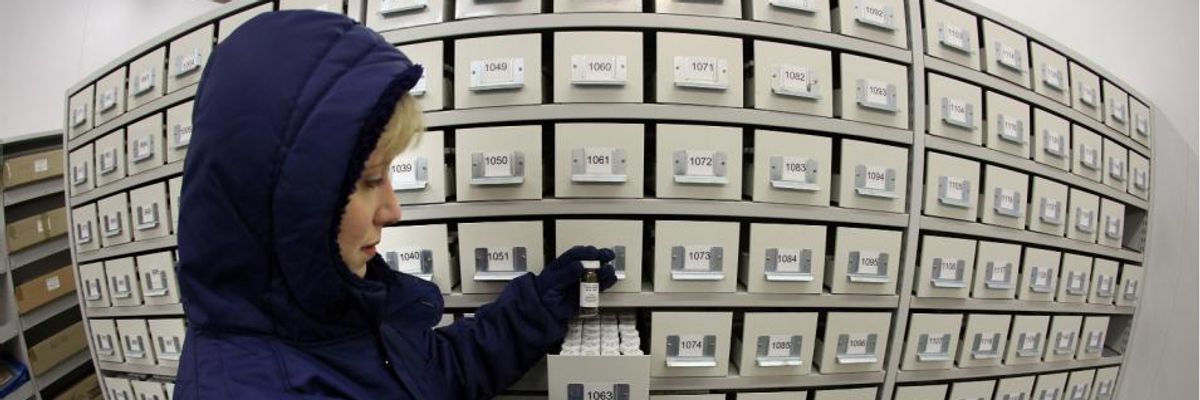
Sarah Gattiker stores the 24,200th species of seed in the vault at Kew's Millennium Seed Bank, which now holds 10% of the world's wild plant species, on October 15, 2009 in Sussex, England. (Photo: Oli Scarff/Getty Images)
A growing number of people around the world are calling for the public ownership of seeds, which they say is essential for a more democratic and ecologically sound food system, as the coronavirus-driven spike in empty supermarket shelves and the continued loss of biodiversity this year shed more light on the negative consequences of allowing a handful of agrochemical corporations to dominate the global seed trade.
"Four companies have gained oligopolistic control over more than two-thirds of commercial seed and pesticide sales, while decimating the innovative contribution of public sector researchers and threatening the 12,000-year-old right of peasants to breed, save, and exchange their seeds."
--Pat Mooney, ETC Group
In the United Kingdom, the seed saving movement had been "quietly growing" for awhile, but "from March onwards, when the pandemic hit the U.K., seed producers and seed banks across the country were overwhelmed with demand," with multiple organizations experiencing a "sharp surge in orders, 600% in some cases," Alexandra Genova reported Monday in The Guardian.
"People crave connection," David Price, managing director of the Seed Cooperative, told The Guardian. "They want connection with other people and connection with the planet, and growing and saving seed is a way of getting both."
Genova noted that while "many British consumers feel disconnected from the processes of food production... seed saving allows everyone to be involved in the food system." Moreover, advocates say seed saving can contribute to reversing the dramatic decline in the availability of plant varieties that are "richly diverse, well adapted to the soil and local climate, and more resilient to climate change."
The United Nations Food and Agricultural Organization (FAO) has estimated that since the beginning of the 20th century, roughly 75% of the genetic diversity of agricultural crops and 93% of unique seed varieties have disappeared. This biodiversity loss has been attributed to industrialized agriculture and what Genova called "the big boom in agrochemicals."
As the FAO has explained, the increasingly commercialized nature of plant breeding has permitted transnational seed and agrochemical corporations--which enjoy so-called plant breeders' rights that give "patent-like protection to breeders with limited monopoly rights over the production, marketing, and sale of their varieties"--to privatize access to genetic resources taken from countries in the global south.
Scholar-activist Pat Mooney of the ETC Group coined the term "biopiracy" to describe how genetic material originally nurtured by impoverished farmers is turned into patented seeds that now generate huge profits primarily for BASF, Bayer/Monsanto, ChemChina-Syngenta, and Corteva Agriscience.
In a 2018 report (pdf) on industrial food chain concentration, Mooney explained that these "four companies have gained oligopolistic control over more than two-thirds of commercial seed and pesticide sales, while decimating the innovative contribution of public sector researchers and threatening the 12,000-year-old right of peasants to breed, save, and exchange their seeds."
"I want all local communities or regions to have their own seed bank so everyone knows exactly where to get free seed."
--Helene Schulze, Seed Sovereignty Program of the U.K. and Ireland
The blossoming of what researchers Karine Peschard and Shalini Randeria call "seed activism" is "largely in response to the intensification of corporate seed enclosures and to the loss of agrobiodiversity," Genova reported. "Many seed savers are motivated by this idea of dismantling the increasing privatization of seeds... by drawing attention to the negative impact of such high levels of concentration." She continued:
Less than 50 years ago, most of the world enjoyed food that came from entirely open-pollinated seed varieties, which could be saved for future crops. Much of the seed sold now by the large companies are, in contrast, GM or F1 hybrid seeds. These cannot be saved for use in following years because they are genetically unstable and are protected by seed and patent laws, meaning most farmers are tied to chains of dependency.
According to Helene Schulze, who works on the Seed Sovereignty Program of the U.K. and Ireland and co-directs the London Freedom Seedbank, "Covid made people really understand how our food system is dominated by a few large corporations, and this has put a focus on seed sovereignty," which Genova defined as "a grower's right to breed and exchange diverse, open-source seeds, which can be saved and are not patented, genetically modified, or owned by one of the four agrochemical companies that control more than 60% of the global seed trade."
Campaigners at Open Source Seeds, the Campaign for Seed Sovereignty, and elsewhere are pushing for seeds to be brought back into public ownership, arguing that "something as universal as food crops should belong to everyone, not a small group of agrochemical companies."
"If you own the seeds you own the food system," Schulze told The Guardian. "Access to open-pollinated seeds is the cornerstone of food citizenship because it creates non-market access to growing."
"I want all local communities or regions to have their own seed bank," she added, "so everyone knows exactly where to get free seed."
Dear Common Dreams reader, It’s been nearly 30 years since I co-founded Common Dreams with my late wife, Lina Newhouser. We had the radical notion that journalism should serve the public good, not corporate profits. It was clear to us from the outset what it would take to build such a project. No paid advertisements. No corporate sponsors. No millionaire publisher telling us what to think or do. Many people said we wouldn't last a year, but we proved those doubters wrong. Together with a tremendous team of journalists and dedicated staff, we built an independent media outlet free from the constraints of profits and corporate control. Our mission has always been simple: To inform. To inspire. To ignite change for the common good. Building Common Dreams was not easy. Our survival was never guaranteed. When you take on the most powerful forces—Wall Street greed, fossil fuel industry destruction, Big Tech lobbyists, and uber-rich oligarchs who have spent billions upon billions rigging the economy and democracy in their favor—the only bulwark you have is supporters who believe in your work. But here’s the urgent message from me today. It's never been this bad out there. And it's never been this hard to keep us going. At the very moment Common Dreams is most needed, the threats we face are intensifying. We need your support now more than ever. We don't accept corporate advertising and never will. We don't have a paywall because we don't think people should be blocked from critical news based on their ability to pay. Everything we do is funded by the donations of readers like you. When everyone does the little they can afford, we are strong. But if that support retreats or dries up, so do we. Will you donate now to make sure Common Dreams not only survives but thrives? —Craig Brown, Co-founder |
A growing number of people around the world are calling for the public ownership of seeds, which they say is essential for a more democratic and ecologically sound food system, as the coronavirus-driven spike in empty supermarket shelves and the continued loss of biodiversity this year shed more light on the negative consequences of allowing a handful of agrochemical corporations to dominate the global seed trade.
"Four companies have gained oligopolistic control over more than two-thirds of commercial seed and pesticide sales, while decimating the innovative contribution of public sector researchers and threatening the 12,000-year-old right of peasants to breed, save, and exchange their seeds."
--Pat Mooney, ETC Group
In the United Kingdom, the seed saving movement had been "quietly growing" for awhile, but "from March onwards, when the pandemic hit the U.K., seed producers and seed banks across the country were overwhelmed with demand," with multiple organizations experiencing a "sharp surge in orders, 600% in some cases," Alexandra Genova reported Monday in The Guardian.
"People crave connection," David Price, managing director of the Seed Cooperative, told The Guardian. "They want connection with other people and connection with the planet, and growing and saving seed is a way of getting both."
Genova noted that while "many British consumers feel disconnected from the processes of food production... seed saving allows everyone to be involved in the food system." Moreover, advocates say seed saving can contribute to reversing the dramatic decline in the availability of plant varieties that are "richly diverse, well adapted to the soil and local climate, and more resilient to climate change."
The United Nations Food and Agricultural Organization (FAO) has estimated that since the beginning of the 20th century, roughly 75% of the genetic diversity of agricultural crops and 93% of unique seed varieties have disappeared. This biodiversity loss has been attributed to industrialized agriculture and what Genova called "the big boom in agrochemicals."
As the FAO has explained, the increasingly commercialized nature of plant breeding has permitted transnational seed and agrochemical corporations--which enjoy so-called plant breeders' rights that give "patent-like protection to breeders with limited monopoly rights over the production, marketing, and sale of their varieties"--to privatize access to genetic resources taken from countries in the global south.
Scholar-activist Pat Mooney of the ETC Group coined the term "biopiracy" to describe how genetic material originally nurtured by impoverished farmers is turned into patented seeds that now generate huge profits primarily for BASF, Bayer/Monsanto, ChemChina-Syngenta, and Corteva Agriscience.
In a 2018 report (pdf) on industrial food chain concentration, Mooney explained that these "four companies have gained oligopolistic control over more than two-thirds of commercial seed and pesticide sales, while decimating the innovative contribution of public sector researchers and threatening the 12,000-year-old right of peasants to breed, save, and exchange their seeds."
"I want all local communities or regions to have their own seed bank so everyone knows exactly where to get free seed."
--Helene Schulze, Seed Sovereignty Program of the U.K. and Ireland
The blossoming of what researchers Karine Peschard and Shalini Randeria call "seed activism" is "largely in response to the intensification of corporate seed enclosures and to the loss of agrobiodiversity," Genova reported. "Many seed savers are motivated by this idea of dismantling the increasing privatization of seeds... by drawing attention to the negative impact of such high levels of concentration." She continued:
Less than 50 years ago, most of the world enjoyed food that came from entirely open-pollinated seed varieties, which could be saved for future crops. Much of the seed sold now by the large companies are, in contrast, GM or F1 hybrid seeds. These cannot be saved for use in following years because they are genetically unstable and are protected by seed and patent laws, meaning most farmers are tied to chains of dependency.
According to Helene Schulze, who works on the Seed Sovereignty Program of the U.K. and Ireland and co-directs the London Freedom Seedbank, "Covid made people really understand how our food system is dominated by a few large corporations, and this has put a focus on seed sovereignty," which Genova defined as "a grower's right to breed and exchange diverse, open-source seeds, which can be saved and are not patented, genetically modified, or owned by one of the four agrochemical companies that control more than 60% of the global seed trade."
Campaigners at Open Source Seeds, the Campaign for Seed Sovereignty, and elsewhere are pushing for seeds to be brought back into public ownership, arguing that "something as universal as food crops should belong to everyone, not a small group of agrochemical companies."
"If you own the seeds you own the food system," Schulze told The Guardian. "Access to open-pollinated seeds is the cornerstone of food citizenship because it creates non-market access to growing."
"I want all local communities or regions to have their own seed bank," she added, "so everyone knows exactly where to get free seed."
A growing number of people around the world are calling for the public ownership of seeds, which they say is essential for a more democratic and ecologically sound food system, as the coronavirus-driven spike in empty supermarket shelves and the continued loss of biodiversity this year shed more light on the negative consequences of allowing a handful of agrochemical corporations to dominate the global seed trade.
"Four companies have gained oligopolistic control over more than two-thirds of commercial seed and pesticide sales, while decimating the innovative contribution of public sector researchers and threatening the 12,000-year-old right of peasants to breed, save, and exchange their seeds."
--Pat Mooney, ETC Group
In the United Kingdom, the seed saving movement had been "quietly growing" for awhile, but "from March onwards, when the pandemic hit the U.K., seed producers and seed banks across the country were overwhelmed with demand," with multiple organizations experiencing a "sharp surge in orders, 600% in some cases," Alexandra Genova reported Monday in The Guardian.
"People crave connection," David Price, managing director of the Seed Cooperative, told The Guardian. "They want connection with other people and connection with the planet, and growing and saving seed is a way of getting both."
Genova noted that while "many British consumers feel disconnected from the processes of food production... seed saving allows everyone to be involved in the food system." Moreover, advocates say seed saving can contribute to reversing the dramatic decline in the availability of plant varieties that are "richly diverse, well adapted to the soil and local climate, and more resilient to climate change."
The United Nations Food and Agricultural Organization (FAO) has estimated that since the beginning of the 20th century, roughly 75% of the genetic diversity of agricultural crops and 93% of unique seed varieties have disappeared. This biodiversity loss has been attributed to industrialized agriculture and what Genova called "the big boom in agrochemicals."
As the FAO has explained, the increasingly commercialized nature of plant breeding has permitted transnational seed and agrochemical corporations--which enjoy so-called plant breeders' rights that give "patent-like protection to breeders with limited monopoly rights over the production, marketing, and sale of their varieties"--to privatize access to genetic resources taken from countries in the global south.
Scholar-activist Pat Mooney of the ETC Group coined the term "biopiracy" to describe how genetic material originally nurtured by impoverished farmers is turned into patented seeds that now generate huge profits primarily for BASF, Bayer/Monsanto, ChemChina-Syngenta, and Corteva Agriscience.
In a 2018 report (pdf) on industrial food chain concentration, Mooney explained that these "four companies have gained oligopolistic control over more than two-thirds of commercial seed and pesticide sales, while decimating the innovative contribution of public sector researchers and threatening the 12,000-year-old right of peasants to breed, save, and exchange their seeds."
"I want all local communities or regions to have their own seed bank so everyone knows exactly where to get free seed."
--Helene Schulze, Seed Sovereignty Program of the U.K. and Ireland
The blossoming of what researchers Karine Peschard and Shalini Randeria call "seed activism" is "largely in response to the intensification of corporate seed enclosures and to the loss of agrobiodiversity," Genova reported. "Many seed savers are motivated by this idea of dismantling the increasing privatization of seeds... by drawing attention to the negative impact of such high levels of concentration." She continued:
Less than 50 years ago, most of the world enjoyed food that came from entirely open-pollinated seed varieties, which could be saved for future crops. Much of the seed sold now by the large companies are, in contrast, GM or F1 hybrid seeds. These cannot be saved for use in following years because they are genetically unstable and are protected by seed and patent laws, meaning most farmers are tied to chains of dependency.
According to Helene Schulze, who works on the Seed Sovereignty Program of the U.K. and Ireland and co-directs the London Freedom Seedbank, "Covid made people really understand how our food system is dominated by a few large corporations, and this has put a focus on seed sovereignty," which Genova defined as "a grower's right to breed and exchange diverse, open-source seeds, which can be saved and are not patented, genetically modified, or owned by one of the four agrochemical companies that control more than 60% of the global seed trade."
Campaigners at Open Source Seeds, the Campaign for Seed Sovereignty, and elsewhere are pushing for seeds to be brought back into public ownership, arguing that "something as universal as food crops should belong to everyone, not a small group of agrochemical companies."
"If you own the seeds you own the food system," Schulze told The Guardian. "Access to open-pollinated seeds is the cornerstone of food citizenship because it creates non-market access to growing."
"I want all local communities or regions to have their own seed bank," she added, "so everyone knows exactly where to get free seed."