

SUBSCRIBE TO OUR FREE NEWSLETTER
Daily news & progressive opinion—funded by the people, not the corporations—delivered straight to your inbox.
5
#000000
#FFFFFF
To donate by check, phone, or other method, see our More Ways to Give page.
Daily news & progressive opinion—funded by the people, not the corporations—delivered straight to your inbox.
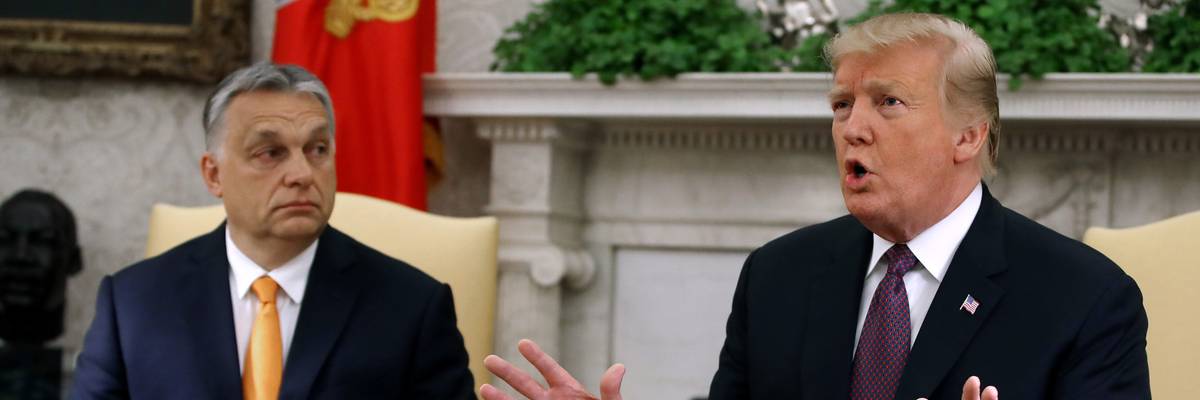
US President Donald Trump speaks to the media during a meeting with Hungarian Prime Minister Viktor Orban, in the Oval Office on May 13, 2019 in Washington, DC. President Trump took questions on trade with China, Iran and other topics.
As academics based in Hungary who have closely followed the trajectory of Orbánism, we urge American citizens to reflect deeply on the nature of the political crossroads facing them.
For some time, there has been something of a political ‘bromance’ between Prime Minister Viktor Orbán of Hungary and US President Donald Trump. Orbán has been a frequent visitor to the US to meet Trump even meeting him during the election campaign in the run up to Trump’s second term. During a visit in late 2025 Trump lauded Orbán “You are fantastic. I know a lot of people don’t agree with me, but I’m the only one that matters.” In response Orbán (2025) spoke of a "golden age between the United States and Hungary." Such is the high regard Orbán is held in by Trump that Budapest was touted as a possible venue for a peace summit for the Ukraine war between Putin and Zelenskyy.
Vice President Vance has long praised Orbán for promoting conservative family policies and the exertion of greater control over higher education which critics claim is undermining academic freedom. Vance, like Orbán, has also been critical of Ukraine. Tucker Carlson, Fox News, and other elements of the MAGA media network often heap praise on Orbán as a visionary and outrider that America could follow.
This article seeks to inform readers about what Orbán represents and highlights the similarities between him and Trump and where this might take America. We speak from a position of experience being academics and civic voices based in Hungary who have closely followed the trajectory of Orbánism.
Deindustrialization and decline in rustbelt areas in both countries exacerbated by the global financial crisis of 2008, creating unprecedented unemployment and anxiety, formed a significant group of ‘have-nots’ (people at the margins) in both countries, susceptible to nativist and exceptionalist rhetoric. More broadly cultural insecurities prompted by an ever-changing highly globalized world have been disorientating for some, especially older voters or those in the countryside. These are the demographic groups that have played an active role in forming the electoral base for authoritarian populism in both countries.
Although Orbán is something of a poster boy for the MAGA network, in Europe his reputation is more controversial. Hungary has experienced frequent criticism and sanction from the European Union for rule of law violations most notably relating to media, civil and academic freedoms and independence of the judiciary during the premiership of Orbán.
One point of difference is Hungary has a limited tradition of liberal democracy which existed for a brief twenty-year period from the end of communism in 1990 up to Orbán’s second premiership that started in 2010. With the interwar autocratic leader Admiral Horthy and the postwar Communist leader János Kádár authoritarianism could be seen as the norm for Hungary unlike the USA that until recently was seen as a model of liberal democracy and rule of law conventions. However, things are changing rapidly with a second Trump term terms being marked by an assertive and rapid upending of the political system.
Both Orbán and Trump are classified as being authoritarian populists. Both are framed as strongman, battling modern day folk devils, namely immigrants, liberals and other minorities cast as an ‘enemy within’ in an emergency politics where the strongman through a performative hypermasculinity takes assertive and often polarizing action, championing a perceived majority of the ‘good’ and ‘pure’ people.
At the centre of the political narrative of these two leaders is a sense of exceptionalism. The Make America Great Again slogan reveals a sense that the US is losing its place in the world and is in need of reorientation. Of course, Hungary was never a superpower, but it sees itself as a bridge to the East and West and an out-rider, or champion, to the challenge of liberalism. Both have a nostalgic and rigid conception of national identity which for them makes migration and diversity an anathema to their monocultural and conservative conception of national identity.
Both Orbán and Trump can be viewed as counter-enlightenment figures in the sense that their analysis is not driven by scientific and rationalist decision-making principles where decisions might be based on a proper evaluation of evidence and notion of public good. Both display an element of what has come to be called ‘Post Truth Politics’, where emotions and conspiracy theory shape political narrative. Orbán and Vance have for example actively espoused the ‘replacement theory’ that contends there is a shadowy plan to flood Europe with migrants to replace domestic European workers and reverse demographic decline but also weaken sovereignty through diluting national identities enabling the creation of a European super-state.
Disregard for fact has led to both Orbán and Trump nurturing a partisan public sphere, in Hungary this is more advanced with newspapers and television stations largely in the control of figures loyal to Orbán, it has been estimated that 80 percent of the Hungarian media is aligned to Orbán, often providing a platform to campaigns steered by polarizing rhetoric which at its core is guided by a ‘politics of fear’ hence immigrants, especially if Muslim, LGBTQI, George Soros and the European Union have been framed as an existential threat, with the media failing to challenge these assertions or giving space to counterviews and generally replicating such views in reporting.
Orbán and Trump also view academia as a bootcamp for liberalism and as bastions of the tyranny of political correctness, thus in Hungary Orbán government has placed most of the public universities in the control of appointed cronies through what has been described as model change. In addition, the government has refused to validate courses like Gender Studies, seeing it as a threat to conservative conceptions of the family. The George Soros supported Central European University was pushed out of Hungary because Orbán, feared the political and intellectual influence of a university with a commitment to open society in its mission. Trump’s attacks on universities with accusations of left-wing bias and the withholding of Federal funding can be seen as a similar effort to exert great control over academia.
In terms of a number of key policy areas there are some striking similarities between Orbán and Trump. Orbán has accused the EU of undermining national sovereignty and the recent and controversial US security strategy indicated that America in its international relations would prioritize alliances with countries like Hungary that place a strong premium on sovereignty. It is a view of state power and sovereignty that relies on a strong executive unencumbered by checks and balances, hence both Orbán and Trump have been accused of rule of law violations that weaken the guardrails and safeguards of democracy, creating a ‘Deep State’ in the sense that public officials are expected to be obedient and align closely to the political narrative and interests of these two leaders. This has created profound constitutional shocks in both countries.
The nativism of Orbán and Trump has led to the securitization of migration, both have constructed ramped up border protection, basically walls, with increased border enforcement often framed as a masculinized and militarized show of strength and determination to keep migrants out and most recently demonstrated in the performance of ICE roundups in some parts of America.
As noted earlier both leaders court moral conservativism and have formed a strategic alliance with traditional and conservative Christian leaders, with both seeking to limit reproductive rights. In 2025 Orbán banned the annual LGBTQ Pride march in Budapest and threatening to fine those who attended with fines based on biometric surveillance, an act that was heavily denounced by the European Union and civil rights defenders like Amnesty International.
In terms of economics both Orbán and Trump have been prepared to use state power to intervene in markets. Orbán has been willing to use state power to freeze utility bills and Trump has interfered with market freedom through protectionism and tariffs. Both, despite their rhetoric and appeals to the ‘have-nots’ seem to support tax, welfare and regulatory frameworks, that favour the interests of oligarchs over workers in a ‘race to the bottom’ of social protection. The alliance with oligarchs in both countries reflects a relational conception of economic strategy where political power is used to further the interests of sections of the economic elite willing to express loyalty and put patronal networks at the service of political leaders.
Trump with his desire to annex Greenland and sympathy for Putin’s expansionism in Ukraine and disparagement of the value of NATO to US interests is perceived as turning his back on the postwar international order of global rules to deter the aggressive expansionism that triggered World War Two. Critics of this postwar order might question whether America really was the ‘Shinning Beacon’ it was held to be, but some would argue this framework strove to give the world a sense of order and stability and stemmed the advance of Soviet totalitarianism.
Orbán has drawn strong criticism for continuing to court Putin and his use of veto power to thwart within the EU support for Ukraine and sanctions against Russia. The sympathy and alliance with Russia are a surprising and contradictory phenomena given Hungary’s historic antipathy to Russian expansionism as reflected by the 1956 uprising where Hungarians sought to eject Soviet occupiers. Such sympathies toward Putin by Trump are surprising too given that in America a deep political consensus once existed in postwar US politics that Russian expansionism, especially in the Cold war, was a major threat to global security. In this new global order both Orbán and Trump seem to support a world dominated by regional hegemons, with the US and Russia appearing to have the right to impose regional hegemonies capable of interfering in the affairs of its neighbors, a Monroe doctrine for the 21st century.
In terms of the Putinization of America and Hungary one of the most significant features may be the spread of cronyism and corruption. As noted, both Orbán and Trump have created a network of cronyism giving patronage and protection to influential supporters. Orbán’s family and network of friends have grown fabulously rich and some would argue Trump has not been averse to using presidential power to advance his business interests and the Trump brand.
There are different possible framings of democratic backsliding, which started in smaller countries, such as Hungary, but after reaching the US as the main geopolitical power, and once the model for democracy, it became a worldwide threat. The first possibility is to call Trump and Orbán populists. Indeed, in their rhetoric they often refer to the ‘people’ in a moral battle against the ‘elites’ to which they both belong to. But as opposed to some pluralist populists their main characteristics are that they are illiberal autocrats willing to use unlimited executive power disregarding any checks and balances and fundamental rights. Moreover, Orbán’s ‘mafia state’ and Trump’s own family and business interests, which some would argue are the main determinators of his decisions as President. And this is not just tyranny, but also oligarchy, the other deviant form of government according to Aristotle.
One may ask, why is it important to emphasize that Trump’s and Orbán’s systems are not only populist and authoritarian but also oligarchic. Because restoring democracy requires different resilience capacities in the three cases. Populism is the easiest to remedy. Sometimes it only requires taking back democratic politics to the needs of ordinary citizens, for example ‘farmers’ and ‘workers’ as the Populist Party sought to in the US in the late 19th century. For reversing democratic backsliding, strong institutional resilience and resistance are necessary, which also presupposes the longstanding structural elements, such as constitutional culture, civil society. The almost 250 years long endurance of the US constitution will most probably enough to preserve constitutional democracy, but the twenty years of liberal constitutionalism in Hungary after 1989 isn’t a guarantee for the same. But the hardest task ahead for both countries will be to get rid of oligarchy, as long as Wall Street supports Trump rather than a democratic populist.
The outcome of the April election in Hungary will determine if Hungary is willing to turn a page, the moderate Conservative leader Péter Magyar seems to be riding high in the polls. If Orbán losses in Hungary it will be an important setback for authoritarian populism that could have impact on the US mid-terms. The turning point in Hungary was that the public stopped believing the Orbán narrative, scandals and corruption eroded public trust. The pardoning of an orphanage manager who had attempted to cover up pedophilia by close supporters of Orbán gave a deeply dark insight into the nature of Hungarian politics which a large section of the public found deeply disturbing. It remains to be seen whether personal and public scandals hovering around Trump provide an equally revelatory moment.
In the USA, worries about an executive overreaching its authority, perhaps most evident in the manner of ICE roundups in some major cities are prompting American citizens to deeply reflect on the nature of the political crossroads facing them. Perhaps in both countries there is a realization that the politics of demagoguery is a distraction from the genuine crises facing the world today, namely ruthless and corrupt leaders who do not respect the rule of law, a failing and unfair economy and global warming and environmental change. There is indeed an emergency, a global one or ‘polycrisis’ and a need for exigency, the problem is we are following the wrong plan in Hungary and America.
Dear Common Dreams reader, It’s been nearly 30 years since I co-founded Common Dreams with my late wife, Lina Newhouser. We had the radical notion that journalism should serve the public good, not corporate profits. It was clear to us from the outset what it would take to build such a project. No paid advertisements. No corporate sponsors. No millionaire publisher telling us what to think or do. Many people said we wouldn't last a year, but we proved those doubters wrong. Together with a tremendous team of journalists and dedicated staff, we built an independent media outlet free from the constraints of profits and corporate control. Our mission has always been simple: To inform. To inspire. To ignite change for the common good. Building Common Dreams was not easy. Our survival was never guaranteed. When you take on the most powerful forces—Wall Street greed, fossil fuel industry destruction, Big Tech lobbyists, and uber-rich oligarchs who have spent billions upon billions rigging the economy and democracy in their favor—the only bulwark you have is supporters who believe in your work. But here’s the urgent message from me today. It's never been this bad out there. And it's never been this hard to keep us going. At the very moment Common Dreams is most needed, the threats we face are intensifying. We need your support now more than ever. We don't accept corporate advertising and never will. We don't have a paywall because we don't think people should be blocked from critical news based on their ability to pay. Everything we do is funded by the donations of readers like you. When everyone does the little they can afford, we are strong. But if that support retreats or dries up, so do we. Will you donate now to make sure Common Dreams not only survives but thrives? —Craig Brown, Co-founder |
For some time, there has been something of a political ‘bromance’ between Prime Minister Viktor Orbán of Hungary and US President Donald Trump. Orbán has been a frequent visitor to the US to meet Trump even meeting him during the election campaign in the run up to Trump’s second term. During a visit in late 2025 Trump lauded Orbán “You are fantastic. I know a lot of people don’t agree with me, but I’m the only one that matters.” In response Orbán (2025) spoke of a "golden age between the United States and Hungary." Such is the high regard Orbán is held in by Trump that Budapest was touted as a possible venue for a peace summit for the Ukraine war between Putin and Zelenskyy.
Vice President Vance has long praised Orbán for promoting conservative family policies and the exertion of greater control over higher education which critics claim is undermining academic freedom. Vance, like Orbán, has also been critical of Ukraine. Tucker Carlson, Fox News, and other elements of the MAGA media network often heap praise on Orbán as a visionary and outrider that America could follow.
This article seeks to inform readers about what Orbán represents and highlights the similarities between him and Trump and where this might take America. We speak from a position of experience being academics and civic voices based in Hungary who have closely followed the trajectory of Orbánism.
Deindustrialization and decline in rustbelt areas in both countries exacerbated by the global financial crisis of 2008, creating unprecedented unemployment and anxiety, formed a significant group of ‘have-nots’ (people at the margins) in both countries, susceptible to nativist and exceptionalist rhetoric. More broadly cultural insecurities prompted by an ever-changing highly globalized world have been disorientating for some, especially older voters or those in the countryside. These are the demographic groups that have played an active role in forming the electoral base for authoritarian populism in both countries.
Although Orbán is something of a poster boy for the MAGA network, in Europe his reputation is more controversial. Hungary has experienced frequent criticism and sanction from the European Union for rule of law violations most notably relating to media, civil and academic freedoms and independence of the judiciary during the premiership of Orbán.
One point of difference is Hungary has a limited tradition of liberal democracy which existed for a brief twenty-year period from the end of communism in 1990 up to Orbán’s second premiership that started in 2010. With the interwar autocratic leader Admiral Horthy and the postwar Communist leader János Kádár authoritarianism could be seen as the norm for Hungary unlike the USA that until recently was seen as a model of liberal democracy and rule of law conventions. However, things are changing rapidly with a second Trump term terms being marked by an assertive and rapid upending of the political system.
Both Orbán and Trump are classified as being authoritarian populists. Both are framed as strongman, battling modern day folk devils, namely immigrants, liberals and other minorities cast as an ‘enemy within’ in an emergency politics where the strongman through a performative hypermasculinity takes assertive and often polarizing action, championing a perceived majority of the ‘good’ and ‘pure’ people.
At the centre of the political narrative of these two leaders is a sense of exceptionalism. The Make America Great Again slogan reveals a sense that the US is losing its place in the world and is in need of reorientation. Of course, Hungary was never a superpower, but it sees itself as a bridge to the East and West and an out-rider, or champion, to the challenge of liberalism. Both have a nostalgic and rigid conception of national identity which for them makes migration and diversity an anathema to their monocultural and conservative conception of national identity.
Both Orbán and Trump can be viewed as counter-enlightenment figures in the sense that their analysis is not driven by scientific and rationalist decision-making principles where decisions might be based on a proper evaluation of evidence and notion of public good. Both display an element of what has come to be called ‘Post Truth Politics’, where emotions and conspiracy theory shape political narrative. Orbán and Vance have for example actively espoused the ‘replacement theory’ that contends there is a shadowy plan to flood Europe with migrants to replace domestic European workers and reverse demographic decline but also weaken sovereignty through diluting national identities enabling the creation of a European super-state.
Disregard for fact has led to both Orbán and Trump nurturing a partisan public sphere, in Hungary this is more advanced with newspapers and television stations largely in the control of figures loyal to Orbán, it has been estimated that 80 percent of the Hungarian media is aligned to Orbán, often providing a platform to campaigns steered by polarizing rhetoric which at its core is guided by a ‘politics of fear’ hence immigrants, especially if Muslim, LGBTQI, George Soros and the European Union have been framed as an existential threat, with the media failing to challenge these assertions or giving space to counterviews and generally replicating such views in reporting.
Orbán and Trump also view academia as a bootcamp for liberalism and as bastions of the tyranny of political correctness, thus in Hungary Orbán government has placed most of the public universities in the control of appointed cronies through what has been described as model change. In addition, the government has refused to validate courses like Gender Studies, seeing it as a threat to conservative conceptions of the family. The George Soros supported Central European University was pushed out of Hungary because Orbán, feared the political and intellectual influence of a university with a commitment to open society in its mission. Trump’s attacks on universities with accusations of left-wing bias and the withholding of Federal funding can be seen as a similar effort to exert great control over academia.
In terms of a number of key policy areas there are some striking similarities between Orbán and Trump. Orbán has accused the EU of undermining national sovereignty and the recent and controversial US security strategy indicated that America in its international relations would prioritize alliances with countries like Hungary that place a strong premium on sovereignty. It is a view of state power and sovereignty that relies on a strong executive unencumbered by checks and balances, hence both Orbán and Trump have been accused of rule of law violations that weaken the guardrails and safeguards of democracy, creating a ‘Deep State’ in the sense that public officials are expected to be obedient and align closely to the political narrative and interests of these two leaders. This has created profound constitutional shocks in both countries.
The nativism of Orbán and Trump has led to the securitization of migration, both have constructed ramped up border protection, basically walls, with increased border enforcement often framed as a masculinized and militarized show of strength and determination to keep migrants out and most recently demonstrated in the performance of ICE roundups in some parts of America.
As noted earlier both leaders court moral conservativism and have formed a strategic alliance with traditional and conservative Christian leaders, with both seeking to limit reproductive rights. In 2025 Orbán banned the annual LGBTQ Pride march in Budapest and threatening to fine those who attended with fines based on biometric surveillance, an act that was heavily denounced by the European Union and civil rights defenders like Amnesty International.
In terms of economics both Orbán and Trump have been prepared to use state power to intervene in markets. Orbán has been willing to use state power to freeze utility bills and Trump has interfered with market freedom through protectionism and tariffs. Both, despite their rhetoric and appeals to the ‘have-nots’ seem to support tax, welfare and regulatory frameworks, that favour the interests of oligarchs over workers in a ‘race to the bottom’ of social protection. The alliance with oligarchs in both countries reflects a relational conception of economic strategy where political power is used to further the interests of sections of the economic elite willing to express loyalty and put patronal networks at the service of political leaders.
Trump with his desire to annex Greenland and sympathy for Putin’s expansionism in Ukraine and disparagement of the value of NATO to US interests is perceived as turning his back on the postwar international order of global rules to deter the aggressive expansionism that triggered World War Two. Critics of this postwar order might question whether America really was the ‘Shinning Beacon’ it was held to be, but some would argue this framework strove to give the world a sense of order and stability and stemmed the advance of Soviet totalitarianism.
Orbán has drawn strong criticism for continuing to court Putin and his use of veto power to thwart within the EU support for Ukraine and sanctions against Russia. The sympathy and alliance with Russia are a surprising and contradictory phenomena given Hungary’s historic antipathy to Russian expansionism as reflected by the 1956 uprising where Hungarians sought to eject Soviet occupiers. Such sympathies toward Putin by Trump are surprising too given that in America a deep political consensus once existed in postwar US politics that Russian expansionism, especially in the Cold war, was a major threat to global security. In this new global order both Orbán and Trump seem to support a world dominated by regional hegemons, with the US and Russia appearing to have the right to impose regional hegemonies capable of interfering in the affairs of its neighbors, a Monroe doctrine for the 21st century.
In terms of the Putinization of America and Hungary one of the most significant features may be the spread of cronyism and corruption. As noted, both Orbán and Trump have created a network of cronyism giving patronage and protection to influential supporters. Orbán’s family and network of friends have grown fabulously rich and some would argue Trump has not been averse to using presidential power to advance his business interests and the Trump brand.
There are different possible framings of democratic backsliding, which started in smaller countries, such as Hungary, but after reaching the US as the main geopolitical power, and once the model for democracy, it became a worldwide threat. The first possibility is to call Trump and Orbán populists. Indeed, in their rhetoric they often refer to the ‘people’ in a moral battle against the ‘elites’ to which they both belong to. But as opposed to some pluralist populists their main characteristics are that they are illiberal autocrats willing to use unlimited executive power disregarding any checks and balances and fundamental rights. Moreover, Orbán’s ‘mafia state’ and Trump’s own family and business interests, which some would argue are the main determinators of his decisions as President. And this is not just tyranny, but also oligarchy, the other deviant form of government according to Aristotle.
One may ask, why is it important to emphasize that Trump’s and Orbán’s systems are not only populist and authoritarian but also oligarchic. Because restoring democracy requires different resilience capacities in the three cases. Populism is the easiest to remedy. Sometimes it only requires taking back democratic politics to the needs of ordinary citizens, for example ‘farmers’ and ‘workers’ as the Populist Party sought to in the US in the late 19th century. For reversing democratic backsliding, strong institutional resilience and resistance are necessary, which also presupposes the longstanding structural elements, such as constitutional culture, civil society. The almost 250 years long endurance of the US constitution will most probably enough to preserve constitutional democracy, but the twenty years of liberal constitutionalism in Hungary after 1989 isn’t a guarantee for the same. But the hardest task ahead for both countries will be to get rid of oligarchy, as long as Wall Street supports Trump rather than a democratic populist.
The outcome of the April election in Hungary will determine if Hungary is willing to turn a page, the moderate Conservative leader Péter Magyar seems to be riding high in the polls. If Orbán losses in Hungary it will be an important setback for authoritarian populism that could have impact on the US mid-terms. The turning point in Hungary was that the public stopped believing the Orbán narrative, scandals and corruption eroded public trust. The pardoning of an orphanage manager who had attempted to cover up pedophilia by close supporters of Orbán gave a deeply dark insight into the nature of Hungarian politics which a large section of the public found deeply disturbing. It remains to be seen whether personal and public scandals hovering around Trump provide an equally revelatory moment.
In the USA, worries about an executive overreaching its authority, perhaps most evident in the manner of ICE roundups in some major cities are prompting American citizens to deeply reflect on the nature of the political crossroads facing them. Perhaps in both countries there is a realization that the politics of demagoguery is a distraction from the genuine crises facing the world today, namely ruthless and corrupt leaders who do not respect the rule of law, a failing and unfair economy and global warming and environmental change. There is indeed an emergency, a global one or ‘polycrisis’ and a need for exigency, the problem is we are following the wrong plan in Hungary and America.
For some time, there has been something of a political ‘bromance’ between Prime Minister Viktor Orbán of Hungary and US President Donald Trump. Orbán has been a frequent visitor to the US to meet Trump even meeting him during the election campaign in the run up to Trump’s second term. During a visit in late 2025 Trump lauded Orbán “You are fantastic. I know a lot of people don’t agree with me, but I’m the only one that matters.” In response Orbán (2025) spoke of a "golden age between the United States and Hungary." Such is the high regard Orbán is held in by Trump that Budapest was touted as a possible venue for a peace summit for the Ukraine war between Putin and Zelenskyy.
Vice President Vance has long praised Orbán for promoting conservative family policies and the exertion of greater control over higher education which critics claim is undermining academic freedom. Vance, like Orbán, has also been critical of Ukraine. Tucker Carlson, Fox News, and other elements of the MAGA media network often heap praise on Orbán as a visionary and outrider that America could follow.
This article seeks to inform readers about what Orbán represents and highlights the similarities between him and Trump and where this might take America. We speak from a position of experience being academics and civic voices based in Hungary who have closely followed the trajectory of Orbánism.
Deindustrialization and decline in rustbelt areas in both countries exacerbated by the global financial crisis of 2008, creating unprecedented unemployment and anxiety, formed a significant group of ‘have-nots’ (people at the margins) in both countries, susceptible to nativist and exceptionalist rhetoric. More broadly cultural insecurities prompted by an ever-changing highly globalized world have been disorientating for some, especially older voters or those in the countryside. These are the demographic groups that have played an active role in forming the electoral base for authoritarian populism in both countries.
Although Orbán is something of a poster boy for the MAGA network, in Europe his reputation is more controversial. Hungary has experienced frequent criticism and sanction from the European Union for rule of law violations most notably relating to media, civil and academic freedoms and independence of the judiciary during the premiership of Orbán.
One point of difference is Hungary has a limited tradition of liberal democracy which existed for a brief twenty-year period from the end of communism in 1990 up to Orbán’s second premiership that started in 2010. With the interwar autocratic leader Admiral Horthy and the postwar Communist leader János Kádár authoritarianism could be seen as the norm for Hungary unlike the USA that until recently was seen as a model of liberal democracy and rule of law conventions. However, things are changing rapidly with a second Trump term terms being marked by an assertive and rapid upending of the political system.
Both Orbán and Trump are classified as being authoritarian populists. Both are framed as strongman, battling modern day folk devils, namely immigrants, liberals and other minorities cast as an ‘enemy within’ in an emergency politics where the strongman through a performative hypermasculinity takes assertive and often polarizing action, championing a perceived majority of the ‘good’ and ‘pure’ people.
At the centre of the political narrative of these two leaders is a sense of exceptionalism. The Make America Great Again slogan reveals a sense that the US is losing its place in the world and is in need of reorientation. Of course, Hungary was never a superpower, but it sees itself as a bridge to the East and West and an out-rider, or champion, to the challenge of liberalism. Both have a nostalgic and rigid conception of national identity which for them makes migration and diversity an anathema to their monocultural and conservative conception of national identity.
Both Orbán and Trump can be viewed as counter-enlightenment figures in the sense that their analysis is not driven by scientific and rationalist decision-making principles where decisions might be based on a proper evaluation of evidence and notion of public good. Both display an element of what has come to be called ‘Post Truth Politics’, where emotions and conspiracy theory shape political narrative. Orbán and Vance have for example actively espoused the ‘replacement theory’ that contends there is a shadowy plan to flood Europe with migrants to replace domestic European workers and reverse demographic decline but also weaken sovereignty through diluting national identities enabling the creation of a European super-state.
Disregard for fact has led to both Orbán and Trump nurturing a partisan public sphere, in Hungary this is more advanced with newspapers and television stations largely in the control of figures loyal to Orbán, it has been estimated that 80 percent of the Hungarian media is aligned to Orbán, often providing a platform to campaigns steered by polarizing rhetoric which at its core is guided by a ‘politics of fear’ hence immigrants, especially if Muslim, LGBTQI, George Soros and the European Union have been framed as an existential threat, with the media failing to challenge these assertions or giving space to counterviews and generally replicating such views in reporting.
Orbán and Trump also view academia as a bootcamp for liberalism and as bastions of the tyranny of political correctness, thus in Hungary Orbán government has placed most of the public universities in the control of appointed cronies through what has been described as model change. In addition, the government has refused to validate courses like Gender Studies, seeing it as a threat to conservative conceptions of the family. The George Soros supported Central European University was pushed out of Hungary because Orbán, feared the political and intellectual influence of a university with a commitment to open society in its mission. Trump’s attacks on universities with accusations of left-wing bias and the withholding of Federal funding can be seen as a similar effort to exert great control over academia.
In terms of a number of key policy areas there are some striking similarities between Orbán and Trump. Orbán has accused the EU of undermining national sovereignty and the recent and controversial US security strategy indicated that America in its international relations would prioritize alliances with countries like Hungary that place a strong premium on sovereignty. It is a view of state power and sovereignty that relies on a strong executive unencumbered by checks and balances, hence both Orbán and Trump have been accused of rule of law violations that weaken the guardrails and safeguards of democracy, creating a ‘Deep State’ in the sense that public officials are expected to be obedient and align closely to the political narrative and interests of these two leaders. This has created profound constitutional shocks in both countries.
The nativism of Orbán and Trump has led to the securitization of migration, both have constructed ramped up border protection, basically walls, with increased border enforcement often framed as a masculinized and militarized show of strength and determination to keep migrants out and most recently demonstrated in the performance of ICE roundups in some parts of America.
As noted earlier both leaders court moral conservativism and have formed a strategic alliance with traditional and conservative Christian leaders, with both seeking to limit reproductive rights. In 2025 Orbán banned the annual LGBTQ Pride march in Budapest and threatening to fine those who attended with fines based on biometric surveillance, an act that was heavily denounced by the European Union and civil rights defenders like Amnesty International.
In terms of economics both Orbán and Trump have been prepared to use state power to intervene in markets. Orbán has been willing to use state power to freeze utility bills and Trump has interfered with market freedom through protectionism and tariffs. Both, despite their rhetoric and appeals to the ‘have-nots’ seem to support tax, welfare and regulatory frameworks, that favour the interests of oligarchs over workers in a ‘race to the bottom’ of social protection. The alliance with oligarchs in both countries reflects a relational conception of economic strategy where political power is used to further the interests of sections of the economic elite willing to express loyalty and put patronal networks at the service of political leaders.
Trump with his desire to annex Greenland and sympathy for Putin’s expansionism in Ukraine and disparagement of the value of NATO to US interests is perceived as turning his back on the postwar international order of global rules to deter the aggressive expansionism that triggered World War Two. Critics of this postwar order might question whether America really was the ‘Shinning Beacon’ it was held to be, but some would argue this framework strove to give the world a sense of order and stability and stemmed the advance of Soviet totalitarianism.
Orbán has drawn strong criticism for continuing to court Putin and his use of veto power to thwart within the EU support for Ukraine and sanctions against Russia. The sympathy and alliance with Russia are a surprising and contradictory phenomena given Hungary’s historic antipathy to Russian expansionism as reflected by the 1956 uprising where Hungarians sought to eject Soviet occupiers. Such sympathies toward Putin by Trump are surprising too given that in America a deep political consensus once existed in postwar US politics that Russian expansionism, especially in the Cold war, was a major threat to global security. In this new global order both Orbán and Trump seem to support a world dominated by regional hegemons, with the US and Russia appearing to have the right to impose regional hegemonies capable of interfering in the affairs of its neighbors, a Monroe doctrine for the 21st century.
In terms of the Putinization of America and Hungary one of the most significant features may be the spread of cronyism and corruption. As noted, both Orbán and Trump have created a network of cronyism giving patronage and protection to influential supporters. Orbán’s family and network of friends have grown fabulously rich and some would argue Trump has not been averse to using presidential power to advance his business interests and the Trump brand.
There are different possible framings of democratic backsliding, which started in smaller countries, such as Hungary, but after reaching the US as the main geopolitical power, and once the model for democracy, it became a worldwide threat. The first possibility is to call Trump and Orbán populists. Indeed, in their rhetoric they often refer to the ‘people’ in a moral battle against the ‘elites’ to which they both belong to. But as opposed to some pluralist populists their main characteristics are that they are illiberal autocrats willing to use unlimited executive power disregarding any checks and balances and fundamental rights. Moreover, Orbán’s ‘mafia state’ and Trump’s own family and business interests, which some would argue are the main determinators of his decisions as President. And this is not just tyranny, but also oligarchy, the other deviant form of government according to Aristotle.
One may ask, why is it important to emphasize that Trump’s and Orbán’s systems are not only populist and authoritarian but also oligarchic. Because restoring democracy requires different resilience capacities in the three cases. Populism is the easiest to remedy. Sometimes it only requires taking back democratic politics to the needs of ordinary citizens, for example ‘farmers’ and ‘workers’ as the Populist Party sought to in the US in the late 19th century. For reversing democratic backsliding, strong institutional resilience and resistance are necessary, which also presupposes the longstanding structural elements, such as constitutional culture, civil society. The almost 250 years long endurance of the US constitution will most probably enough to preserve constitutional democracy, but the twenty years of liberal constitutionalism in Hungary after 1989 isn’t a guarantee for the same. But the hardest task ahead for both countries will be to get rid of oligarchy, as long as Wall Street supports Trump rather than a democratic populist.
The outcome of the April election in Hungary will determine if Hungary is willing to turn a page, the moderate Conservative leader Péter Magyar seems to be riding high in the polls. If Orbán losses in Hungary it will be an important setback for authoritarian populism that could have impact on the US mid-terms. The turning point in Hungary was that the public stopped believing the Orbán narrative, scandals and corruption eroded public trust. The pardoning of an orphanage manager who had attempted to cover up pedophilia by close supporters of Orbán gave a deeply dark insight into the nature of Hungarian politics which a large section of the public found deeply disturbing. It remains to be seen whether personal and public scandals hovering around Trump provide an equally revelatory moment.
In the USA, worries about an executive overreaching its authority, perhaps most evident in the manner of ICE roundups in some major cities are prompting American citizens to deeply reflect on the nature of the political crossroads facing them. Perhaps in both countries there is a realization that the politics of demagoguery is a distraction from the genuine crises facing the world today, namely ruthless and corrupt leaders who do not respect the rule of law, a failing and unfair economy and global warming and environmental change. There is indeed an emergency, a global one or ‘polycrisis’ and a need for exigency, the problem is we are following the wrong plan in Hungary and America.

