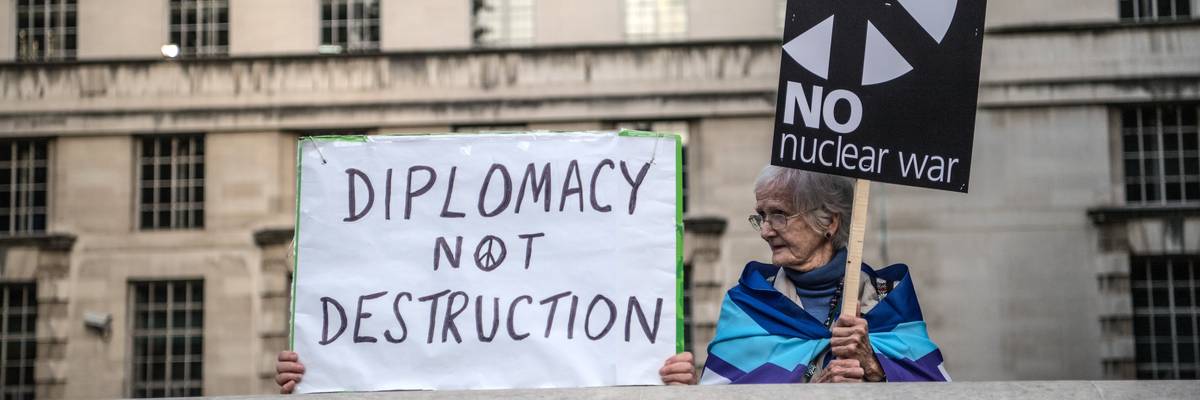
Stop the War protesters demonstrate against the threat of nuclear war in North East Asia, near Downing Street on September 28, 2017 in London, England.
The Only True Nuclear Protective Shield Is Global Disarmament
Politicians and the media use deliberately confusing terms that downplay the dangers of a military and nuclear arms race to the general population.
The use of key security policy terms in public discourse is intended to suggest facts that serve to calm people down. However, there are many reasons for concern that could also trigger peace forces.
The Illusion of a Nuclear Protective Shield
Political scientist and historian Herfried Münkler called for a European atomic bomb as early as 2023. There is currently an increasingly heated debate about whether Germany should seek refuge under France's nuclear protective shield in view of Russia's aggression in Ukraine. The leader of the Social Democrats in the European Parliament, Katarina Barley, also raised the issue of acquiring nuclear bombs as part of European armament in 2024. The German and French heads of government, Friedrich Merz and Emmanuel Macron, are also paving the way for talks on European nuclear armament and the extension of France's nuclear umbrella, according to Merz in his speech at the Munich Security Conference in early 2026.
There is repeated talk of a nuclear umbrella. The problem is already clear in this choice of words. Such a protective shield, which one would only have to deploy to be protected, does not exist. This term suggests that Germany or even Europe would be protected from attacking missiles with nuclear warheads if the nuclear protective shield were installed. However, there is no protection against dozens of hypersonic missiles with multiple nuclear warheads attacking simultaneously. The few minutes of reaction time are not enough for a successful counterattack.
Anyone who promises a nuclear protective shield in this sense is trying to deceive people about the real danger of a nuclear conflict in order to achieve their actual military-strategic goals.
So-called "mini-nukes" have a yield of between 10 and 20 tons of TNT equivalent, which is roughly the same as the bombs dropped on Hiroshima and Nagasaki.
Those who are more knowledgeable know that the term “nuclear protective shield” refers more to the nuclear deterrence of a potential attacker. This deterrence would result from the nuclear second-strike capability if a nuclear first strike is underway or has already taken place. The question here, of course, is whether a nuclear second strike is still possible if the first strike with nuclear weapons could not be repelled. Here, too, the talk of a nuclear protective shield is problematic.
Lowering the Nuclear Threshold Through ‘Tactical’ Nuclear Weapons
The distinction between strategic and tactical nuclear weapons also poses a semantic problem. Here, technological language suggests that there is a clear distinction between the two. Tactical nuclear weapons are weapons that are intended for limited use due to their lower explosive power, shorter range, and deployment. However, the boundaries are fluid, and Russia also considers tactical weapons to be strategic. If this distinction is nevertheless used, the use of more limited (tactical) nuclear weapons could then be viewed fundamentally differently from the use of larger and longer-range nuclear weapons in terms of explosive power.
The conceptual problem is further exacerbated by so-called “mini-nukes.” Thus, the gradation and differentiation of nuclear weapons pretends that a nuclear war could be confined to a regional or local level. This merely lowers the nuclear threshold and thus downplays the risk of nuclear escalation. Incidentally, so-called "mini-nukes" have a yield of between 10 and 20 tons of TNT equivalent, which is roughly the same as the bombs dropped on Hiroshima and Nagasaki. This is therefore also a linguistic distortion and trivialization of a terrible weapon.
Putin's Special Military Operation as a Crude Semantic Deception
Russia's invasion of Ukraine in February 2022 was a clear act of war, albeit without a declaration of war. Russia's war against Ukraine, which has now been going on for over four years, has been disguised as a “special military operation.” To this day, the Kremlin refuses to acknowledge the conceptual truth of its war. In doing so, it attempts to downplay the illegality and barbarity of its aggression to its own population and to the world. "Special military operation" sounds more like a clean, technical intervention. Language could not be used in a more manipulative way, considering that hundreds of thousands of people have already fallen victim to this war, millions have fled, and Ukraine's vital infrastructure and ecology have been destroyed.
When people are satisfied with their governments' security policy, which is secured by a system of terminology that obscures the facts, then a false consciousness is hegemonically induced in them.
Equally problematic is the term "Russian world" (Russkij Mir), which Russian President Vladimir Putin uses repeatedly. A Russian world as such does not even exist in Russia, as it is a multiethnic state created by coercion and military force, with very different cultural characteristics among its peoples. Thus, talk of the "Russkij Mir" serves to justify military aggression against other states with the argument that the Russian world and the Russian-speaking people there are under threat.
This ethnically charged term is also the central ideological construct used to restrict the state independence of countries such as Belarus and Ukraine.
Deception Through the Term ‘Nuclear Sharing’
Since Germany is not permitted to possess nuclear weapons under the 2+4 Treaty and the Nuclear Non-Proliferation Treaty, NATO has agreed on the principle of "nuclear sharing." However, this term also serves to obscure harsh security policy realities. According to reports, up to 20 US B61-3/4 nuclear bombs are stored in Büchel (Rhineland-Palatinate), combined with German Air Force Tornadoes capable of delivering nuclear warheads to an enemy target.
However, the American nuclear capabilities stored there—and also in other European NATO countries—do not allow for participation by the German federal government. Participation implies the possibility of having a say. But the US government repeatedly makes it clear that the possible use of these nuclear weapons is exclusively subject to the respective US government. This undermines and circumvents the United Nations Nuclear Non-Proliferation Treaty on nuclear sharing among NATO countries, while at the same time obscuring the fact that these weapons are controlled by a foreign power.
Misuse of the Term ‘Modernization’ of Nuclear Weapons
The potential dangers of the "modernization" of nuclear weapons are also being downplayed. The term "modernization" as used in security policy also implies a positive development of nuclear weapons—after all, "modern" represents a positive innovation in language usage—and obscures the increasing danger of these weapon systems.
A particularly problematic aspect of this modernization is the integration of artificial intelligence and the expansion of its functionality within the framework of nuclear strategies. However, AI works on the principle of probability calculation and is extremely prone to error. The information from hundreds of sensors, which an AI uses to make a statement in a very short time, e.g., about attacking nuclear missile swarms, cannot be reliably verified by those responsible in the few minutes of time available. However, this development could make an accidental nuclear war more likely.
War Readiness Versus Defense Capability—the Importance of Conceptual Usage
When German Defense Minister Pistorius says that Germany must become “war ready,” this contradicts the defense mandate of the Basic Law and the prohibition of wars of aggression (GG Art. 26 (1) and 115a). The concept of war includes both defense and attack. Therefore, if the federal government adheres to the Basic Law, it should only talk about and take appropriate measures to become defensible.
War readiness is based on the postulate of military strength through deterrence. Since no state wants to voluntarily face the military superiority of an enemy state or military alliance, that state will devote an increasing share of its national budget to further armament measures in order to surpass its opponent in military strength. This leads to an arms race and—as World War I shows, for example—ultimately to war.
Defense capability relies on the priority of negotiations, diplomacy, and systematically coordinated control and disarmament treaties.
Defense capability means prioritizing military defense capabilities, e.g., with regard to defending against drone attacks, in conjunction with improved “resilience” of critical infrastructure. Even this kind of resilience is currently unachievable for any state. Today's industrialized nations in the digital age are virtually impossible to protect against hybrid attacks, especially hacking of power and heating networks. Anyone who suggests that this is entirely possible creates a false sense of security.
But when people are satisfied with their governments' security policy, which is secured by a system of terminology that obscures the facts, then a false consciousness is hegemonically induced in them. They are deprived of the civil society power to resist their government's risky course. This also characterizes the dilemma of the current peace movement. Although it clearly addresses the dangers of military escalation and nuclear war in its appeals, it does not find the resonance that would actually be expected in the current crisis situation.
Deployment of US Missiles in 2026 as a ‘Security Policy’ of Deterrence
The deployment of three different missile systems, including hypersonic weapons, planned for November 2026, follows the verdict of strength through deterrence. These weapon systems will be stationed in Germany under US command. This was agreed upon between former US President Joe Biden and former German Chancellor Olaf Scholz on the sidelines of the NATO summit in New York in the summer of 2024, without any debate in the Bundestag. The deployment will take place without any accompanying offer of negotiation to Russia. These are so-called "decapitation weapons," i.e., weapons that are not primarily intended for defense, as stipulated in the Basic Law.
In this case, too, it is problematic to speak of "security policy" in relation to the US missile deployment. It could well be that this deployment could increase uncertainty and the risk of escalation for Germany. These weapon systems, which certainly pose a threat to Russia, could become targets for Russian missile attacks, which in turn would trigger a corresponding spiral of retaliation, possibly even nuclear.
But defense capability relies on the priority of negotiations, diplomacy, and systematically coordinated control and disarmament treaties. In this context, building up military defenses and attempting to secure critical infrastructure is entirely necessary and legitimate. However, the planned US missile deployment undermines this defense policy objective. What will Russia do in this case? It should not be forgotten that Russia has already deployed Zircon and Kinschal hypersonic missiles, for example in Kaliningrad, and has already used the Oreschnik hypersonic weapon, which is virtually impossible to defend against, at least twice in the war in Ukraine. If NATO's Western allies are not prepared to renegotiate the disarmament and control treaties, Russia will certainly attempt to expand and upgrade its own arsenal once the US missiles are deployed at the end of 2026.
Conclusion
Disclosing the dangers implied in security policy language in connection with nuclear weapons does not mean defeatism or resignation in the face of an opponent armed to the teeth with conventional and nuclear weapons.
However, if people allow themselves to be deceived by appeasing terminology and its use in public discourse on security policy, this leads to a dangerous lulling of these people into a false sense of security. The security policy promises behind this terminology give them a feeling of security that does not correspond to the actual risk when states focus on military armament, in particular the further development of nuclear weapons systems, and military escalation. The disclosure of real dangers is not intended to cause anxiety about security policy and paralysis, but rather to raise awareness of actual dangers as the basis for the priority need for improved defense capabilities, in particular through negotiations and diplomacy.
Historical experience with a policy of deterrence through military strength shows, however, that a spiral of military armament increases the likelihood of military conflict.
In summary, it can therefore be said that the security policy goal must be defense capability. This also includes a disarmament proposal that has already been mentioned several times, within a framework controlled by the United Nations, that the two major military powers, the US and Russia, should gradually disarm all weapons systems, including nuclear weapons, to the level of the People's Republic of China. In a next step, under the transparent supervision of international institutions such as the UN and the Organization for Security and Co-operation in Europe, these three states would have to disarm to the level of smaller states until, for example, the United Nations Treaty on the Prohibition of Nuclear Weapons is fully implemented.
This would be an effective and sensible security policy worthy of the name. Even though there are currently major geopolitical obstacles standing in the way of such controlled and transparent international disarmament, this peace-bringing disarmament strategy must not be lost sight of. The trillions that would be saved by all participating states as a result of disarmament and the elimination of further armament could also be a compelling argument for such an internationally coordinated and balanced disarmament strategy, at least in the medium term.
Historical experience with a policy of deterrence through military strength shows, however, that a spiral of military armament increases the likelihood of military conflict. A security policy that is oriented toward defense capability rather than war capability would also have to use different language. Obscuring terms that are embedded in a context of meaning and semantically designed to conceal rather than reveal military risks are part of a media-mediated military strategy that will not lead to peace.
We are at a crossroads
This country and this world are at a monumental crossroads. In a few short weeks, US voters will have an opportunity to beat back the forces of fascism and confront the billionaires who are rigging the economy, our media system, and our democracy, making it increasingly impossible for ordinary people to get by. We’re not just talking about the election. We’re talking about what must be done once these fascist elements are vanquished from power. We need a bolder set of solutions than what either major party has so far been willing to offer and a working-class movement ready to fight like hell for it. Trump didn't emerge from nowhere. The conditions that fueled MAGA authoritarianism were created by decades of radical neoliberal economic policies and a corrupt political system dominated by corporate interests. They slashed taxes on the super-rich, promising that the benefits would trickle down. They said giveaways to the corporate titans would make life more affordable for the rest of us. It was all bullshit. And when a bitter, betrayed populace searches for someone to blame, right-wing demagogues have little trouble finding scapegoats. People know when they're being lied to, but you won't hear any of this from the corporate media. Only independent journalism—powered and funded by people who believe in building a better world—can deliver truly trustworthy daily news. Our Fall Campaign is underway, and we need your help. To power our newsroom through the rest of the year, we need to raise $125,000 by midnight on October 31. So if you share our vision, please contribute whatever you can to sustain our work. |
The use of key security policy terms in public discourse is intended to suggest facts that serve to calm people down. However, there are many reasons for concern that could also trigger peace forces.
The Illusion of a Nuclear Protective Shield
Political scientist and historian Herfried Münkler called for a European atomic bomb as early as 2023. There is currently an increasingly heated debate about whether Germany should seek refuge under France's nuclear protective shield in view of Russia's aggression in Ukraine. The leader of the Social Democrats in the European Parliament, Katarina Barley, also raised the issue of acquiring nuclear bombs as part of European armament in 2024. The German and French heads of government, Friedrich Merz and Emmanuel Macron, are also paving the way for talks on European nuclear armament and the extension of France's nuclear umbrella, according to Merz in his speech at the Munich Security Conference in early 2026.
There is repeated talk of a nuclear umbrella. The problem is already clear in this choice of words. Such a protective shield, which one would only have to deploy to be protected, does not exist. This term suggests that Germany or even Europe would be protected from attacking missiles with nuclear warheads if the nuclear protective shield were installed. However, there is no protection against dozens of hypersonic missiles with multiple nuclear warheads attacking simultaneously. The few minutes of reaction time are not enough for a successful counterattack.
Anyone who promises a nuclear protective shield in this sense is trying to deceive people about the real danger of a nuclear conflict in order to achieve their actual military-strategic goals.
So-called "mini-nukes" have a yield of between 10 and 20 tons of TNT equivalent, which is roughly the same as the bombs dropped on Hiroshima and Nagasaki.
Those who are more knowledgeable know that the term “nuclear protective shield” refers more to the nuclear deterrence of a potential attacker. This deterrence would result from the nuclear second-strike capability if a nuclear first strike is underway or has already taken place. The question here, of course, is whether a nuclear second strike is still possible if the first strike with nuclear weapons could not be repelled. Here, too, the talk of a nuclear protective shield is problematic.
Lowering the Nuclear Threshold Through ‘Tactical’ Nuclear Weapons
The distinction between strategic and tactical nuclear weapons also poses a semantic problem. Here, technological language suggests that there is a clear distinction between the two. Tactical nuclear weapons are weapons that are intended for limited use due to their lower explosive power, shorter range, and deployment. However, the boundaries are fluid, and Russia also considers tactical weapons to be strategic. If this distinction is nevertheless used, the use of more limited (tactical) nuclear weapons could then be viewed fundamentally differently from the use of larger and longer-range nuclear weapons in terms of explosive power.
The conceptual problem is further exacerbated by so-called “mini-nukes.” Thus, the gradation and differentiation of nuclear weapons pretends that a nuclear war could be confined to a regional or local level. This merely lowers the nuclear threshold and thus downplays the risk of nuclear escalation. Incidentally, so-called "mini-nukes" have a yield of between 10 and 20 tons of TNT equivalent, which is roughly the same as the bombs dropped on Hiroshima and Nagasaki. This is therefore also a linguistic distortion and trivialization of a terrible weapon.
Putin's Special Military Operation as a Crude Semantic Deception
Russia's invasion of Ukraine in February 2022 was a clear act of war, albeit without a declaration of war. Russia's war against Ukraine, which has now been going on for over four years, has been disguised as a “special military operation.” To this day, the Kremlin refuses to acknowledge the conceptual truth of its war. In doing so, it attempts to downplay the illegality and barbarity of its aggression to its own population and to the world. "Special military operation" sounds more like a clean, technical intervention. Language could not be used in a more manipulative way, considering that hundreds of thousands of people have already fallen victim to this war, millions have fled, and Ukraine's vital infrastructure and ecology have been destroyed.
When people are satisfied with their governments' security policy, which is secured by a system of terminology that obscures the facts, then a false consciousness is hegemonically induced in them.
Equally problematic is the term "Russian world" (Russkij Mir), which Russian President Vladimir Putin uses repeatedly. A Russian world as such does not even exist in Russia, as it is a multiethnic state created by coercion and military force, with very different cultural characteristics among its peoples. Thus, talk of the "Russkij Mir" serves to justify military aggression against other states with the argument that the Russian world and the Russian-speaking people there are under threat.
This ethnically charged term is also the central ideological construct used to restrict the state independence of countries such as Belarus and Ukraine.
Deception Through the Term ‘Nuclear Sharing’
Since Germany is not permitted to possess nuclear weapons under the 2+4 Treaty and the Nuclear Non-Proliferation Treaty, NATO has agreed on the principle of "nuclear sharing." However, this term also serves to obscure harsh security policy realities. According to reports, up to 20 US B61-3/4 nuclear bombs are stored in Büchel (Rhineland-Palatinate), combined with German Air Force Tornadoes capable of delivering nuclear warheads to an enemy target.
However, the American nuclear capabilities stored there—and also in other European NATO countries—do not allow for participation by the German federal government. Participation implies the possibility of having a say. But the US government repeatedly makes it clear that the possible use of these nuclear weapons is exclusively subject to the respective US government. This undermines and circumvents the United Nations Nuclear Non-Proliferation Treaty on nuclear sharing among NATO countries, while at the same time obscuring the fact that these weapons are controlled by a foreign power.
Misuse of the Term ‘Modernization’ of Nuclear Weapons
The potential dangers of the "modernization" of nuclear weapons are also being downplayed. The term "modernization" as used in security policy also implies a positive development of nuclear weapons—after all, "modern" represents a positive innovation in language usage—and obscures the increasing danger of these weapon systems.
A particularly problematic aspect of this modernization is the integration of artificial intelligence and the expansion of its functionality within the framework of nuclear strategies. However, AI works on the principle of probability calculation and is extremely prone to error. The information from hundreds of sensors, which an AI uses to make a statement in a very short time, e.g., about attacking nuclear missile swarms, cannot be reliably verified by those responsible in the few minutes of time available. However, this development could make an accidental nuclear war more likely.
War Readiness Versus Defense Capability—the Importance of Conceptual Usage
When German Defense Minister Pistorius says that Germany must become “war ready,” this contradicts the defense mandate of the Basic Law and the prohibition of wars of aggression (GG Art. 26 (1) and 115a). The concept of war includes both defense and attack. Therefore, if the federal government adheres to the Basic Law, it should only talk about and take appropriate measures to become defensible.
War readiness is based on the postulate of military strength through deterrence. Since no state wants to voluntarily face the military superiority of an enemy state or military alliance, that state will devote an increasing share of its national budget to further armament measures in order to surpass its opponent in military strength. This leads to an arms race and—as World War I shows, for example—ultimately to war.
Defense capability relies on the priority of negotiations, diplomacy, and systematically coordinated control and disarmament treaties.
Defense capability means prioritizing military defense capabilities, e.g., with regard to defending against drone attacks, in conjunction with improved “resilience” of critical infrastructure. Even this kind of resilience is currently unachievable for any state. Today's industrialized nations in the digital age are virtually impossible to protect against hybrid attacks, especially hacking of power and heating networks. Anyone who suggests that this is entirely possible creates a false sense of security.
But when people are satisfied with their governments' security policy, which is secured by a system of terminology that obscures the facts, then a false consciousness is hegemonically induced in them. They are deprived of the civil society power to resist their government's risky course. This also characterizes the dilemma of the current peace movement. Although it clearly addresses the dangers of military escalation and nuclear war in its appeals, it does not find the resonance that would actually be expected in the current crisis situation.
Deployment of US Missiles in 2026 as a ‘Security Policy’ of Deterrence
The deployment of three different missile systems, including hypersonic weapons, planned for November 2026, follows the verdict of strength through deterrence. These weapon systems will be stationed in Germany under US command. This was agreed upon between former US President Joe Biden and former German Chancellor Olaf Scholz on the sidelines of the NATO summit in New York in the summer of 2024, without any debate in the Bundestag. The deployment will take place without any accompanying offer of negotiation to Russia. These are so-called "decapitation weapons," i.e., weapons that are not primarily intended for defense, as stipulated in the Basic Law.
In this case, too, it is problematic to speak of "security policy" in relation to the US missile deployment. It could well be that this deployment could increase uncertainty and the risk of escalation for Germany. These weapon systems, which certainly pose a threat to Russia, could become targets for Russian missile attacks, which in turn would trigger a corresponding spiral of retaliation, possibly even nuclear.
But defense capability relies on the priority of negotiations, diplomacy, and systematically coordinated control and disarmament treaties. In this context, building up military defenses and attempting to secure critical infrastructure is entirely necessary and legitimate. However, the planned US missile deployment undermines this defense policy objective. What will Russia do in this case? It should not be forgotten that Russia has already deployed Zircon and Kinschal hypersonic missiles, for example in Kaliningrad, and has already used the Oreschnik hypersonic weapon, which is virtually impossible to defend against, at least twice in the war in Ukraine. If NATO's Western allies are not prepared to renegotiate the disarmament and control treaties, Russia will certainly attempt to expand and upgrade its own arsenal once the US missiles are deployed at the end of 2026.
Conclusion
Disclosing the dangers implied in security policy language in connection with nuclear weapons does not mean defeatism or resignation in the face of an opponent armed to the teeth with conventional and nuclear weapons.
However, if people allow themselves to be deceived by appeasing terminology and its use in public discourse on security policy, this leads to a dangerous lulling of these people into a false sense of security. The security policy promises behind this terminology give them a feeling of security that does not correspond to the actual risk when states focus on military armament, in particular the further development of nuclear weapons systems, and military escalation. The disclosure of real dangers is not intended to cause anxiety about security policy and paralysis, but rather to raise awareness of actual dangers as the basis for the priority need for improved defense capabilities, in particular through negotiations and diplomacy.
Historical experience with a policy of deterrence through military strength shows, however, that a spiral of military armament increases the likelihood of military conflict.
In summary, it can therefore be said that the security policy goal must be defense capability. This also includes a disarmament proposal that has already been mentioned several times, within a framework controlled by the United Nations, that the two major military powers, the US and Russia, should gradually disarm all weapons systems, including nuclear weapons, to the level of the People's Republic of China. In a next step, under the transparent supervision of international institutions such as the UN and the Organization for Security and Co-operation in Europe, these three states would have to disarm to the level of smaller states until, for example, the United Nations Treaty on the Prohibition of Nuclear Weapons is fully implemented.
This would be an effective and sensible security policy worthy of the name. Even though there are currently major geopolitical obstacles standing in the way of such controlled and transparent international disarmament, this peace-bringing disarmament strategy must not be lost sight of. The trillions that would be saved by all participating states as a result of disarmament and the elimination of further armament could also be a compelling argument for such an internationally coordinated and balanced disarmament strategy, at least in the medium term.
Historical experience with a policy of deterrence through military strength shows, however, that a spiral of military armament increases the likelihood of military conflict. A security policy that is oriented toward defense capability rather than war capability would also have to use different language. Obscuring terms that are embedded in a context of meaning and semantically designed to conceal rather than reveal military risks are part of a media-mediated military strategy that will not lead to peace.
- Don't Just Worry About Nuclear War--Do Something to Help Prevent It ›
- The Doomsday Clock and Nuclear Reality: Our World in Peril ›
- 'Insanity Not to Allow This': Calls for Ceasefire to Repair Chernobyl Power Supply ›
- Nuclear Hubris ›
- Some Way Out of Here: Common Security in a World On Fire ›
- New Worries at Chernobyl After IAEA Finds Radiation Shield Has 'Lost Primary Safety Functions' ›
The use of key security policy terms in public discourse is intended to suggest facts that serve to calm people down. However, there are many reasons for concern that could also trigger peace forces.
The Illusion of a Nuclear Protective Shield
Political scientist and historian Herfried Münkler called for a European atomic bomb as early as 2023. There is currently an increasingly heated debate about whether Germany should seek refuge under France's nuclear protective shield in view of Russia's aggression in Ukraine. The leader of the Social Democrats in the European Parliament, Katarina Barley, also raised the issue of acquiring nuclear bombs as part of European armament in 2024. The German and French heads of government, Friedrich Merz and Emmanuel Macron, are also paving the way for talks on European nuclear armament and the extension of France's nuclear umbrella, according to Merz in his speech at the Munich Security Conference in early 2026.
There is repeated talk of a nuclear umbrella. The problem is already clear in this choice of words. Such a protective shield, which one would only have to deploy to be protected, does not exist. This term suggests that Germany or even Europe would be protected from attacking missiles with nuclear warheads if the nuclear protective shield were installed. However, there is no protection against dozens of hypersonic missiles with multiple nuclear warheads attacking simultaneously. The few minutes of reaction time are not enough for a successful counterattack.
Anyone who promises a nuclear protective shield in this sense is trying to deceive people about the real danger of a nuclear conflict in order to achieve their actual military-strategic goals.
So-called "mini-nukes" have a yield of between 10 and 20 tons of TNT equivalent, which is roughly the same as the bombs dropped on Hiroshima and Nagasaki.
Those who are more knowledgeable know that the term “nuclear protective shield” refers more to the nuclear deterrence of a potential attacker. This deterrence would result from the nuclear second-strike capability if a nuclear first strike is underway or has already taken place. The question here, of course, is whether a nuclear second strike is still possible if the first strike with nuclear weapons could not be repelled. Here, too, the talk of a nuclear protective shield is problematic.
Lowering the Nuclear Threshold Through ‘Tactical’ Nuclear Weapons
The distinction between strategic and tactical nuclear weapons also poses a semantic problem. Here, technological language suggests that there is a clear distinction between the two. Tactical nuclear weapons are weapons that are intended for limited use due to their lower explosive power, shorter range, and deployment. However, the boundaries are fluid, and Russia also considers tactical weapons to be strategic. If this distinction is nevertheless used, the use of more limited (tactical) nuclear weapons could then be viewed fundamentally differently from the use of larger and longer-range nuclear weapons in terms of explosive power.
The conceptual problem is further exacerbated by so-called “mini-nukes.” Thus, the gradation and differentiation of nuclear weapons pretends that a nuclear war could be confined to a regional or local level. This merely lowers the nuclear threshold and thus downplays the risk of nuclear escalation. Incidentally, so-called "mini-nukes" have a yield of between 10 and 20 tons of TNT equivalent, which is roughly the same as the bombs dropped on Hiroshima and Nagasaki. This is therefore also a linguistic distortion and trivialization of a terrible weapon.
Putin's Special Military Operation as a Crude Semantic Deception
Russia's invasion of Ukraine in February 2022 was a clear act of war, albeit without a declaration of war. Russia's war against Ukraine, which has now been going on for over four years, has been disguised as a “special military operation.” To this day, the Kremlin refuses to acknowledge the conceptual truth of its war. In doing so, it attempts to downplay the illegality and barbarity of its aggression to its own population and to the world. "Special military operation" sounds more like a clean, technical intervention. Language could not be used in a more manipulative way, considering that hundreds of thousands of people have already fallen victim to this war, millions have fled, and Ukraine's vital infrastructure and ecology have been destroyed.
When people are satisfied with their governments' security policy, which is secured by a system of terminology that obscures the facts, then a false consciousness is hegemonically induced in them.
Equally problematic is the term "Russian world" (Russkij Mir), which Russian President Vladimir Putin uses repeatedly. A Russian world as such does not even exist in Russia, as it is a multiethnic state created by coercion and military force, with very different cultural characteristics among its peoples. Thus, talk of the "Russkij Mir" serves to justify military aggression against other states with the argument that the Russian world and the Russian-speaking people there are under threat.
This ethnically charged term is also the central ideological construct used to restrict the state independence of countries such as Belarus and Ukraine.
Deception Through the Term ‘Nuclear Sharing’
Since Germany is not permitted to possess nuclear weapons under the 2+4 Treaty and the Nuclear Non-Proliferation Treaty, NATO has agreed on the principle of "nuclear sharing." However, this term also serves to obscure harsh security policy realities. According to reports, up to 20 US B61-3/4 nuclear bombs are stored in Büchel (Rhineland-Palatinate), combined with German Air Force Tornadoes capable of delivering nuclear warheads to an enemy target.
However, the American nuclear capabilities stored there—and also in other European NATO countries—do not allow for participation by the German federal government. Participation implies the possibility of having a say. But the US government repeatedly makes it clear that the possible use of these nuclear weapons is exclusively subject to the respective US government. This undermines and circumvents the United Nations Nuclear Non-Proliferation Treaty on nuclear sharing among NATO countries, while at the same time obscuring the fact that these weapons are controlled by a foreign power.
Misuse of the Term ‘Modernization’ of Nuclear Weapons
The potential dangers of the "modernization" of nuclear weapons are also being downplayed. The term "modernization" as used in security policy also implies a positive development of nuclear weapons—after all, "modern" represents a positive innovation in language usage—and obscures the increasing danger of these weapon systems.
A particularly problematic aspect of this modernization is the integration of artificial intelligence and the expansion of its functionality within the framework of nuclear strategies. However, AI works on the principle of probability calculation and is extremely prone to error. The information from hundreds of sensors, which an AI uses to make a statement in a very short time, e.g., about attacking nuclear missile swarms, cannot be reliably verified by those responsible in the few minutes of time available. However, this development could make an accidental nuclear war more likely.
War Readiness Versus Defense Capability—the Importance of Conceptual Usage
When German Defense Minister Pistorius says that Germany must become “war ready,” this contradicts the defense mandate of the Basic Law and the prohibition of wars of aggression (GG Art. 26 (1) and 115a). The concept of war includes both defense and attack. Therefore, if the federal government adheres to the Basic Law, it should only talk about and take appropriate measures to become defensible.
War readiness is based on the postulate of military strength through deterrence. Since no state wants to voluntarily face the military superiority of an enemy state or military alliance, that state will devote an increasing share of its national budget to further armament measures in order to surpass its opponent in military strength. This leads to an arms race and—as World War I shows, for example—ultimately to war.
Defense capability relies on the priority of negotiations, diplomacy, and systematically coordinated control and disarmament treaties.
Defense capability means prioritizing military defense capabilities, e.g., with regard to defending against drone attacks, in conjunction with improved “resilience” of critical infrastructure. Even this kind of resilience is currently unachievable for any state. Today's industrialized nations in the digital age are virtually impossible to protect against hybrid attacks, especially hacking of power and heating networks. Anyone who suggests that this is entirely possible creates a false sense of security.
But when people are satisfied with their governments' security policy, which is secured by a system of terminology that obscures the facts, then a false consciousness is hegemonically induced in them. They are deprived of the civil society power to resist their government's risky course. This also characterizes the dilemma of the current peace movement. Although it clearly addresses the dangers of military escalation and nuclear war in its appeals, it does not find the resonance that would actually be expected in the current crisis situation.
Deployment of US Missiles in 2026 as a ‘Security Policy’ of Deterrence
The deployment of three different missile systems, including hypersonic weapons, planned for November 2026, follows the verdict of strength through deterrence. These weapon systems will be stationed in Germany under US command. This was agreed upon between former US President Joe Biden and former German Chancellor Olaf Scholz on the sidelines of the NATO summit in New York in the summer of 2024, without any debate in the Bundestag. The deployment will take place without any accompanying offer of negotiation to Russia. These are so-called "decapitation weapons," i.e., weapons that are not primarily intended for defense, as stipulated in the Basic Law.
In this case, too, it is problematic to speak of "security policy" in relation to the US missile deployment. It could well be that this deployment could increase uncertainty and the risk of escalation for Germany. These weapon systems, which certainly pose a threat to Russia, could become targets for Russian missile attacks, which in turn would trigger a corresponding spiral of retaliation, possibly even nuclear.
But defense capability relies on the priority of negotiations, diplomacy, and systematically coordinated control and disarmament treaties. In this context, building up military defenses and attempting to secure critical infrastructure is entirely necessary and legitimate. However, the planned US missile deployment undermines this defense policy objective. What will Russia do in this case? It should not be forgotten that Russia has already deployed Zircon and Kinschal hypersonic missiles, for example in Kaliningrad, and has already used the Oreschnik hypersonic weapon, which is virtually impossible to defend against, at least twice in the war in Ukraine. If NATO's Western allies are not prepared to renegotiate the disarmament and control treaties, Russia will certainly attempt to expand and upgrade its own arsenal once the US missiles are deployed at the end of 2026.
Conclusion
Disclosing the dangers implied in security policy language in connection with nuclear weapons does not mean defeatism or resignation in the face of an opponent armed to the teeth with conventional and nuclear weapons.
However, if people allow themselves to be deceived by appeasing terminology and its use in public discourse on security policy, this leads to a dangerous lulling of these people into a false sense of security. The security policy promises behind this terminology give them a feeling of security that does not correspond to the actual risk when states focus on military armament, in particular the further development of nuclear weapons systems, and military escalation. The disclosure of real dangers is not intended to cause anxiety about security policy and paralysis, but rather to raise awareness of actual dangers as the basis for the priority need for improved defense capabilities, in particular through negotiations and diplomacy.
Historical experience with a policy of deterrence through military strength shows, however, that a spiral of military armament increases the likelihood of military conflict.
In summary, it can therefore be said that the security policy goal must be defense capability. This also includes a disarmament proposal that has already been mentioned several times, within a framework controlled by the United Nations, that the two major military powers, the US and Russia, should gradually disarm all weapons systems, including nuclear weapons, to the level of the People's Republic of China. In a next step, under the transparent supervision of international institutions such as the UN and the Organization for Security and Co-operation in Europe, these three states would have to disarm to the level of smaller states until, for example, the United Nations Treaty on the Prohibition of Nuclear Weapons is fully implemented.
This would be an effective and sensible security policy worthy of the name. Even though there are currently major geopolitical obstacles standing in the way of such controlled and transparent international disarmament, this peace-bringing disarmament strategy must not be lost sight of. The trillions that would be saved by all participating states as a result of disarmament and the elimination of further armament could also be a compelling argument for such an internationally coordinated and balanced disarmament strategy, at least in the medium term.
Historical experience with a policy of deterrence through military strength shows, however, that a spiral of military armament increases the likelihood of military conflict. A security policy that is oriented toward defense capability rather than war capability would also have to use different language. Obscuring terms that are embedded in a context of meaning and semantically designed to conceal rather than reveal military risks are part of a media-mediated military strategy that will not lead to peace.
- Don't Just Worry About Nuclear War--Do Something to Help Prevent It ›
- The Doomsday Clock and Nuclear Reality: Our World in Peril ›
- 'Insanity Not to Allow This': Calls for Ceasefire to Repair Chernobyl Power Supply ›
- Nuclear Hubris ›
- Some Way Out of Here: Common Security in a World On Fire ›
- New Worries at Chernobyl After IAEA Finds Radiation Shield Has 'Lost Primary Safety Functions' ›