SUBSCRIBE TO OUR FREE NEWSLETTER
Daily news & progressive opinion—funded by the people, not the corporations—delivered straight to your inbox.
5
#000000
#FFFFFF
To donate by check, phone, or other method, see our More Ways to Give page.
Daily news & progressive opinion—funded by the people, not the corporations—delivered straight to your inbox.
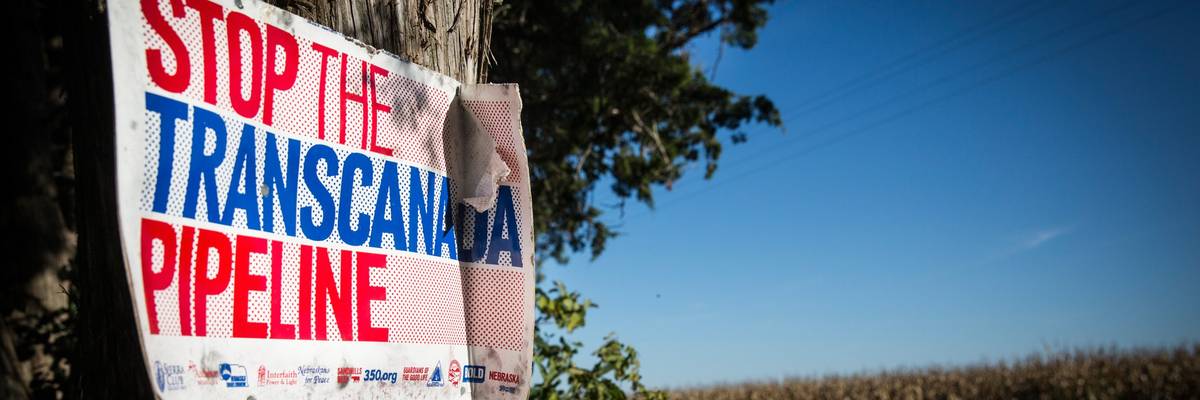
A sign against the proposed Keystone XL pipeline is posted to a tree on Shannon Graves' property on October 11, 2014 in Polk, Nebraska.
The Big Oil powers that be have a Keystone XL obsession that just won’t die. Opponents are just as adamant that it won’t be built.
Here we go again.
The Big Oil powers that be have a Keystone XL obsession that just won’t die. Opponents are just as adamant that it won’t be built. The latest industry brainstorm is to bring a whole bunch of dirty tar sands oil from Canada to Guernsey, Wyoming, and then… well, “some future company” would need to build an additional pipeline, in order to get that oil down to refineries on the Gulf Coast. That’s a risky plan for a pipeline investor.
To review: The pipeline company TransCanada, which later became TC Energy and then recently spun off into new corporate entity “South Bow,” first proposed building the Alberta to Texas tar sands pipeline in 2008. As a trans-boundary pipeline, it required not only state permits and land acquisition from farmers and ranchers along the route, but also a Presidential Permit determining it to be in the national interest.
It was sailing along its permitting process despite opposition from First Nations in Canada, when climate scientist James Hansen pointed out that if the super-dirty high-carbon Alberta tar sands were fully developed it would be “game over” for the climate. At the same time, farmers and ranchers in Nebraska noticed that the route went through the fragile Sand Hills region and threatened the Ogallala aquifer. A battle royale ensued, with an unlikely alliance of farmers and ranchers, students, tribal nations, grassroots climate activists, and environmental nonprofits joining together against KXL supporters, which included the Alberta government, the Canadian government, the Republican Party, about half of the Democratic Party, and the entire oil industry.
To call this plan half-baked would be an insult to baking.
Remarkably, the unlikely alliance won. Barack Obama denied the Presidential Permit in 2015. Donald Trump approved it on the first day of his first term, but litigation prevented it from moving forward for the next four years. Joe Biden re-cancelled it on the first day of his presidency, and KXL was not built.
Now, however, there is an inkling of a plan to sort of revive KXL, although “plan” is an exaggeration. A company called Bridger is testing the waters by proposing to take bitumen, the technical term for the thick gooey hydrocarbon also known as tar sands or oil sands, from Alberta and pipe it through Montana to Guernsey, Wyoming. From there, according to press reports, “spurs” would be “bolted on” to take it to refining hubs and to the Gulf Coast for export. But it’s over 700 miles from Guernsey to the hub in Cushing, Olahoma, and over 400 miles to Steele City, Nebraska, where it could connect to existing underutilized pipelines.
Four hundred (400) miles is not exactly a “spur” that you “bolt on.” In fact, that route would require a state permit from the Nebraska Public Service Commission, and the acquisition of land—through eminent domain if necessary—from hundreds of Nebraskans. The process would take years, and generate the same controversy it did back in the early 2010’s. And if South Bow fails to get the full route built before the militantly pro-oil US president is out of office, the cross-border Presidential Permit could be denied—again. That “spur,” potentially cutting across the entire state of Nebraska, is the part that “some future company” would be responsible for. To call this plan half-baked would be an insult to baking.
The current war in Iran is making oil and energy markets more volatile than anytime since the 1970’s, with oil prices over $100. That might make it seem that tar sands oil, which is not only the dirtiest but most expensive oil to produce, could still make money. But in the long run, oil will probably settle somewhere under $100, because that’s where Saudi Arabia, OPEC, and the US producers want it—high enough to generate high profits, but not high enough to provoke recession. And in the even longer run, the world will inevitably electrify transportation, because this dependence on oil, with its wars and spills and price spikes and insecurity and pollution and global warming, is just too crazy.
Let’s add up the risks:
Let’s add up the rewards:
The risks far outweigh the rewards. Which is why this pipeline should not be built.
The US Bureau of Land Management and the Montana Department of Environmental Quality are now jointly accepting public comments on permit applications for the project through May 1, and holding several public meetings in Montana.
Bold Nebraska, the group that helped lead the original fight against Keystone XL by organizing farmers and ranchers along the route into an unlikely alliance with Tribal Nations, grassroots advocates, and national environmental groups, is collecting comments from citizens for the docket that it will deliver by mail on the May 1 deadline. Click here to use Bold’s form to submit a public comment to oppose the new “Keystone Light” pipeline project.
Dear Common Dreams reader, It’s been nearly 30 years since I co-founded Common Dreams with my late wife, Lina Newhouser. We had the radical notion that journalism should serve the public good, not corporate profits. It was clear to us from the outset what it would take to build such a project. No paid advertisements. No corporate sponsors. No millionaire publisher telling us what to think or do. Many people said we wouldn't last a year, but we proved those doubters wrong. Together with a tremendous team of journalists and dedicated staff, we built an independent media outlet free from the constraints of profits and corporate control. Our mission has always been simple: To inform. To inspire. To ignite change for the common good. Building Common Dreams was not easy. Our survival was never guaranteed. When you take on the most powerful forces—Wall Street greed, fossil fuel industry destruction, Big Tech lobbyists, and uber-rich oligarchs who have spent billions upon billions rigging the economy and democracy in their favor—the only bulwark you have is supporters who believe in your work. But here’s the urgent message from me today. It's never been this bad out there. And it's never been this hard to keep us going. At the very moment Common Dreams is most needed, the threats we face are intensifying. We need your support now more than ever. We don't accept corporate advertising and never will. We don't have a paywall because we don't think people should be blocked from critical news based on their ability to pay. Everything we do is funded by the donations of readers like you. When everyone does the little they can afford, we are strong. But if that support retreats or dries up, so do we. Will you donate now to make sure Common Dreams not only survives but thrives? —Craig Brown, Co-founder |
Here we go again.
The Big Oil powers that be have a Keystone XL obsession that just won’t die. Opponents are just as adamant that it won’t be built. The latest industry brainstorm is to bring a whole bunch of dirty tar sands oil from Canada to Guernsey, Wyoming, and then… well, “some future company” would need to build an additional pipeline, in order to get that oil down to refineries on the Gulf Coast. That’s a risky plan for a pipeline investor.
To review: The pipeline company TransCanada, which later became TC Energy and then recently spun off into new corporate entity “South Bow,” first proposed building the Alberta to Texas tar sands pipeline in 2008. As a trans-boundary pipeline, it required not only state permits and land acquisition from farmers and ranchers along the route, but also a Presidential Permit determining it to be in the national interest.
It was sailing along its permitting process despite opposition from First Nations in Canada, when climate scientist James Hansen pointed out that if the super-dirty high-carbon Alberta tar sands were fully developed it would be “game over” for the climate. At the same time, farmers and ranchers in Nebraska noticed that the route went through the fragile Sand Hills region and threatened the Ogallala aquifer. A battle royale ensued, with an unlikely alliance of farmers and ranchers, students, tribal nations, grassroots climate activists, and environmental nonprofits joining together against KXL supporters, which included the Alberta government, the Canadian government, the Republican Party, about half of the Democratic Party, and the entire oil industry.
To call this plan half-baked would be an insult to baking.
Remarkably, the unlikely alliance won. Barack Obama denied the Presidential Permit in 2015. Donald Trump approved it on the first day of his first term, but litigation prevented it from moving forward for the next four years. Joe Biden re-cancelled it on the first day of his presidency, and KXL was not built.
Now, however, there is an inkling of a plan to sort of revive KXL, although “plan” is an exaggeration. A company called Bridger is testing the waters by proposing to take bitumen, the technical term for the thick gooey hydrocarbon also known as tar sands or oil sands, from Alberta and pipe it through Montana to Guernsey, Wyoming. From there, according to press reports, “spurs” would be “bolted on” to take it to refining hubs and to the Gulf Coast for export. But it’s over 700 miles from Guernsey to the hub in Cushing, Olahoma, and over 400 miles to Steele City, Nebraska, where it could connect to existing underutilized pipelines.
Four hundred (400) miles is not exactly a “spur” that you “bolt on.” In fact, that route would require a state permit from the Nebraska Public Service Commission, and the acquisition of land—through eminent domain if necessary—from hundreds of Nebraskans. The process would take years, and generate the same controversy it did back in the early 2010’s. And if South Bow fails to get the full route built before the militantly pro-oil US president is out of office, the cross-border Presidential Permit could be denied—again. That “spur,” potentially cutting across the entire state of Nebraska, is the part that “some future company” would be responsible for. To call this plan half-baked would be an insult to baking.
The current war in Iran is making oil and energy markets more volatile than anytime since the 1970’s, with oil prices over $100. That might make it seem that tar sands oil, which is not only the dirtiest but most expensive oil to produce, could still make money. But in the long run, oil will probably settle somewhere under $100, because that’s where Saudi Arabia, OPEC, and the US producers want it—high enough to generate high profits, but not high enough to provoke recession. And in the even longer run, the world will inevitably electrify transportation, because this dependence on oil, with its wars and spills and price spikes and insecurity and pollution and global warming, is just too crazy.
Let’s add up the risks:
Let’s add up the rewards:
The risks far outweigh the rewards. Which is why this pipeline should not be built.
The US Bureau of Land Management and the Montana Department of Environmental Quality are now jointly accepting public comments on permit applications for the project through May 1, and holding several public meetings in Montana.
Bold Nebraska, the group that helped lead the original fight against Keystone XL by organizing farmers and ranchers along the route into an unlikely alliance with Tribal Nations, grassroots advocates, and national environmental groups, is collecting comments from citizens for the docket that it will deliver by mail on the May 1 deadline. Click here to use Bold’s form to submit a public comment to oppose the new “Keystone Light” pipeline project.
Here we go again.
The Big Oil powers that be have a Keystone XL obsession that just won’t die. Opponents are just as adamant that it won’t be built. The latest industry brainstorm is to bring a whole bunch of dirty tar sands oil from Canada to Guernsey, Wyoming, and then… well, “some future company” would need to build an additional pipeline, in order to get that oil down to refineries on the Gulf Coast. That’s a risky plan for a pipeline investor.
To review: The pipeline company TransCanada, which later became TC Energy and then recently spun off into new corporate entity “South Bow,” first proposed building the Alberta to Texas tar sands pipeline in 2008. As a trans-boundary pipeline, it required not only state permits and land acquisition from farmers and ranchers along the route, but also a Presidential Permit determining it to be in the national interest.
It was sailing along its permitting process despite opposition from First Nations in Canada, when climate scientist James Hansen pointed out that if the super-dirty high-carbon Alberta tar sands were fully developed it would be “game over” for the climate. At the same time, farmers and ranchers in Nebraska noticed that the route went through the fragile Sand Hills region and threatened the Ogallala aquifer. A battle royale ensued, with an unlikely alliance of farmers and ranchers, students, tribal nations, grassroots climate activists, and environmental nonprofits joining together against KXL supporters, which included the Alberta government, the Canadian government, the Republican Party, about half of the Democratic Party, and the entire oil industry.
To call this plan half-baked would be an insult to baking.
Remarkably, the unlikely alliance won. Barack Obama denied the Presidential Permit in 2015. Donald Trump approved it on the first day of his first term, but litigation prevented it from moving forward for the next four years. Joe Biden re-cancelled it on the first day of his presidency, and KXL was not built.
Now, however, there is an inkling of a plan to sort of revive KXL, although “plan” is an exaggeration. A company called Bridger is testing the waters by proposing to take bitumen, the technical term for the thick gooey hydrocarbon also known as tar sands or oil sands, from Alberta and pipe it through Montana to Guernsey, Wyoming. From there, according to press reports, “spurs” would be “bolted on” to take it to refining hubs and to the Gulf Coast for export. But it’s over 700 miles from Guernsey to the hub in Cushing, Olahoma, and over 400 miles to Steele City, Nebraska, where it could connect to existing underutilized pipelines.
Four hundred (400) miles is not exactly a “spur” that you “bolt on.” In fact, that route would require a state permit from the Nebraska Public Service Commission, and the acquisition of land—through eminent domain if necessary—from hundreds of Nebraskans. The process would take years, and generate the same controversy it did back in the early 2010’s. And if South Bow fails to get the full route built before the militantly pro-oil US president is out of office, the cross-border Presidential Permit could be denied—again. That “spur,” potentially cutting across the entire state of Nebraska, is the part that “some future company” would be responsible for. To call this plan half-baked would be an insult to baking.
The current war in Iran is making oil and energy markets more volatile than anytime since the 1970’s, with oil prices over $100. That might make it seem that tar sands oil, which is not only the dirtiest but most expensive oil to produce, could still make money. But in the long run, oil will probably settle somewhere under $100, because that’s where Saudi Arabia, OPEC, and the US producers want it—high enough to generate high profits, but not high enough to provoke recession. And in the even longer run, the world will inevitably electrify transportation, because this dependence on oil, with its wars and spills and price spikes and insecurity and pollution and global warming, is just too crazy.
Let’s add up the risks:
Let’s add up the rewards:
The risks far outweigh the rewards. Which is why this pipeline should not be built.
The US Bureau of Land Management and the Montana Department of Environmental Quality are now jointly accepting public comments on permit applications for the project through May 1, and holding several public meetings in Montana.
Bold Nebraska, the group that helped lead the original fight against Keystone XL by organizing farmers and ranchers along the route into an unlikely alliance with Tribal Nations, grassroots advocates, and national environmental groups, is collecting comments from citizens for the docket that it will deliver by mail on the May 1 deadline. Click here to use Bold’s form to submit a public comment to oppose the new “Keystone Light” pipeline project.