

SUBSCRIBE TO OUR FREE NEWSLETTER
Daily news & progressive opinion—funded by the people, not the corporations—delivered straight to your inbox.
5
#000000
#FFFFFF
To donate by check, phone, or other method, see our More Ways to Give page.
Daily news & progressive opinion—funded by the people, not the corporations—delivered straight to your inbox.
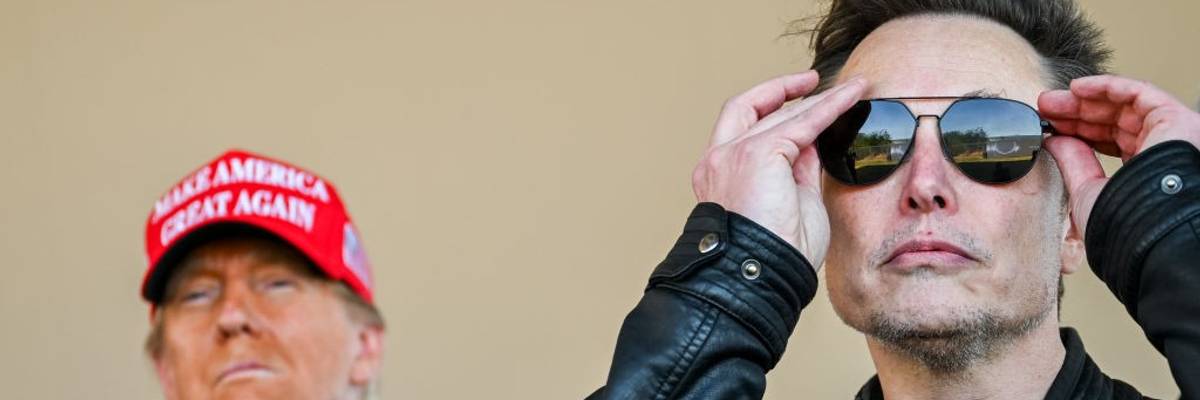
President-elect Donald Trump and Elon Musk watch the launch of the sixth test flight of the SpaceX Starship rocket on November 19, 2024 in Brownsville, Texas.
Morbidly rich people aspiring to power have always, throughout history, rationalized their ownership of politics and even other human beings by arguing that their riches prove their “fitness” to rule. History also shows what it looks like when the people fight back.
The idea is as old as western civilization: “The morbidly rich are born to rule the rest of us.”
And now, with a billionaire as president, 13 billionaires in his cabinet, and rightwing billionaires installing and spiffing Republican Supreme Court justices, it’s become the operational assumption of the GOP.
Older societies used religion to rationalize it, from the “divine right of kings” to Confederate plantation owners invoking Bible verses (both Old and New Testament) to justify oligarchy and slavery.
The scientific revolution era from Edison to Einstein shifted the explanation from “God wills that the rich should rule” to “rich people have superior genes and should therefore be in charge of everything.” Herbert Spenser, who coined the phrase “survival of the fittest” in the late 19th century, explicitly argued against any laws or social reforms that would help the poor, as this would interfere with the “natural” process of eliminating the “unfit.” Today’s GOP continues to embrace this worldview.
Scientist (and Darwin’s cousin) Francis Galton invented the word “eugenics,” arguing that “superior” humans should rule society while “inferior” ones shouldn’t be allowed to reproduce. His eugenics theories were embraced by both US President Woodrow Wilson and British Prime Minister Winston Churchill, the Honorary Vice President of the British Eugenics Society, and became the foundation of the Nazi-led Holocaust.
(It’s worth noting that Darwin, rather than embracing “survival of the fittest,” promoted the idea of cooperation in nature, as my old friend David Loye repeatedly pointed out in his books and lectures.)
Next came the now-discredited Libertarian experiment that animated the Reagan Revolution; it was initiated by Milton Friedman and Ayn Rand and argued that the rich should not only rule but should also be given maximal tax cuts and deregulation of their businesses, so the benefits would “trickle down” to the rest of society.
Finally, today, apologists for the rich are also trying to use philosophy and psychology to justify their holding power in America by attacking “socialism” and the human emotion of empathy that powers it. Billionaire Elon Musk has pinned to the top of his social media account:
“Either the suicidal empathy of Western civilization ends or Western civilization will end.”
The “Dark Enlightenment” that’s the current fad among tech billionaires and the GOP (particularly JD Vance) rebrands hierarchy as inevitability, inequality as virtue, and authoritarianism as efficiency, with their writings wrapped in tech-bro futurism and pseudo-scientific gibberish. Its leading philosophers are explicit:
“Democracy is a pathetic belief in the collective wisdom of individual ignorance.” “Democracy is mob rule. It is the idea that legitimacy comes from numbers rather than competence.” “The best form of government is a monarchy run like a joint-stock corporation, where the ruler owns the state.” “A stable society requires a clear distinction between those who rule and those who are ruled.” — Curtis Yarvin
“Democracy is the political expression of herd morality.” “Selection pressures do not care about fairness.” “The history of life is not the triumph of the weak, but the relentless victory of the strong.” “Compassion is a luxury belief that only stable systems can afford.” — Nick Land
Morbidly rich people aspiring to power have always, throughout history, rationalized their ownership of politics and even other human beings by arguing that their riches prove their “fitness” to rule. It’s why the DuPont brothers and other industrialists tried to kidnap and overthrow FDR back in the 1930s, is the rationalization of every dictator in today’s world, and why so many American billionaires agree with tech billionaire Peter Theil’s assertion:
“I no longer believe that freedom and democracy are compatible.”
They argue, as Yarvin said, that democracy is just another word for “mob rule,” that a nation needs a “strong leader” to overcome the impulses of the mob, and that the more democratic a nation becomes the more likely the mob is to vote themselves the wealth of the rich and use the power of the state to appropriate it through taxation.
All of this is antithetical to the core beliefs on which this country was founded, taken out of the actual period of the Enlightenment, that the larger the group making decisions the better those decisions are likely to be. This assertion of democracy as a good thing and a necessary predicate for freedom, was the foundation for our Constitution.
As I document in my book, The Hidden History of American Democracy: Recovering Humanity’s Ancient Way of Living, democracy is the default system for nearly every species of animal and the historic majority of human societies prior to the so-called Agricultural Revolution. And America’s Founders believed it.
Democracy doesn’t rule out leadership or hierarchies of wealth or power. Rather, it specifies that the power determining how those hierarchies are formed, maintained, and determined — who’s in charge, in other words — comes from, as Thomas Jefferson wrote in the Declaration of Independence, “the consent of the governed.”
And we get there through voting.
This use of voting-based democracy to establish and maintain the resilience — the survival potential — of a group, tribe, nation, or even animal species is so universal that it’s not limited to human beings.
In the Declaration of Independence’s first paragraph, for example, Jefferson wrote that “the laws of nature and of nature’s God” compelled America’s Founders to reject British oligarchy and embrace democracy.
As I discovered when researching my book, Jefferson and Ben Franklin in particular believed after decades of experience working with Native American tribes that those rules of nature are as universal to humans as they are to all other animals on earth.
But were they right? Is nature actually democratic?
Biologists Tim Roper and L. Conradt at the School of Biological Sciences, University of Sussex, England, studied this issue in animals.
We’ve always assumed that the alpha or leader animal of the herd or group makes the decisions, and the others follow, like human kings and queens of old or billionaires running their social media sites, newspapers, and TV networks. The leader knows best, they believe: he or she is prepared for that genetically by generations of Darwinian natural selection, or ordained by an omnipotent sky god.
But it turns out that there’s a system for voting among animals, from honeybees to primates, and we’ve just never noticed it because we weren’t looking for it.
“Many authors have assumed despotism without testing [for democracy],” Roper and Conradt noted in Nature, “because the feasibility of democracy, which requires the ability to vote and to count votes, is not immediately obvious in non-humans.”
Stepping into this vacuum of knowledge, the two scientists decided to create a testable model that “compares the synchronization costs of despotic and democratic groups.”
Contradicting Yarvin, Musk, and JD Vance, they and their research group discovered that when a single leader (what they call a despot) or a small group of leaders (the animal equivalent of an oligarchy) make the choices, the swings into extremes of behavior tend to be greater and more dangerous to the long-term survival of the group.
Wrong decisions, they hypothesized, would be made often enough to put the survival of the group at risk because in a despotic model the overall needs of the entire group are measured only through the lens of the leader’s needs.
With democratic decision-making, however, the overall knowledge and wisdom of the entire group, as well as the needs of the entire group, come into play. The outcome is less likely to harm anybody, and the group’s probability of survival is enhanced.
“Democratic decisions are more beneficial primarily because they tend to produce less extreme decisions,” they note in the abstract to their paper.
Britain’s leading mass-circulation science journal, New Scientist, looked at how Conradt and Roper’s model actually played out in the natural world. They examined the behavior of a herd of red deer, which are social animals with alpha “leaders.”
What they found was startling: Red deer always behave democratically. When more than half the animals were pointing their bodies at a particular water hole, for example, the entire group would then move in that direction.
“In the case of real red deer,” James Randerson noted, “the animals do indeed vote with their feet by standing up. Likewise, with groups of African buffalo, individuals decide where to go by pointing in their preferred direction. The group takes the average and heads that way.”
This explains in part the “flock,” “swarm” and “school” nature of birds, gnats, and fish.
With each wingbeat or fin motion, each member is “voting” for the direction the flock, swarm, or school should move; when the 51% threshold is hit, the entire group moves as if telepathically synchronized.
Dr. Tim Roper told me:
“Quite a lot of people have said, ‘My gorillas do that, or my animals do that.’ On an informal, anecdotal basis it [the article] seems to have triggered an, ‘Oh, yes, that’s quite true’ reaction in field workers.”
I asked him if his theory that animals — and, by inference, humans in their “natural state” — operating democratically contradicted Darwin.
He was emphatic:
“I don’t think it is [at variance with Darwin]. … So the point about this model is that democratic decision-making is best for all the individuals in the group, as opposed to following a leader, a dominant individual. So we see it as an individual selection model, and so it’s not incompatible with Darwin at all.“
Franklin and Jefferson were right. Democracy, it turns out, is the norm in nature’s god’s animal kingdom, for the simple reason that it confers the greatest likelihood the group will survive and prosper.
When democracies begin to drift away from this fundamental principle, and those who have accumulated wealth and the political power typically associated with it acquire the ability to influence or even control the rule-making process, democracy begins to fail. It becomes rigid and fragile.
When this process becomes advanced, democracies typically morph first into oligarchies (where we largely are now because five corrupt Republicans on the Supreme Court legalized political bribery in Citizens United) and then Orbán-like dictatorships (where Trump, Vance, and the other wannabee autocrats in the GOP are trying to take us).
It’s why the billionaires supporting Trump and the GOP embrace the lie of election fraud to justify gerrymandering and voter suppression, why the monarchists on the Supreme Court are supporting these apologetics for an imperial presidency and racial profiling, and why Republican politicians refuse to do anything about the plague of dark money corrupting our political system.
This wasn’t the philosophy of our Founders and Framers, none of whom considered themselves rich. They knew that we’re not a species evolved to be hoarders; we evolved to be sharers. That’s what is in our DNA: to share both wealth and power with others. To depend on others and have them depend on us, and to be reliable in that dependence.
As Jefferson, who died in bankruptcy, famously noted:
“I am not among those who fear the people. They, and not the rich, are our dependence for continued freedom.”
In eleven months, we’ll have an opportunity to retrieve our democracy from the clutches of the morbidly rich, the ideologues who deify them (and have for millennia), and their bought-and-paid-for politicians.
Get ready, double-check your voter registration, join and support organizations speaking out for democracy, and spread the good word as far and wide as you can. This may be America’s last chance.
Dear Common Dreams reader, It’s been nearly 30 years since I co-founded Common Dreams with my late wife, Lina Newhouser. We had the radical notion that journalism should serve the public good, not corporate profits. It was clear to us from the outset what it would take to build such a project. No paid advertisements. No corporate sponsors. No millionaire publisher telling us what to think or do. Many people said we wouldn't last a year, but we proved those doubters wrong. Together with a tremendous team of journalists and dedicated staff, we built an independent media outlet free from the constraints of profits and corporate control. Our mission has always been simple: To inform. To inspire. To ignite change for the common good. Building Common Dreams was not easy. Our survival was never guaranteed. When you take on the most powerful forces—Wall Street greed, fossil fuel industry destruction, Big Tech lobbyists, and uber-rich oligarchs who have spent billions upon billions rigging the economy and democracy in their favor—the only bulwark you have is supporters who believe in your work. But here’s the urgent message from me today. It's never been this bad out there. And it's never been this hard to keep us going. At the very moment Common Dreams is most needed, the threats we face are intensifying. We need your support now more than ever. We don't accept corporate advertising and never will. We don't have a paywall because we don't think people should be blocked from critical news based on their ability to pay. Everything we do is funded by the donations of readers like you. When everyone does the little they can afford, we are strong. But if that support retreats or dries up, so do we. Will you donate now to make sure Common Dreams not only survives but thrives? —Craig Brown, Co-founder |
The idea is as old as western civilization: “The morbidly rich are born to rule the rest of us.”
And now, with a billionaire as president, 13 billionaires in his cabinet, and rightwing billionaires installing and spiffing Republican Supreme Court justices, it’s become the operational assumption of the GOP.
Older societies used religion to rationalize it, from the “divine right of kings” to Confederate plantation owners invoking Bible verses (both Old and New Testament) to justify oligarchy and slavery.
The scientific revolution era from Edison to Einstein shifted the explanation from “God wills that the rich should rule” to “rich people have superior genes and should therefore be in charge of everything.” Herbert Spenser, who coined the phrase “survival of the fittest” in the late 19th century, explicitly argued against any laws or social reforms that would help the poor, as this would interfere with the “natural” process of eliminating the “unfit.” Today’s GOP continues to embrace this worldview.
Scientist (and Darwin’s cousin) Francis Galton invented the word “eugenics,” arguing that “superior” humans should rule society while “inferior” ones shouldn’t be allowed to reproduce. His eugenics theories were embraced by both US President Woodrow Wilson and British Prime Minister Winston Churchill, the Honorary Vice President of the British Eugenics Society, and became the foundation of the Nazi-led Holocaust.
(It’s worth noting that Darwin, rather than embracing “survival of the fittest,” promoted the idea of cooperation in nature, as my old friend David Loye repeatedly pointed out in his books and lectures.)
Next came the now-discredited Libertarian experiment that animated the Reagan Revolution; it was initiated by Milton Friedman and Ayn Rand and argued that the rich should not only rule but should also be given maximal tax cuts and deregulation of their businesses, so the benefits would “trickle down” to the rest of society.
Finally, today, apologists for the rich are also trying to use philosophy and psychology to justify their holding power in America by attacking “socialism” and the human emotion of empathy that powers it. Billionaire Elon Musk has pinned to the top of his social media account:
“Either the suicidal empathy of Western civilization ends or Western civilization will end.”
The “Dark Enlightenment” that’s the current fad among tech billionaires and the GOP (particularly JD Vance) rebrands hierarchy as inevitability, inequality as virtue, and authoritarianism as efficiency, with their writings wrapped in tech-bro futurism and pseudo-scientific gibberish. Its leading philosophers are explicit:
“Democracy is a pathetic belief in the collective wisdom of individual ignorance.” “Democracy is mob rule. It is the idea that legitimacy comes from numbers rather than competence.” “The best form of government is a monarchy run like a joint-stock corporation, where the ruler owns the state.” “A stable society requires a clear distinction between those who rule and those who are ruled.” — Curtis Yarvin
“Democracy is the political expression of herd morality.” “Selection pressures do not care about fairness.” “The history of life is not the triumph of the weak, but the relentless victory of the strong.” “Compassion is a luxury belief that only stable systems can afford.” — Nick Land
Morbidly rich people aspiring to power have always, throughout history, rationalized their ownership of politics and even other human beings by arguing that their riches prove their “fitness” to rule. It’s why the DuPont brothers and other industrialists tried to kidnap and overthrow FDR back in the 1930s, is the rationalization of every dictator in today’s world, and why so many American billionaires agree with tech billionaire Peter Theil’s assertion:
“I no longer believe that freedom and democracy are compatible.”
They argue, as Yarvin said, that democracy is just another word for “mob rule,” that a nation needs a “strong leader” to overcome the impulses of the mob, and that the more democratic a nation becomes the more likely the mob is to vote themselves the wealth of the rich and use the power of the state to appropriate it through taxation.
All of this is antithetical to the core beliefs on which this country was founded, taken out of the actual period of the Enlightenment, that the larger the group making decisions the better those decisions are likely to be. This assertion of democracy as a good thing and a necessary predicate for freedom, was the foundation for our Constitution.
As I document in my book, The Hidden History of American Democracy: Recovering Humanity’s Ancient Way of Living, democracy is the default system for nearly every species of animal and the historic majority of human societies prior to the so-called Agricultural Revolution. And America’s Founders believed it.
Democracy doesn’t rule out leadership or hierarchies of wealth or power. Rather, it specifies that the power determining how those hierarchies are formed, maintained, and determined — who’s in charge, in other words — comes from, as Thomas Jefferson wrote in the Declaration of Independence, “the consent of the governed.”
And we get there through voting.
This use of voting-based democracy to establish and maintain the resilience — the survival potential — of a group, tribe, nation, or even animal species is so universal that it’s not limited to human beings.
In the Declaration of Independence’s first paragraph, for example, Jefferson wrote that “the laws of nature and of nature’s God” compelled America’s Founders to reject British oligarchy and embrace democracy.
As I discovered when researching my book, Jefferson and Ben Franklin in particular believed after decades of experience working with Native American tribes that those rules of nature are as universal to humans as they are to all other animals on earth.
But were they right? Is nature actually democratic?
Biologists Tim Roper and L. Conradt at the School of Biological Sciences, University of Sussex, England, studied this issue in animals.
We’ve always assumed that the alpha or leader animal of the herd or group makes the decisions, and the others follow, like human kings and queens of old or billionaires running their social media sites, newspapers, and TV networks. The leader knows best, they believe: he or she is prepared for that genetically by generations of Darwinian natural selection, or ordained by an omnipotent sky god.
But it turns out that there’s a system for voting among animals, from honeybees to primates, and we’ve just never noticed it because we weren’t looking for it.
“Many authors have assumed despotism without testing [for democracy],” Roper and Conradt noted in Nature, “because the feasibility of democracy, which requires the ability to vote and to count votes, is not immediately obvious in non-humans.”
Stepping into this vacuum of knowledge, the two scientists decided to create a testable model that “compares the synchronization costs of despotic and democratic groups.”
Contradicting Yarvin, Musk, and JD Vance, they and their research group discovered that when a single leader (what they call a despot) or a small group of leaders (the animal equivalent of an oligarchy) make the choices, the swings into extremes of behavior tend to be greater and more dangerous to the long-term survival of the group.
Wrong decisions, they hypothesized, would be made often enough to put the survival of the group at risk because in a despotic model the overall needs of the entire group are measured only through the lens of the leader’s needs.
With democratic decision-making, however, the overall knowledge and wisdom of the entire group, as well as the needs of the entire group, come into play. The outcome is less likely to harm anybody, and the group’s probability of survival is enhanced.
“Democratic decisions are more beneficial primarily because they tend to produce less extreme decisions,” they note in the abstract to their paper.
Britain’s leading mass-circulation science journal, New Scientist, looked at how Conradt and Roper’s model actually played out in the natural world. They examined the behavior of a herd of red deer, which are social animals with alpha “leaders.”
What they found was startling: Red deer always behave democratically. When more than half the animals were pointing their bodies at a particular water hole, for example, the entire group would then move in that direction.
“In the case of real red deer,” James Randerson noted, “the animals do indeed vote with their feet by standing up. Likewise, with groups of African buffalo, individuals decide where to go by pointing in their preferred direction. The group takes the average and heads that way.”
This explains in part the “flock,” “swarm” and “school” nature of birds, gnats, and fish.
With each wingbeat or fin motion, each member is “voting” for the direction the flock, swarm, or school should move; when the 51% threshold is hit, the entire group moves as if telepathically synchronized.
Dr. Tim Roper told me:
“Quite a lot of people have said, ‘My gorillas do that, or my animals do that.’ On an informal, anecdotal basis it [the article] seems to have triggered an, ‘Oh, yes, that’s quite true’ reaction in field workers.”
I asked him if his theory that animals — and, by inference, humans in their “natural state” — operating democratically contradicted Darwin.
He was emphatic:
“I don’t think it is [at variance with Darwin]. … So the point about this model is that democratic decision-making is best for all the individuals in the group, as opposed to following a leader, a dominant individual. So we see it as an individual selection model, and so it’s not incompatible with Darwin at all.“
Franklin and Jefferson were right. Democracy, it turns out, is the norm in nature’s god’s animal kingdom, for the simple reason that it confers the greatest likelihood the group will survive and prosper.
When democracies begin to drift away from this fundamental principle, and those who have accumulated wealth and the political power typically associated with it acquire the ability to influence or even control the rule-making process, democracy begins to fail. It becomes rigid and fragile.
When this process becomes advanced, democracies typically morph first into oligarchies (where we largely are now because five corrupt Republicans on the Supreme Court legalized political bribery in Citizens United) and then Orbán-like dictatorships (where Trump, Vance, and the other wannabee autocrats in the GOP are trying to take us).
It’s why the billionaires supporting Trump and the GOP embrace the lie of election fraud to justify gerrymandering and voter suppression, why the monarchists on the Supreme Court are supporting these apologetics for an imperial presidency and racial profiling, and why Republican politicians refuse to do anything about the plague of dark money corrupting our political system.
This wasn’t the philosophy of our Founders and Framers, none of whom considered themselves rich. They knew that we’re not a species evolved to be hoarders; we evolved to be sharers. That’s what is in our DNA: to share both wealth and power with others. To depend on others and have them depend on us, and to be reliable in that dependence.
As Jefferson, who died in bankruptcy, famously noted:
“I am not among those who fear the people. They, and not the rich, are our dependence for continued freedom.”
In eleven months, we’ll have an opportunity to retrieve our democracy from the clutches of the morbidly rich, the ideologues who deify them (and have for millennia), and their bought-and-paid-for politicians.
Get ready, double-check your voter registration, join and support organizations speaking out for democracy, and spread the good word as far and wide as you can. This may be America’s last chance.
The idea is as old as western civilization: “The morbidly rich are born to rule the rest of us.”
And now, with a billionaire as president, 13 billionaires in his cabinet, and rightwing billionaires installing and spiffing Republican Supreme Court justices, it’s become the operational assumption of the GOP.
Older societies used religion to rationalize it, from the “divine right of kings” to Confederate plantation owners invoking Bible verses (both Old and New Testament) to justify oligarchy and slavery.
The scientific revolution era from Edison to Einstein shifted the explanation from “God wills that the rich should rule” to “rich people have superior genes and should therefore be in charge of everything.” Herbert Spenser, who coined the phrase “survival of the fittest” in the late 19th century, explicitly argued against any laws or social reforms that would help the poor, as this would interfere with the “natural” process of eliminating the “unfit.” Today’s GOP continues to embrace this worldview.
Scientist (and Darwin’s cousin) Francis Galton invented the word “eugenics,” arguing that “superior” humans should rule society while “inferior” ones shouldn’t be allowed to reproduce. His eugenics theories were embraced by both US President Woodrow Wilson and British Prime Minister Winston Churchill, the Honorary Vice President of the British Eugenics Society, and became the foundation of the Nazi-led Holocaust.
(It’s worth noting that Darwin, rather than embracing “survival of the fittest,” promoted the idea of cooperation in nature, as my old friend David Loye repeatedly pointed out in his books and lectures.)
Next came the now-discredited Libertarian experiment that animated the Reagan Revolution; it was initiated by Milton Friedman and Ayn Rand and argued that the rich should not only rule but should also be given maximal tax cuts and deregulation of their businesses, so the benefits would “trickle down” to the rest of society.
Finally, today, apologists for the rich are also trying to use philosophy and psychology to justify their holding power in America by attacking “socialism” and the human emotion of empathy that powers it. Billionaire Elon Musk has pinned to the top of his social media account:
“Either the suicidal empathy of Western civilization ends or Western civilization will end.”
The “Dark Enlightenment” that’s the current fad among tech billionaires and the GOP (particularly JD Vance) rebrands hierarchy as inevitability, inequality as virtue, and authoritarianism as efficiency, with their writings wrapped in tech-bro futurism and pseudo-scientific gibberish. Its leading philosophers are explicit:
“Democracy is a pathetic belief in the collective wisdom of individual ignorance.” “Democracy is mob rule. It is the idea that legitimacy comes from numbers rather than competence.” “The best form of government is a monarchy run like a joint-stock corporation, where the ruler owns the state.” “A stable society requires a clear distinction between those who rule and those who are ruled.” — Curtis Yarvin
“Democracy is the political expression of herd morality.” “Selection pressures do not care about fairness.” “The history of life is not the triumph of the weak, but the relentless victory of the strong.” “Compassion is a luxury belief that only stable systems can afford.” — Nick Land
Morbidly rich people aspiring to power have always, throughout history, rationalized their ownership of politics and even other human beings by arguing that their riches prove their “fitness” to rule. It’s why the DuPont brothers and other industrialists tried to kidnap and overthrow FDR back in the 1930s, is the rationalization of every dictator in today’s world, and why so many American billionaires agree with tech billionaire Peter Theil’s assertion:
“I no longer believe that freedom and democracy are compatible.”
They argue, as Yarvin said, that democracy is just another word for “mob rule,” that a nation needs a “strong leader” to overcome the impulses of the mob, and that the more democratic a nation becomes the more likely the mob is to vote themselves the wealth of the rich and use the power of the state to appropriate it through taxation.
All of this is antithetical to the core beliefs on which this country was founded, taken out of the actual period of the Enlightenment, that the larger the group making decisions the better those decisions are likely to be. This assertion of democracy as a good thing and a necessary predicate for freedom, was the foundation for our Constitution.
As I document in my book, The Hidden History of American Democracy: Recovering Humanity’s Ancient Way of Living, democracy is the default system for nearly every species of animal and the historic majority of human societies prior to the so-called Agricultural Revolution. And America’s Founders believed it.
Democracy doesn’t rule out leadership or hierarchies of wealth or power. Rather, it specifies that the power determining how those hierarchies are formed, maintained, and determined — who’s in charge, in other words — comes from, as Thomas Jefferson wrote in the Declaration of Independence, “the consent of the governed.”
And we get there through voting.
This use of voting-based democracy to establish and maintain the resilience — the survival potential — of a group, tribe, nation, or even animal species is so universal that it’s not limited to human beings.
In the Declaration of Independence’s first paragraph, for example, Jefferson wrote that “the laws of nature and of nature’s God” compelled America’s Founders to reject British oligarchy and embrace democracy.
As I discovered when researching my book, Jefferson and Ben Franklin in particular believed after decades of experience working with Native American tribes that those rules of nature are as universal to humans as they are to all other animals on earth.
But were they right? Is nature actually democratic?
Biologists Tim Roper and L. Conradt at the School of Biological Sciences, University of Sussex, England, studied this issue in animals.
We’ve always assumed that the alpha or leader animal of the herd or group makes the decisions, and the others follow, like human kings and queens of old or billionaires running their social media sites, newspapers, and TV networks. The leader knows best, they believe: he or she is prepared for that genetically by generations of Darwinian natural selection, or ordained by an omnipotent sky god.
But it turns out that there’s a system for voting among animals, from honeybees to primates, and we’ve just never noticed it because we weren’t looking for it.
“Many authors have assumed despotism without testing [for democracy],” Roper and Conradt noted in Nature, “because the feasibility of democracy, which requires the ability to vote and to count votes, is not immediately obvious in non-humans.”
Stepping into this vacuum of knowledge, the two scientists decided to create a testable model that “compares the synchronization costs of despotic and democratic groups.”
Contradicting Yarvin, Musk, and JD Vance, they and their research group discovered that when a single leader (what they call a despot) or a small group of leaders (the animal equivalent of an oligarchy) make the choices, the swings into extremes of behavior tend to be greater and more dangerous to the long-term survival of the group.
Wrong decisions, they hypothesized, would be made often enough to put the survival of the group at risk because in a despotic model the overall needs of the entire group are measured only through the lens of the leader’s needs.
With democratic decision-making, however, the overall knowledge and wisdom of the entire group, as well as the needs of the entire group, come into play. The outcome is less likely to harm anybody, and the group’s probability of survival is enhanced.
“Democratic decisions are more beneficial primarily because they tend to produce less extreme decisions,” they note in the abstract to their paper.
Britain’s leading mass-circulation science journal, New Scientist, looked at how Conradt and Roper’s model actually played out in the natural world. They examined the behavior of a herd of red deer, which are social animals with alpha “leaders.”
What they found was startling: Red deer always behave democratically. When more than half the animals were pointing their bodies at a particular water hole, for example, the entire group would then move in that direction.
“In the case of real red deer,” James Randerson noted, “the animals do indeed vote with their feet by standing up. Likewise, with groups of African buffalo, individuals decide where to go by pointing in their preferred direction. The group takes the average and heads that way.”
This explains in part the “flock,” “swarm” and “school” nature of birds, gnats, and fish.
With each wingbeat or fin motion, each member is “voting” for the direction the flock, swarm, or school should move; when the 51% threshold is hit, the entire group moves as if telepathically synchronized.
Dr. Tim Roper told me:
“Quite a lot of people have said, ‘My gorillas do that, or my animals do that.’ On an informal, anecdotal basis it [the article] seems to have triggered an, ‘Oh, yes, that’s quite true’ reaction in field workers.”
I asked him if his theory that animals — and, by inference, humans in their “natural state” — operating democratically contradicted Darwin.
He was emphatic:
“I don’t think it is [at variance with Darwin]. … So the point about this model is that democratic decision-making is best for all the individuals in the group, as opposed to following a leader, a dominant individual. So we see it as an individual selection model, and so it’s not incompatible with Darwin at all.“
Franklin and Jefferson were right. Democracy, it turns out, is the norm in nature’s god’s animal kingdom, for the simple reason that it confers the greatest likelihood the group will survive and prosper.
When democracies begin to drift away from this fundamental principle, and those who have accumulated wealth and the political power typically associated with it acquire the ability to influence or even control the rule-making process, democracy begins to fail. It becomes rigid and fragile.
When this process becomes advanced, democracies typically morph first into oligarchies (where we largely are now because five corrupt Republicans on the Supreme Court legalized political bribery in Citizens United) and then Orbán-like dictatorships (where Trump, Vance, and the other wannabee autocrats in the GOP are trying to take us).
It’s why the billionaires supporting Trump and the GOP embrace the lie of election fraud to justify gerrymandering and voter suppression, why the monarchists on the Supreme Court are supporting these apologetics for an imperial presidency and racial profiling, and why Republican politicians refuse to do anything about the plague of dark money corrupting our political system.
This wasn’t the philosophy of our Founders and Framers, none of whom considered themselves rich. They knew that we’re not a species evolved to be hoarders; we evolved to be sharers. That’s what is in our DNA: to share both wealth and power with others. To depend on others and have them depend on us, and to be reliable in that dependence.
As Jefferson, who died in bankruptcy, famously noted:
“I am not among those who fear the people. They, and not the rich, are our dependence for continued freedom.”
In eleven months, we’ll have an opportunity to retrieve our democracy from the clutches of the morbidly rich, the ideologues who deify them (and have for millennia), and their bought-and-paid-for politicians.
Get ready, double-check your voter registration, join and support organizations speaking out for democracy, and spread the good word as far and wide as you can. This may be America’s last chance.

