SUBSCRIBE TO OUR FREE NEWSLETTER
Daily news & progressive opinion—funded by the people, not the corporations—delivered straight to your inbox.
5
#000000
#FFFFFF
To donate by check, phone, or other method, see our More Ways to Give page.
Daily news & progressive opinion—funded by the people, not the corporations—delivered straight to your inbox.
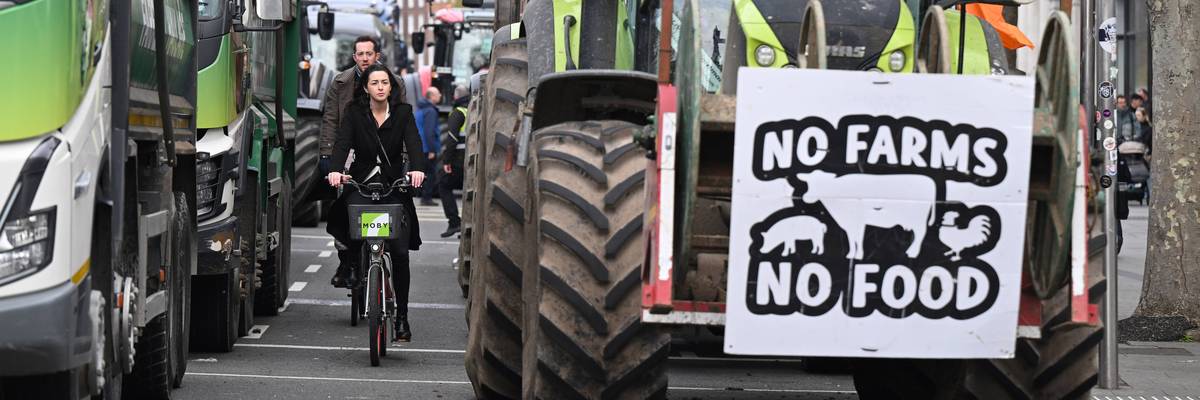
Members of the public make their way past trucks and tractors as fuel protesters block O'Connell street on April 11, 2026 in Dublin, Ireland.
The demonstrations in Ireland still show how small-scale protests driven by economic malaise can get national attention and prompt change.
Can anything make farmers turn away from President Donald Trump?
How right-wing populism has gripped rural areas, especially among farmers, is evidenced by the results from the past few presidential elections.
Still, critical challenges are emerging for key constituencies in Trump's base, principally due to the damage that the Iran War is doing in the countryside. Similar conditions pushed Irish farmers to the streets in early April, causing a change among political leadership shortly after, and also helping producers receive some much-needed relief.
That Irish farmers took to the streets shouldn't surprise folks. Earlier this year in January, some of them were also demonstrating, but against the EU-Mercosur trade deal. Not too long ago in 2024, their counterparts across the English Channel throughout many European countries staged weeks of actions to protest free trade deals and excessive bureaucratic regulations. Outside of Europe, in Mexico beginning in 2025 and continuing into 2026, farmers, for many of the same reasons, are blocking roads to demand government intervention to address falling prices for their produce.
The Iran War is placing unnecessary stress on farmers and most other working people. Such conditions are similar to those in Ireland, which led farmers to find common cause with others.
Taking a quick glance at these recent protests taking place around the world, farmers in the United States seem to be asleep at the wheel as producers in many other countries are taking control by challenging their governments and calling for economic justice.
It is not the case that farmers in the US are living large.
In 2025, farm bankruptcies rose by 46% compared with 2024. In 2026, even though there appears to be some movement in a positive direction concerning prices for corn and soy farmers, the jump in what they have to pay for fuel and fertilizer caused by how the Iran War devastates global supply chains is eating into their profits.
Making matters worse, the fertilizer industry is heavily concentrated. A standard metric for measuring concentration—the four-firm concentration ratio (CR4)—shows that the leading four companies in fertilizer markets control about 75% of sales. When that figure is above 40% within a certain industry, according to researchers, then illegal practices such as price-fixing become endemic and consumers pay more than they should at the register. Put simply, the negative economic impacts from the Iran War are compounded by an industry looking for excuses to further jack up prices.
Meanwhile, the current version of the Farm Bill in Congress woefully fails to meet the needs of a farm economy facing crisis.
First, pricing policy to support farmers was decided last year in the One Big Beautiful Bill (OBBB) when the surge in input prices was not on the political radar. Adding insult to injury for our food and farm system, the OBBB also cut food assistance support and climate change initiatives. Speaking to problems farmers are facing, nowhere in the current Farm Bill do we find any discussion of taking on corporate power. Investing in transitioning farms to small-scale, young producers is also mainly an afterthought in the legislation. How hundreds of agribusiness commodity groups support the current version of the legislation, while as many small-scale producer-led groups have voiced opposition, is testament to the fact that our farm policy is about propping up export markets instead of feeding Americans and creating resilient systems.
Trump’s billion-dollar handout to large-scale, mainly high-income farmers at the start of the Iran conflict shows an administration not concerned with sustaining our food system, but with padding the pockets of rich elite allies.
Farmers in Ireland faced similar challenges and felt that they had no choice but to go to the streets. Their actions, drawing comparisons to France’s yellow vests movement, also boasted no clear leaders. In locally organized, spontaneous actions, groups from April 7 to 14 mobilized by blockading strategic oil refineries as well as slowing down traffic on key streets and highways.
Their mobilizations bore some fruit. First, they managed to secure a short-term relief package in the form of direct payments to offset rising fuel costs. Politically, they also caused some political shifts, driving leaders to leave the governing coalition in opposition to how the farmers were treated. While short of generating long-lasting structural change, the demonstrations in Ireland still show how small-scale protests driven by economic malaise can get national attention and prompt change.
Perhaps more importantly for US farmers is how the Irish managed to overcome their relative isolation in society and mobilize with others. Particularly, Irish producers brought truckers to their side, which aided with their efforts at creating roadblocks and slowdowns. Their interests also were aligned, as truckers also have been negatively impacted by rising fuel prices.
With a Farm Bill widely maligned working its way through Congress, legislators have apparently decided to forget about making meaningful changes to our food and farm system. Meanwhile, the Iran War is placing unnecessary stress on farmers and most other working people. Such conditions are similar to those in Ireland, which led farmers to find common cause with others. Now is as good as any other for their counterparts in the US to say enough is enough and denounce a rigged economy that benefits the few at the expense of the many.
Dear Common Dreams reader, It’s been nearly 30 years since I co-founded Common Dreams with my late wife, Lina Newhouser. We had the radical notion that journalism should serve the public good, not corporate profits. It was clear to us from the outset what it would take to build such a project. No paid advertisements. No corporate sponsors. No millionaire publisher telling us what to think or do. Many people said we wouldn't last a year, but we proved those doubters wrong. Together with a tremendous team of journalists and dedicated staff, we built an independent media outlet free from the constraints of profits and corporate control. Our mission has always been simple: To inform. To inspire. To ignite change for the common good. Building Common Dreams was not easy. Our survival was never guaranteed. When you take on the most powerful forces—Wall Street greed, fossil fuel industry destruction, Big Tech lobbyists, and uber-rich oligarchs who have spent billions upon billions rigging the economy and democracy in their favor—the only bulwark you have is supporters who believe in your work. But here’s the urgent message from me today. It's never been this bad out there. And it's never been this hard to keep us going. At the very moment Common Dreams is most needed, the threats we face are intensifying. We need your support now more than ever. We don't accept corporate advertising and never will. We don't have a paywall because we don't think people should be blocked from critical news based on their ability to pay. Everything we do is funded by the donations of readers like you. When everyone does the little they can afford, we are strong. But if that support retreats or dries up, so do we. Will you donate now to make sure Common Dreams not only survives but thrives? —Craig Brown, Co-founder |
Can anything make farmers turn away from President Donald Trump?
How right-wing populism has gripped rural areas, especially among farmers, is evidenced by the results from the past few presidential elections.
Still, critical challenges are emerging for key constituencies in Trump's base, principally due to the damage that the Iran War is doing in the countryside. Similar conditions pushed Irish farmers to the streets in early April, causing a change among political leadership shortly after, and also helping producers receive some much-needed relief.
That Irish farmers took to the streets shouldn't surprise folks. Earlier this year in January, some of them were also demonstrating, but against the EU-Mercosur trade deal. Not too long ago in 2024, their counterparts across the English Channel throughout many European countries staged weeks of actions to protest free trade deals and excessive bureaucratic regulations. Outside of Europe, in Mexico beginning in 2025 and continuing into 2026, farmers, for many of the same reasons, are blocking roads to demand government intervention to address falling prices for their produce.
The Iran War is placing unnecessary stress on farmers and most other working people. Such conditions are similar to those in Ireland, which led farmers to find common cause with others.
Taking a quick glance at these recent protests taking place around the world, farmers in the United States seem to be asleep at the wheel as producers in many other countries are taking control by challenging their governments and calling for economic justice.
It is not the case that farmers in the US are living large.
In 2025, farm bankruptcies rose by 46% compared with 2024. In 2026, even though there appears to be some movement in a positive direction concerning prices for corn and soy farmers, the jump in what they have to pay for fuel and fertilizer caused by how the Iran War devastates global supply chains is eating into their profits.
Making matters worse, the fertilizer industry is heavily concentrated. A standard metric for measuring concentration—the four-firm concentration ratio (CR4)—shows that the leading four companies in fertilizer markets control about 75% of sales. When that figure is above 40% within a certain industry, according to researchers, then illegal practices such as price-fixing become endemic and consumers pay more than they should at the register. Put simply, the negative economic impacts from the Iran War are compounded by an industry looking for excuses to further jack up prices.
Meanwhile, the current version of the Farm Bill in Congress woefully fails to meet the needs of a farm economy facing crisis.
First, pricing policy to support farmers was decided last year in the One Big Beautiful Bill (OBBB) when the surge in input prices was not on the political radar. Adding insult to injury for our food and farm system, the OBBB also cut food assistance support and climate change initiatives. Speaking to problems farmers are facing, nowhere in the current Farm Bill do we find any discussion of taking on corporate power. Investing in transitioning farms to small-scale, young producers is also mainly an afterthought in the legislation. How hundreds of agribusiness commodity groups support the current version of the legislation, while as many small-scale producer-led groups have voiced opposition, is testament to the fact that our farm policy is about propping up export markets instead of feeding Americans and creating resilient systems.
Trump’s billion-dollar handout to large-scale, mainly high-income farmers at the start of the Iran conflict shows an administration not concerned with sustaining our food system, but with padding the pockets of rich elite allies.
Farmers in Ireland faced similar challenges and felt that they had no choice but to go to the streets. Their actions, drawing comparisons to France’s yellow vests movement, also boasted no clear leaders. In locally organized, spontaneous actions, groups from April 7 to 14 mobilized by blockading strategic oil refineries as well as slowing down traffic on key streets and highways.
Their mobilizations bore some fruit. First, they managed to secure a short-term relief package in the form of direct payments to offset rising fuel costs. Politically, they also caused some political shifts, driving leaders to leave the governing coalition in opposition to how the farmers were treated. While short of generating long-lasting structural change, the demonstrations in Ireland still show how small-scale protests driven by economic malaise can get national attention and prompt change.
Perhaps more importantly for US farmers is how the Irish managed to overcome their relative isolation in society and mobilize with others. Particularly, Irish producers brought truckers to their side, which aided with their efforts at creating roadblocks and slowdowns. Their interests also were aligned, as truckers also have been negatively impacted by rising fuel prices.
With a Farm Bill widely maligned working its way through Congress, legislators have apparently decided to forget about making meaningful changes to our food and farm system. Meanwhile, the Iran War is placing unnecessary stress on farmers and most other working people. Such conditions are similar to those in Ireland, which led farmers to find common cause with others. Now is as good as any other for their counterparts in the US to say enough is enough and denounce a rigged economy that benefits the few at the expense of the many.
Can anything make farmers turn away from President Donald Trump?
How right-wing populism has gripped rural areas, especially among farmers, is evidenced by the results from the past few presidential elections.
Still, critical challenges are emerging for key constituencies in Trump's base, principally due to the damage that the Iran War is doing in the countryside. Similar conditions pushed Irish farmers to the streets in early April, causing a change among political leadership shortly after, and also helping producers receive some much-needed relief.
That Irish farmers took to the streets shouldn't surprise folks. Earlier this year in January, some of them were also demonstrating, but against the EU-Mercosur trade deal. Not too long ago in 2024, their counterparts across the English Channel throughout many European countries staged weeks of actions to protest free trade deals and excessive bureaucratic regulations. Outside of Europe, in Mexico beginning in 2025 and continuing into 2026, farmers, for many of the same reasons, are blocking roads to demand government intervention to address falling prices for their produce.
The Iran War is placing unnecessary stress on farmers and most other working people. Such conditions are similar to those in Ireland, which led farmers to find common cause with others.
Taking a quick glance at these recent protests taking place around the world, farmers in the United States seem to be asleep at the wheel as producers in many other countries are taking control by challenging their governments and calling for economic justice.
It is not the case that farmers in the US are living large.
In 2025, farm bankruptcies rose by 46% compared with 2024. In 2026, even though there appears to be some movement in a positive direction concerning prices for corn and soy farmers, the jump in what they have to pay for fuel and fertilizer caused by how the Iran War devastates global supply chains is eating into their profits.
Making matters worse, the fertilizer industry is heavily concentrated. A standard metric for measuring concentration—the four-firm concentration ratio (CR4)—shows that the leading four companies in fertilizer markets control about 75% of sales. When that figure is above 40% within a certain industry, according to researchers, then illegal practices such as price-fixing become endemic and consumers pay more than they should at the register. Put simply, the negative economic impacts from the Iran War are compounded by an industry looking for excuses to further jack up prices.
Meanwhile, the current version of the Farm Bill in Congress woefully fails to meet the needs of a farm economy facing crisis.
First, pricing policy to support farmers was decided last year in the One Big Beautiful Bill (OBBB) when the surge in input prices was not on the political radar. Adding insult to injury for our food and farm system, the OBBB also cut food assistance support and climate change initiatives. Speaking to problems farmers are facing, nowhere in the current Farm Bill do we find any discussion of taking on corporate power. Investing in transitioning farms to small-scale, young producers is also mainly an afterthought in the legislation. How hundreds of agribusiness commodity groups support the current version of the legislation, while as many small-scale producer-led groups have voiced opposition, is testament to the fact that our farm policy is about propping up export markets instead of feeding Americans and creating resilient systems.
Trump’s billion-dollar handout to large-scale, mainly high-income farmers at the start of the Iran conflict shows an administration not concerned with sustaining our food system, but with padding the pockets of rich elite allies.
Farmers in Ireland faced similar challenges and felt that they had no choice but to go to the streets. Their actions, drawing comparisons to France’s yellow vests movement, also boasted no clear leaders. In locally organized, spontaneous actions, groups from April 7 to 14 mobilized by blockading strategic oil refineries as well as slowing down traffic on key streets and highways.
Their mobilizations bore some fruit. First, they managed to secure a short-term relief package in the form of direct payments to offset rising fuel costs. Politically, they also caused some political shifts, driving leaders to leave the governing coalition in opposition to how the farmers were treated. While short of generating long-lasting structural change, the demonstrations in Ireland still show how small-scale protests driven by economic malaise can get national attention and prompt change.
Perhaps more importantly for US farmers is how the Irish managed to overcome their relative isolation in society and mobilize with others. Particularly, Irish producers brought truckers to their side, which aided with their efforts at creating roadblocks and slowdowns. Their interests also were aligned, as truckers also have been negatively impacted by rising fuel prices.
With a Farm Bill widely maligned working its way through Congress, legislators have apparently decided to forget about making meaningful changes to our food and farm system. Meanwhile, the Iran War is placing unnecessary stress on farmers and most other working people. Such conditions are similar to those in Ireland, which led farmers to find common cause with others. Now is as good as any other for their counterparts in the US to say enough is enough and denounce a rigged economy that benefits the few at the expense of the many.