SUBSCRIBE TO OUR FREE NEWSLETTER
Daily news & progressive opinion—funded by the people, not the corporations—delivered straight to your inbox.
5
#000000
#FFFFFF
To donate by check, phone, or other method, see our More Ways to Give page.
Daily news & progressive opinion—funded by the people, not the corporations—delivered straight to your inbox.
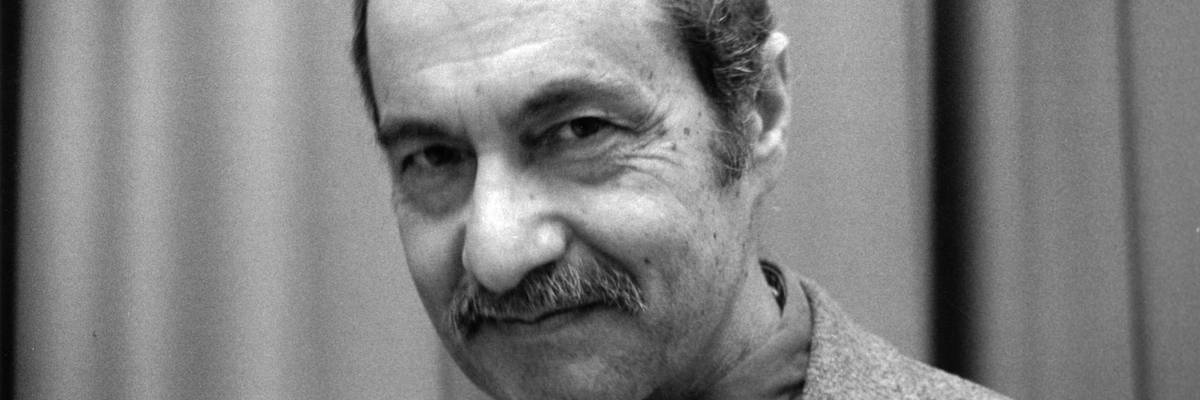
Progressive author Michael Parenti poses for a portrait in 1999 in San Francisco, California.
Parenti stands out as uniquely courageous and unapologetic in directly confronting capitalism, US imperialism, and the manifold corruptions and inequities of society’s powerful.
Michael Parenti, who died on January 24 at the age of 92, blazed a long, brave, and often lonely trail through American political thought and radical politics. The author of more than 25 books, including such many-editioned classics as Democracy for the Few and Inventing Reality, Parenti leaves behind a rich and vital legacy of intellectual and moral clarity.
Arguably one of the most influential thinkers and writers on the US left this past half-century, Parenti stands out as uniquely courageous and unapologetic in directly confronting capitalism, US imperialism, and the manifold corruptions and inequities of society’s powerful. Where many liberal writers bemoaned corporations and the rich, Parenti educated generations (including this writer) about capitalism’s fundamental contradictions and intrinsic forces of inequality, harm, and destruction.
Parenti grew up in a working-class family in East Harlem in New York City, and worked for a few years after high school before obtaining his BA from City College of New York. From there, he gained a teaching fellowship at Brown University, where he earned his MA, then earned his PhD at Yale University. Parenti taught at a slew of different colleges and universities across the United States, eventually becoming an itinerant lecturer and writer after he was widely blackballed from academia for his ideology and activism.
In 1970, Dr. Parenti’s career as a professor was derailed when he was clubbed by police while protesting the shootings of students at Kent State, leading to his ouster from the University of Illinois Urbana-Champaign. He soon resettled at the University of Vermont, which then booted him when he was convicted for the protest altercation. Parenti became part of the Green Mountain State’s upwelling of political ferment. He ran for Congress in 1974 on the Liberty Union ticket, netting third place with 7% of the vote, while his then-friend Bernie Sanders garnered 4% in his run for the US Senate.
At a time when the most radical US political rebellions are sadly emanating from the fascist, bigoted MAGA right, what we so urgently need is a fierce, disciplined, unapologetic, nonviolent uprising from the progressive left.
While growing up in this fertile milieu of 1970s Vermont, I met Parenti through our interconnected communities and chatted with him many times over the years. Alongside his brilliance and courage, Parenti was warm, amiable, engaging, and funny. He had a visceral humanity and compassion to him that embedded both his interactions and his writing.
“What the military-industrialists fail to see is that the pyramid of power and profit they build rests on a crumbling base,” he wrote in a 1981 essay in The Progressive, one of several pieces he contributed to this magazine between 1975-1992. “Ultimately, no political-economic order can remain secure by victimizing its own people. Sooner or later, this truth returns to haunt the mighty.”
One trademark Parenti talent was his ability to pierce through clotted, contorted mainstream narratives with sharp original insights. A favorite of mine comes from a speech he gave before a packed auditorium at the University of Colorado in 1986:
The Third World is not poor. You don’t go to poor countries to make money... Most countries are rich. The Philippines are rich. Brazil is rich. Mexico is rich. Chile is rich. Only the people are poor. There’s billions to be made there, to be carved out and to be taken. There’s been billions, for 400 years, the capitalist European and North American powers have carved out and taken the timber, the flax, the hemp, the cocoa, the rum, the tin, the copper, the iron, the rubber, the bauxite, the slaves, and the cheap labor... These countries are not underdeveloped, they are over-exploited.
The crowd erupted in thunderous applause, as often happened at a Parenti speech.
Many of Parenti’s works, while maligned or dismissed by mainstream critics, have proven to be startlingly prescient. Democracy for the Few, first published in 1974, provides a trenchant original analysis of the multi-layered relationships between economic and political power. A few short quotes from the book bear chillingly close resemblance to the intertwinement of money and politics today:
The close relationship between politics and economics is neither neutral nor coincidental. Large governments evolve through history in order to protect large accumulations of property and wealth.
It is ironic that people of modest means sometimes become conservative out of a scarcity fear bred by the very capitalist system they support.
In almost every enterprise, government has provided business with opportunities for private gain at public expense. Government nurtures private capital accumulation through a process of subsidies, supports, and deficit spending and an increasingly inequitable tax system.
In his 1986 book, Inventing Reality, Parenti delivers a searing and wise indictment of corporate mass media that goes beyond standard critiques. While liberal critics of corporate media may decry big business control of journalism, Parenti’s examination dug deeper into core fundamentals of capitalism: “As with any business, the mass media’s first obligation is to make money for their owners,” he wrote, and these wealthy owners “determine which person, which facts, which version of the facts, and which ideas shall reach the public.”
As a young, budding journalist when Inventing Reality was first published, I learned a great deal, not only about who owns and controls the media, but also about the many hidden biases embedded in US journalism stemming largely from that economic power. As Parenti often pointed out, mainstream media discourse typically spans a narrow political continuum from liberal to conservative, rarely including any radical or progressive perspectives, particularly ones like Parenti’s which confront capitalism directly.
Ironically, following Michael’s passing, the New York Times ran a lengthy obituary piece that illustrated many of these biases, highlighting mainstream criticisms of Parenti’s “uncompromising” stances and terming his speaking style as “feisty and animated.” Displaying some of the biases Parenti long critiqued, Times staffer Trip Gabriel wrote, “Parenti seemed to view every American domestic challenge as the fault of capitalism and every US foreign venture as an act of militarized imperialism.” As if such an assessment is somehow objectively inaccurate.
Parenti’s passing is especially notable and poignant due to the dearth of radical political thought and leadership in the United States today. While he was often outcast and blackballed throughout much of academia, he was of a now-gone generation on the left that, at least to some extent, retained its radicalism and Marxist analysis. In this respect, Parenti and his ideas came from the Old Left of the 1930s to the 1960s, rather than the New Left movement of the 1960s and 1970s, which often diverged from Marxism and communism.
In today’s chaotic and confusing political landscape, we have left-progressive figures of varying prominence and radicalism, but very few who, like Parenti, directly confront capitalism and its structural, systematic destruction, rather than simply chronicling the many anecdotes of its impacts.
Parenti’s legacies are many and important. Through his books and countless lectures, he inspired generations of progressive-left activists and thinkers. He kept the American left’s torch, so often flickering and adrift, lit and sharply afire.
But there’s another reason I think it’s time for many to discover or revisit Michael Parenti’s prolific oeuvre. At a time when the most radical US political rebellions are sadly emanating from the fascist, bigoted MAGA right, what we so urgently need is a fierce, disciplined, unapologetic, nonviolent uprising from the progressive left.
Parenti’s old one-time friend, Sen. Bernie Sanders (I-Vt.), called for political revolution when he ran for president in 2016 and 2020. We hear less of that call to action today, when so much of our political energy and time are consumed by our desperate defenses against President Donald Trump’s hideous autocracy.
Amid the daily chaos and maelstroms over Trump’s unrelenting assaults on immigrants, human, and civil rights, our environment, and this nation’s withering democracy, the “Overton window” of the politically possible has been squelched nearly shut. These days, even many progressives have been at least temporarily reduced to anti-Trumpers and, to some degree, to the dreary-grim “Blue no matter who” camp. We could really use the bold radicalism of Michael Parenti now, with his piercing ferocity and that iconic moral and intellectual clarity.
Dear Common Dreams reader, It’s been nearly 30 years since I co-founded Common Dreams with my late wife, Lina Newhouser. We had the radical notion that journalism should serve the public good, not corporate profits. It was clear to us from the outset what it would take to build such a project. No paid advertisements. No corporate sponsors. No millionaire publisher telling us what to think or do. Many people said we wouldn't last a year, but we proved those doubters wrong. Together with a tremendous team of journalists and dedicated staff, we built an independent media outlet free from the constraints of profits and corporate control. Our mission has always been simple: To inform. To inspire. To ignite change for the common good. Building Common Dreams was not easy. Our survival was never guaranteed. When you take on the most powerful forces—Wall Street greed, fossil fuel industry destruction, Big Tech lobbyists, and uber-rich oligarchs who have spent billions upon billions rigging the economy and democracy in their favor—the only bulwark you have is supporters who believe in your work. But here’s the urgent message from me today. It's never been this bad out there. And it's never been this hard to keep us going. At the very moment Common Dreams is most needed, the threats we face are intensifying. We need your support now more than ever. We don't accept corporate advertising and never will. We don't have a paywall because we don't think people should be blocked from critical news based on their ability to pay. Everything we do is funded by the donations of readers like you. When everyone does the little they can afford, we are strong. But if that support retreats or dries up, so do we. Will you donate now to make sure Common Dreams not only survives but thrives? —Craig Brown, Co-founder |
Michael Parenti, who died on January 24 at the age of 92, blazed a long, brave, and often lonely trail through American political thought and radical politics. The author of more than 25 books, including such many-editioned classics as Democracy for the Few and Inventing Reality, Parenti leaves behind a rich and vital legacy of intellectual and moral clarity.
Arguably one of the most influential thinkers and writers on the US left this past half-century, Parenti stands out as uniquely courageous and unapologetic in directly confronting capitalism, US imperialism, and the manifold corruptions and inequities of society’s powerful. Where many liberal writers bemoaned corporations and the rich, Parenti educated generations (including this writer) about capitalism’s fundamental contradictions and intrinsic forces of inequality, harm, and destruction.
Parenti grew up in a working-class family in East Harlem in New York City, and worked for a few years after high school before obtaining his BA from City College of New York. From there, he gained a teaching fellowship at Brown University, where he earned his MA, then earned his PhD at Yale University. Parenti taught at a slew of different colleges and universities across the United States, eventually becoming an itinerant lecturer and writer after he was widely blackballed from academia for his ideology and activism.
In 1970, Dr. Parenti’s career as a professor was derailed when he was clubbed by police while protesting the shootings of students at Kent State, leading to his ouster from the University of Illinois Urbana-Champaign. He soon resettled at the University of Vermont, which then booted him when he was convicted for the protest altercation. Parenti became part of the Green Mountain State’s upwelling of political ferment. He ran for Congress in 1974 on the Liberty Union ticket, netting third place with 7% of the vote, while his then-friend Bernie Sanders garnered 4% in his run for the US Senate.
At a time when the most radical US political rebellions are sadly emanating from the fascist, bigoted MAGA right, what we so urgently need is a fierce, disciplined, unapologetic, nonviolent uprising from the progressive left.
While growing up in this fertile milieu of 1970s Vermont, I met Parenti through our interconnected communities and chatted with him many times over the years. Alongside his brilliance and courage, Parenti was warm, amiable, engaging, and funny. He had a visceral humanity and compassion to him that embedded both his interactions and his writing.
“What the military-industrialists fail to see is that the pyramid of power and profit they build rests on a crumbling base,” he wrote in a 1981 essay in The Progressive, one of several pieces he contributed to this magazine between 1975-1992. “Ultimately, no political-economic order can remain secure by victimizing its own people. Sooner or later, this truth returns to haunt the mighty.”
One trademark Parenti talent was his ability to pierce through clotted, contorted mainstream narratives with sharp original insights. A favorite of mine comes from a speech he gave before a packed auditorium at the University of Colorado in 1986:
The Third World is not poor. You don’t go to poor countries to make money... Most countries are rich. The Philippines are rich. Brazil is rich. Mexico is rich. Chile is rich. Only the people are poor. There’s billions to be made there, to be carved out and to be taken. There’s been billions, for 400 years, the capitalist European and North American powers have carved out and taken the timber, the flax, the hemp, the cocoa, the rum, the tin, the copper, the iron, the rubber, the bauxite, the slaves, and the cheap labor... These countries are not underdeveloped, they are over-exploited.
The crowd erupted in thunderous applause, as often happened at a Parenti speech.
Many of Parenti’s works, while maligned or dismissed by mainstream critics, have proven to be startlingly prescient. Democracy for the Few, first published in 1974, provides a trenchant original analysis of the multi-layered relationships between economic and political power. A few short quotes from the book bear chillingly close resemblance to the intertwinement of money and politics today:
The close relationship between politics and economics is neither neutral nor coincidental. Large governments evolve through history in order to protect large accumulations of property and wealth.
It is ironic that people of modest means sometimes become conservative out of a scarcity fear bred by the very capitalist system they support.
In almost every enterprise, government has provided business with opportunities for private gain at public expense. Government nurtures private capital accumulation through a process of subsidies, supports, and deficit spending and an increasingly inequitable tax system.
In his 1986 book, Inventing Reality, Parenti delivers a searing and wise indictment of corporate mass media that goes beyond standard critiques. While liberal critics of corporate media may decry big business control of journalism, Parenti’s examination dug deeper into core fundamentals of capitalism: “As with any business, the mass media’s first obligation is to make money for their owners,” he wrote, and these wealthy owners “determine which person, which facts, which version of the facts, and which ideas shall reach the public.”
As a young, budding journalist when Inventing Reality was first published, I learned a great deal, not only about who owns and controls the media, but also about the many hidden biases embedded in US journalism stemming largely from that economic power. As Parenti often pointed out, mainstream media discourse typically spans a narrow political continuum from liberal to conservative, rarely including any radical or progressive perspectives, particularly ones like Parenti’s which confront capitalism directly.
Ironically, following Michael’s passing, the New York Times ran a lengthy obituary piece that illustrated many of these biases, highlighting mainstream criticisms of Parenti’s “uncompromising” stances and terming his speaking style as “feisty and animated.” Displaying some of the biases Parenti long critiqued, Times staffer Trip Gabriel wrote, “Parenti seemed to view every American domestic challenge as the fault of capitalism and every US foreign venture as an act of militarized imperialism.” As if such an assessment is somehow objectively inaccurate.
Parenti’s passing is especially notable and poignant due to the dearth of radical political thought and leadership in the United States today. While he was often outcast and blackballed throughout much of academia, he was of a now-gone generation on the left that, at least to some extent, retained its radicalism and Marxist analysis. In this respect, Parenti and his ideas came from the Old Left of the 1930s to the 1960s, rather than the New Left movement of the 1960s and 1970s, which often diverged from Marxism and communism.
In today’s chaotic and confusing political landscape, we have left-progressive figures of varying prominence and radicalism, but very few who, like Parenti, directly confront capitalism and its structural, systematic destruction, rather than simply chronicling the many anecdotes of its impacts.
Parenti’s legacies are many and important. Through his books and countless lectures, he inspired generations of progressive-left activists and thinkers. He kept the American left’s torch, so often flickering and adrift, lit and sharply afire.
But there’s another reason I think it’s time for many to discover or revisit Michael Parenti’s prolific oeuvre. At a time when the most radical US political rebellions are sadly emanating from the fascist, bigoted MAGA right, what we so urgently need is a fierce, disciplined, unapologetic, nonviolent uprising from the progressive left.
Parenti’s old one-time friend, Sen. Bernie Sanders (I-Vt.), called for political revolution when he ran for president in 2016 and 2020. We hear less of that call to action today, when so much of our political energy and time are consumed by our desperate defenses against President Donald Trump’s hideous autocracy.
Amid the daily chaos and maelstroms over Trump’s unrelenting assaults on immigrants, human, and civil rights, our environment, and this nation’s withering democracy, the “Overton window” of the politically possible has been squelched nearly shut. These days, even many progressives have been at least temporarily reduced to anti-Trumpers and, to some degree, to the dreary-grim “Blue no matter who” camp. We could really use the bold radicalism of Michael Parenti now, with his piercing ferocity and that iconic moral and intellectual clarity.
Michael Parenti, who died on January 24 at the age of 92, blazed a long, brave, and often lonely trail through American political thought and radical politics. The author of more than 25 books, including such many-editioned classics as Democracy for the Few and Inventing Reality, Parenti leaves behind a rich and vital legacy of intellectual and moral clarity.
Arguably one of the most influential thinkers and writers on the US left this past half-century, Parenti stands out as uniquely courageous and unapologetic in directly confronting capitalism, US imperialism, and the manifold corruptions and inequities of society’s powerful. Where many liberal writers bemoaned corporations and the rich, Parenti educated generations (including this writer) about capitalism’s fundamental contradictions and intrinsic forces of inequality, harm, and destruction.
Parenti grew up in a working-class family in East Harlem in New York City, and worked for a few years after high school before obtaining his BA from City College of New York. From there, he gained a teaching fellowship at Brown University, where he earned his MA, then earned his PhD at Yale University. Parenti taught at a slew of different colleges and universities across the United States, eventually becoming an itinerant lecturer and writer after he was widely blackballed from academia for his ideology and activism.
In 1970, Dr. Parenti’s career as a professor was derailed when he was clubbed by police while protesting the shootings of students at Kent State, leading to his ouster from the University of Illinois Urbana-Champaign. He soon resettled at the University of Vermont, which then booted him when he was convicted for the protest altercation. Parenti became part of the Green Mountain State’s upwelling of political ferment. He ran for Congress in 1974 on the Liberty Union ticket, netting third place with 7% of the vote, while his then-friend Bernie Sanders garnered 4% in his run for the US Senate.
At a time when the most radical US political rebellions are sadly emanating from the fascist, bigoted MAGA right, what we so urgently need is a fierce, disciplined, unapologetic, nonviolent uprising from the progressive left.
While growing up in this fertile milieu of 1970s Vermont, I met Parenti through our interconnected communities and chatted with him many times over the years. Alongside his brilliance and courage, Parenti was warm, amiable, engaging, and funny. He had a visceral humanity and compassion to him that embedded both his interactions and his writing.
“What the military-industrialists fail to see is that the pyramid of power and profit they build rests on a crumbling base,” he wrote in a 1981 essay in The Progressive, one of several pieces he contributed to this magazine between 1975-1992. “Ultimately, no political-economic order can remain secure by victimizing its own people. Sooner or later, this truth returns to haunt the mighty.”
One trademark Parenti talent was his ability to pierce through clotted, contorted mainstream narratives with sharp original insights. A favorite of mine comes from a speech he gave before a packed auditorium at the University of Colorado in 1986:
The Third World is not poor. You don’t go to poor countries to make money... Most countries are rich. The Philippines are rich. Brazil is rich. Mexico is rich. Chile is rich. Only the people are poor. There’s billions to be made there, to be carved out and to be taken. There’s been billions, for 400 years, the capitalist European and North American powers have carved out and taken the timber, the flax, the hemp, the cocoa, the rum, the tin, the copper, the iron, the rubber, the bauxite, the slaves, and the cheap labor... These countries are not underdeveloped, they are over-exploited.
The crowd erupted in thunderous applause, as often happened at a Parenti speech.
Many of Parenti’s works, while maligned or dismissed by mainstream critics, have proven to be startlingly prescient. Democracy for the Few, first published in 1974, provides a trenchant original analysis of the multi-layered relationships between economic and political power. A few short quotes from the book bear chillingly close resemblance to the intertwinement of money and politics today:
The close relationship between politics and economics is neither neutral nor coincidental. Large governments evolve through history in order to protect large accumulations of property and wealth.
It is ironic that people of modest means sometimes become conservative out of a scarcity fear bred by the very capitalist system they support.
In almost every enterprise, government has provided business with opportunities for private gain at public expense. Government nurtures private capital accumulation through a process of subsidies, supports, and deficit spending and an increasingly inequitable tax system.
In his 1986 book, Inventing Reality, Parenti delivers a searing and wise indictment of corporate mass media that goes beyond standard critiques. While liberal critics of corporate media may decry big business control of journalism, Parenti’s examination dug deeper into core fundamentals of capitalism: “As with any business, the mass media’s first obligation is to make money for their owners,” he wrote, and these wealthy owners “determine which person, which facts, which version of the facts, and which ideas shall reach the public.”
As a young, budding journalist when Inventing Reality was first published, I learned a great deal, not only about who owns and controls the media, but also about the many hidden biases embedded in US journalism stemming largely from that economic power. As Parenti often pointed out, mainstream media discourse typically spans a narrow political continuum from liberal to conservative, rarely including any radical or progressive perspectives, particularly ones like Parenti’s which confront capitalism directly.
Ironically, following Michael’s passing, the New York Times ran a lengthy obituary piece that illustrated many of these biases, highlighting mainstream criticisms of Parenti’s “uncompromising” stances and terming his speaking style as “feisty and animated.” Displaying some of the biases Parenti long critiqued, Times staffer Trip Gabriel wrote, “Parenti seemed to view every American domestic challenge as the fault of capitalism and every US foreign venture as an act of militarized imperialism.” As if such an assessment is somehow objectively inaccurate.
Parenti’s passing is especially notable and poignant due to the dearth of radical political thought and leadership in the United States today. While he was often outcast and blackballed throughout much of academia, he was of a now-gone generation on the left that, at least to some extent, retained its radicalism and Marxist analysis. In this respect, Parenti and his ideas came from the Old Left of the 1930s to the 1960s, rather than the New Left movement of the 1960s and 1970s, which often diverged from Marxism and communism.
In today’s chaotic and confusing political landscape, we have left-progressive figures of varying prominence and radicalism, but very few who, like Parenti, directly confront capitalism and its structural, systematic destruction, rather than simply chronicling the many anecdotes of its impacts.
Parenti’s legacies are many and important. Through his books and countless lectures, he inspired generations of progressive-left activists and thinkers. He kept the American left’s torch, so often flickering and adrift, lit and sharply afire.
But there’s another reason I think it’s time for many to discover or revisit Michael Parenti’s prolific oeuvre. At a time when the most radical US political rebellions are sadly emanating from the fascist, bigoted MAGA right, what we so urgently need is a fierce, disciplined, unapologetic, nonviolent uprising from the progressive left.
Parenti’s old one-time friend, Sen. Bernie Sanders (I-Vt.), called for political revolution when he ran for president in 2016 and 2020. We hear less of that call to action today, when so much of our political energy and time are consumed by our desperate defenses against President Donald Trump’s hideous autocracy.
Amid the daily chaos and maelstroms over Trump’s unrelenting assaults on immigrants, human, and civil rights, our environment, and this nation’s withering democracy, the “Overton window” of the politically possible has been squelched nearly shut. These days, even many progressives have been at least temporarily reduced to anti-Trumpers and, to some degree, to the dreary-grim “Blue no matter who” camp. We could really use the bold radicalism of Michael Parenti now, with his piercing ferocity and that iconic moral and intellectual clarity.