SUBSCRIBE TO OUR FREE NEWSLETTER
Daily news & progressive opinion—funded by the people, not the corporations—delivered straight to your inbox.
5
#000000
#FFFFFF
To donate by check, phone, or other method, see our More Ways to Give page.
Daily news & progressive opinion—funded by the people, not the corporations—delivered straight to your inbox.
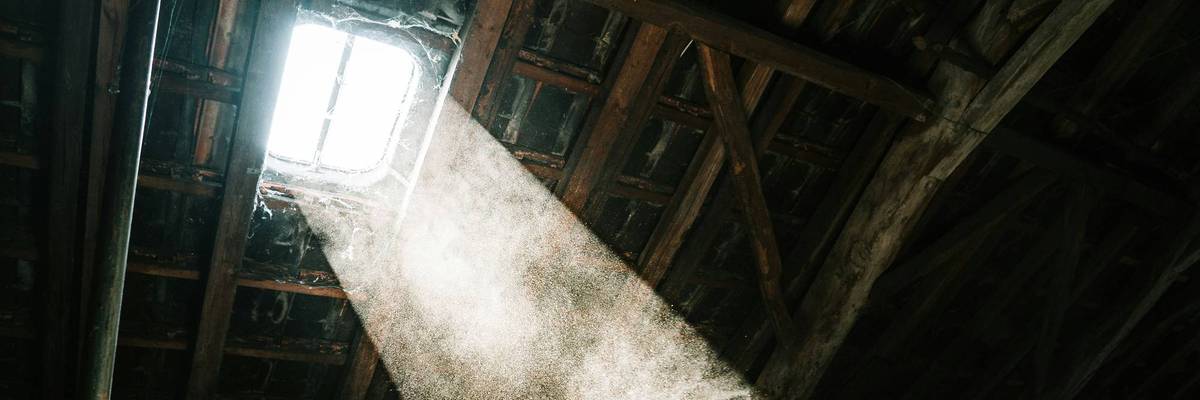
A sun's ray enters an attic.
The following column, called “Haunted House,” was written in November 1999, about a year after my wife died of pancreatic cancer.
Let’s go back a quarter century or so. Join me as I open up aa piece of the past, which I keep stored in containers on my computer, also known as old columns. I became curious about these oldies after I survived a vicious storm and temporary power outage the other day, and only missed the tornado that hit northeastern Wisconsin by a few miles.
Turns out I take electricity for granted! It was out in my retirement community apartment for about eight hours. I also take my personal safety for granted. As I browsed through some of my earliest columns, I also started thinking—up close—about life itself. The following column, called “Haunted House,” was written in November 1999, about a year after my wife died of pancreatic cancer. Here it is.
When my wife died, I spent my first month of mourning disentangling the house from its ghosts and clutter.
I was suddenly appalled at what a wreck the place was. Even under ordinary circumstances, we had fought a losing battle against miscellany. We shoved stuff into corners; chaos bestrewed itself with an easy shrug across every available surface of our lives. After a year of cancer—with such urgent matters as pain management, constipation relief, and a quest for miracles claiming every moment of our attention—all order in the house was shattered.
Oh, the shards and accumulated scraps of a marriage, stashed and forgotten, compressed into layers. Now it’s all luminous, each thing as it is surprised loose from hiding bearing witness to what once was.
I set to the task of cleaning and reorganizing more out of numb instinct than reawakened guilt. I needed a challenge, and this one was Herculean. But even more than that, I sensed that putting myself back together was somehow connected to putting the house back together.
I was at Barbara’s bedside when she died. I held her hand and watched her suffering dissolve in the last hour of her life; her ragged breathing grew calm and the pain furrows on her face loosened. A sudden cloudburst out the window caused me to glance up. When I looked back, her breathing had stopped. That was it. Death came as a gift of peace.
Despite its reputation, death, it turns out, is kind.
It helps to know this. It helps to know the only suffering, after the fact, is yours, the survivor’s; the only sharp edges are around the hole in your own life. But this can be endured, even welcomed. If there had been no great love, the ache would be small. So to me, grief in its intensity, the broken tear ducts—the downpour that came, for instance, when my daughter placed Mother’s Day presents, bubble bath, talcum powder, in Barbara’s still arms—is love all at once, love no longer paid out slowly, over the life of a marriage, but here now with the force of gravity. After death, love is a falling into her absence, not her presence. And that’s what grief is.
And cleaning the house my wife no longer lived in was a continuation of this, a falling in love all over again—a falling in love with the worn and familiar. As I began disturbing the settled dust, crawling around in three stories and 15 years of married life, I soon realized that everything I touched—this tumble of old letters and frayed linen, castaway toys and defunct appliances—was charged with Barbara’s absence. I wasn’t merely restoring order to a house, I was freeing the past, setting its genies scampering.
Basement storage: Cardboard box crammed with travel brochures and misfolded maps, the moldy remnants of trips spanning two decades. Out tumble Missouri and the Berkshires and Urquhart Castle and Kettle Moraine State Park.
Kitchen: That overflowing bookcase by the basement stairs. Spillage of old Weight Watchers pamphlets, never-used cookbooks, unwanted small appliances (gift Cuisinart that mysteriously alarmed Barbara, still secured in its Styrofoam packaging).
Upstairs linen closet: Baby blanket. Light blues and pinks, worn through in spots, numerous stains, the batting lumped in one corner.
Oh, the shards and accumulated scraps of a marriage, stashed and forgotten, compressed into layers. Now it’s all luminous, each thing as it is surprised loose from hiding bearing witness to what once was. In the language of life, these are metaphors, compressions of meaning almost too large for the heart to bear.
And my daughter’s tattered blankie is the most powerful of all, as I hold it against my face and know too much about loneliness. I fold it and remember what it was like to surrender everything for love.
Dear Common Dreams reader, It’s been nearly 30 years since I co-founded Common Dreams with my late wife, Lina Newhouser. We had the radical notion that journalism should serve the public good, not corporate profits. It was clear to us from the outset what it would take to build such a project. No paid advertisements. No corporate sponsors. No millionaire publisher telling us what to think or do. Many people said we wouldn't last a year, but we proved those doubters wrong. Together with a tremendous team of journalists and dedicated staff, we built an independent media outlet free from the constraints of profits and corporate control. Our mission has always been simple: To inform. To inspire. To ignite change for the common good. Building Common Dreams was not easy. Our survival was never guaranteed. When you take on the most powerful forces—Wall Street greed, fossil fuel industry destruction, Big Tech lobbyists, and uber-rich oligarchs who have spent billions upon billions rigging the economy and democracy in their favor—the only bulwark you have is supporters who believe in your work. But here’s the urgent message from me today. It's never been this bad out there. And it's never been this hard to keep us going. At the very moment Common Dreams is most needed, the threats we face are intensifying. We need your support now more than ever. We don't accept corporate advertising and never will. We don't have a paywall because we don't think people should be blocked from critical news based on their ability to pay. Everything we do is funded by the donations of readers like you. When everyone does the little they can afford, we are strong. But if that support retreats or dries up, so do we. Will you donate now to make sure Common Dreams not only survives but thrives? —Craig Brown, Co-founder |
Let’s go back a quarter century or so. Join me as I open up aa piece of the past, which I keep stored in containers on my computer, also known as old columns. I became curious about these oldies after I survived a vicious storm and temporary power outage the other day, and only missed the tornado that hit northeastern Wisconsin by a few miles.
Turns out I take electricity for granted! It was out in my retirement community apartment for about eight hours. I also take my personal safety for granted. As I browsed through some of my earliest columns, I also started thinking—up close—about life itself. The following column, called “Haunted House,” was written in November 1999, about a year after my wife died of pancreatic cancer. Here it is.
When my wife died, I spent my first month of mourning disentangling the house from its ghosts and clutter.
I was suddenly appalled at what a wreck the place was. Even under ordinary circumstances, we had fought a losing battle against miscellany. We shoved stuff into corners; chaos bestrewed itself with an easy shrug across every available surface of our lives. After a year of cancer—with such urgent matters as pain management, constipation relief, and a quest for miracles claiming every moment of our attention—all order in the house was shattered.
Oh, the shards and accumulated scraps of a marriage, stashed and forgotten, compressed into layers. Now it’s all luminous, each thing as it is surprised loose from hiding bearing witness to what once was.
I set to the task of cleaning and reorganizing more out of numb instinct than reawakened guilt. I needed a challenge, and this one was Herculean. But even more than that, I sensed that putting myself back together was somehow connected to putting the house back together.
I was at Barbara’s bedside when she died. I held her hand and watched her suffering dissolve in the last hour of her life; her ragged breathing grew calm and the pain furrows on her face loosened. A sudden cloudburst out the window caused me to glance up. When I looked back, her breathing had stopped. That was it. Death came as a gift of peace.
Despite its reputation, death, it turns out, is kind.
It helps to know this. It helps to know the only suffering, after the fact, is yours, the survivor’s; the only sharp edges are around the hole in your own life. But this can be endured, even welcomed. If there had been no great love, the ache would be small. So to me, grief in its intensity, the broken tear ducts—the downpour that came, for instance, when my daughter placed Mother’s Day presents, bubble bath, talcum powder, in Barbara’s still arms—is love all at once, love no longer paid out slowly, over the life of a marriage, but here now with the force of gravity. After death, love is a falling into her absence, not her presence. And that’s what grief is.
And cleaning the house my wife no longer lived in was a continuation of this, a falling in love all over again—a falling in love with the worn and familiar. As I began disturbing the settled dust, crawling around in three stories and 15 years of married life, I soon realized that everything I touched—this tumble of old letters and frayed linen, castaway toys and defunct appliances—was charged with Barbara’s absence. I wasn’t merely restoring order to a house, I was freeing the past, setting its genies scampering.
Basement storage: Cardboard box crammed with travel brochures and misfolded maps, the moldy remnants of trips spanning two decades. Out tumble Missouri and the Berkshires and Urquhart Castle and Kettle Moraine State Park.
Kitchen: That overflowing bookcase by the basement stairs. Spillage of old Weight Watchers pamphlets, never-used cookbooks, unwanted small appliances (gift Cuisinart that mysteriously alarmed Barbara, still secured in its Styrofoam packaging).
Upstairs linen closet: Baby blanket. Light blues and pinks, worn through in spots, numerous stains, the batting lumped in one corner.
Oh, the shards and accumulated scraps of a marriage, stashed and forgotten, compressed into layers. Now it’s all luminous, each thing as it is surprised loose from hiding bearing witness to what once was. In the language of life, these are metaphors, compressions of meaning almost too large for the heart to bear.
And my daughter’s tattered blankie is the most powerful of all, as I hold it against my face and know too much about loneliness. I fold it and remember what it was like to surrender everything for love.
Let’s go back a quarter century or so. Join me as I open up aa piece of the past, which I keep stored in containers on my computer, also known as old columns. I became curious about these oldies after I survived a vicious storm and temporary power outage the other day, and only missed the tornado that hit northeastern Wisconsin by a few miles.
Turns out I take electricity for granted! It was out in my retirement community apartment for about eight hours. I also take my personal safety for granted. As I browsed through some of my earliest columns, I also started thinking—up close—about life itself. The following column, called “Haunted House,” was written in November 1999, about a year after my wife died of pancreatic cancer. Here it is.
When my wife died, I spent my first month of mourning disentangling the house from its ghosts and clutter.
I was suddenly appalled at what a wreck the place was. Even under ordinary circumstances, we had fought a losing battle against miscellany. We shoved stuff into corners; chaos bestrewed itself with an easy shrug across every available surface of our lives. After a year of cancer—with such urgent matters as pain management, constipation relief, and a quest for miracles claiming every moment of our attention—all order in the house was shattered.
Oh, the shards and accumulated scraps of a marriage, stashed and forgotten, compressed into layers. Now it’s all luminous, each thing as it is surprised loose from hiding bearing witness to what once was.
I set to the task of cleaning and reorganizing more out of numb instinct than reawakened guilt. I needed a challenge, and this one was Herculean. But even more than that, I sensed that putting myself back together was somehow connected to putting the house back together.
I was at Barbara’s bedside when she died. I held her hand and watched her suffering dissolve in the last hour of her life; her ragged breathing grew calm and the pain furrows on her face loosened. A sudden cloudburst out the window caused me to glance up. When I looked back, her breathing had stopped. That was it. Death came as a gift of peace.
Despite its reputation, death, it turns out, is kind.
It helps to know this. It helps to know the only suffering, after the fact, is yours, the survivor’s; the only sharp edges are around the hole in your own life. But this can be endured, even welcomed. If there had been no great love, the ache would be small. So to me, grief in its intensity, the broken tear ducts—the downpour that came, for instance, when my daughter placed Mother’s Day presents, bubble bath, talcum powder, in Barbara’s still arms—is love all at once, love no longer paid out slowly, over the life of a marriage, but here now with the force of gravity. After death, love is a falling into her absence, not her presence. And that’s what grief is.
And cleaning the house my wife no longer lived in was a continuation of this, a falling in love all over again—a falling in love with the worn and familiar. As I began disturbing the settled dust, crawling around in three stories and 15 years of married life, I soon realized that everything I touched—this tumble of old letters and frayed linen, castaway toys and defunct appliances—was charged with Barbara’s absence. I wasn’t merely restoring order to a house, I was freeing the past, setting its genies scampering.
Basement storage: Cardboard box crammed with travel brochures and misfolded maps, the moldy remnants of trips spanning two decades. Out tumble Missouri and the Berkshires and Urquhart Castle and Kettle Moraine State Park.
Kitchen: That overflowing bookcase by the basement stairs. Spillage of old Weight Watchers pamphlets, never-used cookbooks, unwanted small appliances (gift Cuisinart that mysteriously alarmed Barbara, still secured in its Styrofoam packaging).
Upstairs linen closet: Baby blanket. Light blues and pinks, worn through in spots, numerous stains, the batting lumped in one corner.
Oh, the shards and accumulated scraps of a marriage, stashed and forgotten, compressed into layers. Now it’s all luminous, each thing as it is surprised loose from hiding bearing witness to what once was. In the language of life, these are metaphors, compressions of meaning almost too large for the heart to bear.
And my daughter’s tattered blankie is the most powerful of all, as I hold it against my face and know too much about loneliness. I fold it and remember what it was like to surrender everything for love.