SUBSCRIBE TO OUR FREE NEWSLETTER
Daily news & progressive opinion—funded by the people, not the corporations—delivered straight to your inbox.
5
#000000
#FFFFFF
To donate by check, phone, or other method, see our More Ways to Give page.
Daily news & progressive opinion—funded by the people, not the corporations—delivered straight to your inbox.
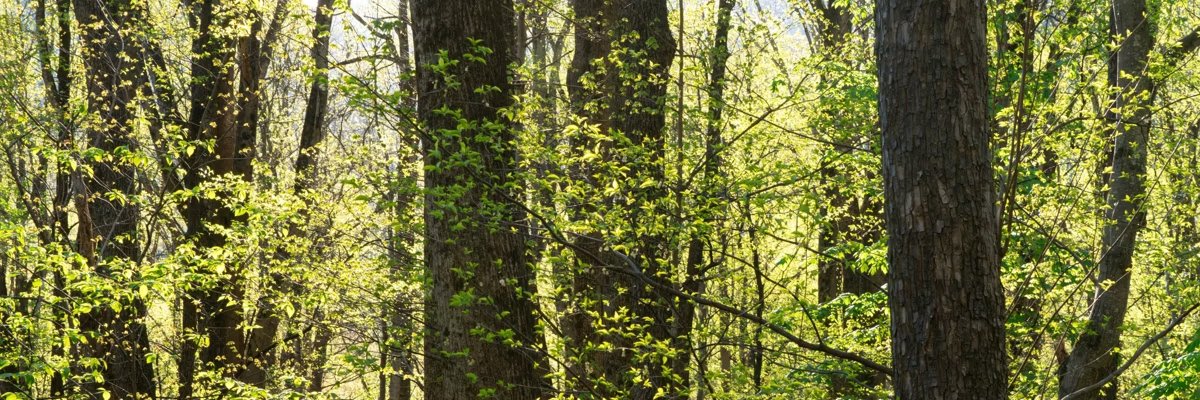
The green color of spring is seen as the trees begin to bloom in the Appalachians.
Local and state governments should invest in protecting natural landscapes as the foundation of rural prosperity—not funnel more public dollars into yet another dirty and destructive industry.
Nature is our lifeline. Technology cannot replace it.
That truth is the heart of a growing conflict in rural America. As data centers and AI infrastructure are sold to communities as “innovation,” “jobs,” and “the future,” we’re being asked to trade away the natural systems that have always sustained us: forests, clean water, a stable climate, and the human need for connection with each other and the natural world.
It’s not a fair trade. It’s not a winning economic strategy. And no matter what Big Tech claims, it’s not good for us.
Like many Americans, my most treasured memories come from time spent outdoors. I grew up exploring the forests of coastal South Carolina—climbing trees, watching birds fly across the sunset, picking wildflowers. Those experiences led me to co‑found Dogwood Alliance, an organization dedicated to protecting Southeastern forests, in 1996.
We still have a choice: Allow hollow promises to lead us into a dead planet, or look to nature for survival and joy.
Our Southern forests are among the most biodiverse in the nation—and are the least protected. Industrial logging has presented the greatest threat to forests I’ve seen in my lifetime. The South is logged at a rate estimated to be four times higher than South American rainforests. I’ve seen how decades of expansion in wood production—from paper to biomass wood pellets—have fouled air and water while degrading millions of acres. I’ve seen how clear-cutting and the conversion of wild forests into single‑species plantations have devastated biodiversity, water quality, natural flood control, and carbon storage. I’ve seen entire communities become sacrifice zones, with low‑income, Black, and Indigenous residents bearing the brunt of pollution and forest destruction.
What I have never seen is a corporation’s promises of clean operations and economic prosperity actually materialize. That’s why I am more convinced than ever that our future depends on protecting standing forests
Today, we stand at a crossroads. After years of community organizing, public pressure, and scientific pushback, paper and wood‑pellet mills are shuttering. For those of us in rural and forest communities, this presents a rare opportunity to rethink what we want our economy to be. Do we continue down a path of destruction, or do we accelerate the protection of nature?
Into this moment steps a new pitch: data centers and AI as the next economic “miracle.” But their enormous appetite for electricity and water accelerates resource extraction, pollution, and climate impacts. The declining forestry industry is now trying to hitch itself to this swindle, promoting the burning of trees to power data centers as a way to prop up its obsolete business model—and calling it “progress.”
Progress toward what? Much of what these AI data centers produce is inflammatory content that fuels political outrage and deepens social division. No wonder people across the country are pushing back—and winning.
In so many ways, forests are the most advanced technology the world has ever known. They regulate temperature, store carbon, support food systems, and offer psychological grounding no device can replicate. When left intact, forests are self‑maintaining, self‑renewing, and infinitely more productive than any data center.
Study after study shows that time in nature improves cognitive function and a wide range of mental and physical health markers. Research also links depression, anxiety, and attention disorders to tech overload and reduced time outdoors. Science shows what we instinctively know to be true—nature brings people together. Protecting it is one of the few remaining ways to restore health and rebuild unity in a divided time.
Equally important, forest protection is a proven economic strategy for rural communities. The outdoor recreation economy generates far more revenue and jobs than the timber industry. Conservation and recreation jobs, ecological restoration, and community‑led development create long‑term prosperity without sacrificing land, water, or health. These sectors keep wealth local, strengthen small businesses, and attract people who want to live in places defined by beauty and belonging—not destruction and noise.
At Dogwood Alliance, we’ve seen what happens when communities reject extractive industry and shift to people power. Last year, we partnered with New Alpha Community Development Corporation to purchase Freedom Land, a 305‑acre property that will become a community‑led hub for forest conservation, ecotourism, and outdoor recreation. We also helped the Pee Dee Indian Tribe purchase 77 acres of wetlands to create an environmental education center celebrating Native American culture and heritage.
These projects offer a blueprint for a community‑led movement to save our forests and our towns. And they come at a critical moment, as rural communities face new threats from Big Tech’s land‑hungry, resource‑intensive infrastructure
We still have a choice: Allow hollow promises to lead us into a dead planet, or look to nature for survival and joy. Local and state governments should invest in protecting natural landscapes as the foundation of rural prosperity—not funnel more public dollars into yet another dirty and destructive industry.
We can and must build a future rooted in nature, not in the false god of AI technology. Nature is not just the original technology—it’s still the best.
Dear Common Dreams reader, It’s been nearly 30 years since I co-founded Common Dreams with my late wife, Lina Newhouser. We had the radical notion that journalism should serve the public good, not corporate profits. It was clear to us from the outset what it would take to build such a project. No paid advertisements. No corporate sponsors. No millionaire publisher telling us what to think or do. Many people said we wouldn't last a year, but we proved those doubters wrong. Together with a tremendous team of journalists and dedicated staff, we built an independent media outlet free from the constraints of profits and corporate control. Our mission has always been simple: To inform. To inspire. To ignite change for the common good. Building Common Dreams was not easy. Our survival was never guaranteed. When you take on the most powerful forces—Wall Street greed, fossil fuel industry destruction, Big Tech lobbyists, and uber-rich oligarchs who have spent billions upon billions rigging the economy and democracy in their favor—the only bulwark you have is supporters who believe in your work. But here’s the urgent message from me today. It's never been this bad out there. And it's never been this hard to keep us going. At the very moment Common Dreams is most needed, the threats we face are intensifying. We need your support now more than ever. We don't accept corporate advertising and never will. We don't have a paywall because we don't think people should be blocked from critical news based on their ability to pay. Everything we do is funded by the donations of readers like you. When everyone does the little they can afford, we are strong. But if that support retreats or dries up, so do we. Will you donate now to make sure Common Dreams not only survives but thrives? —Craig Brown, Co-founder |
Nature is our lifeline. Technology cannot replace it.
That truth is the heart of a growing conflict in rural America. As data centers and AI infrastructure are sold to communities as “innovation,” “jobs,” and “the future,” we’re being asked to trade away the natural systems that have always sustained us: forests, clean water, a stable climate, and the human need for connection with each other and the natural world.
It’s not a fair trade. It’s not a winning economic strategy. And no matter what Big Tech claims, it’s not good for us.
Like many Americans, my most treasured memories come from time spent outdoors. I grew up exploring the forests of coastal South Carolina—climbing trees, watching birds fly across the sunset, picking wildflowers. Those experiences led me to co‑found Dogwood Alliance, an organization dedicated to protecting Southeastern forests, in 1996.
We still have a choice: Allow hollow promises to lead us into a dead planet, or look to nature for survival and joy.
Our Southern forests are among the most biodiverse in the nation—and are the least protected. Industrial logging has presented the greatest threat to forests I’ve seen in my lifetime. The South is logged at a rate estimated to be four times higher than South American rainforests. I’ve seen how decades of expansion in wood production—from paper to biomass wood pellets—have fouled air and water while degrading millions of acres. I’ve seen how clear-cutting and the conversion of wild forests into single‑species plantations have devastated biodiversity, water quality, natural flood control, and carbon storage. I’ve seen entire communities become sacrifice zones, with low‑income, Black, and Indigenous residents bearing the brunt of pollution and forest destruction.
What I have never seen is a corporation’s promises of clean operations and economic prosperity actually materialize. That’s why I am more convinced than ever that our future depends on protecting standing forests
Today, we stand at a crossroads. After years of community organizing, public pressure, and scientific pushback, paper and wood‑pellet mills are shuttering. For those of us in rural and forest communities, this presents a rare opportunity to rethink what we want our economy to be. Do we continue down a path of destruction, or do we accelerate the protection of nature?
Into this moment steps a new pitch: data centers and AI as the next economic “miracle.” But their enormous appetite for electricity and water accelerates resource extraction, pollution, and climate impacts. The declining forestry industry is now trying to hitch itself to this swindle, promoting the burning of trees to power data centers as a way to prop up its obsolete business model—and calling it “progress.”
Progress toward what? Much of what these AI data centers produce is inflammatory content that fuels political outrage and deepens social division. No wonder people across the country are pushing back—and winning.
In so many ways, forests are the most advanced technology the world has ever known. They regulate temperature, store carbon, support food systems, and offer psychological grounding no device can replicate. When left intact, forests are self‑maintaining, self‑renewing, and infinitely more productive than any data center.
Study after study shows that time in nature improves cognitive function and a wide range of mental and physical health markers. Research also links depression, anxiety, and attention disorders to tech overload and reduced time outdoors. Science shows what we instinctively know to be true—nature brings people together. Protecting it is one of the few remaining ways to restore health and rebuild unity in a divided time.
Equally important, forest protection is a proven economic strategy for rural communities. The outdoor recreation economy generates far more revenue and jobs than the timber industry. Conservation and recreation jobs, ecological restoration, and community‑led development create long‑term prosperity without sacrificing land, water, or health. These sectors keep wealth local, strengthen small businesses, and attract people who want to live in places defined by beauty and belonging—not destruction and noise.
At Dogwood Alliance, we’ve seen what happens when communities reject extractive industry and shift to people power. Last year, we partnered with New Alpha Community Development Corporation to purchase Freedom Land, a 305‑acre property that will become a community‑led hub for forest conservation, ecotourism, and outdoor recreation. We also helped the Pee Dee Indian Tribe purchase 77 acres of wetlands to create an environmental education center celebrating Native American culture and heritage.
These projects offer a blueprint for a community‑led movement to save our forests and our towns. And they come at a critical moment, as rural communities face new threats from Big Tech’s land‑hungry, resource‑intensive infrastructure
We still have a choice: Allow hollow promises to lead us into a dead planet, or look to nature for survival and joy. Local and state governments should invest in protecting natural landscapes as the foundation of rural prosperity—not funnel more public dollars into yet another dirty and destructive industry.
We can and must build a future rooted in nature, not in the false god of AI technology. Nature is not just the original technology—it’s still the best.
Nature is our lifeline. Technology cannot replace it.
That truth is the heart of a growing conflict in rural America. As data centers and AI infrastructure are sold to communities as “innovation,” “jobs,” and “the future,” we’re being asked to trade away the natural systems that have always sustained us: forests, clean water, a stable climate, and the human need for connection with each other and the natural world.
It’s not a fair trade. It’s not a winning economic strategy. And no matter what Big Tech claims, it’s not good for us.
Like many Americans, my most treasured memories come from time spent outdoors. I grew up exploring the forests of coastal South Carolina—climbing trees, watching birds fly across the sunset, picking wildflowers. Those experiences led me to co‑found Dogwood Alliance, an organization dedicated to protecting Southeastern forests, in 1996.
We still have a choice: Allow hollow promises to lead us into a dead planet, or look to nature for survival and joy.
Our Southern forests are among the most biodiverse in the nation—and are the least protected. Industrial logging has presented the greatest threat to forests I’ve seen in my lifetime. The South is logged at a rate estimated to be four times higher than South American rainforests. I’ve seen how decades of expansion in wood production—from paper to biomass wood pellets—have fouled air and water while degrading millions of acres. I’ve seen how clear-cutting and the conversion of wild forests into single‑species plantations have devastated biodiversity, water quality, natural flood control, and carbon storage. I’ve seen entire communities become sacrifice zones, with low‑income, Black, and Indigenous residents bearing the brunt of pollution and forest destruction.
What I have never seen is a corporation’s promises of clean operations and economic prosperity actually materialize. That’s why I am more convinced than ever that our future depends on protecting standing forests
Today, we stand at a crossroads. After years of community organizing, public pressure, and scientific pushback, paper and wood‑pellet mills are shuttering. For those of us in rural and forest communities, this presents a rare opportunity to rethink what we want our economy to be. Do we continue down a path of destruction, or do we accelerate the protection of nature?
Into this moment steps a new pitch: data centers and AI as the next economic “miracle.” But their enormous appetite for electricity and water accelerates resource extraction, pollution, and climate impacts. The declining forestry industry is now trying to hitch itself to this swindle, promoting the burning of trees to power data centers as a way to prop up its obsolete business model—and calling it “progress.”
Progress toward what? Much of what these AI data centers produce is inflammatory content that fuels political outrage and deepens social division. No wonder people across the country are pushing back—and winning.
In so many ways, forests are the most advanced technology the world has ever known. They regulate temperature, store carbon, support food systems, and offer psychological grounding no device can replicate. When left intact, forests are self‑maintaining, self‑renewing, and infinitely more productive than any data center.
Study after study shows that time in nature improves cognitive function and a wide range of mental and physical health markers. Research also links depression, anxiety, and attention disorders to tech overload and reduced time outdoors. Science shows what we instinctively know to be true—nature brings people together. Protecting it is one of the few remaining ways to restore health and rebuild unity in a divided time.
Equally important, forest protection is a proven economic strategy for rural communities. The outdoor recreation economy generates far more revenue and jobs than the timber industry. Conservation and recreation jobs, ecological restoration, and community‑led development create long‑term prosperity without sacrificing land, water, or health. These sectors keep wealth local, strengthen small businesses, and attract people who want to live in places defined by beauty and belonging—not destruction and noise.
At Dogwood Alliance, we’ve seen what happens when communities reject extractive industry and shift to people power. Last year, we partnered with New Alpha Community Development Corporation to purchase Freedom Land, a 305‑acre property that will become a community‑led hub for forest conservation, ecotourism, and outdoor recreation. We also helped the Pee Dee Indian Tribe purchase 77 acres of wetlands to create an environmental education center celebrating Native American culture and heritage.
These projects offer a blueprint for a community‑led movement to save our forests and our towns. And they come at a critical moment, as rural communities face new threats from Big Tech’s land‑hungry, resource‑intensive infrastructure
We still have a choice: Allow hollow promises to lead us into a dead planet, or look to nature for survival and joy. Local and state governments should invest in protecting natural landscapes as the foundation of rural prosperity—not funnel more public dollars into yet another dirty and destructive industry.
We can and must build a future rooted in nature, not in the false god of AI technology. Nature is not just the original technology—it’s still the best.