SUBSCRIBE TO OUR FREE NEWSLETTER
Daily news & progressive opinion—funded by the people, not the corporations—delivered straight to your inbox.
5
#000000
#FFFFFF
To donate by check, phone, or other method, see our More Ways to Give page.
Daily news & progressive opinion—funded by the people, not the corporations—delivered straight to your inbox.
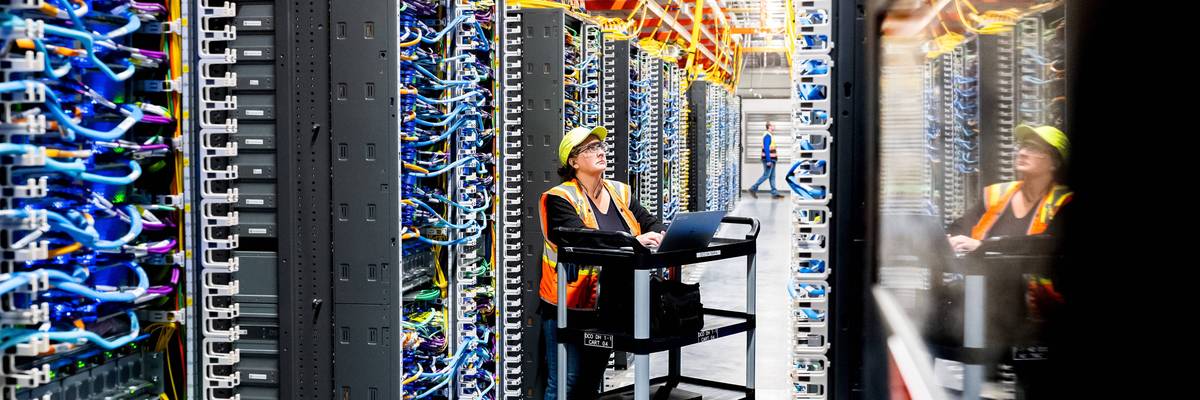
In this handout provided by Amazon, a technician works at an Amazon Web Services AI data center in New Carlisle, Indiana on October 2, 2025.
Data center dukes and barons appropriate land and resources while indirectly taxing the middle and lower class through higher utility bills.
Data centers are the modern equivalent of feudal castles. They dominate the landscape, consume resources, and aggregate power. Unlike medieval barons, though, today’s data dukes don’t live in their castles. Their “court” is in Washington and Silicon Valley, but they expect their local vassals to pay tribute through higher utility rates, water, and electricity consumption. A data center complex is being built near my home. I feel like my village is being colonized.
Data Centers have huge moats, which indirectly consume vast quantities of water, electricity, and land. I’d like to know—in addition to utility rate impacts—what their carbon footprint is over time. Yet, like a lot of non-tech-engaged citizens, I have more questions than answers.
“Unmitigated data center growth puts the public at risk of large cost increases, from higher utility bills to public health costs to climate impacts," according to a recent study by the Union of Concerned Scientists (UCS), a national nonprofit advocacy group. In Illinois alone, where I live, the UCS estimates that electric utility rates could soar:
Data Centers typically have voracious electrical and water demands. They need huge amounts of electricity to power their citadel of computer servers and water to cool them. According to an analysis by CLC JAWA, the local water agency for Lake County, the proposed Grayslake data center near my home will use up to 1.6 billion (giga) watts of electricity in its first phase. When completed, the first phase will use about 50,000 gallons of water daily, which is roughly equivalent to an average-sized health and fitness club.
Worse yet, since there are no national or state regulations on data centers, their power consumption could increase the burning of fossil fuels (mostly coal and gas)
Yet the demand for water in the “T5” Grayslake data center around the corner from my home will spike when it pumps water into its “closed-loop” (recirculated) cooling system. Filling up that system—what the operators call a “flush and fill”—will require an estimated 3.2 million gallons over several days. Keep in mind that’s treated Lake Michigan water, which is not billed at a higher rate for industrial use. Will that outsize water consumption raise rates for residential water users? That’s not clear, although the combined water and power usage will be enormous for a 470 acre-complex (approved by the local village board) with up to 10 million total square feet in less than 20 buildings.
Worse yet, since there are no national or state regulations on data centers, their power consumption could increase the burning of fossil fuels (mostly coal and gas). That means more pollutants and greenhouse gases flowing into our atmosphere. At the very least, local residents need more detailed information on utility and environmental impact.
Across the border in Wisconsin, there’s been an outcry over lack of information on data castles. Meta, the holding company that owns Facebook and Instagram, has proposed a complex as big as 12 football fields in a city with a population of 16,000, reports Wisconsin Watch. It’s 1 of 7 major proposed data centers in Wisconsin that are worth more than $57 billion combined. Local governments in the Dairy State, though, which already has 40 data centers, have been reluctant to disclose details.
There’s also been pushback against data centers in New York state, where a tough data center law is being drafted. At least 19 have been cancelled in Michigan. Although action this year is unlikely, a stricter federal data center bill called the “Power for the People Act (S. 3682) was filed in the US Senate. The bill is supported by the Natural Resources Defense Council and the Citizen’s Utility Board in Illinois.
Back in Illinois, legislators and environmentalists are mobilized. Gov. JB Pritzker announced a two-year pause on data center tax breaks in his recent budget address. In the Illinois General Assembly, the introduction of the POWER Act would set some guardrails on water use and environmental impact. It’s being sponsored by Prairie Rivers Network and the Clean Jobs Coalition.
The Illinois General Assembly is also considering data center regulation this year. “By requiring data centers to supply new carbon-free electricity resources,” the UCS report notes, “Illinois can protect other electricity consumers and stay consistent with its clean energy goals, while at the same time seeking improved federal policies.”
Data Center operators are concentrating their expansion in Great Lakes states because that’s where the water is: They need fresh water to cool their hot, thirsty servers. According to a new study by the University of Virginia:
At the end of 2024, the Great Lakes region was hosting approximately 20% of all US data centers and had 500+ operational facilities. By 2030, Illinois and Ohio together will account for about 50% of regional sites, and planned and under construction facilities will increase by 42% regionally. More than 95% of data centers are located in large or medium metro counties, anchored by Chicago, Columbus, New York City, and Minneapolis.
Unlike the legendary story of Robin of Locksley, who robbed the rich to give to the poor, data center dukes and barons appropriate land and resources while indirectly taxing the middle and lower class through higher utility bills. Yet these “reverse Robin Hoods” don’t do this on roads winding through dark forests. They do it in plain sight during daylight, although they hate the transparency of sunlight and community activism.
Dear Common Dreams reader, It’s been nearly 30 years since I co-founded Common Dreams with my late wife, Lina Newhouser. We had the radical notion that journalism should serve the public good, not corporate profits. It was clear to us from the outset what it would take to build such a project. No paid advertisements. No corporate sponsors. No millionaire publisher telling us what to think or do. Many people said we wouldn't last a year, but we proved those doubters wrong. Together with a tremendous team of journalists and dedicated staff, we built an independent media outlet free from the constraints of profits and corporate control. Our mission has always been simple: To inform. To inspire. To ignite change for the common good. Building Common Dreams was not easy. Our survival was never guaranteed. When you take on the most powerful forces—Wall Street greed, fossil fuel industry destruction, Big Tech lobbyists, and uber-rich oligarchs who have spent billions upon billions rigging the economy and democracy in their favor—the only bulwark you have is supporters who believe in your work. But here’s the urgent message from me today. It's never been this bad out there. And it's never been this hard to keep us going. At the very moment Common Dreams is most needed, the threats we face are intensifying. We need your support now more than ever. We don't accept corporate advertising and never will. We don't have a paywall because we don't think people should be blocked from critical news based on their ability to pay. Everything we do is funded by the donations of readers like you. When everyone does the little they can afford, we are strong. But if that support retreats or dries up, so do we. Will you donate now to make sure Common Dreams not only survives but thrives? —Craig Brown, Co-founder |
Data centers are the modern equivalent of feudal castles. They dominate the landscape, consume resources, and aggregate power. Unlike medieval barons, though, today’s data dukes don’t live in their castles. Their “court” is in Washington and Silicon Valley, but they expect their local vassals to pay tribute through higher utility rates, water, and electricity consumption. A data center complex is being built near my home. I feel like my village is being colonized.
Data Centers have huge moats, which indirectly consume vast quantities of water, electricity, and land. I’d like to know—in addition to utility rate impacts—what their carbon footprint is over time. Yet, like a lot of non-tech-engaged citizens, I have more questions than answers.
“Unmitigated data center growth puts the public at risk of large cost increases, from higher utility bills to public health costs to climate impacts," according to a recent study by the Union of Concerned Scientists (UCS), a national nonprofit advocacy group. In Illinois alone, where I live, the UCS estimates that electric utility rates could soar:
Data Centers typically have voracious electrical and water demands. They need huge amounts of electricity to power their citadel of computer servers and water to cool them. According to an analysis by CLC JAWA, the local water agency for Lake County, the proposed Grayslake data center near my home will use up to 1.6 billion (giga) watts of electricity in its first phase. When completed, the first phase will use about 50,000 gallons of water daily, which is roughly equivalent to an average-sized health and fitness club.
Worse yet, since there are no national or state regulations on data centers, their power consumption could increase the burning of fossil fuels (mostly coal and gas)
Yet the demand for water in the “T5” Grayslake data center around the corner from my home will spike when it pumps water into its “closed-loop” (recirculated) cooling system. Filling up that system—what the operators call a “flush and fill”—will require an estimated 3.2 million gallons over several days. Keep in mind that’s treated Lake Michigan water, which is not billed at a higher rate for industrial use. Will that outsize water consumption raise rates for residential water users? That’s not clear, although the combined water and power usage will be enormous for a 470 acre-complex (approved by the local village board) with up to 10 million total square feet in less than 20 buildings.
Worse yet, since there are no national or state regulations on data centers, their power consumption could increase the burning of fossil fuels (mostly coal and gas). That means more pollutants and greenhouse gases flowing into our atmosphere. At the very least, local residents need more detailed information on utility and environmental impact.
Across the border in Wisconsin, there’s been an outcry over lack of information on data castles. Meta, the holding company that owns Facebook and Instagram, has proposed a complex as big as 12 football fields in a city with a population of 16,000, reports Wisconsin Watch. It’s 1 of 7 major proposed data centers in Wisconsin that are worth more than $57 billion combined. Local governments in the Dairy State, though, which already has 40 data centers, have been reluctant to disclose details.
There’s also been pushback against data centers in New York state, where a tough data center law is being drafted. At least 19 have been cancelled in Michigan. Although action this year is unlikely, a stricter federal data center bill called the “Power for the People Act (S. 3682) was filed in the US Senate. The bill is supported by the Natural Resources Defense Council and the Citizen’s Utility Board in Illinois.
Back in Illinois, legislators and environmentalists are mobilized. Gov. JB Pritzker announced a two-year pause on data center tax breaks in his recent budget address. In the Illinois General Assembly, the introduction of the POWER Act would set some guardrails on water use and environmental impact. It’s being sponsored by Prairie Rivers Network and the Clean Jobs Coalition.
The Illinois General Assembly is also considering data center regulation this year. “By requiring data centers to supply new carbon-free electricity resources,” the UCS report notes, “Illinois can protect other electricity consumers and stay consistent with its clean energy goals, while at the same time seeking improved federal policies.”
Data Center operators are concentrating their expansion in Great Lakes states because that’s where the water is: They need fresh water to cool their hot, thirsty servers. According to a new study by the University of Virginia:
At the end of 2024, the Great Lakes region was hosting approximately 20% of all US data centers and had 500+ operational facilities. By 2030, Illinois and Ohio together will account for about 50% of regional sites, and planned and under construction facilities will increase by 42% regionally. More than 95% of data centers are located in large or medium metro counties, anchored by Chicago, Columbus, New York City, and Minneapolis.
Unlike the legendary story of Robin of Locksley, who robbed the rich to give to the poor, data center dukes and barons appropriate land and resources while indirectly taxing the middle and lower class through higher utility bills. Yet these “reverse Robin Hoods” don’t do this on roads winding through dark forests. They do it in plain sight during daylight, although they hate the transparency of sunlight and community activism.
Data centers are the modern equivalent of feudal castles. They dominate the landscape, consume resources, and aggregate power. Unlike medieval barons, though, today’s data dukes don’t live in their castles. Their “court” is in Washington and Silicon Valley, but they expect their local vassals to pay tribute through higher utility rates, water, and electricity consumption. A data center complex is being built near my home. I feel like my village is being colonized.
Data Centers have huge moats, which indirectly consume vast quantities of water, electricity, and land. I’d like to know—in addition to utility rate impacts—what their carbon footprint is over time. Yet, like a lot of non-tech-engaged citizens, I have more questions than answers.
“Unmitigated data center growth puts the public at risk of large cost increases, from higher utility bills to public health costs to climate impacts," according to a recent study by the Union of Concerned Scientists (UCS), a national nonprofit advocacy group. In Illinois alone, where I live, the UCS estimates that electric utility rates could soar:
Data Centers typically have voracious electrical and water demands. They need huge amounts of electricity to power their citadel of computer servers and water to cool them. According to an analysis by CLC JAWA, the local water agency for Lake County, the proposed Grayslake data center near my home will use up to 1.6 billion (giga) watts of electricity in its first phase. When completed, the first phase will use about 50,000 gallons of water daily, which is roughly equivalent to an average-sized health and fitness club.
Worse yet, since there are no national or state regulations on data centers, their power consumption could increase the burning of fossil fuels (mostly coal and gas)
Yet the demand for water in the “T5” Grayslake data center around the corner from my home will spike when it pumps water into its “closed-loop” (recirculated) cooling system. Filling up that system—what the operators call a “flush and fill”—will require an estimated 3.2 million gallons over several days. Keep in mind that’s treated Lake Michigan water, which is not billed at a higher rate for industrial use. Will that outsize water consumption raise rates for residential water users? That’s not clear, although the combined water and power usage will be enormous for a 470 acre-complex (approved by the local village board) with up to 10 million total square feet in less than 20 buildings.
Worse yet, since there are no national or state regulations on data centers, their power consumption could increase the burning of fossil fuels (mostly coal and gas). That means more pollutants and greenhouse gases flowing into our atmosphere. At the very least, local residents need more detailed information on utility and environmental impact.
Across the border in Wisconsin, there’s been an outcry over lack of information on data castles. Meta, the holding company that owns Facebook and Instagram, has proposed a complex as big as 12 football fields in a city with a population of 16,000, reports Wisconsin Watch. It’s 1 of 7 major proposed data centers in Wisconsin that are worth more than $57 billion combined. Local governments in the Dairy State, though, which already has 40 data centers, have been reluctant to disclose details.
There’s also been pushback against data centers in New York state, where a tough data center law is being drafted. At least 19 have been cancelled in Michigan. Although action this year is unlikely, a stricter federal data center bill called the “Power for the People Act (S. 3682) was filed in the US Senate. The bill is supported by the Natural Resources Defense Council and the Citizen’s Utility Board in Illinois.
Back in Illinois, legislators and environmentalists are mobilized. Gov. JB Pritzker announced a two-year pause on data center tax breaks in his recent budget address. In the Illinois General Assembly, the introduction of the POWER Act would set some guardrails on water use and environmental impact. It’s being sponsored by Prairie Rivers Network and the Clean Jobs Coalition.
The Illinois General Assembly is also considering data center regulation this year. “By requiring data centers to supply new carbon-free electricity resources,” the UCS report notes, “Illinois can protect other electricity consumers and stay consistent with its clean energy goals, while at the same time seeking improved federal policies.”
Data Center operators are concentrating their expansion in Great Lakes states because that’s where the water is: They need fresh water to cool their hot, thirsty servers. According to a new study by the University of Virginia:
At the end of 2024, the Great Lakes region was hosting approximately 20% of all US data centers and had 500+ operational facilities. By 2030, Illinois and Ohio together will account for about 50% of regional sites, and planned and under construction facilities will increase by 42% regionally. More than 95% of data centers are located in large or medium metro counties, anchored by Chicago, Columbus, New York City, and Minneapolis.
Unlike the legendary story of Robin of Locksley, who robbed the rich to give to the poor, data center dukes and barons appropriate land and resources while indirectly taxing the middle and lower class through higher utility bills. Yet these “reverse Robin Hoods” don’t do this on roads winding through dark forests. They do it in plain sight during daylight, although they hate the transparency of sunlight and community activism.