

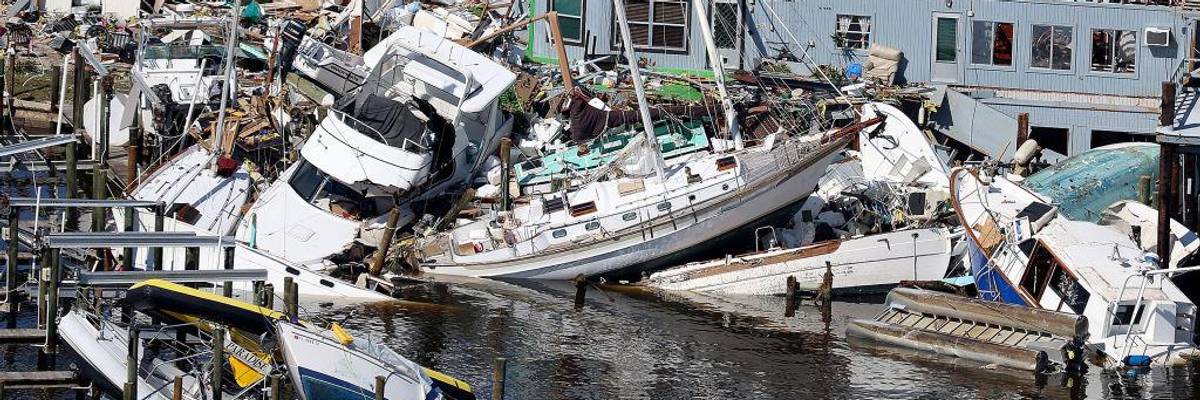
Florida is crazy about resiliency. The word is everywhere, because hurricanes, rising seas, erosion, disappearing beaches and downtowns flooding on sunny days are everywhere. The elected need to look like they’re doing something about it. So here comes resiliency. It’s got toughness, machismo, lilt. The syllables surf off the tongue with just enough self-importance for a word coined in mid-17th century England that our right honorable Gov. DeSantis thinks it’ll power Florida through the catastrophes of the 21st. He’s plastering the word everywhere like wonder whitewash.
 Except that resiliency in Florida is a crock. The state is throwing millions, soon to be billions, at the consequences of global warming. It’s not doing a damn thing about its part in causing global warming. Until then, the state is as good as complicit in its coastal communities’ destruction–maliciously so, because this isn’t mere negligence. It’s active, vindictive denialism. The language of climate change–like so much else in this administration–is censored from all DeSantis playbooks.
Lawmakers and most local governments, certainly in Flagler, self-censor along, to not upset the money spigot. Paul Renner, Flagler County’s own representative and the Speaker of the House, is on the warpath against corporations foolish enough to be socially responsible. He attacks them for “favoring investment in green energy over fossil fuels” (his words).
Florida’s role in warming the planet isn;t small. It is the nation’s fourth largest economy. If it were its own country, it would be the 15th largest economy in the world, just ahead of Mexico and just behind Spain. It also spews more greenhouse gasses than 80 percent of the planet’s countries. Its answer to that? Nothing. Absolutely nothing. It’s replacing–and preventing–actively combating global warming with the fraud of resiliency.
Ironically, the word has often been used to describe the resiliency of ecosystems, of the Amazon forest, of oceans, or the ozone layer in the face of human destruction. Give nature a chance, help it along just a bit (as we somehow managed to do with the ozone layer), go easier on greenhouse emissions, and it’ll reward you tenfold. That’s natural resiliency.
Resiliency in Florida is at best an illusion, and at worst a suicide pact between state and local governments.
Florida hijacked the word, branding it on precisely the human factors that exploit and damage nature and exacerbate warming: concrete, overdevelopment, rebuilding fatter and meaner along the shore and in flood plains, and of course contempt for anything that might help nature along. In Florida, you not only don’t say gay. You don’t say climate change.
In the wake of hurricanes Ian and Nicole, when DeSantis used the shredded coastline in Flagler as a campaign backdrop, he and Kevin Guthrie, the state’s emergency management director, were asked about any lessons learned by the catastrophes. They sounded like Biden administration ambassadors: build back better. That was their message. Amend coastal building code regulations? Flood plain regulations? Discourage building a (vanished) dune’s length from shore? Never. That would be un-American. Keep building. Higher. Bigger. Fatter. Resilience.
Three days ago an article ran in these pages with this opening paragraph: “California is embarking on an audacious new climate plan that aims to eliminate the state’s greenhouse gas footprint by 2045, and in the process, slash emissions far beyond its borders. The blueprint calls for massive transformations in industry, energy and transportation, as well as changes in institutions and human behaviors.” The article, by a Californian deeply involved in the effort, goes on to note that what California does, many states and countries emulate, for the better.
We have a governor more intent on turning the clock back to 1950 Florida than he is concerned about how close the ocean will be to our homes by 2050.
Naturally, the response by some was to pull the ideological parroting of neo-fascist media and deflect to California’s homeless, migrant and housing crises, because we must always be sure never to imagine that another state, a blue one at that, could be doing better that affects us directly: if sea levels are to rise a smidge slower in the next half century, we’ll have Sacramento to thank, not Tallahassee.
What are we doing in Florida? We’re policing the speech of teachers and professors. We’re banning books. We’re sanitizing history. We’re obsessing about drag queens. We have a governor more intent on turning the clock back to 1950 Florida than he is concerned about how close the ocean will be to our homes by 2050.
Meanwhile, we have scenes like we had last week in Flagler Beach, with the Department of Transportation showing how we’ll once again rebuild and strengthen A1A. We have the Army Corps of Engineers waiting for a fifth year to rebuild a couple of miles of what used to be a beach in Flagler Beach. We have Flagler County government yet again rebuilding dunes at the north end of the county, four years after dumping $20 million in an identical effort that washed out to sea. All great and needed efforts, even as all of them toadying the same talking points about resiliency. But without the state doing its part to tackle the crisis at its root, to combine resiliency with a war on greenhouse gasses, Florida is only waging a war against its own.
That’s why resiliency in Florida is at best an illusion, and at worst a suicide pact between state and local governments. It’s borrowed time, wasted money and a scam on a catastrophic scale, because the state is in denial about an existential fact: seas are rising, and nothing but collective action by the planet’s biggest polluters, Florida among them, can hope to slow the calamity. Instead, DeSantis’s triumphalist Florida thinks it can build, burn and ignore its way out of it. The fraud is nothing but catastrophes deferred.
Florida is crazy about resiliency. The word is everywhere, because hurricanes, rising seas, erosion, disappearing beaches and downtowns flooding on sunny days are everywhere. The elected need to look like they’re doing something about it. So here comes resiliency. It’s got toughness, machismo, lilt. The syllables surf off the tongue with just enough self-importance for a word coined in mid-17th century England that our right honorable Gov. DeSantis thinks it’ll power Florida through the catastrophes of the 21st. He’s plastering the word everywhere like wonder whitewash.
Except that resiliency in Florida is a crock. The state is throwing millions, soon to be billions, at the consequences of global warming. It’s not doing a damn thing about its part in causing global warming. Until then, the state is as good as complicit in its coastal communities’ destruction–maliciously so, because this isn’t mere negligence. It’s active, vindictive denialism. The language of climate change–like so much else in this administration–is censored from all DeSantis playbooks.
Lawmakers and most local governments, certainly in Flagler, self-censor along, to not upset the money spigot. Paul Renner, Flagler County’s own representative and the Speaker of the House, is on the warpath against corporations foolish enough to be socially responsible. He attacks them for “favoring investment in green energy over fossil fuels” (his words).
Florida’s role in warming the planet isn;t small. It is the nation’s fourth largest economy. If it were its own country, it would be the 15th largest economy in the world, just ahead of Mexico and just behind Spain. It also spews more greenhouse gasses than 80 percent of the planet’s countries. Its answer to that? Nothing. Absolutely nothing. It’s replacing–and preventing–actively combating global warming with the fraud of resiliency.
Ironically, the word has often been used to describe the resiliency of ecosystems, of the Amazon forest, of oceans, or the ozone layer in the face of human destruction. Give nature a chance, help it along just a bit (as we somehow managed to do with the ozone layer), go easier on greenhouse emissions, and it’ll reward you tenfold. That’s natural resiliency.
Resiliency in Florida is at best an illusion, and at worst a suicide pact between state and local governments.
Florida hijacked the word, branding it on precisely the human factors that exploit and damage nature and exacerbate warming: concrete, overdevelopment, rebuilding fatter and meaner along the shore and in flood plains, and of course contempt for anything that might help nature along. In Florida, you not only don’t say gay. You don’t say climate change.
In the wake of hurricanes Ian and Nicole, when DeSantis used the shredded coastline in Flagler as a campaign backdrop, he and Kevin Guthrie, the state’s emergency management director, were asked about any lessons learned by the catastrophes. They sounded like Biden administration ambassadors: build back better. That was their message. Amend coastal building code regulations? Flood plain regulations? Discourage building a (vanished) dune’s length from shore? Never. That would be un-American. Keep building. Higher. Bigger. Fatter. Resilience.
Three days ago an article ran in these pages with this opening paragraph: “California is embarking on an audacious new climate plan that aims to eliminate the state’s greenhouse gas footprint by 2045, and in the process, slash emissions far beyond its borders. The blueprint calls for massive transformations in industry, energy and transportation, as well as changes in institutions and human behaviors.” The article, by a Californian deeply involved in the effort, goes on to note that what California does, many states and countries emulate, for the better.
We have a governor more intent on turning the clock back to 1950 Florida than he is concerned about how close the ocean will be to our homes by 2050.
Naturally, the response by some was to pull the ideological parroting of neo-fascist media and deflect to California’s homeless, migrant and housing crises, because we must always be sure never to imagine that another state, a blue one at that, could be doing better that affects us directly: if sea levels are to rise a smidge slower in the next half century, we’ll have Sacramento to thank, not Tallahassee.
What are we doing in Florida? We’re policing the speech of teachers and professors. We’re banning books. We’re sanitizing history. We’re obsessing about drag queens. We have a governor more intent on turning the clock back to 1950 Florida than he is concerned about how close the ocean will be to our homes by 2050.
Meanwhile, we have scenes like we had last week in Flagler Beach, with the Department of Transportation showing how we’ll once again rebuild and strengthen A1A. We have the Army Corps of Engineers waiting for a fifth year to rebuild a couple of miles of what used to be a beach in Flagler Beach. We have Flagler County government yet again rebuilding dunes at the north end of the county, four years after dumping $20 million in an identical effort that washed out to sea. All great and needed efforts, even as all of them toadying the same talking points about resiliency. But without the state doing its part to tackle the crisis at its root, to combine resiliency with a war on greenhouse gasses, Florida is only waging a war against its own.
That’s why resiliency in Florida is at best an illusion, and at worst a suicide pact between state and local governments. It’s borrowed time, wasted money and a scam on a catastrophic scale, because the state is in denial about an existential fact: seas are rising, and nothing but collective action by the planet’s biggest polluters, Florida among them, can hope to slow the calamity. Instead, DeSantis’s triumphalist Florida thinks it can build, burn and ignore its way out of it. The fraud is nothing but catastrophes deferred.
- How This Solar Town Survived Hurricane Ian Shows the Promise of a Green Energy Future ›
- Opinion | Florida Isn’t Teaching Its Students About the Climate Crisis Threatening the State’s Survival | Common Dreams ›
- Opinion | Climate Week Is Here; Our Governors Are Still Siding with Polluters | Common Dreams ›
Florida is crazy about resiliency. The word is everywhere, because hurricanes, rising seas, erosion, disappearing beaches and downtowns flooding on sunny days are everywhere. The elected need to look like they’re doing something about it. So here comes resiliency. It’s got toughness, machismo, lilt. The syllables surf off the tongue with just enough self-importance for a word coined in mid-17th century England that our right honorable Gov. DeSantis thinks it’ll power Florida through the catastrophes of the 21st. He’s plastering the word everywhere like wonder whitewash.
Except that resiliency in Florida is a crock. The state is throwing millions, soon to be billions, at the consequences of global warming. It’s not doing a damn thing about its part in causing global warming. Until then, the state is as good as complicit in its coastal communities’ destruction–maliciously so, because this isn’t mere negligence. It’s active, vindictive denialism. The language of climate change–like so much else in this administration–is censored from all DeSantis playbooks.
Lawmakers and most local governments, certainly in Flagler, self-censor along, to not upset the money spigot. Paul Renner, Flagler County’s own representative and the Speaker of the House, is on the warpath against corporations foolish enough to be socially responsible. He attacks them for “favoring investment in green energy over fossil fuels” (his words).
Florida’s role in warming the planet isn;t small. It is the nation’s fourth largest economy. If it were its own country, it would be the 15th largest economy in the world, just ahead of Mexico and just behind Spain. It also spews more greenhouse gasses than 80 percent of the planet’s countries. Its answer to that? Nothing. Absolutely nothing. It’s replacing–and preventing–actively combating global warming with the fraud of resiliency.
Ironically, the word has often been used to describe the resiliency of ecosystems, of the Amazon forest, of oceans, or the ozone layer in the face of human destruction. Give nature a chance, help it along just a bit (as we somehow managed to do with the ozone layer), go easier on greenhouse emissions, and it’ll reward you tenfold. That’s natural resiliency.
Resiliency in Florida is at best an illusion, and at worst a suicide pact between state and local governments.
Florida hijacked the word, branding it on precisely the human factors that exploit and damage nature and exacerbate warming: concrete, overdevelopment, rebuilding fatter and meaner along the shore and in flood plains, and of course contempt for anything that might help nature along. In Florida, you not only don’t say gay. You don’t say climate change.
In the wake of hurricanes Ian and Nicole, when DeSantis used the shredded coastline in Flagler as a campaign backdrop, he and Kevin Guthrie, the state’s emergency management director, were asked about any lessons learned by the catastrophes. They sounded like Biden administration ambassadors: build back better. That was their message. Amend coastal building code regulations? Flood plain regulations? Discourage building a (vanished) dune’s length from shore? Never. That would be un-American. Keep building. Higher. Bigger. Fatter. Resilience.
Three days ago an article ran in these pages with this opening paragraph: “California is embarking on an audacious new climate plan that aims to eliminate the state’s greenhouse gas footprint by 2045, and in the process, slash emissions far beyond its borders. The blueprint calls for massive transformations in industry, energy and transportation, as well as changes in institutions and human behaviors.” The article, by a Californian deeply involved in the effort, goes on to note that what California does, many states and countries emulate, for the better.
We have a governor more intent on turning the clock back to 1950 Florida than he is concerned about how close the ocean will be to our homes by 2050.
Naturally, the response by some was to pull the ideological parroting of neo-fascist media and deflect to California’s homeless, migrant and housing crises, because we must always be sure never to imagine that another state, a blue one at that, could be doing better that affects us directly: if sea levels are to rise a smidge slower in the next half century, we’ll have Sacramento to thank, not Tallahassee.
What are we doing in Florida? We’re policing the speech of teachers and professors. We’re banning books. We’re sanitizing history. We’re obsessing about drag queens. We have a governor more intent on turning the clock back to 1950 Florida than he is concerned about how close the ocean will be to our homes by 2050.
Meanwhile, we have scenes like we had last week in Flagler Beach, with the Department of Transportation showing how we’ll once again rebuild and strengthen A1A. We have the Army Corps of Engineers waiting for a fifth year to rebuild a couple of miles of what used to be a beach in Flagler Beach. We have Flagler County government yet again rebuilding dunes at the north end of the county, four years after dumping $20 million in an identical effort that washed out to sea. All great and needed efforts, even as all of them toadying the same talking points about resiliency. But without the state doing its part to tackle the crisis at its root, to combine resiliency with a war on greenhouse gasses, Florida is only waging a war against its own.
That’s why resiliency in Florida is at best an illusion, and at worst a suicide pact between state and local governments. It’s borrowed time, wasted money and a scam on a catastrophic scale, because the state is in denial about an existential fact: seas are rising, and nothing but collective action by the planet’s biggest polluters, Florida among them, can hope to slow the calamity. Instead, DeSantis’s triumphalist Florida thinks it can build, burn and ignore its way out of it. The fraud is nothing but catastrophes deferred.
- How This Solar Town Survived Hurricane Ian Shows the Promise of a Green Energy Future ›
- Opinion | Florida Isn’t Teaching Its Students About the Climate Crisis Threatening the State’s Survival | Common Dreams ›
- Opinion | Climate Week Is Here; Our Governors Are Still Siding with Polluters | Common Dreams ›