5
#000000
#FFFFFF
To donate by check, phone, or other method, see our More Ways to Give page.
Daily news & progressive opinion—funded by the people, not the corporations—delivered straight to your inbox.
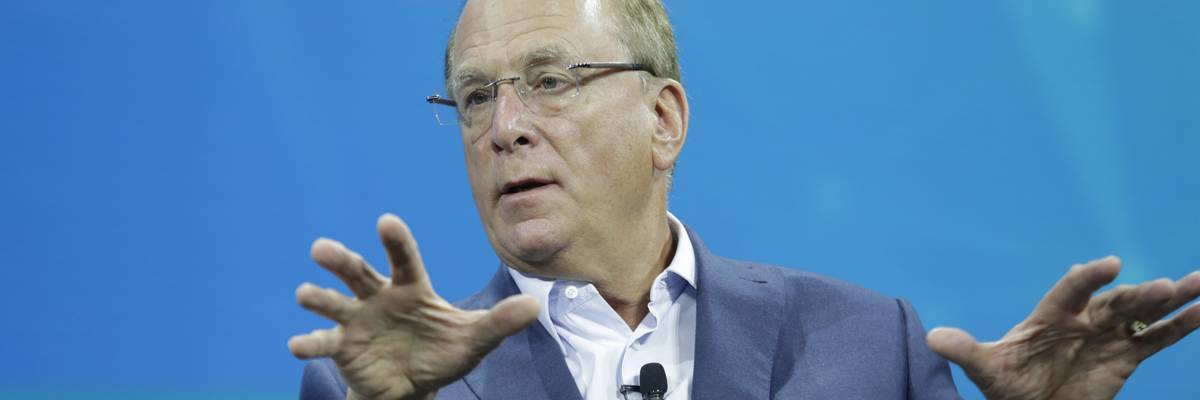
Larry Fink speaks on stage at the 2022 New York Times DealBook on November 30, 2022 in New York City.
For a brief moment, lots of financial leaders said they were going to take steps to address climate change, but when Big Oil pushed back with the help the GOP, they turned tail and ran. It's time for them to turn and fight.
Any resistance needs to celebrate its victories, and the weekend’s retreat by the administration is a big one: Should the forces of decency ever regain the upper hand in DC, we need a monument to the people of Minneapolis on the National Mall, and busts of Renee Good and Alex Pretti in the Capitol.
And it’s not just the Trump administration that those brave people faced down, it’s the pundit class too, who insisted over and over that progressives should avoid talking about immigration because it wasn’t politically popular. The other subject we’ve been told to sideline is “climate change,” for fear of offending voters more interested in “affordability.” (Former Energy Secretary Jennifer Granholm told an industry audience Monday that “on Maslow’s hierarchy of human needs, climate does not rise as much as how much I'm paying for my electricity bill,” which is one of those things that sounds clever until you meet someone who lost their home to a wildfire.)
I actually have no problem with the advice to focus on electric bills—as I wrote a couple of weeks ago, I think affordability, especially of electricity, is an issue that helps both elect Democrats and reduce carbon emissions, since anyone interested in the cost of power is going to be building sun and wind. But I also don’t think that talking about global warming is a mistake—most Americans, polls show, understand the nature of the crisis, and want action to stem it. It isn’t the single most salient issue because all of us live in this particular moment (and in this particular moment the fact that federal agents are executing citizens who dare to take cell phone pictures of them is definitely the most salient issue) but it is nonetheless a net plus for politicians, especially in blue states.
As we were reminded Tuesday morning, when Drew Warshaw, a candidate for New York state comptroller with a long record of building clean energy in the private sector, released a true bombshell report. In it he called for the state to divest its vast pension funds from fossil fuels—and provided the data to show that the failure of the incumbent to do that over the last two decades had cost taxpayers $15 billion in foregone returns. Billion with a b. That’s $750 for every woman, man, and child in the Empire State, all because the longstanding (as in, way too long) state treasurer, Thomas DiNapoli, has ignored the counsel of one expert after another and kept the state invested in Big Oil. (Oh, and since cowardice often consorts with incompetence, another report also finds that DiNapoli has cost the state more than $50 billion by underperforming index funds and giving huge contracts to various advisers.
Always remember, most of the nation’s economy is in places that voted against Trump. It’s a weapon that needs to be used.
A bit of backstory here. Fifteen years ago, some of us launched a fossil fuel divestment campaign. At the beginning the argument was mostly moral: It was wrong to try and make a profit off the end of the world, and if we could convince institutions to sell that stock it would tarnish Big Fossil’s social license.
But it didn’t take long for another argument to emerge. The pension funds, college endowments, and others who joined the movement reported that they were making money as a result, and for a very simple reason: Anything that they put the money into was generating better returns than coal, gas, and oil. And that in turn was for an even simpler reason: Fossil fuel is a faltering industry, because an alternative—the trinity of sun, wind, and batteries—now produces the same product, just cleaner and cheaper. That’s why 95% of new generating capacity around the world last year came from renewables; fossil fuel only has a good year any more if something goes very wrong (the invasion of Ukraine, say).
Anyway, this became the largest anti-corporate effort of its kind in history, with funds representing $41 trillion in investments joining in. Its had powerful effects—when Peabody Coal filed for bankruptcy, for instance, its legal documents listed divestment as a reason. But it also protected the fiscal integrity of the funds that did the right thing—they had more money to pay pensions, provide scholarships, or whatever else. That’s why pension funds in states and entire countries joined in.
Which brings us back to New York. Advocates have put in tens of thousands of person hours explaining to DiNapoli that he should join pension funds in dozens of other places in divesting from fossil fuels, and he has dragged his feet at every turn, with half-measures, occasional strongly-worded letters, and the rest: He is the Chuck Schumer of finance. As Warshaw’s report puts it:
When an investment, and in this case a whole sector of investments, fails to perform over a long period of time and show no realistic signs of turning around, investment managers need to act. Each market cycle over the last two decades has left in its wake less value for fossil fuel companies and less value for fossil fuel investors. This value erosion and strong headwind threats are at the heart of the divestment argument. Why continue to invest in an industry that is now only 2.8% of the market with no plausible strategy to turn things around and a corporate culture that simply that denies the problem even exists? Investment managers need to focus their time on maximizing risk-adjusted returns, not engaging in politically-driven wishful thinking for an industry in permanent decline.
DiNapoli is not alone in his cowardice, of course. For a brief moment—when they were scared by the emergence of Greta’s worldwide movement before the pandemic—lots of financial leaders said they were going to take steps to address climate change. BlackRock, for instance, the biggest investor in the world, which has the power should it choose to use it, to make vast change fast. (BlackRock’s wealth is roughly twice the continent of Africa’s). Here’s what Larry Fink, CEO of BlackRock, said in 2020:
Climate change has become a defining factor in companies’ long-term prospects. Last September, when millions of people took to the streets to demand action on climate change, many of them emphasized the significant and lasting impact that it will have on economic growth and prosperity–a risk that markets to date have been slower to reflect. But awareness is rapidly changing, and I believe we are on the edge of a fundamental reshaping of finance.
The evidence on climate risk is compelling investors to reassess core assumptions about modern finance. Research from a wide range of organizations–including the UN’s Intergovernmental Panel on Climate Change, the BlackRock Investment Institute, and many others, including new studies from McKinsey on the socioeconomic implications of physical climate risk–is deepening our understanding of how climate risk will impact both our physical world and the global system that finances economic growth.
Will cities, for example, be able to afford their infrastructure needs as climate risk reshapes the market for municipal bonds? What will happen to the 30-year mortgage–a key building block of finance–if lenders can’t estimate the impact of climate risk over such a long timeline, and if there is no viable market for flood or fire insurance in impacted areas? What happens to inflation, and in turn interest rates, if the cost of food climbs from drought and flooding? How can we model economic growth if emerging markets see their productivity decline due to extreme heat and other climate impacts?
Investors are increasingly reckoning with these questions and recognizing that climate risk is investment risk.
But then what happened? Big Oil pushed back, in the form of red state treasurers promising to pull their money from BlackRock. Suddenly Fink turned tail and ran. By now he’s part of President Donald Trump’s inner circle. As Pilita Clark explained in that radical journal the Financial Times over the weekend, DiNapoli and Fink’s failure of courage is endemic across too much of the American elite landscape:
This failure is not due to a shortage of scientific understanding or technological breakthroughs. It is because we lack the political changes needed to put financial systems and economies on to paths that avoid burning fossil fuels. Achieving those changes is inordinately difficult.
Public support from large businesses is important. Ultimately, staying quiet at a time like this is self-defeating. It undermines the global institutions needed to address a growing global climate problem that poses serious financial threats.
David Gelles, in the Times, has another sad account of this collective failure of nerve on Wall Street, and it’s well worth reading. As he writes:
Republican legislatures around the country introduced more than 100 bills to penalize financial companies that supported ESG practices. Republican state treasurers around the country began pulling money out.
This is the company DiNapoli keeps, and the people he apparently listens to—again, he’s a lot more like Chuck Schumer than he should be. So it’s very good news that insurgent candidate Warshaw is talking about bringing New York State’s financial might to bear—in part because it amplifies the message being sent by Mark Levine, new comptroller of the city of New York. Levine’s predecessor Brad Lander, who already led the divestment from fossil fuel companies, late in his tenure called for the city to ditch BlackRock, and Levine seems to be interested in following through.
Together, the pension funds of New York City and New York state control far more resources than the funds of the various red states combined. If they manage to put effective pressure on the oil industry and the finance industry, it will have enormous impact—it will aid enormously in the climate fight and it will undercut Trump. And it will encourage other blue state leaders to do likewise: Always remember, most of the nation’s economy is in places that voted against Trump. It’s a weapon that needs to be used.
And New York can do so without putting anyone’s pension at risk—under the Empire State’s laws, the comptroller has to pay pensions in full no matter what happens to his investment portfolio, so there’s no danger Warshaw will do anything except save taxpayers large sums of money. (And Warshaw is not alone; the other Dem in the primary, Raj Goyle, has called for divestment too, though not with the same depth of analysis). This is a no-brainer, except if you’re stuck in your ways.
I helped found an organization devoted to elder action on behalf of climate and democracy; obviously I don’t think age disqualifies one from office. But DiNapoli is 71 and he represents the greatest danger of long tenure in office: a stultification of ideas, an inability to see new facts, a stubborn attachment to old ideas. It’s time for him, finally, to get out of the way, or to be voted out.
The climate fight, even in this country, is very far from over. The basic premise of that battle—that we must move swiftly away from the moral and financial sinkhole of Big Oil—is still clear and powerful.
Dear Common Dreams reader, It’s been nearly 30 years since I co-founded Common Dreams with my late wife, Lina Newhouser. We had the radical notion that journalism should serve the public good, not corporate profits. It was clear to us from the outset what it would take to build such a project. No paid advertisements. No corporate sponsors. No millionaire publisher telling us what to think or do. Many people said we wouldn't last a year, but we proved those doubters wrong. Together with a tremendous team of journalists and dedicated staff, we built an independent media outlet free from the constraints of profits and corporate control. Our mission has always been simple: To inform. To inspire. To ignite change for the common good. Building Common Dreams was not easy. Our survival was never guaranteed. When you take on the most powerful forces—Wall Street greed, fossil fuel industry destruction, Big Tech lobbyists, and uber-rich oligarchs who have spent billions upon billions rigging the economy and democracy in their favor—the only bulwark you have is supporters who believe in your work. But here’s the urgent message from me today. It's never been this bad out there. And it's never been this hard to keep us going. At the very moment Common Dreams is most needed, the threats we face are intensifying. We need your support now more than ever. We don't accept corporate advertising and never will. We don't have a paywall because we don't think people should be blocked from critical news based on their ability to pay. Everything we do is funded by the donations of readers like you. When everyone does the little they can afford, we are strong. But if that support retreats or dries up, so do we. Will you donate now to make sure Common Dreams not only survives but thrives? —Craig Brown, Co-founder |
Any resistance needs to celebrate its victories, and the weekend’s retreat by the administration is a big one: Should the forces of decency ever regain the upper hand in DC, we need a monument to the people of Minneapolis on the National Mall, and busts of Renee Good and Alex Pretti in the Capitol.
And it’s not just the Trump administration that those brave people faced down, it’s the pundit class too, who insisted over and over that progressives should avoid talking about immigration because it wasn’t politically popular. The other subject we’ve been told to sideline is “climate change,” for fear of offending voters more interested in “affordability.” (Former Energy Secretary Jennifer Granholm told an industry audience Monday that “on Maslow’s hierarchy of human needs, climate does not rise as much as how much I'm paying for my electricity bill,” which is one of those things that sounds clever until you meet someone who lost their home to a wildfire.)
I actually have no problem with the advice to focus on electric bills—as I wrote a couple of weeks ago, I think affordability, especially of electricity, is an issue that helps both elect Democrats and reduce carbon emissions, since anyone interested in the cost of power is going to be building sun and wind. But I also don’t think that talking about global warming is a mistake—most Americans, polls show, understand the nature of the crisis, and want action to stem it. It isn’t the single most salient issue because all of us live in this particular moment (and in this particular moment the fact that federal agents are executing citizens who dare to take cell phone pictures of them is definitely the most salient issue) but it is nonetheless a net plus for politicians, especially in blue states.
As we were reminded Tuesday morning, when Drew Warshaw, a candidate for New York state comptroller with a long record of building clean energy in the private sector, released a true bombshell report. In it he called for the state to divest its vast pension funds from fossil fuels—and provided the data to show that the failure of the incumbent to do that over the last two decades had cost taxpayers $15 billion in foregone returns. Billion with a b. That’s $750 for every woman, man, and child in the Empire State, all because the longstanding (as in, way too long) state treasurer, Thomas DiNapoli, has ignored the counsel of one expert after another and kept the state invested in Big Oil. (Oh, and since cowardice often consorts with incompetence, another report also finds that DiNapoli has cost the state more than $50 billion by underperforming index funds and giving huge contracts to various advisers.
Always remember, most of the nation’s economy is in places that voted against Trump. It’s a weapon that needs to be used.
A bit of backstory here. Fifteen years ago, some of us launched a fossil fuel divestment campaign. At the beginning the argument was mostly moral: It was wrong to try and make a profit off the end of the world, and if we could convince institutions to sell that stock it would tarnish Big Fossil’s social license.
But it didn’t take long for another argument to emerge. The pension funds, college endowments, and others who joined the movement reported that they were making money as a result, and for a very simple reason: Anything that they put the money into was generating better returns than coal, gas, and oil. And that in turn was for an even simpler reason: Fossil fuel is a faltering industry, because an alternative—the trinity of sun, wind, and batteries—now produces the same product, just cleaner and cheaper. That’s why 95% of new generating capacity around the world last year came from renewables; fossil fuel only has a good year any more if something goes very wrong (the invasion of Ukraine, say).
Anyway, this became the largest anti-corporate effort of its kind in history, with funds representing $41 trillion in investments joining in. Its had powerful effects—when Peabody Coal filed for bankruptcy, for instance, its legal documents listed divestment as a reason. But it also protected the fiscal integrity of the funds that did the right thing—they had more money to pay pensions, provide scholarships, or whatever else. That’s why pension funds in states and entire countries joined in.
Which brings us back to New York. Advocates have put in tens of thousands of person hours explaining to DiNapoli that he should join pension funds in dozens of other places in divesting from fossil fuels, and he has dragged his feet at every turn, with half-measures, occasional strongly-worded letters, and the rest: He is the Chuck Schumer of finance. As Warshaw’s report puts it:
When an investment, and in this case a whole sector of investments, fails to perform over a long period of time and show no realistic signs of turning around, investment managers need to act. Each market cycle over the last two decades has left in its wake less value for fossil fuel companies and less value for fossil fuel investors. This value erosion and strong headwind threats are at the heart of the divestment argument. Why continue to invest in an industry that is now only 2.8% of the market with no plausible strategy to turn things around and a corporate culture that simply that denies the problem even exists? Investment managers need to focus their time on maximizing risk-adjusted returns, not engaging in politically-driven wishful thinking for an industry in permanent decline.
DiNapoli is not alone in his cowardice, of course. For a brief moment—when they were scared by the emergence of Greta’s worldwide movement before the pandemic—lots of financial leaders said they were going to take steps to address climate change. BlackRock, for instance, the biggest investor in the world, which has the power should it choose to use it, to make vast change fast. (BlackRock’s wealth is roughly twice the continent of Africa’s). Here’s what Larry Fink, CEO of BlackRock, said in 2020:
Climate change has become a defining factor in companies’ long-term prospects. Last September, when millions of people took to the streets to demand action on climate change, many of them emphasized the significant and lasting impact that it will have on economic growth and prosperity–a risk that markets to date have been slower to reflect. But awareness is rapidly changing, and I believe we are on the edge of a fundamental reshaping of finance.
The evidence on climate risk is compelling investors to reassess core assumptions about modern finance. Research from a wide range of organizations–including the UN’s Intergovernmental Panel on Climate Change, the BlackRock Investment Institute, and many others, including new studies from McKinsey on the socioeconomic implications of physical climate risk–is deepening our understanding of how climate risk will impact both our physical world and the global system that finances economic growth.
Will cities, for example, be able to afford their infrastructure needs as climate risk reshapes the market for municipal bonds? What will happen to the 30-year mortgage–a key building block of finance–if lenders can’t estimate the impact of climate risk over such a long timeline, and if there is no viable market for flood or fire insurance in impacted areas? What happens to inflation, and in turn interest rates, if the cost of food climbs from drought and flooding? How can we model economic growth if emerging markets see their productivity decline due to extreme heat and other climate impacts?
Investors are increasingly reckoning with these questions and recognizing that climate risk is investment risk.
But then what happened? Big Oil pushed back, in the form of red state treasurers promising to pull their money from BlackRock. Suddenly Fink turned tail and ran. By now he’s part of President Donald Trump’s inner circle. As Pilita Clark explained in that radical journal the Financial Times over the weekend, DiNapoli and Fink’s failure of courage is endemic across too much of the American elite landscape:
This failure is not due to a shortage of scientific understanding or technological breakthroughs. It is because we lack the political changes needed to put financial systems and economies on to paths that avoid burning fossil fuels. Achieving those changes is inordinately difficult.
Public support from large businesses is important. Ultimately, staying quiet at a time like this is self-defeating. It undermines the global institutions needed to address a growing global climate problem that poses serious financial threats.
David Gelles, in the Times, has another sad account of this collective failure of nerve on Wall Street, and it’s well worth reading. As he writes:
Republican legislatures around the country introduced more than 100 bills to penalize financial companies that supported ESG practices. Republican state treasurers around the country began pulling money out.
This is the company DiNapoli keeps, and the people he apparently listens to—again, he’s a lot more like Chuck Schumer than he should be. So it’s very good news that insurgent candidate Warshaw is talking about bringing New York State’s financial might to bear—in part because it amplifies the message being sent by Mark Levine, new comptroller of the city of New York. Levine’s predecessor Brad Lander, who already led the divestment from fossil fuel companies, late in his tenure called for the city to ditch BlackRock, and Levine seems to be interested in following through.
Together, the pension funds of New York City and New York state control far more resources than the funds of the various red states combined. If they manage to put effective pressure on the oil industry and the finance industry, it will have enormous impact—it will aid enormously in the climate fight and it will undercut Trump. And it will encourage other blue state leaders to do likewise: Always remember, most of the nation’s economy is in places that voted against Trump. It’s a weapon that needs to be used.
And New York can do so without putting anyone’s pension at risk—under the Empire State’s laws, the comptroller has to pay pensions in full no matter what happens to his investment portfolio, so there’s no danger Warshaw will do anything except save taxpayers large sums of money. (And Warshaw is not alone; the other Dem in the primary, Raj Goyle, has called for divestment too, though not with the same depth of analysis). This is a no-brainer, except if you’re stuck in your ways.
I helped found an organization devoted to elder action on behalf of climate and democracy; obviously I don’t think age disqualifies one from office. But DiNapoli is 71 and he represents the greatest danger of long tenure in office: a stultification of ideas, an inability to see new facts, a stubborn attachment to old ideas. It’s time for him, finally, to get out of the way, or to be voted out.
The climate fight, even in this country, is very far from over. The basic premise of that battle—that we must move swiftly away from the moral and financial sinkhole of Big Oil—is still clear and powerful.
Any resistance needs to celebrate its victories, and the weekend’s retreat by the administration is a big one: Should the forces of decency ever regain the upper hand in DC, we need a monument to the people of Minneapolis on the National Mall, and busts of Renee Good and Alex Pretti in the Capitol.
And it’s not just the Trump administration that those brave people faced down, it’s the pundit class too, who insisted over and over that progressives should avoid talking about immigration because it wasn’t politically popular. The other subject we’ve been told to sideline is “climate change,” for fear of offending voters more interested in “affordability.” (Former Energy Secretary Jennifer Granholm told an industry audience Monday that “on Maslow’s hierarchy of human needs, climate does not rise as much as how much I'm paying for my electricity bill,” which is one of those things that sounds clever until you meet someone who lost their home to a wildfire.)
I actually have no problem with the advice to focus on electric bills—as I wrote a couple of weeks ago, I think affordability, especially of electricity, is an issue that helps both elect Democrats and reduce carbon emissions, since anyone interested in the cost of power is going to be building sun and wind. But I also don’t think that talking about global warming is a mistake—most Americans, polls show, understand the nature of the crisis, and want action to stem it. It isn’t the single most salient issue because all of us live in this particular moment (and in this particular moment the fact that federal agents are executing citizens who dare to take cell phone pictures of them is definitely the most salient issue) but it is nonetheless a net plus for politicians, especially in blue states.
As we were reminded Tuesday morning, when Drew Warshaw, a candidate for New York state comptroller with a long record of building clean energy in the private sector, released a true bombshell report. In it he called for the state to divest its vast pension funds from fossil fuels—and provided the data to show that the failure of the incumbent to do that over the last two decades had cost taxpayers $15 billion in foregone returns. Billion with a b. That’s $750 for every woman, man, and child in the Empire State, all because the longstanding (as in, way too long) state treasurer, Thomas DiNapoli, has ignored the counsel of one expert after another and kept the state invested in Big Oil. (Oh, and since cowardice often consorts with incompetence, another report also finds that DiNapoli has cost the state more than $50 billion by underperforming index funds and giving huge contracts to various advisers.
Always remember, most of the nation’s economy is in places that voted against Trump. It’s a weapon that needs to be used.
A bit of backstory here. Fifteen years ago, some of us launched a fossil fuel divestment campaign. At the beginning the argument was mostly moral: It was wrong to try and make a profit off the end of the world, and if we could convince institutions to sell that stock it would tarnish Big Fossil’s social license.
But it didn’t take long for another argument to emerge. The pension funds, college endowments, and others who joined the movement reported that they were making money as a result, and for a very simple reason: Anything that they put the money into was generating better returns than coal, gas, and oil. And that in turn was for an even simpler reason: Fossil fuel is a faltering industry, because an alternative—the trinity of sun, wind, and batteries—now produces the same product, just cleaner and cheaper. That’s why 95% of new generating capacity around the world last year came from renewables; fossil fuel only has a good year any more if something goes very wrong (the invasion of Ukraine, say).
Anyway, this became the largest anti-corporate effort of its kind in history, with funds representing $41 trillion in investments joining in. Its had powerful effects—when Peabody Coal filed for bankruptcy, for instance, its legal documents listed divestment as a reason. But it also protected the fiscal integrity of the funds that did the right thing—they had more money to pay pensions, provide scholarships, or whatever else. That’s why pension funds in states and entire countries joined in.
Which brings us back to New York. Advocates have put in tens of thousands of person hours explaining to DiNapoli that he should join pension funds in dozens of other places in divesting from fossil fuels, and he has dragged his feet at every turn, with half-measures, occasional strongly-worded letters, and the rest: He is the Chuck Schumer of finance. As Warshaw’s report puts it:
When an investment, and in this case a whole sector of investments, fails to perform over a long period of time and show no realistic signs of turning around, investment managers need to act. Each market cycle over the last two decades has left in its wake less value for fossil fuel companies and less value for fossil fuel investors. This value erosion and strong headwind threats are at the heart of the divestment argument. Why continue to invest in an industry that is now only 2.8% of the market with no plausible strategy to turn things around and a corporate culture that simply that denies the problem even exists? Investment managers need to focus their time on maximizing risk-adjusted returns, not engaging in politically-driven wishful thinking for an industry in permanent decline.
DiNapoli is not alone in his cowardice, of course. For a brief moment—when they were scared by the emergence of Greta’s worldwide movement before the pandemic—lots of financial leaders said they were going to take steps to address climate change. BlackRock, for instance, the biggest investor in the world, which has the power should it choose to use it, to make vast change fast. (BlackRock’s wealth is roughly twice the continent of Africa’s). Here’s what Larry Fink, CEO of BlackRock, said in 2020:
Climate change has become a defining factor in companies’ long-term prospects. Last September, when millions of people took to the streets to demand action on climate change, many of them emphasized the significant and lasting impact that it will have on economic growth and prosperity–a risk that markets to date have been slower to reflect. But awareness is rapidly changing, and I believe we are on the edge of a fundamental reshaping of finance.
The evidence on climate risk is compelling investors to reassess core assumptions about modern finance. Research from a wide range of organizations–including the UN’s Intergovernmental Panel on Climate Change, the BlackRock Investment Institute, and many others, including new studies from McKinsey on the socioeconomic implications of physical climate risk–is deepening our understanding of how climate risk will impact both our physical world and the global system that finances economic growth.
Will cities, for example, be able to afford their infrastructure needs as climate risk reshapes the market for municipal bonds? What will happen to the 30-year mortgage–a key building block of finance–if lenders can’t estimate the impact of climate risk over such a long timeline, and if there is no viable market for flood or fire insurance in impacted areas? What happens to inflation, and in turn interest rates, if the cost of food climbs from drought and flooding? How can we model economic growth if emerging markets see their productivity decline due to extreme heat and other climate impacts?
Investors are increasingly reckoning with these questions and recognizing that climate risk is investment risk.
But then what happened? Big Oil pushed back, in the form of red state treasurers promising to pull their money from BlackRock. Suddenly Fink turned tail and ran. By now he’s part of President Donald Trump’s inner circle. As Pilita Clark explained in that radical journal the Financial Times over the weekend, DiNapoli and Fink’s failure of courage is endemic across too much of the American elite landscape:
This failure is not due to a shortage of scientific understanding or technological breakthroughs. It is because we lack the political changes needed to put financial systems and economies on to paths that avoid burning fossil fuels. Achieving those changes is inordinately difficult.
Public support from large businesses is important. Ultimately, staying quiet at a time like this is self-defeating. It undermines the global institutions needed to address a growing global climate problem that poses serious financial threats.
David Gelles, in the Times, has another sad account of this collective failure of nerve on Wall Street, and it’s well worth reading. As he writes:
Republican legislatures around the country introduced more than 100 bills to penalize financial companies that supported ESG practices. Republican state treasurers around the country began pulling money out.
This is the company DiNapoli keeps, and the people he apparently listens to—again, he’s a lot more like Chuck Schumer than he should be. So it’s very good news that insurgent candidate Warshaw is talking about bringing New York State’s financial might to bear—in part because it amplifies the message being sent by Mark Levine, new comptroller of the city of New York. Levine’s predecessor Brad Lander, who already led the divestment from fossil fuel companies, late in his tenure called for the city to ditch BlackRock, and Levine seems to be interested in following through.
Together, the pension funds of New York City and New York state control far more resources than the funds of the various red states combined. If they manage to put effective pressure on the oil industry and the finance industry, it will have enormous impact—it will aid enormously in the climate fight and it will undercut Trump. And it will encourage other blue state leaders to do likewise: Always remember, most of the nation’s economy is in places that voted against Trump. It’s a weapon that needs to be used.
And New York can do so without putting anyone’s pension at risk—under the Empire State’s laws, the comptroller has to pay pensions in full no matter what happens to his investment portfolio, so there’s no danger Warshaw will do anything except save taxpayers large sums of money. (And Warshaw is not alone; the other Dem in the primary, Raj Goyle, has called for divestment too, though not with the same depth of analysis). This is a no-brainer, except if you’re stuck in your ways.
I helped found an organization devoted to elder action on behalf of climate and democracy; obviously I don’t think age disqualifies one from office. But DiNapoli is 71 and he represents the greatest danger of long tenure in office: a stultification of ideas, an inability to see new facts, a stubborn attachment to old ideas. It’s time for him, finally, to get out of the way, or to be voted out.
The climate fight, even in this country, is very far from over. The basic premise of that battle—that we must move swiftly away from the moral and financial sinkhole of Big Oil—is still clear and powerful.