SUBSCRIBE TO OUR FREE NEWSLETTER
Daily news & progressive opinion—funded by the people, not the corporations—delivered straight to your inbox.
5
#000000
#FFFFFF
To donate by check, phone, or other method, see our More Ways to Give page.
Daily news & progressive opinion—funded by the people, not the corporations—delivered straight to your inbox.
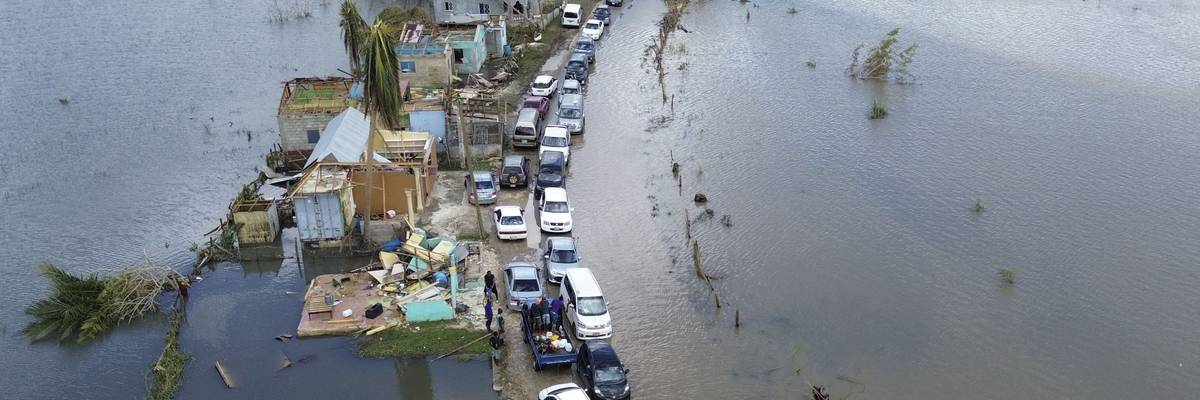
An aerial view shows cars and damaged property in a flooded section of road from Holland Bamboo to Middle Quarters in St Elizabeth, Jamaica, on October 31, 2025, in the aftermath of Hurricane Melissa.
This is the new face of global inequality: Countries that contributed least to the crisis are being made to pay twice—first through climate impacts, and then through debt.
As deadly storms ripped through the Caribbean, a new United Nations report delivered a sobering warning: The world is failing to prepare for the climate it has already created.
The UN Environment Programme’s Adaptation Gap Report 2025, aptly titled Running on Empty, finds that developing nations will need between US$310 and $365 billion annually by 2035 to cope with intensifying climate impacts. Yet, international public finance for adaptation fell to just US$26 billion in 2023, down from US$28 billion the previous year. The result: Only one-twelfth of what’s needed is being delivered.
This gap is not an abstract number. It’s visible in the wreckage of homes, farms, and economies across our region. Last month, Hurricane Melissa, the strongest-ever storm to hit Jamaica, tore through the Caribbean, leaving destruction equivalent to nearly 30% of the island’s GDP. With at least 75 lives lost and damages exceeding US$50 billion, Melissa is not just another storm; it is a case study in the cost of global inaction.
A rapid attribution study found that climate change made Melissa four times more likely and increased its wind speeds by 7%, raising damages by around 12%. For Haiti, Jamaica, and other small island developing states (SIDS), such storms bring unbearable losses eroding livelihoods, tourism revenues, and vital infrastructure. These countries contribute the least to global emissions yet bear the highest costs.
Adaptation finance should not create more debt.
The pattern repeats globally. This year’s monsoon floods in Pakistan displaced 7 million people and destroyed thousands of homes. Whether in South Asia or the Caribbean, the message is clear: The failure to invest in adaptation is costing lives.
Adaptation is not a distant goal; it is an urgent necessity. It means building stronger flood defenses, adopting climate-smart agriculture, and developing social protection systems that safeguard the most vulnerable. Research by the International Institute for Environment and Development (IIED) shows that every US$1 invested early in resilience saves more than US$5 in avoided losses. Yet, the world continues to spend far more on disaster relief than on prevention.
Every dollar delayed multiplies the human and economic toll. In Haiti, where communities are already grappling with political instability, weak infrastructure, and high poverty, each storm magnifies vulnerabilities. The Caribbean, with its densely populated coastal areas and economies heavily dependent on tourism and agriculture, cannot afford to treat adaptation as optional.
At COP29 in Baku, governments pledged through the Baku to Belém Roadmap to mobilize US$1.3 trillion by 2035, including at least US$300 billion annually for developing nations. On paper, this looks ambitious. In reality, it falls far short of what is needed. Adjusted for inflation, adaptation costs could reach US$440-520 billion per year by 2035, and the US$300 billion target covers both mitigation and adaptation, with no separate adaptation goal yet defined.
Adaptation finance was meant to help nations prepare for rising seas, harsher droughts, and lethal floods. Yet, when those funds don’t arrive, countries are forced to borrow. In 2023, 59 least developed countries (LDCs) and Small Island Developing States (SIDS) paid US$37 billion to service their debts and received only US$32 billion in climate finance. These aren’t productive investments but emergency debts taken just to rebuild what has already been lost.
This is the new face of global inequality: Countries that contributed least to the crisis are being made to pay twice—first through climate impacts, and then through debt. And while the rhetoric of “resilience” fills summit halls, the financial architecture remains rigged against the Global South. Only 15% of adaptation finance in recent years has been delivered as grants; the rest comes as loans. For every dollar of “climate support,” developing nations are paying back many more in interest.
The IIED notes that less than 10% of global climate finance reaches the local level, while international credit rating systems penalize small and vulnerable economies for their exposure to climate risks making it harder for them to attract investment in resilience. These structural barriers are blocking climate justice.
So what should change?
Adaptation finance should not create more debt. Countries hit by climate disasters need grants, not loans, because these crises are caused by global emissions, not their own failures. Second, global lending rules must change. The IMF and World Bank should consider pausing repayments after major disasters. Forcing countries to rebuild while paying high interest is unfair and makes recovery harder. Third, regional cooperation must grow stronger. Shared projects prove that joint action works. Regional funds, supported by concessional finance and local expertise, can deliver faster results than slow global systems.
Adaptation is not charity. It is justice and economic common sense. Without equitable support and reparations, the Global South would sink further and keep on building the same roads and homes after every flood, hurricane, and storm. This is not only senseless but also highly unjust. It is time for the Global North to take responsibility, after all its only fair that the poor and vulnerable shouldn’t have to fix a crisis they didn’t create while drowning in debt.
Dear Common Dreams reader, It’s been nearly 30 years since I co-founded Common Dreams with my late wife, Lina Newhouser. We had the radical notion that journalism should serve the public good, not corporate profits. It was clear to us from the outset what it would take to build such a project. No paid advertisements. No corporate sponsors. No millionaire publisher telling us what to think or do. Many people said we wouldn't last a year, but we proved those doubters wrong. Together with a tremendous team of journalists and dedicated staff, we built an independent media outlet free from the constraints of profits and corporate control. Our mission has always been simple: To inform. To inspire. To ignite change for the common good. Building Common Dreams was not easy. Our survival was never guaranteed. When you take on the most powerful forces—Wall Street greed, fossil fuel industry destruction, Big Tech lobbyists, and uber-rich oligarchs who have spent billions upon billions rigging the economy and democracy in their favor—the only bulwark you have is supporters who believe in your work. But here’s the urgent message from me today. It's never been this bad out there. And it's never been this hard to keep us going. At the very moment Common Dreams is most needed, the threats we face are intensifying. We need your support now more than ever. We don't accept corporate advertising and never will. We don't have a paywall because we don't think people should be blocked from critical news based on their ability to pay. Everything we do is funded by the donations of readers like you. When everyone does the little they can afford, we are strong. But if that support retreats or dries up, so do we. Will you donate now to make sure Common Dreams not only survives but thrives? —Craig Brown, Co-founder |
As deadly storms ripped through the Caribbean, a new United Nations report delivered a sobering warning: The world is failing to prepare for the climate it has already created.
The UN Environment Programme’s Adaptation Gap Report 2025, aptly titled Running on Empty, finds that developing nations will need between US$310 and $365 billion annually by 2035 to cope with intensifying climate impacts. Yet, international public finance for adaptation fell to just US$26 billion in 2023, down from US$28 billion the previous year. The result: Only one-twelfth of what’s needed is being delivered.
This gap is not an abstract number. It’s visible in the wreckage of homes, farms, and economies across our region. Last month, Hurricane Melissa, the strongest-ever storm to hit Jamaica, tore through the Caribbean, leaving destruction equivalent to nearly 30% of the island’s GDP. With at least 75 lives lost and damages exceeding US$50 billion, Melissa is not just another storm; it is a case study in the cost of global inaction.
A rapid attribution study found that climate change made Melissa four times more likely and increased its wind speeds by 7%, raising damages by around 12%. For Haiti, Jamaica, and other small island developing states (SIDS), such storms bring unbearable losses eroding livelihoods, tourism revenues, and vital infrastructure. These countries contribute the least to global emissions yet bear the highest costs.
Adaptation finance should not create more debt.
The pattern repeats globally. This year’s monsoon floods in Pakistan displaced 7 million people and destroyed thousands of homes. Whether in South Asia or the Caribbean, the message is clear: The failure to invest in adaptation is costing lives.
Adaptation is not a distant goal; it is an urgent necessity. It means building stronger flood defenses, adopting climate-smart agriculture, and developing social protection systems that safeguard the most vulnerable. Research by the International Institute for Environment and Development (IIED) shows that every US$1 invested early in resilience saves more than US$5 in avoided losses. Yet, the world continues to spend far more on disaster relief than on prevention.
Every dollar delayed multiplies the human and economic toll. In Haiti, where communities are already grappling with political instability, weak infrastructure, and high poverty, each storm magnifies vulnerabilities. The Caribbean, with its densely populated coastal areas and economies heavily dependent on tourism and agriculture, cannot afford to treat adaptation as optional.
At COP29 in Baku, governments pledged through the Baku to Belém Roadmap to mobilize US$1.3 trillion by 2035, including at least US$300 billion annually for developing nations. On paper, this looks ambitious. In reality, it falls far short of what is needed. Adjusted for inflation, adaptation costs could reach US$440-520 billion per year by 2035, and the US$300 billion target covers both mitigation and adaptation, with no separate adaptation goal yet defined.
Adaptation finance was meant to help nations prepare for rising seas, harsher droughts, and lethal floods. Yet, when those funds don’t arrive, countries are forced to borrow. In 2023, 59 least developed countries (LDCs) and Small Island Developing States (SIDS) paid US$37 billion to service their debts and received only US$32 billion in climate finance. These aren’t productive investments but emergency debts taken just to rebuild what has already been lost.
This is the new face of global inequality: Countries that contributed least to the crisis are being made to pay twice—first through climate impacts, and then through debt. And while the rhetoric of “resilience” fills summit halls, the financial architecture remains rigged against the Global South. Only 15% of adaptation finance in recent years has been delivered as grants; the rest comes as loans. For every dollar of “climate support,” developing nations are paying back many more in interest.
The IIED notes that less than 10% of global climate finance reaches the local level, while international credit rating systems penalize small and vulnerable economies for their exposure to climate risks making it harder for them to attract investment in resilience. These structural barriers are blocking climate justice.
So what should change?
Adaptation finance should not create more debt. Countries hit by climate disasters need grants, not loans, because these crises are caused by global emissions, not their own failures. Second, global lending rules must change. The IMF and World Bank should consider pausing repayments after major disasters. Forcing countries to rebuild while paying high interest is unfair and makes recovery harder. Third, regional cooperation must grow stronger. Shared projects prove that joint action works. Regional funds, supported by concessional finance and local expertise, can deliver faster results than slow global systems.
Adaptation is not charity. It is justice and economic common sense. Without equitable support and reparations, the Global South would sink further and keep on building the same roads and homes after every flood, hurricane, and storm. This is not only senseless but also highly unjust. It is time for the Global North to take responsibility, after all its only fair that the poor and vulnerable shouldn’t have to fix a crisis they didn’t create while drowning in debt.
As deadly storms ripped through the Caribbean, a new United Nations report delivered a sobering warning: The world is failing to prepare for the climate it has already created.
The UN Environment Programme’s Adaptation Gap Report 2025, aptly titled Running on Empty, finds that developing nations will need between US$310 and $365 billion annually by 2035 to cope with intensifying climate impacts. Yet, international public finance for adaptation fell to just US$26 billion in 2023, down from US$28 billion the previous year. The result: Only one-twelfth of what’s needed is being delivered.
This gap is not an abstract number. It’s visible in the wreckage of homes, farms, and economies across our region. Last month, Hurricane Melissa, the strongest-ever storm to hit Jamaica, tore through the Caribbean, leaving destruction equivalent to nearly 30% of the island’s GDP. With at least 75 lives lost and damages exceeding US$50 billion, Melissa is not just another storm; it is a case study in the cost of global inaction.
A rapid attribution study found that climate change made Melissa four times more likely and increased its wind speeds by 7%, raising damages by around 12%. For Haiti, Jamaica, and other small island developing states (SIDS), such storms bring unbearable losses eroding livelihoods, tourism revenues, and vital infrastructure. These countries contribute the least to global emissions yet bear the highest costs.
Adaptation finance should not create more debt.
The pattern repeats globally. This year’s monsoon floods in Pakistan displaced 7 million people and destroyed thousands of homes. Whether in South Asia or the Caribbean, the message is clear: The failure to invest in adaptation is costing lives.
Adaptation is not a distant goal; it is an urgent necessity. It means building stronger flood defenses, adopting climate-smart agriculture, and developing social protection systems that safeguard the most vulnerable. Research by the International Institute for Environment and Development (IIED) shows that every US$1 invested early in resilience saves more than US$5 in avoided losses. Yet, the world continues to spend far more on disaster relief than on prevention.
Every dollar delayed multiplies the human and economic toll. In Haiti, where communities are already grappling with political instability, weak infrastructure, and high poverty, each storm magnifies vulnerabilities. The Caribbean, with its densely populated coastal areas and economies heavily dependent on tourism and agriculture, cannot afford to treat adaptation as optional.
At COP29 in Baku, governments pledged through the Baku to Belém Roadmap to mobilize US$1.3 trillion by 2035, including at least US$300 billion annually for developing nations. On paper, this looks ambitious. In reality, it falls far short of what is needed. Adjusted for inflation, adaptation costs could reach US$440-520 billion per year by 2035, and the US$300 billion target covers both mitigation and adaptation, with no separate adaptation goal yet defined.
Adaptation finance was meant to help nations prepare for rising seas, harsher droughts, and lethal floods. Yet, when those funds don’t arrive, countries are forced to borrow. In 2023, 59 least developed countries (LDCs) and Small Island Developing States (SIDS) paid US$37 billion to service their debts and received only US$32 billion in climate finance. These aren’t productive investments but emergency debts taken just to rebuild what has already been lost.
This is the new face of global inequality: Countries that contributed least to the crisis are being made to pay twice—first through climate impacts, and then through debt. And while the rhetoric of “resilience” fills summit halls, the financial architecture remains rigged against the Global South. Only 15% of adaptation finance in recent years has been delivered as grants; the rest comes as loans. For every dollar of “climate support,” developing nations are paying back many more in interest.
The IIED notes that less than 10% of global climate finance reaches the local level, while international credit rating systems penalize small and vulnerable economies for their exposure to climate risks making it harder for them to attract investment in resilience. These structural barriers are blocking climate justice.
So what should change?
Adaptation finance should not create more debt. Countries hit by climate disasters need grants, not loans, because these crises are caused by global emissions, not their own failures. Second, global lending rules must change. The IMF and World Bank should consider pausing repayments after major disasters. Forcing countries to rebuild while paying high interest is unfair and makes recovery harder. Third, regional cooperation must grow stronger. Shared projects prove that joint action works. Regional funds, supported by concessional finance and local expertise, can deliver faster results than slow global systems.
Adaptation is not charity. It is justice and economic common sense. Without equitable support and reparations, the Global South would sink further and keep on building the same roads and homes after every flood, hurricane, and storm. This is not only senseless but also highly unjust. It is time for the Global North to take responsibility, after all its only fair that the poor and vulnerable shouldn’t have to fix a crisis they didn’t create while drowning in debt.